Book Review: Be Delivered

The book of Exodus contains some of the most dramatic passages in the Bible: baby Moses being placed in a basket in a river after Pharaoh’s command to kill Israelite male babies and being found and rescued by Pharaoh’s daughter, God speaking from a burning bush, the plagues in Egypt, the parting of the Red Sea, Moses receiving the Ten Commandments, the golden calf.

But Exodus also contains chapters that seem a little tedious at first, like the instructions for the tabernacle and all its furnishings and the priests’ wardrobe.

A good study Bible like the ESV Study Bible and a short commentary like Warren Wiersbe’s Be Delivered (Exodus): Finding Freedom by Following God help fill out understanding of these passages.

At the end of Genesis, Joseph had brought his family to Egypt to provide for them during the prophesied famine. He knew this people would be returning to their homeland, but evidently he didn’t expect that to happen in his lifetime. He made his family promise to take his bones with them when they went back.

Wiersbe notes that “the Hebrew text of Exodus begins with the word and, for God is continuing the story He started in Genesis” (p. 17). We’re not sure how much time passed before “there arose a new king over Egypt, who did not know Joseph” (Exodus 1:8), but by that time all Joseph’s generation had died off (1:6) and the children of Israel had multiplied so much that Pharaoh was afraid they could turn on Egypt. So the Egyptians “ruthlessly made the people of Israel work as slaves and made their lives bitter with hard service” (1:13-14). Pharaoh went so far as to call for the killing of Israel’s male babies.

After Moses’ miraculous deliverance, he got off to a rocky start trying to help his brethren: in trying to save one from a fight, he killed an Egyptian. When he realized his deed was known, he fled, married, and tended sheep for 40 years, until God called to him from a burning bush. After a lot of convincing, Moses answered God’s call to go back to Egypt to deliver Israel from 400 years of slavery.

That process did not go as Moses had thought it would, but God was in control. The plagues sent on Egypt were not random. Each plague countered a god the Egyptians worshiped. God was not just rescuing His people: He was making Himself known as the one true God. There’s evidence that at least some Egyptians came to believe on Him.

After Pharaoh finally let Israel go in defeat, they started a new chapter. Not only did God miraculously deliver them: He wanted to actually dwell among them. He taught them His ways and gave them instructions for building a meeting place.

But, though they had been delivered from Egypt, they still carried Egypt in their hearts. They complained over every little thing and blamed Moses. God was patient with them at first: they had been in Egypt for a long time and needed to become better acquainted with Him and trust Him. Eventually the people made a golden calf to worship while Moses was away receiving God’s law. And God had to deal with that. Moses’ intercession in 32:30-34 and chapter 33 are some of the most touching places in the Bible.

When the people repented, they responded to God’s command and made the tabernacle just as God had instructed. And God’s glory filled the tabernacle.

There’s a lot of symbolism in the different parts of the tabernacle, and that’s one area where study Bibles and commentaries help a lot. Wiersbe’s book had a diagram and the ESV Study Bible had several drawings about what the tabernacle and its parts looked like. Wiersbe went into a lot of detail about what each part represented.

Wiersbe’s overarching theme was freedom: the Israelites needed to be freed from Egypt physically but also in their hearts.

Fools use freedom as a toy to play with; wise people use freedom as a tool to build with (p. 13).

Exodus teaches us that freedom is not license and discipline is not bondage. God tells us how to enjoy mature freedom in His will, a quality that is desperately needed in our churches and in our world today (p. 13).

I have multitudes of places marked, but here are a few other quotes that stood out to me:

God used Israel’s experiences in Egypt to prepare them for the special tasks He gave them to accomplish on earth: bearing witness to the true and living God, writing the Holy Scriptures, and bringing the Savior into the world (p. 18).

The phrase as weak as a baby doesn’t apply in the kingdom of God, for when the Lord wants to accomplish a mighty work, He often starts by sending a baby. This was true when He sent Isaac, Joseph, Samuel, John the Baptist, and especially Jesus. God can use the weakest things to defeat the mightiest enemies (1 Cor. 1: 25–29). A baby’s tears were God’s first weapons in His war against Egypt (p. 21).

What does it mean to harden your heart? It means to see clear evidence of the hand of God at work and still refuse to accept His Word and submit to His will. It means to resist Him by showing ingratitude and disobedience and not having any fear of the Lord or of His judgments. Hardhearted people say with Pharaoh, “Who is the LORD that I should obey His voice?” (5: 2) (p. 41).

The same sun that melts the ice also hardens the clay. It all depends on the nature of the material (p. 41).

There was one place where I disagreed with Wiersbe. He says of Moses’ famous argument about why he couldn’t do what God commanded in Exodus 3-4 , “Moses was clothing his pride and unbelief in a hollow confession of weakness” (p. 26). I don’t think his claims of weakness were hollow. When Moses left Egypt, he was a wanted man. His misguided attempts to help his brethren had backfired. God didn’t say Moses was wrong when Moses listed his weaknesses. But God promised to be with him and give him everything he needed. I can identify with Moses a lot in these passages and have to lean on the same truth: that it’s through God’s presence and ability that I can accomplish anything for Him.

One aspect I noticed in this trek through Exodus was how Moses grew as a leader from quaking in his boots to confident in God’s working.

Overall I found this commentary very helpful and informative.

(Sharing with Carole’s Books You Loved, Booknificent)

Two Dickensian Christmas Stories

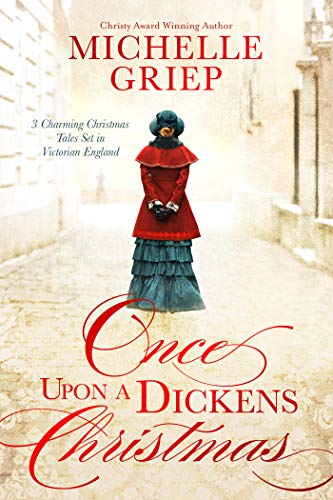
In A Tale of Two Hearts by Michelle Griep, Mina Scott is an innkeeper’s daughter in 1853 London. She enjoys Dickens novels when she can borrow them and dreams of a better life. She wouldn’t mind if William Barlow, a regular customer in her father’s tap room, was part of those dreams.

And then the unthinkable happens: William asks her to pose as his wife for a dinner with his uncle. The uncle is trying to determine which nephew will be his heir, and William thinks that appearing married will give him a better chance, especially considering his unstable earlier years.

Mina reluctantly agrees. She enjoys the visit to the restaurant and then the uncle’s townhouse, where she feels like a real lady. But she finds she really likes William’s uncle and feels bad for deceiving him. William does as well. Then they discover a scheme by the other nephew in line for the inheritance, and their focus turns to protecting the uncle. But how will they be believed without sounding like they are just angling for a better position themselves?

In The Old Lace Shop, also by Griep, Bella White is recently widowed, but not in mourning. Her husband was abusive, and she had only married him due to her father’s machinations. While selling off her husband’s property, she decides to keep one industry: a small lace manufacturer. She doesn’t need the income, but she needs to prove she can function on her own.

The shop has a partner, though Bella is the majority owner. When she moves to Nottingham to visit the shop, she’s stunned to find that the partner is the man she loved who left without a word to her several years before. After their awkward getting to know each other again and overcoming his resistance to her partnership, they try to find a good working relationship. But they clash on several points. And then they discover a plot that endangers both of them and the people they love.

These books were the second and third of Griep’s Once Upon a Dickens Christmas series. The first was 12 Days at Bleakly Manor, which I read a couple of years ago (linked to my review). The first two books were released separately in two subsequent years, but now they are combined in Once Upon a Dickens Christmas with the third.

As far as I could tell, the stories didn’t seem to be a retelling of a particular Dickens book. But they were from the same era and in similar style. Dickens himself shows up in the last two (I can’t remember if he did in the first).

Another common thread was a “second chance” coin—not a token of luck, but just a wish or acknowledgement for the recipient.

A few quotes:

Real joy is not found in the best moments of life, but in trusting that God is making the best of every moment.

My mother–God rest her– always told me to think of eternity, then live backward from that. Such a view has a way o’ whittlin’ down our current troubles to a size we can crumple up into a ball and toss aside.

His face was a road map of years.

Maybe, perhaps, true meaning in life had nothing to do with outward trappings but with inward genuineness.

Funny, is it not, that one doesn’t know how bad one really is until trying hard to be good.

One quote was overstated a bit. . . . “The heat of a thousand suns burned along every nerve, and settled low in his belly.”

I got a little frustrated with the characters and their choices sometimes. But these books weren’t bad companions for the last weeks of the year.

(Sharing with Carole’s Books You Loved, Booknificent)
When It Looks Like Evil Is Winning

Sometimes when I am dismayed over the state of the world or a personal problem, I am tempted to think, “God, why aren’t you winning? You’re stronger than evil. You’re bigger than this problem. Why isn’t all of this taken care of? It would be nothing to You to right these things.”

The psalmists wrestled with this question in a slightly different way. In Psalm 73, Asaph struggled with not only the presence of the wicked, but the fact that they prospered. He even came to the point of thinking that his efforts to live purely had been in vain. Job’s friends’ asserted that God blesses the righteous and punishes the wicked, and therefore Job must have done something wrong to be experiencing so much trouble. One of Job’s arguments against their theory was that the wicked often prosper in this life.

But nothing in Job’s circumstances indicated that God wasn’t “winning,” that He was absent, didn’t care, or had lost control of the situation. God was with Job all along, even though Job couldn’t sense His presence. God displayed mercy and compassion to Job, even though it looked different from what we might expect. All of the physical, material blessings that God restored to Job at the end of the book are items that he once again lost at the end of his life. But through the first loss of them, God taught him eternal truths and drew Job closer to Himself. Job’s relationship with God and the spiritual truths he learned would affect the rest of his life. Though it might have looked like Satan was winning, God was working out His purposes.

I love the Psalms for their honest emotion. Whether the psalmists faced personal danger or lamented the seeming triumph of evil in the world, they brought their own thoughts and those of their listeners back to the truth they knew about God. Psalm 10 (ESV) starts out, “Why, O Lord, do you stand far away? Why do you hide yourself in times of trouble?” But the psalmist reminded himself, “But you do see, for you note mischief and vexation, that you may take it into your hands; to you the helpless commits himself; you have been the helper of the fatherless.” He concludes back on solid ground:

 The Lord is king forever and ever;
    the nations perish from his land.
O Lord, you hear the desire of the afflicted;
    you will strengthen their heart; you will incline your ear
to do justice to the fatherless and the oppressed,
    so that man who is of the earth may strike terror no more.

When God seems far away, we remind ourselves of the truth we know about Him from His Word. He sees what is going on. He loves us. He will deal justly. He might be waiting to answer for a number of reasons. We ask Him to search us and show us anything that might be hindering His answer to our prayers. And we rest in His wisdom, love, righteousness, and strength.

Trusting that God has control of the situation doesn’t mean inaction on our part. Only God can take care of all the needs of the world, but He often works through people. A needy world is a call to pray and then to look for ways to help those in need. William Wilberforce and Hannah More not only prayed against the evil of slavery but fought against it. We may not be able to solve world pproblem, but we can help those within our sphere of influence.

In the May 19 selection of Spectacle of Glory by Joni Eareckson Tada, she wrote:

On the whole, the good that we are able to tally in this life doesn’t seem to outweigh the bad that we observe. We keep praying, but we don’t see some of the answers closest to our hearts. Only heaven will reveal a clear picture of how the sweet fragrance of our faith in Jesus, even in times of grief and loss, influenced the lives of those around us. Only eternity will show how our fainthearted prayers changed the destinies of people on our prayer list. Great faith believes in God even when He plays His hand close to the vest, not showing all His cards. God wants to increase your “measure of faith.” He does this whenever He conceals a matter and you trust Him nevertheless (p. 156).

The Bible tells us the world will get worse before the end. “But as for you, continue in what you have learned and have firmly believed, knowing from whom you learned it and how from childhood you have been acquainted with the sacred writings, which are able to make you wise for salvation through faith in Christ Jesus” (2 Timothy 3: 14-15).

God not only wins in the end. He is winning now. He’s working out His purposes even now.

Ye fearful saints fresh courage take,
The clouds ye so much dread
Are big with mercy, and shall break
In blessings on your head.

His purposes will ripen fast,
Unfolding ev’ry hour;
The bud may have a bitter taste,
But sweet will be the flow’r.

Blind unbelief is sure to err,
And scan his work in vain;
God is his own interpreter,
And he will make it plain.

(From “God Moves in a Mysterious Way” by William Cowper, 1773)

Revised from the archives. I had another post in mind for today, but then was inclined to this one.

(Sharing with Hearth and Soul, Sunday Scripture Blessings, Selah, Scripture and a Snapshot, Inspire Me Monday, Senior Salon, Remember Me Monday, Tell His Story, Legacy Link-Up, InstaEncouragements, Recharge Wednesday, Let’s Have Coffee, Share a Link Wednesday, Heart Encouragement, Grace and Truth, Faith on Fire, Blogger Voices Network)

Laudable Linkage

IMG_0195

Here are several good reads recently discovered:

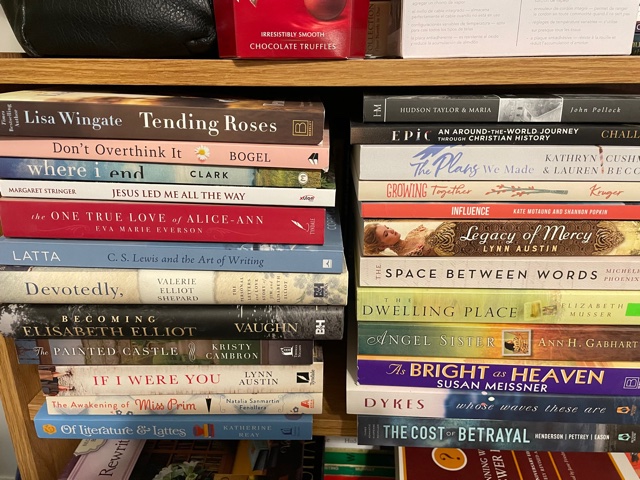
Don’t Overthink It Book Club. Linda is hosting a three-week book club on Sunday evenings to discuss Anne Bogel’s book Don’t Overthink It. I just finished chapter four this morning, and the book is proving very helpful so far. At the moment, it’s on sale for the Kindle for $1.59—don’t know how long it will be at that price.

Be a Truth-Lover. “Your love for truth must be greater than your party, your political pre-commitments, and your agenda.”

He Is a Jealous God. “If the United States of America ceased to exist tomorrow, would that be the end of our belief in the God that we claim to hold so dear? Or do we have a faith that extends beyond the bounds of country, of comfort, of confidence in the systems of this world?

A Call for Content Creators to Cultivate Discernment, HT to Challies. “But beautiful language, by itself, does not encompass all that it means to write well as a Christian. Christian writers must labor not only to write what is true but also to write in a manner that adorns the truth.”

Remembering God’s Faithfulness in the Face of a Detour, HT to Challies. “How about you? Do you trust God’s faithfulness to deliver again in the midst of your daily detours?”

Five Key Questions for Setting Gospel-Shaped Goals, HT to The Story Warren. “It was an apt senior quote for the young perfectionist, who keenly felt her failure to ‘obtain all this,’ who knew how short she fell in every area where she longed to succeed. Sadly, that seventeen-year-old senior, who had only been a Christian for two years when she chose Philippians 3:12 to mark her life, didn’t fully understand the dynamic of grace and goals.”

Stupid and Wise People. “There will always be those with whom we cannot agree or come to a compromise. We cannot control their actions but we can control our own reactions and choices.”

Your Work Matters More Than You Think, HT to Challies. “God puts his people in some surprising places. The testimony of Obadiah can encourage Christians who have been called to serve God in dark places for His purposes.” I enjoyed this contrast between Obadiah and Elijah.

A Blog about Blogging, HT to Challies. Good overview for Christian bloggers in particular.

Tookish Bagginses. Lessons from hobbits. “Because nowness and not-yet-ness overlap and intermingle. God made us out of dust, but he also breathed eternity down our lungs. We’re a walking marriage of the sacred and the profane— the eternal and the ordinary. We’re Bagginses with the blood of Tooks who’ve been to Mordor and back again.”

This is as good a time as any for my occasional reminder that links here do not mean 100% endorsement of the blog or blogger they come from. Some of these are from blogs I read regularly, but others are from posts I happened upon or saw on other’s blogs.

Finally, to end with a smile: a cat interrupts a UK parliamentary live call:

Friday’s Fave Five

On Fridays I like to pause for a few moments with Susanne and friends
to reflect on some of the blessings of the week.

I’m incredibly sad over events in our country. But I am going to set those aside for now and concentrate on good things from the week.

1. Setting up new calendars. I love the blank pages and filling in birthdays and anniversaries or the year.

2. Moving day. We helped my son and daughter-in-law move into their new home last weekend. I couldn’t do heavy lifting or box-toting, but I kept Timothy company part of the time and helped load and unpack a few boxes. By the time we left, they had bedrooms, living room, and kitchen set up, so they could function pretty well.

3. Catching up. It’s been good to catch up on things that have been set aside or had piled up over the holidays—a bit of cleaning, computer work, etc.

4. A quiet week. I don’t know if it’s post-Christmas or post-moving tiredness, but I haven’t felt like doing much the last day or two. I’m thankful the schedule was clear enough that I could rest a bit and then get some low-key things done.

5. Old family videos. My uncle sent some old videos of a big family reunion from over 30 years ago—the only one like it that we ever had with my mom’s father’s siblings and their families. It was fun to see all of us thirty years younger. Plus several are no longer here—my mom, my grandfather, my aunt, and one uncle. I loved seeing and hearing them again. My grandfather had a distinctive laugh that I loved, and now I have it on video. What a treasure!

Bonus: Sales and special offers. I could use another couple of items of winter clothing. I looked up one site that I’d ordered from before. I love the quality of their things, but they are a bit more expensive, so I don’t shop there often. I found a couple of things on sale (one dress for $19.99!) plus a 35% off special offer that was expiring at 1:00 p.m. that day. I didn’t know if the special offer would apply to sales things, but it did–and I got my order in just a few minutes before 1.

How about you? Any bright spots in your week?

Bedside Blessings

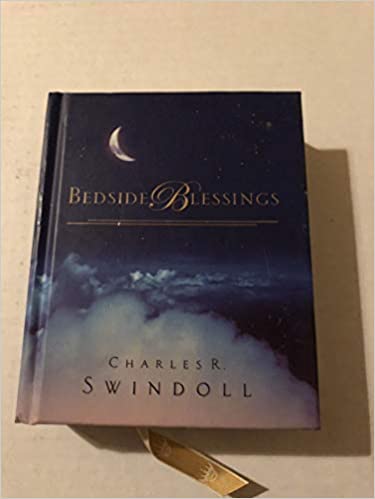
Bedside Blessings by Charles R. Swindoll was one of my mother-in-law’s books. I had never read him, but I have heard parts of his sermons on the radio. I decided to go through this book last year.

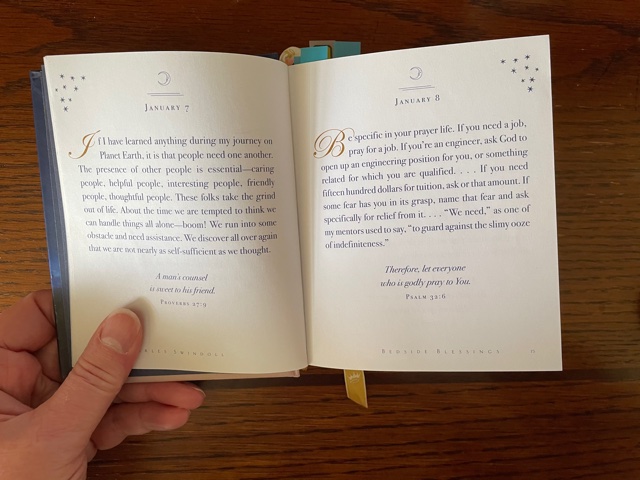
It’s a small book, 5 1/2 inches by just under 4 1/2 inches. Most pages contain just a paragraph or two from Swindoll and a Bible verse. It takes its theme from Psalm 63:6 (NASB): “When I remember You on my bed, I meditate on You in the night watches.” It’s just the right size for the nightstand, just the right length for a thought to begin or end the day with (or turn to in the middle of the night.)

Most, if not all, of Swindoll’s writings here seem to come from his other books. Sometimes his sentences didn’t seem to be on the same theme as the verse for the day—maybe they were in their original context. But for the most part, his words go along with the verse in the readings.

A few quotes from the book:

The Word of God doesn’t tell us about the truth; it is the truth. It doesn’t merely contain words about God; it is the Word of God. We don’t have to try real hard to make it relevant; it is relevant. Don’t neglect it. It is the foundation of a stable life. It feeds faith (p. 22).

When I read God’s Word, I don’t find that many stories about great crusades and city-wide revivals and mass meetings where God’s attention rested on an entire country or a whole community. More often, I find individual men and women who made a difference, who set the pace or cut a wide swath or stood in the gap and changed their times. From Genesis to Revelation, we see God’s hand on the lives of individuals who thought and said and did what was right – regardless- and as a result, history was made (p. 186).

When the temptation to worry first arrives, that’s the critical moment. The tendency is to entertain it. To let it onto the front porch and allow it to sit there. But before you know it, worry has crawled in through the window and made itself at home! No, worry must be stopped. We have to decide that we are going to commit this worry to God right now and refuse to entertain it, even on the front porch of our thinking (p. 190).

When preparing for an unprecedented event, wait on the Lord before getting involved. At least as important as the thing we are waiting for is the work God does in us while we wait (p. 208).

If you are blessed with abilities, if you are gifted, if you are used by God, it is easy to start believing your own stuff. Yet one of the marks of a truly mature life is humility of spirit. A truly humble person looks for opportunities to give himself freely to others rather than holding back, to release rather than hoarding, to build up rather than tearing down, to serve rather than being served, to learn from others rather than clamoring for the teaching stand (p. 315).

God’s redemptive providence is always at work, even through the most diabolical schemes and actions. . . .So, take heart, my friend. God is in full control. Nothing is happening on earth that brings a surprise to heaven. Nothing is outside the scope of His divine radar screen as He guides us safely home. Things that seem altogether confusing, without reason, unfair, even wrong, do indeed fit into the Father’s providential plan (p. 332).

All in all, I thought it was a good resource.

(Sharing with Booknificent Thursday, Carole’s Books You Loved)

Reading Plans for 2021

One of my favorite things to do is chart out my reading plans for the year. I don’t want to be rigid about them: I like flexibility to pick up something unexpected during the year. But being intentional with my plans helps me get to the books I’ve long wanted to read plus expands my reading horizons.

Last year I participated in several reading challenges, thinking that they’d be easy to do since they overlapped and I could list the same books for several of them. But the record-keeping took way too much time and thought. Then one host just stopped blogging in February and one took her blog down during the year. So this year, I am back to the tried and true plans I have used for years plus a couple of new ones that worked out well last year.

Karen at Books and Chocolate hosts the Back to the Classics Challenge. Books have to be 50 years old and fit within the categories chosen for the year in order to qualify. Karen draws a name from participants at the end of the year to receive a $30 gift card towards books, and the number of categories you finish determines how many entries you get.

Here are the categories for this year. We don’t have to name what books we’ll read yet, but I have a couple of ideas (subject to change!)

 
1. A 19th century classic: any book first published from 1800 to 1899. Probably The Warden by Anthony Trollope, the first of his Chronicles of Barsetshire series. I read the middle book in the series, Doctor Thorne, last year and loved it.
2. A 20th century classic: any book first published from 1900 to 1971.
3. A classic by a woman author. Something from D. E. Stevenson.
4. A classic in translation, meaning any book first published in a language that is not your primary language.
5. A classic by BIPOC author; that is, a non-white author.
6. A classic by a new-to-you author, i.e., an author whose work you have never read. Daddy Long Legs by Jean Webster. I’ve read a couple of books based on this one, so I need to read the original.
7. New-to-you classic by a favorite author — a new book by an author whose works you have already read. I’m working on reading what Dickens books I haven’t read yet. Maybe Nicholas Nickleby.
8. A classic about an animal, or with an animal in the title. The animal can be real or metaphorical. (i.e., To Kill a Mockingbird).
9. A children’s classic. Thinking about either Peter Pan or Tarzan.
10. A humorous or satirical classic.
11. A travel or adventure classic (fiction or non-fiction). It can be a travelogue or a classic in which the main character travels or has an adventure.
12. A classic play. Plays will only count in this category.
 

Bev at My Reader’s Block hosts the Mount TBR Challenge to encourage us to read the books we already own.. Every 12 books read is another level or “mountain” climbed. We don’t have to list the books yet, but we do have to commit to a level. I am committing to Mt. Vancouver (36 books). The one main rule here is that the books have to have been owned by us before January 1, 2021.

The Backlist Reader Challenge hosted by The Bookwyrm’s Hoard has the same idea as Mt. TBR. The main difference is we don’t have to own the books–they can be on our TBR list as well as actually on our shelves.

We don’t have to list what books we’ll read for the TBR or Backlist challenges, but these are some that I want to get to. I only asked for two books for Christmas—a record low for me!—because I had so many stacked up from previous gifts.

The Nonfiction Reading Challenge hosted by Shelly Rae at Book’d Out should be easy, since I read a lot of nonfiction anyway. But the books need to fit in these categories for this year’s challenge.

  1. Biography
  2. Travel
  3. Self-help
  4. Essay Collection
  5. Disease
  6. Oceanography
  7. Hobbies
  8. Indigenous Cultures
  9. Food
  10. Wartime Experiences
  11. Inventions
  12. Published in 2021

There are different levels to choose from for goals. Though I know I’ll read more than 12, I am only going to aim for the Nonfiction Nibbler (6 books). If I come up with titles to fit the other categories–titles that I want to read for themselves and not just for the challenge—I’ll see how far I can get.

Finally, Tarissa at In the Bookcase hosts a Louisa May Alcott Reading Challenge in June and a Literary Christmas Challenge in November and December. I’ll say more about those when they come up.

So that the plan for this year. I am excited!

Do you have any plans for reading this year? Do you participate in any reading challenges? I’d love to hear about them.

(Sharing with Senior Salon)

Book Review: Mistletoe and Murder

Mistletoe and Murder: A Christmas Suspense Collection contains ten novellas by different authors. Some are cozy mysteries: some are a bit darker. For some, Christmas just happens to be the time of year the story occurs and doesn’t really figure into the plot. Others depend on the Christmas setting more heavily. Most have Christian characters and undertones, some more than others.

Here’s just a brief description of the types of stories in the book:

Dead of Winter by Mary Alford: A deputy receives a mysterious text from her brother and then finds his cabin empty, his rifle missing, and blood on the door frame.

Death the Halls by Adam Blumer: A woman plans to introduce her boyfriend to the family at their cabin over Christmas. But someone has ransacked the cabin and takes the woman hostage.

Revenge Ignited by Liz Bradford: A Christmas thief is hitting houses in Knoxville. But the person who robs the home of an FBI agent on bereavement leave, taking care of her dead sister’s children, seems different from the rest.

The Marked Witness by Vicki Hinze: A security consultant hears from a woman and her daughter who had previously been placed in witness protection. They have reason to believe they’ve been discovered and are in danger.

Ghost of Christmas Past by Shaen Layle: An unstable man stalks his ex-wife and lures their deaf son away from her.

The Confession of John Doe by Loree Lough: An Amish Good Samaritan comes to the aid of a man thrown from his car and badly injured. When he returns to the hospital to visit the man, he is asked an even bigger favor: to hide the man from the criminals seeking his life.

Killing Christmas by Nancy Mehl: A long-dormant serial killer resurfaces and wants a pastor who writes a weekly column for the newspaper to write his story.

Deadly Drive by Cara Putnam: A woman’s twin brother has been shot, and she’s called to make a positive identification. When her plane arrives, she’s met in the airport by her brother’s roommate . . . only her brother didn’t have a roommate.

Dangerous Christmas by Lynn Shannon: A social worker narrowly escapes an attacker. When a policeman takes her home, her apartment has been broken into and someone has painted an ominous message on her wall. But why?

Yuletide Protector by Virginia Vaughan: A woman had told the police that her ex-boyfriend was stalking and threatening her. But he’s also a policeman, and the officers protected him instead of her. She changed her name and took precautions. But now someone with her same name is killed in a car bomb. Had that bomb been meant for her?

Most of these are stand-alone stories, but a few tie in to an author’s previous series. But enough was explained that I wasn’t left hanging.

I had only read Adam Blumer and Cara Putnam before. I’d heard of Loree Lough and Nancy Mehl. The other authors were completed new to me.

The stories were definitely suspenseful! I enjoyed some more than others. Since they were all set at Christmas, they all turned out well in the end.

In some cases, a novella doesn’t really provide enough time for two people to fall in love, especially if they were strangers beforehand. So some of the romances seemed a little rushed.

There was one spot where the theology was a little wonky, but most of the time the faith element was a clear and vital thread in the story.

Christmastime seems to lend itself to anthologies. But I’ve never read a collection of Christmas novellas with as many as ten stories. That added up to 938 pages—a little long, in my opinion, for a book that’s primarily going to be read in one month. I would have enjoyed it more if it had broken broken up into two books read on subsequent Christmases.

But I did enjoy it, for the most part. And I think anyone who likes mystery, suspense, crime drama, detective stories, and the like would love it.

(Sharing with Carole’s Books You Loved, Booknificent Thursday)


Literary Christmas Challenge Wrap-Up 2020

A Literary Christmas: Reading Challenge // inthebookcase.blogspot.com

Tarissa at In the Bookcase hosts a Literary Christmas Reading Challenge to encourage reading and sharing at Christmas time.

I didn’t get to one book from my original plans, but I did listen to an audiobook I hadn’t planned to—so I guess it all worked out evenly in the end.

Here’s what I finished, linked back to my reviews:

  • Loving My Actual Christmas by Alexandra Kuykendall, nonfiction. Ways to enjoy Christmas as it is rather than an idealized version, with lots of tips.
  • Joy to the World: Daily Readings for Advent by Charles Spurgeon, nonfiction. Short excerpts taken from some of Spurgeon’s Christmas sermons and arranged as a 25-day devotional.
  • A Christmas Longing by Joni Eareckson Tada, nonfiction. A lovely book filled with Joni’s artwork and meditations about Christmas.
  • A Very Bookish Christmas by Sarah Holman, J. Grace Pennington, Kate Willis, and Rebekah Jones, fiction. Four stories each tie in with a classic book.
  • Mistletoe and Murder: A Christmas Suspense Collection of ten novellas by different authors, fiction. Very suspenseful!
  • A Tale of Two Hearts and The Old Lace Shop, two stories in Michelle Griep’s Once Upon a Dicken’s Christmas. I’m not quite done with the last one, but I wanted to get the wrap-up post in before the reading challenge closed completely.

Thanks to Tarissa for hosting once again! I always enjoy it.

What’s Normal, Anyway?

God is faithful though any circumstances

The transition from December 31 to January 1 is just a change from one day to the next. But January 1 is not just a new day or even the start of a new month: it’s a whole new calendar of blank pages, full of hope and possibilities.

The most prevalent hope I hear is that life gets “back to normal,” especially in regard to the coronavirus. We’d love for it go away completely, or at lease recede to rare occurrences, like the swine flu or the bird flu. We want to go about our business without worrying about exposure and masks how many people are gathered in one place.

It’s harder to hope for some of the other issues prevalent during the last year. We still have a long way to go in race relations. And I don’t know if the political landscape will ever improve.

But desiring normalcy for the last several months has led me to wonder—what’s normal, anyway?

America has always had its troubles, but we’ve had it a good deal better than many. We have poverty here, but people who travel to third-world countries are often stunned by the breadth and depth of poverty in other places. Some countries are almost perpetually in a state of war. Some areas are rife with corruption. Armed guards regularly patrol some streets. Some citizens risk their lives to vote.

Through the Bible, Israel was in captivity to Egypt 400 years, Babylon 70 years. Most of their rulers were evil.

Early Christians were persecuted under wicked emperors. More recent believers suffered under Communist oppression. Many are persecuted in several countries even now.

The prophet Habakkuk complained to the Lord:

Destruction and violence are before me; strife and contention arise. So the law is paralyzed, and justice never goes forth. For the wicked surround the righteous; so justice goes forth perverted. (Habakkuk 1:3b-4)

He basically asked God, “What are you going to do about this?

God replied that he was sending the “dreaded and fearsome” Chaldean army (vv. 5-11).

Habakkuk wonders, “What? You can’t let that happen!”

But in their further conversation, God established that He can and He will. But, He says, “but the righteous shall live by his faith” (2:4b).

By the end of chapter 3, Habakkuk concludes that, though his body trembles and lip quivers (3:16):

Though the fig tree should not blossom,
    nor fruit be on the vines,
the produce of the olive fail
    and the fields yield no food,
the flock be cut off from the fold
    and there be no herd in the stalls,
yet I will rejoice in the Lord;
    I will take joy in the God of my salvation.
God, the Lord, is my strength;
    he makes my feet like the deer’s;
    he makes me tread on my high places. (3:17-19)

I hope with everything in me that life improves on every front this year. But whatever happens, these are some of the truths I carry with me:

  • God is good, even if circumstances aren’t.
  • God is at work, even if it doesn’t look like it.
  • God loves me, even if life is hard.
  • My job is the same: trust in Him, live for Him, rejoice in Him, love Him, grow in Him, fortify and feed myself with His Word.

In the book of Deuteronomy, Moses repeated God’s instruction to Israel before they entered the promised land after 40 years of wilderness wandering. One of the things He promised them was:

But the land that you are going over to possess is a land of hills and valleys, which drinks water by the rain from heaven, a land that the Lord your God cares for. The eyes of the Lord your God are always upon it, from the beginning of the year to the end of the year. (Deuteronomy 11:11-12)

Though our context is different, I think we can take comfort and courage in these same truths. Through the “hills and valleys” of the coming year, God eyes are on us and He cares for us.

The righteous shall live by his faith

(Sharing with Inspire Me Monday, Senior Salon, Hearth and Soul, Selah, Tell His Story, Instaencouragements, Recharge Wednesday, Share a Link Wednesday, Let’s Have Coffee, Heart Encouragement, Grace and Truth, Faith on Fire, Blogger Voices Network)