Seven Deadly Sins for Writers. Even though this post is aimed at writers, its discussion of the pervasiveness of pride applies to anyone.
Tolerance Trouble, HT to Challies. “The Corinthian church boasted about its tolerance of the incestuous man who was permitted to retain membership and acceptance within the Corinthian church. They were congratulating themselves for such open-mindedness when they should have been weeping.”
Sorry, Banning Plastic Bags Won’t Save Our Planet, HT to Challies. “As with other environmental issues, instead of tackling the big-picture problems to actually reduce the plastic load going into oceans, we focus on relatively minor changes involving consumers, meaning we only ever tinker at the margins.”
It’s Friday, time to look back over the blessings of the week with Susanne and other friends at Living to Tell the Story .
It’s been deliciously cool this week! Here are some other high points:
1. Lunch with friends. Our church had a potluck dinner Sunday, then I met with a friend for lunch later in the week. Good times!
2. Water bottle rockets. We did these with our kids, and it was fun to do them with Timothy. It was fun to hear him count down and then get so excited watching them blast off and land.
3. A bit of color on two different fronts. We haven’t had much fall color this year, they say because we haven’t had much rain. The leaves in our neighborhood look mostly rusty. But as I was out yesterday, I saw some bright orange and yellow trees here and there. I miss the full-blown fall color we usually have, but that little bit cheered me.
Then I looked out the back door and was surprised to see my hydrangea with fresh blooms:
The roses and begonias are still going strong as well some of the petunias.
4. Lindt candy. Lindt milk chocolate truffles are my favorite candy. But my husband found and bought this Lindt variety pack last weekend. Usually with these kinds of candy collections, there are a few duds in the mix that no one likes. But these were all really good!
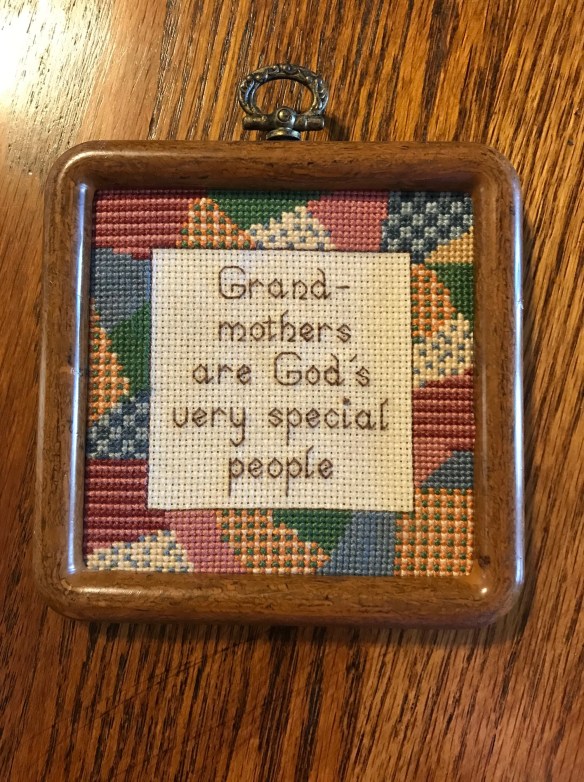
5. A special discovery. Several years ago, I made this little plaque for my mother-in-law. Since her passing, this was the one thing of hers I wanted to keep personally, but I had no idea where it was. Last weekend, Jim and I were going through some boxes of his mom’s things in our attic, and we found this. I was thankful.
In the novel Like a Flower in Bloom by Siri Mitchell, Charlotte Withersby’s father is a botanist in Chesire, England, in the 1850s. Her mother was a botanist as well, and Charlotte loves to study and illustrate plants. Since her mother died, Charlotte has been her father’s assistant, secretary, and all around right-hand person.
But Charlotte is now 22, and her uncle, the Admiral, thinks it’s high time for her to go into society and find a husband. Charlotte has no interest in either society or matrimony. She loves her work, and she doesn’t think her father can possibly do without her.
But then a long-time correspondent, a Mr. Edward Trimble from New Zealand, shows up on the Withersby’s doorstep. He seems the ideal solution: he can assist Charlotte’s father so the Admiral can introduce Charlotte to society.
Besides Charlotte’s lack of interest, being presented to society is fraught with another major problem. Charlotte’s father has never had any interest in society. He has always been the somewhat eccentric absent-minded professor type. With only her father as her main companion for life, Charlotte doesn’t know how to dress or act. Fortunately she finds a friend in Miss Templeton, who likes Charlotte’s quirky ways. Miss Templeton is younger but also tasked with finding a husband, something she dislikes as much as Charlotte, but for different reasons.
Charlotte hatches a plan. Since she can’t seem to escape her fate, she’ll go after a husband just to make her father realize that he can’t do without her. Then he’ll call off this nonsense.
But Mr. Trimble proves himself an able assistant, so that her father seems to be able to get along without her very well. And her plan to attract suitors, assisted by Miss Templeton, succeeds only too well.
I’m afraid I didn’t like Charlotte at first. Even the person who came to love her called her “the most maddening, most vexing, most exasperating woman I have ever met.” I didn’t mind the fact that she didn’t know how to fit in society, and I even agreed with her that some conventions seemed silly. But at first she seemed to see only her own viewpoint. Yet, as I got to know her, and as she broadened her horizons and learned a little humility, she grew on me.
One of my favorite quotes from the book:
Conversation, my dear Miss Withersby, is a very fragile creature. You must nourish it if you would have it survive. Its favorite food is a question.
Siri Mitchell’s books are far more than romances. I loved her note at the end of the novel where she explained the different influences that went into this story: women who contributed to the study of botany but could not be published under their own names, the conflicting views of botany between scientists and religious people, the eccentricity of botanists, the unusual collections and plant projects of the times, the Opium wars between Britain and China, the nature of introverts, the concept of a helper in the Bible, Victorian gender roles and expectations. She wove all of these together seamlessly, with warmth and humor. Above all the book illustrates the main theme of being who God created you to be.
I don’t know how to type correctly. Somehow I never had a typing or keyboarding class. Over the years I have developed my own “hunt and peck” method, which is slow and riddled with mistakes.
Since I’m not trained to know which keys are what direction, I have to look down at the keyboard. You’d think, after typing for 40 years, that I’d know the keyboard by now. Because I’m looking down, I don’t realize what mistakes I’ve made until I look up again. Sometimes I don’t realize I accidentally hit the “Caps Lock” button until I look up and see a sentence or two capitalized. Sometimes I highlight something to delete or move, and when I look up again, I can’t even recognize my paragraph because somehow my highlighting shifted and caught more words than I meant for it to. I’m abundantly thankful for Control+Alt+Z to undo my last action! Other times, I miss a prompt that would have saved me a few keystrokes.
I may not be able to help looking down at a keyboard: my (bad) habits have been ingrained for so long, I don’t know if a typing class could help me now.
But this continual looking down reminds me of a character in the second half of John Bunyan’s Pilgrim’s Progress. Part 1 of the story focuses on Christian; Part 2 features his wife, Christiana. In one scene, the Interpreter takes Christiana to a room “where was a man that could look no way but downwards, with a Muckrake in his hand. There stood also one over his head with a Celestial Crown in his Hand, and proffered to give him that Crown for his Muck-rake ; but the man did neither look up, nor regard; but raked to himself the Straws, the small Sticks, and Dust of the Floor.”
Then said Christiana, “I persuade myself that I know somewhat the meaning of this: For this is a Figure of a man of this World : Is it not, good Sir?”
“Thou hast said the right,” said he, “and his Muck-rake, doth shew his Carnal mind. And whereas thou seest him rather give heed to rake up Straws and Sticks, and the
Dust of the Floor, than to what he says that calls to him from above with the Celestial Crown in his Hand ; it is to show, that Heaven is but as a Fable to some, and that things here are counted the only things substantial. Now whereas it was also shewed thee, that the man could look no way but downwards, it is to let thee know that earthly things when they are with Power upon Men’s minds, quite carry their hearts away from God.”
Then said Christiana, “O! deliver me from this Muck-rake.”
“That Prayer,” said the Interpreter, “has lain by till ’tis almost rusty: Give me not Riches, is scarce the Prayer of Prov. 30. 8. One of ten thousand. Straws, and Sticks, and Dust, with most, are the great things now looked after.”
With that Mercy and Christiana wept, and said, “It is alas! too true.”
I assume this was in the days of dirt floors, so this man’s task was a necessary one. But it wasn’t the only thing in life that needed his attention. He was so caught up in the everyday tasks that he missed the most important things.
In the parable of the sower, Jesus described some “who hear the word,but the cares of the world and the deceitfulness of riches and the desires for other things enter in and choke the word, and it proves unfruitful.”
We can get so caught up with the cares of this word, can’t we? Floors have to be cleaned, as well as the rest of the house, errands run, meals cooked, laundry washed, dried, and folded, family tended to, and so on, and so on, and so on. And then the desire for other things distracts our thoughts.
But we need to take time to look up.
Lift up your eyes on high and see:who created these?He who brings out their host by number,calling them all by name;by the greatness of his mightand because he is strong in power,not one is missing. (Isaiah 40:26, ESV).
All our tasks and pursuits here are only temporary. There’s a greater reality beyond our muckraking.
Lift up your eyes to the heavens, and look upon the earth beneath: for the heavens shall vanish away like smoke, and the earth shall wax old like a garment, and they that dwell therein shall die in like manner: but my salvation shall be for ever, and my righteousness shall not be abolished (Isaiah 51:6).
And when these things begin to come to pass, then look up, and lift up your heads; for your redemption draweth nigh (Luke 21:28).
The muckraker didn’t believe in anything higher to look up to. Let’s not follow his mistake.
They shall look upon me whom they have pierced, and they shall mourn for him, as one mourneth for his only son (Zechariah 12:10b).
Look unto me, and be ye saved, all the ends of the earth: for I am God, and there is none else (Isaiah 45:22).
And I, if I be lifted up from the earth, will draw all men unto me. (John 12:32).
Even after salvation, we have to continually remind ourselves to keep the right perspective, to put God first, to seek His ways.
My voice shalt thou hear in the morning, O Lord; in the morning will I direct my prayer unto thee, and will look up (Psalm 5:3).
If then you have been raised with Christ, seek the things that are above, where Christ is, seated at the right hand of God.Set your minds on things that are above, not on things that are on earth (Colossians 3:1-2, ESV).
We look up to acknowledge our need for the only One who can help:
I lift up my eyes to the hills. From where does my help come? My help comes from the Lord, who made heaven and earth (Psalm 121:1-2, ESV).
And we need to look from our pursuits to minister to others:
Look, I tell you, lift up your eyes, and see that the fields are white for harvest (John 4:35b).
Let each of you look not only to his own interests, but also to the interests of others.Have this mind among yourselves, which is yours in Christ Jesus (Philippians 2:4-5a, ESV).
God has given us good work to do, but He never meant for those tasks to eclipse Him. Much of our life and ministry is in the mundane, everyday moments of life. But that work and those moments are given meaning by the time we look up to Him. It’s vital to spend time with Him, and then carry those thoughts we gain from His Word back into our everyday lives.
Looking unto Jesus the author and finisher of our faith. ~ Hebrews 12:2a
O soul, are you weary and troubled? No light in the darkness you see? There’s light for a look at the Savior, And life more abundant and free!
Turn your eyes upon Jesus, Look full in His wonderful face, And the things of earth will grow strangely dim, In the light of His glory and grace.
When You’re Tempted to Hate People, Part 10. Aspects of God’s forgiveness that we don’t often think about: He knows whether our repentance is sincere and He knows we’re going to fall again in the same way, yet still forgives.
Exactly Where I Need to be When I Need to Be There. “Recently the Lord took a frustrating situation that tested my patience and reminded me my timing and priorities are different than His and that He often places me exactly where I need to be when I need to be there.”
The Importance Of Doing What Anyone Could Do, HT to Challies. “It’s a good thing for all of us that people have developed these skills. It’s also true that the world is always in need of the non-specialised abilities that all of us are capable of using: Love. Friendship. Shared time. A listening ear. A hard day’s work. Loyalty. Respect.”
It’s Friday, time to look back over the blessings of the week with Susanne and other friends at Living to Tell the Story .
Fall has well and truly arrived here in eastern TN. It’s been downright chilly in the mornings, though we’ve not turned on the heat yet. Someone posted on FaceBook a funny meme that we get all four seasons in one day: winter in the early morning, spring mid-morning, summer early afternoon, and fall late afternoon. That’s about right.
Here are some favorites from the last week:
1. “Girl time” with Mittu. I met my son and daughter-in-law and grandson for lunch at the mall Saturday, and then Mittu and I saw a movie that none of the guys were interested in. We wondered that we hadn’t done more girl things over the years. With Timothy’s babyhood and then caring for my mother-in-law, there wasn’t as much opportunity. But maybe now there is!
2. Ladies group from church met Saturday morning. Always a joy to get into the Word of God with these ladies.
3. Family time. Jason and Mittu came over and made burritos Saturday night. Then Jim and Timothy shot off some rockets made from plastic soda bottle and propelled by water. By the time we got outside, it was a little too dark to see how far they went up, so we’ll have to do them again some time when it’s light outside. But Timothy enjoyed watching them take off and land. Then the next day we met for lunch and wandered around an antique show for a bit. Not all of it was antiques: many of the displays looked like things Chip and Joanna Gaines (from Fixer Upper) would use.
4. Toy Story 4 was part of our family time as well, but I wanted to give it its own slot. When I first heard they were making a fourth installment, I was wary. I didn’t want the franchise run into the ground, and I felt the third movie had wrapped things up nicely. But this fourth movie was really good and as heart-touching as the others.
5. Surprise treats. Since I was away from home most of Saturday, I asked Jim if he would pick up a few things from the store for me. For the next couple of days, I found small packs of my favorite candy hidden in spots around the house. I hadn’t had them on my list—he saw them and wanted to surprise me. ♥
Then when I picked up a grocery order from W-Mart, they handed me a surprise bag of goodies, too.
The October 11th Daily Light on the Daily Path reading touched off a quick study of the word “near” in the ESV. There are many passages that talk about drawing near to God without using that exact word. But what I found in this search was rich food for thought. I wanted to share just a portion from this study.
Writers and bloggers are advised these days not to just list a bunch of verses because people skip over them. And I agree, good teaching and writing is not just listing verses. But the meat of this topic is in the Word itself, so I hope you’ll follow the progression here and read the verses for themselves.
God is omniscient. He’s everywhere all the time.
“Am I a God at hand, declares the Lord, and not a God far away?Can a man hide himself in secret places so that I cannot see him? declares the Lord. Do I not fill heaven and earth?” declares the Lord (Jeremiah 23:23-24).
He has promised never to leave and forsake His own.
He has said, “I will never leave you nor forsake you” (Hebrews 13:5).
“I am with you always, to the end of the age” (Matthew 28:20).
After Jesus ascended back to heaven, the Holy Spirit was given to live with believers. Can’t get much closer than that!
Because you are sons, God has sent forth the Spirit of His Son into our hearts, crying, “Abba! Father!” (Galatians 4:6).
You are not in the flesh but in the Spirit, if indeed the Spirit of God dwells in you But if anyone does not have the Spirit of Christ, he does not belong to Him (Romans 8:9).
So in one sense He is always near. But it’s possible to be right next to someone and be miles apart in heart.
All through the Bible, God calls people to draw near:
Seek the Lord while he may be found; call upon him while he is near; let the wicked forsake his way, and the unrighteous man his thoughts; let him return to the Lord, that he may have compassion on him, and to our God, for he will abundantly pardon. (Isaiah 55:6-7)
In the Old Testament, people could not approach God except through the sacrificial system. They could pray at any time, of course, and their relationship with God was based on faith rather than rituals. Nevertheless, God required them to draw near in various ways through a sacrifice which served as a picture and a foretelling of the sacrifice Christ would make on their behalf. Strict rules allowed that only the priests could offer the sacrifices, and even the high priest could only go into the Holy of Holies once a year. God’s holiness and the people’s sinfulness kept them separated until their sins had been atoned for.
In the New Testament, God is still just as holy and people are still just as sinful. But we don’t have that sacrificial system any more. Through Jesus, “a better hope is introduced, through which we draw near to God‘ (Hebrews 7:19). Ephesians 2 explains:
And you were dead in the trespasses and sinsin which you once walked, following the course of this world, following the prince of the power of the air, the spirit that is now at work in the sons of disobedience—among whom we all once lived in the passions of our flesh, carrying out the desires of the body and the mind, and were by nature children of wrath, like the rest of mankind. But God, being rich in mercy, because of the great love with which he loved us,even when we were dead in our trespasses, made us alive together with Christ—by grace you have been saved— and raised us up with him and seated us with him in the heavenly places in Christ Jesus,so that in the coming ages he might show the immeasurable riches of his grace in kindness toward us in Christ Jesus.For by grace you have been saved through faith. And this is not your own doing; it is the gift of God,not a result of works, so that no one may boast.For we are his workmanship, created in Christ Jesus for good works, which God prepared beforehand, that we should walk in them.
Remember that you were at that time separated from Christ, alienated from the commonwealth of Israel and strangers to the covenants of promise, having no hope and without God in the world.But now in Christ Jesus you who once were far off have been brought near by the blood of Christ.For he himself is our peace, who has made us both one and has broken down in his flesh the dividing wall of hostilityby abolishing the law of commandments expressed in ordinances, that he might create in himself one new man in place of the two, so making peace,and might reconcile us both to God in one body through the cross, thereby killing the hostility.And he came and preached peace to you who were far off and peace to those who were near.For through him we both have access in one Spirit to the Father.So then you are no longer strangers and aliens, but you are fellow citizens with the saints and members of the household of God,built on the foundation of the apostles and prophets, Christ Jesus himself being the cornerstone, in whom the whole structure, being joined together, grows into a holy temple in the Lord.
I don’t usually quote whole chapters here, but this passage is so marvelous and so perfectly expresses how we’re ale to draw near to God, I didn’t feel I could leave much out. As the Getty’s hymn, Beneath the Cross of Jesus, says, “hands that should discard me
hold wounds which tell me, ‘Come.'”
Because of Jesus’ holiness, because He is the Son of God, and also because of His eternality, He can save: “He is able to save to the uttermost those who draw near to God through him, since he always lives to make intercession for them” Hebrews 7:25).
After Jesus’ atonement for us, the next requirement to draw near to God is faith:
And without faith it is impossible to please him, for whoever would draw near to God must believe that he exists and that he rewards those who seek him. (Hebrews 11:6).
It’s possible to draw near hypocritically. God often remarked that Israel “[drew] near with their mouth and honor me with their lips, while their hearts are far from me” (Isaiah 29:13). Judas “drew near to Jesus to kiss him” in betrayal (Luke 22:47).
By contrast:
Therefore, brothers, since we have confidence to enter the holy places by the blood of Jesus,by the new and living way that he opened for us through the curtain, that is, through his flesh,and since we have a great priest over the house of God,let us draw near with a true heart in full assurance of faith, with our hearts sprinkled clean from an evil conscience and our bodies washed with pure water. (Hebrews 10:19-22).
The Lord is near to all who call on him . . . truth (Psalm 145:18).
Drawing near to God also requires humility and forsaking of sin:
“God opposes the proud but gives grace to the humble.”Submit yourselves therefore to God. Resist the devil, and he will flee from you.Draw near to God, and he will draw near to you. Cleanse your hands, you sinners, and purify your hearts, you double-minded.(James 4:6-8).
We can draw near for grace and help:
Since then we have a great high priest who has passed through the heavens, Jesus, the Son of God, let us hold fast our confession.For we do not have a high priest who is unable to sympathize with our weaknesses, but one who in every respect has been tempted as we are, yet without sin.Let us then with confidence draw near to the throne of grace, that we may receive mercy and find grace to help in time of need. (Hebrews 4:14-16).
We know that we can draw near to God to have our sins forgiven and to bring Him our requests. But when we’re undergoing some kind of trouble, often God seems far away. However:
When the righteous cry for help, the Lord hears and delivers them out of all their troubles. The Lord is near to the brokenhearted and saves the crushed in spirit (Psalm 34:17-18).
God is our refuge and strength, a very present help in trouble (Psalm 46:1).
However, nearness to God is not a feeling. Nothing surpasses those moments of feeling close to God, but it’s possible sometimes to have faith, to have confessed every sin, and yet lose that sense of God’s nearness. Darlene Deibler Rose experienced this while in a POW camp in the Philippines during WWII. That closeness to God was what got her through her severe trials, and she was troubled when she didn’t feel it. She shares in her book, Evidence Not Seen:
“Lord, I believe all that the Bible says. I do walk by faith and not by sight. I do not need to feel You near, because Your Word says You will never leave me nor forsake me. Lord, I confirm my faith; I believe.” The words of Hebrews 11:1 welled up, unbeckoned, to fill my mind: “Now faith is the substance of things hoped for, the evidence of things not seen.” The evidence of things not seen. Evidence not seen — that was what I put my trust in — not in feelings or moments of ecstasy, but in the unchanging Person of Jesus Christ. Suddenly I realized that I was singing:
When darkness veils His lovely face,
I rest on His unchanging grace.
In every high and stormy gale,
My anchor holds within the veil.
On Christ the solid Rock I stand;
All other ground is sinking sand.
I was assured that my faith rested not on feelings, not on moments of ecstasy, but on the Person of my matchless, changeless Savior, in Whom is no shadow caused by turning. In a measure I felt I understood what Job meant when he declared, “Though He slay me, yet will I trust in Him” (13:35). Job knew that he could trust God, because Job knew the character of the One in Whom he had put his trust. It was faith stripped of feelings, faith without trappings. More than ever before, I knew that I could ever and always put my trust, my faith, in my glorious Lord. I encouraged myself in the Lord and His Word.
We can also encourage ourselves in the Lord and His Word. We were born far from a holy God who can’t tolerate or overlook sin. Our sin separated us from Him. Jesus took our sins and their penalty on Himself, providing access to God. We can draw near to Him in any need in truth through faith, repentance, humility. God wants us near. Will you come?
For behold, those who are far from you shall perish; you put an end to everyone who is unfaithful to you. But for me it is good to be near God; I have made the Lord God my refuge, that I may tell of all your works. (Psalm 73:27-28).
There is a place of quiet rest, Near to the heart of God; A place where sin cannot molest, Near to the heart of God.
Refrain: O Jesus, blest Redeemer, Sent from the heart of God; Hold us, who wait before Thee, Near to the heart of God.
There is a place of comfort sweet, Near to the heart of God; A place where we our Savior meet, Near to the heart of God.
There is a place of full release, Near to the heart of God; A place where all is joy and peace, Near to the heart of God.
Living a Legacy Life. The older we get, the more we realize how little time we have left. Make it count.
Be Patient with Us as We Learn, HT to Challies. “Older saint, we need you to make the first move and keep pursuing us. We need you to seek, mentor, disciple, and love the younger Christians in our church. I’m asking you to be patient with younger Christians with a patience such as our Lord Jesus exemplified. When we act in pride, please patiently endure us.”
Announcements at Church: Why Do We Do Them? HT to Challies. I love this description: “It’s being like the family at Sunday lunch, sharing about what’s happened and what’s coming up. It’s about connecting, lining up, knowing what we are all up to. It’s about love.”
To Infinity . . . “I’m thankful for stories that awaken our imaginations and, in so doing, encourage us to press on. I’m thankful for the adventures that happen in Narnia and Middle Earth and Aerwiar and Natalia. I’m thankful for the imaginary world and surprising wisdom of Andy’s toys. And I’m thankful for the Story that all good stories ultimately point to, whether the authors themselves realize it or not . . .”
Finally, this is amazing. A man with cerebral palsy creates art using just ten keys on a typewriter:
It’s Friday, time to look back over the blessings of the week with Susanne and other friends at Living to Tell the Story .
I’m going to just jump right in with this week’s favorites:
1. Cooler weather. After saying for weeks that it hasn’t felt like fall yet, finally we’re down into the 70s during the day, 50s-60s at night. By contrast, the week before we had three days of record high heat.
2. Rain. I don’t know the statistics for how long we’ve been without rain, but it has been quite a while. We finally got a bit last weekend and are due for more tomorrow.
3. Watching football. I never (willingly) watched football before moving here, but it’s hard not to get caught up in UT Vols fandom. We had been able to watch their games via the ESPN app on our Apple TV for years. But when we tried this season, a notice would come up saying that we’d have to pay more to watch, which we weren’t willing to do. Last Saturday night I checked, on a whim, and the game was on! I hope that continues.
4. Going for a walk. Last weekend when the kids were here, Timothy wanted to take a walk after dinner. It was nice out, and there were all sorts of crunchy leaves on the ground that I hadn’t noticed before (I remarked, “I guess it really is fall!”) I’ve noticed a lot more fallen leaves, but not much fall color yet. I so hope that comes before all the leaves go—I depend on that beauty to carry me through the barrenness of the winter landscape.
5. Timothy’s first lost tooth was an experience. 🙂 He was okay with it being loose until it started hurting and then bleeding a bit. He (and his parents) were much relieved when it finally came out.
I’ve mentioned several times here that I struggle with my own selfishness and with not being more loving (not thinking of romantic love necessarily, but generally loving others) . Recently I was discussing with a friend that overcoming selfishness is not a once-and-done effort. It requires an every day yielding to God instead of ourselves.
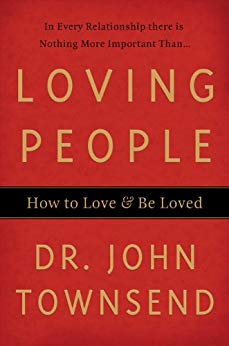
So when Loving People: How to Love and Be Loved by John Townsend came through on a Kindle sale, I got it. I had heard of Townsend but never read him before.
Early in the book, Townsend says:
You may have noticed that the title of this book has a double meaning. Loving can be both a verb (the action of demonstrating love) and an adjective (the description of someone who demonstrates love). The intent here is to bring attention to the reality that both meanings are necessary for each other to exist. If you want to be a loving person, you must actively show love to people. And if you want to love people, you are to be a person characterized by loving.
A few more of his introductory comments about love:
Care and love aren’t the same thing. Almost any of us could say that we truly care about some people. We can freely admit that, and we are glad these people are in our lives. We want what’s best for them. But the reality is often that we don’t know how to treat those we care about in the most loving way. We want to be the best for those people, but we don’t know how to love them in the way that is best. That is, we would like to be close to them, to be a positive influence for them, and to bring them to intimacy and a better life. But there is a disconnect between our care for those we love and how we address or approach them.
Love is much more than good feelings or intentions. It has direction, movement, and purpose. But while we may feel love, we may not be doing love. Most of us don’t know how to experience and become competent in the art form of love.
We cannot force ourselves to feel anything. Feelings are the result of changes inside us. They aren’t a cause; they are an effect. Trying to will ourselves to feel love doesn’t work. Yet when we say that love is only a feeling, we reduce it to something less than what it truly is. As I said earlier, love encompasses and experiences feelings, but love is not limited to feelings. It is much more—genuine love involves the heart, soul, and mind.
In this book, I define love simply as “seeking and doing the best for another.” When we love someone, we bend our heart, mind, and energies toward the betterment of someone else. That is what loving people do. It involves the whole person. It is ongoing and intentional.
As the architect of love, God lives out this definition. He is constantly seeking and doing what is for our best, things that help us connect, grow, and heal. He is actively doing whatever it takes for us to be the people he designed us to be. The ultimate example of his love is, and always will be, in the sacrifice of Jesus for an alienated and broken creation: “For God loved the world so much that he gave his one and only Son, so that everyone who believes in him will not perish but have eternal life.”
He proposes that love is made up of the following components:
Connecting—making an emotional bond
Truth-Telling—honesty that serves the other person
Healing—repairing brokenness
Letting Go—giving up what should be surrendered
Romancing—the unique love of being a couple
He spends more than a fourth of the book on connecting, which he defines as “a heart-to-heart attachment that goes beyond knowing about someone to actually knowing that person.” He gives multiple examples: one involved a wife who shared problems and frustrations about her day, and her husband, thinking he was being helpful, suggested possible solutions. But she didn’t want solutions, at least, not yet. She wanted the connection: she wanted to know she was truly heard and understood. By contrast, disconnection isn’t just missing someone who is away for a few days, but rather “the inability to feel and experience the warmth of connection over time. It is the absence of the security of being attached. It is the lack of bonding inside.”
I thought truth-telling was an odd inclusion, because of course you don’t lie to people you love. But Townsend means truth-telling as more than just not lying: it means confronting the other person in a kind and loving way when they need to be confronted. “If your loved one’s life is going down the drain, someone needs to say something. Be that person.” “People who are truly loving will confront, limit, and quarantine people who consistently make wrong choices. So keep that distinction in mind: love seeks the best, but it does not enable bad behavior.”
Under healing, he says: “Loving people are the primary agents of restoration.”
About letting go: “Sometimes love means knowing when it is time to let someone go or to let him do something he is going to do. When you accept reality and give up efforts to control someone’s life or change who he is, you are being loving . . . Letting go is the ability to surrender and to allow what is real to exist. By letting go, I mean giving up efforts to control, manipulate, or force someone to do something different.”
About romance: “Romance is a wonderful aspect of love, but it is not as broad or as deep as love itself. Romance must fit into and serve love. Love can never serve romance.”
He discusses the components of each of these aspects and gives numerous examples, illustrations, and balancing considerations.
This book is not a Bible study, so it reads differently from one. Surprisingly absent from a book by a Christian about love was any discussion about the classic biblical passage on love, 1 Corinthians 13 (except for verses 1 and 13). But Townsend provides a biblical basis for most of his points. In the chapter on connection, for instance, I thought, “This is all well and good, but where do you get this from the Bible?” Well, from the One who made the greatest effort to connect with people who were not only uninterested in Him, but opposed to Him. “Therefore he had to be made like his brothers in every respect, so that he might become a merciful and faithful high priest in the service of God, to make propitiation for the sins of the people.For because he himself has suffered when tempted, he is able to help those who are being tempted” (Hebrews 2:17-18).
The last chapter, “Putting It All Together,” didn’t really put it all together for me. I had hoped it would recap the main points. Instead, it contained instructions to “assemble your team” and “measure and evaluate your process of growth.”
I got a lot of helpful points and thoughts from the book, but I can’t say, “Aha! Now I’ve got it!” Townsend brought up aspects of love that I had not heard or read in other pieces on this subject, but he also did not address other aspects that are usually considered.
While Townsend had a lot of good things to say, his style just didn’t gel with me. Not to say there is anything wrong with his style: he is a best-selling author, after all. But many of the conversations he described in the book are just not the kind I can imagine anyone I know having. Real people did have them, but I guess they were very different personalities from mine and my family and friends.
The best advice I’ve heard about love came from a book I have not been able to recall or find again. But the writer said that for years she berated herself for not being more loving. She was a missionary in a difficult area, and she found herself too often irritated with unloving thoughts towards others. The more she tried to become more loving, the more frustrated she became. But then she started to think about God’s love for her, gracious and undeserved. And without even being aware of it at first, resting in His love overflowed into her own heart and actions.
That’s not to say we can’t learn from books like this. I was particularly convicted about connecting, truly listening and empathizing instead of just offering my two cents to fix the other person’s problems.
I’ve heard similar definitions of love before, that’s it’s a self-sacrificing desire to meet the needs of the loved person. And I’ve heard that it’s not just a feeling. Yet I struggle with doing the right thing, but with resentment. That’s part of having a sin nature, I guess, and we’ll never have it down perfectly while here on earth. Maybe in some ways love is doing your best for another despite resentment. But that’s not how God loves. And I want to love more like Him.












 Stray Thoughts