One picture is worth a thousand misunderstandings

IMG_1383

Imagine a defendant going to trial. He’s told his story to his lawyer and worked with him to lay out all the proofs of his innocence. As the trial begins, the prosecutor introduces just one piece of evidence: a seemingly incriminating photograph. The judge calls for the verdict without giving the defense a chance to say anything. The jury convicts the defendant and the judges sentences him.

Imagine the same scenario, but the evidence is one statement the defendant is known to have made without any context as to its meaning.

“Ridiculous!” you might say. “How can anyone judge a case without hearing both sides?” And you’d be right.

Yet people do this every day. As you are probably aware, a young man was vilified recently on social media for a photograph that seemed to indicate he was disrespecting, if not downright mocking, an older Native American man. But in the following days, more information came out about the scenario, proving there was much more to the story. (I don’t know all the details: I just bring this up as an example of how quickly people rush to judgment before they know the facts.)

Once one of my son’s friends who had never met me thought that I must be pretty grouchy. The reason? Another son had posted pictures of a family outing, and one photo caught me looking quite irritable after waiting outside in the heat for seats in a restaurant for what seemed like an interminable amount of time. Someone else assumed in another group photo that there must have been some underlying hostilities because a few people were sitting with arms folded. Yet the conversation had been as amiable as could be.  But these are minor misunderstandings compared to the way people tear each other apart on Twitter with as little substantial cause.

“A picture is worth a thousand words,” the saying goes. Yet a picture captures just one moment in time, not the whole story. It doesn’t give context, the events leading up to or coming after, the circumstances behind the scene.

That’s true whether the picture seems bad or good. There are multitudes of articles about people feeling depressed after viewing other peoples’ seemingly perfect lives on social media. We see the perfectly decorated cake, but we don’t see that it has been turned so the best side faces the camera. We see the beautifully redone room, but we missed the part where the clutter was cleared off to the side before the picture was taken. We see the adorable family Christmas photo, but we don’t see the several pictures taken and rejected to get just the right poses and expressions. When we think other people on social media have such perfect lives, we don’t realize that those captures of perfect moments don’t tell the whole story. Nobody has a picture-perfect life all day, every day.

The same is true with isolated statements. Take, for example, the sentence, “I’m going to kill you!” Now imagine it in different scenarios:

  • Two friends setting up a chessboard
  • One brother pulling a prank on the other
  • A young wife being mercilessly tickled by her husband
  • A jealous man stalking a girl who doesn’t want his attention
  • A woman trying to escape an abusive relationship

Depending on the context, saying “I’m going to kill you!” might be perfectly innocent, though maybe not very wise to say.  Other contexts make the statement more realistic or sinister.

In addition to the folly of rendering judgment based on pictures or individual statements out of context, we can also misjudge scenarios. Imagine a parent hearing a loud crash, running into the living room, and seeing her son with a baseball bat standing by a broken window. Before launching into a tirade based on what seems to have happened, the wise parent calms herself down to ask questions and assess the situation further.

Proverbs 18:13 says in the ESV, “If one gives an answer before he hears, it is his folly and shame.” I am not familiar with the Holman Christian Standard Bible, but I like their translation of this verse: “The one who gives an answer before he listens– this is foolishness and disgrace for him.” We agree it is foolish, unjust, and harmful for a jury to convict a man over just one photo or statement. It’s just as foolish, unjust, and harmful to play armchair prosecutor, jury, and judge over situations we know little about; it’s even more foolish to do so publicly.

James tells us, “Know this, my beloved brothers: let every person be quick to hear, slow to speak, slow to anger; for the anger of man does not produce the righteousness of God” (1:19-20, ESV). Jesus said, as well, “And as ye would that men should do to you, do ye also to them likewise” (Luke 6:31, KJV).

This is true whether our judgment is good or bad, condemning or helpful. When we rush to “help” someone by pouring forth the benefit of our wisdom and experience without first hearing them out, we do more harm than good. Why? Because the person is wounded and alienated due to feeling misjudged and unheard, and our advice is off base because we’ve misdiagnosed the case.

We’re quick to pull out the “Judge not” card (often out of context) when anyone misjudges us, but we too often rush to judgment of others. Instead, we need to consider first of all whether it’s even our business to judge a particular situation. Then, in Matthew 7:1-5, Jesus admonishes us to take care of any “planks” in our own eyes before we try to take a speck out of someone else’s and to remember “with the judgment you pronounce you will be judged, and with the measure you use it will be measured to you.” Then we need to hear all the facts and consider carefully and fairly. Withholding judgment due to not knowing all the facts would wipe out the great majority of public judgments on social media and in our persona lives.

“Do not judge by appearances, but judge with right judgment” (John 7:24, ESV).

(Sharing with Inspire Me Monday, Literary Musing Monday, Tell His Story, Let’s Have Coffee, Porch Stories, Wise Woman, Woman to Woman Word-filled Wednesday, Faith on Fire, Grace and Truth. Linking does not indicate full endorsement)


Friday’s Fave Five

friday fave five 12

It’s Friday, time to look back over the blessings of the week with Susanne at Living to Tell the Story and other friends.

Hard to believe we’re at the last FFF of February! 1/6 of the year will be over in a few days! Here are some of my favorite parts of the last week:

1. Valentine’s Day observed. We celebrated late because my husband was traveling on Feb. 14.

Valentine

2. Being treated at a restaurant. My son, daughter-in-law, and grandson treated us to lunch last Saturday at a favorite Mexican food restaurant of theirs that we hadn’t tried yet.

3. Lunch with a friend. Always good to catch up and fellowship.

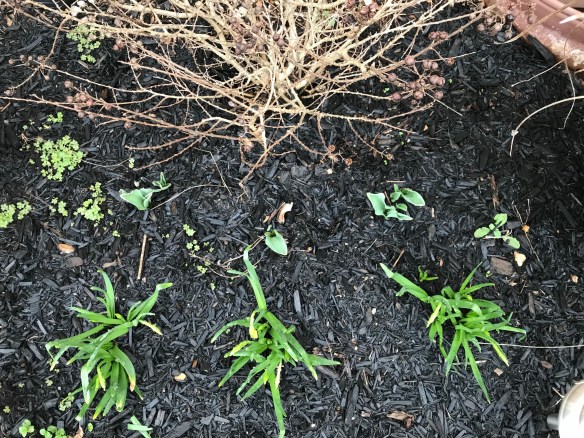
4. Signs of spring.

IMG_1361

IMG_1362

5. Humor. We’ve been having a lot of rain here in TN. That has led to some humorous memes floating around Facebook:

20597035_1329026907209880_4994681594685984561_n

52460347_10217259776260052_2984365095141769216_n

52668825_2227586430612858_89316606584291328_n

I am thankful the temperatures have not been low enough for all this moisture to freeze. And when we had a couple of hours of sunshine one morning, I looked out the window and soaked it in. But I’ll be glad for sunnier skies and dryer weather, hopefully next week.

By the way, I reviewed and will be giving away a book called Journaling for the Soul here if you are interested.

Book Review: I’d Rather Be Reading

ReadingAnne Bogel’s I’d Rather Be Reading is aptly subtitled The Delights and Dilemmas of the Reading Life. Anne is the blogger behind Modern Mrs. Darcy, where books and reading are among her primary topics.

In this book Anne covers nearly every aspect of being an avid reader communicating with other avid readers.

Since she writes so much about books, people sometimes feel compelled to divulge their guilty reading secrets: hating books that everyone else loves, never having gotten around to reading a well-loved classic, having books on their shelves for decades that they haven’t read yet.

She discusses the books that we seem to come across at just the right time, even though we picked them up randomly, the books that “hooked” us into lifelong readership, the puzzling love for books that make us cry, the charm of libraries and bookstore, books that we keep because they were given to us or remind us of friends, how reading enhances real-life experiences, “bookworm problems” like never having enough storage space for books or needing to stop just at the best part of a book to go to work  or pick up a child from school, the different types of readers we are at different stages of life, the discoveries made in an author’s extra notes (acknowledgements, introductions, afterwords), and much more. Along the way she references a plethora of books she’s read.

Maybe because I am only an occasional visitor rather than a regular follower of Anne’s blog, I didn’t have the same sense of conspiratorial camaraderie I might have had in discussing some of these same topics with friends. But I enjoyed plenty of head-nodding and “me, too!” moments, which, along with Anne’s breezy style, made this book a pleasant read.

(Sharing with Carole’s Books You Loved)

Review and Giveaway: Journaling for the Soul

I kept journals in high school, but I became embarrassed by their content and threw them out. I wish I had kept them, embarrassing as they may have been, for a window into my teenage mind. I made notes from my devotional time for years, but stopped for two main reasons. My writing took up much more time than my reading, and I felt I needed to be listening to God in His Word more than writing my thoughts about His Word. Plus I had stacks of small spiral notebooks that I wasn’t sure what to do with. I rarely went back through them, so I figured they had served their purpose, and I threw them out, too. The closest thing I’ve had to a journal in recent years has been my blog.

But lately I’ve been reminded of the value of writing in connection with our time in God’s Word. Writing helps us process thoughts, and writing helps reinforce and make those thoughts permanent.

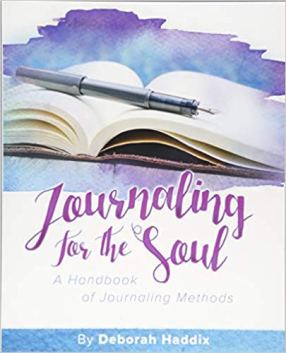
JournalingAbout this time, Michele’s review of Journaling for the Soul: A Handbook of Journaling Methods by Deborah Haddix caught my eye, so I asked for a copy for Christmas.

Deborah shares that journaling in the only way she knew it seemed like too much pressure and took up too much time. But as friends shared with her a variety of journaling methods, she hit on one that resonated with her and enhanced her time with the Lord.

Deborah shares several benefits to journaling. In addition to the ones I mentioned above, journaling can help us engage with a text of Scripture more than a cursory reading would provide, “moving you from reading for information to reading for transformation” (p. 13). Journaling enables us to slow down and focus, “documents what God is currently teaching us” (p. 16), “provides a record of our spiritual growth, one that we can look back on as a reminder of God’s persistent work in our lives” (p. 16). And journaling can be a tool to speak to our loved ones and others. The Journals of Jim Elliot profoundly affected me when I discovered it as a young adult.

Deborah has amassed a multitude of journaling methods. Some are written; some are more artsy. Some focus on prayer, some of self-reflection, some on meditating on one particular text, some on on working through a particular passage, some on gratitude lists or prompts.

Deborah recommends that we “start small and keep it simple” (p. 21). First we need to decide the purpose for which we want to journal and then assess which method fits within our interests and talents. She also advises that we evaluate what we’re doing periodically and decide whether it’s working or whether we need to change. She emphasizes that journaling should not be a source of pressure or driven by perfectionism. One of the best pieces of advice, and new to me, was the recommendation of leaving space for an “insight line” at the bottom of the journaling page – when we read back through our journal entries, we can add a line or two about how we’re doing with whatever we wrote about, whether we’ve grown or are still struggling, ways the Lord answered prayer, etc.

I found, as Deborah predicted, that not all of the methods appealed to me. One that did was Inductive Study Journaling – reading through a passage and jotting down our observations (what it says), interpretations (what it means) and application (“How does God want me to live in light of the truth of His Word” [p. 52]). Another was the Spiritual Markers Journaling, taken from the memorial stones Joshua was instructed to gather and set up as a reminder to Israel of His working among them in Joshua 4:2-7, something like the Ebenezers I listed a while back.  She has a couple of pages on Truth Journaling developed by Barb Raveling. I’m more inclined towards journaling through a passage of Scripture than responding to seemingly random prompts, though the latter has its value as well. I’m considering a variation on the bullet method. I often read from more than one source, and it’s amazing how often they intersect. I’ve thought of just writing a sentence or two from each source each day.

Of course, some people’s minds work differently. A man in our former church was speaking on a particular topic, and in his presentation he shared some “doodles” he had made during a recent sermon. They weren’t art in the sense of being enhanced by frills and flourishes, but he had just arranged the words of a verse or quote from the sermon in a way that illustrated its meaning just by how it was arranged. I wish I had a sample to explain it. I could not have done it in a week’s worth of thought and effort, much less in a quick few strokes while listening to a sermon. His mind worked in such a way that his note-taking took that form. Some like to study a passage not by outlining and highlighting but by verse mapping (some examples here, here, and here). Some take it a step further with art journaling, like Robin Lee Hatcher’s examples here or Karla Dornacher‘s. I’ve seen some examples of art journaling where the illustration covers over the Scripture itself, which, in my opinion, seems to be exalting it over the words of the Bible. To me, some of these types of methods would work best with one verse, whether meditating on it and/or trying to memorize it.

I’d add a word of caution with some of the more artsy methods. There’s a difference between coloring a verse as a hobby, a method of relaxation, etc., and engaging mentally with the text while drawing and illustrating it. I wouldn’t use coloring a verse as my whole time with the Bible. It does take thought and effort to engage with a text to determine the meaning and the best way to apply it. If drawing and illustrating it does that for a person, that’s fine.

So there are any number of methods for engaging with the Bible text in a way that helps us understand and apply its meaning. Deborah has done a great job detailing the reasons for and benefits of journaling and finding examples for just about every personality and mindset.

When I asked for a copy of this book for Christmas, somehow I ended up with two. So I’d like to share one with one of you. If you’d like to be entered for a drawing to win this book, just leave a comment on this post. A week from today, Feb. 27, I’ll collect all the comments here and use random.org to draw a name. (I’ll take all the comments on this post as entries for the drawing unless you let me know that you don’t want your name entered.) In addition, I must have a way to contact you: if you would, leave your email not in the comments but in the form underneath where you place your name. If you are commenting from a WordPress account, your email fills in automatically with the email associated with your account. And, due to shipping costs, I am only able to ship to the US.

Do you journal? Do you use a particular method?

Update: The giveaway is now closed. The winner is Kathie!

(Sharing with Literary Musing Monday, Carole’s Books You Loved)


Book Review: A Little Princess

PrincessIn A Little Princess by Frances Hodgson Burnett, seven-year-old Sara Crewe has grown up in India with her beloved father. Her mother had died years before. Now the time has come for Sara to go to a boarding school in England.

Her father takes her to Miss Minchen’s Select Seminary for Young Ladies. Because he is rich, he provides for Sara to have her own room, maid, and carriage. Because Sara’s father is rich, Miss Minchen fawns over Sara and sets her as her “star pupil.” Privately she dislikes Sara. Because Sara is so elevated, the older popular girls immediately dislike her.

Sara herself is largely unaware of what being rich means. She seems much older than she is, quiet, thoughtful, and serious. But she has a sweet disposition and befriends other outcasts, like the overweight and not very smart Ermengarde, a motherless younger child named Lottie, and the scullery maid Becky.

Sara likes to pretend, and her most frequent pretend is that she is a princess – not because she is haughty or thinks herself entitled to be a princess, but to remind herself to act as a princess would act. Acting as a princess helps her not to lash or or slap people, even when they deserve it.

Suddenly Sara’s world is turned upside down when her father dies amidst a massive business failure. With no time to mourn or even adjust to the news, Sara is relegated to the attic and now has to work at whatever Miss Minchen assign to her. Sara has no other relatives and apparently there is nothing like children’s protective services in that day and time: Miss Minchen is now responsible for Sara and her upkeep, so she’s determined that Sara will earn her keep.

Sara still pretends to be a princess to help her act right, and she pretends that she is a prisoner in the Bastille to make her situation a little more palatable. But she is sad and miserable. Demands are made on her all day, she’s scolded and denied food for the least infraction. She visits with Becky, who has the attic room next to hers, but Lottie and Ermengarde can only come up when they can sneak in unawares.

At Sara’s lowest point, she wakes up to find “a dream come true” in her attic room – a fire in the grate, good food, warm bed coverings, a stack of books. Where could they have come from?

Though A Little Princess isn’t written exactly in the style of a fairy tale, it has many fairy tale elements: a “princess” in disguise or down on her luck, facing various trials, hidden away in a dark place, only to have things change and put to rights at the end with the villains getting their due comeuppance.

I searched a bit to try to discover Burnett’s purpose in writing the book. I couldn’t discover anything except that Wikipedia said “The novella appears to have been inspired in part by Charlotte Bronte’s unfinished novel, Emma, the first two chapters of which were published in Cornhill Magazine in 1860, featuring a rich heiress with a mysterious past who is apparently abandoned at a boarding school.” Perhaps she just wanted to write a fairy tale set in her time. But Sara certainly seems to be an exemplary heroine: not perfect (she admits to having pride and a temper), but constant in her character, kindness, and interest in others no matter what her circumstances. Maybe Burnett set up a character children could look up to and emulate.

But one factor that stood out to me was the way people treat others based on their economic status. Sara was the same person in good times or bad. Neither she nor her father asked or expected that she be out on a pedestal when they were rich, and certainly no one deserves to be treated as Sara and Becky were just because they were poor. The difference came in how others perceived them. Sure, there are some rich people in every age who feel entitled and deserving of pedestals and accolades. But we need to treat people with kindness and consideration no matter what their circumstances.

There’s some mention of “magic” in this book, but it’s not as pervasive as in The Secret Garden. The view of English imperialism and Indian servants might be offensive to modern sensibilities.

I had never read this book, that I can remember, but some years ago I saw a film version which I’d like to see again now.

I didn’t like the cover (pictured above) of the audiobook I listened to, but I enjoyed the wonderful narration by Virginia Leishman.

C. S. Lewis said the best children’s books are good reading for adults, too, and I agree. I very much enjoyed getting acquainted with this classic.

(Sharing with Literary Musing Monday, Carole’s Books You Loved)


Smelting the Soul

Photo courtesy of alejandro godoy at pngtree

Perhaps you’ve heard this old illustration, as I often have. When metalworkers need to refine metals, they melt them down and then have to skim off the dross, impurities, and other metals until the product is pure. The actual process has changed over the years, but it still involves smelting, separating, and removing impurities. We’re told that the way the refiner knows that his product is pure is when he can clearly see his face reflected in the liquefied metal.

All my Christian life I have heard this refining process as an illustration of God’s sanctifying us.

The crucible is for silver, and the furnace is for gold, and the Lord tests hearts. Proverbs 17:3

Take away the dross from the silver, and the smith has material for a vessel. Proverbs 25:4

Behold, I have refined you, but not as silver; I have tried you in the furnace of affliction. Isaiah 48:10

He will sit as a refiner and purifier of silver, and he will purify the sons of Levi and refine them like gold and silver, and they will bring offerings in righteousness to the Lord. Malachi 3:3

But he knows the way that I take; when he has tried me, I shall come out as gold. Job 23:10

The refiner’s skill in applying just the right temperature illustrates God’s skill in adjusting our trials at just the right level. Too little “heat” might upset us but not purify us: too much might discourage or destroy us. The impurities or mixtures of other metals speaks of our need to be cleansed and purified from various sins and divided loyalties. The melting liquid shows our need to yield to the process. And since God’s goal in our sanctification is that we become like His Son, the refiner’s seeing his reflection in the melted metal is a beautiful illustration of our God’s refining and purifying us until we’re conformed to the image of His Son.

And we all, with unveiled face, beholding the glory of the Lord, are being transformed into the same image from one degree of glory to another. 2 Corinthians 3:18

For those whom he foreknew he also predestined to be conformed to the image of his Son. Romans 8:29a

These parallels have been a blessing in considering the process and end goal of God’s sanctifying work in my life.

But one particular aspect that I had not considered much before blessed me in a big way last week.

I’ve mentioned before that I am sometimes discouraged at my lack of love, my innate selfishness, and I often pray to be more loving. I know that the struggle between the Spirit and our flesh is a lifelong one that won’t end until we’re in heaven. Yet it seemed like, after around 45 years of being a Christian, I should be further along than I am now, and it should be less of a struggle.

But since that struggle doesn’t end until heaven, we’re going to continue to have our impurities brought to our attention. And that’s a good thing – not that we have them, but that they come to the surface so we can deal with them by confessing them to the Lord and seeking His grace to overcome them.

Whoever conceals his transgressions will not prosper, but he who confesses and forsakes them will obtain mercy. Proverbs 28:13

When I first became a Christian, I was convicted of a lack of love and a need to be more unselfish in some areas. But they were probably big, obvious areas. The more I grow in the Lord, the more He makes me aware of smaller, deeper areas, like a harsh thought as well as harsh words.

The refining process is an answer to my prayer to be more Christlike and more loving. I can’t be more loving until I see the ways in which I am unloving. I can’t turn from selfishness until I see the ways my selfishness displays itself. I can’t grow more like Christ until I see the ways I am not yet fully like Him.

So instead of being discouraged that God continually shows me the ways in which I fall short, I can rejoice that He is continuing to refine me. And I praise Him for the grace that washes away all sin.

(Sharing with Inspire Me Monday, Literary Musing Monday, Tell His Story, Let’s Have Coffee, Porch Stories, Woman to Woman Word-filled Wednesday, Wise Woman, Faith on Fire, Grace and Truth)

Laudable Linkage

Here are the reads I have found most compelling this week:

Have This Mind Among You, HT to Michele. “‘We don’t treat our marriage like it’s the place where we can be our worst selves. We don’t treat our home like it’s the place where we can ‘be real,’ as though every other relationship in our lives deserves the fruit of the Spirit, but at home we can drop the facade and level all the pent up frustration of the day at one another.’ I said, ‘Nate should get my best self, the best of the Spirit’s fruit in my life and heart, not the worst self.'”

When Being “Relatable” Does Damage, HT to True Woman. “At its best, relatability is a transparent humility that aims to serve others by providing a starting point for relationship. At its worst, it’s a longing for others to relate to our sin in a way that minimizes it.”

Don’t Put Your Hope in Date Night, HT to True Woman. “When we falsely believe a date night out is the only way to grow in marriage, enjoy one another, foster intimacy, and maintain a healthy commitment, we’re bound to continually feel defeated and disappointed. God is gracious to provide many ways for couples to connect and grow deeper in their love for one another beyond a night out.”

You Don’t Want to Have a Megapastor.

5 Myths About Christian Publishing, HT to Challies.

Friday’s Fave Five

friday fave five 12

It’s Friday, time to look back over the blessings of the week with Susanne at Living to Tell the Story and other friends.

This turned out to be a busier week than expected! But here are some favorite parts of it:

1. Valentine’s Day – though we’re celebrating it as a family today since my husband was traveling yesterday. Therefore I wasn’t expecting anything Valentiney yesterday, but when my husband got home last night, he brought these and a sweet card:

IMG_1350(1)

This is my favorite candy, but I only have it on special occasions – because otherwise I’d be eating it all the time and weigh a ton. He got extra because he had forgotten it at Christmas. 🙂 I’ll have to make myself ration it out so I don’t overdo – but the advantage there is that will just make it last longer. 🙂

2. Meal delivery services. A lot of restaurants these days outsource their deliveries, like Uber for food. It makes sense – some of them probably don’t have enough delivery orders to hire someone for that purpose full time. But I still felt wary of a stranger having my food between the restaurant and my home – until I reminded myself that everyone at the restaurant is a stranger, and even a delivery driver hired directly by the restaurant is as well. So we tried delivery from a favorite Mexican food place one night this week. The ordering process was painless and efficient, and the food came in a timely manner. We remarked how it was so much better than the fast-food Mexican alternative we had considered. 🙂

3. Photo Booth was a forgotten app on my iPad mini until Timothy discovered it recently. You can see yourself with negative, thermal, kaleidoscope, and funhouse-mirror type effects and take a picture. It was so fun to watch him giggle as he tried the different effects, especially one that swirled various features around.

IMG_0301

IMG_0093(1)

4. Timothy texting. He has sent voice texts with his parents’ help, but recently discovered how to put GIFs and images in a text. Since they have pictures of each of us in their contacts, he can easily choose who to send them to. Right now he sends a dozen at a time. 🙂 But it’s fun to hear from him throughout the day.

5. God’s Grace. When brought low by my faults and failures – sin – I’m blessed to remember that my relationship with God isn’t based on what I deserve. He took care of the punishment I deserved 2000 years ago. I can cast myself totally on His grace.

If we say we have no sin, we deceive ourselves, and the truth is not in us. If we confess our sins, he is faithful and just to forgive us our sins and to cleanse us from all unrighteousness. 1 John 1:8-9, ESV

Praying to love more

Valentine’s Day vies with Christmas as my favorite holiday. I’ve shared before why I think it’s worth celebrating and compiled a list of some of my favorite quotes, songs, etc. for Valentine’s Day.

Of course, everyone is free to celebrate or not celebrate the day according to their own preferences. And though I love the fun and even silly aspects of the day, today I want to take a different tack.

One of my ongoing struggles in my Christian life is learning to love as Jesus did, and my biggest obstacle is my own selfishness.

A new commandment I give to you, that you love one another: just as I have loved you, you also are to love one another. John 13:34

This is my commandment, that you love one another as I have loved you. Greater love has no one than this, that someone lay down his life for his friends. John 15:12-13

Love is patient and kind; love does not envy or boast; it is not arrogant or rude. It does not insist on its own way; it is not irritable or resentful; it does not rejoice at wrongdoing, but rejoices with the truth. Love bears all things, believes all things, hopes all things, endures all things. 1 Corinthians 14:4-7

Set the believers an example in speech, in conduct, in love, in faith, in purity. 1 Timothy 4:12

Let brotherly love continue. Hebrews 13:1

 Having purified your souls by your obedience to the truth for a sincere brotherly love, love one another earnestly from a pure heart. 1 Peter 1:22

Above all, keep loving one another earnestly, since love covers a multitude of sins. 1 Peter 4:8

Whoever keeps his word, in him truly the love of God is perfected. 1 John 2:5

Beloved, if God so loved us, we also ought to love one another. 1 John 4:11

By this we know that we love the children of God, when we love God and obey his commandments. For this is the love of God, that we keep his commandments. And his commandments are not burdensome. 1 John 5:2-3 (This might be a surprising one to some, but Jesus said “If you love me, you will keep my commandments” (John 14:15). If we love someone we don’t disregard their words: we take heed and try to keep them. He also said all the law and the prophets hang on to the command to love God and our neighbor.)

I was just discussing with a friend earlier this week how we often hear that Christian love is not just a warm fuzzy feeling: rather, as one professor used to put it, it’s a “self-sacrificing desire to meet the needs of the cherished person.” I think of a mother being awakened at 2 a.m. by her baby’s cries. She might not feel lovey-dovey right at first: in fact she might feel a little irritable. But she knows her baby needs her, and often, some time during their nocturnal meeting, that warm, loving feeling rises up again.

However, the opening of the great love chapter in the Bible, 1 Corinthians 13, warns us that we can make substantial sacrifices without doing so in love.

In my ongoing quest to understand what Christian love is and to grow in it, I compiled Bible verses which specifically spoke of praying to love. I sometimes use them for my own prayers.

For this reason I bow my knees before the Father, from whom every family in heaven and on earth is named, that according to the riches of his glory he may grant you to be strengthened with power through his Spirit in your inner being, so that Christ may dwell in your hearts through faith—that you, being rooted and grounded in love, may have strength to comprehend with all the saints what is the breadth and length and height and depth, and to know the love of Christ that surpasses knowledge, that you may be filled with all the fullness of God. Ephesians 3:14-19. (It’s interesting to note that right after this prayer comes Paul’s’ declaration, “Now to him who is able to do far more abundantly than all that we ask or think . . . “)

And it is my prayer that your love may abound more and more, with knowledge and all discernment, so that you may approve what is excellent, and so be pure and blameless for the day of Christ, filled with the fruit of righteousness that comes through Jesus Christ, to the glory and praise of God. Philippians 1:9-11

Now may our God and Father himself, and our Lord Jesus, direct our way to you, and may the Lord make you increase and abound in love for one another and for all, as we do for you, so that he may establish your hearts blameless in holiness before our God and Father, at the coming of our Lord Jesus with all his saints. 1 Thessalonians 3:11-13

Of course, it helps to remember that love is a fruit of the Holy Spirit, and I can only be filled with love as I am filled with Him.

And since we’re to love as God does did, it helps to meditate on how He showed love to us. That would take more study and a different post, but here are a few ways:

For God so loved the world, that he gave his only Son, that whoever believes in him should not perish but have eternal life. John 3:16

By this we know love, that he laid down his life for us, and we ought to lay down our lives for the brothers. 1 John 3:16

God shows his love for us in that while we were still sinners, Christ died for us. Romans 5:8

In this is love, not that we have loved God but that he loved us and sent his Son to be the propitiation for our sins. 1 John 4:10

Those verses don’t enlighten me as to the “feeling” part of love, but they show that God loved first, He loved people who were enemies to Him, and He made every provision, at the highest cost to Himself, to redeem them.

The more I think about the myriad ways He has shown His love to me, the more His love will fill me and overflow to others.

As the Father has loved me, so have I loved you. Abide in my love. John 15:9

IMG_1344

(Sharing with Literary Musing Monday)

Book Review: Read the Bible for Life

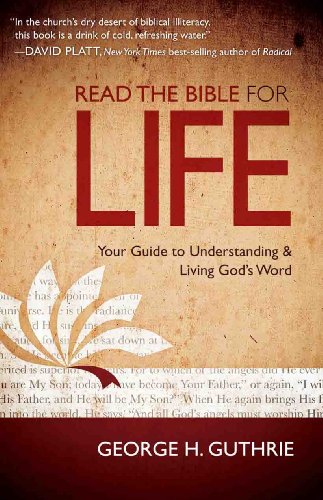
I first discovered George Guthrie through links to his blog from others. The posts I read there were so helpful that I got his book, Read the Bible for Life: Your Guide to Understanding and Living God’s Word.

After an introduction detailing reasons for reading the Bible, lamenting a lack of Biblical literacy among Christians, and posting several reasons why Christians don’t read, Guthrie launches into the four parts of his book.

The first part covers “Foundational Issues,” like how to read it, reading it in context and for transformation. etc.

Part 2 discusses reading the various genres in the Old Testament: stories, laws, psalms and proverbs, and prophets.

Part 3 covers the different types of literature in the New Testament: stories, Jesus’ teachings, epistles (letters), and Revelation.

Part 4 contains four chapters concerning “Reading the Bible in Modern Contexts,” like personal and family devotions, as a church, and in times of sorrow.

At the end, Guthrie includes a couple of reading plans, including a chronological one.

Most of the chapters are the result of interviews Guthrie conducted with experts in various fields of Bible study. I appreciated that the interview format kept the book informal and accessible rather than academic. But because of the interview setting, sometimes extraneous details were included, like scenes from where the interview took place, the interviewee’s posture, etc. But I think the benefits of this process probably outweighed the extra unnecessary details.

I have multitudes of places marked in this book, but I’ll try to share just a few. If the source was someone other than Guthrie, I put that person’s name in parentheses.

God’s Word, wielded by the Holy Spirit, has the power to sort us out spiritually, to surprise and confront us, growing us in relationship with our Lord Christ. Thus, reading the Bible ought to at once be as encouraging as a mother’s gentle touch and, at moments, as unsettling and disturbing as a violent storm.

I would suggest that true literacy—the kind that matters—brings about clearer thinking and informed action. Thus, true biblical literacy involves an interaction with the Bible that changes the way one thinks and acts, and that kind of interaction takes time.

As we read on a daily basis, growing in our skill in Bible reading, the rhythm of a life lived deeply in God’s Word will become as nurturing as our daily meals, as spiritually strengthening as daily exercise, and as emotionally satisfying as a good-morning kiss from a spouse. It takes discipline, but Bible reading can come to be a discipline of delight if we open our hearts and lives to it.

The key is to have a posture toward God’s Word by which His Word is changing us in our context rather than our molding the Word to our cultural tastes and values. That is hard to do. We have to read with humility. And I think the beginning of humility is the fear of God. We have to believe in the authority of God’s Word and be ready to adjust our lives to it. (Andreas Kostenberger)

Jesus meant for people to put His words into action in specific, tangible ways. Our problem is that we think it is enough just to grasp general concepts as if taking in the Word of God is a mental exercise. Jesus, rather, meant our interaction with the Word to be a life exercise.

When we begin to see the beauty and power of the Bible’s story as a whole, we then begin to read each part of the Bible better. (Bruce Waltke)

When slogging through the myriad of laws about priestly worship practices, the tabernacle, uncleanness, and primitive issues of justice, you may feel like the wheels are coming off your momentum. Yet this part of Scripture is also God’s gift to His people. Gems here are waiting to be unearthed from under the seemingly crusty surface, and those gems form a vital part of the foundation of the Bible’s grand story.

I would hope, that when we come to Scripture, we would approach it not as a chore or a duty or a textbook but as a source of delight. At times we should say, ‘Wow! I’ve actually got the next half hour to read the Bible and talk to God!’ (David Howard)

So we need to remember that the Lord wants us to understand this book. We should pray, asking the Holy Spirit for insight and discernment as we read, even as we are putting forth effort to study and understand it. (J. Scott Duvall)

Lament teaches us that we have to go through the process of dealing with our suffering before God. You don’t just stuff your feelings down and put a good face on it, like a lot of us tend to do. You need to go through the process of pouring your heart out to God. And if you don’t have the language for it, the Bible will give you the language. (Michael Card)

Because we are ‘self-help’ oriented, too often we as Christians have become more content to go to the Christian bookstore and get good books there, neglecting our reading of the Bible. We think those books apply to us better than the Bible does, but the reality is, no book in the Christian bookstore can do what the Bible is divinely inspired to do: to transform us at the deepest levels in the way we think and live, to mold us into the image of Christ and show us our place in the grand story of Scripture. (Buddy Gray)

All I know about Guthrie is from some of his blog posts and this book, and I didn’t know any of the people he interviewed except that I had heard of a few of them. But don’t remember seeing any theological problems or concerning issues or statements.

This is a book I wish I had kept running notes or outlines of. But Guthrie does include a summary of the principles discussed at the end of each chapter, which helps for a quick review.

The general helps to reading and understanding as well as the specific advice and tips for the different genres were greatly helpful. I thought this book was an excellent resource for anyone who would like to understand and apply more of the Bible.

(Sharing with Literary Musing Monday, Carole’s Books You Loved)