Not the Messiah They Were Looking For

As a young Christian, I wondered why Jesus came incognito, so to speak. Why didn’t He go on a hilltop or to the temple and proclaim Himself: “I am the Messiah you’ve been waiting for all these years!”

There may be a variety of reasons. But in my current I-don’t-know-how-many-eth time through the Bible, I happen to be in John after having read the other three gospels. I’ve enjoyed going over all of Christ’s life on earth during the month of December, not just the “Christmas” portions. I’m using the ESV Study Bible, and its notes often remark that Jesus did not declare Himself openly because most of the Jews at that time were expecting a military ruler who would throw off Roman oppression. Several times in the gospels Jesus had to get away from the crowds because they wanted to make Him king immediately. Some, Jesus said, followed Him because of the loaves of bread He miraculously reproduced in the feeding of the 5,000.

There is a sense in which Jesus does fulfill all those roles already. He is the King of Kings, and some day the whole world will be under His righteous rule. Someday the crooked will be made straight and rights will be wronged. But these roles will be fully manifested at His second coming.

And there is a sense in which we do depend on Jesus for our daily bread and all other needs. But, as He told the crowds then:

Truly, truly, I say to you, you are seeking me, not because you saw signs, but because you ate your fill of the loaves. Do not work for the food that perishes, but for the food that endures to eternal life, which the Son of Man will give to you. For on him God the Father has set his seal.” Then they said to him, “What must we do, to be doing the works of God?” Jesus answered them, “This is the work of God, that you believe in him whom he has sent.” (John 6:26-29, ESV).

Before He could declare Himself openly, He had to teach them the true nature of the Messiah. By many signs (miracles), by His claims (“I am the bread of Life,” “I am the light of the world,” etc.), by His declarations and teachings, bit by bit He showed them exactly who He was and what He was about. And some understood and accepted Him for who He was. They came to understand that His kingdom is a spiritual one.

But some left Him when he started to share “hard things.” Others realized He didn’t fit their image of what the Messiah would be and do, they rejected Him and sought to destroy Him.

Don’t people still do that today? Instead of learning from God’s Word the true nature of the Savior, they’ve imagined their own version of what a Savior would be like. He wouldn’t let evil happen. He’d take care of the bad guys. He’d answer every prayer just the way they want Him to. And when He doesn’t perform according to expectations, well, then, who needs Him?

We all need Him. But we need Him as He truly is, not as we think He should be. Even those of us who are Christians, even those of us who have been for a long time, still have to continually “renew our minds” and adjust our thinking according to truth. We come to know Him as Savior and Lord, but then we spend the rest of our lives getting to know Him better and adjusting ourselves away from our preconceived notions and expectations and toward who He really is. And we’re not disappointed, because in the end He’s a much better Savior than we could ever have imagined.

Do you know Him today as He truly is? Get to know Him through His Word. If you’re new to the Bible, start reading the gospel of John. See what He does and what He says about Himself.

And if you’ve known Him for years, keep getting to know Him better. Keep learning more and more what a wonderful Savior He is.

(Sharing with Inspire Me Monday, Literary Musing Monday, Tell His Story, Let’s Have Coffee, Porch Stories, Wise Woman, Woman to Woman Word-filled Wednesday, Faith on Fire)

Laudable Linkage

It’s been another good week for online reading! Here are posts I have learned from lately – maybe some of them will interest you as well.

Routine Bible Reading Can Change Your Life, HT to Challies. “But the way the Bible does its work on our hearts is often not through the lightning bolt, but through the gentle and quiet rhythms of daily submission, of opening up our lives before this open Book and asking God to change us. Change doesn’t always happen overnight. Growth doesn’t happen in an instant. Instead, it happens over time, as we eat and drink and exercise. The same is true of Scripture reading.”

Advent Reading Plans. Several doable, workable plans for reading from the Christmas-related passages of Scripture during December.

Don’t Downplay Your Suffering, HT to Challies. “One of the biggest mistakes believers can make when facing a tragedy is to minimize it. I think so many of us do it because we are lacking a robust theology of suffering.

The Most Difficult Time of the Year: How to Love Grieving Parents at Christmas.

How Long Does It Takes to Read Each Book of the Bible? HT to Lisa.

Should We Stop Publicly Shaming People?  HT to Lisa. Yes, indeed. Sometimes a public outcry helps, like the reaction to the Dove commercial a while back. But often instead of letting people learn from their mistakes, they are run into the ground and ruined for the rest of their lives.

Beyond Truth and Fiction: Loving Our Neighbors With Dementia, HT to Out of the Ordinary. The Christian alternative to lying to someone with dementia so as not to upset them.

My Husband Was Hurt by an I.E.D. The Lasting Injury Was to Our Family, HT to Challies. Sometimes devastating injuries don’t “show” on the outside and affect the whole family.

Join Me on a Ride to Malvern, HT to Challies. A favorite childhood memory, a reminder that “all of these ‘small moments’ have the potential of eternal significance for your child.”

Stop Hand Washing Your Dishes, HT to Lisa. Nice to have my preferences justified. 🙂

And a smile for the day, found on Pinterest:

Happy Saturday!

Friday’s Fave Five

christmas FFF

It’s Friday, time to look back over the blessings of the week with Susanne at Living to Tell the Story and other friends.

The first Friday and FFF of December! Here are some of the best parts of my week:

1. “Christmas Tree Day,” as Timothy called it – the day we choose our tree and decorate it and the rest of the house for Christmas. I love that we still do this all together as a family. We set aside my oldest son’s special ornaments for him to add when he comes later this month. Mittu brought over chili and cornbread.

2. Rain holding off. The day we planned to get our tree, rain was forecast for the later morning. Then Saturday morning we woke up to steady rain. I prayed Friday night and Saturday morning that the rain would hold off at least until we got our tree home. It did – in fact, it held off until my husband got most of the outdoor decorations up as well. Our tree was pretty wet when we got it, but the drive home of top of the car dried it out pretty well. It touched my heart that God would grant that unessential, but heartfelt request.

3. Snowflakes on the ceiling – or decorating with boys. At our last house, there was a hook above where we set our Christmas tree, leftover from a hanging light or planter. One year one of the boys hung a plastic snowflake ornament up on that hook. I blustered about it but finally accepted it. Then it became a tradition to see who could get the snowflake ornament on that hook without my noticing. When we moved to this house, there was no hook on the ceiling, so one of them taped the snowflake to the ceiling. This year they took it up a notch:

IMG_1226

IMG_1227

If you can’t quite see them, there are snowflakes hanging all around the room. 🙂 One of the boys wanted to hang some from the ceiling fan blades…thankfully they didn’t go that far!

4. A movie with Jim. A week or two ago we watched An Old-Fashioned Thanksgiving, based on a Louisa May Alcott story. This week Jim and I watched its sequel, An Old-Fashioned Christmas. Jim is not all that into period dramas, so I appreciated his watching this with me. 🙂 We watched these through the Hallmark channel app on our Apple TV, but I imagine they are available to rent in the usual places.

5. Impromptu get-togethers. Besides planned outings, activities, and dinners, it’s fun when Jason, Mittu, and Timothy come over unexpectedly. Sunday nights have been “fend for yourself night” in the kitchen ever since the boys were old enough to run the microwave. We usually have something leftover or in the freezer, so everyone rummages around for their own preferences whenever they get hungry. Another impromptu gathering occurred last night when Mittu texted and asked if they could bring dinner over. Always! It was very good! And since Jim had been out of town for a couple of days, and I had the full care of his mom, it was nice to have dinner taken care of.

Happy Friday!


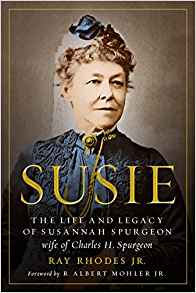
Book Review: Susie: The Life and Legacy of Susannah Spurgeon

SusieSusie: The Life and Legacy of Susannah Spurgeon, Wife of Charles H. Spurgeon is a new biography by Ray Rhodes, Jr. Susannah’s life can’t be told apart from apart from her husband’s, but Rhodes doesn’t describe her just in relation to Charles. He tells her own story fully.

Susie, as she was called because her mother and an aunt were also Susannah, “shared a lifetime” with Queen Victoria. “Susie was five when Victoria was crowned, and she died two years after Victoria’s death.” She was a city girl, living in London all her life and traveling often to Paris.

She became a Christian at about age 21, but experienced a lot of doubts for a while thereafter. She was not impressed with Pastor Spurgeon at first. He came from a rural background, and:

Charles violated her preconceived notions of what was appropriate for a polite young man in Victorian times, and a preacher at that. Susie found Charles’s hair, suit, mannerisms, and his provocative preaching style offensive. Later, reflecting on her earlier sentiments, she wrote:

Ah! How little I then thought that my eyes looked on him who was to be my life’s beloved; how little I dreamed of the honour God was preparing for me in the near future! It is a mercy that our lives are not left for us to plan, but that our Father chooses for us; else we might sometimes turn away from our best blessings and put from us the choicest and loveliest gifts of His providence.

Charles’ counsel and gift of Pilgrim’s Progress helped Susie. It wasn’t long before his pastoral concern turned romantic. The sections about their courtship are sweet, but Susie had a cold splash of reality one day. Charles was asked to preach somewhere and Susie accompanied him. They got separated in the crowd, but Charles never noticed. Lost, alone, and upset, Susie went home. Her mother “wisely reasoned that my chosen husband was no ordinary man, that his whole life was absolutely dedicated to God and His service, and that I must never, never hinder him by trying to put myself first in his heart.”

Charles and Susie married and enjoyed home life, travel, and togetherness. They had twin sons, Charles and Thomas. But both Charles and Susie developed health problems. He suffered from gout, kidney problems, and depression. It’s not known exactly what Susie’s health issues were, but severe endometriosis is suspected. She had surgery at one point but spent much of her life in pain. Sadly, she usually could not accompany Charles to places he was advised to go for his health. But he wrote to her every day, and their letters to each other are often delightful. In one of his letters from before they were married, Charles wrote:

I shall feel deeply indebted to you if you will pray very earnestly for me. I fear I am not so full of love to God as I used to be. I lament my sad decline in spiritual things. You and others have not observed it but I am now conscious of it; and a sense thereof has put bitterness in my cup of joy. Oh! what is it to be popular, to be successful, to have abundance, even to have love so sweet as yours, if I should be left of God to fall and to depart from His ways? I tremble at the giddy height on which I stand, and could wish myself unknown, for indeed, I am unworthy of all my honors and my fame. I trust I shall now commence anew and wear no longer the linsey-woolsey garment; but, I beseech you, blend your hearty prayers with mine, that two of us may be agreed, and thus will you promote the usefulness and holiness and happiness of one whom you love.

Once Susie wished aloud that one of Charles’s books could be sent to poor pastors who could not afford a much-needed library. Charles said, not in these words but to this effect, “What are you going to do about it?” That was the beginning of Susie’s book fund, which grew far beyond what she envisioned at the beginning. In one particular month, Feb. 1883, Susie received 657 letters. In 1886 she distributed 9,941 volumes. Correspondence as well as packaging, sending books, and seeking donations was a blessed ministry yet took time and energy. This ministry spawned others, like a pastor’s aid society for sending money and clothes, an auxiliary book club for lay preachers, and the Home and Foreign Sermon distribution. She said, “It is the joy of my life thus to serve the servants of my master.” She felt that the confinement necessitated by her illness enabled her to minister in these ways.

Though Susie knew some congregations were themselves poor and could not provide for their pastors, she encouraged those who could to do so in her book Ten Years of My Life in the Service of the Book Fund:

Keep your minister’s table well provided, and you shall be fed with the finest of the wheat; see that his earthly cares do not press on him painfully, and your own hearts’ burdens will be lifted by his heavenly teachings; supply him with this world’s needful comforts, and he will not fail to bring you solace and consolation in the time of your extremity. If he has sown unto you spiritual things, is it a great thing if he shall reap your carnal things?

Susie did a fair amount of her own writing, and, after Charles’s death, was instrumental in planting a church and edited The Sword and the Trowel magazine.

I’ve read Mrs. C. H. Spurgeon by Charles Ray several times, and this book draws heavily from that one. But Ray’s book was written in 1903, not long after Susie’s death. I’m sure more resources were available to Rhodes than Ray might have had, plus over 100 years of perspective adds to Rhodes’ book.

I did get just a bit frustrated at times with how the book was laid out. Though Susie’s life is covered chronologically, at each point Rhodes goes backward and forward in time to pull details about that point. So there’s a lot of back-and-forth and repetition. It helped to think of the book as a documentary. I listened to the audiobook, but I think this book would be better read than listened to.

Nonetheless, this is a great resource. I enjoyed so much hearing again the parts of Susie’s life that I knew and learning what I did not know. I appreciated the historical context, something Ray’s book could not have given as effectively since it was written in the same era. I especially enjoyed both Charles and Susie’s letters. And I was blessed by her heart and her walk with God. One phrase that stood out in many of her writings was “the glory of God.” Everything she did was ultimately for His glory.

(Sharing with Semicolon‘s Saturday Review of Books, Literary Musing Monday, and Carole’s Books You Loved)

Book Review: Homeless for the Holidays

HomelessIn the novel Homeless for the Holidays by P. S. Wells and Marsha Wright, Jack Baker’s future looks bright. He has a lovely family, a great job, and expectations of a good Christmas bonus and possibly a promotional. His boss is a bit demanding, calling him nights, weekends, even Thanksgiving. But if Jack can hang on til he gets the promotion, everything will be better – so he tells his wife.

As the Bakers prepare for Christmas, they stuff shopping carts, max out credit cards, competitively search for the last of the “hot” toys. And when encountered by a child seeking donations for a charity or a Salvation Army bell ringer, Jack begrudgingly hands over the spare change in his pocket and gripes about people who don’t work for a living.

Then the unthinkable happens. A mistaken label on one of Jack’s company’s products creates a hazard. To save face, Jack’s boss makes Jack the fall guy, placing the responsibility for the fiasco on his shoulders and firing him. Jack’s boss promises Jack that once the hoopla has died down, Jack can have his job back.

In the meantime, Jack’s search for a job proves fruitless and bills start piling up. One by one his family loses services, then their car, then their home.

The book’s tag line says, “One family learns what is truly important when they lose it all and find they have everything.”

Overall it is an enjoyable book. You feel the characters’ fear and angst as the walls close in and the losses pile up and then as they discover that having all the “stuff” doesn’t matter as much as time for each other, humility, faith, and compassion. There’s a telling exchange when Jack’s wife tries to apply for food stamps and runs into all kinds of weird rules.

The one factor that keeps this story from being just another “learning the true meaning of Christmas” tale is that it is based on true events from the life of scriptwriter George Johnson. George eventually produced a movie based on his experience called Homeless for the Holidays, which released in 2009. In the back of the book George tells about his own situation and how the movie came to be.

(Sharing with Semicolon‘s Saturday Review of Books and Carole’s Books You Loved)


Book Review: Come Back, Barbara

Come backFather and daughter C. John Miller and Barbara Miller Juliani team up to share Barbara’s prodigal daughter story from both sides in Come Back, Barbara. In each chapter John – also known as Jack – shares situations from his point of view at the time, then Barbara shares hers.

Miller and his wife, Rose Marie, thought they had a fairly normal Christian family until Barbara suddenly announced at eighteen that she wanted nothing to do with their rules and their Christianity any more. She wanted freedom on every level. The Millers were stunned. They had caught Barbara in a few lies over the years but thought those were isolated incidents. Her outward conformity for most of her life had fooled them into believing her heart was right as well. They realized they had been mistaken in not looking below the surface.

For a time they puzzled over comparing what they had always thought about her and the “new Barbara” emerging now. It just didn’t seem to fit – she had seemed like a genuine Christian. They thought at first that perhaps she was just going through a rebellious phase and would hopefully come out of it soon. Gradually they realized that her rebellion and deception went further than they had ever guessed. They had to accept, by her words and actions and reactions, that she was not a Christian, though she had once professed to be.

There’s no five-step foolproof plan to winning back a prodigal, but Jack shares some of what he learned. First, he had to realize he was truly powerless. All his efforts backfired. Often control is the first weapon against rebellious children. Of course, some degree of control is necessary in raising children, but parents “have to confront your own manipulative techniques of consolidating power” (p. 160).

Many fathers and mothers are simply more satisfied with a child’s conformity and less concerned with the youngster’s motivation and hidden desires, with what the Bible calls “the thoughts of the heart.” Often unconsciously, the self-centered parent labors to form an orderly child who performs well in public and does not shame the family by disturbing the status quo. The problem, of course, is not with the orderliness of the child, but with the shaping of a person with a desensitized conscience, a performer who has never learned to love God or people from the heart (pp. 160-161).

He had to give up control to God and depend on Him to draw Barbara to Himself. He also had to confront his own sins, realizing the irony of God’s using a rebellious child to show him his own heart.

And he had to genuinely apologize to Barbara. Even though he felt wronged and wounded, he could not hold on to victim status. He had to confess his wrongs whether she did or not. And that humility and honesty was a step in the right direction in their relationship.

The constant practice of forgiveness leaves no room for self-righteousness. Frustrated condemnation of others and treasuring of old wrongs are not part of the artillery of God, but the slithering, slimy, deadly creatures of the Prince of Darkness (pp. 79-80).

Jack and his wife wrestled for a long time over whether Barbara had apostatized and how to respond if she had. Finally they just had to accept that she was not a believer and treat her as they would any other unbeliever. They just had to show her Christ’s love. That didn’t mean accepting everything she did, but she knew where they disagreed. They asked that some things not be done in their house.

Showing such love in the face of disdain and rebellion is exactly what God has done for us. “God demonstrates His own love toward us, in that while we were yet sinners, Christ died for us” (Romans 5:8, NASB). Drawing from His love and grace enabled them to show love and grace to Barbara.

We were facing the death side of the Christian life, but there was a resurrection waiting to take place as we stepped into the grave. Today it is my conviction that no matter how heavy the blow inflicted by circumstances, each negative experience is part of the heavenly Father’s perfect plan for each believer. He allows the hour of destruction for the purpose of building something better in its place. Our part is not to run away from the pains but to walk through the briars and thorns and let Christ teach us how to turn each scratch into positive learning about the depths of God’s love (p. 67).

There is no more impenetrable barrier to God’s love than the sense of being right. So often self-righteousness controls a parent’s attitudes toward a rebellious offspring (p. 150).

He’s not saying to ignore right and wrong: they had to stand up for right and truth often. But they had to “speak the truth in love,” not from a sense lofty condescension.

Many parents tend to turn out an erring child, and sometimes indeed that’s the only option. The prodigal in Scripture left his father’s house in rebellion, and Barbara did that for a while, too. But Jack and his wife felt they needed to be open to Barbara, and when she moved back in their area, the Millers welcomed Barbara and her friends in their home, to show love and kindness to them as Jesus did with “tax collectors and sinners.”

At one point Barbara had “come back” in the sense of “settling down,” becoming responsible, not engaging in destructive behaviors. But she still was not a believer. As Jack pressed that point, it led to a major battle between him and Barbara.

Barbara, meanwhile, began “groping for the light while still resisting it” (p. 139). “Many painful things happened to me during this period, but the work of the Holy Spirit was to gently lead me from darkness to light” (p. 167). She described it like walking into a large, dark room, turning on the nearest lamp, moving to another area and turning on another lamp, continuing until there’s enough light to clearly see. She didn’t think she could have stood it if God had turned all the lights on at once. “Instead, God showed me the truth about myself bit by bit, in pieces I could handle” (p. 167.) One “light” was the realization that the things she thought would bring her happiness and allay her insecurities and anxiety could not. She was still unhappy, anxious, and insecure though at one time she had everything she thought she wanted. Another “light” was realizing her tendency to deceive and blame-shift. One by one God opened her eyes to the needs of her own heart and to His love.

I’ve noticed that C. John Miller has written some other books, but I don’t know anything about his theology other than what is in this book. One aspect that I was a little wary of was what he called “praying with authority.” In my experience, people using that kind of terminology advocate “demanding” answer to prayer, which to me seems to contradict the humility and surrender manifested in Scripture. But from what’s said in this book, that didn’t seem to be what they were talking about. Jack’s wife had said in the beginning of their troubles that she felt like an orphan. But gradually she realized she could come to God as a child to her Father, basing her requests on Scriptural truths. If that’s what they mean by praying with authority, then, yes, I agree. I was also a bit cautious when they talked about “claiming” certain things, associating that with the “name it and claim it” culture. But, again, in the context here that doesn’t seem to be what they are referring to.

I found this book on a sale table at a Christian bookstore years ago: the name in the title caught my eye. 🙂 I don’t know why I haven’t gotten to it before now, but I am glad I finally did. I marked many more places in the book than I have space and time to share here. I’d highly recommend it to anyone with a prodigal friend of family member or anyone who wants to read how God worked in lives to bring people to Himself.

(Sharing with Carole’s Books You Loved, Semicolon‘s Saturday Review of Books, Literary Musing Monday)

There is no one right way to celebrate Christmas

Traditions help make holidays special. We look forward to the things we “always” do, the seasonal foods, events, activities, decorations.

But as busy as everyday life is, adding in all the holiday extras can increase pressure. Every year brings tips about managing Christmas. But this year I have seen a new emphasis, calling for a more minimalist approach to the holidays: less spending, less decorating, less going and doing.

Most of us truly appreciate finding ways to reduce pressure. We shouldn’t keep doing things just because that’s what we’ve always done. It might be best to discard traditions that have become burdensome rather than joyful or rotate some so that we’re not overwhelmed.

But some of the posts I have read on this topic cause me to fear a new judgmentalism, a looking down on those who don’t do less.

If a minimalist approach appeals to you, that’s fine. But the person who enjoys putting out all 32 pieces of a Christmas village because she loves the way they look and she remembers the people who gifted her with the pieces one by one through the years shouldn’t feel guilty about it.

What everyone does for Christmas depends on how many people are in the family, how much time, energy, and money is available, personal preferences, etc.

One person likes to put out just a handful of decorations. Another likes to display every Christmas item she has accumulated for 30 years or put trees of various sizes in every room.

One family’s Christmas dinner might look like any other meal, with the exception of pumpkin pie for dessert. Another likes to go all out with special dishes for the season.

One family prefers no gifts or a gift to a charity in their name. Another saves up for months or shops all year for gifts.

Some like to hit all the Christmas performances and events they can. Others prefer quiet nights at home by the fire with hot chocolate and Christmas movies. Most of us are somewhere in-between.

None of these is wrong one way or the other.

Most of us find that some traditions change through the years. We’ve added some and discarded others over time. We made Christmas cookies when my sons were young. Then one year we just didn’t get to it – but no one seemed to notice. We have so many sweets that time of year, we didn’t suffer for not having cookies. But with a young grandson now, it’s fun to revive that tradition. We used to do a birthday cake for Jesus mainly for the kids to remember Whose birthday it was. But in later years we stopped. One year we had an elementary Christmas piano recital on Monday night, a high school piano recital Tuesday, church on Wednesday night, an elementary school Christmas program Thursday night, and a high school Christmas program Friday night. That week was probably bookended by Christmas cantatas and children’s Christmas programs at church on Sundays. Talk about exhausting. Fun, but exhausting. Thankfully our church and school adjusted their calendars after that. But in those years of so much to attend, we didn’t go to many community events. Since our kids are grown, we have been able to venture out and try a few new things. Some have laid aside the tradition of Christmas cards and family newsletters, but I will determinedly keep sending them as long as I can because I enjoy both sending and receiving greetings

The point is, there is no one right way to celebrate Christmas. We have to be careful that we don’t impose the solutions we find for our family onto everyone else. It’s up to each family or individual to assess all the factors involved and decide what works best.

We can commemorate the birth of our Savior in many ways. Let’s not judge each other on how we do it. Let’s just each work on keeping the focus of Christmas where it ought to be: remembering that Jesus Christ came into the world to save sinners.

(Sharing with Inspire Me Monday, Literary Musing Monday, Tell His Story, Let’s Have Coffee, Woman to Woman Word-filled Wednesday,Wise Woman, Faith on Fire)

Laudable Linkage

IMG_0195

Here’s my latest list of good reads found online recently:

Should Christians Abandon Christmas? HT to Challies. “When churches ‘ignore’ Christmas, how much preaching and teaching are they likely to receive on the incarnation?” “The abuse of something shouldn’t be allowed to destroy its proper use.”

On the Death of John Allen Chau. Good points all, especially the first one: “We don’t need to rush to judgment.”

3 Internet Accusations Against Missionaries, HT to Challies.

Singleness Is Not a Problem to Be Solved, HT to True Woman.

Gospel Hope for a Weary Mom, HT to True Woman.

Pastors: Preach, Don’t Rant, HT to Challies. Good advice for writers and teachers, too.

The 50% Lie, HT to Challies. Turns out it has never been true that 50% of marriages end in divorce, by any way of measuring. “Imagine the difference to our collective consciousness about marriage and divorce if we began to say ‘Most marriages last a lifetime’ [8 out of 10] rather than ‘Half of marriages end in divorce.'”

Why J. I. Packer Reads Mystery Novels (Or, In Defense of Light Reading), HT to Challies. “Light reading is not for killing time (that’s ungodly), but for refitting the mind to tackle life’s heavy tasks (that’s the Protestant work ethic, and it’s true).”

And finally, a smile found on Pinterest:

Happy Saturday!

Friday’s Fave Five

christmas FFF

It’s Friday, time to look back over the blessings of the week with Susanne at Living to Tell the Story and other friends.

Let’s just plunge right in to this week’s faves:

1. An extra week. At first Thanksgiving felt too early, but I’m glad we had an extra week between Thanksgiving and December this year. We’ve started a bit of shopping, but it was nice to have a little breathing space between holiday activities.

2. Fantasy of Trees. We’ve never been to this before, but my son and daughter-in-law suggested going. It’s a fundraising event for the East Tennessee Children’s Hospital where area businesses decorate a tree and people can buy the whole thing. Some of the trees were just generic Christmas, and very pretty! But some had themes, like the Lego tree:

IMG_0026(1)

The UT tree:

IMG_0034

The one made of cross-stitch ornaments:

IMG_0016(6)

One was covered in sloths. 🙂 They also had a gingerbread house contest and display and booths for kids to make wreaths, ornaments, cookies, etc.

IMG_0007(1)

And a carousel!

IMG_0083(1)

It was a fun time and definitely ignited my Christmas spirit! Then we went out to eat at a pizza place downtown.

3. A bit of straightening. I have a place in my closet where I leave packaging materials in case I need to return items and other things I just don’t know what to do with yet. That place needed some straightening to hide away Christmas presents. 🙂 So it felt good to get that done.

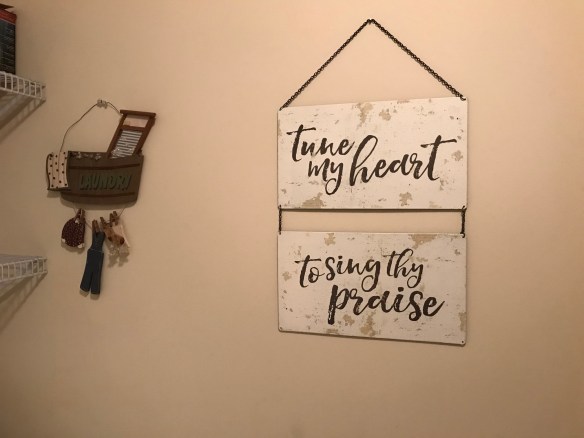
4. Rediscoveries. In the course of the straightening I found a clearance purchase from a Hobby Lobby trip several weeks ago. I remember I was rethinking this – it’s big and a little too shabby. But I guess the decision is made for me since it is too late to return it now. 🙂 It was marked down to $5, and I like the sentiment, a line from “Come Thou Fount of Every Blessing.” I have some things on the other side of my laundry room, but this side was almost bare. This fit right in this empty space with a needed reminder.

IMG_1216

5. Online ordering, both for general shopping and groceries. I’ve ordered groceries online from WalMart several times now. I have only had problems a couple of times, but they have been very quick to take care of any issues. This morning I a trying Kroger’s online ordering, and I hope that goes as well. I liked that you could apply their online coupons in the process of shopping. WalMart’s grocery pick-up is always free: Kroger’s is only free for the first three orders. I really like ordering groceries online: I hope more stores make that possible.

Happy Friday!

Literary Christmas Reading Challenge

e7f96-a-literary-christmas-banner-2017

Tarissa hosts the Literary Christmas Challenge in December: actually, it started in November, but I like to hold off on Christmas reading til after Thanksgiving. The main rule: read Christmas books! And link up your posts about them (via a blog, Goodreads review, etc.).

Here’s what I am planning to read this month:

Finding Christ in Christmas by A. W. Tozer (99 cents for the Kindle app as of this writing. Tozer always makes one think.)

Tozer Christmas

Homeless for the Holidays by P. S. Wells and Marsha Wright.

Homeless

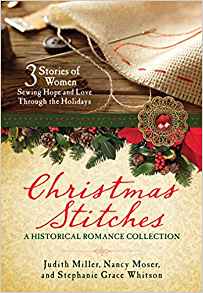
Christmas Stitches by Judith Miller, Nancy Moser, and Stephanie Grace Whitson. I’ve read many of Judith and Nancy’s books, so I am looking forward to this Christmas collection.

Stitches

Baby, It’s Cold Outside by Susan May Warren

Cold Outside

I’ll Be Home For Christmas: Four Inspirational Holiday Novellas by Lenora Worth, Belle Calhoune, Jill Kemerer, and Allie Pleiter. This is not showing up on Amazon anymore, but you can read more about it on Goodreads here. I’ve not read any of these authors, but I used to follow a blog that Lenora contributed to, so that’s probably what prompted this purchase.

Home

If I should finish all these and I’m not tired of Christmas stories at that point, I’d love to get Terri Blackstock’s Catching Christmas and Michelle Griep’s Once Upon a Dickens Christmas series, Twelve Days at Bleakly Manor and A Tale of Two Hearts. I’m trying to read what I have already accumulated through sales before I add any more.

And that’s it for this year! Do you plan to do any Christmas-themed reading this month?