Laudable Linkage

IMG_0195

Here are some interesting reads discovered in the past couple of weeks:

It Is Never Right to Be Angry With God, HT to Challies.

What Our Stay-at-Home Mom taught us About Human Dignity, HT to Challies.

What to Do When Your Friend Loses a Baby.

When Mother’s Day Isn’t a Celebration.

Celebrating All Mothers by a Not-Yet Mother.

How to End Sibling Rivalry Like a Christian.

Unity About Modesty Among Differences of Opinion and Practical Considerations About Modesty, 3 and 4 in a series.

What’s Too Violent for Christian Readers?, a discussion with several authors. Pretty much agree with these points.

Animal Expressions, HT to Lisa. These are so cute! Especially the lamb and the baby gorilla with its mom.

And finally, some smiles, found on Pinterest:

I actually do that kind of thing sometimes….

Happy Saturday!

Save

Friday’s Fave Five

It’s Friday, time to look back over the blessings of the week with Susanne at Living to Tell the Story and other friends.

Thursday morning as I was thinking about what I might include in this week’s FFF, I thought, “Well, I don’t know. It’s been a pretty bad week.” And then I had to correct myself, as it was really only one bad day, and that wasn’t even the whole day. So I am thankful for the FFF, because otherwise I would have let that one day shade all the rest.

1. My mother-in-law’s regular caregiver. Most of you know we have someone from a health-care agency in our home a few hours a day to take care of my mother-in-law so I can run errands, make and go to appointments, or just have a break. Our regular helper is wonderful – the best we’ve had either at home or in any facility. She needed a day off this week, so the agency sent a substitute. We’ve had this substitute before, and while she was not our favorite, we figured she could handle the basics well enough. But she was the source of my Very Bad Day this week. She won’t be coming back. And she made me appreciate our regular person even more. It was so nice, the day she came back, to be able to relax and do whatever I needed to do, knowing that Jim’s mom was in good hands.

2. Pool time with Timothy. The little wading pool we had for him is cracked and too small now, so his parents brought theirs over. It was fun to get the little pool toys out again and to show him a couple of new ones I had gotten. I may be a grandma, but I still get excited about little wind-up animals that “swim” in the water. 🙂

3. Pleasant evenings. Both during the “pool night” and one other evening when I was refilling bird feeders and watering plants, it was so pleasant outside. Just the right temperatures, little humidity, and a little breeze.

4. Time off from cooking. I know I say this frequently – but it’s a favorite whenever it happens. 🙂 Jason and Mittu brought barbecue from a favorite place one evening last weekend, and Jim and I brought McAlister’s Deli home for Sunday dinner since Jesse had plans with friends. Then Mittu brought dinner over for the “pool night.”

5. My husband’s thoughtfulness. He had to leave early one morning to go out of town. He usually makes his mom’s breakfast, but I would need to that morning. But he set everything out, crushed her pills (that always takes me a long time), measured out her coffee, and got as much ready as he could ahead of time. And then he even got the bathroom set up for her shower (towels on the floor under the ramp, shower curtain tucked out of the way, etc.). He’s a keeper. 🙂

Happy Friday!

Save

Book Review: Waiting For Peter

I’m sorry I’ve written about nothing but books so far this week. I’ve been working on another post for some time now but just haven’t had the time and mindset to pull it together this week. I guess book reviews are easier posts, in a way, because I am dealing with definite subject matter, and while I’m sharing my thoughts, it’s different from wrestling through a subject and the Biblical implications and coming to a conclusion. And I just happened to finish several books lately. 🙂

I’m not normally drawn to animal stories. They’re often designed to be heartwarming – and my heart needs warming as much as anyone else’s – but I find myself perversely resistant to stories that I know upfront are going for that effect. Or they’re sad, sometimes while simultaneously being heartwarming. One son shared a quote with me something to the effect that getting a dog is an investment in a small tragedy. Because they live a much shorter time than humans, generally, we’re going to have to deal with their deaths.

Waiting For PeterSo I don’t think I would normally have picked up the novella Waiting for Peter except that I really like Elizabeth Musser. This is a short book: only 90 pages. And it’s heartwarming and sad. But it’s good.

The story is about a boy named Peter who was in an accident that took the life of his friend and left Peter with severe injuries. He survives with nothing worse than a limp physically, but his confidence is shattered. His whole world has been shaken up and nothing is the same. His parents decide to let him choose a dog to try to help him, and Peter finds one who seems a little sickly and neurotic, but responds to him.

Dog and boy grow up together. They have adventures and Peter learns to extend himself (talking to strangers when not naturally prone to, etc.). Mom has to deal with the messes, chewed up household items, etc., but likes how dog and boy are both developing. When she deals with her own midlife issues – physical changes, aloof daughter, emptying nest – the dog becomes her companion, too.

The back of the book says, in addition to the book being about “the healing power of love between a boy and his dog,” it is also an “allegory of how we should view our relationship with God, our Master.” Those parts were a little more…not didactic, exactly, but more direct, more like one would see in a devotional than in fiction. That’s not characteristic of Musser, but maybe because the book was so short, there wasn’t space to develop it like one would in a novel. Or maybe she meant it exactly like she wrote in order to make the points she made. I’m not criticizing it or saying it’s bad – it’s just different from how she usually writes.

The story is told alternately from the points of view of the mom, Lanie, and the dog…the latter of which could be a little tricky, but it was kind of fun reading Sunny’s “thoughts.”

There is not a forward or afterward, so I don’t know if the story is based on one from the author’s life (although on her author’s page she does mention having a neurotic dog).

Overall, though not my usual cup of tea, I enjoyed it.

(Sharing with Semicolon‘s Saturday Review of Books and Carole’s Books You Loved)

Save

Save

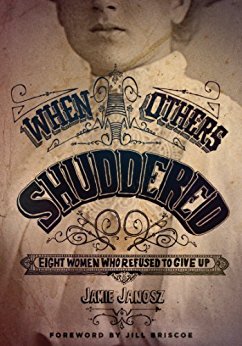
Book Review: When Others Shuddered

When Others ShudderedWhen Others Shuddered: Eight Women Who Refused to Give Up by Jamie Janosz contains eight short biographies of women who lived between 1820 and 1955 who influenced their world for God. They came from different walks of life: some single, some married, some wealthy, some former slaves. They were ordinary women except, as the title indicates, they didn’t “shudder,” they didn’t turn away from circumstances or tasks that many of us would have, and thus they can inspire us.

They are:

Fanny Crosby, who was blinded due a mistreatment to her eyes when she was six weeks old. Yet she later thanked God for this “gift,” feeling that it set the course of her life and made her more attuned to God working in and through her. Fanny determined to be optimistic, and her mother and grandmother tried to give her as normal a childhood as possible and teach her about God. She went to a blind school, taught there, married, was active in Christian work. She had always loved music and reading and composed poems since her girlhood, and that grew into hymn writing, many of her hymns well-known ones that we still sing today. The book shares her manner of hymn-writing and many of the incidences that led to hymns.

Emma Dryer was “a thinker, a dreamer, a girl who wanted more out of life” (p. 37). She loved and excelled at school and eventually became a teacher even though extra schooling was thought to “make women unfit for marriage and motherhood” (p. 37). She loved teaching and the orderliness of her life, but wondered if there was something more. A bout of severe typhoid fever hanged her life and made her want to give herself to Christian work. Visiting the growing city of Chicago, she was burdened with the needs of people, particularly women, there who came to the city to work but were often led astray. She felt “the Bible was the solution to the social problems” she saw there (p. 42). A meeting with D. L. Moody and the Great Chicago Fire of 1871 convinced her that she was needed in Chicago. Eventually Moody talked with her about a training school he wanted to establish, something right up Emma’s alley. Emma worked and planned toward that end, but Moody, distracted with his travels, meetings, and other work, didn’t get around the the school for some time. When Emma, who could be outspoken and confrontational at times, wrote strongly to him about it, he was offended and decided to leave Chicago and start a school in NY. But another letter and the urging of his wife and others led him to Chicago and the founding of the Moody Bible Institute.

Nettie McCormick was the wife of Cyrus McCormick, wealthy from his invention of a reaper. A number of her children died, she suffered several miscarriages, two of her children developed mental illnesses, and Nettie herself went deaf at age 34. She “struggled to see God’s hand” (p. 66) but wrestled in prayer and rested in Him. The McCormicks were always generous, giving to many good causes and works, and after Cyrus died, Nettie continued to give wherever she could, even to missionary schools in other countries. She wasn’t self-promotional and did much behind the scenes, but she didn’t stay behind her four walls: she traveled and even planted trees herself in front of a building she had funded. She was close friends with Emma Dryer and a major supporter of Moody and the Institute.

Sarah Dunn Clark grew up wealthy and privileged, but in her mid-twenties felt God’s urging to work in that which will last for eternity. She moved to Chicago and helped in many ways by visiting needy families and establishing a mission Sunday School. She met her husband there: they moved in the same social circles and had similar burdens. They visited slums and jails and opened a small rescue mission “in the heart of what people called ‘the devil’s territory'” (p. 80), which eventually eventually became the Pacific Garden Mission (which you may know of from the radio program Unshackled). George was called by some “the poorest preacher who ever tried to expound God’s Word,” but he was “deeply convicted and spoke emotionally about the condition of the lost” (p. 81). Sarah became the “mother of the mission,” ministering to people on a personal level. “In her quiet way, she extended respect and dignity to people regardless of their condition. It was this steadfast love that broke through many hardened hearts” (p. 87). The Clarks invested all of their money in the mission and lived simply and frugally.

Amanda Smith grew up the child of parents who were slaves at two different farms. Her father purchased his freedom, and the rest of the family was set free as the dying wish of the family’s daughter they tended. Her parents “believed in God,” “demonstrated a calm and steady faith” (p. 92) and were active helpers for the Underground Railroad. Amanda was only able to attend a short time of school and then began domestic work. Lonely one day, she decided to attend church, where the preaching and singing reminded her of home, and she felt God “wanted her, a poor, simple black girl, to serve Him” (p. 93). She wanted to be a “consistent, downright, outright Christian” (p. 99). Her first husband was a drunkard and died; only one of her children lived to adulthood; her second husband deceived her as to what kind of a man he was so she would marry him, deserted his family, and later died. She was invited to camp meetings, began to sing and testify at them, and soon people were paying her expenses to do so at other camp meetings. She had opportunity to travel to England, India, and Africa. She never asked for money, but prayed, and God sent her money that she then used to meet needs she saw in other places. She became active in the Christian temperance union, established an orphanage, and wrote a book about her life.

Virginia Asher became active in Christian work after her salvation, in time particularly drawn to “‘fallen women’ and the madams who ran houses of prostitution. She was often called in to read and pray with the sick, write letters to parents, dress wounds, and whisper words of peace to the dying” (p. 119). She helped care for their children: though she was unable to have her own, she “took in the world of lost souls and mothered them with divine love” (p. 122). She and her husband sometimes entered saloons and ask if they could put on a brief service for their customers – and they were allowed to. She established Business Women’s Councils.

Evangeline Booth was the daughter of William and Catherine Booth, founders of the Salvation Army in London, who “believed in the three ‘S’s while reaching those the rest of society rejected: soup, soap, and salvation” (p. 148). Evangeline remained single and eventually became the head of the Salvation Army in the US, and eventually led it internationally.

Mary Mcleod Bethune was born after the Emancipation Proclamation to parents who had been slaves. She thirsted for education and prayed earnestly for it. God answered through a local mission school and later through scholarships to other schools, eventually to Moody Bible Institute. She had a beautiful singing voice and toured with the choir. She wanted to be a  missionary in Africa, but God closed the door. She eventually established a school in Florida with the meagerest of supplies, in opposition to the white community and the KKK, which eventually joined with another college to become Bethune Cookman. She became an advisor to presidents, eventually taking the newly created position of administration of the Office of Minority Affairs for FDR and then other government posts, and established the National Council of Negro Women. She realized her dream of going to Africa when as a US representative she went to Liberia for the inauguration of their new president when she was in her seventies.

Along with more detail about the life and faith of these women, there are three chapters on “Woman and Education,” “Women in Missions,” and “Women in Politics,” detailing a bit of the history of the times in each of those areas. A final chapter wraps up “Being That Kind of Woman,” discussing some of the key features they had in common. None had a trouble-free life: some dealt with poverty, health issues, marital problems, deaths of children, opposition. None were faultless or flawless. But each sought to follow God in the way that He led them and relied on Him for what they needed to do so.

You may have noticed that most of them had some connection with D. L. Moody and/or the Moody Bible Institute. That’s because the author is a professor at Moody and her initial research into Emma Dryer’s life led her to a study of all these women.

If you like biographies, you will probably like this book. If you don’t like biographies but feel you might be able to take them in smaller doses, this book is worth a try. If you like hearing how God has worked in people’s lives and get inspired by them in your own – which is why I like biographies – you will glean a lot from this book.

(Sharing with Semicolon‘s Saturday Review of Books, Literary Musing Monday, and Carole’s Books You Loved)

Save

Save

Book Review: A Portrait of Emily Price

Emily PriceIn  A Portrait of Emily Price by Katherine Reay, the title character is a “fixer.” She works for an insurance company in restoration, particularly of art pieces, but she also tackles wall damage, toys, even appliances. In the rest of her life, her dysfunctional broken family developed the “fixer” in her as well. When her sister can’t keep a job, Emily has to find a new one for her. When her clients reveal issues beyond the fire damage in their home, she tries to help the visible as well as invisible family problems. She would like to be an artist as well and has a degree of talent, but something is missing.

Though she lives in Chicago, she’s been sent to Atlanta for her most recent assignment, and her company rented space in a conservator’s studio for her work. The proprietor, Joseph, takes her to his aunt and uncle’s Italian restaurant her first night in town, where she meets his brother, Benito, or Ben. Ben is visiting from Italy, where he works in his family’s restaurant, and is helping his aunt and uncle revitalize their place. Immediately attracted to Ben, Emily agrees to help him restore the restaurant in her spare time. They fall in love (no spoiler, as this happens early in the book and is mentioned in the summary on the back), marry, and she accompanies him back to Italy.

But it’s no fairy tale honeymoon. Ben’s mother doesn’t approve and feels hurt that she was left out of her son’s wedding. Much of the family lets her know in covert ways that she doesn’t fit in. She feels constantly in the way, and efforts to help usually end up making things worse. Ben’s time away has left the family restaurant in a mess, so he’s working all hours to get things back in shape. Only Lucio, Ben’s father, shows Emily any kind of warmth or welcome, and later, Ben’s sister Francesca does as well.

Emily’s fixer mode kicks in, but without understanding the background of the issues, the family, and the culture, her advice and actions backfire. She has to learn that everything can’t be fixed, and furthermore, it’s not always her job to try. But somehow amidst all the pain, she finds a new freedom in her own art.

Yet when she unwittingly stumbles across a long-hidden family secret, it seems to be the last straw, for her as well as Ben’s mother. Will all the relationships shatter, or can they find the grace to heal?

One of Reay’s hallmarks is the wealth of literary allusions in her books. There didn’t seem to me to be quite as many this time, and they mainly came in Lucio’s book recommendations to Emily. Sadly, I wasn’t familiar with most of them, but one I did know was Jane Austen’s Emma. One review at Amazon mentioned this book was a nod to Emma. I hadn’t really caught that – the plots aren’t similar, but Emma and Emily do share “fixer” tendencies (and name similarities I just noticed.) I wished I had thought of that in the passages where Emily discussed her thoughts on Emma.

Reay also usually writes Christian fiction, and around 3/4 of the way into the book, I realized that aspect was absent, and Emily herself seemed woefully ignorant about the Bible or spiritual things. But it does come through in the end. Since it’s in Italy, it’s heavily Catholic-flavored, but the need and provision for grace do come through.

Reay infuses the book with a lot of detail about art restoration, Italy, and Italian cooking, but it flows naturally and nothing sounds overly technical. I almost felt like I could see the sunflowers out the window and smell some rich sauce simmering in the kitchen.

I loved her characters here, especially Emily, Ben, and Lucio, but all of them are well fleshed-out.

This was a book that pulled me in and made me want to spend all day curled up with it.

Update: Here is an interview with the author about this book, her blog, and the C. S. Lewis roots to her stories. It’s an excerpt from a longer interview here.

(Sharing with Semicolon‘s Saturday Review of Books and Carole’s Books You Loved)

Save

Save

Save

Friday’s Fave Five

It’s Friday, time to look back over the blessings of the week with Susanne at Living to Tell the Story and other friends.

Wow – May already! I am enjoying this spring so much, I’m not eager for summer yet. So I’m trying to  treasure the days as they go by. Here are some favorites parts of the last week:

1. Meeting Melanie! We’ve been following each other’s blogs for…I don’t know how many years now. She recently moved to TN after caring for her mom for many years until her mom’s recent passing. We got together for lunch, and enjoyed talking so much. We had our faith in common as well as caregiving, and as we talked, we just seemed to find more and more areas of similarity. She’s a sweet lady. It was such fun to meet her in person, and we’re already planning our next get-together!

IMG_0201

2. Clean curtains, windows, and blinds, at least in three rooms. These weren’t originally on my agenda this week, but some spatters on the valance above the sink led to taking it down to be washed (actually, asking Jesse to take them down – I found I couldn’t reach them even with my step-ladder), which led to taking down the curtains in my bedroom and bathroom to make a full load, which led to cleaning the blinds and windows while I had everything off of them. You don’t notice how much dust, spiderwebs, etc., have accumulated on those things til you get up close! And I thought all but the kitchen valance would be ready to hang back up from the dryer, but they all needed ironing. Even though it’s not something immediately noticeable, it’s a nice feeling to know they’re all fresh and clean. And since I’ve made that start, I am planning to do some of the other windows in the next few days.

3. Sheet pan meals. Have you heart of these? I’d seen them mainly on the Skinnytaste blog and then searched for more. The basic idea is that meat (usually chicken) and vegetables and sometimes potatoes are all baked together on one cookie sheet. I printed off a few different recipes, which all had different cooking temperatures and spices, and drew from the different ones to make my own creation. 🙂 I cooked the chicken a bit too long, but the roasted broccoli, cauliflower, and carrots turned out really well. Jesse isn’t usually crazy about broccoli, but loved them this way – less crunchy than raw, but not limp. Plus it was nice not having several pans to clean. I’m looking forward to trying more variations of this.

4. Neighbors coming together. One neighbor lost half of a huge tree in his front yard during some strong winds this week. It was so neat to see many of the neighbors pitching in to help cut up and clean up the debris. When Jim got in from work, he took his chain saw over and helped.

IMG_0196(1)

IMG_0207

I hope it survives. It’s my favorite tree in the neighborhood, beautiful especially in the spring and fall.

5. Cute Timothy moment of the week. Timothy and his parents were over last night and went over to look at the tree. He was taking various sticks from one of the piles of debris and playing with them, pretending the kinds of things little boys do with sticks. Then he took his stick and put it into a crack in the bark of the “broken” tree – to “fix” it by trying to put some branches back in.

Happy Friday!

Save

Book Review: Lavender and Old Lace

Lavender_and_Old_LaceLavender and Old Lace by Myrtle Reed, written in 1902, opens with 34-year-old Ruth Thorne coming to occupy her aunt’s cottage while her aunt is away. She’s never met her aunt, Miss Jane Hathaway. Miss Jane has never forgiven her sister for running away to elope, but for whatever reason, she decides to establish relationships with her niece. However, she ends up having to leave before her niece arrives, so Ruth finds only Hepsey, the farm-girl working as the maid, at the house. Her aunt left a letter with various instructions, the most mysterious and inexplicable of which was to leave a light burning in the attic window every night.

Ruth worked for a newspaper in the city, but has six months off to house-sit for her aunt. Bored and restless, she explores her aunt’s attic, the first “real attic” she’s ever been in, until she comes across her aunt’s unused wedding dress and some newspaper clippings about a couple’s wedding and the wife’s death. At first Ruth thinks the couple had been friends of her aunt’s, but then surmises that the man was Aunt Jane’s lost love who married someone else. Feeling she’s intruding into her aunt’s privacy, she leaves the attic and vows to stifle her growing curiosity.

She visits her aunt’s best friend and neighbor, Mary Ainslie, who is thought a little odd by the community because she never leaves her home. But Miss Ainslie has a reputation for being kind and sending things to people who need help. Ruth finds her gracious and beautiful, and they soon become friends. Miss Ainslie also leaves a lamp burning in her window at night for unknown reasons.

Soon Ruth has unexpected company: a young man named Carl Winfield looks her up at the recommendation of his editor. Carl works for the same newspaper as Ruth but has developed a problem with his eyes and is ordered not to read or write for several months. He’s staying in town, and their excursions eventually blossom into romance.

In fact, there’s a lot of romance happening in the book:

  • Ruth and Carl
  • Hepsey and a young man, Joe
  • a long lost love recovered
  • a long lost love forever gone

Ruth comes across as somewhat prickly at first, easily offended and angered. Carl is laid-back and merry-hearted, and once they got to the point where they expressed their feelings for each other, I enjoyed their banter and their relationship.

There is a bit of a mystery with one of the characters having an unknown connection with another that, to me, was pretty easy to put together, but no one in the book did until they came across evidence of it. The one person who did know of it, for some reason, never tells anyone else. There’s also the mystery of the lights in the windows and why Miss Ainslie never leaves her home. There’s one odd section where two people have the same dream of an old man saying the same thing to them.

The title comes from Miss Ainslie, who has dark violet eyes, always wears some shade of purple or lavender, and scents all her things with lavender. She often, if not always, wears lace as well. Various types of lace are mentioned often in the book: “Ruth was gathering up great quantities of lace—Brussels, Point d’Alencon, Cluny, Mechlin, Valenciennes, Duchesse and Venetian point.” I think in those days it was a precious commodity, possibly made by hand.

The emotions in the book seem a bit overwrought sometimes:

Ruth was cold from head to foot, and her senses reeled. Every word that Winfield had said in the morning sounded again in her ears. What was it that went on around her, of which she had no ken? It seemed as though she stood absolutely alone, in endless space, while planets swept past, out of their orbits, with all the laws of force set suddenly aside.

The earth trembled beneath Ruth’s feet for a moment, then, all at once, she understood.

That may be due to the author’s being twenty when she wrote the book, or it may be due to the times.

But quite a lot of the writing reminded me of Lucy Maud Montgomery, though her first book, Anne of Green Gables, was published six years after this book. The relationships and romances and quarrels are similar to hers, as are some of the descriptive passages:

Have not our houses, mute as they are, their own way of conveying an impression? One may go into a house which has been empty for a long time, and yet feel, instinctively, what sort of people were last sheltered there. The silent walls breathe a message to each visitor, and as the footfalls echo in the bare cheerless rooms, one discovers where Sorrow and Trouble had their abode, and where the light, careless laughter of gay Bohemia lingered until dawn. At night, who has not heard ghostly steps upon the stairs, the soft closing of unseen doors, the tapping on a window, and, perchance, a sigh or the sound of tears? Timid souls may shudder and be afraid, but wiser folk smile, with reminiscent tenderness, when the old house dreams.

The rain had ceased, and two or three stars, like timid children, were peeping at the world from behind the threatening cloud. It was that mystical moment which no one may place—the turning of night to day. Far down the hill, ghostly, but not forbidding, was Miss Ainslie’s house, the garden around it lying whitely beneath the dews of dawn, and up in the attic window the light still shone, like unfounded hope in a woman’s soul, harking across distant seas of misunderstanding and gloom, with its pitiful “All Hail!”

That night, the gates of Youth turned on their silent hinges for Miss Ainslie. Forgetting the hoary frost that the years had laid upon her hair, she walked, hand in hand with them, through the clover fields which lay fair before them and by the silvered reaches of the River of Dreams. Into their love came something sweet that they had not found before—the absolute need of sharing life together, whether it should be joy or pain. Unknowingly, they rose to that height which makes sacrifice the soul’s dearest offering, as the chrysalis, brown and unbeautiful, gives the radiant creature within to the light and freedom of day.

One of my favorite lines occurred after Ruth and Carl profess their love, but he has to return to the city for a doctor’s visit: “She had little time to miss him, however, for, at the end of the week, and in accordance with immemorial custom, the Unexpected happened.”

The ending was bittersweet – in fact, one character’s whole story was mostly shaded that way – but overall the book was a sweet, clean read.

I listened to the free audiobook at Librivox, which was, unfortunately, read with almost no expression. I enjoyed going over some passages at Project Gutenberg, where one can read the whole book online. I had thought that a movie was made of this in the 40s, but the only movie of it I found mention of was made in the 20s. I may have been confusing it with Arsenic and Old Lace, another classic film and book I’ve not yet read or seen.

(Sharing with Semicolon‘s Saturday Review of Books and Literary Musing Monday)

Save

Save

Save

My Ebenezers

I wrote this a few years ago and enjoy looking at it every now and then, reminding myself of things God has done. I thought I’d update and repost it again today.

Some of you might recall the line in the hymn “Come Thou Fount” which says, “Here I raise mine Ebenezer — hither by Thy help I’m come,” and you might know that it echoes 1 Samuel 7:12: “Then Samuel took a stone and set it up between Mizpah and Shen and called its name Ebenezer; for he said, ‘Till now the Lord has helped us.’” “Ebenezer” means “stone of help,” and it was not uncommon in Old Testament times for Israelites to set up a pile of stones for a monument marking God’s help. You can read more of the background on this story here.

A few years ago, Do Not Depart called for some modern day Ebenezer stories: those situations in your life when you knew beyond a shadow of a doubt that it was the Lord who helped you, those seeming “coincidences” that you knew were really evidence of God’s hand at work. I wrote most of this out then and added a little to it. There are numerous encouragements in the Bible to remember what God has done, not only in His Word, but in our own lives: it reminds us of His care, power, and provision, and encourages us to pray, thank Him and trust Him in our current circumstances and for the future.

Here are a few of my Ebenezers:

  • A move during junior high led to a school that was extremely cliquish. Sometimes people toss that word around lightly when they’re feeling a little lonely, but this school had definite, well-defined cliques with very little interaction between them, and I didn’t seem to be accepted in any of them. I’d had a circle of friends before, so I wasn’t sure what the problem was. I had a crush on one guy in the most “cool” group, but of course he and that group were impossible dreams. In later years I found out it was God’s great mercy that kept me from getting “in” with that crowd as they were involved in a number of things that would have been detrimental to me.
  • When I was 15, my parents divorced. It had not been a happy home for years, but the break-up of a family still hurts deeply. Besides that, we were moving from our very small town to the teeming metropolis of Houston, I was leaving my friends and all that was familiar and going into the unknown right in the middle of high school.  I laid on my bed clinging for dear life to Romans 8:28: “And we know that all things work together for good to them that love God, to them who are the called according to his purpose.” Even though I had only a surface understanding of that verse then, God honored that faith and fulfilled His Word. As a result of all those changes I began seeking Him earnestly, God led to a Christian school and a good church, I heard about the college where I would one day attend and find my husband.
  • After we moved, when we visited the high school I was to attend, I was convinced I could never go there for various reasons. We didn’t know what the alternatives could be, but we saw an ad for a Christian school. We visited and interviewed, and I wanted to go, but my parents could not afford the tuition. One day we drove to the school to tell them I wouldn’t be able to come. My mom went in, and I stayed in the car. The pastor and his wife drove up, saw me, and came over and told me someone offered to pay my way that year, and someone anonymously did the next year as well. It was through this school and church that I got stabilized in my faith in Christ and grounded in His Word.
  • My parents could not pay for college, either, but through various means God got me through five years at a Christian university. Lots of Ebenezers there! But one stands out: an offering from my Sunday School class at my home church allowed me to buy some necessities like deodorant and toothpaste. Coming back to my dorm room, I heard our hall was having a party and everyone was asked to contribute a dime for ice cream and toppings. I had literally only one dime left. As I gave it, I began to feel panicky about not having any money at all to my name. Then God reminded me of the offering just given. He was taking care of me in big and small ways.
  • One Christmas Eve morning shortly after our first anniversary, we were driving from SC, where we lived, to visit my family in TX. Our car broke down near Biloxi, MS. It was an old German car called an Opel, and when we’d had problems with it before, it took weeks to fix because the parts were hard to find. I had no idea how everything was going to work out, how we’d get home and then get back to get the car, etc. My husband found a phone booth (no cell phones in those days), and found a random mechanic with a tow truck in the yellow pages. He explained the problem and then said something like, “By the way, it’s an Opel, so it might be a problem to get parts for it.” The mechanic answered, “No problem — we just bought out the local Opel dealership.”
  • I could heap up a whole pile of Ebenezers from my experience with transverse myelitis, but I’ll share just one: when I was scheduled for an MRI, everybody kept asking me if I was claustrophobic. I wasn’t sure (nowadays I would say, “YES!”), but their questions were making me nervous. I was told that I would have to be very still for the procedure, which would last the better part of an hour. The day before, in my Daily Light on the Daily Path devotional book, all the verses were about being still. A few of them: Ruth 3:18: Sit still, my daughter; Psalm 46: 10: Be still, and know that I am God; Psalm 4:4: Commune with your own heart upon your bed, and be still (more are here). Those verses kept running through my mind while I was in the MRI machine, and God kept me very calm: I even dozed off.
  • For years my husband had to travel quite a bit. At first I was a total basket case beset by fears, but God gradually enabled me to cope. Three years ago I wrote a post about coping when a husband is away, and it has become one of my most viewed posts in 10 years of blogging. Though at first I inwardly whined and wailed about having to be alone so much, I am thankful to be able to testify of God’s grace and help and to be able to encourage other ladies in the same situation.
  • When my son was planning to be married in OK and we were making plans to drive there and back from SC, my husband planned to rent a U-Haul there in OK to bring back our new daughter-in-law’s furniture and the wedding presents. But U-Haul wouldn’t rent to him because someone with his type of car had sued them once before because of some problem. We couldn’t find any other rental options in OK, so we ended up having to rent a trailer from a local business and take it with us there and back. Everything was fine on the return trip until the trailer blew a tire. I don’t even remember where we were at the time — some stretch of Interstate between cities. We tried calling AAA, but they don’t deal with tires on rental trailers. Thankfully my oldest son had a data plan on his phone and looked up local businesses and found a Wal-Mart a few exits up. But we’d have to unhitch the trailer and leave it while we went for the tire. I remember looking out the window and praying that my kids would see God’s hand in this. We were nervous about leaving the trailer there alone, but we also didn’t want to leave any one of us alone to guard it while everyone else went to Wal-Mart. I was praying fervently that no one would break into it and steal any of my son’s and daughter-in-law’s things. When we went to Wal-Mart, they were just closing their tire service center and didn’t really want to let us in, but we explained the situation, and they did. Meanwhile we got a call from our newly-married son, on his way East on his honeymoon trip: “Dad…did you leave the trailer on the side of the road?” They were passing by just at that time and saw it. We explained what had happened, and they circled back to stay with the trailer while we got the new tire, then we went back, put the new tire on, and went to get something to eat together. Though it’s a bit unconventional to go out to eat with one’s parents on one’s honeymoon, there were so many evidences on God’s hand at work in this situation: if we had rented a generic trailer, Jason would not have recognized it as the one we had and wouldn’t have called about it; if they hadn’t been passing that way at that time, they wouldn’t have seen it; if we had been even a few minutes later, we wouldn’t have gotten into Wal-Mart, and as our other calls hadn’t led to any other options, we would have had to spend the night in town and leave the trailer out on the Interstate all night.
  • Our precious grandson, Timothy, was born 10 1/2 weeks premature and spent all of that time in the NICU. Sometimes God’s provision isn’t one big miraculous deliverance, but the grace and strength to endure the ups and downs of a long trial. We all felt His hand a number of times through those weeks, often through people who ministered to us in various ways.

There have been so many other situations…wrecks narrowly averted, running late and coming upon the scene of an accident that might have been mine if I’d been on time, financial needs met right at the needed time, finding something that was lost after earnest prayer about it, praying for wisdom and receiving it, a word of encouragement at just the right moment, help for a task that was too big for me, something from the Word that was just exactly what I needed for the day. I am so thankful for His loving, intimate, wonderful care!!

 Help me, O Lord my God: O save me according to thy mercy:
That they may know that this is thy hand; that thou, Lord, hast done it.
Psalm 109:26-27

My soul will be satisfied as with fat and rich food,
    and my mouth will praise you with joyful lips,
 when I remember you upon my bed,
    and meditate on you in the watches of the night;
 for you have been my help,
    and in the shadow of your wings I will sing for joy.
 My soul clings to you;
    your right hand upholds me.
Psalm 63:5-8

(Sharing with Inspire Me Monday, Literary Musing Monday, Testimony Tuesday)

Save

Save

Save

Book Review: Old Yeller

I loved the movie version of Old Yeller when my kids were little. I don’t know if I knew then that it came from a book, but I’ve been wanting to read the book by Fred Gipson for years. When I was searching for a classic about an animal for the Back to the Classics Reading Challenge, plus a shorter classic after finishing a very long one, this fit the bill on both counts.

Old YellerThe story is told from the point of view of Travis, the fourteen-year-old oldest son of a family in Texas in the 1860s. Though the family lived off the land easily, they didn’t have much in the way of “cash money.” Some of the settlers were joining a cattle drive to a town some 600 miles away, and Travis’s dad decided to go. He left Travis as the “man of the house,” with the responsibility of a man: shooting game for food, keeping critters out of the corn, protecting the family from Indians and wildlife, milking the cows, looking after his Mama and little brother, Arliss, marking the new pigs, and not waiting for his mom to tell him to do things.

Travis felt “pretty near a grown man” and welcomed the opportunity to prove himself. With the exception of being able to reign in Little Arliss, he put in full days of work and did a good job. He was especially gratified when his mother waited supper for him, just like she did for his dad when his work ran late.

But then one day a scruffy, yellow ugly dog showed up on the property and stole some of the family’s meat. Little Arliss claimed the dog immediately, and their mom was willing for him to have him. But Travis hated him especially because of his thieving but also because he was ugly and seemed worthless.

But it wasn’t long before the dog proved it could learn and be a big help to the family, herding hogs, chasing off bears and wolves, etc. And it wasn’t long before Travis loved the dog even more than Little Arliss.

That made it all the harder when tragedy struck, which the author speaks of on the first page.

I love “coming of age” stories, especially the character has to stretch him- or herself farther than they think they can go (Keep the Lights Burning, Abbie, is another favorite along these lines.) I also enjoyed the peek into this era. It used to be a regular thing for a teenager to be trained to do an adult’s work, though they weren’t often left with it all on their shoulders like Travis was. Sometimes I wonder if that would be a better thing than not expecting young people to take on adult responsibilities until they’re out of college or later. Then again, it was a hard life, and I enjoy the fact that young people now have avenues to explore in their teens that young people didn’t have then. I also can’t imagine being nearly alone on the edges of a settlement while a husband is away for months with no means of communication for all that time, and having to patch up serious injuries of both boys and animals and take on the extra work that they can’t do while injured.

Probably my favorite part of the book is the advice Travis’s dad gave him when he returned and heard all that had gone on in his absence:

That was as rough a thing as I ever heard tell of happening to a boy. And I’m mighty proud to learn how my boy stood up to it. You couldn’t ask any more of a grown man… It’s not a thing you can forget. I don’t guess it’s a thing you ought to forget. What I mean is, things like that happen. They may seem mighty cruel and unfair, but that’s how life is part of the time. But that isn’t the only way life is. A part of the time, it’s mighty good. And a man can’t afford to waste all the good part, worrying about the bad parts. That makes it all bad.

I listens to the audiobook very nicely read by Peter Francis James. he did a good job with the expression as well as the accents. It’s been a long while since I’ve seen the movie version, but it seems to have followed closely to the book except for drawing out the climax more.

(Sharing with Semicolon‘s Saturday Review of Books and Carole’s Books You Loved)

Save

Save

Laudable Linkage

IMG_0195

It’s time for another Roundup of Recommended Reading Researched from Remarkable Writers around cyberspace. 🙂

11 Questions to Ask of a Bible Passage, HT to Challies.

How to Be an Encouraging Friend in Times of Pain.

The Worst Consequence of Skipping Church.

Sister, You Can Do Hard Things.

Satan Wields Ignorance of the Word as a Weapon. “Most Christians I talk to have never read the entirety of the Bible. They may read it frequently but only parts of it. But daily reading parts of the Bible doesn’t mean you know it any more than daily reading the first chapter of Moby Dick makes you an expert on the famous novel. Ignorance of the whole of God’s Word makes us easy targets in the war Satan has waged against God. Lies can slip through undetected like poison gas because we’re just not that familiar with the truth.”

A Hill to Die On, HT to Challies. “When you’re fighting a war, there’s very rarely a compelling reason to die for the next yard of soil – but that’s how wars are won, and that is how the line is held – yard by yard.”

Beware of Broken Wolves, HT to Challies. “These are the false teachers who use their own authenticity, pain, and brokenness to attract believers who are also suffering and broken—and then using their “brokenness” to lead the sheep to turn away from God’s Word and embrace sin.”

Don’t Skim the “Minor” Bible Stories.

What We Gained When We Lost Our Hymnals. This was a follow-up to What We Lost When We Lost Our Hymnals. I have read online a lot of complaining about using screens vs. hymnals, but I like the advantages he brings out about using screens. There are pluses and minuses to each. Our church uses both. If a song is not in the hymnal, it is projected on the wall. If it is in the hymnal, the words are also projected but our songleader tells where it is in the hymnbook for those who prefer to use it.

Living Faithfully Instead of Fancifully in an HGTV World. HT to True Woman. “To revel in the beauty of an earthly home knowing it will never completely satisfy because there’s a heavenly one ahead”; “The pursuit of joy is good but can come dangerously close to hedonism and not the Christian kind.”

Giving Up or Giving Back. This was from the Lenten season but has some tips for “giving back” in various other settings as well.

4 Ways Satan Uses Christian Generosity for Evil, HT to Challies.

Manage profanity in writing, HT to Adam Blumer. Tips for making villainous characters realistic without filling your readers’ heads with foulness.

And, to end with a smile:

naps

mistakes

Happy Saturday!

* Links do not imply complete endorsement of site.

Save

Save