Friday’s Fave Fives

FFF birds on a wire

It’s Friday, time to look back over the blessings of the week with Susanne at Living to Tell the Story and other friends.

It’s been kind of a crazy week. I’m happy to pause here at the end of it and look for the blessings large and small along the way.

1. A clear calendar. The past few weeks have been full of good things (birthdays, outings) and a few not-so-fun things (dentist appointments), but it felt good to face this week with nothing “extra” on the calendar. Turned out to be a good thing in many ways, as some extra things did come up.

2. Dodging a bullet. My husband had a medical issue one day this week that I thought could possibly mean emergency surgery. Thankfully that was not the case. The doctor adjusted some medicine and he may have to have a much smaller procedure done in the office in a few weeks.

3. A son who helps out and runs errands cheerfully. Jesse was out picking up a prescription for his dad while I was making dinner. When I opened one of the essential ingredients for dinner, it was spoiled, so I called Jesse to see if he was close to the store or already near home. He was right at the light in front of the store, but the wrong lane, so he drove to where he could turn around and then got the needed item for me without complaint.

4. Matchstick carrots. I had to buy some a while back for a particular recipe and had quite a few left over. I discovered they work great in salads and soup and casseroles, so I keep them on hand now.

5. Veggie chips. I had some at Jason and Mittu’s house and enjoyed them, so they brought me a bag of them next time they came over. I know they’re not as healthy as eating actual vegetables, but they’re good! 🙂

I’m thankful we were spared the snow in the forecast. Here in the South, more than a dusting of snow causes traffic problems, which in turn means some of my mother-in-law’s helpers can’t come in, so I was very glad to be spared that. I am so ready for spring!

Happy Friday!

Save

Book Review: How to Read the Bible For All Its Worth

In How to Read the BibleHow to Read the Bible For All Its Worth, Gordon D. Fee and Douglas Stuart attempt to help the reader understand and interpret the Bible with particular consideration of the genre of each book. They explain that the “Its” of the title is deliberate, rather than “It Is,” saying, “‘Its’ is a deliberate wordplay that works only when it appears without the apostrophe; and in the end our own emphasis lies with this possessive. Scripture is God’s Word, and we want people to read it because of its great value to them. And if they do it ‘for all it’s worth,’ hopefully they will also find its worth.”

The first chapter covers general principles for reading and understanding the Bible: exegesis, “the careful, systematic study of Scripture to discover the original, intended meaning,” which involves learning “to read the text carefully and to ask the right questions of the text,” questions of context (historical and literary) and content; interpretation, and hermeneutics, learning “to hear that same meaning in the variety of new or different contexts of our own day.” They insist, several times over, that we must understand what the text meant to the original readers before attempting to apply it to ourselves.

The concern of the scholar is primarily with what the text meant; the concern of the layperson is usually with what it means. The believing scholar insists that we must have both. Reading the Bible with an eye only to its meaning for us can lead to a great deal of nonsense as well as to every imaginable kind of error—because it lacks controls. Fortunately, most believers are blessed with at least a measure of that most important of all hermeneutical skills—common sense.

Whether one likes it or not, every reader is at the same time an interpreter. That is, most of us assume as we read that we also understand what we read. We also tend to think that our understanding is the same thing as the Holy Spirit’s or human author’s intent. However, we invariably bring to the text all that we are, with all of our experiences, culture, and prior understandings of words and ideas. Sometimes what we bring to the text, unintentionally to be sure, leads us astray, or else causes us to read all kinds of foreign ideas into the text.

Let it be said at the outset—and repeated throughout—that the aim of good interpretation is not uniqueness; one is not trying to discover what no one else has ever seen before. Interpretation that aims at, or thrives on, uniqueness can usually be attributed to pride (an attempt to “outclever” the rest of the world), a false understanding of spirituality (wherein the Bible is full of deeply buried truths waiting to be mined by the spiritually sensitive person with special insight), or vested interests (the need to support a theological bias, especially in dealing with texts that seem to go against that bias). Unique interpretations are usually wrong. This is not to say that the correct understanding of a text may not often seem unique to someone who hears it for the first time. But it is to say that uniqueness is not the aim of our task. The aim of good interpretation is simple: to get at the “plain meaning of the text.”

Because the Bible is God’s Word, it has eternal relevance; it speaks to all humankind, in every age and in every culture.

The second chapter deals with the different translations of the Bible. You may not agree with the one they feel is best (I later learned one of them was on the translation committee for it), but this chapter will help you appreciate the difficulties involved in translating and the reasons there are so many translations, but will also reassure you that we have a few today that are especially accurate and trustworthy. There are a number of considerations, but the main differences in translations are those which use formal equivalence, “the attempt to keep as close to the ‘form’ of the Hebrew or Greek, both words and grammar, as can be conveniently put into understandable English”; functional equivalence, “the attempt to keep the meaning of the Hebrew or Greek but to put their words and idioms into what would be the normal way of saying the same thing in English” at the time of the translation, and free translation (or paraphrase), which is more concerned about translating the ideas rather than the “exact words of the original.”

The problem with a “free” translation, on the other hand, especially for study purposes, is that the translator updates the original author too much…On the one hand, these renditions often have especially fresh and vivid ways of expressing some old truths and have thus each served to stimulate contemporary Christians to take a fresh look at their Bibles. On the other hand, such a “translation” often comes very close to being a commentary, but without other options made available to the reader. Therefore, as stimulating as these can sometimes be, they are never intended to be a person’s only Bible; and the reader needs constantly to check particularly eye-catching moments against a true translation or a commentary to make sure that not too much freedom has been taken.

The rest of the book’s chapters discuss the different genres of literature in the Bible: epistles, narratives, Acts, the gospels, parables, the law, the prophets, the psalms, wisdom literature (Job, Proverbs, Song of Solomon), and Revelation.  They apply the principles they discussed in Chapter 1 to each and also discuss their forms and the particular difficulties or concerns in reading and interpreting each one. For instance, concerning the epistles, the authors  “offer the following guidelines, therefore, for distinguishing between items that are culturally relative on the one hand and those that transcend their original setting on the other hand and are thus normative for all Christians of all times.” Of the OT narratives, they say:

Our concern in this chapter is to guide you toward a good understanding of how Hebrew narrative “works,” so that you may read your Bibles more knowledgeably and with greater appreciation for God’s story. Unfortunately, failure to understand both the reason for and the character of Hebrew narrative has caused many Christians in the past to read the Old Testament story very poorly. If you are a Christian, the Old Testament is your spiritual history. The promises and calling of God to Israel are your historical promises and calling. Yet, in our experience, people force incorrect interpretations and applications on narrative portions of the Bible as much as or more than they do on any other parts. The intended value and meaning are replaced with ideas read into rather than out of the text.

Old Testament narratives are not allegories or stories filled with hidden meanings…[and] are not intended to teach moral lessons. The purpose of the various individual narratives is to tell what God did in the history of Israel…

However, even though [they] do not teach directly, they often illustrate what is taught explicitly and categorically everywhere.

One crucial thing to keep in mind as you read any Hebrew narrative is the presence of God in the narrative. In any biblical narrative, God is the ultimate character, the supreme hero of the story.

Even though the chapters on the different genres make up the bulk of the book and I have multitudes of places marked in them, for the sake of space and time I’ll stop there.

They have an appendix for “The Evaluation and Use of Commentaries” and their recommendations for good ones.

Overall, though I would not agree with every little point, I found the book very helpful. Though there is value in reading it through as a whole, I think there would be more value in reading the chapter on a particular genre just before reading that genre, and I may try to do that, or at least refresh myself on some of the applicable points, on starting a new genre in my own reading.

The authors are scholars who try very hard to make their points readable and understandable to the average layperson, and they mostly succeed. I don’t know if this is a book I would give to a brand new Christian right off the bat, though. It might be overwhelming, like trying to get a sip from a fire hydrant. But maybe not. Maybe it would help people get off on the right foot.

One frustration was that the authors often referred to what they called “How to 2” for further reading or for information they evidently didn’t want to reprint here. Since this is a third edition of the book, I thought they were referencing the second edition, and wondered why they didn’t just include that information here. But as I reread the first part, “How to 2” is referring to a different book of theirs, How to Read the Bible Book by Book.

I got this book on a Kindle sale because I had seen it referred to often, and it happened to be the third edition, which apparently is no longer available in the Kindle format. There is now a fourth edition, though, available both for print and ebook form.

(Sharing with Semicolon‘s Saturday Review of Books, Literary Musing Monday, and Carole’s Books You Loved)

lmml-button-2-6

Books you loved

Save

Save

Save

Save

Save

Don’t Make Your Spouse Feel Like an Outsider

949797c4b0adf9475c7263fc17048f66_-life-program-2011-clipart-mom-and-child-silhouette-clipart_432-583.jpeg154962e90da7a62d7af535d762d221a7_man-silhouette-clip-art-bing-man-silhouette-clipart_564-2037.jpeg

I don’t usually offer unsolicited parenting advice, because a lot of moms are sensitive to it. I am not sure what brought this to mind today, but as I found myself thinking about it, I decided to try to write those thoughts down – perhaps they may be of help to someone.

It’s natural when Mom is home with little kids that certain routines arise. It’s good to involve your child in your day, and they enjoy the togetherness as much as the “helping.” Maybe Little One always closes the dishwasher door for you after you’ve loaded the dishes, or always puts the canned goods in the pantry after coming home from the grocery store, or always cuddles with a drink and a blanket and book before nap time, or whatever. Then when Dad is home during the evenings or on weekends, he has no idea about such routines and can’t understand why Little One is crying while he’s putting the canned goods away or why shutting the dishwasher door caused a major meltdown.

If Mom scolds impatiently because Dad has done it “wrong,” Little One is going to pick up on the resentment, and Dad is going to feel like an outsider in his own family.

In the immediate moment, a gentle explanation is in order, and maybe Baby can be given a can to put away or the door can be opened so he/ she can shut it. I’m not for a little one calling the shots or ruling the roost, but I don’t think this is a case of “giving in” to his or her wants. I think this is not so much a case of selfishness or wilfulness as it is just disappointment. At some point Baby needs to learn not to melt down over every disappointment, but that is easier to deal with when you can talk and reason more later on. Perhaps early training can begin that way by saying, “It’s ok. As soon as you stop crying, you can put this can away,” etc.

In the bigger picture, Mom can welcome Dad into their routines. Perhaps Mom can talk about their routines in the ordinary course of life. “It’s so cute that she likes to help me put the cans away.” That way Dad is familiar with them. Or let him know ahead of time, while bringing the groceries in, that you usually let Baby put away the cans.

In addition, let Dad and Baby establish their own routines. Maybe Dad can do bath time or bed time, at least some times. Once when I walked by as my husband was helping one of our little guys with a bath, I heard him say, “It’s pancake time!” And I thought, “Pancake time? In the bath tub?” I backtracked and peeked in. What he was referring to was pouring the shampoo on the little one’s head like syrup on a pancake. My first thought was, “You know, it uses less shampoo if you pour a little bit in your hands and rub them together.” But I didn’t say it. I figured in the long run the amount of shampoo wasn’t that big a deal, and it was cute that that was a part of their ritual. And they never asked me for “pancake time” during baths, accepting that that was a dad thing. One of their other routines, when the boys were older, involved going to an indoor swimming pool on certain evenings (Tuesdays, I think) and getting donuts afterward. Not only was that a fun routine for them, it gave me a little bit of solitude, and they brought me a donut afterward. 🙂

Dads can help by understanding that a certain amount of this is going to be inevitable when Mom and the kids spend all day together and avoid getting feelings hurt over it. Participate, ask to help, let Mom know if you’re feeling left out.

Something else we have to watch out for is that we can get so wrapped up in our kids and their needs that we neglect our husband and his. That need weighs on us with our children because they’re so helpless, and we feel our husbands can take care of themselves. But that’s not how we felt when we married them! It can be difficult, especially with young babies, but this is another way in which it’s important to let dads in, to let him handle the baby’s care sometimes – both so you’re not overloaded, and so he can increase his time and interaction with the baby. He may not do everything just like you would, but that’s okay.

And, of course, this can involve other scenarios than little ones’ routines: a spouse can feel left out if one is on top of the family schedule and the other misses a memo, or if mom and the kids always get ice cream on Mondays after school (one of our routines the last several years of school), and dad didn’t know or forgot when he picked them up. As kids get older, they can be taught to be gracious, to respect others’ feelings, not to whine when something doesn’t go their way, to ask respectfully rather than throw a tantrum or sulk, etc. Not making someone feel left out of the loop becomes a family issue and not just a marital issue.

And, also, it’s not only dads who sometimes feel left out. Sometimes he is the one who is at home more, or who has fun routines with the kids, or who has regular activities with them that don’t include mom (hunting, sports, etc.).

The point is to remember that you’re a family unit. That doesn’t mean everyone has to do everything together all the time. We used to go camping as a family, but when I got transverse myelitis, that became more difficult for me. So sometimes my husband and sons went either by themselves or with a men-and-boys church activity. Once they were close enough that I drove over to eat the dinner that my husband prepared at the campsite, and we sat around the campfire and roasted marshmallows and made s’mores. Then before it got dark I drove to my climate-controlled home and comfortable bed while they enjoyed the rest of their camping experience. 🙂 And I still felt included because I heard all about the rest of the adventures when they got home. When my husband traveled a lot, we looked for ways to keep him from feeling out of the loop.

Keep the lines of communication open, keep each other informed, be gracious when a slip-up happens, find ways to include each other, share conversation and possibly photos about experiences even if the experiences themselves can’t be shared.

What ways have you found to help your spouse feel included in your day to day rituals and activities?

(Silhouettes courtesy of clipartfest.com)

(Sharing with Inspire Me Monday, Wise Woman, Faith on Fire)

Save

Save

Save

Save

Book Review: Traces of Guilt

Traces of GuiltIn Traces of Guilt by Dee Henderson, Evie Blackwell is an Illinois State Police detective helping test out the possibility of a new task force dedicated to reexamining cold cases. To that end she comes to small town Carin. The disappearance of a policeman and his family  as well as the disappearance of a small girl have been unsolved for years. A fresh pair of eyes and an objective point of view should aid in coming up with new angles and questions and hopefully new trails of evidence to solve the case.

Evie’s primary contact is Gabriel Thane, Carin’s sheriff. He makes sure she has everything she needs, from case files to work space to food, answers questions, and considers possibilities of the cases with her. He loves his job, the town, and his close-knit family.

Meanwhile Gabriel’s brother, Josh, receives news that an old friend – in fact, the only girl he ever had feelings for – is coming back to town and will need his help. Learning what she needs and the reason for it is gut-wrenching, but he and his whole family are willing to help, and he hopes he can begin to reestablish a relationship with her.

Ann and Paul Falcon of Dee’s earlier book Full Disclosure make appearances here: Ann is something of the connector for various people in the story. I don’t remember if Gabriel was in any of Dee’s earlier books or not, but here they have a full-fledged working relationship and history. A few other characters from Dee’s most recent books are referenced as well.

The suspense in this story is not that of mile-a-minute action or edge-of-your-seat expectation: it’s more the suspense of puzzle-solving as Evie tugs on different threads to see which one unravels the case.

An attraction is growing between Evie and Gabriel, but they wonder if any kind of romance can thrive between a self-professed “woman of no small ambitions” and a small town sheriff committed to the area.

I always enjoy Dee, and this book is no exception. The cases themselves were intriguing, and I imagine a real-life cold case investigator would have to do much of what Evie did, examining evidence, coming up with and running down leads  that don’t end up anywhere but that tip off other details or questions, before something leads to the right outcome.

I appreciate that the Christianity in the book is neither subtle or blatant. Characters do normal Christian things like pray and talk about spiritual issues, but they don’t preach at each other or the reader.

Evie receives a tantalizing offer near the end of the book, one that contributes to fulfilling her ambitions but does nothing to resolve her personal life. But this book is evidently the first in a series, with a sequel due out in May, so we’ll see where her next steps take her.

(Sharing with Semicolon‘s Saturday Review of Books, Literary Musing Monday, and and Carole’s Books You Loved)

lmml-button-2-6

Books you loved

Save

Save

Friday’s Fave Five

FFF birds on a wire

It’s Friday, time to look back over the blessings of the week with Susanne at Living to Tell the Story and other friends.

It’s been a nice, springy week, but there is talk of possible snow over the weekend! Here are some favorite parts of the last week:

1. Jim’s birthday! We had fun celebrating with the family. Timothy is a good assistant present unwrapper. 🙂

Jim's birthday 2017

IMG_0098

2. An outing with the ladies. The ladies of our Sunday School class got together last Saturday for a potluck lunch, a time of working together on projects for one’s daughter’s wedding, and watching a film about Lilias Trotter. Very enjoyable. I am usually home by 2, when Jim’s mom’s caregiver leaves, but Jim was able to be home this time, so I felt a little like a teenager with permission to stay out after curfew. 🙂

3. Kitchen puttering. Last week I cleaned out and organized the food side of the pantry, and this week the kitchen drawers. It’s always good to get those areas back in order and get reacquainted with what’s in there and where it is. I’m amazed at how dust and crumbs accumulate in drawers that are only open to put things in and out. Threw some things away, set aside a few things for donation, but mainly just reorganized.

4. Hospital bed fix. Jim was out of town one night this week, and as I was putting his mom to bed, the part of the hospital bed that raises and lowers the head of the bed stopped working. I called Jesse in to look underneath it, but he couldn’t figure out what was wrong and how to fix it. Thankfully it was in the down position. The next day we propped her up with pillows so she wasn’t lying flat, and her caregiver put her in the wheelchair for meals, so we were able to work around it. When Jim got home, thankfully he was able to fix it.

5. Toddler dancing. Jim got a video of Timothy dancing to music, and it’s so cute – so joyful, and with such total abandon.

Happy Friday!

Save

Book Review: Uncle Tom or New Negro?: African Americans Reflect on Booker T. Washington and UP FROM SLAVERY 100 Years Later

booker-wAround 20 years ago when we lived in the Atlanta area, twice our home school group had Booker T. Washington’s granddaughter as a guest speaker. I’m sorry to say that I can’t remember her name or what she spoke about, but I do remember very much enjoying hearing her. Washington’s Up From Slavery was one of several books in the back of my mind to be read some time, and for whatever reason, I decided the time was now. As I searched for an audiobook version, I came across Uncle Tom or New Negro?: African Americans Reflect on Booker T. Washington and UP FROM SLAVERY 100 Years Later, edited by Rebecca Carroll.

I mentioned when I reviewed Uncle Tom’s Cabin that I was surprised when I heard “Uncle Tom” used as a derogatory term, because my pastor had called him “the kind of Christian you always wanted to be.” One reason I was motivated to read the book, besides its being one of many classics I wanted to catch up with, was to discover just who Uncle Tom was and why there could be two such opposite opinions of him. After reading the book, I felt he was a Christian character trying to live out Jesus’s command to “Love your enemies, bless them that curse you, do good to them that hate you, and pray for them which despitefully use you, and persecute you” (Matthew 5:44) in some of the worst circumstances ever. But unfortunately that came across to some as weakness or passivity or kowtowing to his master. When I reviewed Roots I contrasted Kunta Kinte a bit with Uncle Tom and theorized that the former is regarded as heroic, as opposed to Tom, because he was angry, fought against his circumstances as much as he could, and when he got too comfortable, hated himself for it.

I was similarly astonished when I saw this title referring to Booker T. Washington as an “Uncle Tom,” thinking, “Isn’t his the quintessential American success story? Why would anyone refer to him in a derogatory way?”

Well, Rebecca Carroll tries to cover that in her book. She writes in the introduction:

My goal with this particular project was to find out, if possible, who Booker T. Washington was and moreover, to find out if talking with contemporary black figures about him might do one or all of several things: reflect the impact that Washington has had on black people throughout history; invoke closer scrutiny of a man already quite scrutinized (by those who actually know who he is to begin with); help a younger generation of black Americans understand the ways in which we often create and then tear down our black historical leaders all by ourselves; and simply serve as a reintroduction to Washington’s classic autobiography, Up from Slavery, which appears in its entirety following the interview portion of the book.

The first part of the book contains essays by twenty African-Americans successful in various walks of life: politics, education, music, industry, law, films, business, writing, and others. Some are very pro-Washington, some are very against him (using words like “evil” and “buffoon”), and a great many have mixed thoughts about him.

The second part of the book contains the text of Washington’s Up From Slavery which I am going to discuss first.

Up From Slavery

Booker T. Washington was born into slavery in Virginia in the late 1850s. He lived with his mother, brother, and sister in a slave cabin on a plantation where his mother was the cook. She had very little time or opportunity for instructing her children. They were put to work at the earliest possible age. He knew almost nothing about his father. The black children were not schooled, but on occasion when he carried his mistresses’ books to the school door, “The picture of several dozen boys and girls in a schoolroom engaged in study made a deep impression on me, and I had the feeling that to get into a schoolhouse and study in this way would be about the same as getting into paradise.”

He discusses the news about the Civil War filtering into their community and his mother’s fervent prayers that Lincoln would be successful. One day all the slaves were called to assemble before the big house, and a stranger read the Emancipation Proclamation and told them they were free. “For some minutes there was great rejoicing, and thanksgiving, and wild scenes of ecstasy,” but “by the time they returned to their cabins there was a change in their feelings. The great responsibility of being free, of having charge of themselves, of having to think and plan for themselves and their children seemed to take possession of them…In a few hours the great questions with which the Anglo-Saxon race had been grappling for centuries had been thrown upon these people to be solved…questions of home, a living, the rearing of children, education, citizenship, and the establishment and support of churches.” Some of the older people contracted to stay on with their former masters.

Booker’s step-father had belonged to different owners, and he sent for the family to join him in Malden, West Virginia. He worked in the salt mines and had Booker and his brother work with him. Booker had a thirst for learning, and when someone came to town with some degree of education, the folks contracted with him to teach the children (and adults as well who wanted to learn) and took turns boarding him. But Booker’s step-father wanted him to continue working in the salt mines, one of the “keenest disappointments” of his life. After a while he arranged with the teacher to have lessons at night, and during some months of the year he  was allowed to go to day school for a few hours in the middle of the work day. After some time he had to begin work in the coal mines, a dangerous and scary place. But there he overheard talk of a school for colored people in Virginia and the opportunity for students to work in exchange for some of the costs of their learning (he used black, Negro, and colored interchangeably; I’m using whatever word he used in the context of what I am quoting). Immediately he “was on fire with one ambition” to go to that school, Hampton Institute, even though at the time he knew nothing else about it. An opening became available in the household of the owner of the mines, so his mother applied for him to work there, and he was hired. He came to regard the lessons he learned there “as valuable to me as any education I have ever gotten anywhere since.”

He was still set on going to Hampton, though. Some considered it a “wild goose chase” while others sympathized and even helped in whatever way they could. It’s hard to imagine a boy making his way alone 500 miles with very little money, riding the train sometimes, “begging rides in both wagons and cars” other times, finding himself unwelcome in hotels due to his skin color, sleeping under a sidewalk in one city, finding work for a few days to finance the rest of his trip. When he arrived in a bedraggled state after traveling the way he had to, it can be imagined what the teacher interviewing him might have thought. She asked him to clean a room, and his work at the mine owner’s home stood him in good stead. He cleaned it several times over and passed his unusual entrance exam.

He worked his way through for several years, learning not only much he wanted to know educationally, but also hitherto unknown aspects of life like regular bathing, brushing teeth, and sleeping between sheets. He found many there to learn from in both knowledge and example, particularly General Armstrong, the principal.

After graduating and teaching at home for a while and then back at Hampton, he was recommended by Armstrong to take on the Tuskegee Institute in Alabama. He developed it from the ground up and worked there the next 30 years. It’s amazing that they had any students remain in the first few years, conditions were so primitive.

One policy with which several students and parents disagreed was that every student was required to work in various capacities on campus. They planted vegetables, built the buildings, the furniture, did the laundry, eventually learned brickmasonry and all manner of other work. There were several reasons for this. He doesn’t mention that this was less expensive than hiring the work out, but it seems like it had to have been a factor since money was at a premium. But mainly his philosophy was that there is dignity in honest labor, and he didn’t want students to lose sight of that in their aspirations. One of his most famous sayings is, “No race can prosper till it learns that there is as much dignity in tilling a field as in writing a poem.” Many understandably thought an education would give them a life of ease, but he wanted them to appreciate the value of hard work and its rewards. Plus he wanted the students to lean a trade they could rely on as well as teaching them self-help and self-reliance.

There is so much that could be said both of his education and his efforts and philosophy at Tuskegee, but this review is long already and there is much I still want to say.

He had to spend much of his time traveling and speaking to raise funds for the school. From his student days he developed a growing skill and reputation as a speaker among both black and white audiences . Eventually he had opportunity to speak at the Atlanta Cotton States and International Exposition in 1985, which thrust him into national attention and proved to be a historical moment. He writes of the pressure he was under both due to his own busyness plus the diverse audience he would be addressing. A farmer told him, “Washington, you have spoken before the Northern white people, the Negroes in the South, and to us country white people in the South; but in Atlanta, to-morrow, you will have before you the Northern whites, the Southern whites, and the Negroes all together. I am afraid that you have got yourself into a tight place.” Booker added, “This farmer diagnosed the situation correctly, but his frank words did not add anything to my comfort.”

Reviews were mixed. One newspaper reported, “It is the first time that a Negro has made a speech in the South on any important occasion before an audience composed of white men and women. It electrified the audience, and the response was as if it had come from the throat of a whirlwind.” Many people across the country who heard of it thought highly of the speech and speaker. A lot of other black leaders at the time disagreed with parts of it (more on that later.)

He goes on to tell of his family (he was married three times: his first two wives passed away. He had three children), of receiving an honorary doctorate from Harvard, a trip to Europe paid for and urged on him by friends, further work at Tuskegee, a visit to the school from the Present of the United States. He continued to receive invitations to speak but tried to keep them balanced and secondary to his work at the school. At the time of this writing he had been working at Tuskegee for 20 years.

He speaks of accolades he received at the end, but not, I don’t think, at least, to glorify himself. I think he included it to show how far the black race had come since the days of slavery. He mentions in one place while on a ship to Europe that he was reading Frederick Douglass’s account of traveling in the same way and being told he had to stay below deck. Washington contrasted that with the cordial way he was treated to show the difference a relatively few years had made.

I enjoyed reading his account and can’t help but admire his initiative and diligence. He worked hard all his life, whether in the fields, the mines, the classroom, or behind the lectern. He was highly optimistic, perhaps overly so (more on that later).  I’m very glad to have gotten to know him better in his own words.

Uncle Tom or New Negro?

At first I wondered why Carroll put the commentaries before the reprint of Up From Slavery, but I ended up being glad she did, because I could then keep those comments in mind as I read. Most of them agreed that Washington’s success and drive were impressive. Some, as I said, had high opinions of him and his legacy.

The differences of opinion come in a few areas.

1. Some felt that he de-emphasized higher education for black people. Others said that he wanted them to be able to pursue any avenue of education they desired eventually, but that, right out of slavery, they needed practical training first. He says:

[While some] “could locate the Desert of Sahara or the capital of China on an artificial globe, I found out that the girls could not locate the proper places for the knives and forks on an actual dinner-table, or the places on which the bread and meat should be set.

I had to summon a good deal of courage to take a student who had been studying cube root and “banking and discount,” and explain to him that the wisest thing for him to do first was thoroughly to master the multiplication table.

One of the saddest things I saw during the month of travel which I have described was a young man, who had attended some high school, sitting down in a one-room cabin, with grease on his clothing, filth all around him, and weeds in the yard and garden, engaged in studying a French grammar.

He believed the need for other kinds of education would come eventually.

The individual who can do something that the world wants done will, in the end, make his way regardless of his race. One man may go into a community prepared to supply the people there with an analysis of Greek sentences. The community may not at that time be prepared for, or feel the need of, Greek analysis, but it may feel its need of bricks and houses and wagons. If the man can supply the need for those, then, it will lead eventually to a demand for the first product, and with the demand will come the ability to appreciate it and to profit by it.

One of the commentators pointed out that he did teach literacy as well as vocational skills, and that would spread as students went home or pursued jobs and taught others as well.

2. He did not feel that politics was the way to advance the causes of his people, and some disagreed with that. Some felt his desire not to agitate for political rights was indicative of passivity or kowtowing to the whites in control. He felt that, instead of demanding rights, they should learn and grow and develop skills to prove that they were worthy; others said they shouldn’t have to prove their worthiness. Some of his comments in this:

I tried to emphasize the fact that while the Negro should not be deprived by unfair means of the franchise, political agitation alone would not save him, and that back of the ballot he must have property, industry, skill, economy, intelligence, and character, and that no race without these elements could permanently succeed.

My own belief is…that the time will come when the Negro in the South will be accorded all the political rights which his ability, character, and material possessions entitle him to. I think, though, that the opportunity to freely exercise such political rights will not come in any large degree through outside or artificial forcing, but will be accorded to the Negro by the Southern white people themselves, and that they will protect him in the exercise of those rights. Just as soon as the South gets over the old feeling that it is being forced by “foreigners,” or “aliens,” to do something which it does not want to do, I believe that the change in the direction that I have indicated is going to begin. In fact, there are indications that it is already beginning in a slight degree.

I believe it is the duty of the Negro—as the greater part of the race is already doing—to deport himself modestly in regard to political claims, depending upon the slow but sure influences that proceed from the possession of property, intelligence, and high character for the full recognition of his political rights. I think that the according of the full exercise of political rights is going to be a matter of natural, slow growth, not an over-night, gourd-vine affair

His views on political involvement may have been shaped as well by the fact that in his experience, some of the first blacks to hold offices weren’t qualified to do so yet. He writes that early on, “I saw coloured men who were members of the state legislatures, and county officers, who, in some cases, could not read or write, and whose morals were as weak as their education.” He also said:

I felt that the Reconstruction policy, so far as it related to my race, was in a large measure on a false foundation, was artificial and forced. In many cases it seemed to me that the ignorance of my race was being used as a tool with which to help white men into office, and that there was an element in the North which wanted to punish the Southern white men by forcing the Negro into positions over the heads of the Southern whites. I felt that the Negro would be the one to suffer for this in the end. Besides, the general political agitation drew the attention of our people away from the more fundamental matters of perfecting themselves in the industries at their doors and in securing property.

3. His Atlanta Exposition speech was objected to by some due to his urge for cooperation rather than agitation. The following section from it, especially the last sentence, seemed to raise the most negative reaction:

As we have proved our loyalty to you in the past, in nursing your children, watching by the sick-bed of your mothers and fathers, and often following them with tear-dimmed eyes to their graves, so in the future, in our humble way, we shall stand by you with a devotion that no foreigner can approach, ready to lay down our lives, if need be, in defence of yours, interlacing our industrial, commercial, civil, and religious life with yours in a way that shall make the interests of both races one. In all things that are purely social we can be as separate as the fingers, yet one as the hand in all things essential to mutual progress.

This site has the text of the speech, more information about it, and a partial recording of it, the only recording of Washington’s voice.

4. Another quote of his that many object to is “Notwithstanding the cruel wrongs inflicted upon us, the black man got nearly as much out of slavery as the white man did. The hurtful influences of the institution were not by any means confined to the Negro.” But taken in context, he explains that he means that the slaves were trained to work hard, to get by with little, and had been taught skills that they could then use to find jobs, all of which helped them in the next steps of managing life after slavery. Conversely, the plantations owners, by and large, had deemed physical labor as “a badge of degradation, of inferiority,” and their children had often not been taught any skills, even basic cooking or caring for a home. Some got into severe financial straits after slavery ended.

5. Another quote that flummoxes some is, “As a rule, not only did the members of my race entertain no feelings of bitterness against the whites before and during the war, but there are many instances of Negroes tenderly caring for their former masters and mistresses who for some reason have become poor and dependent since the war.” Other accounts of slaves do express bitterness. But in another place in the book where he makes a similar assertion, he adds the qualifier that lack of bitterness was true “where the Negro was treated with anything like decency.”

6. There is a lot of discussion, comparison, and contrast between Washington and his contemporary W. E. B. DuBois, much more than I can touch on in this already-long post. One person described them as the “vocational tech guy” and the “art intellectual guy,” but it wasn’t that simple. In one of the essays, James Clingman says:

I feel that this idea of Washington as a sellout, which I find among mostly older folks, is not based on any real facts but more so on word of mouth. There is this division between the older folks—and I’m talking fifty years and up—and the younger folks on the subject of Washington, particularly in relation to Du Bois. I wrote a paper a few years ago in which I suggested that we had made a mistake in forcing ourselves to choose between these two black men. We should have taken the best from both of them. Older folks say about Washington, “Oh, he was an Uncle Tom, he was a sellout,” but they don’t even know the things that he did behind the scenes, particularly in regard to supporting some of the activities and strategies of Du Bois.

7. Many of them commented that you have to take Washington in the context of his times. He describes being present at an incident where there was physical conflict between blacks and the Ku Klux Klan, about a hundred on each side, and the white people were even attacking other whites who were trying to help the blacks. Though he didn’t seem to live in in a lifelong fear of the Klan, he does admit that “the acts of these lawless bands made a great impression on me.” (Inexplicably, he wrote later that “To-day there are no such organizations in the South, and the fact that such ever existed is almost forgotten by both races. There are few places in the South now where public sentiment would permit such organizations to exist.” I don’t know if the Klan went through a period of decline and activity when he wrote that, but unfortunately they are still around.) It’s understandable that being a witness to that kind of conflict and animosity, plus the realization that black people were outnumbered, would affect his views of how black people should go about gaining their footing as a people. But I don’t think he was primarily motivated by fear. He wanted the races to cooperate and be friends and felt that “forcing” change would only cause bad feelings.

8 Some objected to his asking for and taking money from white people for his school. Others pointed out that black people didn’t have money then to contribute, and that even the NAACP received contributions from white people.

One of the commentators asserted that you can’t really know Washington and his philosophies without reading all of his books, and that’s a fair statement. But both parts of this book were quite helpful in understanding him as a person and his continuing influence even today. I think he and those who opposed him in the black community ultimately wanted the same things, but had different philosophies of how to go about it. I have wondered if any of his philosophies would have been different if he had lived in the 1950s or 1960s. I don’t think that he would ever have advocated militancy, but I think maybe he would have recognized by that time that some things would not change without political intervention and new laws.

During election seasons I’ve always chafed at comments or speculations about “the black vote,” “the women’s vote,” “the Hispanic vote,” etc., as if everyone in those categories thought and voted exactly alike. The first part of this book is a demonstration that all African-Americans don’t think just alike. The commentaries were enlightening to me in many ways. I was a child during the 60s in a nonpolitical family, our schools were integrated and we interacted fairly easily, so I was pretty much unaware of a lot that was going on in the larger world until I became an adult. Though of course I’ve become more informed and aware since then, a lot of the discussion was new and eye-opening to me.

I think that words like “evil” and “buffoon” certainly don’t apply to Washington, nor do accusations that he “got drunk on the fawning of white people” or said primarily what they wanted to hear. Most of the writers were much more generous than that, even while not agreeing with everything about him.

Again, there is so much more that could be said about both parts of this book, and so many more quotes that I have marked than I can share. But both parts were enlightening, informative, and helpful.

Genre: Non-fiction
Objectionable elements: A smattering of words like “damn” and “hell” in the first part of the book, a couple of vulgar and profane references in chapter 17.
My rating: 9 out of 10

(Sharing with Semicolon‘s Saturday Review of Books, Literary Musing Monday, and Carole’s Books You Loved)

lmml-button-2-6

Books you loved

Save

Save

Save

Save

Save

Save

Save

Save

Save

Save

Save

The Laura Ingalls Wilder Reading Challenge Winner

I promised to draw a name and announce the winner for the Laura Ingalls Wilder Reading Challenge drawing today, and I apologize for not doing so before now. It has been a busy day – I’ll spare you the details. 🙂 But the winner is Laura Ingalls Gunn! Congratulations, Laura! And thanks so much to all of you for participating! I enjoyed reading your posts!

Sandpaper Christians

img_0107

Some years ago I read a book by a Chinese Christian whose life was severely impacted by the mercurial demands of his mother. In that culture at that time, respect for elders was taken to extremes, and neither this man nor his wife felt that they should ever confront his mother. He wrote of the Lord using the situation to smooth some of his rough edges, like a pebble that has been worn round and smooth by being tossed and bumped around in a stream. I wish I could remember the book title or author’s name, because I would love to revisit this book. (By the way, I am not suggesting that mothers-in-law should act that way or that adult children shouldn’t sometimes have some frank discussions with their parents, but this was how this man felt led in his time and culture.)*

Around that same time, there was a lady at the church I was attending who, I am sad to say, really rubbed me the wrong way. Unfortunately, that says more about me than it does about her. She was not mean or unkind. I won’t go into the details about what I found so irritating, but I had just about decided that the best way to keep positive thoughts about her and to keep peace in my heart towards her was just to avoid her as much as possible. Then one January, our ladies’ group at church drew names for “secret pals” from others in the group: our primary duty to our secret pal was to pray for her, but we were also encouraged to send notes and small gifts through the year. Guess whose name I drew. Yes, that particular lady. I was tempted to put her name back and draw another, but I decided that was petty, and this woman was one for whom I was supposed to especially pray that year. And praying for her did help. I began to understand a little of why she acted the way she did and, though we never became very close friends, I saw her in a different light and my attitude changed.

I don’t remember exactly when those two incidents happened in relation to each other, but in my mind I connected them, and began to think of my “secret pal” as a sandpaper Christian, one designed to smooth off some of my jagged edges.

Though I have moved away and lost touch with that particular lady, it seems like I almost always have one or two sandpaper acquaintances in my life. Again, that is a sad commentary on me more than a reflection on them. I admit sometimes I wonder who is sandpaper to them, but God reminds me that’s His business, and He is working with each of His children to help them grow more Christlike. And, sadly, though I am not aware of being an irritant to anyone else, I am sure I am unwittingly sandpaper to somebody.

Elisabeth Elliot wrote in A Lamp For My Feet (and it encourages me that she felt this way about some people, too, sometimes):

How can this person who so annoys or offends me be God’s messenger? Is God so unkind as to send that sort across my path? Insofar as his treatment of me requires more kindness than I can find in my own heart, demands love of a quality I do not possess, asks of me patience which only the Spirit of God can produce in me, he is God’s messenger. God sends him in order that he may send me running to God for help.

We’re all made in God’s image and deserve each other’s respect for being His creation if nothing else. That image is marred in each of us not only because sin in general entered the world, but because each of us has our own particular sinful tendencies. God loved us “while we were yet sinners,” and since He wants us to love as He does, that means loving others who are still sinners, who aren’t yet perfect, who don’t have their act completely together yet. And if the other person is a Christian, he or she is my spiritual sibling. Further, He calls us to “in lowliness of mind let each esteem other better than themselves.” I often remind myself that I am no better than the other person; in fact, I am a good deal worse.

I am often discouraged by my lack of love and my abundance of irritation towards people, and it is a frequent matter of prayer. In a quote I saved but can’t find now from a sermon by David Martyn Lloyd-Jones from I John, he makes a distinction between liking and loving and says we are to love people we might not necessarily like, and that helped some. Biblical love, after all, is not just a warm fuzzy feeling. I always appreciated Bible verses about “forbearing one another in love” partly because it’s an admission that there are going to be people in our lives who are going to require forbearance. Sometimes I have felt that tolerating or forbearing was the best I could do, but God calls me to more. They are His dear children for whom He died, and He wants me to love them as much as I love myself, and even more – as He loves me. A tall order that can only be accomplished by meditating on His great love.

A few years ago I read C. S. Lewis’s Weight of Glory, and one section in the first essay of the same title really helped along these lines. After discussing what our future glorification in heaven means, he writes:

“It may be possible for each to think too much of his own potential glory hereafter; it is hardly possible for him to think too often or too deeply about that of his neighbour. The load, or weight, or burden of my neighbour’s glory should be laid daily on my back, a load so heavy that only humility can carry it, and the backs of the proud will be broken. It is a serious thing to …remember that the dullest and most  uninteresting person you talk to may one day be a creature which, if you saw it now, you would be strongly tempted to worship, or else a horror and a corruption such as you now meet, if at all, only in a nightmare. All day long we are, in some degree, helping each other to one or other of these destinations. It is in the light of these overwhelming possibilities, it is with the awe and the circumspection proper to them, that we should conduct all our dealings with one another, all friendships, all loves, all play, all politics. There are no ordinary people. You have never talked to a mere mortal. Nations, cultures, arts, civilization—these are mortal, and their life is to ours as the life of a gnat. But it is immortals whom we joke with, work with, marry, snub, and exploit—immortal horrors or everlasting splendours. This does not mean that we are to be perpetually solemn. We must play. But our merriment must be of that kind (and it is, in fact, the merriest kind) which exists between people who have, from the outset, taken each other seriously—no flippancy, no superiority, no presumption. And our charity must be a real and costly love, with deep feeling for the sins in spite of which we love the sinner—no mere tolerance or indulgence which parodies love as flippancy parodies merriment. Next to the Blessed Sacrament itself, your neighbour is the holiest object presented to your senses. If he is your Christian neighbour he is holy in almost the same way, for in him also Christ vere latitat—the glorifier and the glorified, Glory Himself, is truly hidden.”

I would disagree with what I think he is saying about the sacrament – I believe it is symbolic and representative and doesn’t contain any glory in itself. It is bread, not Christ’s actual body, meant to put us in mind of His body torn for us. But Christ does indwell a fellow child of God, and he is continually working in His children so that more of Himself can be seen through them.

No mere mortals. No ordinary people. Future glorified saints. Fellow citizens of the household of God. Sons and daughters of the King. These are the ones with whom we have to do. May we treat them accordingly. And may we treat those who are not yet in the family of God as if we are eager for them to be.

Beneath the cross of Jesus
His family is my own—
Once strangers chasing selfish dreams,
Now one through grace alone.
How could I now dishonor
The ones that You have loved?
Beneath the cross of Jesus
See the children called by God.

~ Keith and Kristen Getty

And the King shall answer and say unto them, Verily I say unto you, Inasmuch as ye have done it unto one of the least of these my brethren, ye have done it unto me. Matthew 25:40

Love each other

(Revised from the archives)

*There are times to confront, and there is some behavior that should not be tolerated. Sometimes the authorities even need to be brought in, for example, in cases of abuse. This post is not dealing with those issues, and I am not saying we should be doormats for people to walk all over us. This post is talking mainly about those everyday irritations we experience as our personalities bump against each other.

(Sharing with Inspire Me Monday, Testimony Tuesday, Wise WomanWoman to Woman Word-Filled Wednesday, Tell His Story, Thought-provoking Thursday)

Save

Save

Save

Save

Friday’s Fave Five

FFF birds on a wire

It’s Friday, time to look back over the blessings of the week with Susanne at Living to Tell the Story and other friends.

We’re at the first FFF of March, and one day closer to spring! Here are the best parts of the last week:

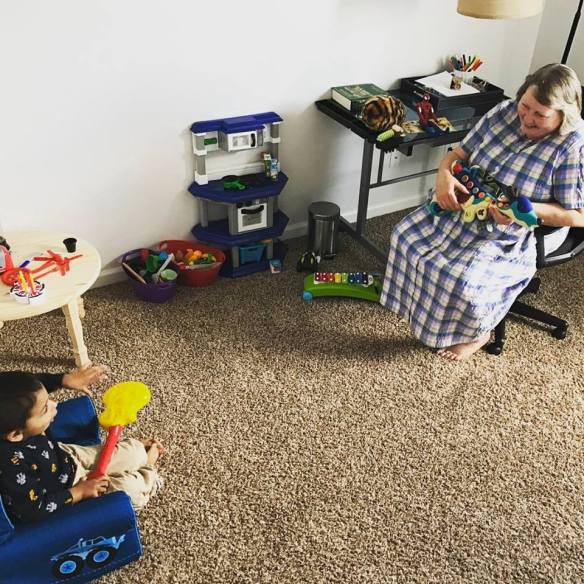
1. Lunch at Jason and Mittu’s house. Usually, due to my mother-in-law being in our home, not being able to be left alone, and not easily moveable, gatherings take place at our house. But we were invited to lunch on Saturday at my son and daughter-in-law’s on Saturday. We went over mid-morning so we’d have time to visit and have lunch and then leave in time for Great-grandma’s caregiver to leave. They had done a lot of painting and redecorating at their house – even building a table! So it was nice to see how everything looked, nice to visit, and nice to get out for an outing. Of course Timothy and I spent a lot of time playing in his room. 🙂 Jason caught this picture of our guitar duet. 🙂

guitar-duet

2. A rug. I have been wanting to get a rug for this room for ages. It’s smaller than the average living room, so we call it by turns the reading room or the alcove or just the living room. I hadn’t seen anything I liked in the local chain stores and just hadn’t made it out yet to some other floor covering stores in town. I had seen things I liked in catalogs but was antsy about buying something that large that way and then having to deal with it if I didn’t like it. So we had this rug in Jim’s mom’s room. It used to be Jason and Mittu’s – I think we bought it for them not long after they were married – but they didn’t have space for it when they moved into an apartment, and it didn’t really go with their decorating in their rental house. It didn’t really “go” with the things in Jim’s mom’s room either, but it kept part of the concrete floor warm. I had been thinking for months now that it might work in the living room. I was thinking I needed to roll it up and bring it in and try it when it occurred to me that I could just take a pillow from the couch over there (duh!) I asked Jim what he thought, thinking that one Saturday when he had time we might transfer it over, but he got out the cleaning supplies that evening after dinner, and we got it set up. I like both the way it looks plus that the proportions fit so much better than the little mat we had there. Of course, if J&M ever want it back, we’ll be back to square one. 🙂 But we’ll cross that bridge when we come to it. And we did have another rug on hand for his mom’s room that Jim had bought at one point to put in the bottom of the tent when they have their big epic backyard camp-out this summer, so we put that in her room. It actually goes well with the futon and curtains there.

img_0093

3. A visitor to the bird feeder. I mentioned last week a new clear bird feeder that attached to the kitchen window. We finally had our first visitor there! He was very skittish about movement or sounds in the kitchen, so he didn’t stay long. I think he was a tufted titmouse. Hopefully he’ll come around again and get more used to us, but next time I see him I’ll stay still for a bit. Plus the replacement one I bought for another window has regular visitors now.

4. Weather. We had some pretty severe and scary storms on Wednesday, but thankfully didn’t suffer any damage or lose power. Then Thursday and this morning, though it has been cold, we’ve had bright, beautiful, blue skies.

5. This video. God’s creation is such a marvel. If this world, marred by sin, contains so much wonder, what must heaven be?

Happy Friday!

Save

It’s March!

120-hello-march-quotes-6622-9

“March is a tomboy with tousled hair, a mischievous smile, mud on her shoes and a laugh in her voice.” –  Hal Borland

“It was one of those March days when the sun shines hot and the wind blows cold:  when it is summer in the light, and winter in the shade.” –   Charles Dickens

Spring Musings

March bustles in on windy feet
And sweeps my doorstep and my street.
She washes and cleans with pounding rains,
Scrubbing the earth of winter stains.
She shakes the grime from carpet green
Till naught but fresh new blades are seen.
Then, house in order, all neat as a pin,
She ushers gentle springtime in.

– Susan Reiner, Spring Cleaning

I’ve used all of these quotes before on the blog, but it has been a few years, and I wanted to share them again. I like the Borland one especially.

March sure is “coming in like a lion” here, with a severe thunderstorm warning for a good part of the day. I am hoping we don’t lose power, always a concern with this kind of weather.

We have a lot of flowers and trees budding already. I’m hoping they don’t get destroyed by a late freeze. Spring officially begins on the 20th, but I’m very much enjoying the early spring-like conditions!

I’ve got to get back to work now, but I just wanted to pop in and say I am glad it is March!

Save