This is later in the day than I usually post these, but, looking at my list, I wanted to go ahead and post what I had instead of waiting for a week and having a longer list. If you’re like me, the more there are, the more I get kind of lost in them and lose interest in looking. I found these all thought-provoking in one way or another: perhaps you’ll see something of interest as well.
Irritability. HT to Challies. This one hit me right where it hurts. “Life is never lived in the sterile confines of a sinless, utopian laboratory well-removed from the Curse’s numerous provocations. This side of heaven, we are either about to be provoked, being provoked, just having been provoked, or some combination of the three. Everything inside and outside of us has the potential to provoke in one way or another.”
Synonyms For the Word of God. Have you ever wondered, especially in places like Psalm 119, what the difference was between a statute, testimony, precept, etc., or whether they were all just synonyms for God’s Word? This article explains the differences.
The Craft and Courage of L. M. Montgomery. I was surprised to learn a few years ago that the author of Anne of Green Gables was not happy in her personal life, in contrast to many of her characters. This was a good perspective.
It’s Friday, time to look back over the blessings of the week with Susanne at Living to Tell the Story and other friends.
Wow, this week seems to have just flown. Well, they all seem to these days, but this one faster than most for some reason. I enjoy the time to stop and reflect over the good things God has allowed the last week or so.
1. Saying good-bye to the “boot” I had to wear after breaking my toe. I am grateful for its protection but glad to be done with it. It’s taken me a couple of days to regain my equilibrium since the boot made my gait uneven, but I am getting there.
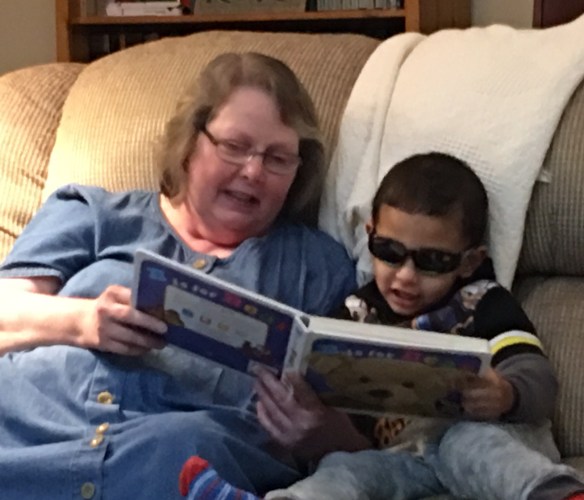
2. Reading with Timothy.
Mr. Cool with his sunglasses on. 🙂
3. Plastic spoons in a variety of sizes. I’ve been adding to my non-stick cookware with some Christmas gift cards, and I’ve been determined to seek out some plastic or silicon utensils to use with it (just used metal before – which is probably why my previous non-stick cookware didn’t last…). I don’t like the thickness of wooden utensils. Always before I could only find small or really big plastic spoons, but last week I found an inexpensive pack of three in different and more manageable sizes.
4. Hairdresser house calls. The hairdresser of the helper we have for my mother-in-law in the mornings goes to some nursing homes and such to cut hair there, and she (our helper) asked her (the hairdresser friend) if she would mind coming to our house to cut my mother-in-law’s. She’s been doing that for some time now, most recently yesterday. It’s such a big help. My m-i-l’s hair grows fast and then keeps falling in her face. It would be hard to take her in somewhere to get it cut, then we wouldn’t be able to get her into one of their chairs, and she couldn’t sit up even if we could. I could snip at it, but it wouldn’t look very good. So, all told, it’s a big blessing that she can come and do that for us.
June Bug by Chris Fabry caught my eye both because I have enjoyed others of his books, plus this one was said to be based on Victor Hugo’s Les Miserables, one of my top two all-time favorite novels.
It begins with 9 year old June traveling around the country with her father, John Johnson, in an old RV. It’s the only life she has ever known. They home school (or RV school, as they like to joke) and have seen much of the country. But one day a part in the RV breaks down, and they park in a Wal-mart parking lot waiting for it to come in. When June goes into the store one day, she sees her picture on a bulletin board of missing children. It says she is Natalie Edwards and she has been missing since she was 2 from Dogwood, WV. The age progression technology forms a pretty accurate representation, and a birthmark is a key identifying factor. June doesn’t tell her father, or supposed father, this right away, though. He’s been a good dad, though quiet and not wanting to stay in one place for long.
Meanwhile, back in Dogwood, Mae Edwards is the only one who believes her granddaughter is still alive. Her daughter, Dana, said her car was abducted with the baby still in it, and neither was ever seen again. Until now: someone has discovered an old car in the lake, and Sheriff Hadley Preston presides as it is extricated from the lake. When he investigates, he finds it is the missing car, but there is no child’s body in it, and the strap on the car seat has been cut.
The story started out a little slowly for me, but picked up in the latter half as all the pieces started coming together.
Also, at first, I was expecting it to be more of a parallel to Les Mis than it was based on some of the blurbs I had seen about it. I know remakes or retellings of favorite stories never match point for point, but once I stopped trying to compare and contrast it to Les Mis and just enjoyed it for the story itself, I got a lot more out of it plus enjoyed the throwbacks to it I did see.
Probably the most disappointing comparison was with the mother of the girl. In Les Mis, Fantine was something of a tragic victim. She made some wrong choices, but she was taken advantage of first by the man who got her pregnant, then the couple who were taking care of her child and inventing stories about her needs to get more money out of her, then she ran into hard luck when she was fired after it was discovered she had a child out of wedlock. Desperate to get the money she thought her child needed, she sold everything she had, including her hair and teeth, and finally ended up in prostitution. I read somewhere that author Victor Hugo considered prostitution was a form of slavery. When her path crossed Valjean’s and he realized that being fired from his factory had contributed to her situation, he helped her and took care of her child when she died, and the grace shown between the two is one of the best parts of the story. However, the mother in June Bug, Dana, comes across as just a bad, selfish person. I guess you could say she is a victim of her addictions, and we’ve had extended family members in the same boat and know what drugs can do to a person’s perspective. But there’s nothing about Dana that makes the reader sympathetic to her.
The most exciting surprise, though, was in the character who turned out to be Johnson’s benefactor, the part taken in Les Mis by the bishop who shows Valjean a kindness that changes his life and helps him both spiritually and practically. I don’t want to spoil it, so I won’t say more about it, but it totally caught me by surprise and I was delighted by how that played out.
As a story on its own merits, I ended up liking it and enjoying it much more near the end than I did at the beginning. Fabry’s characters are well drawn, and I liked the journey they went through.
Looking around Chris Fabry’s blog a little bit for more information on June Bug, I found this fun entry on How to Get Your Book Mentioned on Jeopardy, which tells some of the background and progression of writing the book and how it really did end up being a clue of Jeopardy.
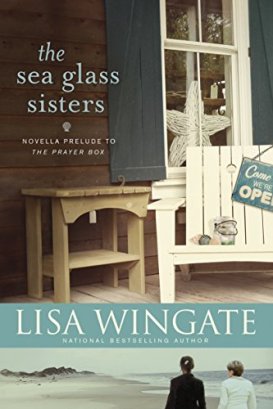
The Sea Glass Sisters by Lisa Wingate is an novella prequel to The Prayer Box, which I read and reviewed last year. A major character in that book is Sandy, owner of Sandy’s Sea Shell Shop on North Carolina’s Outer Banks, who has a significant influence on the life of main character Tandi. The Sea Glass Sisters shares some of Sandy’s background and the circumstances involving the hurricane that hit the area just prior to The Prayer Box.
The main character in this story, however, is Sandy’s niece, Elizabeth Gallagher. Her life is coming unraveled: pressures on her job as a 911 dispatcher, distance in her relationships with her husband and children, problems piling up she doesn’t know what to do about. Just as she is riddled with guilt that a mistake she made on a call may have cost a young girl her life, her mother recruits her for a multi-state drive to Hatteras Island, NC. Her mother and Sandy are sisters, and her mother wants to “talk some sense” into Sandy and get her to move back. All the rest of the relatives live on properties all touching each other. Sandy, seemingly on a whim, went to NC and opened this shop, and now wants to sell her property in Michigan. Besides wanting to keep the family properties together and have Sandy back, she is worried about hurricanes and Sandy’s neglected health.
In fact, as Elizabeth and her mother drive to NC, a hurricane is on its way to the area. But her mother is convinced she can persuade Sandy to come back with them before they’re in danger. When they arrive, they can understand what attracted Sandy to the area, but they still want her to come home. When the hurricane presses toward them, they ride out the storm together and get to know each other better in the process.
Some standout quotes:
I decipher the brewing machine because I am, after all, trained to save lives, and this is a life-or-death situation. We need coffee. Now. Or heads will roll.
Every decision you make in life has benefits and consequences. Sometimes you just have to go on faith, and even that comes at a price. It means you have to give up the idea that you’re the one in charge of the universe.
No way out but through the storm now.
That’s the only thing you can do with a mess. Start cleaning it up, a little at a time.
The shadow of the highest evil intermingled with the light of the highest good. Maybe all lives are filled with this. Maybe it is always a choice between embracing the darkness of one or the saving grace of the other.
We’ve tried to set her straight, but you don’t set that woman anywhere. She’s like the value of pi. She just is.
Maybe life is a series of little deaths and rebirths, of passages and rites of passage, of God teaching you to stop clinging to one thing so you can reach for another.
Lisa packed quite a lot into this little book. I loved what Elizabeth learned along the way and the sense of place or setting Lisa created in the book. I love that cover! It looks like a shop I would want to visit. I enjoyed my second visit to the outer Banks via Lisa’s books – or third, actually, including A Sandy’s Seashell Shop Christmas – and look forward to more.
Genre: Christian fiction Objectionable elements: None.
My rating: 10 out of 10
As many of you know, I broke and dislocated my little toe about ten days before Christmas. I had never broken any bone before, and this has left me feeling very glad that I hadn’t and hoping that I never will again. Even though it’s just a little toe, the pain, discomfort, and inconvenience have had an impact on me as well as the rest of the family.
The first week I was to stay off of it as much as possible and keep it elevated as much as possible. When I saw the doctor for a follow-up visit a week after the injury, I was hoping for some specific directions for the next weeks. But the doctor was rather vague. He said it should heal in six or so weeks, and if it hurt, that meant I should stay off of it a bit. I was hoping to avoid hurting it.
One thing the doctor did emphasize, though, was protecting the toe. I didn’t have to “buddy wrap” it to the next one like the doctor did the first week, but he gave me adhesive tape to wrap lightly around the foot to keep the toe in place and told me to continue wearing the boot I was given or a good walking shoe. Thankfully we’re coming up on the six week mark, when it should be fully healed.
The emphasis on protecting the broken toe while it heals caused me to think of other injuries or wounds that we don’t really associate with needing protection: spiritual or emotional hurts. The protection for a broken bone involves supporting the broken member so the bone heals correctly. For an open wound, protecting it not only keeps other things from bumping it and causing pain, but covering it keeps it from infection. But we don’t usually think about protecting those who have been wounded in non-physical ways, except perhaps the first few days. And how would we even go about that, anyway?
You might think the answer would be that Christian community should surround and support the wounded member. “Community” seems to be the popular, go-to solution for everything these days. And, yes, we are to “Bear one another’s burdens, and so fulfill the law of Christ” (Galatians 6:2) and “weep with those who weep” (Romans 12:15). Community can do much to help and aid.
But what if community is part of the problem?
When you’re single, longing for someone to love, and there are no prospects on the horizon, but at a wedding people ask, “So when is it going to be your turn?”
When you’ve had four miscarriages, with only the first made public, and someone asks, “So when are you guys going to start a family?”
When you’re mourning on the anniversary of a loved one’s death, and a friend says, “Shouldn’t you be over that by now?”
When years later your family is still suffering the effects of a trauma that, to other eyes, seems to be all over, and someone says, “Shouldn’t you have moved on from that by now?”
When you’re visiting a new church in a new town with some trepidation, and the members of your small group or class aren’t cliquish in the sense that they deliberately keep others out, but they have all been friends for so long that anyone new feels out of the loop. When an observer mentions aside to the leader that perhaps they could take pains to reach out to the new ones, the leader says, “Well, the Bible says if you want to have friends, you should be friendly. They need to extend themselves.”
When people say the wrong things, we need to extend grace and assume they meant well. Thank God for sensitive, Holy Spirit-filled and led people who truly know how to come alongside and help, who know how to comfort as they have been comforted. Lisa shared a wonderful post recently on Invisible Band-aids and the need to be alert and attentive to those wounds which don’t show.
But other people can’t be there all the time, and in a sense it’s true that, as the old hymn says, no one understands like Jesus.
The best protection and support for wounded hearts, minds, and spirits is God’s truth, whether we apply it ourselves or share it with someone else..
When Hannah was childless and her rival provoked her and her husband didn’t understand the full weight of her sorrow, she poured out her heart to the Lord, knowing He was the only one who could meet her need.
When Joseph was betrayed, lied about, and forgotten, he trusted that God was sovereign and meant it for good.
When David’s men blamed him when the Amalekites raided their camp and kidnapped their families, to the point that they were going to stone him, David encouraged himself in the Lord.
When the psalmists brought problems and trials and anguish before the Lord, they eventually reminded themselves of His character, power, and love.
Paul was “troubled on every side, yet not distressed; we are perplexed, but not in despair; Persecuted, but not forsaken; cast down, but not destroyed; Always bearing about in the body the dying of the Lord Jesus, that the life also of Jesus might be made manifest in our body” (2 Corinthians 4:8-10).
All throughout the Bible, you see people in various troubles or problematic situations reminding themselves of what they knew to be true of God, staking their souls on what He said, no matter how things looked or felt at the time.
A few other parallels between physical and internal wounds came to mind. You often don’t realize what muscles are used where until something is injured. I didn’t realized my toes dug in to keep balance when I picked up something on the floor, or that I pushed off with my toes when reaching for something from a cabinet, or moved my toes when I stretched in bed, and I got some rude awakenings when I did those things. Years ago, recovering from an old-fashioned gallbladder surgery before they started doing them laparascopically, one of the things I had been told to hold off doing was vacuuming. I thought that was odd – vacuuming didn’t seem strenuous to me. But the first time I tried it, I discovered, wow, you do use abdominal muscles when you vacuum! Similarly, after the deaths of my parents, I was unprepared for being blindsided by waves of grief set off by the most innocent things.
Both of them passed away at Christmas time, so for the first few years, though we celebrated, rejoiced, and even laughed, we just weren’t into what a friend called the “froth” of the season. I remember thinking that I wished sometimes that we still wore mourning clothes for a season after the death of a loved one to let others know to be sensitive. With my “boot” now, or when I used a walker or cane after transverse myelitis, I’ve been glad that I had some way of conveying to others that there was a reason I was walking a little more slowly, and hoped those devices signaled them to be careful and not to jostle me. We don’t have any such signalers after a trauma or loss or heartbreak.
Even though the intensity lessens over time, that spot still may be tender for a very long time. One friend whose husband was in prison for several years is very sensitive to jokes about prisoners, or condescending stereotypical remarks about them, or things like baby onesies made to look like prison uniforms, and after her experience, I’m more sensitive to them, too.
We need to take appropriate measure to promote healing – setting a bone, resting, taking medicine for physical wounds; for spiritual ones, we might need to confront an offender, confess any wrong on our parts, forgive, and seek reconciliation. Both health and spiritual ills usually get worse when they are not dealt with. We do have to be careful that we’re not preventing healing or making things worse by nursing our wounds.
But we can no more tell someone with a broken spirit to “get over it” any more than we could someone with a broken limb. Healing takes time. Community can and should help. But ultimately we need to splint our souls to God’s truth, to prevent the infection of bitterness by resting in His love and care, to protect our broken hearts and spirits by trusting in His grace.
The Lord is near to the brokenhearted and saves the crushed in spirit. Psalm 34:18
He healeth the broken in heart, and bindeth up their wounds. Psalm 147:3
Remember your word to your servant, in which you have made me hope. This is my comfort in my affliction, that your promise gives me life. Psalm 119:49-50
Let, I pray thee, thy merciful kindness be for my comfort, according to thy word unto thy servant. Psalm 119:76
Unless thy law had been my delights, I should then have perished in mine affliction. I will never forget thy precepts: for with them thou hast quickened me. Psalm 119:92-93
The hymn “Still, My Soul, Be Still” has ministered to me since I first heard it, and the last couple of stanzas especially bring out the need to stake ourselves on God’s truth:
Still my soul be still Do not be moved By lesser lights and fleeting shadows Hold onto His ways With shield of faith Against temptations flaming arrows
Still my soul be still Do not forsake The Truth you learned in the beginning Wait upon the Lord And hope will rise As stars appear when day is dimming
God You are my God And I will trust in You and not be shaken Lord of peace renew A steadfast spirit within me To rest in You alone
~ Words and Music by Keith & Kristyn Getty & Stuart Townend
It’s Friday, time to look back over the blessings of the week with Susanne at Living to Tell the Story and other friends.
It has been a rather bleak week outside, but a good one inside. Here are some highlights:
1. One bright, sunshiny day with blue skies in the midst of a grey, overcast week.
2. Hambone and Potato Soup. This was actually from a week or so ago, and I forgot to mention it. The only thing I had ever done with a hambone from our Christmas ham was put it into a pot of beans, but my family doesn’t like beans, so I usually throw it away. My husband encouraged me to look for another dish or soup that I could use it in, and I found this one. It used items I had on hand and was delicious. This may become an after-Christmas tradition like Turkey Bone Soup is after Thanksgiving.
3. Closet reorganization. We’re blessed with four closets near the front entry. One holds coats and jackets, and another has games. I spent the better part of a day with the other two to carve out some space for Timothy’s toys, which had been in a corner of the family room, but his collection was growing. I was able to fill one box from the closet to give away, three more to put in the attic, and consolidate everything else into one so we could use the other for Timothy. Not only does the family room look neater, but I was glad to get reacquainted with what I had in there and pulled out a few items for use around the house.
4. Feeling better after both Jim and I had colds he last couple of weeks. We thought his mom might be catching it from us, which would have been a more serious problem in her condition, but thankfully she just had sniffles for a few days.
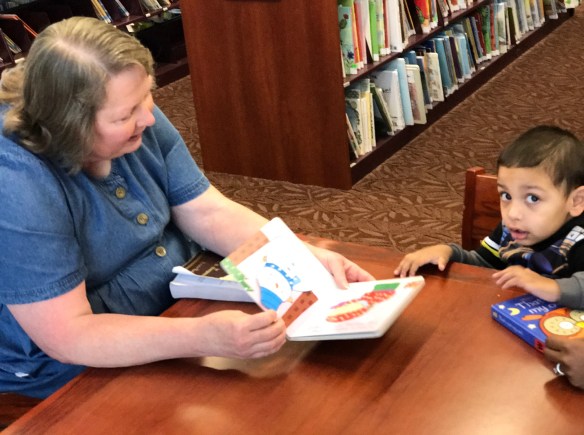
5. Library time with Timothy. His parents took him to the library for the first time, and I was glad to hear he loved it, as that had been a favorite activity when my kids were little. He called it the book house. 🙂 Then I had to stop at the library one day to pick up a book I placed on hold, and remembered on my way that they had been planning to take Timothy that day to a kid’s reading session there. So after checking out my book, I wandered over to the children’s section, and they were still there. It’s such a joy to my heart when he is delighted to see me. I got to sit with them for a few minutes and read a few books with him and see him point out and talk about the big rug with the bunnies on it. ♥
I don’t actually watch too many home flipping and fixing shows because we don’t get HGTV on our main TV, connected to Tivo (though we do get it on the TVs in my mother-in-law’s room and our bedroom, which aren’t connected to Tivo). But we watched a few through Netflix. last summer when nothing else was on. I enjoyed them, but some of the renovations were too sleek and modern for my tastes. Then I found “Fixer Upper” with Chip and Joanna Gaines. I liked the warmth of the show and Joanna’s style. So, even though I’d only seen a handful of episodes, I was excited to see that they were coming out with a book, The Magnolia Story, by Chip and Joanna with Mark Dagostino.
The book starts with the offer they received to have someone come out and do some filming with the idea of developing a reality show, how it almost bombed out before it even got going, and what turned the tide. Then they backtrack to how they first met, their backgrounds, what led to their business and the TV offer, and then shoot ahead to how they got to where they are today.
The book is written in a conversational style with different fonts for the two of them.
They’re a definite case of opposites attracting, but they’ve learned to work with each other’s differences and draw out the best in each other.
Chip seems always to have had a bent toward entrepreneurship. Joanna was actually a communications major with no background in design, but while doing an internship in New York City, she came across some warm and cozy little shops and wanted to start a similar one in Waco, TX. That led to helping customers find just the right accents for their homes, and eventually she got involved in Chip’s house-flipping business. They both learned along the way by doing, and the success they’ve had indicates they’ve obviously learned well.
They talk candidly about their faith, though they don’t really define it or tell how they came to it. Joanna mentioned her faith becoming more personal while in college. But they do credit God with guiding and providing for them.
Here are a few things that stood out to me:
It seemed as if every homeless guy in Waco knew Chip Gaines. On the flip side, every baker in Waco knew Chip, too. And he talked to those very different groups of people exactly the same way (p. 19).
I realized that my determination to make things perfect meant I was chasing an empty obsession all day long. Nothing was ever going to be perfect the way I had envisioned it in the past. Did I want to keep spending my energy on that effort, or did I want to step out of that obsession and to enjoy my kids, maybe allowing myself to get messy right along with them in the process? I chose the latter – and that made all the difference.
It’s up to us to choose contentment and thankfulness now—and to stop imagining that we have to have everything perfect before we’ll be happy.
Most people think that you start off not thriving. Then you get a TV show or some other amazing opportunity, you get fame, you get fortune, and then you thrive…I always thought that the “thriving” would come when everything was perfect, and what I learned is that it’s actually down in the mess that things get good (pp. 167-168).
They share why they use the magnolia as a symbol, what landed Chip in jail once, the business venture that almost ruined them, how they got their farm, and pictures!
I very much enjoyed reading their story.
Genre: Non-fiction Objectionable elements: None
My rating: 9 out of 10
The Silent Songbird by Melanie Dickerson is a Christian fiction retelling loosely based on “The Little Mermaid.” It’s book 7 of the Hagenheim/ Fairy Tale Romance Series, so some other characters in the other books appear here, mainly from The Merchant’s Daughter, as the hero here is the son of the couple there. But it could be read as a stand-alone book.
In this book, Evangeline is the ward of her cousin, King Richard II. When he plans for her to marry Lord Shively, a much older man whom she finds disgusting, she decides to escape. Her maid, and older woman named Muriel, finds out and, not being able to stop her, comes with her.
Evangeline is known for her beauitful singing voice, so she decides to act as if she is mute as part of her disguise. She and Muriel travel with a group going away from the castle back to their home village. Right away Evangeline notices that the apparent leader, Wesley le Wyse, is both handsome and kind. He notices her as well, and feels sorry for her when Muriel tells him that Eva (as she’s known now) lost her voice when her master beat her. Eva and Westley find ways to communicate, and as she comes to know him better, she regrets deceiving him. She wants to tell him the truth but is afraid of how he might react to her deception.
When they get to Westley’s village, he gets Eva and Muriel jobs at his family’s home. But Eva has never been trained to do menial labor and either injures herself or someone else at everything she tries. Muriel is more capable but also more miserable, longing for home and a special someone there.
Eventually Westley catches on the Eva is not who she seems to be, learns of her deception, and is understandably angry. Just then Eva learns that Westley’s life is in danger, as is the king’s safety, but will anyone believe her now? And can she ever be forgiven, not only by other people, but by God?
“Losing everything is sometimes the price one must pay for doing the right thing.”
I wasn’t sure if perhaps Westley’s name was a nod to The Princess Bride, but when “As you wish” was said a couple of times, it seemed so.
This series is labeled as Young Adult, and I mentioned last time that most of them didn’t read that way to me. This one did seem meant for a younger audience, but I generally enjoyed it.
Genre: Christian fiction fairy tale Objectionable elements: None
My rating: 8 out of 10
A couple of weeks into January, and the excitement of Christmas and new beginnings has died away. Darkness comes early, the skies are often overcast, it’s cold, the landscape seems barren with no hope of any new blooms or growth for months yet. Our family makes a big deal of Valentine’s Day, so we have that to look forward to as well a few birthdays before spring. But otherwise this time of year seems bleak and colorless. I feel I’m just longing for that first warm breeze and green shoot indicating spring.
John Updike’s poem “November,” from A Child’s Calendar, seems more suited to January for me except for the last verse and the line about the year being old:
The striped and shapely Maple grieves The loss of her Departed leaves
The ground is hard As hard as stone. The year is old. The birds are flown.
And yet the world, Nevertheless, Displays a certain loveliness–
The beauty of The bone. Tall God Must see our souls This way, and nod.
Give thanks: we do, Each in his place Around the table During grace.
The first time I ever read this, the quote I was reading stopped at “the beauty of the bone,” and that phrase arrested me. (This, by the way, is not a total endorsement of Updike: I’m not familiar with his other work.)
Leafless trees do have “a certain loveliness.” You see the structure, the symmetry, the basic form that is usually hidden underneath the leaves. Artist Andrew Wyeth is quoted as saying, “I prefer winter and fall, when you feel the bone structure of the landscape – the loneliness of it, the dead feeling of winter. Something waits beneath it, the whole story doesn’t show.”
The lack of foliage also allows other sights to come into view. On the “scenic route” to church, there’s a stretch where trees line the road. But in the wintertime, when the leaves are gone, I can see what was hidden before: a pond with various animals coming to drink from it. Mountains covered in varying leaves most of the year display houses and meadows I would never have known of without the missing leaves.
These observations led to reflections about winter times of the soul, when everything (financially, relationally, or otherwise) seems stripped down to the bone. My own salvation was like that. Everything in my life that I had ever leaned on was no longer available: my parents divorced; my mom, with whom I had always been very close, was distant for a while; we moved from a very small town of less than 200 to Houston, a city of over a million, causing a major culture shock, especially when I started school; I had no contact with friends or relatives for a time. I never felt so totally alone in my life. I had not grown up in a church-going family, but I had heard enough in going occasionally with friends and relatives to know where to turn. I had made a profession as a child that I struggled with, but at this point I desperately needed to know God was there and He cared for me. Through a series of events and seeming “coincidences,” God led me to a Christian school and then a church where I was regularly under solid teaching and eventually made sure of my salvation.
When life seems like a barren winter landscape, we can see and understand spiritual truths we never realized before, or at least not in the same depth. In a different metaphor, Hebrews speaks of ” the removal of things that are shaken—that is, things that have been made—in order that the things that cannot be shaken may remain” (12:27, ESV). Spurgeon said in the June 22 reading of Morning and Evening:
We have many things in our possession at the present moment which can be shaken, and it ill becomes a Christian man to set much store by them, for there is nothing stable beneath these rolling skies; change is written upon all things. Yet, we have certain “things which cannot be shaken,” and I invite you this evening to think of them, that if the things which can be shaken should all be taken away, you may derive real comfort from the things that cannot be shaken, which will remain. Whatever your losses have been, or may be, you enjoy present salvation. You are standing at the foot of his cross, trusting alone in the merit of Jesus’ precious blood, and no rise or fall of the markets can interfere with your salvation in him; no breaking of banks, no failures and bankruptcies can touch that. Then you are a child of God this evening. God is your Father. No change of circumstances can ever rob you of that. Although by losses brought to poverty, and stripped bare, you can say, “He is my Father still. In my Father’s house are many mansions; therefore will I not be troubled.” You have another permanent blessing, namely, the love of Jesus Christ. He who is God and Man loves you with all the strength of his affectionate nature–nothing can affect that. The fig tree may not blossom, and the flocks may cease from the field, it matters not to the man who can sing, “My Beloved is mine, and I am his.” Our best portion and richest heritage we cannot lose. Whatever troubles come, let us play the man; let us show that we are not such little children as to be cast down by what may happen in this poor fleeting state of time. Our country is Immanuel’s land, our hope is above the sky, and therefore, calm as the summer’s ocean; we will see the wreck of everything earthborn, and yet rejoice in the God of our salvation.
Sometimes when things are shaken to their core, we see the strength of that core of God’s truth; we see what really matters. Corrie ten Boom said, ” “You can never learn that Christ is all you need, until Christ is all you have.” Or, taken in reverse, when Christ is all you have, you find He is all you need.
Nancy Guthrie wrote in Holding on to Hope. “Trusting God when the miracle does not come, when the urgent prayer gets no answer, when there is only darkness—this is the kind of faith God values perhaps most of all. This is the kind of faith that can be developed and displayed only in the midst of difficult circumstances. This is the kind of faith that cannot be shaken because it is the result of having been shaken. “
Our winters shall not frown for ever; summer shall soon smile. The tide will not eternally ebb out; the floods retrace their march. The night shall not hang its darkness for ever over our souls; the sun shall yet arise with healing beneath his wings. – ‘The Lord turned again to the captivity of Job.’ Our sorrows shall have an end when God has gotten his end in them. ~ Spurgeon
Glory follows afflictions, not as the day follows the night but as the spring follows the winter; for the winter prepares the earth for the spring, so do afflictions sanctified prepare the soul for glory. ~ Richard Sibbes
The tendinous part of the mind, so to speak, is more developed in winter; the fleshy, in summer. I should say winter had given the bone and sinew to literature, summer the tissues and the blood. ~ John Burroughs
So winter is still not my favorite season, but I have learned it has its purposes. I almost never see a bare tree any more without thinking of that phrase, “the beauty of the bone.” Sometimes winter is a time of rest or preparing for new growth. A friend who describes herself as a homesteader loves winter for catching up on reading and knitting and planning for her garden, things she can’t do when planting, weeding, harvesting, and tending animals are all in full swing. Hard freezes kill bugs. And if nothing else, winter helps us appreciate spring and summer all the more. So in spiritual “winters,” we can “hunker down” with the bedrock of God’s truth, nourish our souls with it, and trust that spring will come.
Thou hast set all the borders of the earth: thou hast made summer and winter. Psalm 74:17.
I usually go a couple of weeks or more between these, but had so many, I decided to go ahead and list them. These are all thought-provoking reads found in the last week or so.
God’s Work in Your Bible Reading. “The Bible was precious because it mediated a sight of God, and a relation to God, which are sweeter than any other experience. This was the spring of what Sweeney called ‘Edwards’s lifelong love affair with Scripture.'”
Rethinking Phil. 4:13. It’s for far more than positive thinking and winning ball games.
#NotMyPresident. I’ve been appalled at some of the reaction to the president-elect. Many of us weren’t happy with the last two elections, but we didn’t act like this. I don’t agree 100% with everything about Trump, but, as a Christian, I appreciated this perspective.
Want to raise successful boys? Children, especially boys, learn better when they have more opportunities to move around than the average school gives them.










 The Silent Songbird

 Stray Thoughts