Friday’s Fave Five

friday fave five spring

It’s Friday, time to look back over the blessings of the week with Susanne at Living to Tell the Story and other friends.

This has been a fairly uneventful week. Which is nice, because uneventful weeks are relatively more peaceful. But now I am trying to remember what happened that I can comment on. πŸ™‚

1. Progress on the fence. Last week my husband had two panels up: as of Thursday afternoon, he had finished eight. Due to some rain and other responsibilities, he wasn’t able to work on it much Saturday, so most of that has been done in the evenings after he gets off work. I’m not sure how many there are all together. So thankful for my hard-working husband.

IMG_1704

I mentioned last week that he had found this (or at least, the pieces of it) on Craig’s list. When he first went out to look at them, he told me that they were tan. I had only seen vinyl fencing in white before and was afraid tan might make them look old. But they were such a good deal, we decided to get them and then we could paint them later if we wanted to. They turned out to be kind of a sandy, just off-white color. I really like that, because sometimes the sun hits it in full force, and I think the white would be blinding – or at least glaring. At some point we want to put some bushes and plants at intervals.

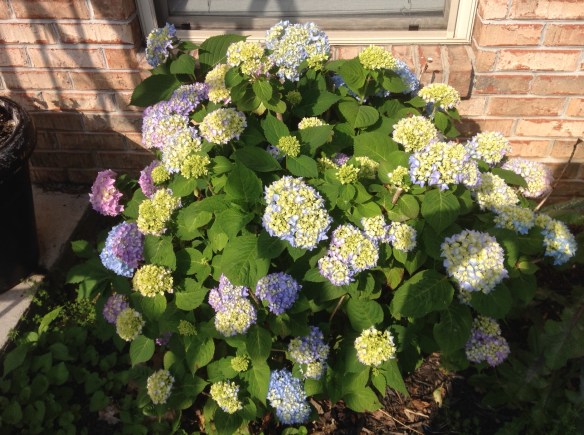
2. My hydrangea bush has never put out this many blossoms before. Lovely! And I like that they are different colors.

IMG_1702

3. Time with my little grandson. I know I have said that before. πŸ™‚ But time spent with him makes up my favorite parts of every week. Those who know me well will appreciate that I especially love when he climbs up beside me and says, “Book! Book!”

4. A family open to experimental recipes. I tried cabbage rolls for the first time this week (this recipe), and they were ok, but a little bland. That one was nice in that it was a stovetop recipe. I’d like to try this one which has some different flavorings, but it will have to wait til cooler weather – it’s already too hot to have the oven on for 75 minutes. Somewhere I saw a crockpot version that I might have to try as well. My son wasn’t sure if he’d like the cabbage, but he gave it a try and did.

5. Take-out meals. I know, I have mentioned them several times as well. But I love the combination of not having to decide what’s for dinner, having someone else cook it, and not having clean-up. We got take-out from my husband’s favorite Asian place Saturday evening, which almost always has enough for leftovers for lunch another day – another favorite of take-out. And then, this isn’t take-out exactly, but it was made by someone else: my son and daughter-in-law brought over some homemade enchiladas left from a dinner they had hosted the night before to us for lunch on Saturday – yummy! Better than take-out!

Happy Friday!

Book Review: The Renewing of the Mind Project

Renewing the MindI first became aware of The Renewing of the Mind Project by Barb Raveling through my friend Kim’s blog. She had also introduced me to two of Barb’s other books which I reviewed together last year: I Deserve a Donut (And Other Lies That Make You Eat) and Taste For Truth: A 30 Day Weight Loss Bible Study.

Barb begins with her testimony of the joy she found when she became a believer in Christ and the changes He worked in her heart and life. After a while, though, she “left her first love” and began skipping her quiet times with her Bible and prayer. She’d make resolutions and minor changes, but the same bad habits kept resurfacing. She knew only God could change her, and she prayed for that and waited, but nothing really happened. Finally she realized Romans 12:1-2 about being “transformed by the renewing of your mind” had an expectation for her. It is God who does the changing, not our self-will or self efforts, but He does expect us to learn the truth He has given us in His Word and apply it.

She expands on this in Chapter 3, “Just Say ‘No’ to Sin?” She brings up God’s commands to the Israelites to walk around the walls of Jericho a certain number of times for a certain number of days. She points out that it was definitely God who brought the walls down, yet He required this action and obedience on their part. She notes that though Jesus won the “ultimate victory…conquered sin through His death and resurrection, and we’re already new creatures if we’re His children through faith (2 Corinthians 5:15-21, Romans 6:4-11),” there are still things He “tells us to do after we’re saved, if we want to be transformed” (p. 13). Things like “Fight with spiritual weapons (Ephesians 6:10-18); “Take your thoughts captive to the truth” (2 Corinthians 10:3-5);Β  Abide in Jesus (John 15:1-5); Abide in God’s Word (John 8:31-32); Walk by the Spirit (Galatians 5:16-25)” (p. 13), among others.

Do you see what an active role God asks us to play in the transformation process?…[This] list requires all kinds of effort. But there is a problem: the word effort is a no-no in the church today. People mistakenly think that if we talk about effort, suddenly we’re not believing in salvation by grace through faith, and we’re going all legalistic. Nothing could be further from the truth (p. 13).

Barb shares a couple of clarifications:

Don’t make the mistake of thinking [transformation] is the easy three-step plan to fix up your life. It’s not. Instead, it’s a way of life. A continual taking off lies and putting on truth in order to break free from our sins, bad habits, and negative emotions so we can love God and others better (p. 6)

We’re not starting from a point of having to measure up to be acceptable to God. We’re starting from a point of already being accepted by God if we’re His children through faith (Ephesians 2:4-9). This gives us a secure foundation. We can rest in His love and walk hand in hand with Him, working on this project together (p. 7).

[God] sees things right now in your life that He’d like to change. Not because He’s a demanding perfectionist who’s disgusted with you. But because He’s a loving Father who cares about you and also about the people you interact with each day. So as you look at your weaknesses, look at them from the comfort and safety of your Father’s arms. knowing that He’s looking at them with you, but through eyes of grace and love and a desire to help (p. 8).

She shares another motive for transformation: God wants us to “lay down our lives to love God and others well. The more we stay stuck in our sins and negative emotions like worry, anger, and insecurity, the harder it is to do that” (p. 14).

Some years ago, after being distressed with an angry response of mine, I looked up several verses on anger, typed them up in a neat list, and saved them to a file. That helped while I was working on them, but making lists in themselves doesn’t renew my mind. Barb describes the process like this: “The renewing of the mind is an active time of fellowship with God…but [it] is more than just reading the Word. It’s mulling over the Word, meditating on the Word, memorizing the Word, and allowing the Word to transform us” (pp. 15-16). It is “to put off your old self, which belongs to your former manner of life and is corrupt through deceitful desires, and to be renewed in the spirit of your minds, and to put on the new self, created after the likeness of God in true righteousness and holiness” (Ephesians 4:22-24).

When we’re in the midst of temptation, everything within us is screaming to just give in and do it! We’re believing lies right and left–so many lies that there’s no way we can say no to temptation in our own strength. We desperately need to go to God for help so we can see the situation from His perspective. Because when we see it from His point of view, we’ll actually want to obey Him. The truth is, Satan and the lies of this world are so convincing that unless we go to God again and again to discuss life with Him, we won’t have much of a chance of living the way He asks us to live. If we want to be victorious over our habits and emotions, we need to take time to renew our minds (p. 17).

Barb goes on to discuss ways to meditate on the Scripture, using it in fighting sin and in prayer, and a concept she calls truth journaling, a way of putting out your thoughts one by one and then applying truth to them. Sometimes it is easier to evaluate our thoughts when we can take them out of their swirl in our brain and get them down in black and white, and applying the truth to them in that way helps to reinforce truth. She walks the reader through renewing our minds to deal with negative emotions, stop a bad habit, start a good one, or accomplish a goal.

The rest of the book is divided into different headings (emotions, stopping a habit, etc.) and then subdivided into specific areas (loneliness, insecurity, entitlement, failure, pride, frustration, stress, “I’ll start tomorrow,” and many, many more.) Under each specific emotion, habit, or thought, she has a list of questions, things you might need to accept or confess, Bible verses, and tips. For instance, some questions under the Entitlement heading are:

Why do feel like you deserve your habit in this particular situation?

Do you think God agrees? Why or why not?

What usually happens when you live by your rights and feelings in this area of your life?

Would your life be better if you gave up your rights and held life and your habit with open hands?

Are boundaries easy to follow or do you usually have to give up something to follow them?

What will your life look like in a few months if you consistently follow your boundaries?

Then she lists several Bible verses applicable to this subject. She ends with these tips:

It’s hard to break free from our habits because we hear the message everywhere we go: Life should be fair. You shouldn’t have to suffer. You deserve the good life. So when something bad or unfair is going on in our lives, we automatically reach for our habits.

The best way to break free from entitlement habiting is to adopt a biblical perspective of life. God never said, “You deserve the good life.” Instead, He said, “If you want to follow me, you have to give up everything” (Matthew 19:16-22, Matthew 16:21-28).

When we hold our habits tightly with clenched fists, we’re basically saying, “I deserve this, God, and I am not willing to give it up!”

God replies, “Your habit will never make you happy. Come to me and I’ll give you the abundant life.”

The more we hold our habits with open hands, willing to give up all things for God, the more content we’ll be. If you want to gain victory over entitlement habiting, learn to hold your habits–and your “right to the good life”–with open hands (pp. 186-187).

Of course, Barb isn’t saying that if you just answer these questions, read or even memorize the verses, and read the tips, then, Voila! You’re done! You’ve conquered! You’ll no longer have trouble with that habit! No, as she said in an earlier quote, it’s a way of life. When we’re tempted, when we’ve failed, when we think we have pretty good reasons for what we want to do or feel, when we’re going into a situation where we know we’ll have trouble – these are all situations, among others, where we need to go to God’s Word and renew our minds to think like He does.

A few more quotes that stood out to me:

[Boundaries] cramp our style, but you know what? Our style needs to be cramped. Because there are consequences to doing “what we want when we want” with our habits. Just think of your own habit. What happens when you do it as much as you want to do it? Do you live a wonderful, peace-filled life, thanking God every day for your habits? Or do you live a stressful, regretful life, full of the consequences of too much habit? (pp 60-61).

Is God enough to satisfy you even if you don’t get what you want? (p. 131).

Will breaking your boundaries make you feel better?…Will it solve your problems? Will it create new problems or make the situation worse in some way? What do your boundaries protect you from? Do you need that protection today? (p. 183).

The key to gaining victory over reward habiting is to remember that boundaries make our lives better, not worse. And if boundaries makes our lives better, then breaking them is a punishment — not a reward (p. 206).

Her mention of boundaries in these quotes refers to whatever specific guidelines we set up to curb a habit – say, for instance, we’re not going to eat sweets after dinner, or open Facebook until we’ve had devotions, or whatever. “The minute we set boundaries, our first impulse is to break them. Since we feel guilty about breaking them, our minds frantically (and secretly) try to come up with some justification of why in this situation, it’s okay to break our boundaries” (p. 202). There may be some times to legitimately break our boundaries, but we need to be honest with ourselves and not just make excuses and remember why we set the boundary in the first place.

As you can surmise, I found this book immensely helpful, hopeful, and encouraging. I love Barb’s direct, practical, straightforward style and her emphasis on the power of the Word of God and not a “formula” to help us change to be more like our God. She has a website here: the “Renewing of the Mind tools” tab expands on some of the principles in the book.

(Sharing atΒ Semicolonβ€˜s Saturday Review of Books)

Book Review: Pride, Prejudice, and Cheese Grits

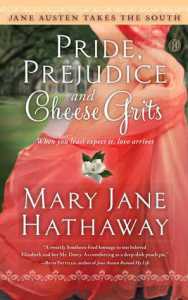
PP&CGPride, Prejudice, and Cheese Grits by Mary Jane Hathaway might sound like a Southern version of Jane Austen’s novel, and indeed it is. Set in the present-day South, it is not a point for point retelling – there are a few differences in characters and plot. But if you’re thinking of P&P while reading it, you’ll recognize a number of plot points and people. This book is the first in Hathaway’s “Jane Austen Takes the South” series. I had read the second book, Emma, Mr. Knightly, and Chili Slaw Dogs, first and then backtracked to read this one.

In this story, Shelby Roswell appreciates history, from old houses to old diaries. In fact, she is a professor of history specializing in the Civil War era working to become tenured. She had written a book with hopes of it propelling her toward her goal, but eminent Civil War expert and writer Ransom Fielding wrote a scathing review of it for a national magazine. And now he’s a visiting guest professor at her college for an entire year. She hopes to avoid him, but at their first meeting, they clash big time, and publicly at that. They each push all the wrong buttons in the other, yet find qualities attractive in each other.

Ransom is, of course, devastatingly handsome, sure of himself, and seemingly a little stuffy at first. He lost both a wife and child, leaving him bitter against God and determined to guard his heart from ever loving another woman.

Of course, following P&P, you know where this is going to go, but it is fun to see how it gets there. Jane from P&P is replaced by Shelby’s roommate, Rebecca, English professor and Jane Austen expert. Ransom’s aunt Margaret Greathouse represents the formidable Lady Catherine de Bourgh. Shelby’s family represents Elizabeth’s in a laid-back father, marriage-minded mother, and silly sisters. Mr. Collins and Wickham are combined in a David Bishop.

I’ve seen a couple of reviewers refer to this volume as more preachy than the second book, but I’d have to ask what they mean by “preachy.” To me, a preachy Christian fiction book is more a “lesson” thinly veiled as a story and may entail finger-wagging and implied “You ought…” advice to the reader. I saw none of that here. As I wrote in Why Read Christian Fiction?, you’d expect in this genre to see professing Christian characters doing Christian things like reading their Bibles and trying to figure out how to apply their faith to everyday life. I do find that here in a natural, uncontrived way, such as when Shelby, after a heated encounter with Ransom, wonders why she has a hard time with putting into practice the verse she had read that morning about being swift to hear, slow to speak, and slow to wrath when she is around him (though actually it’s not just around him – she tends to blurt things out before speaking to nearly everyone) and, when they finally talk about his wife and child, and she advises him in ways to deal with it. That’s perfectly normal. The author seemed to go the other way in the second book – I remember wondering why it was called Christian fiction when there wasn’t really anything distinctly Christian in it that I could recall. Perhaps she did so in response to criticism in this book, but I’d rather have Christianity displayed as it is here rather than being so subtle it is unobservable.

There were a couple of plot points that didn’t quite make sense to me, but overall the writing was fine. There were a couple of sections I felt didn’t need to be there: for instance, when Shelby is holding her cousin’s baby while talking to Ransom, the baby keeps putting its fist in her cleavage. Sure, babies do things like that, but in a book there was really no reason to draw attention (ours or Ransom’s) to her cleavage. And one character is framed with a fake video of a fake sexual encounter. Sure, there is scandal in P&P when Lizzie’s sister runs off with Wickham, but we are told very little about it. This book doesn’t go into all the specifics of the tape but mentions more than necessary – and I felt the conflict and tension this incident was supposed to create could have been handled in a different way. I’ve seen a couple of reviewers mention a swear word in the book, but I don’t remember any, and I am usually sensitive to that.

But I thought the theme that “love changes us” was nicely brought out, and I enjoyed the ways it changed Ransom and Shelby. And the Austen connections were fun, too.

(Sharing atΒ Semicolonβ€˜s Saturday Review of Books)

Fleeting Pleasures, Eternal Joys

As Jenny’s parents drove her to her birthday celebration at Disney World, she sat in her car seat bouncing a helium balloon. Her uncle had stopped by that morning to tell her happy birthday and surprise her with a balloon, and she insisting on bringing it to the theme park. Her parents had looked at each other, shrugged “Why not?” and consented. Jenny talked to her balloon, giggled, tapped it against the window, the seat beside her, and anything she could reach.

Her dad pulled into the parking lot and maneuvered the car into a spot. Her mom turned around and said, “Jenny, if you let go of your balloon, it will float up into the sky and we won’t be able to get it back. It will be too hard to hold it for a long time, so we’ll tie it around your wrist, okay? If you get tired of it, we can tie it to the stroller.” Jenny nodded enthusiastically.

She sat very still as her mother tied the balloon ribbon loosely around her wrist. Her parents allowed her to walk rather than sit in her stroller, knowing that soon enough she’d be tired and want to ride. As Jenny’s mother took her hand, she bounced her other hand up and down to make the balloon dance. But she couldn’t see it up so high and control it as well as when she held it, so she pulled her hand from her mother’s grasp and started fumbling with the balloon ribbon to get it off her wrist and hold the balloon herself. Her mother saw what she was doing, plus they had a rule about holding mommy’s hand in parking lots. “Jenny, you need to take my hand. And don’t pull the string off or the balloon will float…” Before she could even finish, Jenny had gotten the ribbon off her wrist, but didn’t have enough of a grasp of it to keep it from sliding between her fingers. The balloon floated out of her reach, and she cried, “Balloon! Balloon!” Her dad tried to catch it, but he couldn’t quite reach it. The three of them watched despondently as the balloon caught the breeze and floated farther and farther up and away. Jenny’s mother knelt down beside her daughter. “I’m so sorry, honey. But that’s what balloons do. Next time we’ll figure out a better way to hold it.” Her mother thought to herself, next time we won’t bring a balloon on an outing. To try to distract Jenny from her loss, her mom began talking about the party and pleasures to come. “Jenny, let’s go on in to Disney World. Your friends are waiting, we have birthday cake and presents, and then rides, and maybe we’ll even see Minnie Mouse!” But Jenny was too distraught. With all the thrills of the theme park and a birthday party ahead, she sat down in the parking lot, crying for her lost balloon.

___

The above is a fictional story, but I think it somewhat displays a spiritual truth. There are many good gifts from God in this life, and there is nothing wrong with enjoying them. But we get too caught up in them, grasping them, distracted by them, and forget that they were always meant to be momentary. We’re saddened when we experience loss or when something in life no longer satisfies. That’s normal. But it’s a reminder that this life is not all there is. Eternal life, for those who know the Lord, will be so much more than anything we have here, even anything we can imagine.

“Heaven is not here, it’s There. If we were given all we wanted here, our hearts would settle for this world rather than the next. God is forever luring us up and away from this one, wooing us to Himself and His still invisible Kingdom, where we will certainly find what we so keenly long for.” ~ Elisabeth Elliot

IMG_1700

(Sharing with Inspire Me Mondays, Woman to Woman, Testimony Tuesday, Telling His Story, Works For Me Wednesdays, Wise Woman, Thought-Provoking Thursday)

Save

Friday’s Fave Five

friday fave five spring

It’s Friday, time to look back over the blessings of the week with Susanne at Living to Tell the Story and other friends.

After a busy weekend, the rest of the week hasn’t been quite as productive as I had hoped, but it has been a good one. Here are some of the best parts:

1. Lunch with a friend last Friday. Enjoyed a great conversation and time away.

2. Bagels. I’d only had one bagel in my life before, and I was not impressed: it was on an airplane, and the outside of it was so hard, I couldn’t bite into it. I had to pull out the soft bread inside of it to eat it. Jason told me not to judge all bagels by an airplane bagel. So when my friend wanted to meet at Einstein Bros Bagels, I wasn’t so sure at first, but then decided this would be a good opportunity to give bagels another try. I ordered pizza bagels, thinking that if the crust was a little firm, it wouldn’t be too bad. But they were very soft and very good! Nice to have a new food option!

3. Fencing. I’ve mentioned before having to take down a row of diseased trees bordering the back of our property. We wanted to replace them with a fence, and my husband found a great deal on fencing on Craig’s list and picked it up last Saturday. He has two panels up already.

4. Delicious weather. It’s been my favorite kind of weather most of this week – sunny and cool. I’m treasuring up the coolness, knowing before long it will be hot and humid out there.

5. A productive Saturday. I had a marathon grocery shopping expedition in the morning and then spent the afternoon catching up on “Amazing Race” episodes on the Tivo while ironing. While ironing and grocery shopping aren’t favorite things to do, there is a sense of satisfaction getting them done.

Happy Friday!

Book Review: The Book Thief

Book ThiefThe Book Thief by Markus Zusak begins in the Germany of the 1930s with ten year old Liesel Meminger, who is being taken to German foster parents. Her own parents were “taken away” because they were Communists and her brother dies en route, so she arrives alone and very frightened. Her foster father, Hans Hubermann, is kind and gentle and comforts her when she wakes up with nightmares. Her foster mother, Rosa, seems gruff at first, calling her and everyone else an endless stream of bad words, but soon Liesel learns it’s just Rosa’s way, that she does have a caring heart underneath the gruff exterior.

Though Liesel is ten years old, she is illiterate, so in school she is grouped with the younger children. Hans only got through third grade himself, but he tries to help Liesel with the one book in the house – the grave digger’s handbook that a worker accidentally dropped at her brother’s burial, which she stole just as a remembrance of him. Hans is a painter, and he furthers Liesel’s lessons in the basement, writing letters and words on the walls, which he can repaint as needed.

For a few years life goes on as normal, or as normal as possible as the clouds of WWII gather on the horizon. Liesel becomes best friends with neighbor and classmate Rudy Steiner and learns to read more proficiently. The children are all made to join the Hitler youth, and one activity they are required to go to is a book burning. As the crowd disperses, Liesel sees a book that is singed but hasn’t burned, and when she thinks no one is looking, she takes it – her second book theft. But then she realizes someone has seen her, and lives in terror of what might happen to her. As it turns out, her observer is the mayor’s wife, Ilsa Hermann, who, instead of turning Liesel in, invites her to her home to use her library.

Times get harder as rations are enacted, Rosa loses laundry customers due to the financial situation, and Hans loses painting customers because he’s stigmatized after painting over slurs on a Jewish man’s door.

Years earlier in WWI, Hans’s life was saved by a Jewish friend, and when he visited the man’s wife and son, he told them to call on him if they ever needed anything. They do so in quite an unexpected way: the son, Max, is now a grown Jewish young man seeking refuge. The Hubermanns hide him in their basement and share their already meager food rations with him.

The plot goes on from there with the dangers of air raids, of discovery, of being sent to war and not making it back or returning maimed, of the tightened Nazi atmosphere.

The story is told in an odd way with Death as the narrator, but he offers a unique perspective. He, or rather, the author, uses quite a lot of foreshadowingΒ  – not even shadowing, but foretelling what’s going to happen, like one character’s death. That bugged me quite a lot at first: I’d rather have the drama of building up to it and then being surprised. In one place Death says, after revealing a significant coming situation,

β€œOf course, I’m being rude. I’m spoiling the ending, not only of the entire book, but of this particular piece of it. I have given you two events in advance, because I don’t have much interest in building mystery. Mystery bores me. It chores me. I know what happens and so do you. It’s the machinations that wheel us there that aggravate, perplex, interest, and astound me. There are many things to think of. There is much story.”

In another place he says he foretells a bit to soften the coming blow. He also narrates in a zig-zag way, jumping ahead, then backtracking, that’s a little confusing at times.

The worst thing about the book is the excess of profanity. I had read somewhere that there were a few bad words, but they were mostly German, so the non-German reader is spared the full impact of them. That didn’t turn out to be true. Both general bad words and taking the Lord’s name in vain pervade seemingly every page. If I had known just how extensive it was going to be, I would have been less inclined to read the book. I had read somewhere that the author didn’t specifically write this as a young adult novel, but rather wrote it for a general audience; however, it’s seems to have been marketed as a YA novel, and some of the explanation of things adults wouldn’t need explained seems to indicate it’s written more for young people, which makes the profanity all the more atrocious.

Aside from the profanity, though, it’s a beautiful story. It’s mainly about the power of words. As Liesel’s world opens up with reading, she finds books a help as she reads to Max to alleviate boredom, to comfort him when he is sick, and to help distract people inΒ  air raids shelter. But at one point, after so much loss in her life, which she traces back to Hitler, she hates the power of words for evil and rips apart a book, vowing to never read again. Then she is given a blank book to write her own words and discovers the healing power of being able to express her own thoughts and to combat hate with words. She concludes, “I have hated the words and I have loved them, and I hope I have made them right.”

The writer does have a knack for descriptive phrasing:

The brute strength of his gentleness

A snowball in the face is surely the beginning of a lasting friendship.

The church aimed itself at the sky.

Lacerated windows

The gun clicked a hole in the night.

Her teeth elbowed each other for room in her mouth.

His blond hair peppered with dirt.

Night watched. Some people watched it back.

Somewhere, far down, there was an itch in his heart, but he made it a point not to scratch it. He was afraid of what might come leaking out.

I loved the well-drawn characters – Liesel, Hans, Rosa, Rudy, Max, Ilsa Hermann.

It’s also a book about humanity. Death often muses on humans’ penchant for good and evil:

“I’m always finding humans at their best and worst. I see their ugly and their beauty, and I wonder how the same thing can be both.”

β€œI guess humans like to watch a little destruction. Sand castles, houses of cards, that’s where they begin. Their great skill is their capacity to escalate.”

β€œSo much good, so much evil. Just add water.”

β€œI wanted to explain that I am constantly overestimating and underestimating the human race – that rarely do I even simply estimate it. I wanted to ask her how the same thing could be so ugly and so glorious, and its words and stories so damning and brilliant…I am haunted by humans.”

The last is one of many examples of irony in the book – Death haunted by humans, when usually humans are haunted by the thought of death. Another is when Max carries a copy of Mein Kampf with him on his way to Hans, a book in which Hans had hidden a key. Thus the book which condemns him is instrumental in saving him.

As to death’s conundrum over humans, I have often pondered over the atrocities committed by people against their fellow men through the years, particularly in the case of slavery, prisoners of war, treatment of the Jews, child abuse, etc.Β  Humans’ occasional penchant for beauty and good comes from having been made in the image of God. But that image has been marred by sin – in all of us. It’s not a matter of fanning the flames on the good side so that it will outweigh the bad. We all fall short of the glory of God – some to a further degree than others, but none of us can ever attain that original image by our own efforts. Wondrously, God provided a Savior to forgive our sin and draw us back to that image.

In some ways, the book itself reflects Death’s summation of humans: kindness and beauty in unexpected places, profanity, darkness, and cruelty in others.

I enjoyed the audiobook, wonderfully read by Allan Corduner. I haven’t yet seen the recent film based on the book, but want to soon. From what I have read, it doesn’t have the profane words that the book does. I don’t know how they condensed almost 14 hours of reading into a 2 hour movie and what they might have changed or left out – we’ll see! Here is a trailer for it:

(Sharing atΒ Semicolonβ€˜s Saturday Review of Books)

My Father, My King

IMG_1696

We’ve been focusing on various aspects of God’s holiness the last few weeks in Sunday School. Yesterday we looked at several verses where someone encountered God’s holiness nearly full force and what effect it had on them. People responded to the physical appearance of angels in the Bible with fear and trembling and sometimes spontaneous worship (which the angels had to correct and stop): how much more fearful would be the presence of God Himself?

One that always particularly strikes me is John, who had been the closest disciple to Jesus during the Lord’s time on Earth. Yet when John saw Jesus in all His glory in Revelation 1:17, he didn’t shake his hand, slap him on the back, cry out, “So good to see you again!” He “fell at his feet as dead,” overwhelmed.

That’s perfectly understandable, yet I’ve always had a hard time reconciling that realization of God, both Father and Son, with concepts like being held by God and calling Him Abba (an affectionate name for Father, something like “Daddy.”) One seems so close, loving, intimate; the other so distant, troubling, unapproachable.

Though this is an imperfect analogy, it has helped me to think of it something like this.

Imagine a child interacting with his father in all the ways a child would: playing on the floor, being held in his lap and rocked to sleep, being read to, being comforted when hurt or afraid, etc. The child might know his father is something called a king, but he doesn’t quite understand what that is or what his father does.

But one day, an affair of state comes up which requires his father to wear his full royal regalia. As the child stands with his mother and siblings off to the side, the king’s entrance is announced and accompanied by a trumpet fanfare. When the king comes in, the child hardly recognizes the man as his father. He looks so different in his crown and royal robe, standing so erect, receiving the applause of the audience, speaking in such authoritative and measured tones, followed by his entourage. He has been told he must not run to him in this moment, but he wouldn’t be inclined to, anyway. He’s a little afraid of him and unsure of him. But as his father finishes speaking and turns to go back to the family part of the castle, he searches for his son, and smiles. And then the child recognizes the love in his eyes and knows that he was indeed, the same daddy who had comforted him and played with him so often before.

As I said, it’s an imperfect analogy, and it wouldn’t carry over in every single point. But the gist of it helps me to reconcile how the Lord whose full holiness will overwhelm me is the same Abba Father who comforts and cares for me now.

( Sharing with Inspire me Monday, Literary Musing Monday, Testimony Tuesday, Woman to Woman, Works For Me Wednesdays, Thought-provoking Thursday)

Friday’s Fave Five

friday fave five spring

It’s Friday, time to look back over the blessings of the week with Susanne at Living to Tell the Story and other friends.

This is one of those weeks when it’s not hard at all to name five blessings – in fact, it will be hard to keep it to five!

1. Mother’s Day. I so appreciate my family’s efforts to make it a special day for me. Flowers, a balloon, a great lunch, and thoughtful cards and gifts. Plus my husband replenished my hanging flower baskets and planters.

IMG_1672

Mother’s Day Dinner

IMG_1673

IMG_1671

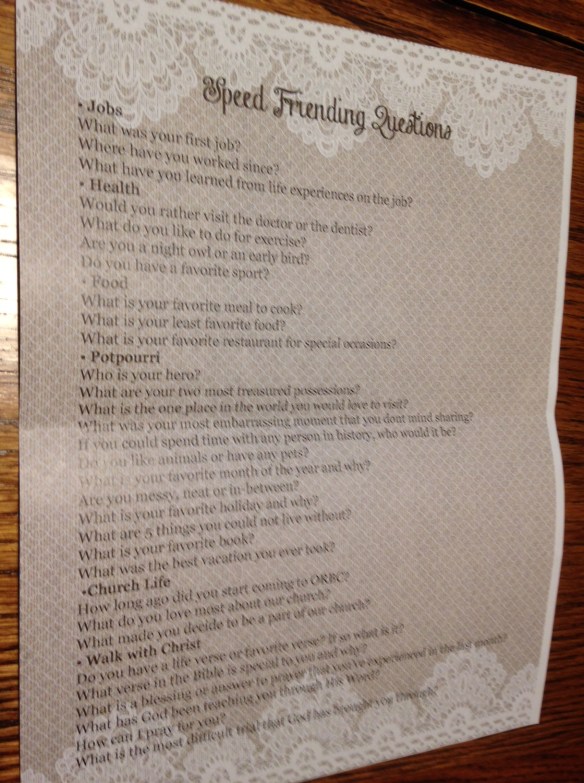
2. The Church Ladies’ Brunch with my daughter-in-law. Heard a wonderful testimony and participated in “speed friending” – we sat across from another lady, took turns asking each others questions from a provided list, and moved to the next person when someone rang a bell after 3 minutes or so. We did that for about half an hour, so we got to meet and get a little acquainted with ten ladies.

IMG_1668(1)

IMG_1689

3. Mexican food take-out on either Friday or Saturday night, I can’t remember. It was good!

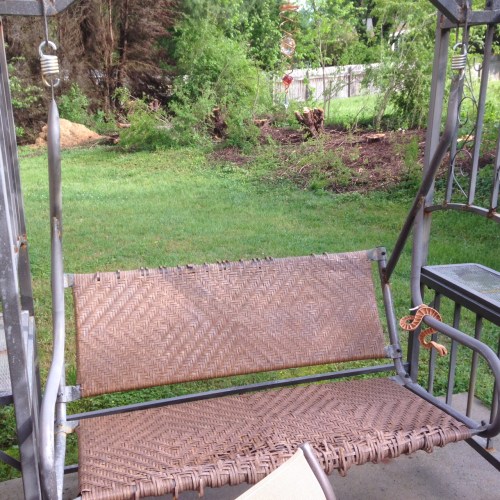
4. Refurbished swing. I showed you recently how my patio swing had deteriorated after just four years. My husband painted it and built a new seat and back for it. We sat in it and talked last night.

IMG_1653

Rusty, deteriorating swing


IMG_1690

Refurbished swing!

5. Thoughtful son and daughter-in-law. As I write this on Thursday afternoon, I got back not long ago from a follow-up visit to the cardiologist. Everything’s fine – I’m told to keep doing what I am doing and he’ll see me in a year unless something comes up (Yea!) Because the appointment was a distance away, they took a long time to call me back, traffic was heavy, and it was raining, I spent most of the afternoon out. Then my son texted me asking if I’d like them to bring or make dinner tonight. Well, sure! I can’t imagine that I’ll ever turn down someone else making me a meal! But especially on a busy day, it’s nice to be able to just relax until dinner time instead of having to start dinner. I’m not sure what we’ll have, but I know it will be good!

Happy Friday!


Book Review: One Perfect Spring

One Perfect SpringI’ve seen many blog posts recommending Irene Hannon, so when One Perfect Spring came through on a Kindle sale, I got it. Hannon is most known for mysteries, but has written a few contemporary romance novels, this being one of them.

The story opens with workaholic Keith Watson sifting through requests for his boss’s McMillan Charitable Foundation to find the best two or three he could recommend. Among them he finds a handwritten note from an eleven year old girl named Haley asking for the firm’s help for her neighbor. Haley had seen Mr. McMillan’s picture in the newspaper and was told by her mom that he “did nice things for people.” Her neighbor was seeking for a son she had given up for adoption, and Haley wanted Mr. Macmillan to help her. Keith places the note on the reject pile to be sent a standard letter. But his boss finds the note and wants Keith to follow up on it. He sees in Keith a younger version of himself and wants to help him avoid the mistakes he made in putting his work first place for too much of his life. Keith is less than thrilled, but follows through.

The neighbor in question is Maureen Chandler, a college professor. She had just been through cancer treatments that seemed to be successful so far, but the bout caused her to reflect. She had given up her son twenty-two years ago and kept him a secret. Now she wants to make a connection and try to find some closure.

Keith’s pursuit leads him not only to Maureen, but her neighbor, Haley’s mother, Claire Summers. Claire is a single mom who bought a fixer-upper house and is trying to take one project at a time as the budget allows, doing much of the work herself to save money. Keith and Claire don’t hit it off at first, but Maureen and David MacMillan do.

While Keith works on Maureen’s case, some of each character’s past and issues are revealed. They have to learn that dealing with the past and forgiveness are necessary parts of preparing for a future, that learning to trust again is possible but takes time, and that giving a person another chance is necessary.

I enjoyed the story very much. But one aspect of Hannon’s writing grated on me after a bit.

“Mmm. Cream cheese…sweet, smooth, and yummy. Kind of like the man who’d brought it.”

“The effort to eradicate [the paint] chafed her skin, leaving an angry red blemish. Kind of like the lingering blemish left on her heart…”

“[The chair] must be stronger than it looked. Kind of like the owner of this house.”

“She transferred the [hot] dish to the table as fast as she could, touching it as briefly as possible. Kind of like the way she’d handled the events that had gotten her into a mess…Like the hot casserole, her story had the power to burn.”

“[The race] was neck and neck, making the outcome hard to predict. Kind of like the outcome of her relationship with Keith.”

There are half a dozen or so of these “kind of like” comparisons, and many more that don’t use that exact phrasing (“She picked up his glass, swirling the ice that was quickly melting in the heat of the house. Warmth could melt so many things. Including hearts.” “She swiped up a stray drip of mustard left from their dinner, the cheerful hue reminding her of Haley’s comment about Keith brightening up their house.” “It was only a room. But could it symbolize more?”) The first time, I thought, “She didn’t just do that, did she?” Symbolism is a great literary device, but it’s usually much more subtle than that. I don’t think many people see that many connections or object lessons throughout life.

But I am hoping that this isn’t characteristic of Hannon’s writing, and I liked the story well enough to seek out another of her books. In fact, the preview of one of her mysteries at the end of this book hooked me in enough to want to find out what happened.

If you like clean (except for one inexplicit yet to me kind of tacky reference) Christian fiction where characters are realistically flawed, yet learn and grow through the story, you would probably like this book.

(Sharing atΒ Semicolonβ€˜s Saturday Review of Books)

Uncontrolled Reactions

Photo Courtesy of Photokanok at FreeDigitalPhotos.net

Photo Courtesy of Photokanok at FreeDigitalPhotos.net

I’ve never been particularly interested in or good at science classes, though I could always pass them fairly easily. My college major of Home Economics Education required a few sciences, though: biology, chemistry, and zoology. I have never figured out the zoology requirement – all I remember from that class is a session about parasites in some countries that could get into a break in the skin if you’re wading and grow the length of your leg – inside your leg. (Yikes!)

The chemistry class was a very basic one that mostly Home Ec. and P. E. majors took. Some of my memories from it were the experiments where we had an unidentified solution and had to try to do different things to it to determine what it was. I enjoyed the puzzle-solving aspect of that. One other memory from that class comes from one of our first times doing lab work. Among the safety instructions was this: if you pick up a beaker or test tube that is excessively hot, don’t drop it. Whether it’s hot from a chemical reaction or from heating, dropping it would likely cause it to break, splash, or spill, causing more damage to one’s skin than a momentary burn. We were instructed to carefully and calmly put it down, and then see if our burned skin was anything more than minor discomfort. I’m sure there had to have been instructions on avoiding that problem in the first place (timed heating, tongs, gloves, etc.), but what stood out to me was the necessity of controlling a reaction in a situation where a natural but uncontrolled one would multiply any damage already done.

This came to mind recently when a reaction of mine could have been disastrous if the circumstances had been just a little different. I find I am in the most danger of an uncontrolled reaction when I’m angry, hungry, frustrated, over-tired, over-stimulated, wronged. But I don’t see any of those listed as excuses in Scripture for not being filled with the Spirit. Yes, there is grace and forgiveness. Yes, God remembers that we’re just dust, and we need to do the same. But He does want us to grow in grace and the knowledge of Him and to continually change us to act more and more like Him. Lashing back at hurtful words, yelling at a child who has done wrong, matching the speed of the car trying to cut us off, could all cause more damage than the original offense.

I’m not talking about stuffing or burying our feelings. Sometimes we need to clear the air, deal with an offense, make a change. But we do also need to be forbearing, loving, and kind, which does not characterize uncontrolled reactions.

Usually afterward I can put the situation in perspective, apply Scriptural truth, see what I should have done. But how to keep from those wrong reactions in the first place?

I read just recently that we have more self-control than we think we do, because there are certain people we wouldn’t react wrongly in front of (a boss, a pastor, etc.), and because we can shift gears if, for instance, we answer the phone or someone walks in. Perhaps pretending that someone I respect is with me or watching me would help – or, more likely, to remember that my Lord is with me and watching all the time.

Of course, the general means of Christian growth help as well: reading, remembering, and meditating on Scripture, prayer, etc. Perhaps specific study in problems areas or in yielding to God’s control would particularly help. The more we are in God’s Word, the more the Holy Spirit can bring it to our minds when needed. “But I say, walk by the Spirit, and you will not gratify the desires of the flesh” (Galatians 5:16).

Here are some other steps that I find helpful:

  1. Stop. Just stop whatever the natural reaction is and take a moment to take a deep breath and think.
  2. Pray – for help, for the right reactions, for wisdom.
  3. If possible, get a few moments alone. That helps emotions to cool down and gives time to gain perspective. When my children needed to be disciplined, we always told them to go sit on our bed, wait for us, and think. While we did want them to think about the situation, we also needed that time to make sure our own emotions were under control, to pray, and to discuss the best course of action.
  4. Take care of whatever needs to be taken care of at the moment. (Wipe up the spill, slow down, feed the hungry child, etc.)
  5. Listen to that voice in your head telling you not to react the way you feel like reacting.
  6. Remember the damage that could be caused if you react the way you feel like reacting.
  7. Let it go. Not like the Disney song, but, as someone once said, you don’t have to attend every argument you’re invited to. So what if another driver cuts me off, if every line I get in at the store slows to a stop, if interruptions invade my day. It’s not the end of the world. Who says I have any right to expect everything to go exactly my way all the time? (I need to preach this to myself often!)
  8. Don’t feed the flame. This is related to the above, but don’t keep rehearsing over and over whatever got you upset in the first place. That’s only going to keep your emotions stirred up.
  9. Die to self. “See in this which seems to stir up all you most wish were not stirred up β€” see in it a chance to die to self in every form. Accept it as just that – a chance to die” (Amy Carmichael).
  10. Afterward, consider ways the problem could be avoided next time (leave early enough so that I am not stressed driving, don’t over-schedule, get enough rest, make sure to listen to what the other person is saying and ask questions to avoid misunderstanding, etc.)
  11. Don’t give way in little things and then expect to be longsuffering in major areas.

A word of explanation about that last one: I used to think that if I gave way to temper or frustration in little things when I was home alone, it wouldn’t be a problem: there was no one to see me and no one would be hurt by anything I said or did. But I was wrong, because it fosters the habit of giving way instead of reinforcing the exercise of self-control.

In our last couple of Sunday School classes, we’ve been talking about Moses, specifically the incident in Numbers 20 when the children of Israel needed water and got after Moses about it. Moses went to God, and God told him to speak to the rock, and water would come forth. But after chiding the people a bit, Moses struck the rock instead of speaking to it. Now, I confess I would have lost it with the people long before Moses did. In verse 12 God says Moses’ action reflected unbelief. I don’t know whether he was going by the formula that worked before (in Exodus 17, God did tell Moses to strike a rock to get water), trusting in his action or his rod rather than in the word of God, or what exactly. His words, “Must we fetch you water out of this rock” (verse 10) indicates he was trusting in his action rather than God’s word. But for that God barred him from entering into the promised land that he had been leading Israel to for almost 40 years (verse 12), one of the costliest consequences of an uncontrolled reaction recorded in Scripture. On the other hand, David, when slighted and repulsed by Nabal, was going to come and decimate Nabal and his men until Abigail intervened and talked him down with her calmness, reason, and gifts (1 Samuel 25). To David’s credit, he listened and stopped what he planned to do, and God took care of Nabal. Abigail prevented major bloodshed and became David’s wife.

Of course, our prime example of godly, controlled reactions is our Lord Jesus. His turning out the money changers in the temple was not a temper tantrum: it was a cleansing of His Father’s house. He “did no sin, neither was guile found in his mouth:Β Who, when he was reviled, reviled not again; when he suffered, he threatened not; but committed himself to him that judgeth righteously:Β Who his own self bare our sins in his own body on the tree, that we, being dead to sins, should live unto righteousness: by whose stripes ye were healed” (I Peter 2:22-24). The more we “with unveiled face, behold the glory of the Lord,” the more we”are being transformed into the same image from one degree of glory to another” (2 Corinthians 3:18).

Wherefore, my beloved brethren, let every man be swift to hear, slow to speak, slow to wrath. James 1:19

But the fruit of the Spirit is love, joy, peace, longsuffering, gentleness, goodness, faith,Β Meekness, temperance: against such there is no law. Galatians 5:22-23

________________

See also:

It’s the Little Things.
Irritants as God’s Messengers.
Beholding His Glory.

( Sharing with Inspire Me Monday, Testimony Tuesday, Woman to Woman, Works For Me Wednesdays, Thought-provoking Thursday.)