The Mother’s Hymn

The Mother’s Hymn

by William Cullen Bryant.

Lord, who ordainest for mankind
Benignant toils and tender cares!
We thank Thee for the ties that bind
The mother to the child she bears.

We thank Thee for the hopes that rise,
Within her heart, as, day by day,
The dawning soul, from those young eyes,
Looks, with a clearer, steadier ray.

And grateful for the blessing given
With that dear infant on her knee,
She trains the eye to look to heaven,
The voice to lisp a prayer to Thee.

Such thanks the blessed Mary gave,
When, from her lap, the Holy Child,
Sent from on high to seek and save
The lost of earth, looked up and smiled.

All-Gracious! grant, to those that bear
A mother’s charge, the strength and light
To lead the steps that own their care
In ways of Love, and Truth, and Right.

(HT to Ivory Spring, where I saw this a couple of years ago).

My heart echoes the last stanza especially, even though mine are grown men now.

Happy Mother’s Day!

mothers-day-flowers-13

Laudable Linkage

Unfortunately Delicious.com, where I have been saving links for 8-10 years now, has been down for a week or two now. I hope it gets fixed soon – I would hate to think I’d lost all those, especially some I have returned to multiple times. It may be time to investigate Evernote or a different source. What do you use to save links you want to remember and return to?

Anyway – for now I have just been making a list of them. As you might expect, with Mother’s Day on Sunday, there have been a lot of posts relating to mothers this week.

To My Friends Who Still Have Their Mothers.

This Stage of Life? It’s Hard.

Don’t Blink.

Joy at Rejoicing in the Present has been running a series on moms in different situations. The two that stood out to me were A Letter to the Mommy-Heart Whose Dream Didn’t Come True and A Letter to Moms With Physical Limitations, but there are also posts about losing a child and having special needs children.

Coping With Verbal Abuse when a mom has Alzheimer’s.

And a couple not relating to mothers directly:

5 Question Checklist for Blog Commenting.

40 Most Valuable Toys From Your Childhood.

Susan at Girls In White Dresses is hosting a giveaway for an ESV Family Devotional Bible.

And finally, this cracked me up:

Happy Saturday!

Friday’s Fave Five

friday fave five spring

It’s Friday, time to look back over the blessings of the week with Susanne at Living to Tell the Story and other friends.

My posting has not gone as planned this week….but perhaps that means the things I wanted to work on either weren’t in God’s plan yet and/or need more incubation. 🙂 But here are some high points of the last week:

1. A meal with my husband in a restaurant. I think you call that a date. 🙂 All the kids had other plans for lunch Sunday, and there was a little Asian place near church we thought we could get in and out of before Great-Grandma’s caregiver had to leave. We did. It was very nice!

2. The tree saga is finally over. I mentioned a couple of weeks ago that we had about 50 trees that were dead (hemlocks, we were told) and needed to be cut down. We’ve had guys coming by and leaving their business cards for tree-cutting for months now. We called one who worked about 15 hours over three weeks and got 17 of them down, but would not show up or answer calls for days and then asked for more money. We finally gave him a deadline, and when that passed with the job unfinished, we moved on. The second guy did the same thing over a weekend, and we decided we weren’t going through this again. The third guy had a much higher bid, but he dug in and stuck with it til it was done. They’re all down now, so it’s nice to have it taken care of (and to enjoy the lack of chainsaw noise. 🙂 ).

3. Privacy. We were afraid that taking down the trees would remove any privacy from the neighbors directly behind us. We do most of our living on that side of the house and I wasn’t keen on being able to be seen through the windows. But one had enough shrubs and trees in their back yard that it’s not a problem, and the other house is empty. We’re planning on putting a fence up, but it’s nice we don’t have to feel on display until then.

4. Little grandson kisses. Timothy’s gotten more kissy lately. Nothing sweeter than a little boy being glad to see you, wanting up, and pulling you in for a kiss. ♥

5. Gluten-free snacks. My d-i-l has to avoid gluten due to stomach issues. We’ve found good alternatives to most things, but sweet snacks seem the hardest to use anything other than wheat flour. I passed by these in the store yesterday and thought they looked good – and they were!!!

IMG_1667

We’ve been enjoying beautiful spring weather this week. A little rain one day, but otherwise sunny, with today being just the right degree of coolness.

Happy Friday!

Christians with political differences

Arguing

Photo Courtesy of Ambro at freedigitalphotos.net

Normally I stay far away from politics online, especially here. It’s just too volatile a subject, with good people on the opposite sides of some fences.

While differences and their tensions are present every election, I’ve been dismayed this year by comments such as, “I don’t see how any Christian can vote for that candidate.” We don’t need to call each other’s spirituality into question over politics.

I came across a couple of good posts this morning on the subject. Especially now that it looks like the final nominees are not the ones some of us wanted, we have been pondering what to do. In Can You Vote For Trump With a Clear Conscience? Andy Naselli discusses the options, none of which is ideal, but makes the point that believers can vote in totally opposite ways or think in different ways about this and still have a clear conscience. He’s obviously against Trump, but I’m sharing this for his delineation of the different ways a Christian’s conscience might lead him to vote, not necessarily for his views on Trump, even though I agree with many of them. For or against, “fellow Christians who are members of the same church should be able to disagree on these issues and still have close fellowship with each other” – and fellow Christians who don’t go to the same church should be able to do this with disputable matters as well.

Joel Arnold brings out many good points as well in Trump vs. Clinton: The Story of the Great Evangelical Predicament. He notes, “It’s entirely possible that there is not a single ‘right Christian response'” and “red vs. blue isn’t light vs. darkness.” “Don’t call your friend a liberal/heretic/moron because he didn’t agree with you.”

In this arena as well as all others, we need to remember:

  1. To “Let your speech always be gracious, seasoned with salt, so that you may know how you ought to answer each person” (Colossians 4:8).
  2. To be “wise as serpents, and harmless as doves” (Matthew 10:16).
  3. To spend more time praying than arguing over these options.
  4. Though we do have a responsibility to be aware of issues and vote our conscience, our ultimate hope and the greatest need of any citizen is not in a political candidate.

See also:

Thoughts on Inauguration Day.
Thoughts About the Election.
Post-election Blues.

Book Review: Beyond Stateliest Marble

I first “discovered” Puritan poetess Anne Bradstreet in a college American Literature class, and loved her work. I focused on her for one of my 31 Days of Inspirational Biography series a couple of years ago. So when I heard there was a good biography of her life, I put it on my Christmas “wish list.”

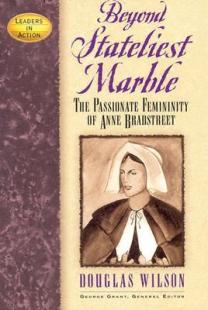
Beyond Stateliest MarbleI finally got to it this past month: Beyond Stateliest Marble: The Passionate Femininity of Anne Bradstreet by Douglas Wilson. The title comes from a quote by Cotton Mather, leading preacher of the day, saying that Anne’s poetry provided a “monument for her memory beyond the stateliest marbles.”

In all honesty, I spent the first 3/4 or so of this book being aggravated at it for what it lacked as a biography. It took that long for me to realize it’s not really a biography. Wilson says near the end it’s a tribute to her. It’s part of a “Leaders in Action” series, so it’s presenting that aspect of her. And the great bulk of it is a treatise. So once I realized and acknowledged those things, I was able to relax and take it for what it was.

One of Wilson’s biggest purposes in writing the book (what I called his treatise) is to defend against two erroneous suppositions: that the Puritans were dour, repressed, cheerless, unimaginative, legalistic people as a whole, and, 2) that Anne was anything but a thoroughgoing Puritan. Many modern treatments of Anne will portray her as a closet feminist, or an anomaly, or as having written such bright poetry in spite of her setting and position as a wife and mother rather than her Puritans beliefs, community, and calling as a wife and mother being the springboard from which she wrote. I do believe these misunderstandings at best, or false accusations at worst, do need to be shown as mistaken and wrong, and this book does a very good job of that.

The book is divided into three parts: her life, her character, and her legacy. The chapters are generally thematic rather than linear. We do get some of Anne’s background in the first section: the kind of family she grew up in, the times and setting, her marriage to Simon Bradstreet, their decision to sail from England to America, the voyage, the adjustments for a cultured woman in a non-settled area, her children, and her writing. She had no intentions of publishing her work, but her brother-in-law took copies of her poems and had them published in 1650 in England under the title The Tenth Muse Lately Sprung Up in America (or, to be exact: The Tenth Muse, lately Sprung up in America, or Several Poems Compiled with Great Variety of Wit and Learning, Full of Delight, Wherein especially is Contained a Complete Discourse and Description of the Four Elements, Constitutions, Ages of Man, Seasons of the Year, together with an exact Epitome of the Four Monarchies, viz., The Assyrian, Persian, Grecian, Roman, Also a Dialogue between Old England and New, concerning the late troubles. With divers other pleasand and serious Poems, By a Gentlewoman in those parts.)

It was well-received, to say the least, and her poetry has been well-read ever since.

The second section deals with about 30 different character traits (each chapter focusing on one and only about three pages) with Wilson illustrating those traits in Anne’s life either through her poetry or others’ comments about her. And the last section contains four chapters dealing with her legacy.

Though I appreciated what I learned about Anne in this book, overall I felt it contained too much of Wilson and not enough of Anne. I know that “show, don’t tell” is a mantra of fiction rather than non-fiction, but I felt Wilson spent too much space telling his opinions about Anne and what he thought was right and wrong and not enough of showing her through her own writings. I also didn’t like his tone, which I felt was condescending towards those he disagreed with. He faults others for the broad brush strokes with which they portray the Puritans, but then he does the same towards other groups. But most of the reviews I perused on Goodreads voiced high praise for this book, so don’t take my word for what I consider its problems. Maybe our personalities just don’t mesh: in his chapter on humor, I didn’t think anything he brought up as an example of humor was remotely funny (for instance, he says that when Christ brought up to the woman at the well in John 4 that she’d had five husbands and the man she currently had was not her husband, that he was teasing her [p. 163]. I don’t think Jesus would tease people about their sin, and she certainly didn’t seem to take it as a joke.)

However, I do agree with him that Anne is a worthy subject, and that the Puritans were not what people think of them today, and that Anne was content as a wife and mother within a conservative Christian setting and wrote from that setting contentedly, not rebelliously.

One quote of Anne’s that stood out to me was in reference to her children: “Diverse children have their different natures; some are like flesh which nothing but salt will keep from putrefaction, some again like tender fruits that are best preserved with sugar…Those parents are wise that can fit their nurture according to their nature.”

Though some of her poetry’s subjects include theology and even the Queen, my favorites are the ones dealing with her walk with God, and her home, and family. I’ll close with my favorite two:

By night when others soundly slept
And hath at once both ease and Rest,
My waking eyes were open kept
And so to lie I found it best.

I sought him whom my Soul did Love,
With tears I sought him earnestly.
He bow’d his ear down from Above.
In vain I did not seek or cry.

My hungry Soul he fill’d with Good;
He in his Bottle put my tears,
My smarting wounds washt in his blood,
And banisht thence my Doubts and fears.

What to my Saviour shall I give
Who freely hath done this for me?
I’ll serve him here whilst I shall live
And Loue him to Eternity.

___

To My Dear and Loving Husband

If ever two were one, then surely we.
If ever man were loved by wife, then thee;
If ever wife was happy in a man,
Compare with me ye women if you can.
I prize thy love more than whole mines of gold,
Or all the riches that the East doth hold.
My love is such that rivers cannot quench,
Nor ought but love from thee give recompense.
Thy love is such I can no way repay;
The heavens reward thee manifold, I pray.
Then while we live, in love let’s so persever,
That when we live no more we may live ever.

(Sharing at Semicolon‘s Saturday Review of Books)

Book Review: Robinson Crusoe

CrusoeI tried to read Robinson Crusoe by Daniel Defoe some years ago, but, even though I know to be patient with older classics, I was bored to tears and never finished it. When I listened to The Moonstone recently, one of the characters in it referred to Robinson Crusoe quite a bit, and I thought, that’s it, I have got to finally read this thing. 🙂 I did not find it hard at all to get into this time. I think listening to an audiobook, read by David Warner’s easy-on-the-ears voice, helped immensely. I read parts in the online version on Project Gutenberg.

All I knew about the story was that Crusoe went off to sea in rebellion to his father’s wishes and somehow landed on a deserted island – deserted, he thought, until he had been there alone for some years and then was startled one day to find a single footprint that he knew wasn’t his, and that later he finds a black man whom he names Friday who becomes his servant. I didn’t realize that there were other adventures, both before and after his time on the island. In fact, the original (and very long) title to this book was The Life and Strange Surprizing Adventures of Robinson Crusoe, Of York, Mariner: Who lived Eight and Twenty Years, all alone in an un-inhabited Island on the Coast of America, near the Mouth of the Great River of Oroonoque; Having been cast on Shore by Shipwreck, wherein all the Men perished but himself. With An Account how he was at last as strangely deliver’d by Pyrates. Quite a mouthful! These days it’s usually shortened to The Life and Adventures of Robinson Crusoe or just Robinson Crusoe.

Wikipedia says this book, published in 1719, “is often credited as marking the beginning of realistic fiction as a literary genre,” and Sparknotes comments, “His focus on the actual conditions of everyday life and avoidance of the courtly and the heroic made Defoe a revolutionary in English literature and helped define the new genre of the novel. Stylistically, Defoe was a great innovator. Dispensing with the ornate style associated with the upper classes, Defoe used the simple, direct, fact-based style of the middle classes, which became the new standard for the English novel.”

The story opens with a bit of background of Crusoe’s family. “Being the third son of the family and not bred to any trade, my head began to be filled very early with rambling thoughts.” His father wanted him to go into law, but Robinson “would be satisfied with nothing but going to sea.” His father earnestly admonished him that he had an opportunity for a comfortable life that had none of the problems of the very poor or very rich, and that he feared that if Robin persisted in his plans, it would come to no good end. Robin listened and waited a year, but in all that time could not make himself settle down to a profession. When he was nineteen, an opportunity arose for him to go out on a friend’s father’s ship, and “I consulted neither father nor mother any more, nor so much as sent them word of it; but leaving them to hear of it as they might, without asking God’s blessing or my father’s, without any consideration of circumstances or consequences,” he went.

His first journey is beset by storms and seasickness; his second journey ends with the ship being overtaken by pirates and his being made a slave.  After a while he escapes with a young boy named Xury, whom he makes his servant. They are rescued by the captain of a Portuguese ship, which takes him to Brazil. He sells Xury to the captain, obtains a plantation, and gets on fairly well for a number of years. Then he goes out to sea again with some others to obtain slaves, and that ship wrecks in a storm and Robinson lands, alone, on the island where he will spend the bulk of his life.

A great part of the story is taken up with his management on the island. He’s greatly afraid at first until he explores enough to find that he is alone and there doesn’t seem to be any kind of dangerous creatures. He fashions a raft and gets as much as he can off the ship before it’s broken to bits. Then he sets about making a shelter and planning how to ration his supplies and supplement them with what he can find on the island.

He calls it the “Island of Despair.” Many times he feels bad about his situation and prays to God for help, but he’s not really repentant yet. He’s like the stony ground in the parable of the sower in which something seems to be growing at first, but as the bedrock beneath has never been broken up, spiritual life doesn’t really take root. It’s not until some time later when he is very sick with ague that he comes to the end of himself and truly repents and turns to God. The book is surprisingly frank and orthodox about spiritual issues (surprising in the sense that a book this close to Biblical truth, and, in fact, somewhat didactic at times spiritually, has been so popular for hundreds of years. I’m glad – just surprised. Even the Sparknotes and Shmoop commentaries handle this aspect with being derogatory). When he gets discouraged, he makes up a list of the bad and the good: I’m alone on a desert island/at least I’m alive; I don’t have clothes/but I’m in a hot climate where I don’t need them, etc., and thus he is encouraged.

As first Robinson is in bare survival mode, but after a while his skills and possessions increase. He knows he must make provision for when his supplies from the ship run out. He throws out some leftover seed from a bag and is surprised when corn and barley grow from what he thought was just dust and feed remains, and he thanks Providence. He finds some birds which are good to eat, as well as turtles (which he cuts open to gather their eggs). He is pretty ingenious: one thing he lacked was any kind of iron. Once when cooking something in an earthenware pot he made, a piece of it broke off in the fire and became hardened. He began to try ways of heating his clay creations to make hardened, watertight vessels. Much of this and the rest of his work was trial and error, and many things took a great deal of time. Much of the middle section of the book is his dealing with these kinds of things and musing to himself.

He learns to be pretty content expect for the lack of companionship and sometimes feels like “my majesty the prince and lord of the whole island.” He even makes different areas to live, calling one his castle and another his “country house.”

But the pivotal moment comes when, after years on the island alone, he unexpectedly finds a man’s footprint in the sand. Further investigation leads to a site where cannibals have had a disgusting feast. Robinson determines to prepare for the next time they come to the island and kill them all, but then he wrestles with his conscience about whether that would be the right thing since they don’t know they are doing wrong. When they do come again, one of their prisoners breaks away. Robinson rescues him, names him Friday (that being the day of the week he found him), and makes him his servant.

This is one area that would offend modern sensibilities: Crusoe’s making Xury and servant and then selling him, and then making Friday a servant. Friday seems happy to be a servant in exchange for his life having been saved, but it seems arrogant and ungracious for one person to enslave another. It was the way of the world then, but Sparknotes makes this interesting analysis from Chapters 24-27:

The affectionate and loyal bond between Crusoe and Friday is a remarkable feature of this early novel. Indeed, it is striking that this tender friendship is depicted in an age when Europeans were engaged in the large-scale devastation of nonwhite populations across the globe. Even to represent a Native American with the individual characterization that Defoe gives Friday, much less as an individual with admirable traits, was an unprecedented move in English literature. But, in accordance with the Eurocentric attitude of the time, Defoe ensures that Friday is not Crusoe’s equal in the novel. He is clearly a servant and an inferior in rank, power, and respect. Nevertheless, when Crusoe describes his own “singular satisfaction in the fellow himself,” and says, “I began really to love the creature,” his emotional attachment seems sincere, even if we object to Crusoe’s treatment of Friday as a creature rather than a human being.

Robinson begins to teach Friday about God and Christianity, which Friday readily seems to accept.

What happens to Crusoe and Friday, what other visitors come to the island, and their other adventures off the island, I’ll leave for you to discover.

I’m glad to finally know the story of Robinson Crusoe. Have you read it? What did you think?

(Sharing at Semicolon‘s Saturday Review of Books)

 

Book Review: The Hardest Peace

Some of you may know the name Kara Tippetts. She was a young pastor’s wife and mom of four who blogged at Mundane Faithfulness, first as a mom blogger, but then sharing God’s grace in her diagnosis and battle against cancer. She passed away about a year ago and her blog now runs archives of her past posts. She came to national attention when, in the midst of her own battle, she wrote an open letter to Brittany Maynard, who was planning to employ physician-assisted suicide to avoid the downward spiral and suffering of a brain tumor, to beg her not to take that route, to promise that God would meet her in her suffering.

I didn’t read Kara’s blog regularly. I would look at the occasional post that someone linked to on Facebook or their blog. But it was too raw, too intense, too much (for me) to read every post.

Hardest PeaceBut I got her book, The Hardest Peace: Expecting Grace in the Midst of Life’s Hard when it was on sale. And just recently someone asked me if I knew of anything to help a woman she knows who is struggling to face her own cancer diagnosis, so I thought I’d read this and see if it would.

Ecclesiastes 7:2 says, “It is better to go to the house of mourning than to go to the house of feasting, for this is the end of all mankind, and the living will lay it to heart.” Nothing wrong with feasting (God planned some into Israel’s calendar, Jesus attended a wedding feast), parties, joy. But someone’s death or dying turns the heart and mind turn to the eternal like perhaps no other situation. We’re reminded that eternity is real, that life really is but a vapor, that Jesus provided a way for heaven, and not this world, to be our final home. That heaven isn’t a cheery add-on to a nice life, but it’s our real home, and this world is just one we’re “strangers and pilgrims” in.

And in Kara’s situation, it was not “just” illness, suffering, and death that she had to wrestle with. It was leaving her husband and children, and finding the peace to trust God that He would work this for good in their lives, and struggling to believe that this was His best for them, even praying for the woman who might some day take her place.

Kara gives us a brief biography of the kind of home she grew up in, of coming to know Christ as Savior, of going to work at a camp as a very raw, green, and unconventional recruit but experiencing life-changing growth in that place. Of meeting her husband and having to learn to put away the anger she grew up with. Of her four children, her husband’s ministry, a difficult church situation, moving to plant a church only to find their new home in a fire zone from which they had to be evacuated. And then receiving her diagnosis, fighting it with surgery and treatments, having it spread, and finally accepting that God was calling her home. She says in this trailer to a documentary made about her that she felt like a little girl at a party whose dad was telling her she had to leave early, and she was “throwing a fit” about it.

“Jason recently said in a sermon, ‘We want suffering to be like pregnancy—we have a season, and it’s over, and there is a tidy moral to the story.’ I’ve come to sense that isn’t what faith is at all. What if there is never an end? What if the story never improves and the tests continue to break our hearts? Is God still good?”

“It would be easier to shake my fist at the test results and scream that this isn’t the right story, but to receive—humbly receive—the story no one would ever want, and know there is goodness in the midst of its horror, is not something I could ever do in my own strength. I simply cannot. That receiving comes from the One who received His own suffering for a much greater purpose than my own.”

“That though the hard might come and our hearts be broken, that brokenness isn’t bad. The tears are evidence of our love for one another. They did not stop that day, and they will not stop in the days to come. But tears are a gift, not something to withhold or bottle up—they are the essence of the best of life.”

“Trusting God when the miracle does not come, when the urgent prayer gets no answer, when there is only darkness—this is the kind of faith God values perhaps most of all. This is the kind of faith that can be developed and displayed only in the midst of difficult circumstances. This is the kind of faith that cannot be shaken because it is the result of having been shaken. Nancy Guthrie, Holding on to Hope.”

“Sometimes the hardest peace to find is the peace in saying good-bye and leaving the work of justice and reconciliation to Jesus.”

“Hard is often the vehicle Jesus uses to meet us, point us to that peace, and teach us grace.”

“If the hardest is asked of us, we believe grace will be there.”

“Dear heart, the purpose of life is not longevity.”

“But because I believe God’s plans for me are better than what I could plan for myself, rather than run away from the path he has set before me, I want to run toward it. I don’t want to try to change God’s mind—his thoughts are perfect. I want to think his thoughts. I don’t want to change God’s timing—his timing is perfect. I want the grace to accept his timing. I don’t want to change God’s plan—his plan is perfect. I want to embrace his plan and see how he is glorified through it. I want to submit. Nancy Guthrie, Holding on to Hope.”

“Seeking grace has been a theme since I met Jesus, but it wasn’t the very air I breathed to get through each moment—each scary, hard moment. The looking has now become my practice. The names of the graces, the gifts I don’t deserve, is new to me. But I do not believe you need to face cancer to see the value of looking for and naming the graces in your own moments, days, weeks, lifetime. To capture this beauty in this weariness, even if your story doesn’t look like mine, will enrich your moments, give you a new perspective, and help you lift your head in the impossibility and pain in living. Hard is hard.”

So, yes, this was a raw, wrenching read in many parts. But it was still a good and necessary one, because we all have to face our own mortality, and there is no guarantee we won’t have to do so for 60-80 years. We need to be ready.

And whatever our “hard” is, as she said in the last quote, when we know Jesus, we can trust Him for the grace to meet it.

(Sharing at Semicolon‘s Saturday Review of Books)

Friday’s Fave Five

friday fave five spring

It’s Friday, time to look back over the blessings of the week with Susanne at Living to Tell the Story and other friends.

It’s so hard to believe April is about over. I don’t know where this month went! But here are some highlights from the last week:

1. “Skinny” Chocolate “Ice Cream.” I’ve been collecting lower-calorie or healthier recipes on Pinterest. and tried this one this week. I halved it to 1 sliced, frozen banana, 1 Tbsp. of peanut butter, and 1/2 Tbsp cocoa. It was pretty good. It was a little hard to get the frozen banana completely blended with the little off-brand “magic bullet” type blender I was using, but otherwise it was fine.

IMG_1646

2. One pound. My weight has been stuck at about the same level for a couple of weeks. It finally went down another pound this week – a pound that put me under a weight that ends in zero. 🙂 That pound from one set of ten down to the next feels really nice.

3. A quiet day. I wasn’t feeling well last weekend and ended up staying home from church on Sunday. I tried listening to a sermon online, but mainly slept while everyone was gone, then spent most of the evening reading. It was a refreshing day.

4. Two take-out meals. We got take-out from my husband’s favorite Asian place on Saturday, then, when I stayed home Sunday, I asked if we could get take-out from McAlister’s Deli for lunch – so basically I had the weekend “off” from cooking except for Great-Grandma’s stuff and heating up leftovers for Sunday night.

5. Our little grandson and his new battery-operated car – or cycle – or “mower” as he calls it, since it’s shaped like his granddad’s riding lawn mower. My husband checks several “deal” sites often and found it for a good price. It was so fun to show it to Timothy and hear his giggles as he tried it. Unfortunately I didn’t get a photo then: in this one I was trying to get him to look up and smile, but he was distracted by a neighbor on his riding lawn mower.

IMG_1647

Happy Friday!

What’s been going on around here lately

I have some thoughts for a couple of posts I haven’t had time to develop yet, and a couple of books just about ready for review. I thought about making some headway on one of those posts, but then decided to just have a chat. 🙂

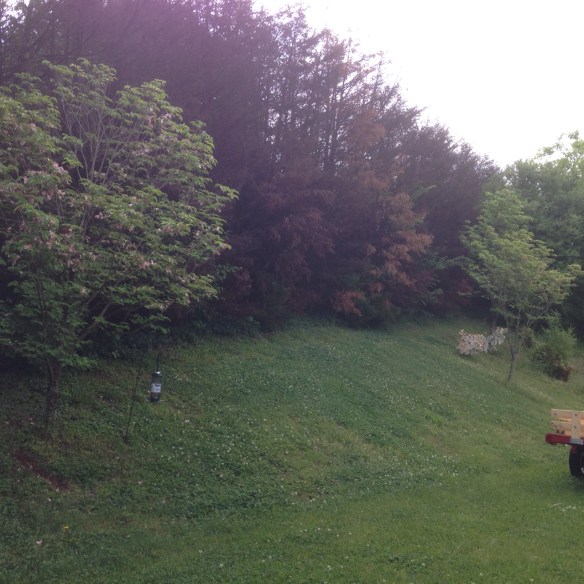
One focus of our life right now is a row of trees in our back yard. 52 trees, to be exact, that caught something called “blight” and are in the process of dying. You can see them when they were healthy in a couple of photos I shared when we had spiffed up our patio a few years ago.

This is looking to the left from the patio.

This was the view from the right:

These photos were from a Memorial Day picnic, and Jim was defending us from bugs with his electric flyswatter. 🙂 As you can tell, we don’t have much of a back yard, which bothered me a bit when we first looked at the house. But, we decided in our stage of life that we didn’t really need a big back yard, and there was less to mow that way.

These are the trees now:

IMG_1651

IMG_1652

A few years ago we noted a few brown patches in the trees, wondered if it might be a problem, decided it was just a part of the trees shedding their old foliage. But we were wrong.

Now, of course, the problem is how to get them cut down. We’ve had guys coming by dropping off business cards offering to do it for months now. Jim called one of them, but in three weeks he has only cut down 15 trees – keeps asking us for money and then disappearing for days after we give him some. (Grrr!) So we’re trying to deal with that situation.

We’re planning on putting up a fence when all the trees are down. One unexpected bright side of removing the trees is that it’s creating much more room in the yard. We didn’t realize just how much space they took up. Plus when we get a fence up, it will still provide privacy, but it won’t be as tall as the trees, so we’ll get more sunlight and our plants back there should grow better.

So, though I’ll miss our lovely green bower back there, I think everything will work out well in the end. Once we can get someone to cut them down. 🙂

Oh, and that swing in the first photo, that I had just gotten as a Mother’s Day present just before that photo four years ago….now it looks like this:

IMG_1653

I was SO disappointed that it didn’t hold up well in the weather. I had wanted to have it taken to the dump, but Jim said he thought he could refurbish it – make a wooden seat and back and treat for rust and paint it. I think that’s the best idea: I’ve looked at new ones, and just don’t like any as well as I liked this (except for high-end ones that were too many $$$).

You can see behind it a few of the trees that have been cut down. The guy is supposed to take care of the stumps, too, but I’m not holding my breath.

By the way, the rubber snake on the swing is to help keep birds from using the patio furniture for their restrooms. 🙂 We keep a few on the patio chairs. It seems to work except when they’ve gotten used to them, so it helps to rearrange them or add a new one every now and then. They’re only $1 at Wal-Mart, so not a bad investment.

In other news…Great-Grandma has been a little sick lately. She had a cough and was having trouble eating because she couldn’t coordinate breathing with swallowing. You don’t think about needing muscles to cough, but with her losing muscular ability over the years, she coughs but can’t really bring anything up. Now she’s pretty much only coughing when she’s lying flat, when we change her, but it sounds worse. She’s had a low grade fever off and on. The hospice nurse was out yesterday and has called in some cough medicine and an antibiotic, so hopefully she’ll be on the mend soon.

And, finally…my husband peruses various “deal of the day” types sites, and recently came across a little battery-powered vehicle for Timothy. We thought about giving it to him before his birthday, then for his birthday, then decided to wait on it. We just gave it to him last week. He was so excited – he loves anything on wheels and figured out how to use it right away. He calls it his “mower” because it’s shaped like Granddad’s riding lawn mower. I was trying to get him to look up and smile when I was taking this picture, but he was distracted by a neighbor on his riding mower. 🙂

IMG_1647

Such fun! I wish I could upload a little video Jason made of his driving it the first time and giggling, but my WordPress account only allows YouTube or Vimeo videos unless I want to pay extra. :-/

He keeps amazing us with words and activities we didn’t know he knew.

For his birthday, Jason asked Jesse to blow up some balloons and put them in the pack-and-play. He played in there for ages – and they’re still there, two weeks later, and he plays in them every time he comes over. I’m amazed they’re still holding air.

IMG_0159

Well, I guess I’d better get back at the responsibilities of the day. Nice visiting with you!

What’s On Your Nightstand: April 2016

What's On Your NightstandThe folks at 5 Minutes For Books host What’s On Your Nightstand? the last Tuesday of each month in which we can share about the books we have been reading and/or plan to read.

The days, they are a-flying. But it’s nice to catch a few moments to read and seemingly slow time down for a bit.

Since last time I have completed:

True Woman 201: Interior Design by Mary Kassian and Nancy Leigh DeMoss, reviewed here. Excellent resource.

The Moonstone by Wilkie Collins, audiobook, reviewed here.

The Reunion by Dan Walsh, reviewed here.

A Slender Thread by Tracie Peterson, reviewed here.

Every Waking Moment by Chris Fabry, reviewed here.

What Follows After by Dan Walsh, reviewed here.

The last four were on my Kindle app. I’ve started reading from it at night before going to sleep – amazing how much you can read in that time! Occasionally a book will keep me up later than I should be, but not often. I got one more in than I thought I would due to a sick day home from church last Sunday.

I’m currently reading:

Beyond Stateliest Marble: The Passionate Femininity of Anne Bradstreet by Douglas Wilson. Not enjoying this one as much as I had expected to. 😦

Pioneer Girl: The Annotated Autobiography by Laura Ingalls Wilder and Pamela Smith Hill

The Renewing of the Mind Project by Barb Raveling

Robinson Crusoe by Daniel Defoe, audiobook.

The Hardest Peace: Expecting Grace in the Midst of Life’s Hard by Kara Tippetts

Up Next:

Pride, Prejudice, and Cheese Grits by Mary Jane Hathaway

Ten Fingers For God by Paul Brand

If I finish these, I have a stack of books to be read on my bedroom bookcase and a multitude in my Kindle.

How about you? Have these spring days allowed you some reading time?