From Depletion to Abundance

IMG_1407

In Mark 6:31-44, after a long period on ministering, Jesus and His disciples were so thronged with people that they couldn’t even find time to sit down and eat. He told them to “Come ye yourselves apart into a desert place, and rest a while.” They all got into a boat, but the people saw them and outran the boat to get to the place they were landing before they did. When Jesus “saw much people,” instead of being irritated that His plans to get alone and rest were foiled (as I would likely have done), He was rather “moved with compassion toward them, because they were as sheep not having a shepherd.”

He spent time teaching them, and “when the day was now far spent,” and they were in a setting where there was no place to buy food, the weary disciples wanted Jesus to finally send the people away. But instead, He told them, “Give ye them to eat.” Besides there being no place to buy bread, they could not have afforded enough to feed all the people (5,000 men plus women and children) anyway. He asked them what they had, which was five loaves and two fish. When everyone was seated in an orderly fashion, Jesus “looked up to heaven, and blessed” the food and broke it into pieces to give to the disciples, who in turn gave it to the people. Not only was everyone satisfied, but there were 12 baskets of food left over.

As I read this familiar account this morning, several truths stood out to me.

Jesus is concerned about our physical and emotional needs as well as our spiritual ones. It is not wrong to feel weary and make plans to get away some times. But when those plans are thwarted, I am not to cling to my “right” or “need” to be alone and regroup. God knows those needs, but if He allows someone in need of ministry to come into my path, I am to have compassion on them and minister to them. I should not be irritated with them or with Him or at the circumstances. That compassion will come as I look away from my own needs and desires and see others in their need.

But when I am depleted and don’t have enough to give, I’m not off the hook. I’m not excused from giving. He instructs me to give what I have, and when He blesses it, it’s not only sufficient, it’s abundant. Though the disciples couldn’t find time to eat, in ministering to others, they were fed. Like those Macedonians in 2 Corinthians 8, who gave liberally even out of their poverty, we’re to give even when we know what we have isn’t enough. In His hands, it’s turned into more than enough.

This doesn’t mean we’re to ignore our needs, not take care of ourselves, and run ourselves into the ground. There is still the principle employed on airplanes where people are instructed to put their own oxygen masks on before they help others with theirs.

But God doesn’t usually call on us to minister to someone when we’re feeling the most spiritual and ready. Often it comes when we’re depleted from already giving, like the disciples after a busy day of teaching and healing, or a mom after a full day of teaching, training, clothing, feeding, changing, and entertaining a little one, or a father after a long day at work, or a teacher or caregiver or nurse or minister or anyone who has already given just about all they thought they had. What we have in ourselves is never enough anyway, but when we’re “running on empty,” and we ask God to bless, fill, and use us, He ministers to us through our ministry to others.

How I praise Thee, precious Savior,
That Thy love laid hold of me;
Thou hast saved and cleansed and filled me
That I might Thy channel be.

Refrain:
Channels only, blessed Master,
But with all Thy wondrous pow’r
Flowing through us, Thou canst use us
Every day and every hour.

Just a channel full of blessing,
To the thirsty hearts around;
To tell out Thy full salvation,
All Thy loving message sound.

Emptied that Thou shouldest fill me,
A clean vessel in Thy hand;
With no pow’r but as Thou givest
Graciously with each command.

Witnessing Thy pow’r to save me,
Setting free from self and sin;
Thou who bought me to possess me,
In Thy fullness, Lord, come in.

Jesus, fill now with Thy Spirit
Hearts that full surrender know;
That the streams of living water
From our inner man may flow.

~ Mary E. Maxwell

(Sharing with Literacy Musing Mondays, Me, Coffee, and Jesus, Thought-Provoking Thursday, Soul Survival)

Book Review: Knowing God

Knowing GodEven though I’ve been posting weekly summaries of my reading from Knowing God by J. I. Packer, I still wanted to do a general review, partly for those who did not want to keep up with the weekly readings, and partly for me to have a general review to link back to.

Even though this book has been considered a classic and has been in print for over 40 years, somehow I had never gotten around to reading it before, though I had heard of it and wanted to.

Packer says the most basic definition of a Christian is that he or she is a person who has God as Father. We are not all God’s children: we become His when we believe on Jesus Christ as our Lord and Savior.

Packer begins with the virtues of studying about God as well as the warning not to stop with just the academics, but to use what we learn to get to know God personally.

To be preoccupied with getting theological knowledge as an end in itself, to approach Bible study with no higher a motive than a desire to know all the answers, is the direct route to a state of self-satisfied self-deception. We need to guard our hearts against such an attitude, and pray to be kept from it (p. 22).

The psalmist [of Psalm 119] was interested in truth and orthodoxy, in biblical teaching and theology, not as ends in themselves, but as means to the further ends of life and godliness. His ultimate concern was with the knowledge and service of the great God whose truth he sought to understand (pp. 22-23).

He talks about what it means to know God, how knowing Him differs from knowing others, the different analogies the Scriptures use to illustrate our relationship to Him.

John 17:3: “And this is life eternal, that they might know thee the only true God, and Jesus Christ, whom thou hast sent.”

Knowing God is more than knowing about him; it is a matter of dealing with him as he opens up to you, and being dealt with by him as he takes knowledge of you. Knowing about him is a necessary precondition of trusting in him (‘how could they have faith in one they had never heard of?’ [Romans 10:4 NEB]), but the width of our knowledge about him is no gauge of the depth of our knowledge of him (pp. 39-40).

He discusses the need to know God as He truly is, not as our mental picture of Him is nor as He has been falsely portrayed by others.

All speculative theology, which rests on philosophical reasoning rather than biblical revelation, is at fault here [emphasis mine here]. Paul tells us where this sort of theology ends: “The world by wisdom knew not God” (1 Cor 1:21 KJV). To follow the imagination of one’s heart in the realm of theology is the way to remain ignorant of God, and to become an idol-worshipper, the idol in this case being a false mental image of God, made by one’s own speculation and imagination (p. 48).

He discusses what it means to believe that Jesus is God Incarnate and yet also fully man, the person and ministry of the Holy Spirit, the truth of the Bible, the need for and nature of propitiation, what the Bible means by adoption, how God guides us, why we still have trials if we know Him and He loves us, and His full adequacy to handle whatever He allows in our lives. He covers in great detail several of God’s attributes: His immutability (His unchanging nature), His majesty, wisdom, love, grace, judgment, wrath, goodness, severity, and jealousy. Each of those topics is the subject of a whole chapter, and it’s impossible to give an overview of them here, but they were quite beneficial and helpful.

As I said in one week’s summaries, sometimes in the middle of a given chapter, it was easy to get occupied with the individual topics or chapters and forget that they are there in connection with how we know God, so it helped me to stop periodically and remember to tie the individual chapters back to the main point of the book. They do all have that connection even though it might not seem like it from the titles.

Though I didn’t agree with every single little point, especially those emphasizing a Calvinistic viewpoint, I did benefit from and can highly recommend the book. I appreciate that it is not full of theologicalese – terminology that only an academic could understand. I wouldn’t call it simple reading: there were a few places that were a little hard to follow. But for the most part I think an average reader could handle it fairly easily.

I am glad I finally made time for this book and thoroughly understand why it is considered a Christian classic. There were multitudes of places I marked and many memorable and helpful quotes in the book, many more than I can possibly recount here. But I’ll close with this one:

In the New Testament, grace means God’s love in action toward people who merited the opposite of love. Grace means God moving heaven and earth to save sinners who could not lift a finger to save themselves. Grace means God sending his only Son to the cross to descend into hell so that we guilty ones might be reconciled to God and received into heaven (p. 249).

For more information, my thoughts on a couple of chapters a week are as follows:

Chapters 1 and 2, “The Study of God” and “The People Who Know Their God”
Chapters 3 and 4, “Knowing and Being Known” and “The Only True God”
Chapters 5 and 6: “God Incarnate” and “He Shall Testify”
Chapters 7 and 8: “God Unchanging” and “The Majesty of God”
Chapters 9 and 10: “God Only Wise” and “God’s Wisdom and Ours”
Chapters 11 and 12: “Thy Word Is Truth” and “The Love of God”
Chapters 13 and 14: “The Grace of God” and “God the Judge”
Chapters 15 and 16: “The Wrath of God” and “Goodness and Severity”
Chapters 17 and 18: “The Jealous God” and “The Heart of the Gospel” (Propitiation)
Chapters 19 and 20: “Sons of God” and “Thou Our Guide”
Chapters 21 and 22: “These Inward Trials” and “The Adequacy of God”

(This review will also be linked to Semicolon‘s Saturday Review of Books.)

Laudable Linkage

It has been a few weeks since I have been able to share with you some interesting things found around the internet. Perhaps you’ll find something of interest in the following:

3 Things to Tell Yourself When Others Prosper While You Suffer.

Thank God for Your Normal, Boring Life.

Grieving Over the Holidays – What You Need to Know.

14 Reasons to Memorize an Entire Book of the Bible. Though some of this addressed to preachers, other parts of it are applicable to us all.

“Mama, What Does $*@#%! Mean?” Wise advice for how to handle those times when, no matter how protective you’ve been, your child overhears a bad word.

Why I Show Children Hospitality (Even Though I Am Not a Parent), HT to The Story Warren.

Please Don’t Be Intolerant. As Inigo Montoya says, I think many people use that word without knowing what it really means.

You keep using that word...

Why Readers Are Skipping Crucial Parts of Your Story.

The Most Instagrammed Location In Every State.

12 Ridiculously Warm Products For People Who Are Always Ridiculously Cold. I am usually warmer than everyone else, but I know people who are always cold and could use some of these.

There were so many more Write 31 Days series than I could possibly read, and I dipped in here and there with quite a few, but a few I kept up with almost daily were:

Tools to Memorize a Bible Chapter.

31 Days of Hope for Caregivers.

31 Glimpses Into the Unquiet Mind. A mother and daughter share the daughter’s journey with bipolar disorder and the long journey to diagnosis and treatment.

31 Uplifting Quote Graphics.

31 Ways to Snag a Literary Agent.

Happy Saturday!

Friday’s Fave Five

FFF fall background

It’s Friday, time to look back over the blessings of the week with Susanne at Living to Tell the Story and other friends.

This has been a week where it hasn’t been hard at all to find favorite highlights to share. Here are a few:

1. Pumpkin carving night with the family. Here’s the fruit of our labors:

Pumpkins 2015
Timothy painted his with bath soap paints. 🙂

2. Apple cider in the crockpot and my annual homemade caramel corn to go along with the above festivities.

IMG_1396
3. Baked potatoes like Red Lobster’s
using this recipe. Love those things and was happy to finally find a recipe for them.

4. A week of “finallys” – finally getting to some things that have been on my agenda for weeks, like getting a haircut, getting the rest of my fall decorations out, weeding some clothes out of my closet that I no longer wear, getting out and washing some winter clothes so they’re ready to wear, and cleaning out the inside of my car. Feels good to finally have those done.

5. This message on what the Bible calls our “flesh from a former pastor. I have heard him speak on this before in more detail, but it was nice to have the “condensed version” here. Very helpful.

http://livestream.com/accounts/1359895/events/4301805/videos/101930246/player?autoPlay=false&height=360&mute=false&width=640

How could I have forgotten to add getting back that hour of sleep last weekend? I don’t like the early evening darkness afterward, but I love that extra hour.

Happy Friday!

Am I Doing Any Good?

Old Woman Dozing by Nicolaes Maes (1656), Royal Museums of Fine Arts, Brussels

As my mother-in-law has gotten older, she has been sleeping more. Usually when I went to see her when she was in assisted living facilities and then in a nursing home, she would be dozing in her wheelchair and I would have to wake her up to visit. She used to encourage me to wake her up because she could sleep any time, but she didn’t get many visitors and didn’t want to miss a visit because she was sleeping. Later she was more inclined to stay asleep. Once when I woke her up to visit, she actually told me, “Next time, don’t wake me up.” Usually, though, she did her best to be pleasant, but even then, after just a few minutes, she would start yawning and rubbing her eyes, her head would start drooping, and if she had a pillow propping her up in her wheelchair, she’d nuzzle against it to get comfy again.

When she was awake, though, many times our conversations would get stuck in a loop with the same questions and answers and comments over and over again.

Sometimes I was tempted to wonder if it was worth a 40 minute drive round trip to wake her up for 5-10 minutes of groggy conversation that she likely wouldn’t even remember, or to have the same conversational loops repeatedly.  I’d wonder what good it was really doing to visit her.

Other times, she’d be awake and we’d have a good talk, or I would be able to do some little service for her, like change her hearing aid battery, clean off her table, advocate for her with the staff over something, bring her mail, etc., and then I’d feel useful or feel like I had accomplished something with the time.

What I had to realize was that visiting her was not supposed to be about making me feel useful. It was supposed to be about letting her know she was loved and remembered and ministering to her in whatever way she needed.

A dear lady at church writes to my mother-in-law periodically and will occasionally check in with us to see if she seems to be getting anything out of her notes. I tell her that she may not remember who the lady is or that she wrote to her, and she wouldn’t know if she never wrote again, but for those few minutes that I read the note to her, she knows that someone was thinking about her.

I think perhaps this is why some elderly seem to be forgotten in facilities. We assume their needs are being taken care of, they won’t remember whether we’ve come or not, they might not even remember who we are, and our lives are filled with “important” things to do. But here are a few reasons why it is still good to visit or write them, even if it seems the visits or notes don’t seem to be accomplishing all that much:

Pure religion and undefiled before God and the Father is this, To visit the fatherless and widows in their affliction, and to keep himself unspotted from the world.  (James 1:27)

For I was an hungred, and ye gave me meat: I was thirsty, and ye gave me drink: I was a stranger, and ye took me in: Naked, and ye clothed me: I was sick, and ye visited me: I was in prison, and ye came unto me.

Then shall the righteous answer him, saying, Lord, when saw we thee an hungred, and fed thee? or thirsty, and gave thee drink? When saw we thee a stranger, and took thee in? or naked, and clothed thee? Or when saw we thee sick, or in prison, and came unto thee?

And the King shall answer and say unto them, Verily I say unto you, Inasmuch as ye have done it unto one of the least of these my brethren, ye have done it unto me. (Matthew 25:35-40)

Now we exhort you, brethren…comfort the feebleminded, support the weak, be patient toward all. (I Thessalonians 5:14)

Whosoever shall give to drink unto one of these little ones a cup of cold water only in the name of a disciple, verily I say unto you, he shall in no wise lose his reward (Matthew. 10:42)

To do good and to communicate forget not: for with such sacrifices God is well pleased (Hebrews. 13:16)

There were a few gems in the aides at many of those facilities, but, in our experience, many of them were just punching the time clock, going through the motions for the day. We’ve actually witnessed some talking to each other over her while they tended to her, never once speaking to her, hardly even looking her in the eyes. You can imagine, then, what it would mean in a situation like that to have someone come to see you personally, to look you in the eyes and just be with you rather than bustling about getting other things done.

A couple of years ago, we brought my mother-in-law to our home. She had gotten down to about 90 lbs. in the nursing home and seemed out of it most of the time, and we thought we were bringing her home to die. But as she got off the medications they had her on and under one-on-one care, she started eating again, gained weight, became more mentally alert, and thrived. Now, though, she sleeps about 20 hours a day and doesn’t speak much at all any more. My “wondering if I am doing any good” takes a different tack now. We know we’ve done her good in taking care of her needs. Our ministrations have kept her alive. But to what kind of life? To sleeping interrupted by meals that are not always wanted, to baths that are definitely not wanted,  and to occasional episodes of The Waltons are Matlock? Who would want to live like that? Well, I suppose if that was the life I had, I would still value it over losing it. It would be unthinkable not to meet her needs even in such a condition. Life and death are in God’s hands. So why does He leave one of His loved ones to linger here in such a condition when they long ago prepared for heaven by trusting Jesus as Savior and are eager to joined loved ones there? We don’t know all the answers to that, but I believe a large part of it is what my friend Esther shared after caring for her mother-in-law with Alzheimer’s for several years: He works in us through them, teaching us what it means to honor a parent, to minister, to love unconditionally, to confront our selfishness, to stop bustling around and just sit and connect with one other person. I think He also shows us a picture of how we must look before Him: helpless, completely dependent, messy and unable to do anything about it. Yet He loves us. He doesn’t resent cleansing and caring for us. He knows how thoroughly we need Him even more than we do. Seeing my own helplessness and basking in His love and care for me helps love for others to well up in my own heart.

A new commandment I give to you, that you love one another: just as I have loved you, you also are to love one another.
(John 13:34)

So after [Jesus] had washed their feet, and had taken his garments, and was set down again, he said unto them, Know ye what I have done to you? Ye call me Master and Lord: and ye say well; for so I am. If I then, your Lord and Master, have washed your feet; ye also ought to wash one another’s feet. For I have given you an example, that ye should do as I have done to you (John 13:12-15).

Therefore all things whatsoever ye would that men should do to you, do ye even so to them: for this is the law and the prophets.  (Matthew 7:12)

Ministry to the elderly may not have the pizzazz or “results” that other ministries have, but it’s an essential ministry that we cannot forget, as individuals or as churches. Some elderly may have physical needs that we can help meet, particularly those still living alone. But for many, their main need is God’s love shown thrown human connection.

God is not unrighteous to forget your work and labour of love, which ye have shewed toward his name, in that ye have ministered to the saints, and do minister (Hebrews. 6:10).

IMG_1404

(Revised from the archives)

(Sharing at Inspire Me Mondays, Testimony Tuesdays, Telling His Story, Thought-Provoking Thursday)

Book Review: Come Rain or Come Shine

Come Rain or Come ShineIn the very first Mitford book, At Home in Mitford, a young boy who has been deserted by his alcoholic mother and left to the care of his aging grandfather ends up on Father Tim’s doorstep. Father Tim later becomes the guardian of Dooley Barlow, and over the several Mitford books we’ve seen Dooley transformed from a surly, standoffish, hurt boy to a kind, thoughtful, responsible young man, due to the grace of God shown largely through Father Tim’s care, instruction, and example and Miss Sadie’s investment and belief in him. Now in Come Rain or Come Shine by Jan Karon, Dooley is about to graduate from vet school, take over his mentor Hal Owens’ vet practice and farm, add some heifers and a bull to the mix…and get married, all within the space of a few weeks’ time.

Dooley and his fiance, Lace Harper, have planned on a simple country wedding. But no wedding is simple, and there are various snafus one might expect and a few no one expected.

I don’t want to spoil any of the details of the story, but, as often happens at weddings, there is a bit of a reunion with several characters, and sweet and tender moments arise in the midst of the details and hecticness.

I don’t think it is too much of a spoiler to say that at the end of the last Mitford book, Somewhere Safe With Somebody Good, it seemed like there was a definite passing of the torch from Father Tim to Dooley as a main character, and I wasn’t sure how I felt about that. I’ve been interested in Dooley’s welfare and liked him well enough, but I read the Mitford books for Father Tim. But Father Tim is still a large presence in the book and still a main character, though of course the emphasis is on Dooley at this point.

The book is written from multiple points of view, which I enjoy: I like knowing what the various characters are thinking and what an incident looks like through various eyes. The only problem in this case is that, in listening to the audiobook, there were not any pauses or spacing between sections, so often I didn’t realize the “he” or “she” or “they” had changed to different characters until a few sentences into a new paragraph.

I particularly liked getting to know Lace a little better. She first appeared in These High Green Hills as an abused child, and we saw her adopted by town doctor Hoppy Harper and his wife Olivia. As she got older, she and Dooley went to different schools and had a rather stormy beginning, but we haven’t really seen much of her character and particularly what she has been thinking. I liked that she noted that people often said she and Dooley were so much alike, but it was actually their situations that were alike, though their personalities were quite different. I enjoyed getting to know Lace as a person and seeing some of those differences fleshed out more in this book.

I wasn’t sure if I wanted to listen to the audiobook of this one: I enjoyed going through the audiobook series of most of the other books, wonderfully narrated by John McDonough, but I had read them all previously, so listening was a nice way to revisit them. I wanted the reading experience first with this one. But as I already had several books on my reading plate and knew I wouldn’t get to it for a while that way, and I had credits with Audible, I decided to go ahead, and I am glad I did.

The only aspect of the book that was jarring and out of place was one character’s taking God’s name in vain a couple of times. I don’t remember Karon ever including that in one of her books, though perhaps my memory is just faulty.

I’ll leave you with a couple of my favorite quotes from the book:

“You could tell a lot about people who would stop what they were doing to watch the Almighty go about His business” (said as several stopped to watch a beautiful sunset, Chapter 14).

“There is no such thing as too many deviled eggs” (Chapter 10) (Agreed!)

(This review will also be linked to Semicolon‘s Saturday Review of Books.)

31 Days With Elisabeth Elliot: Book List and Memorial Video

Elisabeth Elliot2

Someone commented early on in this series that I should list some of Elisabeth’s books, particularly those that are autobiographical. I think all of her books are autobiographical to a degree, though there is not any one that tells her whole life story. I hope that someone will put all the pieces together in a biography of her someday soon. I’ve also had a few comments from people who had never heard of her or didn’t know much about her, so I thought a book list would be a good idea. I am using the original publication dates where I can find them: many of them have been reprinted multiple times, some with an update from Elisabeth in them, so on Amazon or other places the more recent date they show is that of the reprint.

Books by Elisabeth Elliot

Through Gates of Splendor (1957) was her first, in which she told the story of her husband and the four other missionaries who were killed by the Auca (now known as Waorani) Indians in the 1950s. I reviewed it here. This book started me on the path of reading missionary biographies and reading Elisabeth Elliot.

The Journals of Jim Elliot (1978) are, as the title says, the journals of her first husband, Jim, with some notes by Elisabeth here and there. I wrote about them here.

The Shadow of the Almighty: The Life and Testament of Jim Elliot (1958) is her biography of Jim. This and his journals were prime reading material among many students when I was in college.

The Savage My Kinsman (1961) tells of Elisabeth’s years working with the Aucas/Waorani after Jim’s death.

These Strange Ashes: Is God Still in Charge? is an account of her first year as a missionary, before her marriage to Jim, and if I remember correctly, contains the account of the murder of the man who was helping her translate the Colorado language and her wrestlings with why God allowed it to happen.

Passion and Purity: Learning to Bring Your Love Life Under Christ’s Control (1984) shares her love story with Jim, which was not a smooth one, as they both originally thought God wanted them to be single missionaries. They were willing for that, if that was what God wanted, though they did love each other. This book mainly talks about the need to put God first in one’s love life and to trust Him for the outcome.

Quest For Love: True Stories of Passion and Purity contains Elisabeth’s answers to questions people sent her after reading Passion and Purity.

Furnace of the Lord: Reflections on the Redemption of the Holy City (1969) contains some of her thoughts as she visited Israel (out of print).

Let Me Be a Woman (1977) was written not long before her daughter was married and discusses what the Bible has to say about Biblical womanhood.

Discipline: The Glad Surrender.

The Mark of a Man:Following Christ’s Example of Masculinity, originally written for a nephew.

Path Through Suffering: Discovering the Relationship Between God’s Mercy and Our Pain. Excellent – one of my top three favorite books on suffering.

The Path of Loneliness: Finding Your Way Through the Wilderness to God.

The Music of His Promises: Listening to God with Love, Trust, and Obedience.

The Shaping of a Christian Family. “Drawing from 40 years of observation and her own family experience, Elliot illustrates how we can create a fulfilling Christian home based on Scriptural principles and values.” (Out of print).

God’s Guidance: A Slow and Certain Light (Out of print)

Taking Flight: Wisdom for Your Journey, for graduates (out of print).

 A Chance to Die: The Life and Legacy of Amy Carmichael (1987), her only full biography other than Jim’s (out of print).

No Graven Image, 1966, is her only foray into fiction, but it is based somewhat on her first years as a missionary, also out of print.

All of the following are collections of her thoughts on a wide variety of topics, arising from her study of God’s Word: marriage, motherhood, singleness, abortion, as well as a gamut of aspects on the Christian life:

Twelve Baskets of Crumbs (1977) (out of print).

All That Was Ever Ours (1988)(out of print).

A Lamp Unto My Feet: The Bible’s Light For Your Daily Walk (1985).

Love Has a Price Tag

On Asking God Why: Reflections On Trusting God (1997)

Keep a Quiet Heart 

Be Still My Soul

Secure in the Everlasting Arms

I’ve read the majority of these, though it was some years ago for most of them. Most her books can be ordered on Amazon and other sites as well as her website, along with some CDs and DVDs. There are also a few videos of her speaking on YouTube. Many of her out of print books can still be found used on Amazon and other places.

In addition to her books, her newsletters, which were published every other month from 1982 to 2003, can be found here. Some of the material made its way into her books and vice versa. She also had a radio program called Gateway to Joy for almost 13 years, ending in 2001. Back to the Bible used to have transcripts of it on their site, but, sadly, they don’t any more. However, the Bible Broadcasting Network has started replaying them at 11:15 a.m. on BBN stations, or they can be listened to at that time through live streaming here or on their mobile app, or they can be listened to on demand here.

After Elisabeth Elliot passed away, I was glad to learn that her memorial service would be available online. It was rather long (2+ hours), so it took me a while to have the time to watch it, but I am glad I did. You can find the whole service here.

It looked like they cut out all but one of the grandchildren’s testimonies. I was sorry to see that. I am not sure whether it was because of the time factor or whether theirs would have been a bit too personal. But there were testimonies from a number of personal friends and family members.

It was wonderful both to be reminded of aspects of her life I was familiar with and to learn a few new things. Her daughter, Valerie Shephard, reads some excerpts from her mother’s journal. Elisabeth never tried to portray herself as perfect and was always honest about her shortcomings, but readings from her journal were raw, recounting grief over her impatience with the Indians (which touched me, having battled my own impatience lately – again), times she felt like a failure, her missing her husband in the days after his death, her frustration in dealing with some issues that he usually dealt with. Part of me hopes that some day they might publish her journals, but I would understand if they didn’t: she shared much of her life publicly already, and I would not be surprised if they might want to keep some things private. But that short glimpse helped me see her anew as a woman “of like passions as we are,” who had to deal with grief and frustrations and wrong attitudes and then adjust them in light of Scriptural teaching and what she knew about her Father’s character and workings.

Valerie’s segment as well as that of Joni Eareckson Tada were my favorite parts, though I enjoyed all the testimonies.

A few other observations: I enjoyed the majestic old hymns, something I knew Elisabeth appreciated and used in her devotional times. Evidently she taught them to her children and grandchildren as well. I love many new hymns, but some of these old ones I had not heard in a long time. At first I was going to try to skip through some of the singing to get to the speeches, but I am glad I didn’t.

I loved hearing about her humor. She doesn’t strike you as a funny person at first, but she enjoyed a good laugh.

I also enjoyed seeing photos I had not seen before, including some of places and people and even pets.

But the thing that struck me most was Elisabeth’s interest in and ministry to people. She wasn’t just off at a desk writing all the time. Honestly, that would be my own preference. I often don’t know what to say “in the moment.” That’s one reason I like writing and blogging – I can turn things over in my mind, write a bit, let it sit for a while and come back to it, and finally after days or months give you a fairly thorough answer or opinion on something. But that can’t substitute for an interest in and ministry to people in everyday moments, and one thing those testimonies did was to awaken and encourage that in me.

Though Elisabeth would never want to be out on a pedestal, as she once said of others in the faith whom we admire, so I think we can say this of her:

Pedestals are for statues. Usually statues commemorate people who have done something admirable. Is the deed worth imitating? Does it draw me out of myself, set my sights higher? Let me remember the Source of all strength (“The Lord is the strength of my life,” says Ps 27:1 AV) and, cheered by the image of a human being in whom that strength was shown, follow his example.

I have enjoyed this time over the past month reminding myself of things Elisabeth said. I hope you have as well. Thank you for your kind comments!

To see all the posts in this series, see the bottom of this post.

(Update: Since the time I wrote this, The Elisabeth Elliot Foundation was formed, and many of her articles and broadcasts are available here. In addition, transcripts from her talks from a conference were transcribed and published in Suffering Is Never for Nothing (linked to my review). Her daughter, Valerie Shephard, wrote of her parents’ love story and shared excerpts from some of their letters and journals in Devotedly. Ellen Vaughn published a biography of Elisabeth in Becoming Elisabeth Elliot, drawing largely on EE’s journals and letters. And recently Christianity Today reported that a lost manuscript of Elisabeth’s was found and will be published under the title Heart of God: 31 Days to Discover God’s Love for You.

Friday’s Fave Five

(For those looking for today’s 31 Days With Elisabeth Elliot post, it is just below this one.)

FFF fall background

It’s Friday, time to look back over the blessings of the week with Susanne at Living to Tell the Story and other friends.

This week had a share of frustrations, but those are the weeks when it’s especially helpful to stop and count the blessings. Here are some of the best parts:

1. Timothy walking. He’s been on the verge of it for some time, but suddenly this week he just took off.

2. A bridal shower. Always fun, and this one came at a time when I really needed to get out of the house for a bit and enjoy being with some other ladies.

3. Fall color has finally come more fully this week. I’m afraid the rain we’ve had this week has knocked leaves off a little earlier than usual, but there’s still a lot of autumn color around to enjoy.

4. Oven meals. I usually wait til it’s a little cooler to make meals that take an hour or so in the oven (I don’t dare in the summer – the AC would never catch up), but decided it was cool enough this week. It’s nice to pull some recipes out of the repertoire that we haven’t had in a while.

5. Impromptu potluck. Jason and Mittu needed something they had left over here, and offered to bring the dinner they had in a crockpot to share. I already had dinner in the oven, but we decided to pool our resources and enjoy each other’s food. 🙂

Have a great weekend! Don’t forget to turn your clocks back Saturday night!

31 Days With Elisabeth Elliot: Several Short Quotes

Elisabeth Elliot2

As I knew would happen, there were many more quotes from Elisabeth that I wanted to share than there were days in October for the Write 31 Days project. I decided to put a few of the shorter ones together in one post:

From A Lamp For My Feet.

To listen to one word and go out and obey it is better than having the most exalted “religious experience.” “The man who has received my commands and obeys them–he it is who loves me: and he who loves me will be loved by my Father; and I will love him and disclose myself to him” (Jn 14:21). There is the order: hear, do, know.

From Keep a Quiet Heart:

If my life is once surrendered, all is well. Let me not grab it back, as though it were in peril in His hand but would be safer in mine!

IMG_1393

Convicting, isn’t it? And it is so silly that we do this, but too often we do.

I don’t know which of Elisabeth’s writings this came from, but it is short and sweet and very helpful:

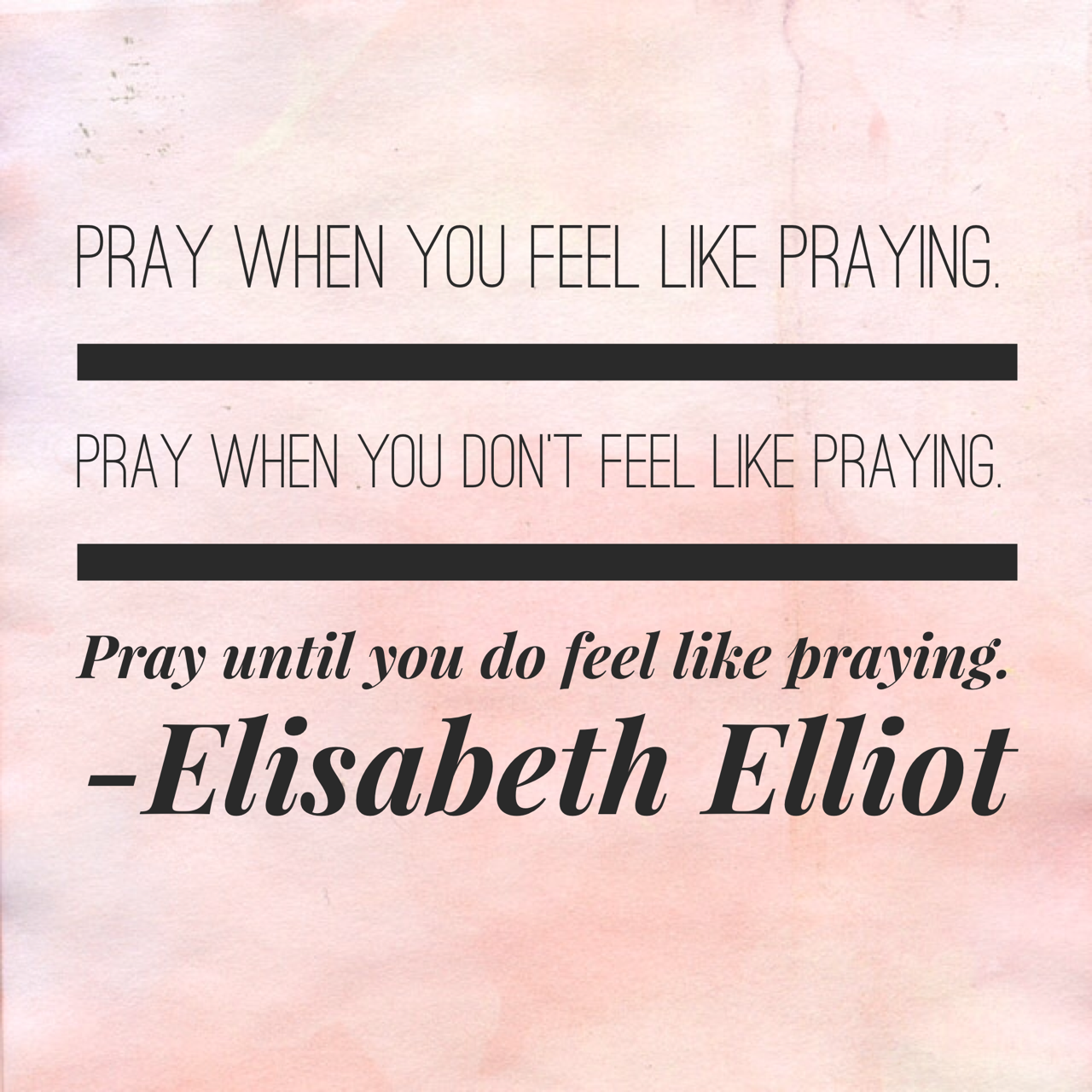
“Pray when you feel like praying. Pray when you don’t feel like praying. Pray until you do feel like praying.”

IMG_1392

From a chapter titled “God’s Curriculum” in  Keep a Quiet Heart:

An angry retort from someone may be just the occasion we need in which to learn not only longsuffering and forgiveness, but meekness and gentleness; fruits not born in us but borne only by the Spirit.

Too often I fail to learn that lesson and react in a fleshly manner instead of a spiritual one, so I am thankful for this reminder to seek the Spirit’s help in reacting in a right way.

I don’t know the source of this one, either:

A surrendered mind is not one which is no longer in operation. It is, rather, a mind freed from rebellion and opposition. To be Christ’s captive is to be perfectly free.

From Keep a Quiet Heart in a section on self-image:

If I’m so beautiful and lovable, what was Jesus doing up there, nailed to the cross and crowned with thorns? Why all that hideous suffering for the pure Son of God? Here’s why: There was no other way to deliver us from the hell of our own proud self-loving selves, no other way out of the bondage of self-pity and self-congratulation. How shall we take our stand beneath the cross of Jesus and continue to love the selves that put Him there? How can we survey the wondrous cross and at the same time feed our pride? No. It won’t work. Jesus put it simply: If you want to be My disciple, you must leave self behind, take up the cross, and follow Me.

Finally, this is from a chapter titled, “Nevertheless We Must Run Aground” in Love Has a Price Tag:

Heaven is not here, it’s There. If we were given all we wanted here, our hearts would settle for this world rather than the next. God is forever luring us up and away from this one, wooing us to Himself and His still invisible Kingdom, where we will certainly find what we so keenly long for.

Someone suggested that I share a list of Elisabeth’s books, so I will do that tomorrow, along with a video shown at her memorial service.

See all the posts in this series here.

_____________________________________________________

This is the last day to enter DaySpring.com’s contest for Write 31 Days readers. To enter to win a $500 DaySpring shopping spree, just click on this link & follow the giveaway widget instructions by October 30. Best wishes, and thanks for reading!

Knowing God, Chapters 21 and 22: Trials and God’s Adequacy

Knowing GodWe’re finishing Knowing God by J. I. Packer along with Tim Challies’ Reading Classics Together Series with chapters 21 and 22.

Chapter 21, “These Inward Trials,” discusses the problems of believing, or, worse yet, teaching, that the Christian life will be a “bed of roses,” when the Bible tells us repeatedly that we will have trials in this life. Thinking that there won’t be any more trouble after one becomes a Christian “is bound to lead sooner or later to bitter disillusionment” (p. 245). Either they will think they’ve been deceived, or they’ll think something is wrong with their faith or practice.

We still have our old nature within us and the devil and the world system opposed to us, not to mention potential conflicts with others, believers or not, who also still have a sin nature. We need Biblical understanding of sanctification, spiritual warfare, and growth in grace.

Packer’s definition of grace is one of the best I have ever seen: “God’s love in action toward people who have merited the opposite of love” (p. 249). God’s grace saves us, revives us, transforms us, and will some day raise our bodies to glory. The work of grace leads us to “an ever deeper knowledge of God, and an ever closer fellowship with Him. Grace is God drawing us sinners closer and closer to Himself” (p. 250).

How does God in grace prosecute this purpose? Not by shielding us from the assault of the world, the flesh and the devil, nor by protecting us from frustrating and burdensome circumstances, nor yet by shielding us from troubles created by our own temperament and psychology; but rather by exposing to us all these things, so as to overwhelm us with with a sense of our own inadequacy, and to drive us to cling to him more closely. This is the ultimate reason, from our standpoint , why God fills our lives with troubles and perplexities of one sort and another: it is to ensure that we shall learn to hold him fast. The reason why the Bible spends so much of its time reiterating that God is a strong rock, a firm defense, and a sure refuge and help for the weak, is that God spends so much of his time bringing home to us that we are weak, both mentally and morally, and dare not trust ourselves to find, or to follow the right road (p. 150).

Chapter 22 studies “The Adequacy of God” primarily from Romans, primarily from Romans 8. After the despair of Romans 7, Romans 8 encourages and edifies by pointing us to “the adequacy of the grace of God” to deal with a number of things and teaching us of “four gifts of God given to all who by faith are “in Christ Jesus”: righteousness (no condemnation), the Holy Spirit, adoption, and security (p. 258). Packer reminds us that “God is for us” and encourages us to “let evangelical thinking correct emotional thinking” (p. 260).

This is one of the longest chapters in the book with Packer unpacking many truths from Romans 8, but that will give you a little glimpse. There were a couple of paragraphs of a Calvinistic bent that I did not agree with, but otherwise it was very good. The last section of this chapter is called “Learning to Know God in Christ” and gives a nice overview of all that the book has discussed.

Overall I’ve much enjoyed the book and can see why it is considered a Christian classic. I am glad to have read it.