Here are some noteworthy reads discovered in the last week or so:
The Christian Life Isn’t Meant to Be Effortless. Very helpful, especially dealing with a couple of ways of looking at Christian life that I thought were a little off but I couldn’t quite articulate why.
Love and Entitlement. “But, you’re getting it all wrong, girls. Love isn’t a laundry list of behavior requirements.”
Member of the Family. Interesting thoughts about the difference between books where a child character feels like he is contributing to the family vs. the ones popular with the “misfit/outcast archetype in children’s literature. There is a strong trend in fiction for young people that consists of jettisoning of one’s God-given family and cobbling together a new one on a road trip.” I agree we need more of the former.
Expositional Imposters. Though this is written to preachers, I think the points he makes are good for general Bible study as well. We can pull the wrong lesson from a passage if we’re not reading it carefully.
I’m Done Making My Kid’s Childhood Magical, HT to Ann. Nothing wrong with a lot of what is mentioned, but I agree every day, every lunch, etc. doesn’t need to be Pinterest-worthy, and there’s a lot of magic for childhood in everyday life.
Bringing the Prairie to the Hood. “Black people (at least the ones I know) do not watch Little House on the Prairie.…So how did Little House on the Prairie mosey its way into my Southeast D.C. home?”
The Mount TBR Reading Challenge (to read books one already owned) has checkpoints every quarter where we can report how we’re doing. So far for this challenge I have read (each title links back to my review of it):
The levels, or “peaks,” for this challenge are met with every 12 books read, so I am well on my way to the first one. I had only committed to the first one, but it looks like I may reach the second one by year’s end as well.
Only five of these were on my original list, but I don’t think that matters. I do still plan to read the rest of them plus others if I can. In fact, I am nearly done with one of them and partway into another one.
Bev (our hostess) also suggested some other things we could share about the books we’ve read, like a favorite book cover or character. I think for me the favorite book cover would go to Searching for Eternity by Elizabeth Musser.
I like elements of the story that are there – Emile, the scene from the Varsity in Atlanta, and the passport from France. I tend to like drawn/painted rather than photographed covers for fiction.
Favorite characters….that’s a hard one. But I think it would be Truman Wiley from Not In the Heart by Chris Fabry, even though he’s not a good guy for most of the novel. I like his journey and how he is written.
Another question was whether any of the books surprised us. That would again go to Not In the Heart by Chris Fabry. The initial description of the story intrigued me, but there were so many more layers to it than I expected. It was my first of Fabry’s books, but I immediately bought another one after finishing this one.
One that surprised me negatively was Gilead by Marilynne Robinson. Perhaps that was due to having heard such wonderful things about the writing, so my expectations were built up overly high. I did come to agree about the writing by the time I finished, but it was awfully hard to get into.
It’s Friday, time to look back over the blessings of the week with Susanne at Living to Tell the Story and other friends.
Many of us skipped the FFF last week, due to Good Friday and Easter preparations and also because our hostess, Susanne, was getting ready for her daughter’s wedding the next day and would need to take a week off from FFF, even though she graciously left it open for the rest of us. So we should have two weeks of blessings to catch up on…except that I didn’t make notes and can’t remember much past this week. (Blush!) But here are some of the highlights:
1. Easter isn’t the only time we think about the resurrection of Christ and all it means to us, but it is a time for special emphasis on it. What a cause for joy!
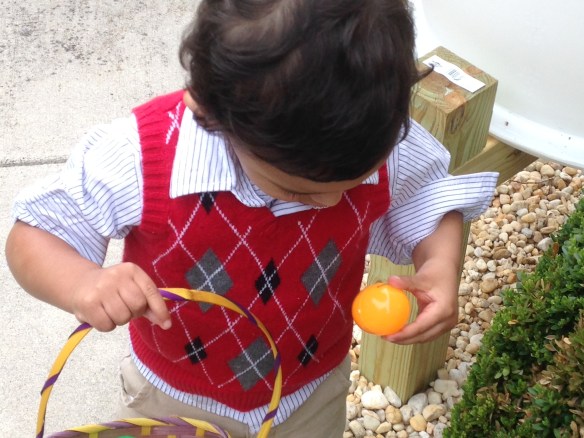
2. Celebrating with the family. We enjoyed a nice meal and then had a little Easter egg hunt, Timothy’s first. For years we’ve put coins in the little plastic eggs for the older kids, with an occasional bill of some kind. Timothy is not into money yet, and no one here likes hard-boiled eggs, so we put Goldfish crackers and M&Ms in his. He caught on right away to gathering the eggs but was more interested in gathering, opening, and closing them than on what was inside. Later we had an extended Facetime with my oldest son out of state.
3. New spring dish towels. I found these at JoAnn’s and thought they were a little pricy, but they were on sale 40% off and I had a gift card. 🙂 Lately it’s been rare for me to find the fluffy type of dish towels in any kind of design I like, so I was thrilled with these.
4. Safe travels. Jason, Mittu, and Timothy traveled several hundred miles for her mom’s birthday last week. They had a bit of an issue with their car that thankfully happened there and not on the road, but delayed them a bit getting back. Last time Timothy wasn’t too happy with all the time in the car seat, but this time he traveled well and wasn’t overwhelmed with being around unfamiliar people. All in all it was a good trip for them. Then Jim safely went to Atlanta for a day earlier this week.
5. Flowering trees around town are such beautiful harbingers of spring…even though they ramp up pollen production and allergy problems.
Hope you’re having a wonderful Friday free from “April fools.” 🙂
In Every Waking Moment by Chris Fabry, Devin Hillis is a filmmaker with vision but no cash. He wants to make a documentary of the stories of people in the Desert Gardens assisted-living facility. He tries to support himself in the meantime by making shorter memorials for funerals, but that’s not paying the bills, and both his partner and his landlord are on his case.
His time in Desert Gardens brings to his attention an employee there named Treha Langsam. At first she looks like perhaps she is developmentally delayed somehow, but she is very intelligent. She has nystagmus, a condition which causes her eyes to be almost constantly moving, and when she’s agitated she makes a typing motion with her hands, but otherwise she seems emotionless. She grew up in various foster homes and has little to no memory of her history. But she seems to have a gift: she is able to bring out residents who have been closed off and uncommunicative to where they are speaking clearly. She was hired for janitorial services, but when the facility supervisor, Miriam Howard, saw her work with the residents, she let her have free reign to interact with them. Devin thinks Treha may be the story he’s looking for.
But Miriam is about to retire, and the new supervisor is more concerned about her own rules and regulations than care of the residents. She has her eye on Treha, threatening to fire her if she does anything other than clean.
What will happen to Treha and the residents if she loses her job, and will Devin and Miriam be able to solve the mystery of Treha’s background, not just for the documentary, but for her future?
I got this book right on the heels of finishing Not in the Heart by Chris Fabry because I loved his writing so much and wanted to read more. I was looking at that book on Amazon when a link to this book with these words from Chris intrigued me:
What if this is as good as life gets? Are you okay with that?
This question has haunted me over the past few years. Several years ago we moved to the desert for health reasons. Looking for recovery in a dry and thirsty land. And I realized my soul was more thirsty than anything.
Every Waking Moment is my effort to take some of the pain and loss of life and sift it through the life of a young woman who’s been marginalized in society, working among people who are marginalized (the elderly). This character, Treha, has an extraordinary gift that few observe because she’s “different.”
Like most of my tales, it’s a love story, a mystery, part thriller–but mostly a character sketch of lonely people looking for hope. And it’s my intent that you find hope and meaning for your own life through Treha’s journey.
That theme of “What if this is as good as it gets” comes up for several characters throughout the book. Poking around Chris’s web site, I saw that this novel arose in part because of his family’s experience with toxic mold and the detrimental effects it has had on his family’s health. That is not what caused Treha’s problems, but he draws parallels from the experience.
Not in the Heart was fast-paced and suspenseful. Every Waking Moment is a different kind of book. It has moments of suspense, and of course there is the mystery of Treha’s history and what made her the way she is. But overall the book has a different pace and feel to it. But it is still quite good.
The daughter didn’t realize that this was part of the problem. The same tasks that wore her mother down were the tasks that gave her structure and stability. Worth. When she could no longer do them and others were paid to accomplish things she had done as long as she could remember, life became a calendar of guilt–every day lived as a spectator, watching others do what she couldn’t.
Deciding what Mother would like or wouldn’t like was a seesaw between two relatives who were guessing. Love looked like this and worse and was accompanied by a mute, white-haired shell.
“I want that person you knew to return. But the truth is, this may be the best we achieve. Today, having her here and comfortable and not agitated…that may be as good as we get. Are you okay with that?”
“Your love for your mother is not conditional on her response. You love her for who she is. You don’t love her because of the things she can do for you.”
“The medical community views individuals as patients to be cured. But when people age, they’re not looking for a cure as much as they are for encouragement to continue. Our work here is not about curing. It’s about the dignity of each person…”
“Value people not just for the income they provide us. Value them because of the lives they’ve lived. Value each person who pushes a broom or cleans a bedpan. And value the girl whose life is marred, yes, but who gives these people more than a doctor ever will.”
“Growing older is not much fun. It’s the slowing down that gets to you. Elsie calls it ‘vigor mortis.’ You just can’t do what you used to.”
“Old age teaches you in a very unkind way that things won’t necessarily get better. Not in this life. In fact, you can pretty much count on things degenerating. Being content is not a lack of ambition. It’s being able to rest and relax and know that your worth doesn’t come from what others think of you or even what you think of you.”
And one I loved just for the writing: “Retirement was bearing down on Miriam like a semitruck trying to make it through a yellow light.”
For those of you who like book trailers:
I enjoyed this book quite a lot and can heartily recommend it to you.
Every Waking Moment by Chris Fabry. Just finished it this weekend – review coming soon, hopefully.
Though that looks like a lot, a couple of them were mostly read in Feb. and just finished up this month, the last Nightstand was almost a week before Feb. ended (giving us an extra week in this Nightstand’s reading), and five of these were fairly short audiobooks.
Pioneer Girl: The Annotated Autobiographyby Laura Ingalls Wilder and Pamela Smith Hill. I probably should not include this because I don’t know if I have actually looked at it this month. As I’ve said before, it’s a big book that doesn’t really fit in the places where I keep books I am reading, so I keep forgetting to pick it up. I started it in Feb. and need to make a determined effort to finish it.
The Old Man and the Sea is a short novel by Ernest Hemingway published in 1951. The last of his major works published during his lifetime, it earned him a Pulitzer Prize and contributed to his winning the Nobel Prize in Literature.
The old man is named Santiago but is usually just called the old man. He’s an aging fisherman in Cuba who, at the story’s beginning, has gone 84 days without catching a fish. A boy, Manolin (usually just called the boy), had been assisting him, but after forty days without a catch, his parents make him quit to work with another boat and tell him the old man is the worst form of unlucky. But the boy still cares for him and helps him out as he can.
As the old man wraps up his tasks for the day and prepares for the next, we see a little of his home and lifestyle. He lives alone with very little interaction with others except the boy. His wife has died and he has taken her picture down because it makes him too lonely. He lives in pretty abject poverty (offering the boy some of his dinner of fish and rice which the boy knows is nonexistent, tattered and patched sails, sleeping on newspapers). His one great interest besides fishing is American baseball with Joe DiMaggio being his favorite (partly because DiMaggio’s father was a fisherman). The old man and the boy discuss baseball while they eat a dinner donated by the local cafe owner. Santiago muses that he must do something nice for the cafe owner when he can.
The old man determines the next morning to go out further into the sea than fishermen usually do. He notices a bird circling the water and decides to follow it. He caches a tuna that he saves to use as bait. He’s precise in his actions and obviously skilled by many years at sea, knowledgeable about the characteristics and habits of many sea creatures.
Finally his deepest line tugs. The old man can tell it is a big fish and is confident that it is probably a marlin. He manages the line to keep it from breaking yet tries to hold it firmly enough that the fish is actually hooked. It’s too big to haul in, however, and he realizes that the fish is pulling him out to sea. At one point he sees enough of it to tell it is two feet longer than his skiff. He pulls the line over his shoulders to distribute the weight of it, but his hands still cramp and bleed from the line. He lets the fish pull his boat until it can get close enough for him to harpoon it. But he is pulled even further out to sea and can no longer see land.
Since this is such a short novel, telling more of the story would reveal the rest of the plot, so I’ll leave it there. But as you can imagine, the man has to deal not only with the fish but his own age, injuries, need for food and rest, and eventually sharks. The reader is given a window to his thoughts about life, baseball, nature, etc.
I chose this book for the Back to the Classics Challenge as a reread of a classic I had read in high school. I do remember the story from then, but I don’t think I had appreciated Hemingway’s sparse, clear writing at the time. I believe this is the only book of his that I have read, but rereading it has made me want to explore some of his other work.
I read some of the analysis of the story at Sparknotes and Shmoop, and both offer some interesting theories about symbolism in the book, but a quote I read from Hemingway (which didn’t name the source) said there is no symbolism in it (“There isn’t any symbolism. The sea is the sea. The old man is an old man. The boy is a boy and the fish is a fish.”) But I think the story does show the dignity, endurance, and triumph of the spirit of the old man through the ordeal he faces.
Here are just a few quotes that stood out to me:
“Now is no time to think of what you do not have. Think of what you can do with that there is.”
“I may not be as strong as I think, but I know many tricks and I have resolution.”
“You did not kill the fish only to keep alive and to sell for food, he thought. You killed him for pride and because you are a fisherman. You loved him when he was alive and you loved him after. If you love him, it is not a sin to kill him. Or is it more?”
“Only I have no luck any more. But who knows? Maybe today. Every day is a new day. It is better to be lucky. But I would rather be exact. Then when luck comes you are ready.”
“Fish,” the old man said. “Fish, you are going to have to die anyway. Do you have to kill me too?”
I listened to the audiobook read quite nicely by Donald Sutherland.
If in this life only we have hope in Christ, we are of all men most miserable. But now is Christ risen from the dead, and become the firstfruits of them that slept. For since by man came death, by man came also the resurrection of the dead. For as in Adam all die, even so in Christ shall all be made alive. 1 Corinthians 15:19-22
Jesus said unto her, I am the resurrection, and the life: he that believeth in me, though he were dead, yet shall he live: And whosoever liveth and believeth in me shall never die. Believest thou this? John 11:25-26
See the destined day arise! See a willing sacrifice!
Jesus, to redeem our loss, hangs upon the shameful cross;
Jesus, who but You could bear wrath so great and justice fair?
Every pang and bitter throe, finishing your life of woe?
Hallelujah! Hallelujah! Lamb of God for sinners slain!
Hallelujah! Hallelujah! Jesus Christ, we praise your name!
Who but Christ had dared to drain, steeped in gall, the cup of pain,
And with tender body bear thorns, and nails, and piercing spear?
Slain for us, the water flowed, mingled from your side with blood;
Sign to all attesting eyes of the finished sacrifice.
Holy Jesus, grant us grace in that sacrifice to place
All our trust for life renewed, pardoned sin, and promised good.
Grant us grace to sing your praise, ‘round your throne through endless days,
Ever with the sons of light: “Blessing, honor, glory, might!”
The Sword in the Stone by T. H. White tells the story of the boyhood of King Arthur. He has no idea he is descended from royal blood. He’s growing up in the family of Sir Ector in his castle near the Sauvage Forest in England. Arthur is known then as “The Wart” and knows he is not a “proper son,” but we’re not told yet where he came from and how he got there. Sir Ector’s son, Kay, is about the Wart’s age, and they take lessons together in everything from History to jousting and hawking. Kay’s destiny is to become a knight: the best that The Wart can hope for is to become Kay’s squire.
When Sir Ector decides the boys need a tutor, the Wart happens upon Merlin. Merlin is a magician who is moving through time backwards, which often confuses him as to whether something is about to happen or has already happened. He is an able tutor, but he gives more time to the Wart, telling him it’s best to learn from experience and therefore turning him into various creatures, like a fish, a snake, an ant, a bird, and a badger, and sending him into each creatures environment to interact with others.
The Wart feels bad that Kay doesn’t get any adventures and wants Merlin to turn him into something, but Merlin insists he can’t use that magic for Kay. But he does send them off on a trail in the forest which leads them to Robin Hood’s camp and an expedition to save prisoners from the fairy queen, Morgan la Fey.
The word that seems to stand out to me to describe the Wart as a boy is decent. It’s not that he’s brave because bravery is a good trait in itself, but in doing the right thing he has to exercise bravery, such as when he and Kay take their father’s prize hawk into the woods to hunt rabbits, and Kay mishandles the hawk, resulting in its flying into a tree and not coming back to them. Kay goes home, but the Wart stays all night alone in the forest to keep an eye on the hawk so they don’t lose it. He’s also thoughtful, merciful, humble, and kind.
The musical Camelot is based on White’s version of Arthur’s story, and once I saw an interview with Richard Harris, who played Arthur in the film version, in which he said that he played him as someone who has greatness thrust upon him, but Richard Burton, who played Arthur on stage, played him as someone born to greatness. I can see both elements here. He is born to greatness, but he doesn’t know it yet. But events like the climatic removing the sword from the stone are done, not with the desire to overcome the challenge and prove himself king, but to help someone. He discovers only later that the sword would only come out for the person destined to be king (having missed the conversation in which everyone else talks about it) and at first feels quite uncomfortable with Sir Ector and Kay treating him like a king.
The Wart’s various experiences with animals were not just to teach him about nature. According to various sources, they also served to teach him about various governments. The pike, for instance, who was the king of that particular body of water in which the Wart was learning to be a fish, had absolute power but was deceptive and cruel. A colony of ants, on the other hand, acted like mindless automatons working for the greater good, which some suggest is meant to portray Communism (oddly, the ants aren’t included in the version I listened to, but I saw them mentioned in other sources). Perhaps what he learns about governing from each of them is brought out in the later books, but in this one, the various lessons he learns from them come back to him as he tries to pull the sword out of the stone. For instance, when he was trying to learn to swim as a fish with fins instead of arms and a tail instead of legs, Merlin kept telling him to “put his back into it.” That as well as bits from his other experiences came back to him in that moment.
The Sword in the Stone by T. H. White was originally published in 1938 but eventually it was combined with other books about the legend of King Arthur in The Once and Future King in 1958. It underwent quite a bit of revision by the time the 1958 version was published, incorporating some material that White had wanted to include in a fifth book in the series. According to Wikipedia, stand-alone publications of the novel tend to use the first version while publications of all four books into The Once and Future King used the revised. According to the PDF accompanying the audiobook I listened to, this version uses elements of both.
This book reads like a fairy tale or a boy’s adventure story, but it’s not technically aimed at children. There are comic moments along with the adventures and lessons as well. It was the basis for the Disney movie by the same name, but, as usually happens, much was changed in the cartoon version. I understand that the rest of the legend gets darker as it progresses in the other books. I haven’t decided yet whether to read them.
As far as potential objectionable elements go, there’s the whole issue of Merlin being a wizard, the Wart being turned into other creatures, and a fight with a witch. If you allow fairy tales, these shouldn’t be a problem: when my kids were young, I avoided stories with witches, but at some point when they were older decided that fairy tale witches were different from the real thing and operated more as the antagonist in stories. But if you have a problem with that or think your children shouldn’t be exposed to that yet, then you’d want to avoid this book. There is also a good deal about evolution and a good bit of violence, though it’s not gratuitous nor overly descriptive. The one brief part I didn’t like was the flippant portrayal of God in one legend.
But when it comes to the adventures themselves and Arthur’s growth into the man and king he eventually became, I enjoyed the story quite a lot.This book ends not long after Arthur’s coronation, and I assume the next one picks up some time after that.
I grew up extremely shy. I think it’s party due to my natural personality, but it’s probably also influenced by my being the oldest and the only child for four years. As a child I preferred being with the adults – that’s what I had gotten used to. I didn’t interrupt or try to monopolize the conversation – I grew up in the “Children should be seen and not heard” era and was taught to sit quietly. But my mom would often “make” me go play so the adults could talk. Once when another mom with kids about the age of my brother and myself came over, my mom, an extrovert who never knew a stranger, told us to take them into the bedroom and play. We all just looked at each other for a long moment before finally venturing off to the toys, where eventually the ice broke. Even as a young adult I was content to listen to others talk and would almost panic if someone tried to draw me into the conversation. I did have friends growing up, but often it was just one or two very close friends.
I say all that to convey that I understand what it is to be painfully shy. But I want my shy friends to consider something for a moment.
Picture this scenario: you’re about to come down a sidewalk or aisle at church, and you see someone you know coming toward you from the other direction. So you begin to consider when and at what point to make eye contact and say something, try to think of what to say, etc. (This probably sounds totally insane to non-shy people, but it’s a very real process!) So just when you’re about to come up even with the person, you look toward them, open your mouth to say hello, and….find them looking in the complete opposite direction as they pass you in silence. That feels like a slap in the face or a deliberate snub. It’s not, and the people that this has happened with all have a reputation for being shy, but even though I understand, it hurts, especially when it happens at church, and I have to remind myself that it probably wasn’t meant to be personal. It happened so often with a few people that it was obviously more than that they had just been deep in thought and hadn’t noticed me.
I was surprised more than once in college when someone would tell me, after they got to know me, that they had originally thought I was “stuck up.” They took my natural quietness as snobbishness. And who knows how many people’s feelings I may have hurt or how many beneficial conversations and potential friendships I missed out on because I didn’t want to engage people.
I can’t say I have truly overcome shyness; it’s still my default mode. But I have grown to the point that I can usually have (and even start!) a conversation with most people without going into a panic attack. One thing that helped me personally was that I attended a small Christian school for my last two years of high school. I had come from a big high school where it was easy to be a wallflower, but in the smaller group setting I was able to get involved in a number of areas I never would have dreamed of in my former school. Plus, in a smaller group, it was obvious that one was the “new kid,” and it was easier for people to talk with and welcome me in that setting. College was an adjustment, but it did improve my “people skills.” Then the man God directed me to marry was much more relaxed that I was and had no trouble talking to people, though he would describe himself as an introvert. But besides those factors, here are some general principles I learned:
Relax! If you work yourself into a tizzy over interacting with people, it’s very hard to overcome that.
Think of the other person. Once when I was an officer in a ladies’ group at one church, at an officer’s meeting the pastor’s wife was admonishing all of us to speak up when addressing the group so we could be heard. She was a no-nonsense older lady and went on to say, firmly but not unkindly, that if we felt self-conscious, as Christians we were supposed to forget self. Putting it that way helped me a lot, because often the tension comes in focusing on myself and how the other person might react, etc. But if I think of them instead, that takes the focus off myself. Greeting new people at church is still something that does not come naturally to me, but one thing that motivates me is the thought of how they’ll feel if no one speaks to them, or if I am sitting right by them but don’t extend myself. And in situations like passing another person I know but not well, one thing that motivates me to speak to them is remembering the feeling of being snubbed when someone else looks away instead of speaking to me.
Remember an acronym to aid conversation.The husband of a couple that have been our friends for 35+ years once said that his mom taught him as a boy the acronym for what she called the conversation ball: ALC for ask, listen, and comment. That’s really what conversation boils down to, but remembering that helps if it doesn’t come naturally. I wished I had known this years before.
Practice. You may feel stiff and stilted and awkward at first, but interacting with people is a skill that improves with use. Even making mistakes and experiencing conversational flubs happens to everyone.
Accept that you’re probably not going to be the life-of-the-party type. Big, crowded, noisy events are not my favorite thing, but I can usually find a quiet spot with one or two people to talk to.
Pray. This is really the first principle. Even though God made you more quiet and probably introverted (though introversion and shyness are not exactly the same thing), there are times He wants you to step out of your comfort zone and interact with people. You may not feel comfortable being the church greeter and glad-handing everyone in the lobby, but look for people you can say a few words of greeting to. Ask Him for what to say and for help with nerves and for the grace to focus on the other person’s needs.
A couple of thoughts for parents: if you have a child who is painfully shy, I think the “sink or swim” method of leaving them in a large social setting like nursery or preschool to “cry it out” might be more traumatic than helpful, especially if they panic. It’s helpful to introduce them to social settings on a smaller scale, having one other couple or mom over with their kids. Instead of shooing them off to play, suggest things they might do (“Mary, Susie might be interested in your paper doll collection,”) or start the “conversation ball” rolling yourself (“Stevie, I heard you’re learning to ride horses. That sounds like fun – how did you get started?”)
Do you have any other tips for overcoming your own shyness or helping shy children?


 Happy Saturday!








 As I’ve said before, it’s a big book that doesn’t really fit in the places where I keep books I am reading, so I keep forgetting to pick it up. I started it in Feb. and need to make a determined effort to finish it.
 The Old Man and the Sea is a short novel by Ernest Hemingway published in 1951. The last of his major works published during his lifetime, it earned him a Pulitzer Prize and contributed to his winning the Nobel Prize in Literature.