Book Review: Songs of the Morning: Stories and Poems for Easter

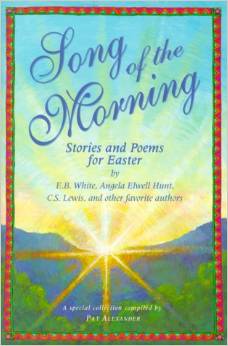
Song of the MonringSongs of the Morning: Stories and Poems for Easter was compiled by Pat Alexander and includes excerpts from the writings of C. S. Lewis, E. B. White, Dickens and others, some (mostly poems) written by children. I had bought it ages ago from a clearance section, put it on my shelf, noticed it it off and on through the years, and kept forgetting about it at Easter time. Finally this year I remembered to pull it out in the weeks preceding Easter. I like to read something devotional pertaining to Easter during that time, and while this wasn’t that exactly, it was both pleasant and beneficial.

I don’t think I realized, or I had forgotten, that it was geared primarily to children, probably the same age as those who would be able to read the Narnia series. But adults can gain from it, too.

I like that it couches the Easter story within historical context. The first section is “How It All Began” and begins with a short excerpt from a children’s Bible about God creating the world and sin entering in (Pat Alexander also wrote The Lion’s Children’s Bible, which I had not heard of before this, so I don’t know how well it expresses Biblical truth, but the excerpts I read here were fine). Then there are Narnia excerpts about the founding of Narnia and the White Witch and a couple of other sources to further illustrate those truths.

Other sections follow a similar pattern and focus on the birth of Christ, the triumphal entry on Palm Sunday, the crucifixion, and the resurrection. There’s also a section of “The Greatest Love,” with several historical and story illustrations of sacrificial love (like Sydney Carton’s in A Tale of Two Cities and a story about a boy’s dog risking its life to save the boy’s), one called “It’s All Right,” dealing with how new life in Christ should affect our lives in practical terms, like forgiveness of others, and a final one called “A New Beginning.”

The stories come from a variety of countries. Some are old, some are new. Some are from adults’ work, some from children’s books. Some are fun, some are serious. Pat did a fine job putting all these sources together. It doesn’t look like the book is in print any more, but there are copies that can be purchased online, or perhaps you can keep an eye out for it at library sales and such.

(This review will also be linked to Semicolon‘s Saturday Review of Books.)

Laudable Linkage

Here are some noteworthy reads from the last couple of weeks:

Shine Like Stars: Give and Rejoice {Philippians 2:17-18}. What it means for our lives to be poured like like a drink offering. Hit me right where and when I needed it.

10 Things We Don’t Want Our Kids to Learn From Church.

What these ladies did to turn a friend’s day around, and what they received in return. Loved this!

Why Can’t Christians Intelligently Discuss Current Events. “I suspect that by yelling so loudly about nearly everything, we’re obscuring the big thing (Matt. 12:36).”

Responding to the Increasingly Short Shelf-Life of Worship songs, HT to Challies. Songleaders/music pastors/worship leaders have an abundance of songs to choose from, and being able to project the words for all to see enables us to sing more than just what’s in the hymnbook. That’s good in many ways but complicates things in other ways. Though this was written to song leaders and such, it helped me to see what  big job it is to choose songs from the multitude we have available. I especially appreciated his caveat that some songs are for just a season. It used to bother me that we heard some songs often for a while and then not at all – kind of like a current “hit” – but then I realized that even the older hymn-writers wrote many songs that we know nothing about now, so that must have happened then, too.

This is a  neat overview of the Bible for kids, showing how it all points to Christ:

https://vimeo.com/123430346

Have a good weekend!

Friday’s Fave Five

FFF spring2

It’s Friday, time to look back over the blessings of the week with Susanne at Living to Tell the Story and other friends.

It’s been a busy week, and I haven’t been able to work any more on my “project” I’ve been talking about lately, but I should have it done next week. Meanwhile, here are some highlights of this week:

1. Sweet and Spicy Bacon Chicken. I was looking through my Pinterest recipes for something simple yet flavorful that I could toss in the oven, and this fit the bill nicely. I sprinkled bacon bits on it rather than wrapping a bacon slice around it, and sprinkled brown sugar instead of rolling it in it. This one’s a keeper. I didn’t think to take any pictures of my own.

2. Froyoz frozen yogurt. I don’t usually run errands in the evening, but one night I had a prescription I needed to pick up and had run out of time earlier in the day when I was out. I took the opportunity to stop by Froyoz to get Chocolate Milk and Creamy Peanut Butter flavored frozen yogurt topped with chocolate covered peanuts and a small bit of brownie. Good stuff.

3. Blooming trees. Several flowering trees are in bloom this week. Our neighbor’s trees turned white overnight – I don’t know what they are, but I’ve always called them popcorn trees because that’s what the round, white blossoms look like to me from a distance. After the colorlessness of winter, I love to see color springing up all over this time of year.

4. The Hobbit:The Battle of the Five Armies. Enjoyed watching this with the family. I know the films have been maligned and added elements that weren’t in the book, but I still enjoyed it, especially Bilbo and Bard.

5. Thinking about the death and resurrection of Christ. I knew one blogger who felt that putting spiritual things on a favorite’s list trivialized them, but I disagree. Though in one sense we celebrate the resurrection every Sunday, and the death of Christ is applicable every day, I especially appreciate the focus this time of year, the reminder of all He went through so that He could offer us salvation, His great love for us, and the joy resulting from His resurrection.

I hope you have a wonderful Easter!

When the message isn’t for me

Courtesy offreedigitalphotos.net

Courtesy of freedigitalphotos.net

A week or two ago I came across a blog post that got me to thinking about how we respond when a meeting, church service, or even a Bible passage seems to apply to someone other than myself. When there is an ordination service or a Mother’s or Father’s Day message or children’s program, do I skip them because I am not a part of any of that?

I don’t think so. Here’s why:

1. “All scripture is given by inspiration of God, and is profitable for doctrine, for reproof, for correction, for instruction in righteousness: That the man of God may be perfect, thoroughly furnished unto all good works.” II Timothy 3:16-17. It is all profitable for me in some way even if the particular passage doesn’t seem to apply to me.

Some years ago the pastor of the church where we were at the time read a few verses from Exodus with instruction about oxen. He asked, “Do any of you own an ox?” No one raised their hands.

He then asked, “How many of you have even seen an ox?” One or two raised their hands.

“So,” he said, “We should just turn the page and skip this passage, right?” No, we didn’t think so, but what do we do with that passage?

He then brought out several applications from the passage. For instance, someone who owned an ox that was known for trying to push people with its horn was more liable if it injured someone. So if we have, say, a dog with a tendency to bite, we are even more responsible to keep it from people it could hurt. Or, to apply it further, if our tail lights are out on our car, we’re liable if someone crashes into us because they didn’t know we were stopped or slowing down to turn, so it behooves us to keep up with those things.

2. It helps us understand our brothers and sisters in the Lord. I may not be a pastor or a husband or a mother, but the passages that talk about them help me understand their roles, not so I can form a checklist and note when they’re not getting it right, but so that I can pray for them, understand their problems, needs, and temptations, and encourage them. The Bible says the church is the body or Christ, and “If one member suffers, all suffer together; if one member is honored, all rejoice together.” (I Corinthians 12:26).

3. Their position is under attack. Satan is not omnipresent, but he does get around, and he seeks to undermine everything God calls good. Any role or function within the church, home, or family as designed by God is under attack in some way or another. The blog post I mentioned at the beginning was complaining, in part, that the focus on married women and mothers in some women’s ministries left single ladies out. I do think that is a valid point: not all women are called to be married, not all mothers are able to stay home, and we need to find ways to minister to the whole scope of womanhood. However, there are particular ways marriage and motherhood are being particularly attacked and undermined in the world today, so we need to help support those roles.

4. I can learn something that applies to me even though the particular focus of the passage or sermon is for someone else. Loving one another as Christ loved the church is something that applies to us all, not just husbands, so I can take an illustration that may be particularly about husbands and learn something I need in loving others. Years ago in college we were encouraged to read a particular book about leadership which I gleaned a lot from even though I was not a leader at the time (and still don’t naturally feel inclined to be now).

This is not to say that I should attend every focus group within the church since we’re all part of the body of Christ. Some of those were created to handle specific concerns in a smaller group setting. But when a Bible passage or sermon or ladies’ meeting seems to apply to someone else, there is still much I can learn and benefit from if I have ears to hear and a heart to receive.

Book Review: A Million Little Ways: Uncover the Art You Were Made to Live

Million Little Ways

When you disagree with a foundational statement eighteen pages into a book, it’s hard not to let that color the rest of your reading. But I tried to give it my best effort. More on that in a moment.

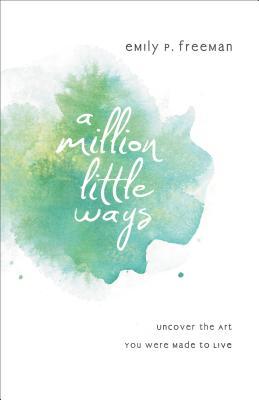
I got A Million Little Ways: Uncover the Art You Were Made to Live by Emily Freeman because I enjoyed her Grace For the Good Girl so much. The title sounds like it might be about finding ways to be more creative or finding time to express yourself artistically. However, though that is involved, that’s not exactly what the book is about, at least not in the way you might be thinking at first glance. The basis of the book is taken from Ephesians 2:10: “For we are his workmanship, created in Christ Jesus unto good works, which God hath before ordained that we should walk in them.” Other versions use “handiwork” or “masterpiece” in place of “workmanship,” and the Greek word they are translated from is poiema, from which we get our English word poem.

Being his workmanship doesn’t mean we are all poets. It means we are all poems, individual created works of a creative God. And this poetry comes out uniquely through us as we worship, think, love, pray, rest, work, and exist.

Jesus reminds us we are art and empowers us to make art.

There isn’t one right way to do the job of glorifying God. There are many ways, a million little ways, that Christ is formed in us and spills out of us into the world.

Knowing you are a poem doesn’t confine you to be artsy, it releases you to be you (p. 29).

So the art she is talking about our creating isn’t writing or painting or sculpture – unless we’re called to that – but rather finding the purpose for which God made us, that which makes us most “fully alive” (a phrase she uses often), and then doing that by the enabling of God and for His glory, whether it is being a doctor, a mom, a janitor, a hostess, or whatever. But she is not talking primarily about our occupation, though that’s a big part of it:

I don’t believe there is one great thing I was made to do in this world. I believe there is one great God I was made to glorify. And there will be many ways, even a million little ways, I will declare his glory with my life (p. 40).

So we can express God’s glory whether we’re listening to a friend’s troubles, making dinner for our family, playing an instrument, or whatever else is a part of our day.

Part of uncovering what we are uniquely called to do is examining our desires. “Our passions aren’t the goal, but they are the signposts, like arrows pointing to our center” (p. 60).

Could it be possible that the thing the thing you most long for, the thing you notice and think about and wish you could do, is the thing you were actually made and equipped to do?

Could it also be possible that somewhere along the way you got the message that to follow desire would be selfish, when, really, it would be the opposite? (p. 47)

A couple of chapters discuss the ins and outs of that in greater detail, including redeemed desires (not everything we desire is something we should pursue). Other chapters discuss the need to do all leaning on God’s power and enabling, realizing we can’t do it on our own, handling criticism (I especially appreciated the thought that criticism has a purpose even when unfounded), waiting on God’s timing, learning when to say “no.” Probably my favorite chapter was “Wonder.” A close second would be the one on waiting, from which this favorite quote came:

The Spirit came over Mary in a moment, but it took nine months for him to grow. Jesus waited thirty years to begin what we cal his earthly ministry. But really, wasn’t he always being God in the world, from his first breath to his last? He was crucified and waited until day three to resurrect. Don’t lose hope on day two (p. 155).

Another favorite quote came neat the end: “One masterpiece is the work of ten thousand rough drafts” (p. 195).

So what was it I disagreed with so strongly at the beginning? A statement on page 18 that “God is not a technician. God is an artist.” My immediate thoughts ran something like this:

God is a technician AND an artist! When He creates a beautiful sunset, He doesn’t just throw colors in the sky: there is science behind it, and it’s not the less wondrous for that. When you think of the marvels of human biology, the mathematical properties in the universe that enable space travel, and so many other factors involved in his creation, it’s impossible not to see that He is a master technician. (My kids used to have a book titled God Thought of It First, showing that many of man’s inventions were based on properties in creation, like the similarity between how a submarine and a chambered nautilus works). My husband was a physics major and has worked for most of his career in the science of color, first in textiles and now in plastics. He can’t just say, “Hmm, this looks a little too blue” and add a dab of another color until it looks right, like an artist might do on a canvas: there are formulas involved which enable them to get the right color not just for the moment, but to be able to reproduce it in massive quantities for carpet fiber, plastic bottles, and even paint in artist’s tubes.

I think Emily would agree that God is a God of detail, engineering, and technology as well as artistry and creativity. But that’s not really what she is talking about when she says God is not a technician. She precedes that statement with these thoughts:

Is he only a God of right answers and right angles and acceptable behavior? Have we exalted the will of God and the plans of God above God himself?

He does not manage us, to-do list us, or bullet-point us. He loves us. Is with us. And believing him feels impossible, until we do, like a miracle, like lukewarm water turning merlot red right there in the cup. And hope sprouts new, because God doesn’t give us a list. He invites us into the story (p. 17).

Actually He does give us a list or two, like this one and this one. But, yes, I do get the point she’s making that we’re not saved or sanctified by keeping lists or commandments. It’s possible to keep commandments and totally miss God, as the Pharisees did.  We’re saved by grace through faith and sanctification and service come about the same way. Or, as she says later, when discussing Jesus washing the disciples’ feet and then instructing them to do likewise, “Maybe Jesus is inviting them into a relationship of do as I do rather than pointing to a list and saying, Copy me” (p. 75).

So once I understood where she was coming from, I could agree, but I still had to fight against that feeling when similar statements were made: “Technicians don’t move us. Artists do” (p. 14); “When a poet writes a poem, he isn’t writing a technical manual or a how-to book” (p. 26); “Are you living like a programmer instead of a poet?” (p. 135).

The bulk of the book is written from a right-brained, creative, artsy vantage point, which will appeal to that kind of thinker but not so much to the more left-brained, literal, logical one (I know the whole left vs. right-brained theory has been labeled incorrect now, but you know what I mean.) Although I struggled with that at times, and I wouldn’t agree with every little sub-point, overall I appreciated the message of the book, was inspired and challenged, and gleaned a lot from it. I’ll close with a section which I think sums it up:

 What if we approached the critic, our jobs, the kids at our table with the same wonder and anticipation an artist has when she approaches the canvas? What if we decided our purpose in this world really is to reflect the glory of God?

Would we begin to see ourselves as wildly free to approach the universe – the meal plan, the work project, the yard sale, our neighbor, the roof leak, the doctor appointment, the eternal destiny of our children – to approach it all with a wide-eyed wonder, with an edge-of-your-seat breath, with an expectation that any minute God will show himself in a way we have not yet seen? And he’ll likely do it through us?

When we embrace the beauty of our design, when we recognize that he has made us to be the unique expressions of himself, when we receive the gifts he has equipped us with and have the courage to pour them out, we worship. What else would it be? (pp. 188-189).

(This review will also be linked to Semicolon‘s Saturday Review of Books.)

Friday’s Fave Five

FFF spring2

It’s Friday, time to look back over the blessings of the week with Susanne at Living to Tell the Story and other friends.

This has been another good week – busy, but different. Here are some of the best parts of it:

1. An outdoor lunch. Great-grandma’s caregiver couldn’t come Tuesday due to having a sick child, so Jim worked from home partly to help take care of her and partly to work on something that he could do better at home without all the interruptions at work. It was a beautiful day, so we took GG (as we shorten her name in texts) in her wheelchair out on the back patio and the three of us had lunch together. It was just the perfect temperature to do that, and Jim and I don’t eat lunch together during the week very often, and I had brought Chick-Fil-A back after a trip to the store, so it was a treat all around.

2. Putting away winter clothes. Even though it’s supposed to get into the 20s again this weekend. 🙂 We still have some sweaters and jackets handy in the front closet if we need them.

3. Greening and pinking of some of the bushes and trees in the yard. More signs of spring!

4. Progress on the project I mentioned last week. I had hoped to be done with it in time to show you today, but these things almost always take longer than expected.

5. Timothy crawling! He’s been working on it for some time, though we almost wondered if he was going to skip crawling and go straight to walking, as he seems to be trying to figure out ways to pull up on the furniture and can stand a few seconds at a time without help. But somehow Tuesday night it all clicked, and he took off! And now I need to buy outlet covers and put some items out of reach. 😀

Timothy standing

Happy Friday!

P. S. I am having a giveaway for the excellent book She Is Mine: A War Orphan’s Incredible Journey of Survival by Stephanie Fast. Leave a comment on my review of the book to enter – the drawing is Monday.

What’s On Your Nightstand: March 2015

 What's On Your NightstandThe folks at 5 Minutes For Books host What’s On Your Nightstand? the fourth Tuesday of each month in which we can share about the books we have been reading and/or plan to read.

Often I am caught off guard when the fourth Tuesday of the month is not the last Tuesday, but this time I saw it coming. 🙂

Since last time I have completed:

Out of a Far Country: A Gay Son’s Journey to God. A Broken Mother’s Search for Hope by Christopher and Angela Yuan, reviewed here. Excellent – I am predicting it will be one of my top ten books of the year.

I Deserve a Donut (And Other Lies That Make You Eat) and Taste For Truth: A 30 Day Weight Loss Bible Study, both by Barb Raveling, reviewed together here. Excellent.

She Is Mine: A War Orphan’s Incredible Journey of Survival by Stephanie Fast, review and a giveaway here. Riveting.

To See the Moon Again by Jamie Langston Turner, reviewed here.

The Pursuit of God by A. W. Tozer, reviewed here.

My Emily by Matt Patterson, a family’s true story of a young daughter born with Down’s Syndrome who is then diagnosed with leukemia at the age of two, reviewed here.

Better To Be Broken by Rick Huntress, his personal testimony of God getting hold of his heart after an accident left him in a wheelchair, reviewed here.

The Long Winter by Laura Ingalls Wilder, reviewed here.

The Pound a Day Diet by Rocco DiSpirito, reviewed here.

That looks like more than usual – but one was a children’s book, and two were very short.

I’m currently reading:

A Million Little Ways: Uncover the Art You Were Made to Live by Emily Freeman. Got off on the wrong foot with this one but am settling into it now. Will explain more when I review it.

War and Peace by Leo Tolstoy, audiobook. I’m about 2/3 of the way through.

The Swan House by Elizabeth Musser

Songs of the Morning: Stories and Poems for Easter compiled by Pat Alexander, including excerpts from C. S. Lewis, E. B. White, and others.

Next Up:

Hard to say. I’m working on my reading plans for the year, and you people keep adding to my lengthy list of books I want to get to. 🙂 Once I finish War and Peace, I think I’ll get back to the Sherlock Holmes series via audiobook. Pioneer Girl by Laura Ingalls Wilder had been delayed but I am informed it is on its way now just arrived. I’ve seen several people mention Being Mortal by Atul Gawande, and I just ordered it. I may need something lighthearted to break up some of the heavier reading.

What are you reading now?

Book Review and Giveaway: She Is Mine: A War Orphan’s Incredible Journey of Survival

She Is MineI first became aware of She Is Mine: A War Orphan’s Incredible Journey of Survival by Stephanie Fast through Carrie’s review, and then I won her giveaway of the book.

Stephanie does not remember her birthday or her given name: she gave herself the name of Yoon Myoung in her book. She was born in Korea not long after the Korean War: her mother was Korean and her father was an American serviceman who never knew of her. Because she was of mixed blood, she was not accepted, even by her mother’s family. Stephanie explains:

In Korea, having a fatherless child of mixed blood brought impurities to the ancestral bloodlines. It was culturally unacceptable – a disgrace. And children who were not given a family name literally had no birthright and lived unacknowledged. They were rejected. Worthless. Nothings. (p. 34).

The Korean people had suffered greatly during the Japanese occupation before WWII. Then the communist occupation had come, and then the Korean War–their cultural identity had been ripped away. Although grateful to their Western liberators, their greatest desire was to rebuild their lives, reclaim their land, and forget their pain. The site of mixed blood children such as Yoon Myoung stirred up their anger, frustration, and hurt. The foreigners may have fought to preserve South Korea’s independence, but they were not permitted into Korean families, heritages, or bloodlines (pp. 35-36).

When Stephanie was four, her mother’s family found someone who was willing to marry her despite her indiscretion, but who was unwilling to take her mixed child. Her mother sent her away on a train, telling her an uncle would meet her at her destination. It’s unclear whether that was an outright lie or whether Stephanie got off at the wrong stop or what, but an uncle was not there when she got off the train. Instead of trying to find out what happened and taking care of her, the station master just shooed her away when he closed. Stephanie decided to follow the train tracks back the direction from which she had come to find her village and her mother, but she never found them. She wandered around the Korean countryside alone for three years. She had to try to find shelter and forage for food, finding out by trial and error what worked and what didn’t. When she did encounter people, it almost always went badly. She was called names, treated in abominable ways, betrayed at the deepest level from someone she had come to trust. At times she lived with groups of other abandoned children, once at a large encampment of many of them. Over time, due to exposure, malnutrition, and lack of ability to get clean, and everything else she had gone through, she was filthy, had a head full of lice, open wounds, and worms, so that added to the repulsion people felt toward her, but the primary hatred always went back to her mixed race.

At a very few intervals she came across someone kind who rescued her from death and danger, until finally she was near the end of her rope, abandoned on a garbage heap. A Swedish nurse passed by who picked up abandoned babies and nursed them back to health so they could be sent to an orphanage and adopted. She cared for all the children but could not possibly help them all, so she concentrated primarily on the babies. But when she saw Stephanie, she was compelled to pick her up. Stephanie then described her time at the clinic, the orphanage, and finally her adoption by an American missionary couple who actually had been planning to adopt a baby boy.

This is a heart-breaking story. It’s hard to fathom people being so cruel to a child for any reason.

But it is also a story of hope.

Stephanie writes in the third person rather than first because she wants people to think not only of her story but of the millions of orphans in need in the world. She has become an advocate for orphan care.

Overall I was greatly touched by this book, and also convicted about how I would react if, as happened to several in her book, I found a dirty, wounded, and somewhat wild child stealing from my garden or sleeping in my garage. I would want someone to help them but would be more likely to call a shelter or something than to take them into my own home. Yet throughout the Bible we’re told both by instruction and example to care for people. I was convicted to look beneath the surface to the person underneath, to see their souls, and to care for their needs.

Stephanie said in her preface that there were great gaps in her memory, so she filled in some of the story the best she could. I can’t help but wonder if much of the filling in was in the first three chapters about her mother and father and how they came together: I don’t know how much of that her mother would have told her in her early childhood. I would rather have had a little less filling in there than to wonder how much of it was true. And I would have liked to have heard a bit more about how she adjusted after being adopted. She told of many doctor’s visits and the healing of her physical wounds, and mentioned that it was a long time before she could return affection to her adopted parents. But after the trauma she went through, it had to have taken a long time for her to heal mentally and emotionally. I think families need to be aware that adoption, as wonderful as it is,  is not necessarily a fairly-tale “happily ever after,” that there is a lot to work through. But I realize, too, that the main purpose of this book is to draw attention to and awareness of the needs of orphans, so perhaps the rest is for another book.

Stephanie says at the end that she eventually came “to a place in my life where I can say with all conviction: There is nothing that has happened to me that I would have been better off without” (p. 224). She plans to write another book about how she came to that acceptance – that is one I can’t wait to read.

A synopsis of her story is here:

I highly recommend this book to you. I’d like to follow Carrie’s example and give this copy away to one reader. I’ll take all comments on this post as entries for the giveaway unless you tell me you would not want to receive the book. Due to shipping costs I am afraid I can only send it to the US and Canada. I’ll draw a name from among those who have commented using random.org a week from today.

(This review will also be linked to Semicolon‘s Saturday Review of Books.)

The giveaway is closed: The winner is Michele. Thanks for participating!

Laudable Linkage and a Jan Karon Video

I didn’t do one of these last week because I only had two or three – and now this week I have several. That’s how it goes sometimes. But here is some noteworthy reading found in the last couple of weeks:

Moms Need Theology Too. Excellent. Not just for moms.

Adding to Our Faith? Good study of what 2 Peter 1:5 means when it talks about things we need to add to our faith.

5 Things People Blame the Church For – But Shouldn’t.

A Good [Wo]man is Easy to Find. Excellent piece about finding a mentor.

From Lesbianism to Complementarianism – one woman’s testimony.

Dear Gay Community: Your Kids Are Hurting. From the daughter of a gay couple.

An 11-Year-Old Boy’s Open Letter to Sports Illustrated.

Nancy Leigh DeMoss’s Advice to Young Writers and Speakers.

Solid Food for Little Ones. A list of books for young children that teach about God. Keeping in mind for future reference when my little grandson gets older.

Remember Card Catalogs? As a former librarian and avid reader, I loved this piece about people who take the old cards from library card catalogs and illustrate them.

I thought this was really cool. With a nerdy family who loves the Marvel universe films, Iron Man being one on them, I loved this video of Robert Downey, Jr. (aka Iron Man) delivering a bionic arm to a boy who has only a partially developed right arm.

And for Jan Karon fans, I saw on her Facebook page this announcement about her newest book coming out this fall!

I loved hearing her talk and watching her expressiveness! I also saw this post on her Facebook page saying that there might be a movie about Mitford and asking for suggestions about who should play which part. I hope if this comes to pass that they let her have creative control. I have mixed feelings – I love the books and would definitely see any film made from them, but I’m not sure I’d want any images other than the ones in my head. 🙂 But we’ll see.

Happy Saturday!