
Friday’s Fave Five

FFF fall backgroundIt’s Friday, time to look back over the blessings of the week with Susanne at Living to Tell the Story and other friends. Here are my favorite parts of the last week:

1. A surprise for our assistant pastor. Our assistant pastor has been with our church for 10 years now, and last Sunday the church was able to surprise him and his wife with a celebration during the Sunday School hour. We saw a video of some of his testimony (he has been in a wheelchair for some years now due to a car accident when he was on college), then our music pastor “interviewed” him and his wife about how they met, how God miraculously provided a handicap-accessible van with hand controls, etc. Then we presented a check that had been collected toward an upcoming Disney trip they were planning. Someone made signs with their faces on them like those used in campaigns – some of the kids held and waved those. Someone else put together a photo of their family in a frame with a wide white mat and asked everyone to jot a note to them on the mat. It was a lot of fun, and it was a treat to surprise and hopefully bless them in this way.

2. A camping trip – not for me, but for Jesse. He and some friends had been planning to go camping Friday night, but the weather turned wet and drizzly. They decided it was dry enough to go, and the rain started coming down again just as they were finishing eating. They were able to spend the night and then went into town the next morning to eat breakfast and shop a little. I was so glad it worked out for them to go – it takes a lot of preparation to go camping, and it’s sad to go through all that then not be able to go.

3. An in-house dinner date. Since Jesse was gone, I texted Jim about the possibility of bringing home something from Red Lobster for a “date.” πŸ™‚

4. A scheduling snafu untangled. It’s a long story and would be pretty boring to read, but suffice it to say that somehow I ended up with two appointments at the same time on the same day. The one I’d rather have put off was one where the office staff had been a little….rude, let’s say, when I had tried to reschedule once before, so I wasn’t looking forward to having to reschedule again. But this time they were kind and friendly and it wasn’t a problem at all. Must have been a different person on the phone this time. At any rate, I was thinking and dealing with this over 2 or 3 days, and it was a relief when it was all worked out.

5. An incident with a spider. Such incidents are usually far from favorites. But last night after we got Great-Grandma ready for bed, I opened the door from her room into the garage, and a spider was coming straight my direction. I said, “Oh! Spider! Spider! Spider!” (I’m so articulate at such times.) Just then he jumped straight up and then started running around like crazy, almost as if thinking, “Oh! Human! Human! Human!” Thankfully the one who promised to love, cherish, and defend me from bugs took care of it for me.

Happy Friday!

31 Days of Inspirational Biography: Margaret Paton, Missionary to Cannibals in the South Sea Islands

Margaret PatonI wrote last year about John Paton, a missionary to the New Hebrides in the 1800s and a great man of God, who is the source of one of my all time favorite missionary quotes. Before he went to the field, some regarded him as foolish for going to minister where there were cannibals. To one man’s warning about his potential fate, he replied, β€œMr. Dixon, you are advanced in years and your own prospect is soon to be laid in the grave, there to be eaten by worms. I confess to you that if I can but live and die serving and honoring the Lord Jesus, it will make no difference to me whether my body is eaten by cannibals or by worms.”

Some time ago I happened upon a book titled Margaret Paton: Letters From the South Seas, which, as its name implies, is a collection of letters that John Paton’s wife sent out over the years. The letters were written primarily to family back home, though there are a few to other individuals. They are quite long, but that is because they did not have the opportunity to send and receive mail very often. Since they were written to family, they contain more personal glimpses and anecdotes than a prayer letter to supporters would, and Margaret (or Maggie, as she signs herself) often had an amusing way of telling them. But there were also times of tragedy and perplexity that they experienced, and Maggie’s letters convey the situations and the wrestlings of heart they had in trying to discern the Lord’s will and His grace through every trial.
Rather than trying to summarize the whole book, I just want to give you a few excerpts here and there.

Maggie was John’s second wife: his first wife and son had died of malaria on the island of Tanna. When Maggie first came to the island with John, he pointed out β€œthat Sacred Spot [the grave of his wife and child], so indelibly photographed on his memory. Oh, how I longed to spend a quiet hour by the grave of her whose footsteps I feel so unfit to follow, and who met her trials so unshrinkingly and alone β€” alone, so far as regards female companionship and sympathy!”

They were going to another island to labor and dropping off fellow missionaries at their respective islands on the way. On one island, β€œGreat crowds of people came to look at us, as I believe we are the first white women who eve landed on Fotuna. The ladies were, in consequence, very curious to have us examined properly; and they went about it in a business-like way, as I can testify from the pokes and thumps received. They always felt themselves at the same time, to see how far we were alike. Poor things, they had yet to learn that we were sisters, resting under the same penalty and equally in need of and entitled to the same Saviour.” Then she mentioned having to β€œescape” when β€œtheir examinations” became β€œrather too minute.”

One thing that some missionaries struggle with, especially in primitive areas, is whether their living arrangements should be just like the natives or closer to what they are used to. There is no one right answer: it depends on the place, the people, health issues, and the leading of the Lord in each circumstance. The Paton’s home would have been nothing really like European homes, but Maggie writes, β€œI am trying my best to make it the prettiest and most inviting home I know β€” as refined, as civilized, and as nearly what we have been accustomed to, as our limited resources will permit. We must not let ourselves ‘down’ because we are among Savages, but try rather to lift them up to our Christian level in all things. One’s home has so much influence on one’s work, and on life and character; and it is due to our two wee boys to make it a bright one…it is no part of my creed to believe that…everything pleasant in sinful.” She then writes that, before she left for the field, one lady told her, β€œthat missionaries’ wives were expected to live and dress in the most primitive way, and to set an example of great gravity and solemnity, else they would get to be talked about.” After wrestling with the β€œold Adam” in her, Maggie β€œcontrolled myself to retort, that in my Bible there was no separate code of rules for missionaries’ wives, any more than for other Christian gentlewomen.” She then wonders β€œthat any one can be blind to the fact that our kind Creator has given us such wealth of beauty in Nature.” He could have made everything just useful, yet He chose to scatter beauty and charm throughout creation. This could probably be a separate post, but it all comes back to balance: I’ve read other stories of missionaries trying to find the right balance. I’m thinking of Isobel Kuhn in particular, who had some nice things from her wedding in her new home in a primitive area of China only to have them ruined by such practices the people then had of blowing their nose in their hands and then wiping them on the (new!) furniture, or letting babies use the bathroom on the beloved rug. She had to learn that though it isn’t wrong to “nest” or have nice things, it’s wrong to let them have priority over people’s souls or the work they were called to. I don’t think Maggie went too far the other way, but I’m just offering the other side of the balance for perspective.

In struggling to learn the language, she writes, β€œHow the Apostles must have appreciated the gift of tongues on the Day of Pentecost! I wonder if it was accorded to their wives as well!” She writes how β€œprovoking” it s to think you’ve mastered enough to converse a little, only to see them β€œlooking at each other wonderingly.” β€œI got Mr. Paton’s help in any great difficulty β€” though he did not at all times enjoy the interruption, especially if the point in question turned out to be only about a needle and a thread, while he had been called away” from his work.

To some children who had given toward the Dayspring, the mission ship that transported people and supplies to the islands, she wrote, ”Now, if I tell you how really grateful all the missionaries are to the children who give their money so willingly to keep the Dayspring in nice order, and how the little vessel actually helps to keep the missionaries alive, as well as those so dear to them, by bringing them food and medicine and all they require, I am sure you will not grudge having denied yourselves many little gratifications to help in so important a work.”

There is a section I wish I had space to include answering some who criticize a missionary having a family. β€œThe life of the Christian home is the best treatise on Christianity β€” a daily object lesson, which all can…’read, mark, learn, and inwardly digest.’” She also has a good section answering the comments some make that β€œ seem to grudge a man of burning enthusiasm and magnetic eloquence going to the foreign field, as if it were so much power and genius being wasted.” She argues convincingly for sending our best to the field.

I’ll forewarn you that there is a bit of perspective that’s not what we would think of as politically correct by today’s standards but I think is probably common for the times.

All of this comes just from the first third of the book! There’s so much more I wish I could include. I hope I’ve inspired you to read it for yourself.

photo 3(2)

For the 31 Days writing challenge, I am sharing 31 Days of Inspirational Biography. You can find others in the series here.

(This will also be linked toΒ Semicolonβ€˜s Saturday Review of Books.)

31 Days of Inspirational Biography: Dr. Sa’eed of Iran

Some years back I wrote about Dr. John Dreisbach, a modern-day missionary who had recently gone Home to heaven. I was listening to his memorial service online when I heard the following poem read:

Christ is my Life, and Christ is my light;
Christ is my guide in the darkness of night;
Priest and strong Advocate Christ is for me;
Christ is my Master, to truth he’s the key.

Christ is my Leader, he peace to me brought;
Christ is my Savior, Christ righteousness wrought;
Christ is my Prophet, my Priest, and my King;
My Way, and the Truth to which I firmly cling.

Christ is my Glory, and Christ is my Crown;
Christ shares my troubles when woe strikes me down;
Christ is my treasure in heaven above:
In every deep sorrow he soothes me with love.

Christ is my Savior, my Portion, my Lord;
All honor and homage to Him I accord.
Christ is my Peace, and Christ my Repast;
Christ is my Rapture forever to last.

In joy and in sorrow Christ satisfies me;
β€˜Tis Christ who from bondage of sin set me free.
In all times of sickness Christ is my Health;
In want and in poverty Christ is my Wealth.

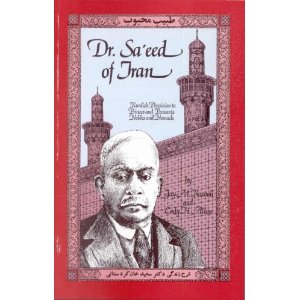
Afterward I searched online to find out who wrote this poem and discovered it was titled β€œDr. Sa’eed’s Hymn” and was contained in the bookΒ  Dr. Sa’eed of Iran: Kurdish Physician to Princes and Peasants Nobles and Nomads by Jay M. Rasooli and Cady Hews Allen. It is no longer in print, but Amazon.com has inexpensive used copies, so I ordered one. (If you don’t mind reading books on the computer, the text is online through Google books.)

Dr. Sa’eed’s is a fascinating story. He was born into a Kurdish mullah’s (an Islamic teacher) family in June of 1863 in what was then Persia, now known as Iran. He was uncommonly bright and well-taught, so much so that he was given the title of mullah at the age of thirteen when his father died.

As a child he once saw a foreigner wearing a hat with a brim, uncommon because Persians then wore brimless hats. When he asked his mother why the man wore that β€œfunny hat.”

β€œHe is an unbeliever,” she replied, β€œand they do not wish him to see the sky, which is the abode of God.” By such an answer was aversion to non-Moslems instilled in the receptive mind (p. 23).

Sometimes he might be in a Christian home and β€œaccidentally” knock something fragile off a shelf so that it broke or sit on a rug and cut holes in it with his knife. β€œSuch misdeeds, while inspired by bigotry, were done especially to earn merit with God by causing damage to an unbeliever or even to one of a rival Moslem sect” (p 24).

But he also had a thirst for holiness that led him to fervent study and extreme rituals. After years he was still β€œdissatisfied and restive” (p. 29.) His first encounters with professing Christians were with Catholics who disgusted him, as they drank alcohol (forbidden in the Koran).

When he was seventeen, some Protestant missionaries came to town and engaged Sa’eed as a tutor in the Persian language. He had heard even worse things about Protestants, but he acquiesced.

He was surprised by many things: they knew something of the Koran, they prayed for their enemies, they did not drink, lie, or gossip. Their behavior matched their teaching. They used the Bible for language study, and Sa’eed heard many discussions about Christian teachings. Over time he began to speak with Kasha Yohanan about religion and read the Bible for himself. He began to see his own failings and to doubt what he had always been taught. This was agony to him, causing him to burn himself with hot coals as a vow never to speak with Christians about religion again and to tell the missionary that he was no longer available. But the words he had heard continued to burn in his heart until he finally prayed to be led in the true way. He decided to study both the Bible and the Koran. β€œIn Mohammed’s teachings and personal life I found nothing which would satisfy the longing soul β€” not a drop of water to quench the thirsty spirit” (p. 38). Finally he yielded to faith in God.

His heart was now at peace, but his persecutions began in earnest. Even his own brother planned to kill him. The rest of the book details his growth, his training as a physician, and his life as a testimony to the One who saved him. Though often in danger, he never failed to treat anyone who called on him, even his enemies. His faith and godly character were a witness and a reflection of the One in Whom he believed.

(Reposted from the archives)

photo 3(2)

For the 31 Days writing challenge, I am sharing 31 Days of Inspirational Biography. You can find others in the series here.

31 Days of Inspirational Biography: Mimosa

783046_the_sensitive_flower

Sometimes people who work in children’s ministries can get discouraged due to the seeming lack of fruit or the fact that they have some children just a few times and then never see them again. Mimosa by Amy Carmichael tells the story of a little girl who was marvelously changed by just a short encounter with the gospel.

When Amy Carmichael was a missionary in India she learned that some little girls were sold to the temples for immoral purposes. Whenever she could, she tried to rescue these girls, to talk their parents into letting them stay with her instead. One such little girl was named Star. She had been with Amy for a while when her father came, bringing her sister, Mimosa, with him, to try to take Star back. He met and talked with Amy and Mr. Walker, the director, and at one point even stretched out his arm to take Star β€” yet he felt he could not move, that some strange power was preventing him.

Mimosa saw this. Some of the workers had a short time to talk with her, not even time enough to present the gospel completely. Mimosa asked her father to let her stay: he would not hear of it.

Those who had met with Mimosa longed for her: she seemed intelligent and interested. They lamented that they had not had time to tell her more. β€œHow could she possibly remember what we had told her? It was impossible to expect her to remember……Impossible? Is there such a word where the things of the Lord are concerned?”

Something of what she heard about a God who loved her stayed with her. She knew instinctively she could no longer rub the ashes of her family’s god on her forehead, as was their custom. The women in the house thought her naughty or β€œbewitched” and beat her with a stick. She was bewildered, but she knew God loved her, in spite of all she could not understand of her circumstances.

After she was married at age seventeen, she found she had been deceived by her husband’s family: He was β€œlandless [and] neck-deep in debt.” It was no shame to be in debt: in that culture: β€œβ€If you have no debt, does it not follow that no one trusts you enough to lend you anything, and from that is it not obvious that you are a person of small consequence?” But Mimosa’s character could not endure it, though she had never been taught against it. She encouraged him to sell the land in her name, the only piece of land he had that he had given as a dowry, to pay off the debt, and then suggested they would work. He was amazed at such a thing, but agreed. His unscrupulous elder brother suggested they start a salt market and that Mimosa sell her jewels to get them set up: he would take care of it. He instead somehow misused the money. She gave some money to her mother to keep for her, but then her mother would not give it to her when she asked for it: her mother was angry with her over the loss of the jewels that had been passed to her. β€œLet thy God help thee!” she told her daughter.

Mimosa went out to pray: β€œO God, my husband has deceived me, his brother has deceived me, even my mother has deceived me, but You will not deceive me…Yes, they have all deceived me, but I am not offended with you. Whatever You do is good. What should I do without you? You are the Giver of health and strength and will to work. Are not these things better than riches or people’s help?….I am an emptiness for You to fill.”

Thus her life went. She was a derision because she would not worship the false gods or engage in idolatrous practices. She worked hard because her husband would not. There were times when she was weak and could not work that God worked in unusual ways to provide for her. She had three sons; then a snake bite left her husband blind and crazy. In a couple of instances she received a bit more information about the God she loved, and she clung to it and to Him.

Meanwhile, Star was concerned for her sister. She felt led to write to her and prayed someone would read the letter to Mimosa. A cousin did read it to her, as often as Mimosa asked him, but neither of them thought to write back to Star, so she and the ladies of Dohnavur were left to wonder and pray.

A mysterious illness which took the life of one of her sons caused the neighbors to torment her further with their words. They felt it was all her fault since she would do nothing to appease the gods. Mimosa replied, β€œ My child God gave; my child has God taken. It is well.” Though weak, ill, grieving, and alone, she still told God, β€œI am not offended with you.”

The years followed in much the same way. She had two more sons. The oldest one was taken by the father (who had regained something of his right mind) to another town to work but, to Mimosa’s grief, required him to rub the god’s ashes on his forehead.

She began to long that her children should have β€œwhat she had never had, the chance to learn fully of the true and living and holy God and themselves choose His worship.” It would take too much space here to tell how God wondrously worked out the all the details to go to Dohnavur, even, miraculously, her husband’s approval. Her sister, Star, was strongly burdened to pray for Mimosa and discovered later that was just the time when all of this was coming to pass. Twenty-two years after she first visited Dohnavur, she returned. It can only be imagined what she felt as she soaked up Christian fellowship, learned to read, studied the Bible, was baptized. After a time she went back to her husband, determined to win him. He was in a less tolerant caste, yet amazingly he did not put her away. Her life was not easy. β€œBut then, she has not asked for ease; she has asked for the shield of patience that she may overcome.”

β€œIs not the courage of the love of God amazing?” Amy Carmichael wrote. β€œCould human love have asked it of a soul? Fortitude based on knowledge so slender; deathless, dauntless faith β€” who could have dared to ask it but the Lord God Himself? And what could have held her but Love Omnipotent?”

photo 3(2)

For the 31 Days writing challenge, I am sharing 31 Days of Inspirational Biography. You can find others in the series here.

31 Days of Inspirational Biography: Bill Maher, “Missionary to the Handicapped”

photo 3(2)

Beyond My DreamsWhen Bill Maher was born in 1928, the midwife assisting his mother thought he was dead. He was laid in the crib while the midwife and doctor turned their attentions to his mother, who was having severe complications. Bill was not dead, however, he was diagnosed with severe cerebral palsy. His parents were advised to put him away in an institution and forget they had him. The shocked mother refused. His parents sought any help and advice they could find to help their son while trying to treat him as normally as possible. His neck muscles were too weak to hold up his head, his arm and leg and tongue muscles were contracted and had to be stretched out daily. The therapy had both mother and son in tears, but it worked.

When Bill was two, he developed mumps and measles at the same time and lost his hearing. Yet he somehow learned to lip read. By the age of five he still could not talk.

Other children and even adults would taunt and tease Bill if his family was not around. Sadly, some of those people were even Christians β€” who would then ask Bill if he wanted to become a Christian! Neither he nor his parents did. Bill writes later in his autobiography, Beyond My Dreams, β€œApparently these people had never read Leviticus 19:14: β€˜Thou shalt not curse the deaf, not put a stumblingblock before the blind, but shalt fear thy God: I am the Lord.’ In other words, Christians should realize that God made the afflicted the way they are for a purpose and no one should take advantage of them because of their afflictions.”

One Christian lady knocked him down into the mud to get him out of her way and then told his mother he should not be allowed to walk where other civilized people did; he should instead be taken into the woods where the other animals were. Bill did not want to walk outside any more after that, but his mother told him, β€œGiving up is not in our vocabulary.”

Bill’s parents made him do chores and work hard. One time when he got out of a job his grandfather paid him to do by paying another child a lesser amount to do it, his mother was angry, but his grandfather realized he had to use his brains to figure that out. Bill had a wonderful sense of humor, manifested throughout his book.

Bill attended a regular school until fifth grade, when he failed because he could not keep up. The school felt they had taken him as far as they could, but the principal recommended a school for the deaf 30 miles away. His family made the daily commute, and Bill began to learn more.

When Bill was about 12, one family that was kind to him invited him to their church. There he saw many of the kids who picked on him, as well as the lady who had pushed him down. Yet he enjoyed the service and came back that evening. He misunderstood something the pastor said, and asked to speak to him afterward. Bill was ignorant of what the Bible said, and the pastor patiently explained Bill’s need for a Savior. Thankfully he did not let the failures of some of God’s people keep him from the one and only Savior who could meet his deepest needs. He accepted Christ and experienced immediate changes. He writes, β€œWhen I had walked into church that night, I had seen people I hated. When I left, I couldn’t hate them any more.”

When Bill completed the tenth grade at the school for the deaf, he was told he needed to face the β€œreal world” and go to the public high school. He did passing work, got involved in extracurricular activities, held down part time jobs, got his driver’s license. But on graduation night, as he walked across the stage to receive his diploma, the man handing them out said, β€œIt is amazing that you’ve graduated. You work hard, but you will still not amount to anything. If you can get a job, all you’ll ever be is maybe a janitor.” Bill was stunned, his mother was in tears, his dad was angry. Yet Bill was more determined that ever to prove this kind of thinking wrong.

Bill got a good job, but began getting into some of the activities of the unsaved coworkers and backslid. One day at work he had a heart attack, at the age of 22, and was told he only had a month to live. He asked his parents if he could stay with the pastor who had led him to the Lord at the camp where the pastor now ministered. They agreed, and over time Bill confessed his sins to the Lord and surrendered to do anything the Lord wanted him to do. The pastor felt Bill was called to preach. Bill didn’t think so because of his impediments. As he studied his Bible, he came across II Cor. 1:3-4 about comforting others with the comfort wherewith God comforted us, II Cor. 12 about God’s grace being sufficient, Phil. 4:13, and God’s answers to Moses’ objections. He surrendered to preach. His parents were upset and his dad told him not to come home.

Eventually his father did overcome his objections, Bill became a preacher, married, had two children, traveled all over the United States and then the world, preaching, ministering to the handicapped and afflicted, helped to start Christian schools for them, became a police chaplain, and received a honorary doctorate. He went home to be with the Lord in 2002.

In Dr. John Vaughn’s forward to Dr. Bill Maher’s book, he writes, β€œGod is to be praised for the wonderful way he has worked in and through this man’s life. Bill Maher is to be commended for the wonderful way he has served the Lord under circumstances that would have discouraged most others from the start. As you read, you will probably ask yourself the question that comes to me so often when I am with this man who is like a father to me, ‘If he has done this with the Lord’s help, what could I do if I would really trust Him myself?’”

Luke 14: 13-14: But when thou makest a feast, call the poor, the maimed, the lame, the blind: And thou shalt be blessed; for they cannot recompense thee: for thou shalt be recompensed at the resurrection of the just.

For the 31 Days writing challenge, I am sharing 31 Days of Inspirational Biography. You can find others in the series here.

(This will also be linked toΒ Semicolonβ€˜s Saturday Review of Books.)

31 Days of Inspirational Biography: One Woman Against the Reich

photo 3(2)

Sometimes, when we hear of the possibility of future hard times or even persecution, our greatest concerns are for our loved ones. We know from Scripture that God is in control, that He won’t allow anything that He won’t give us the grace to handle, that the β€œtrial of our faith” works patience and endurance in us and glorifies the Lord. From time to time we also hear testimonies of God’s keeping grace during trial.

One WomanOne such book I discovered some years ago is titled One Woman Against the Reich: The True Story of a Mother’s Struggle to Keep Her Family Faithful to God in a World Gone Mad by Helmut Ziefle. Mr. Ziefle’s parents lived in Germany during WW II; in fact, he was born in April 1939. In the previous years, the Nazi regime had grown, and trials and persecutions had grown for anyone not in agreement with them. There were two older brothers and a sister already in the family before Helmut made his appearance. His brother Kurt, 11, rushed home excited one day to tell his parents he had joined the Hitler Youth Organization. His mother reminded him that he belonged first to Jesus. But he was carried away with excitement. Of course, the youth organization happened to meet at the same time the rest of the family went to church. Hitler is quoted as saying, β€œIn my Teutonic order, a youth will grow up which will frighten the world. I want a fierce, masterful, fearless and ferocious youth. It can’t show any weakness or tenderness. The free and magnificent beast of prey must finally glow again from their eyes.” Can you imagine such a man after the young people of our homes and churches?

Maria, Helmut’s mother, had many concerns to deal with in those days: her children being carried away with Nazism; the possibility of persecution from neighbors when she did not return their β€œHeil Hitler;” threats against her husband; safety for herself and her family during air raids and bombings; severe scarcity of food; having a baby during all of this; the safety of her two older sons when they became old enough to go into military service, one fighting for Nazism, one against it but having to go nonetheless (the latter son ended up in a Russian POW camp for 5 years, sadly, ironically, for a cause he did not believe in); being turned out of their home so that soldiers could use it; her own poor health with phlebitis; the uncertainty of being separated from the rest of her family for a time. Yet in each situation her heart instinctively turned to her Lord. And in each situation she found Him faithful.

For the 31 Days writing challenge, I am sharing 31 Days of Inspirational Biography. You can find others in the series here.

(This will also be linked toΒ Semicolonβ€˜s Saturday Review of Books.)

31 Days of Inspirational Biography: Lady Huntingdon

photo 3(2)

For the 31 Days writing challenge, I am sharing 31 Days of Inspirational Biography. You can find others in the series here.

Lady Huntingdon used to say she was β€œsaved by an M,” pointing out that I Corinthians 1:26 did not say β€œnot any noble,” but rather that β€œnot many noble” after the flesh are called. She rejoiced to be counted among those called.

Lady Selina Shirley Huntingdon lived in England in the time of John Wesley and George Whitfield in the 1700s. Though a member of the Church of England as the Wesleys were, she came to trust completely in Christ alone for salvation around age 32 through the influence of a sister-in-law. Her husband died a few years after her conversion, and she lived her remaining years helping to establish 64 β€œmeeting-houses,” supporting George Whitefield and other clergy, opening chapels attached to her residences, opening a college to train men for the ministry, and supporting the Bethesda orphanage in Savannah which George Whitfield willed to her. It was her desire that the orphanage become a launching ground for missionary work in Georgia.

Lady Huntingdon also tried to reach her own friends for the Lord, who did not always appreciate her efforts. The Duchess of Buckingham wrote, “I Β  thank your Ladyship for information on the Methodist preaching. Their doctrines are strongly tinctured with impertinence toward their superiors… It is monstrous to be told you have a heart as sinful as the common wretches who crawl the earth.” The Duchess of Marlborough replied: “Your concern for my improvement and religious knowledge is very obliging and I hope I shall be the better for your excellent advice…women of wit, beauty and quality cannot bear too many home truths… I am forced to the society of those I detest and abhor. There is Lady Sanderson’s great rout tomorrow night-I do hate the woman as much as I hate a physician, but I must go if only to mortify and spite her…I confess my little peccadilloes to you; your goodness will lead you to…forgiving. β€œ

A Sunday School teacher once commented that God needs and uses people at all economic levels, all classes, all types, to reach those within their influence. Lady Huntingdon certainly used her influence for the Lord and followed after Joanna, Susanna, and others in the Bible who β€œministered unto Him of their substance.” (Luke 8:2-3) A good book about her life and ministry is Lady Huntingdon and Her Friends by Helen Knight.

(This will also be linked toΒ Semicolonβ€˜s Saturday Review of Books.)

31 Days of Inspirational Biography: Facing the Darkness

photo 3(2)

For the 31 Days writing challenge, I am sharing 31 Days of Inspirational Biography. You can find others in the series here.

Last year I wrote about Don Richardson and his book, Peace Child. I wanted to include one passage that I thought was somewhat symbolic of what most missionaries, and indeed, what most Christians must face at one time or another if they want to shine light into darkness. This was written about Don’s first foray into the jungle in which he was going to work:

Β The wildness of the locale seemed to taunt me. Something in the mood of the place seemed to say mockingly, β€œI am not like your tame, manageable Canadian homeland. I am tangled. I am too dense to walk through. I am hot and steamy and drenched with rain. I am hip-deep mud and six-inch sago thorns. I am death adders and taipans and leeches and crocodiles. I am malaria and dysentery and filariasis and hepatitis.

β€œYour idealism means nothing here. Your Christian gospel has never scrupled the conscience of my children. You think you love them, but wait until you know them, if you can ever know them! You presume you are ready to grapple with me, understand my mysteries, and change my nature. But I am easily able to overpower you with my gloom, my remoteness, my heedless brutality, my indolence, my unashamed morbidity, my total otherness.

β€œThink again before you commit yourself to certain disillusionment! Can’t you see I am no place for your wife? I am no place for your son. I am no place for you…”

The voices of the leafy arena seemed to swell and then fade into the masses of creeping tendrils and twisted vines…

It’s only a bluff, I thought. This swamp is also part of my Father’s creation. His providence can sustain us here as well as anywhere else. Then the peace of God descended on me, and suddenly this strange place became home! My home! I turned to Ken and John and said, β€œThis is where I want to build!”

That, in turn, reminds me of a poem I just recently rediscovered from Gracia Burnham’s book To Fly Again. I wrote about Gracia last year as well.

His lamp am I, to shine where He shall say,
And lamps are not for sunny rooms,
Nor for the light of day;
But for the dark places of the earth,
Where shame and wrong and crime have birth,
Or for the murky twilight gray
Where wandering sheep have gone astray;
Or where the lamp of faith grows dim
And souls are groping after Him.
And as sometimes a flame we find,
Clear-shining, through the night
So bright we do not see the lamp,
But only see the light:
So may I shine β€” His light the flame,
That men may glorify His name.

~ Annie Johnson Flint


Laudable Linkage

I wasn’t sure whether to post my usual collection of interesting links while the 31 Days of Inspirational Biography was going on: in my experience, the more posts I publish in a week, the less they are read, especially if I post more than one a day. But if I save these all up until after October is over, I’ll have a massive list. πŸ™‚ So I’ll go ahead and post them and hope that you’ll find something useful in them.

The Book of Books Is a Knowable Word.

Encouragement in the Word: Truth.

Bible Verses For When You Need Hope. I particularly liked the distinction “between hoping for something and hoping in Someone.”

Five Questions With a Former Muslim Who Converted to Christianity, an interview with Nabeel Qureshi, whose book I reviewed recently.

Lay Aside the Weight of Self-indulgence. Quote: “At the moment of indulging, it doesn’t feel like an enemy. It feels like a reward that makes us happy.” “…their beliefs finally changed. They went from believing one promise of happiness to believing another. That belief fueled their behavioral change and they went from self-indulgence to self-denial β€” but a denial for the sake of a better happiness.”

Lay Aside the Weight of Irritability. I forgot I had this in my files when I wrote about being easily irrtate-able – if I had remembered it, I probably would have just referred you to this. I need to refer to it often.

7 Conditions for Confrontation. I tend to avoid confrontation like the plague, but there is a time and place and even a Scriptural demand for it, and these are some principles to remember.

On Piles of Sand and Eating Babies on differences in cultures and judgmentalism, HT to Challies.

It’s Still a Bad Idea to Vent.

When Someone Reaches Out, Reach Back. Written particularly for those new to a church.

When Your Child’s Personality Annoys You. Quote: “Before you work to uproot them, consider whether behind that annoying trait is a strength waiting to be trained up. So often, the quality that manifests as a child’s greatest weakness holds the potential to be his greatest strength. ” Excellent post.

Boyhood, the Masculine Spirit, and the Formative Power of Work, HT to The Story Warren. Quote: We should be connecting the dots for young men between their lofty views of manhood and the small things they encounter everyday.”

Blogs Gone Cold and 7 Real-Life Reasons Why Women’s Blogs Go Cold. Some good and thoughtful reasons why women’s blogs seem less active.

Help for Aging Parents and Their Caregivers. I know these folks personally.

How to Make Driving Time Productive. Love this. Being in a car is one of my least favorite ways to pass time.

Save My Bleeding Quilt! How to Properly remove excess dye and a quilt and how to prewash fabrics to prevent the problem. Though I don’t quilt, I thought this would be useful for bleeding fabrics generally.

Happy Saturday!

Friday’s Fave Five

FFF fall backgroundIt’s Friday, time to look back over the blessings of the week with Susanne at Living to Tell the Story and other friends. Here are my favorite parts of the last week:

1. β™«β™ͺ It’s beginning to look a lot like autumn…β™ͺβ™« Leaves are starting to turn, temperatures are starting to lower a bit sometimes. I agree with Anne of Green Gables: I am glad to live in a world where there are Octobers! I changed my floral arrangement out front to an autumnal one, but hope to get the rest of the fall decorations out soon.

2. Ladies’ Luncheon at church. It was originally going to be an overnight retreat, which I could not have gone to, then with all that has gone on in our church this summer, it was decided to make it a one-day seminar, and then finally changed to just a 3 hour event with our speaker sharing before and after a meal. The messages, food, and fellowship were all really good and the fall decorations were just right.

3. Home-made bread. One lady at our church makes scrumptious home-made bread and made about four different types for the luncheon. There was a lot left over, and she urged us to take some home. That was a rare treat. I haven’t tried to bake bread since early marriage when my attempts did not turn out so well.

4. Our hibiscus bush. I’ve never tried one of these before, but we needed something for a couple of places around the house and got a couple of these last spring. They’ve done wonderfully with really very little care. We thought one of them was damaged due to an early frost, but it came back. I should have taken a photo a couple of days ago when it had several open blooms on it, but here is one:

photo
It looks a little red there, I guess because it is in my shadow, but it’s pink. We’ve enjoyed watching how the flowers unfold as they bloom.

5. A visit, a meal, and rocking a grandchild to sleep. I had an appointment one afternoon, and Jason and Mittu came over, brought me flowers and made dinner for us. I got to rock little Timothy while the dinner preparations were going on and even made him laugh a few times. We also made the flight arrangements for our oldest to come home for Thanksgiving. I’m so looking forward to it!

It’s been a busy week – now I need to regroup and figure out what’s next. πŸ™‚ Have a great weekend!