Book Review: Quiet: The Power of Introverts in a World That Can’t Stop Talking

QuietLast year I kept seeing Quiet: The Power of Introverts in a World That Can’t Stop Talking by Susan Cain mentioned favorably all over the blogosphere, and being an introvert myself (I got 11 out of 12 questions as an introvert on the Quiet Quiz!) and highly intrigued, I put it on my Christmas wishlist.

The author traces the history from a Culture of Character, when disciple, honor, and quietly doing the right thing were valued, to the Culture of Personality, where being likeable and presenting oneself well emerged as the more valued qualities (fueled, among other things, by the transition from an agricultural society to an industrial one and the need for salespeople), to these days esteeming charisma and overt extroversion. She draws examples from the worlds of business, education, and politics to show that Western society really is set up for the Extroverted Ideal, and she cites numerous scientific studies to show that introverts aren’t just shy (not all introverts are), but that they have physical, neurological differences that affect how they process things, and they also have many valuable qualities..

I was amazed at the many ways in which the world is indeed set up for more extroverted personalities, from businesses which put workers together in the same room to brainstorm and feed off each other’s energy rather than giving them quiet offices in which to think, to classrooms set up for groups, where contributing to class discussions is highly prized (she cites one classroom sign of “‘Rules for Group Work,’ including, ‘You can’t ask a teacher for help unless everyone in your group has the same question'” [p. 77] Talk about snuffing out individuality!)

The author isn’t saying that introverts are better than extroverts, but that they have valued gifts and abilities that society can and should make provision for, and that it is okay to be an introvert. Part of a larger quote from Allen Shawn says, “A species in which everyone was General Patton would not succeed, any more than a race in which everyone was Vincent Van Gogh” (p. vii). Both personality types are needed.

But she acknowledges that it’s not good for introverts to sit in a corner all our lives and never extend ourselves, and she suggests ways to interact in an extroverted world, like a popular public speaker who skips the social venues while on a speaking engagement to walk quietly by a river or hide out in the bathroom to “recharge” between sessions.

Probably one of the most helpful sections for me was a study of “highly reactive” babies. When disturbed in some way, the highly reactive babies would flail their arms, kick, and cry, but the other babies seemed to take everything in stride. I thought at first that the highly reactive babies would be the extroverts, since they were more vocal and expressive, but they became introverts. They reacted “not because they were extroverts in the making, but because their little bodies reacted strongly — to new sights, sounds, and smells. The quiet infants were silent not because they were future introverts — just the opposite — but because they had nervous systems unmoved by ” such stimulation (p. 102). As they grew older this high reactivity manifested itself in more stressful reactions to new people and situations, while extroverted people were easy-going. Turns out something called the amygdala in the brain affects our reactions. This came to a crux for me after TM: in even normal, not too busy and loud public settings (like a restaurant), I’d feel as if I were on sensory overload. Looking back, I can see I have pretty much always been this way. I think it just came to the forefront then because my mind and emotions were tied up with recovering from illness. Sometimes I’ve been stressed over my ability to get too easily stressed and wondered why I couldn’t take things in stride as easily as other people. It’s nice to know there is a reason! That doesn’t mean, of course, I should just give way to that and not seek God’s help as well as practical ways to react more calmly, but it does help to know it’s part of my make-up that I need to learn to deal with and not a character flaw.

Cain also dispels some myths about introverts: they are not all shy, they are not all bookish, they are not all sensitive, they are not anti-social — of the last, she says “introverts and extroverts are differently social” (p. 226). “When extroverts show up at a party, everyone knows they are present,” (p. 227), while an introvert will be quietly talking with one or two other people. Both do need and value intimacy, but introverts will likely have a few very close friends and small get-togethers rather than a lot of friends and big parties.

A chapter on communication, especially in relationships, yielded this helpful quote: “It can be hard for extroverts to understand how badly introverts need to recharge at the end of a busy day. We all empathize with a sleep-deprived mate who comes home from work too tired to talk, but it’s harder to grasp that social over-stimulation can be just as exhausting. It’s also hard for introverts to understand just how hurtful their silence can be…whatever the reasons for these differences in social needs…what’s important is that it is impossible to work through them” (p. 228).

This chapter (“The Communication Gap”) as well as the next on dealing with introverted children in ways that help and encourage them were probably the most helpful and valuable to me. It broke my heart to read one one set of highly extroverted parents seeking “treatment” for their very introverted son because they thought something was wrong with him. Cain shares a lot of ideas for both teachers and parents about ways to recognize an introverted child’s gifts and abilities and to help them in areas where they fall short, like social skills.

This book is written from a secular point of view, so there is a small smattering of words like “hell” sprinkled throughout, and I wouldn’t agree with the evolutionary reasoning behind some of the studies quoted. Some of the religious references are a bit “off,” such as this one: “The Western God is assertive, vocal, and dominant; his son Jesus is kind and tender, but also a charismatic, crowd-pleasing man of influence (Jesus Christ Superstar)” (p. 189). At first I was astounded that she would quote Jesus Christ Superstar as a reference, but then I thought maybe she was just citing it as one example of popular perception (though a mistaken one, in my opinion. Jesus was kind and tender, yes, but I wouldn’t call him charismatic and crowd-pleasing. Crowds did follow him, but for different reasons. But that’s another subject for another day).

But despite those caveats, I found this a fascinating and very helpful book in many ways. I would recommend it to both introverts and extroverts!

(This will also be linked to Semicolon‘s Saturday Review of Books.)

Sanctity of Life

I didn’t realize until earlier today that today is Sanctity of Life Sunday, but I didn’t want to let the day end without saying something about it.

As a Christian I believe God is the author of life, and He says he knew us even in the womb.

“Before I formed you in the womb I knew you, And before you were born I consecrated you; I have appointed you a prophet to the nations.” Jeremiah 1:5

For you formed my inward parts;
    you knitted me together in my mother’s womb.
 I praise you, for I am fearfully and wonderfully made.
Wonderful are your works;
    my soul knows it very well.
My frame was not hidden from you,
when I was being made in secret,
    intricately woven in the depths of the earth.
Your eyes saw my unformed substance;
in your book were written, every one of them,
    the days that were formed for me,
    when as yet there was none of them.
Psalm 139:13-16

This column, On abortion, it’s best to err on the side of life, makes the point that if there is any chance at all that the unborn fetus is a real human life, then it is best to treat it as such. I would think that even non-Christian people could see that. But apparently they don’t.

I saw this going around Facebook:

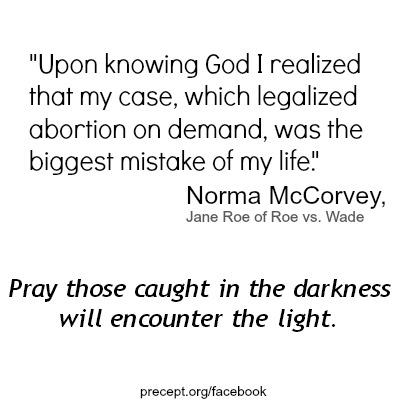
Roe mistake

“Each day, 2,150 women wake up in America believing abortion is the only realistic solution to an unplanned pregnancy” (care-net.org).
God brought Norma out of darkness and into His marvelous light.
Many women are still sitting in the darkness; will you help them see the light of the world?
We win by showing love, compassion, and mercy to one frightened woman at a time.

Laudable Linkage

Here are a few worthwhile reads from around the Web this week:

As It Gets Worse, It Cannot Get Desperate.

Cold-Case Christianity, a review of a book examining the claims of Christianity as a cold case detective. “The answers are available; you don’t have to turn off your brain to be a believer. Yes, it is possible to become a Christian because of the evidence rather than in spite of the evidence.”

6 Steps to Aging Well.

The Parenting Pause (And Why You Don’t Want to Miss It).

This is a funny one, especially if you’ve ever had a preschooler: 46 Reasons Why My Three Year Old Might Be Freaking Out.

I don’t watch Jimmy Kimmel, but someone shared this funny clip of CA newscasters’ reactions to their “cold snap” in the 50s. 🙂

And someone shared this on Facebook, true of many of us in the South. 🙂

Snow excitement

Have a great weekend!

Friday’s Fave Five

Welcome to Friday’s Fave Five, hosted by Susanne at Living to Tell the Story, in which we can share five of our favorite things from the last week,  wonderful exercise in looking for and appreciating the good things God blesses us with. Click on the button to learn more, then go to Susanne’s to read others’ faves and link up your own.

It’s been a rather heavy week for many friends and family members. In my extended family just within the last week, two have been diagnosed with cancer, one struggling with a drug addiction had a relapse, and my husband’s uncle passed away. Then there have been serious illnesses among many friends’ families. It is always good to look for and acknowledge God’s blessings, but in those times perhaps it is even more necessary and helpful than others. Here are a few high spots from the last week:

1. Snow! I think it was just a week ago that we were experiencing almost summer-like weather. I remember saying that I don’t mind a mild winter at all, but I was hoping we’d get at least one good snow before it was all over, and we got it last night.

Snow2013

2. Sunshine. We haven’t seen it in at least 1 and 1/2, maybe two weeks.

3. Cessation of rain. It has been raining almost constantly for days.

Sorry to be so weather-related, but that has greatly affected the last week or two!

4. Safety driving. Wednesday we had some of the hardest rains after more than a week of steady rain, and one of the main roads I travel was flooded. I had to go the back way into our neighborhood, which is made up of very narrow roads — not too bad normally, but a bit tense since all traffic was rerouted that day. I almost got side-swiped by a school bus turning onto the street I was on. Then last night hubby and kids all made it home safely in the inclement weather — the interstate my husband usually travels was blocked for 3 hours, I think due to an accident, but he got off and came the back way, so was spared that wait.

5. Good books, good food, good programs, good music, all brighten up the days.

Most of all I am grateful for God’s presence with His children and His grace for every moment.

Book Review: A Light in the Window

Light in the Window

A Light in the Window is the second book in the Mitford series by Jan Karon, and the second I have listened to narrated wonderfully by John McDonough.

In the last book, At Home in Mitford, Father Tim, a 60 year old Episcopalian priest, realizes he is attracted to his neighbor, Cynthia. Most of this book is his struggle to come to terms with what that means and how far he wants the relationship to go. He had thought he would be a lifelong bachelor, so he was surprised for love to come to him at this stage of life, plus he’s highly introverted, “set in his ways,” “buttoned-down,” fearful by nature, and not at all sure if he would even be capable of giving of himself in the way a marriage would require.

One section in his ponderings really stood out to me:

Was he willing to blend into the life of another human being for the rest of his days, and have hers blend into his?  That, of course, was the Bible’s bottom line on marriage: one flesh. Not separate entities, not two autonomous beings merely coming together at dinnertime or brushing past one another in the hallway, holding on to their singleness, guarding against invasion. One flesh! (p. 207).

The phrase “guarding against invasion” particularly struck me. I still have that tendency sometimes and have to remind myself that love means being open to others.

Their relationship is strained when another town widow sets her sights for him, Cynthia has to go to New York to work on her newest book, and they have a series of misunderstandings. It’s further strained when Cynthia is ready for further commitment to their relationship and can’t understand his hesitancy. In all honesty, I felt she was a little pushy in some places, and I felt she just needed to give him time and let him lead in the relationship. But the underlying thought amongst his friends seems to be that without a little pushing, he’d never move forward.

Among several subplots is Father Tim’s cousin Meg from Ireland coming to visit, proving to be every bit as eccentric as some of Mitford’s other characters; Miss Sadie’s desire to provide for Dooley Barlow, the boy under Father Tim’s care, with better schooling out of town; the danger that his favorite (and the town’s only) restaurant will be shut down; and a very abrasive, rough around the edges construction supervisor in charge of the nursing home being built with Miss Sadie’s donated money.

My only real objection with this book in the series is a number of references to something or other being s*xy, even a “Better Than S*x Cake” (disguising the words not because I am a prude but to avoid certain kinds of searches ending up here and certain over-sensitive filters blocking this post). There is nothing explicit, and by comparison to other books it’s quite tame, but still, I didn’t think even this needed to be tossed in the mix.

As with the first book in the series, I don’t think this was written and marketed as “Christian fiction,” but there is Scriptural truth throughout. This was another enjoyable visit with Father Tim and the Mitford residents.

(This will also be linked to Semicolon‘s Saturday Review of Books.)
Laudable Linkage and Cute Videos

Here are a few interesting things seen around the Web this week:

Why We Read the Bible. “I have a burden for my people right now, just like I do for myself, that we get beyond propositions and Bible verses to Christ. I do not mean “get around” Bible verses, but “through” Bible verses to Christ, to the person, the living person, to know Him, cherish Him, treasure Him, enjoy Him, trust Him, be at home with Him.”

Ashamed of the Gospel, HT to Challies. I think most Christians have probably all had similar experiences.

A Kind Wife.

Why Don’t You Just Apologize? The last few paragraphs are especially good.

How Is Obedience a Gateway to Understanding the Gospel? I haven’t read of the gospel-centered-parenting type books, but the posts I have seen on the subject seem to downplay the need to teach and train children to obey. But this post shows how it actually goes hand-in-hand with teaching the gospel. Girltalk has been doing a series on gospel-centered parenting that has been refreshing.

Parenting as Storytelling. I enjoyed the video with Sally Lloyd Jones about stories in children’s lives. I’d disagree a bit with the comparison with video games: I’ve raised three boys who play them, and though sometimes they’ve spent more time with them than I have thought beneficial, they don’t come out of playing them as she describes.  But I would rather see them reading than playing them.

18 Ribbon and Fabric Storage Ideas.

This has got to be one of the cutest videos ever:

One of mine was drawn to puddles like that. Such pure joy!

My son shared these on Facebook: One dog teaching another how to go down the stairs.

And this is how cats do it…

Ha! And finally, a friend shared this on Facebook.

Device

Rather amazing, isn’t it?

Happy Saturday!

Friday’s Fave Five

Welcome to Friday’s Fave Five, hosted by Susanne at Living to Tell the Story, in which we can share five of our favorite things from the last week,  wonderful exercise in looking for and appreciating the good things God blesses us with. Click on the button to learn more, then go to Susanne’s to read others’ faves and link up your own.

I didn’t think I’d do a FFF today. There have been a couple of rough patches this week (nothing I can share publicly), I’ve been pretty down, I didn’t want to pretend to be all bright and happy when I was not, and I honestly couldn’t come up with more than a couple of “faves” this morning. But throughout the day a few things came to mind:

1. More daylight. I know the days start getting longer after Dec. 21, but I usually can’t really tell it for several weeks. But this year somehow there is noticeably more daylight already, even though it has been overcast daylight. Even overcast daylight is better than darkness (I’m pondering multiple meanings of that….)

2. Nice temperatures. It has been pretty comfortable this week, feeling not at all like January. I hope we do get one good snow this year, but otherwise I am all for mild winters.

3. Letterpress, an iPhone word game I play with my oldest son.

4. Talking things over. You know how when you’re married sometimes your conversations are just about everyday things — it’s been nice to have some good talks this week.

5. Humor, especially my husband’s. He can lighten almost any situation.

Above all, I am glad that Jesus is “a friend who sticks closer than a brother” (Proverbs 18:24) and that He invites us to cast every care on Him.

Devotional Tips

Bible

One of my passions is to get women into the Word of God for themselves. Since this is the time of year many renew their efforts to have read their Bibles, I thought some might find this post from the archives (2006) helpful.

For those who might be unfamiliar with the term, “devotions” or “having devotions” is the time spent in the Bible and prayer. Others call it their quiet time or their “God and I” time or other terms.

Hopefully if you are considering devotions, you already feel it is important to read the Bible, but if you need to be encouraged along those lines, some reason to read the Bible are here.

When I first became a Christian as a teen-ager, the church I was in then had a strong emphasis on reading the Bible through in a year. I am so glad, because I think that, more than anything else, got me grounded spiritually. There are many advantages to reading the Bible through in a year: it kept me focused; I knew where to read next instead of wandering around aimlessly; I discovered choice nuggets in places like II Chronicles and Zephaniah that I probably would never have discovered otherwise; it kept me balanced; it helped me understand passages in their context; and each time through I would understand the passage more. There are, however, a few disadvantages: I felt like I couldn’t stop and ponder anything because I had to keep going in order to finish the day’s reading in the time frame I had, and if I fell behind it would get awfully discouraging trying to catch up. So after some time I continued to read the Bible through, but not necessarily in a year. I feel free to stop and meditate on a particular truth I found or to study it out further. I usually read a couple of chapters a day, but I sometimes stop after a few verses or sometimes go on and read more. Then sometimes between books, I take a break and work through a Bible study book or do a word study or topical study.

Most “reading the Bible through” plans encourage reading from both the Old Testament and the New, or reading a passage from Psalms or Proverbs along with the day’s scheduled reading. I think that is probably to help you through some of those “drier” books like Leviticus.

I think this is one of those areas where anything is better than nothing, though, so if someone says, “I’m sorry, I just can’t get into Leviticus,” I would say that’s fine. Maybe some day you’ll get back to that, but reading somewhere in the Bible is better than reading nothing.

Probably for most people the first big battle is getting regular about it. It does help to make a regular time and place for it. I like to have devotions in the mornings because my mind isn’t as cluttered as it is later on. I get up a little earlier than everyone else so it is quiet, and I have my shower first so I am awake. There were some years during the getting-kids-off-to-school morning rush when the best time was after everyone left for the day. The best time for some people is in the evenings.

There are some seasons of life, like when there is a new baby in the house, or vacation times, or when company is there, when it’s hard to maintain that regular time. It’s easier to let that time slip then, but if we go back to the “anything is better than nothing” principle, we can grab a few quiet moments here and there.

Once some semblance of regularity is maintained, the next big battleground is keeping our minds on what we’re doing. There is a quote from John Donne which expresses it well: “I throw myself down in my chamber, and I call in and invite God and His Angels thither; and when they are there, I neglect God and His Angels for the noise of a fly, for the rattling of a coach, for the whining of a door.”

I think the biggest help in avoiding distractions is to be actively looking for something rather than passively reading (more on that later). Another help is to keep a notepad nearby so that when something else comes to mind, as it so often does, like an item I need to get at the store or someone I need to call today, I can jot it down so I don’t forget it later and so my mind can acknowledge that it will be taken care of and not keeping going back to that thought.

It helps to “get in gear” as we begin. I often pray, “Open thou mine eyes, that I may behold wondrous things out of thy law” (Psalm 119:18), or asking the Lord to make my heart “good ground” that the seed of His Word can fall upon. It can help, also, to ask Him for something from His Word to carry with you through the day. Some people like to begin listening to, singing, or reading through a hymn. I like to start off with the reading from Daily Light on the Daily Path for the day.

Ps. 66:18 says, “If I regard iniquity in my heart, the Lord will not hear me.” We need to ask Him to search us, show us anything wrong, and enable us to get it right so we don’t block the channels of communication.

On to some general tips:

  • I was advised early on to look for a command to follow, a warning to heed, a promise to rely on, and even to underline (this was before highlighters were invented ) those things with different colors (red for warnings, blue for promises, black for commandments, yellow for verses about salvation. etc.) or marking beside the verse with different symbols for each category. The point isn’t “coding” your Bible, but to use that as a method to think through what the passage is saying and how to apply it.
  • Ask the old journalism questions: who, what, why, when, and how. What is being said to whom by whom? Is the promise there to all people or only to a specific person or group?
  • Notice recurring words or phrases, like the phrase “let us” which occurs three times in Hebrews 10:22-24, or the recurrence of the words “know” or “knowledge” in II Peter 1:2-8.
  • Underline verbs in passages like I Cor. 13 (the love chapter) or Proverbs 2:1-5 (about the search for wisdom).
  • In some of those long sentences of Paul’s, going back to basic English can help us understand them better: find the subject and verb to learn what the sentence is actually about, and then see how the phrases fit around it.
  • When reading the epistles, it can be helpful to write them out as they were originally written: as a letter without the chapter and verse markings.
  • Use a basic dictionary. One exercise in Changed Into His Image by Dr. Jim Berg instructed the reader to go through I Corinthians 13: 4-8 and write the definitions of the major words on a separate piece of paper, then write the verses out using those definitions. That was one of the most rewarding studies I have ever done. Even though that passage isn’t hard to understand, going through that exercise opened it up in a fuller way.
  • Some passages lend themselves to charts and diagrams, like the letters to the seven churches in Revelation 2-3 or the different sacrifices in Leviticus. That kind of thing really appeals to some people, and it’s easy to compare the similarities and differences that way.
  • Sometimes it is edifying to have some type of Bible project to study out. For instance, you might look up all the references to “the fear of the Lord” to see exactly what it is and how it manifests itself, or the references to “the fool” in Proverbs so you know what kind of behavior to avoid. Matthew 4 tells us Jesus countered Satan’s temptations with the Word of God, and it’s strengthening to look up verses on the specific temptations we face. Once when I had a fleeting thought doubting God’s goodness in a certain situation, instead of just telling myself, “Don’t be silly; you know God is good,” I began to search out verses that spoke of God’s goodness. Not only did that result in knowing my God better, but it fortified my soul against that doubt. Using a concordance or computer Bible program or even Bible Gateway helps with those kinds of studies, and we can supplement those studies later as we come across verses in other reading. Once I heard someone say that Jesus never claimed to be God, and I knew that Jesus did in fact proclaim His deity. So as I read through the Gospels, I put a “C” (for “claims”) beside each verse where Jesus said something about Himself that indicated His Deity. He may have never climbed on a mountaintop and said the phrase, “I am God,” but His deity is all throughout the gospels (the results of that study are here in The Claims of Christ). When I do a study like that, I usually write all the verses out in one place (I used to do it on index cards, but now I keep it on the computer) so I can refer back to it or add to it later on.
  • Sometimes we divide our devotional time into separate prayer and Bible reading times, but we can combine the two. When we read a verse that convicts about a particular sin, we can confess it immediately. When we read something that tells us about God, we can thank and praise Him immediately. When we read a character trait that we need to incorporate in our lives, we can acknowledge that need and ask for help and grace.
  • On very familiar passages, try to imagine you are reading it for the very first time, that you are there watching the events occur, or that you are reading and trying to convey it’s truth to someone who has never heard it before.
  • Something else that Jim Berg advocates in his book it to look for the Person, the Lord, in our reading, not just the principles.
  • Remember that “all scripture is given by inspiration of God, and is profitable for doctrine, for reproof, for correction, for instruction in righteousness” (II Timothy 3:16) – even the genealogies and Leviticus. We can ask the Lord for help in some of those drier passages to see His purpose for them. For instance, from the genealogies we learn that: God keeps records; God keeps detailed records; God knew all of those people whose names we can’t pronounce and cared about them; He knows and cares for us the same way.
  • Much has been written in recent years about journaling. I stopped doing so some time ago because, for me, it was too easy to spend most of the time and thought during devotions on “what I thought” rather than what God had to say to me. But journaling can be a good way to process what you’ve read and help make it more permanent in your own mind.

There are many good books on this subject. One is Tim LaHaye’s How To Study the Bible For Yourself. One I just read recently was Jason Janz’s Alone With God: A Practical Plan for Dynamic Devotions. His plan might seem a little regimented to some, but he invites the reader to adapt it. The basic idea is that if you don’t have some type of plan for your devotional time, you’ll drift and not benefit from it: having a basic format helps keep you on track just like writing things down on a prayer list helps keep you focused and helps you remember what to pray for. He has a lot of good tips and practical advice as well. Another good book is What Do I Know About My God? by Mardi Collier. I have heard her speak on this topic of how she wanted to get to know God better, and, at her husband’s suggestion, read through the Psalms, making notes of everything that was said about God. That led to a study of several years throughout the Bible. She tells about that study and how it has impacted her life in her book.

There is much more that could be said (and if I don’t stop soon, I’ll almost have a book, myself! 🙂 ). There are days and seasons of life when we might only have one verse to carry us through the day – and it is better to read one verse and truly get something from it than to read 10 chapters inattentively. But there will be some times we’ll be able to read and study a little more extensively than others. However we “do devotions,” we can ask God to show us Himself, that we may know Him, love Him, and serve Him better.

Here are some additional previous posts about devotions:

The blessing of hymns.
I have a preposition for you.
Meet my Bible.
Reasons to read the Bible.
God’s Word...
What do you say about this book?
Having devotions when you’re not feeling very devoted.
When there is no hunger for God’s Word .
Encouragement for mothers of young children .

This post will be also linked to “Works For Me Wednesday,” where you can find an abundance of helpful hints each week at We Are THAT family on Wednesdays.

Remembering Operation Auca 57 years later

It was the first week of January, 1956, that Operation Auca finally began to come to fruition for five missionary couples in Ecuador: Jim and Elisabeth Elliot, Roger and Barbara Youderian, Nate and Marj Saint, Ed and Marilou McCully, and Pete and Olive Fleming. On January 8, one of the men radioed the wives back at their stations, “Pray, girls: today’s the day!” On this date, January 9, the scheduled radio contact did not come and a missionary friend flew over the area where the men had been camped and saw their airplane stripped of fabric but saw no one. It was two days later that the first bodies were found. The men had been speared to death on January 8.

I can only imagine what it was like for those five women to go through those days with hope but no word and then to finally learn that their husband were gone and they were alone thousands of miles from home.

Yet, as many of you know, God used this incident to greatly impact both the Aucas (now know as Waodani or Huaorani) and the rest of the world. Later Rachel Saint (sister to Nate) and Elisabeth Elliot and her daughter Valerie were invited to come and live with the Aucas, and eventually many of them were led to the Lord: one of the killers even became a surrogate grandfather to Steve Saint’s children.

And not til eternity will we know the full impact of these men and their wives. Many lives have been touched, stirred, and inspired. Sometimes we still wrestle with why things happened as they did, but there is no doubt God used them.

A good post on the impact of Jim Elliot in particular is Today Jim Elliot was Killed. If you ever have the chance, see the documentary Beyond the Gates of Splendor. It is in four parts on Vimeo (Part 1, 2, 3, and 4), but I found the audio a bit hard to hear even turned all the way up.

In June for Carrie’s Reading to Know Book Club I’ll be hosting the reading of Through Gates of Splendor, Elisabeth Elliot’s book on the five families, what led them to Ecuador, and how their families coped in the aftermath of the men’s deaths. But when I realized this was the anniversary of that time, I couldn’t let it go by without acknowledgment.

I’ll leave you with some excerpts someone put together of the wives’ testimonies from Beyond the Gates of Splendor.

A few quick book reviews

I finished a few books fairly close together so I thought I’d review them all at once.

Journey Into ChristmasJourney Into Christmas by Bess Streeter Aldrich was recommended on someone’s blog, but I forget whose. The book is a collection of short stories, all, of course, having something to do with Christmas, in different times and settings. Some are sweet, some are poignant, none are frothy. Probably my favorite was an excerpt from her novel A Lantern in Her Hand (which I think I’d like to read some time). In the short story from it, times have been extremely hard for folks on the frontier, with no good crops for several years in a row. Most aren’t in the mood to celebrate Christmas and have little with which to celebrate anyway. Abbie, a young wife and mother, starts out feeling the same way, despairing at first, but then decides to do what she can, even as others scoff. Her husband gets into the Christmas spirit as well, and soon they both have stayed up late or stolen moments to make little gifts for the children, and that Christmas goes down as one that remains most in their memories. Abbie’s efforts remind me of a quote I once saw from a pioneer woman that went something like, “I make my quilts well to keep my family warm; I make them beautiful to keep my heart from breaking.”

I did find, however, that it is hard for me to get into short stories. You’d think they’d be easy to pick up and put down, especially during a busy time like Christmas, but without the momentum of one chapter carrying over to the next, for me it was harder to stay with it. But overall it was a good book.

100-Pound-Loser100 Pound Loser: How I Ate What I Wanted, Had Four Babies, & Still Took Control Of My Weight – And You Can Too! by Jessica Heights of Muthering Heights is an e-book available in a Kindle format or as a PDF file. I don’t remember how I became aware of this, but the title is certainly an attention grabber, especially for anyone who needs to lose weight.

What was there was good and inspirational: I just wish there was more of it. When anyone has successfully lost weight, the first thing everyone wonders is “How did you do it?!?!” The author shares some of the details, but not as much as I would have liked.

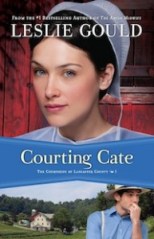
Courting-CateI won Courting Cate from its author, Leslie Gould, through a fun Fall Scavenger Hunt involving several Christian fiction authors. I had never read Leslie before, and though I don’t read a great deal of Amish fiction, this title intrigued me because it is based on Shakespeare’s Taming of the Shrew. That is one of his plays I have never seen or read, but I knew the basic gist of it. I was glad I didn’t know the plot details, though, because then much of the book was a surprise to me, and afterward it was fun to find out more about Shrew through Wikipedia and SparkNotes and compare.

Cate, in this story, is a sharp-tongued, short-tempered Amish young woman who works in her father’s shop, loves to read, is not handy in the kitchen, and has decided she will never marry. Her sister, Betsy, seems to attract potential suitors like flies, but not Cate: she seems to repel them. When Pete Treger comes to town, she’s strangely attracted to him, but as the sparks fly even with him, she knows they have no future. But then her father makes an edict that Betsy can’t marry until Cate does, and since Betsy wants to marry, she and her cohorts conspire to bring Pete and Cate together.

I was expecting this book to be lighthearted and comedic, and it is in some places, but I was surprised and touched at the poignancy of Cate’s feeling unloved and unlovable and her wrestling with God when she finds herself stuck in very hard circumstances. I ended up loving this book and looking forward to reading more from Leslie.

(This will also be linked to Semicolon‘s Saturday Review of Books.)