Friday’s Fave Five

Welcome to Friday’s Fave Five, hosted by Susanne at Living to Tell the Story, in which we can share five of our favorite things from the last week, a wonderful exercise in looking for and appreciating the good things God blesses us with. Click on the button to learn more, then go to Susanne’s to read others’ faves and link up your own.

It’s a busy day, so I’ll have to be (hopefully) short and sweet. Here are a few highlights of the week:

1. Jason’s birthday was last week but we had to wait to celebrate as a family on Saturday.

2. Handy, helpful, thoughtful hubby. Trying to dust off the light fixtures in my bathroom wasn’t working, but I couldn’t reach them to take them off for a washing. Jesse could, but he couldn’t figure out how to get them off — it’s a design I haven’t seen before. I asked Jim if he could get them down for me: he went “above and beyond” and cleaned them and the base and then put them all back together for me. Plus he fixed the garbage disposal when it stopped working (evidently a corn cob holder had gotten broken and stuck down there).

3. Going through old e-mails. In trying to create some more disc space, I’ve been going through files and deleting things. I’ve been going through the “filing cabinet” of my personal e-mail account, and was able to delete many no longer needed items, but had such fun rummaging through others, particularly notes from my sister who never writes or calls. 🙂

4. Scheduling Jeremy’s flights. He’s coming for a whole week next month!

5 Finding a baby bird in my hanging basket.

He sat there for a long while, blinking and observing, the little tuft on top of his head ruffling on the breeze. Cute!

Hope you have a great week! I will try to catch up with you later tonight or over the weekend.

The surprise at Mary’s prayer meeting

Those dear folks praying for Peter at Mary’s house in Acts 12 get such a bum rap. You remember the story: Peter was in prison, many were gathered together at Mary’s house praying for him, he was miraculously delivered, he came to Mary’s house, Rhoda answered the door, in her excitement she left him at the door while she told the others he was there, and they thought she was crazy. They’re accused of not really praying in faith if they were so astonished when the prayer was answered.

But Dr. Layton Talbert, in his book (Not By Chance: Learning to Trust a Sovereign God, brings up a different viewpoint. We don’t know that they were praying for Peter’s deliverance from prison. He points out that the text doesn’t say. James was killed by Herod earlier in the chapter: since he was not delivered they may not have expected Peter to be, either. “The only precedent we have for the church’s prayer under similar circumstances is in Acts 4:23-30. There, in the face of recent imprisonment, persecution, and renewed threats, the church made only one request. And it wasn’t for deliverance from prison or persecution; it was for boldness in the face of both (4:29)” (p. 203).

That’s a rebuke to me. When I’m experiencing any kind of trouble, the main focus of my prayer is likely to be deliverance. “Lord, please get me out of this. Please remove this problem. Soon. As soon as possible. Today, even? Now? Please?”

It’s not wrong to pray for or seek for deliverance. There are examples of both all through the Bible. Jacob. The Psalmist’s prayers. Persecution scattered the early disciples far beyond Jerusalem, taking the gospel with them. Paul escaped for his life several times. Even Jesus evaded the murderous intents of mobs when His time was not yet come.

But as we saw yesterday, it is not always God’s will to deliver, at least not in the way or the time we wanted. James was killed. Joseph spent long years as a slave and then as a prisoner. Paul was eventually imprisoned. Jesus, when His time was come, faced betrayal, arrest, torture, and death.

When we don’t know when or whether God will deliver us or a loved one from a serious trial, besides praying for deliverance, we can pray for these as well:

  • that with all boldness they may speak His word (Acts 4:29)
  • that they or we would “count it all joy when ye fall into divers temptations” (James 1:2)
  • that  we’d know “that the trying of your faith worketh patience” and “let patience have her perfect work, that ye may be perfect and entire, wanting nothing” (James 1:3-4).
  • that we’d “fear none of those things which thou shalt suffer: behold, the devil shall cast some of you into prison, that ye may be tried; and ye shall have tribulation ten days: be thou faithful unto death, and I will give thee a crown of life.” (Revelation 2:10).
  • that we’d let “none of these things move me, neither count I my life dear unto myself, so that I might finish my course with joy, and the ministry, which I have received of the Lord Jesus, to testify the gospel of the grace of God” (Acts 20:24).
  • “That their hearts might be comforted, being knit together in love, and unto all riches of the full assurance of understanding, to the acknowledgement of the mystery of God, and of the Father, and of Christ; In whom are hid all the treasures of wisdom and knowledge.” (Colossians 2:2-3) (It’s interesting to look through verses about comfort in Paul’s epistles.)

In fact, the more I look through these, the more I seem to find: not surprising since many of Paul’s epistles were written while people were after him or while he was in prison.

May we and our loved ones seek His will and grace and help in our afflictions as well as out of them.

When God doesn’t deliver

In the wake of the horrible tragedy that occurred recently when a gunman entered a movie theater and opened fire, some remarkable testimonies of God’s providential deliverance have emerged. So you STILL think God is a merciful God? tells how the author and her children escaped the theater unharmed. A Miracle Inside the Aurora Shooting: One Victim’s Story relates how a bullet entered one victim’s brain through a previously undiscovered birth defect, causing the bullet to miss the brain itself.

Of course, some will attribute the circumstances to happenstance or luck. But others wonder, why does God deliver some but not others?

In Rosalind Goforth’s book How I Know God Answers Prayer, one chapter details the miraculous bur harrowing account of her family’s deliverance during the horrors of the Boxer rebellion in China in the 1900s. She says:

Many times we were asked in the homeland to tell the story of our escape during the Boxer uprising, and often the question was put, “If it was really God’s power that saved you and others on that journey, then why did He not save those of His children who were so cruelly put to death?” For a time this question troubled me. Why indeed? One day when seeking for light on the matter I was directed to Acts 12. There I found the only answer that can be given. We are told in verse 2 that James was put to death by the sword; then the rest of the chapter is given to the detailed record of Peter’s wonderful deliverance in answer to prayer (vv. 5, 12).

She goes on to say that a great many people were praying for them and that undoubtedly had a lot to do with their deliverance.

But some pray and are prayed for, yet still die or suffer. What then?

Hebrews 11, that great “Hall of Faith” passage tells of many marvelous things God wrought through the faith of His people. But then verses 36-38 take a turn from all that deliverance and provision and answered prayer:

And others had trial of cruel mockings and scourgings, yea, moreover of bonds and imprisonment: They were stoned, they were sawn asunder, were tempted, were slain with the sword: they wandered about in sheepskins and goatskins; being destitute, afflicted, tormented; (Of whom the world was not worthy:) they wandered in deserts, and in mountains, and in dens and caves of the earth.

Why were these not delivered? The text doesn’t say, but they are commended just the same as the others: “And these all, having obtained a good report through faith, received not the promise: God having provided some better thing for us, that they without us should not be made perfect” (vv.39-40).

In the New Testament, John the Baptist was beheaded. Stephen was stoned. James was killed. Layton Talbert asserts:

But martyrdom is no less providential than deliverance, and the martyrdom of these men was as providentially superintended by God as was the martyrdom of His own Son. Such deaths are neither a failure on God’s part nor a victory on Satan’s. They are a part of the outworking of God’s all-wise and always good purposes. (Not By Chance: Learning to Trust a Sovereign God, page 198).

He goes on to relate:

You have probably heard that “the safest place to be is in the center of God’s will.” A veteran missionary to Colombia, South America, once explained how experience and personal Bible study led him to modify that saying. “The most fulfilling, joyful, and peaceful place to be is in the center of God’s will,” he concluded. “But it is not necessarily the safest.” This is not heresy — unless we measure orthodoxy by conformity to cliche rather than to Biblical realism. (p. 198).

The quote is taken from the article “Peace, if not safety,” and the missionary, Timothy A. McKeown, goes on to make these statements, also quoted in Not By Chance:

It seems to me that the Bible is full of examples of God’s people often-not occasionally-being placed in unsafe, uncomfortable, and dangerous situations.

Most prayers in Scripture focus not on the personal safety and benefit of believers but on the power, majesty, testimony, and victory of God over his-and, of course, our-enemies.

The Lord calls us to obedience in spite of the “costs”-not to personal comfort and safety!

Dr. Talbert continues:

Our death is as much a matter of providence as our life. It may seem tragic or ignominious or accidental. But God’s providence rules over the tragedy, the ignominy, and yes, even accidents. Moreover, we must labor to think God’s thoughts, to maintain God’s perspective (p. 199).

He goes on to point out that the deaths of John the Baptist, Stephen, and James were not the end of them, in two senses. 1) They go on to life in heaven with God, our true and ultimate home, and 2) their influence and testimony continue on.  This is true in our times as well, as illustrated by Jim Elliot and the other four missionaries who were killed by the tribe they were trying to reach, Gracia Burnham’s husband, and any saint of God.

In On Asking God Why by Elisabeth Elliot, she included a chapter called “On Brazen Heavens” written by her brother, Thomas Howard. After describing times when God has not answered prayer, at least not as the person praying wanted, he says:

Turning again to the disclosure of God in Scripture, we seem to see that, in his economy, there is no slippage. Nothing simply disappears. No sparrow falls without his knowing (and, one might think, caring) about it. No hair on anybody’s head is without its number. Oh, you say, that’s only a metaphor; it’s not literal. A metaphor of what, then, we might ask. Is the implication there that God doesn’t keep tabs on things?

And so we begin to think about all our prayers and vigils and fastings and abstinences, and the offices and sacraments of the Church, that have gone up to the throne in behalf of the sufferer. They have vanished, as no sparrow, no hair, has ever done. Hey, what about that?

And we know that this is false. It is nonsense. All right then–we prayed, with much faith or with little; we searched ourselves; we fasted; we anointed and laid on hands; we kept vigil. And nothing happened.

Did it not? What angle of vision are we speaking from? Is it not true that again and again in the biblical picture of things, the story has to be allowed to finish?

Was it not the case with Lazarus’ household at Bethany, and with the two en route to Emmaus? And is it not the case with the Whole Story, actually–that it must be allowed to finish, and that this is precisely what the faithful have been watching for since the beginning of time? In the face of suffering and endurance and loss and waiting and death, what is it that has kept the spirits of the faithful from flagging utterly down through the millennia? Is it not the hope of Redemption? Is it not the great Finish to the Story–and to all their little stories of wandering about in sheepskins and goatskins as well as to the One Big Story of the whole creation, which is itself groaning and waiting? And is not that Finish called glorious? Does it not entail what amounts to a redoing of all that has gone wrong, and a remaking of all that is ruined, and a finding of all that has been lost in the shuffle, and an unfolding of it all in a blaze of joy and splendor?

A finding of all that is lost? All sparrows, and all petitions and tears and vigils and fastings? Yes, all petitions and tears and vigils and fastings.

“But where are they? The thing is over and done with. He is dead. They had no effect.”

Hadn’t they? How do you know what is piling up in the great treasury kept by the Divine Love to be opened in that Day? How do you know that this death and your prayers and tears and fasts will not together be suddenly and breathtakingly displayed, before all the faithful, and before angels and archangels, and before kings and widows and prophets, as gems in that display? Oh no, don’t speak of things being lost. Say rather that they are hidden–received and accepted and taken up into the secrets of the divine mysteries, to be transformed and multiplied, like everything else we offer to him–loaves and fishes, or mites, or bread and wine–and given back to you and to the one for whom you kept vigil, in the presence of the whole host of men and angels in a hilarity of glory as unimaginable to you in your vigil as golden wings are to the worm in the chrysalis.

There may be any number of reasons why someone faces death without actually dying. Many who have done so have testified it gave them a new sense of purpose. But as to the question, why does God deliver some people from death and not others, we can’t really know the answers. Even those who were delivered will have to face death another time. All we can do is trust that God has His purposes in what He allows.

But God never promises that all His people will comfortably live the American Dream for 80+years. One of the lessons in such tragedies as the one in Aurora is that truly we never know what a day may bring forth and we’re not promised another breath. We need to be ready to face our Maker. “And this is the record, that God hath given to us eternal life, and this life is in his Son.  He that hath the Son hath life; and he that hath not the Son of God hath not life” (I John 5:11-12).


What’s On Your Nightstand: July 2012

What's On Your NightstandThe folks at 5 Minutes For Books host What’s On Your Nightstand? the fourth Tuesday of each month in which we can share about the books we have been reading and/or plan to read.

Since last month I’ve finished:

(All links in this section are to my reviews.)

Beyond the Shadows by Robin Lee Hatcher (audiobook) about  a woman whose husband is an alcoholic. Very good.

Cold Sassy Tree by Olive Ann Burns, about a small-town Southern community’s reaction when a widower remarries just three days after his wife’s funeral. Not crazy about it but it did have some good points.

Coming Home by Karen Kingsbury. End of the Baxter family saga.

Lost Melody by Lori Copeland and Virginia Smith (audiobook). A promising classical pianist is severely injured in a subway accident, ruining her career hopes and dreams. Then she begins to have a recurring nightmare and an impression that she’s supposed to warn her small seaside town of a coming disaster. Mixed emotions.

Walking on Broken Glass by Christa Allan, about a woman recovering from alcoholism and learning how to respond to her controlling husband.

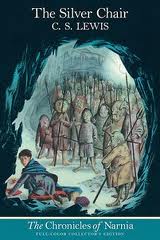
The Silver Chair by C. S. Lewis. Two children are sent on a quest to find a lost prince held captive by an evil queen. Good stuff. A part of Carrie‘s The Chronicles of Narnia Reading Challenge and July Book Club choice.

I’m currently reading/listening to:

The Horse and His Boy by C. S. Lewis.

The House at Riverton by Kate Morton. A former maid is the only living person associated with an old manor house and has a secret she’s kept quiet all these years. Pretty intriguing so far. I’m sorry to have listed this here. The story ended up being very sordid with some use of vulgar language and I cannot recommend this book or author.

Not By Chance: Learning to Trust a Soveriegn God by Layton Talbert. Excellent.

Roots by Alex Haley, audiobook. This book was not on my radar at all, but I was looking for a new audiobook and scrolling through the classics listing at Audible.com, and saw it.  I don’t know that I’d call it a classic just because it is not that old. But it’s pretty fascinating. I do have another reason for reading it (listening to it) that I’ll share later.

Up next:

I still haven’t decided whether to join in the summer Louisa May Alcott reading challenge but since there is only one more month of summer, I guess I’d better decide soon. I always enjoy a visit with her books. I have The Discovery by Dan Walsh on hand and I’ve got about 38 downloads on my Kindle app, so I should probably work on a few of them.

Happy Reading!

Book Giveaway

Author Adam Blumer is giving away a copy of his book

 Fatal Illusions

here.

I read and reviewed this book here and can highly recommend it.

Fatal Illusions

I’m going to close comments here so people don’t get confused. Go to Adam Blumer’s for a chance to win a copy of his book, Fatal Illusions.

Friday’s Fave Five

Welcome to Friday’s Fave Five, hosted by Susanne at Living to Tell the Story, in which we can share five of our favorite things from the last week, a wonderful exercise in looking for and appreciating the good things God blesses us with. Click on the button to learn more, then go to Susanne’s to read others’ faves and link up your own.

It’s actually been a pretty frustrating week, with a computer issue taking up most of two mornings resulting in not getting done even a fourth of what I had planned for the week. So it has been a little harder to come up with five favorite parts of the week, but sometimes that’s when it is most needful and helpful to look for them.

1. Electronic means of contact. Within my extended family this week there have been three birthdays, one funeral, a drug overdose and a missing (adult) child for one night. It’s nice for someone in a crisis to be able to send a text message or Facebook message to multiple people and have thoughts, prayers, words of comfort and reassurance flooding back within moments without having to spend hours on the phone. Sure, these don’t replace phone contact (for those far away and face-to-face contact with those close by) but there are times they do greatly help  both the person sending the messages and those waiting for updates.

2. A successful reinstall of Picasa. I had to do that last week and mentioned being thankful I had just backed up photos. I’d been getting pop-up notices that there wasn’t much disk space left, and Picasa finally crashed even though I’d been going through and deleting photos (like ones I had taken just to show something on my blog, or ones where we’d taken multiple shots of the same thing, etc.). When I reinstalled Picasa, somehow it imported not just photos but scans, clip art, etc., resulting in taking up too much space again and another crash. Thankfully through an online help forum I found out what to do and reinstalled it and set it just to import from the My Pictures folder. We do need to get a bigger disk drive some time soon, but hopefully this will take care of things for now.

3. AC. Again. I might say that every week this summer. 🙂 I was doing one project just in the garage, not even outside, and got so hot it took several hours to feel comfortable again once I came back inside.

4. Mini pies. I was lamenting a few weeks ago that I couldn’t find single-servings pies in just a plain chocolate flavor, and I didn’t want to bring a whole one home because I’d be too tempted to eat too much of it. Just this week I found Marie Callender’s Mini Pies — Chocolate Satin for me and Key Lime for Jesse. Good stuff! they also show an apple one I haven’t seen yet in the store but I’d love to try it.

5. Godly teachers, preachers, and writers who carefully handle the Word of God. I’ve been so dismayed lately by a few posts where the author glosses over clear Scripture in order to justify an unscriptural position. By contrast, I’ve been blessed in reading Not By Chance by Layton Talbert on the sovereignty and providence of God. This paragraph highlights his approach in this book and what should be the approach of anyone who teaches from the Bible:

The Holy Spirit is not capricious or careless in His use of words. It is incumbent upon us, therefore, to handle the text of Scripture attentively and accurately. If we are to form a correct understanding of the facts of the story (and, consequently, to arrive at sound theological conclusions), it is vital that we carefully observe the details — and confine our conclusions to the information explicitly communicated by those details (p. 87).

Bonus: Congratulations to Susanne on the 200th Friday’s Fave Five post! She asks how we first came to participate in FFF. I had been reading her anyway, so when she started FFF I jumped right in fairly soon. I think some of my family reads these weekly posts even if they don’t read the rest of my blog, LOL! 😀 It’s been a great way to review the week and remember God’s blessings in it.

Hope you have a great weekend! Jason’s birthday was Wednesday but we’re celebrating tomorrow, and I’m looking forward to that.

Book Review: The Silver Chair

Chronicles of Narnia Reading Challenge

Reading to Know - Book Club

I read The Silver Chair by C. S. Lewis for the Chronicles of Narnia Reading Challenge and the book club choice for July sponsored by Carrie at Reading to Know.

I’m reading the Narnia books in the order in which they were first published, and The Silver Chair comes fourth, just after The Voyage of the Dawn Treader (linked to my thoughts.)

The book opens with Eustace from that book (though by now Eustace is “not a bad sort,” having changed from the negative, complaining boy he used to be) and schoolmate Jill Pole dealing with some bullies in the school. As Eustace tries to tell Jill about Narnia, they wonder if maybe they could ask to be taken there. Then they hear the bullies pursuing, make a run for a gate in a wall, and find themselves suddenly somewhere else. Eustace ends up falling over a cliff while trying to help Jill keep from doing so, but Aslan rescues him by sending him to land.

Jill is frightened by Aslan at first. She’s dreadfully thirsty, but Aslan is beside the stream, and Jill is hesitant to go forward. He invites her to come and drink. She wants to look for another stream, but he tells her there is no other. Parts of this conversation recall the invitation from Christ to come and drink and the fact that there is no other stream of living water that can be had other than His.

Jill does finally trust Aslan enough to come and drink. After dealing with her about her part in Eustace’s fall, Aslan gives her a task for the both of them but says it will be harder because of her actions. She and Eustace must find and bring home the young prince Rillian, Caspian’s son, who has been missing for ten years. Aslan gives Jill four signs and makes her memorize them, then sends her off to join Eustace.

She quickly “muffs” the first sign, which makes their task even harder than it would have been. With the help of some owls and Puddleglum, a Marsh-wiggle, they set off to find the prince. They are sent the wrong way by what seems to be a beautiful woman and a silent knight, run into some trouble with the next two signs, brush against great danger at a giant’s castle, and end up searching through an underground world to find a seemingly silly young man who has to be tied to a silver chair every evening during a fit of insanity. Or is that when he is truly sane?

Though I missed the Pevensie children, I did enjoy this foray back to Narnia. A repeated theme throughout the book seems to center around obedience and trust. When they don’t follow the first signs, their task gets that much harder. Then when things come to a crisis and the final sign seems to be before them, yet the circumstances are not what they thought they would be, Puddleglum says, “There are no accidents. Our guide is Aslan…and he knew already all things that would” happen, and “Aslan didn’t tell Pole what would happen. He only told her what to do.”

Besides those already mentioned, there are other Biblical allusions, among them, the reminder from Aslan about how important it was to keep reminding oneself of his word, and his remark, when Jill wonders how he could have been calling them when they were the ones looking for a way to Narnia, “You would not have called to me unless I had been calling to you.” Though at first they fall into trouble by being more concerned with creature comforts, getting to a place where they could get in out of the elements, rest, and eat, though that place was a place of danger to them, later on they’re delivered from great temptation and disaster by reminding themselves of Aslan’s words and the bedrock truth they know.

I enjoyed some of the veiled humor sprinkled throughout the book as well, often aimed at the children’s school, known as the “Experiment House.” The best of those lines was when “the Head’s friends saw that the Head was no use as a Head, so they got her made into an Inspector to interfere with other Heads. And when they found out she wasn’t much good even at that, they got her into Parliament where she lived happily ever after.”

I also read the chapter pertaining to The Silver Chair from The Way Into Narnia (linked to my thoughts. I had read it last year except for the chapters specific to the books I hadn’t read yet. It’s a great Narnian resource). He pointed out something that hadn’t dawned on me in the structure of the story, that it takes descending steps and then ascending steps. He felt the theme was freedom and obedience, or freedom through obedience, and I think I’d agree.

(This review will also be linked to Semicolon‘s Saturday Review of Books.)

Book Review: Lost Melody

In Lost Melody by Lori Copeland and Virginia Smith, Jill King is a talented concert pianist on her way to Carnegie Hall when she’s involved in a horrible subway accident which kills most of the passengers. Jill survives, but sustains an injury to her hip, and what’s worse, to her hand, tragically ending any dreams she had for her future as a pianist.

In the year following she slowly recovers physically as much as possible, but she is still seeing a counselor to deal with the emotional trauma. People feel it’s time for her to move on, and things begin to move toward a permanent commitment to her boyfriend Greg, a lawyer with promising political ambitions.

About this time she begins having recurring terrifying dreams, and she feels they are portending a disaster to her oceanside Novia Scotia town and she’s supposed to warn people. But warning people carries the risk of being thought crazy, which would not only damage her reputation but would also affect her fiance’s career.

I’d seen this pop up on other blogs and always thought it sounded interesting until I got to the part about the dreams, then I’d close the screen and move on to something else. But when I was looking for a new audiobook, somehow I missed that part when I ordered.

For me, I can’t help reading/listening and wondering “Where are the authors going with this? Are they trying to promote a view that God speaks to people in this way today?”

Personally, I don’t believe that He does. No, there is no Bible verse where God says, “I will never again speak audibly or through dreams to anyone ever again until they get to heaven.” But my understanding of I Corinthians 13:8b-10 (“But whether there are prophecies, they will fail; whether there are tongues, they will cease; whether there is knowledge, it will vanish away. For we know in part and we prophesy in part. But when that which is perfect has come, then that which is in part will be done away.”) is that once the Word of God came, the need for the “sign gifts” faded away. I know there are differences of opinion about that, and that’s fine: I don’t mean to start a debate. I’m just relaying my mindset as I listened to the book. The most realistic and seemingly genuine incidents I’ve heard of their use today have occurred among primitive people who don’t have the Scriptures in their languages yet. Plus, I don’t know of a Biblical prophecy that’s just about getting out of town because of a coming disaster: usual it has to do with a call to repentance. There are multitudes of crashes, floods, explosions, earthquakes, and other disasters throughout the world on a daily basis: why would God pick one little town and send a prophecy to them to leave town because something bad is about to happen?

But I decided if I was going to get anything out of the book, I needed to just set that aside mentally, accept it as just a fictional part of a fictional story rather than reality, and just see how it played out.

I felt the authors did handle well the ramifications of such a character with such a message: the disbelief of some, including her fiance, and his wrestling with how to support her while not letting her stance have a negative impact on his career; the support of others, with a tiny few carrying it over into a bit of extreme fanaticism; the media interest and “spin” on it, etc. All of that was very realistic and did make me empathize with the prophets of old, the reluctance some of them may have felt at proclaiming a message that many would not receive. The authors also did a great job with the plot development and the build-up of suspense to the climax at the end.

I enjoyed most the parts about Jill’s recovery and the issues she faced in connection with the loss of her dream. But even regarding the prophecy as fictional, as a plot element, I didn’t really enjoy that part of the book as well.

(This review will also be linked to Semicolon‘s Saturday Review of Books.)

Discernment

I was dismayed recently, when reading through the comments on a somewhat controversial blog post, to see that when one commenter tried to bring the Scriptures to bear on the topic, he was called legalistic and judgmental (and this by other professing Christians.)

Conversely, the Bible says the Bereans “were more noble than those in Thessalonica, in that they received the word with all readiness of mind, and searched the scriptures daily, whether those things were so” (Acts 17:10). Searching through the Scripture to see if what was being said lined up with what was there was considered a noble thing.

A couple of nights ago, the evening reading from Daily Light on the Daily Path contained several verses on this topic:

The ear trieth words, as the mouth tasteth meat. Job 34:3

Beloved, believe not every spirit, but try the spirits whether they are of God: because many false prophets are gone out into the world. I John 4:1

Judge not according to the appearance, but judge righteous judgment. John 7:24

I speak as to wise men; judge ye what I say. I Corinthians 10:15.

Let the word of Christ dwell in you richly in all wisdom. Colossians 3:16a

He that hath an ear, let him hear what the Spirit saith. Revelation 2:29

He that is spiritual judgeth all things. I Corinthians 2:15a

Take heed what ye hear. Mark 4:24a

I know thy works, … and how thou hast tried them which say they are apostles, and are not, and hast found them liars. Revelation 2:2

Prove all things; hold fast that which is good. I Thessalonians 5:21

Several of those verses that speak of judging. Someone might say, “Whoa, wait a minute…I thought we weren’t supposed to judge.” That’s one of the most misunderstood concepts from the Bible. We’re not supposed to judge in the sense of condemning someone on the assumption that we know what what their motives are, condemning someone’s actions that might be different from ours when there is not a Scriptural principle involved, acting as if we’re superior in some way, etc. But to exercise discernment, to judge whether this or that statement or action is in line with Scripture (especially when the one saying or doing says it is but seems to be a little off-base) is another thing entirely.

According to a Greek lexicon the word used for “judgeth” in Acts 17:11 and I Cor. 2:14-15 quoted above means:

examine or judge

  1. to investigate, examine, enquire into, scrutinise, sift, question
    1. specifically in a forensic sense of a judge to hold an investigation
    2. to interrogate, examine the accused or witnesses
  2. to judge of, estimate, determine (the excellence or defects of any person or thing

I’ve linked back to some of the other definitions in the verses themselves so as not to be too lengthy here.

Sometimes what another person advocates won’t seem major, but as one pastor put it, if you’re taking a trip and start off on the right path, and then turn just ten degrees the wrong direction, it won’t look like a big difference at first, but if you keep going you’ll find yourself way off course.

Of course, there are some areas where Christians can have differences of opinion and practice, where the Bible doesn’t speak directly or in clear principle, and we should allow each other the grace to do so (Romans 14). But many today are taking Christian liberty to mean “I can do whatever I want and other Christians shouldn’t judge me for it,” when Romans 14 teaches the exact opposite, the reigning in of one’s freedom so as not to cause others to stumble. And even the premise there is wrong: we’re not free to do “whatever we want” as Christians.

I was stunned recently when a blogger I read and love linked to another’s post advocating a certain position that is controversial in the church today, and the author of this post effectively swept away all the New Testament arguments against her position by saying the N. T. is about attitudes rather than rules. That should raise a number of red flags to any discerning reader.

The Bible has many warnings against false prophets. Paul warns that it is not just those from the outside, but even some from within the church will lead some astray: “ For I know this, that after my departing shall grievous wolves enter in among you, not sparing the flock. Also of your own selves shall men arise, speaking perverse things, to draw away disciples after them” (Acts 20: 29-30). But he goes on to say in v. 30, “And now, brethren, I commend you to God, and to the word of his grace, which is able to build you up, and to give you an inheritance among all them which are sanctified.”

Soak in the Word of God. Hold it to a higher esteem than anyone else’s words. “Let the word of Christ dwell in you richly in all wisdom” Colossians 3:16a.

For more on this topic, see also:

Tension.
Controversies.
Analyzing vs. criticizing.
Just what does “judge not” mean, anyway?
Does niceness really matter?
Doctrine.