Prince Caspian is the second book of the Chronicles of Narnia series (in publication order; in story it is the fourth.) The book begins with the four Pevensie children at a train station waiting to go back to boarding school when they’re suddenly pulled back into Narnia. Before too long they discover that time in Narnia moves much differently than in their world, and multitudes of years have passed since their last visit.
It takes them a long time, actually to encounter anyone, and finally they meet a dwarf who tells them that men called Telmarines are in power, chiefly a King Miraz, uncle to the rightful heir, Prince Caspian. No one knows anything about talking animals and most everyone thinks the time of Kings Peter and Edmund and Queens Susan and Lucy and even Aslan himself are just myth, or at least so far back in history as not to be significant anymore. Miraz has just had his own son and desires to seal his succession to the throne by killing the rightful heir, Caspian.
Caspian, meanwhile, in the course of his escape discovers there really are “Old Narnians” who, once they realize who he really is (it takes more convincing for some than others), side with him. He realizes there is more at stake than his own life: for the sake of Narnia he has to overthrow his uncle’s rule.
My only complaint with this book is that it takes a while for anything to happen: it’s about three-fourths of the way into the book before the Pevensies even meet up with Caspian. But everything leading up to it is necessary to lay the foundation and background.
Aslan returns as well, seeming larger (though not because he is older, he tells Lucy, but because she is), but I think he and the Pevensies are the only returning characters from The Lion, the Witch, and the Wardrobe: new beloved characters emerge, such as Trumpkin the Dwarf, Trufflehunter the Badger, and noble mouse Reepicheep.
Two of my favorite quotes from this book:
Aslan asks Caspian, “Do you feel yourself sufficient to take up the Kingship of Narnia?”
“I — I don’t think I do, Sir,” said Caspian. “I’m only a kid.”
“Good,” said Aslan. “If you had felt yourself sufficient, it would have been a proof that you were not.”
And when Caspian, upon learning something of the history of his people, wishes he came of a more honorable lineage, Aslan replies:
“You come of the Lord Adam and the Lady Eve, and that is both honor enough to erect the head of the poorest beggar, and shame enough to bow the shoulders of the greatest emperor on earth.”
Though perhaps not quite as exciting as LWW (to me), the book still has many beloved elements of the first: Lewis’s inimitable style, good versus evil, memorable characters, quests that take characters beyond themselves, and moral lessons such as Lucy’s need to follow Aslan even though others don’t see him or understand or agree.
(This review will also be linked to Semicolon‘s Saturday Review of Books.)
As I have mentioned before, somehow I didn’t encounter Narnia until about twelve years ago, in my early forties. I read the whole Chronicles of Narnia through at that time and loved them. Somehow I must have read The Lion, the Witch, and the Wardrobe more than once, or maybe a couple of viewings of the movie helped cement the details in my mind, because this reading was like visiting old friends whereas I don’t even remember the characters of some of the other books in the series.
I chose to read the series in the order Lewis published the books rather than the story order. Maybe next time I’ll do it the other way — that probably would help keep elements of the story in order, But I can’t imagine beginning with anything other than LWW, and I like exploring the stories as they as the public first discovered them.
If you are not familiar with the series, Narnia is another land that you could call enchanted: time moves much more slowly, animals talk, fauns, centaurs, and dwarves abound, and, in this book, Narnia is in a perpetual winter without the benefit of Christmas. Lucy, the youngest Pevensie child, accidentally discovers Narnia while playing hide and seek with her brothers and sister during a stay in an old professor’s house. She hides in a wardrobe and tries to get as far back into it as possible when she discovers snow and trees, and on further exploration, meets a fawn who tells her, among other things, that Narnia is under the control of the White Witch who has deemed it always winter but never Christmas.
When Lucy comes back through the wardrobe, her siblings don’t believe her until they have their own encounters with Narnia. The Narnians call them Sons of Adam and Daughters of Eve and tell them of a prophecy in which four humans will rule on the thrones of Cair Paravel. They also tell the children of Aslan, a talking lion, the King of Beasts, son of the Emperor-Over-the-Sea. In one of my all-time favorite literary passages, Lucy asks Mr. Beaver whether Aslan is safe. He responds, “Safe?…’Course he isn’t safe. But he’s good. He’s the King, I tell you.”
There follows all the best elements of a fairy tale: classic battles of good versus evil while they learn about themselves and Aslan along the way.
And although LWW is not meant to be an exact allegory with every minute element being symbolic, there are numerous parallels to Christianity. In the article “What’s Christian About Narnia?” Lauren Winter writes:
[Lewis] preferred to think of the Chronicles as “supposals”–“Let us suppose,” he wrote in his essay “Sometimes Fairy Stories May Say Best What’s to be Said,” “that there were a land like Narnia and that the Son of God, as He became a Man in our world, became a Lion there, and then imagine what would happen.”
Lewis also uses elements from mythology, and some have seen pagan elements in these writings as well. I discussed this more in Narnian Magic and concluded that I see those as fairly tale elements and have read enough about Lewis’s Christianity to feel secure that its overarching truths are the underpinnings of the series though I would not agree with every little point.
Two words kept coming to mind during this reading: delicious and delightful. Lewis is a master storyteller. Imaginative names and elements mingle with the very real and human struggles and characters. I love the way Lewis describes things to the children reading using examples of what they might know. One example, when Lucy and Susan were riding on Aslan’s back:
That ride was perhaps the most wonderful thing that happened to them in Narnia. Have you ever had a gallop on a horse? Think of that; and then take away the heavy noise of the hoofs and the jingle of the harness and imagine instead the almost noiseless padding of the great paws. Then imagine instead of the black or grey or chestnut back of the horse the soft roughness of golden fur, and the mane flying back in the wind. And then imagine you are going about twice as fast as the fastest racehorse. But this is a mount that doesn’t need to be guided and never grows tired.
In fact, one of the marvels of this book to me is that a learned Oxford scholar who never claimed to be theologian but was one of the greatest thinkers in recent times could write such marvelous tales that are easily accessible to children and yet delight grown-ups as well.
I had originally committed to only reading this book for Carrie’s Chronicles of Narnia Reading Challenge, but I had forgotten the books are not all that long. I’ve actually already finished Prince Caspian as well. My original desire was to read LWW, Caspian, and The Voyage of the Dawn Treader and then see the corresponding films of each again. I don’t know if there will be time to get to the films before the challenge is over, but I’ll easily be able to finish these three books.
(This review will also be linked to Semicolon‘s Saturday Review of Books.)
I started to write about the magical aspect of Narnia in a book review of The Lion, the Witch, and the Wardrobe, but it then took on a life of its own, so I decided to make it a separate post.
I came to The Lion, the Witch, and the Wardrobe by C. S. Lewis via a slightly different route than many of you. I don’t remember reading or even hearing about the Chronicles of Narnia until about twelve years ago. A lady in my church who is very gifted in art and drama was talking about being in a local stage production of The Lion, the Witch, and the Wardrobe along with her daughter. This lady herself was playing the White Witch. I was very surprised.
There was a time when I avoided any book, program, cartoon, anything that had anything remotely to do with witches, magic, etc., for a couple of very good reasons. First of all, back in the ninth or tenth grade I had done a group research project in English class on the occult. This was before I became a Christian, and some time after I became a Christian a few years later, I realized how foolish that was and rejoiced that God had protected me from getting any further involved. I discovered dire warnings in the Bible against witches, wizards, and the like. Secondly, when my kids were younger, we picked up a truly horrible book. The title had to do with a magic carpet, and as my son showed it to me at the library, I felt what I can only describe as a check in my spirit, kind of a warning signal that this might be a problem. But we had had a different book about a magic carpet before and it was just a sweet reference to a rug where a girl and her grandmother or aunt had sat and told stories. So I let my son check out the book with the thought that I’d look at it before we read it. As I got into it, I discovered it was written from a New Age viewpoint complete with a “spirit guide” (who had his own chapter in the back), and the book advocated things like throwing books at your teachers if they didn’t let you do what you wanted, hinted at an incestuous relationship between a brother and sister, and urged the reader to throw off everything he had ever learned before from his parents. I can’t adequately describe the revulsion and horror at the book I had in my hands.
So naturally I was a bit skittish at the thought of anything “magical.” But somewhere along the way, I can’t remember just how, I came to the conclusion that fairy tale magic usually is a different thing than the actual occult. Usually the witch in a fairy tale is just the representation of the bad guy in the “good versus evil” plot. When we watched The Fellowship of the Ring, the first of the Lord of the Ring series (I had also missed these books growing up. My education was sadly deficient of classics), I struggled a bit with the wizardry in them, but eventually concluded that the wizards were more like Middle Earth super heroes than actual occultish wizards. Real life wizards, after all, don’t ride on the backs of giant birds or fight each other with power blasts (at least as far as I know).
One definition of “magical” in Dictionary.com is “mysteriously enchanting” and one of “magic” is “any mysterious or extraordinary quality or power.” I did read the Chronicles of Narnia and a biography of Lewis not long after the encounter with my friend at church, and I think when Lewis speaks of the “deep magic” of Narnia, he is meaning this “mysterious or extraordinary quality or power.”
Yet I recently read (and I wish I could remember where) of a modern-day pagan who claims Narnia every bit as much as Christians do. And “Googling” “paganism in Narnia” results in many articles and posts discussing the issue from both sides. Such pagan ideas existed in Lewis’s day: did he have any idea pagans in days to come would champion elements from his work as much as Christians do? Or is it a matter of the principle that “Unto the pure all things are pure: but unto them that are defiled and unbelieving is nothing pure; but even their mind and conscience is defiled” (Titus 1:15)? I don’t know: perhaps some of you who have read more of the background of the books can lend some insight.
I’ve read that Lewis never meant Narnia as an exact Christian allegory, but Christian elements are definitely there: Christ is referred to as “the lion of the tribe of Judah”; Aslan, the Christ figure of Narnia, is a great lion. Aslan dies for one who betrayed him just as Christ did, and he is similarly resurrected. I mentioned in yesterday’s post that the way the children felt about Aslan being good and terrible at the same time mirrored our feelings of God. (See What’s Christian About Narnia” for more.)
Having read a biography of Lewis, his Mere Christianity, and snips of his other writings, I am content to say, like Lauren Winner, “That an unmistakably biblical narrative emerged is perhaps a testimony to Lewis’s own formation, a reminder of how deeply steeped he was in the Christian story.” Though I don’t know how to reconcile all the elements of the stories, I know enough about his Christian beliefs to trust that they really are there in the stories.
I would say, however, to anyone who has a doubt or a question about this or any other book or program, don’t violate your conscience. Read about them, talk to others, pray about it before going ahead, and if you decide not to read them, that’s fine. And those of us who do read them shouldn’t scoff at those who don’t. We each need to remember the principles of Romans 14 when it comes to differing convictions: that we shouldn’t despise or judge each other on these kinds of things, that we should each be “fully persuaded in our own minds,” that whatever we do or don’t allow needs to be done as unto the Lord, that we will all give account of ourselves to God, that we shouldn’t put stumblingblocks in each other’s way, that we should “follow after the things which make for peace, and things wherewith one may edify another,” that we shouldn’t condemn ourselves in what we allow, and that if we can’t do a thing in faith, we shouldn’t do it.
Welcome to The Week In Words, where we share quotes from the last week’s reading. If something you read this past week inspired you, caused you to laugh, cry, think, dream, or just resonated with you in some way, please share it with us, attributing it to its source, which can be a book, newspaper, blog, Facebook — anything that you read. More information is here.
Forgive me, I am running late today. But here are a few quotes that spoke to me this week:
“Without love for God & His Word, [our obedience is] just trying to be good. Nothing will wear you out faster.” Beth Moore
I’ve never read a Beth Moore book or Bible study, but I can attest to the truth of this statement.
From The Lion, the Witch, and the Wardrobe by C. S. Lewis:
But as for Aslan himself, the Beavers and the children didn’t know what to do or say when they saw him. People who have not been in Narnia sometimes think that a thing cannot be good and terrible at the same time. If the children had ever thought so, they were cured of it now. For when they tried to look at Aslan’s face they just caught a glimpse of the golden mane and the great, royal, solemn, overwhelming eyes; and then they found they couldn’t look at him and went all trembly.
For those who might not know, Aslan the lion is the Christ figure in the Narnia stories, and I thought this was a sweet and lovely depiction trying to explain his being both good and terrible (terrible not meaning “bad” here but inspiring awe, as in these verses.) Sometimes I have tried to reconcile in my own mind how we can think of Christ as an elder brother and friend and God as an “Abba” father, and yet, as John, the closest disciple to Christ, fall on his face as dead when we see Him in all His glory. The closest parallel that comes to mind is what it might be like when a child of royalty sees his parent “in state” at a royal function all decked out in royal garb with pomp and ceremony.
Commenting on Job being a man who “eschewed evil“: The Hebrew verb means to recoil and to go out of one’s way to avoid. Job feared God and was frightened of evil because he understood the true nature of each. Being frightened of evil is not a sign of immaturity or paranoia. It is the same sane aversion to danger that my nephew has to peanuts: they may appear harmless but he knows they can kill him (p. 29).
And later commenting on some people’s disagreeing with James’s assessment of the patience of Job: This Biblical virtue is not a sappy, carefree cheeriness. It is a manly word that means to ‘remain under’ whatever pressure or pain one is presently enduring from the hand of God. Patience is fortitude under adversity. Job struggled to maintain his integrity and his faith under great duress. (p. 32).
Finally, from the July 1 reading of The Invitation by Derick Bingham:
The Lord Jesus got down below the level of their couches and washed their feet, gently. So if we would seek to correct, say, someone’s attitude problem, we must not do it in an arrogant and proud manner, else we will do them more harm than good. Humility of attitude and helpfulness goes a long way to guiding those who have bee soiled to a place of cleansing. If you would be a true foot-washer, imitate the Lord’s method. Christians are often hopeless at this ministry simply because they are not willing to stoop low enough.
Much food for thought today!
If you’ve read anything that particularly spoke to you that you’d like to share, please either list it in the comments below or write a post on your blog and then put the link to that post (not your general blog link) in Mr. Linky below. I do ask that only family-friendly quotes be included.
I hope you’ll visit some of the other participants as well and glean some great thoughts to ponder. And don’t forget to leave a comment here, even if you don’t have any quotes to share!
Here are some great reads that caught my eye this week:
The Valley of the Shadow of Death….from one in that valley now. “You will all face what I am facing now. I want for everyone of you to be blessed with the peace and confidence that Christ has given me. I wish that everyone could see during their whole lives what I am seeing so clearly now.”
Motherhood Is a Calling. I’ve seen many reference this but I just had time to read it today. Excellent.
Do You Bring Meaning to Your Work? HT to Ann. “For us to live our faith with consistency and integrity it has to be spread throughout our lives—and that undoubtedly includes our work lives. If this is true, then we don’t have to try and find meaning at work, but instead can realize that work itself is meaningful.”
Pray a Fresh Prayer. “’I have 30 minutes (or less) to talk with God today. What do I say? Repeat the same requests as yesterday? Exact same thanks? Same confessions?’ If this is how we pray, no wonder we don’t look forward to it.” Lisa gives some great tips to revive prayer life.
Journal-keeping. Great advice. “Journal-keeping has been viewed in some quarters as a spiritual exercise, right up there with Bible reading and prayer. I realize that keeping a journal can be very positive…but it is not a spiritual duty or the key to super-spirituality. In fact, it may very well be a snare.”
How Many Books Are You Reading? I tend to have only two at most going. With nonfiction, especially, I feel the need to concentrate more to get what the author is saying as well as the flow of it. If I just read things in snatches (except for reference), I have all these disconnected bits floating in my head. But this post helped me understand the mindset of someone who is dipping into multiple books at a time. Neither reading personality is right or wrong — just read, however you do it. 😀
Patriotic flash mob at a grocery store, HT to Kim. I’d love to see one of these things “live” though I think a grocery store might be a little too crowded and busy for it. I always admire the bravery of the one person who gets it started.
Hope you have a great (there’s that word again…) wonderful, stupendous, enjoyable, relaxing Saturday. It’s been a very busy last few days for me, so I am taking it easy this morning.
Welcome to Friday’s Fave Five, hosted by Susanne at Living to Tell the Story, in which we can share five of our favorite things from the last week. This has been a wonderful exercise in looking for and appreciating the good things God blesses us with. Click on the button to learn more, then go to Susanne’s to read others’ faves and link up your own.
Here are a few faves from the past week:
1. Protein bars. I just discovered them. I think I knew about them but just recently tried some. I have a low blood sugar, and they help over that “low” that sometimes comes mid-morning or afternoon. And the ones with chocolate satisfy that craving.
2. The cool button on my hair dryer. Just drying my hair can induce sweatiness: it feels so good to blow some cool air after all the heat.
3. This single serving pizza has a really good flavor and makes for an occasional nice lunch along with a few carrots.
4. My mother-in-law’s physical therapist. She saw one at her last assisted living place, and he’s the one who got her set up with a walker. But the therapy stopped once she got stable with it. Now she is having an increasingly hard time getting up from her chair, and the nurse at her new place recommended a physical therapist which, thankfully, her Medicare and supplemental insurance are taking care of, plus he comes to her place rather than having to bundle her off somewhere. We don’t know how much her problem is just aging and how much is just the fact that decreased activity leads to decreased ability. But I am glad they have someone working with her…and that she’s willing, for now, to do what he says. 🙂
5. Jesse’s coming home! OK, that doesn’t happen til tomorrow, but I can count the anticipation today! He’s been away at a combination camp and mission trip with his youth group for ten days — the longest he has been away from home before. It’s been awfully quiet around here.
It will probably be later tonight or tomorrow before I can catch up with you — company coming tonight means cleaning and cooking today! Have a great weekend!
(Oh, by the way — those of you who guessed last week that my new cross stitch project, at least the part I’ve done so far, was a nest are correct. Good work!
Our pastor is taking us through a study of the book of Job, and of course one of the questions that arises from Job is the problem of suffering, especially seemingly undeserved suffering. That’s a question too big for one small blog post, but I wanted to share one outline that our pastor shared with us that was helpful to me.
He had titled it “How Does God Mesh Good and Evil?”
1. Sometimes He prevents it:
Gen 20:6: And God said unto him in a dream, Yea, I know that thou didst this in the integrity of thy heart; for I also withheld thee from sinning against me: therefore suffered I thee not to touch her.
2. He permits it:
Psalm 81:12-13: So I gave them up unto their own hearts’ lust: and they walked in their own counsels. Oh that my people had hearkened unto me, and Israel had walked in my ways!
3. He directs it [redeems it, uses it for good]:
Genesis 50:20: But as for you, ye thought evil against me; but God meant it unto good, to bring to pass, as it is this day, to save much people alive.
Romans 8:28: And we know that all things work together for good to them that love God, to them who are the called according to his purpose.
4. He limits it:
Psalm 124: all, sample 2-3: If it had not been the LORD who was on our side, when men rose up against us: Then they had swallowed us up quick, when their wrath was kindled against us.
God put limits on what Satan could do to Job: Job 1:12, 2:6.
I think you could also add that He punishes it — not immediately, always, but He promises that He will take care of justice and vengeance.
Pastor has encouraged us to journal what we’re learning as we go through Job. I haven’t done that in connection with Bible study in a long while, but decided to do so this time. I’ve been thinking of putting those thoughts in a separate blog just for that purpose but I haven’t decided — it’s more in a rambling style of jotting things down as I think of them, of snatches from sermon notes, etc., rather than well thought-out and put-together posts. But we’ll see.
In the meantime, I just thought I’d share this one little section of things I’ve found helpful so far.
Ipod? Ipad? Iphone? What do you use? What do you like and dislike?
What prompted me to ask is that I have a birthday coming up and I was thinking of asking for an iPod so that I could listen to music, podcasts, and audiobooks wherever I am. But it is an expensive device to have just for that one purpose, and I do have radios and CD players in most rooms of the house. I know there is an ap for almost anything one could think of — so what else do you use your iPod for?
One son thinks I should get an iPad. I could definitely see it better (important at my stage of life), but then easy portability is lost since it is so much bigger. I couldn’t tuck it into purse or pocket.
Does an iPhone do everything an iPod does? Maybe it would be best to just get an upgrade to my phone.
A while back when I mentioned using the Biggest Loser Ultimate Workout for the Kinect, Carrie asked me what I thought of it, so I thought I’d answer in a blog post and expand it to include other electronic workout systems I’ve tried.
The Biggest Loser Ultimate Workout for the Kinect begins with a body scan and a series of questions. There is a fitness test as well, and they recommend a fitness program or you can “do your own thing” and choose exercises you want to do. If you go with one of their programs, it tracks your progress. You can select light intensity, moderate, hard, etc. (they suggest an intensity based on your fitness test), how many times a week you want to work out, and how long you want your sessions to be, and which trainer you want. I started with a light intensity and 20 minutes a day six days a week.
Then each day when you log on, you just go to “Today’s Activities” for your workout of the day as well as choosing a diet or lifestyle task for the day (like eating part of an apple instead of a sugary snack or going for a 30-minute walk.)
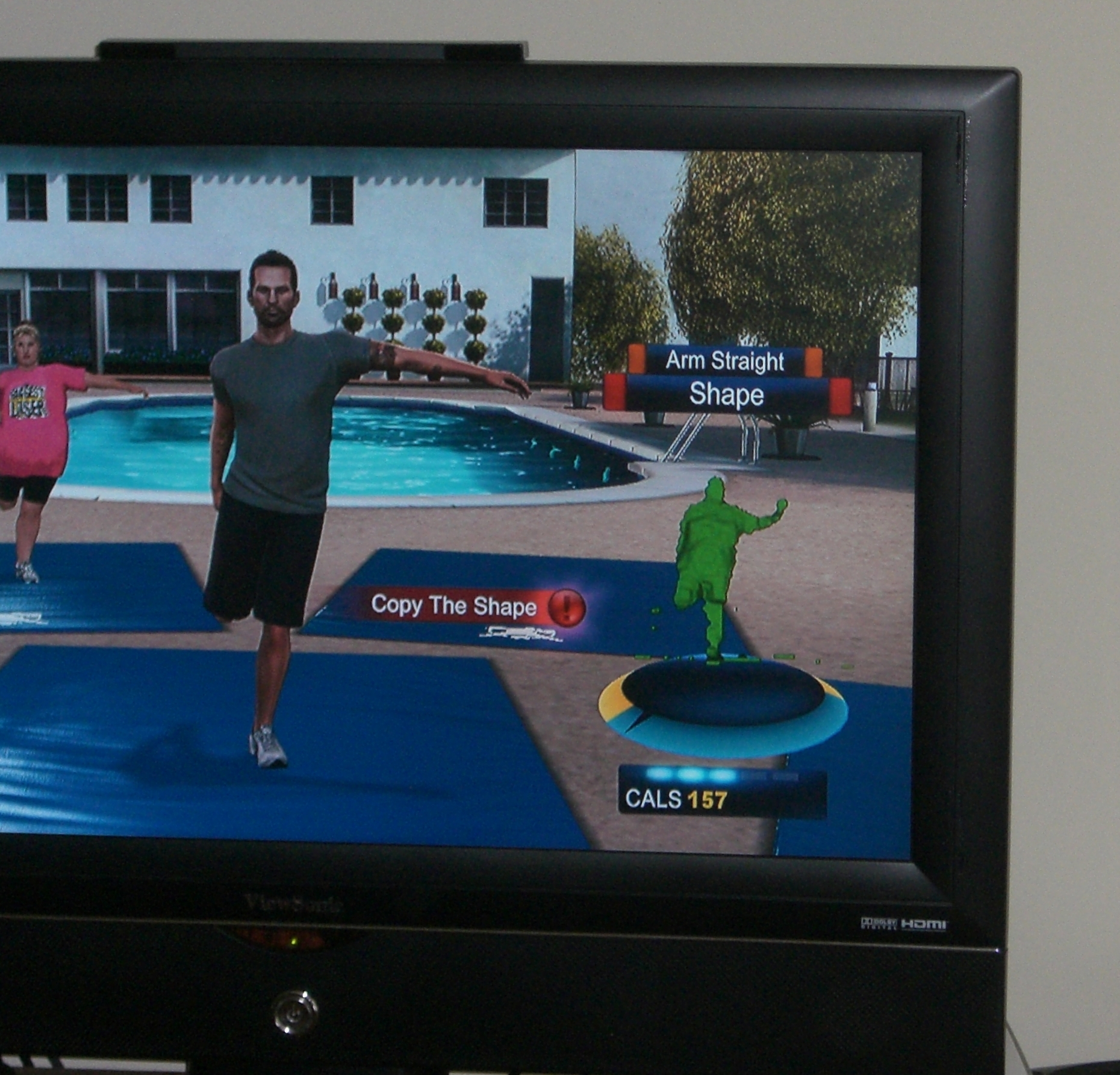
I tried to take a few pictures of the screen during one workout:
That blue figure in the lower right hand corner is me — taking a picture instead of exercising. 🙂 The Kinect, if you’re not familiar with it, can “see” you, and that is the image it sees. It’s almost like a silhouette but more 3-D-ish. It does help in that you can see if you are positioning yourself like the trainer. It turns blue between exercises, green if you’re doing the exercise right, red if you’re doing it wrong, and a muddy color if you’re somewhere in-between.
The figure in the upper left corner gives you an idea where you are in the workout. I love seeing it get to the end! 🙂
They always have a random character in the back doing the exercises as well, and you can change its hair, eye color, shirt color, etc., to look like you if you’d like.
I apologize that this picture isn’t centered, but I was having trouble with balance in general at the moment. 🙂 I’ve mentioned before that my balance is not good since having transverse myelitis, and my foot is propped up on the couch behind me there, but Virtual Bob said that was okay. 🙂 But what I wanted to show in this picture were the bars above me, the ends of which also turn red or green depending on whether you’re doing the exercise correctly. Then at the bottom it shows how many calories you’re supposedly burning and how many repetitions you’ve done (on exercises that have repetitions: on something like this where you just hold position, the little blue bars go across the bottom til time is up.)
I didn’t think to have someone video the workout, but of course someone else did theirs and put it in Youtube:
Thought it was funny when his little character was eating pizza instead of exercising.
It also has a weigh-in once a week. It doesn’t have a way to weigh you in, so you have to get your weight some other way and then enter it. Also everything you do — how well you work out, your weight loss, your “lifestyle” tasks, etc. — all go into a “score.” I don’t pay much attention to that — I’m just happy if it keeps going up. They do have “challenges” like the show does once a week, but it is kind of silly — they just have you do certain exercises that propel your character toward whatever it is supposed to be accomplishing in the challenge. They also simulate the show’s weigh-in and eliminations, and yes, I was up for elimination the second week when I gained .9 lbs.! But I have lost every week since then.
So what do I think about it? Well, you definitely get a good workout. The whole first week I was achy and felt like I had the flu, even with just 20 minutes at light intensity. That went away after a while, but I do work up a good sweat every time. There is one setting that is such a high intensity you’re warned not to try it unless you are already in good shape, so I think any level could get an adequate workout. I like the silhouette and the fact that I don’t have to hold the controller. I have definitely developed more strength, stamina, and flexibility over the weeks I have used it — and lost 7 lbs. so far. (I’m not dieting per se yet — I know I need to work on that but I hate the tediousness of counting calories or grams or whatever. At this point I’m just cutting way back on sweets and trying to make general better choices in what I eat. I know when I do adjust my diet more the weight loss will increase, but I am pleased that just exercise and cutting back sweets has resulted in a 7 lb. loss so far.) They seem to use some of the same exercises a lot, but they do vary others, and just when I am on the verge of getting bored, they throw in a new one.
The down sides? Entering information is a little tedious. Since the Kinect doesn’t have a controller, you use your hand. To enter anything you have to hold your hand in the right position, and to enter information, like the weight you’ve gained or lost, you have to hold up or down arrows until it gets to the right place. It’s very hard to get that exact, because even when I am holding my hand still, onscreen it appears to move a bit.
Because of balance issues and bad knees, I can’t quite do every exercise they bring up, so I wish you could skip or eliminate some, but I haven’t seen that as an option (in the prescribed fitness program. If you’re just choosing random exercises to do, of course you can skip the ones you can’t do as well) . I do a modified version, so I know I am still moving and burning calories, but then you get the little red screen and silhouette saying you’re not doing it right, which is not really a big deal but it bugs me. On the other hand, some exercises that I couldn’t do at first I am able to do now for short periods, so I am sure that is one reason they don’t let you “skip” — we’d tend to just do the easier ones and then not really be challenged or strengthened.
I haven’t tried this game for the Wii, but it looks pretty similar except for showing your silhouette and having to have the controller on you. I haven’t watched the whole video here, but it looks like a higher intensity than what I use (I assume you can set the intensity for the Wii as well as the Kinect). Some of the catch phrases and tips are even the same as the Kinect:
I have tried Wii Fit, and you can get a good workout there as well, but they have a lot of emphasis on balance, which I don’t do well on. Wii Fit also weighs you with their balance board so you don’t have to go and do that separately. The more you do with the Wii, the more it unlocks new exercises, and that keeps it from getting boring.
It’s funny that though I detest boxing as a sport, I feel the most worked out on both the Kinect and Wii Fit with the boxing exercises.
I’ve also used the Biggest Loser Power Walk DVD and really enjoy it. It’s divided into 4 15-minute segments in which they take you through a number of steps that are supposed to equal a mile, and they add different types of steps, arm movements, even light weights (I used canned foods 🙂 ) to add variety and intensity. Though it is not the full-fledged workout of these video games, it does get your heart rate going. It doesn’t take long til you feel like you have everything they say memorized, and I am thinking of turning their sound off and listening to my own music or maybe even an audio book while working.
I’ve also had on my shelf for a while but just opened a DVD of the Biggest Loser 30 Day Jump Start. I haven’t looked at the bigger segments of it since I had already started with the Kinect, but they also have 10 minutes workouts for upper body, lower body, and cardio and they’re easily doable yet they do put you through good paces as well.
What I like about both DVDs is that they use previous contestants, and they don’t always get things just right — you’ll see one of them look for a minute at the trainer and then take a few steps before they get the rhythm right, or adjust their clothes, etc., and the fact that they’re not perfect makes you feel more comfortable than the video game characters. Plus they always give modified versions of what they’re doing if you can’t keep up or don’t have the equipment they do.
I’ve also years ago used several videos set to classical music by a teacher from my alma mater, Linda Haught, and I was just wishing they had been converted to DVDs — and I just found that many of them have been. In the video version, you start with the warm-up, then work as far as you want (she listed suggested stopping places depending on whether you were a beginner, etc.), then fast forward to the cool down: I am sure that process would be much easier with the DVD. The one I used most was “Wimp Aerobics,” which at the time was not as professionally done as her others, but was great for low impact workouts (her parents were her back-up exercisers.)
Really any of these will give you some exercise, with the convenience of being right there at home without having to take the time to go to a gym and pay their fees. I love the Kinect game and I think it does give me the best workout of all of these, but we already had a Kinect system — I don’t think I’d spend money to get the X-box and Kinect (they work together) just to get this game. But I think there are Biggest Loser games for just about any current video gaming system. And of course, there are other fitness games besides Biggest Loser ones — I just tend to gravitate towards them because I watch the show and know the name, so I have some idea of their background.
When I found I could handle the 20 minute workouts pretty well, I tried to up the intensity to 30 minutes. But when the next workout seemed to go on and on and on, I discovered I had set it to 40 minutes instead — twice as much as I was used to! The first day at 40 minutes seemed extremely long, but I was able to do it. Previously I had been doing 20 minutes with the Kinect game and then 15 with the Power Walk DVD, but when I started doing 40 minute workouts (and actually they go 43-48 minutes), I stopped the DVD. But sometimes the 40 minute workouts cycle through the same exercises, which gets boring. So I think I am going to go back to 30 minute workouts and then add either 15 minutes of the Power Walk DVD or one of the ten-minute segments from the 30 Day DVD. I’ve been working out with the Kinect 5 days a week, but I may go to three or four and then use something else on the other days just for variety.
So, that’s my regimen for now. This is the first time in a long time I’ve exercised regularly. To me the convenience of being able to do it from home helps: I would be much less motivated if I had to go somewhere else, but for some people that is more motivating than working from home. I am struggling with adding 40-50 minutes of exercise into my schedule, but I have become convinced that I need to do this, so I am trying to adjust getting everything else done around it.
On a side note, I’ve always used Bob as trainer with the Kinect game, but once my son chose Jillian and did things wrong deliberately just to see if she’d yell at him, but she didn’t. 🙂 They do alternately compliment or “get after” you depending on how well you’re doing.
And there you have my experience. Have you tried any of these? What works for you?
Welcome to The Week In Words, where we share quotes from the last week’s reading. If something you read this past week inspired you, caused you to laugh, cry, think, dream, or just resonated with you in some way, please share it with us, attributing it to its source, which can be a book, newspaper, blog, Facebook — anything that you read. More information is here.
I hope you’ll forgive the length of some of these: I cut them down but didn’t want to cut too much.
The following is an excerpt from from the Day 12 reading titled “Sanctification by Satisfaction” of Gospel Meditations For Women:
Scripture describes the Christian life as the source of such great joy that temptations lose their appeal. Like the feeling we have after Thanksgiving dinner, we should be so full of Christ that we don’t have room for sin!…Does obeying Christ mean saying no to sinful pleasures? Sure. However, saying no to sin in favor of Christ is like saying no to a scooter in favor of a sports car, or no to peanuts in favor of filet mignon. Life with Christ is a feast, not a famine.” ~ Chris Anderson
I never thought of “fullness” in that way — what a great illustration.
This is an excerpt from an Elisabeth Elliot e-mail devotional taken from a chapter titled “How to Be Free” from All That Was Ever Ours.
Dietrich Bonhoeffer, a man who epitomized true freedom in his acceptance, for God’s sake, of the prison cell and death, wrote: “If you set out to seek freedom, then learn above all things to govern your soul and your senses. . . . Only through discipline may a man learn to be free.”
Freedom and discipline have come to be regarded as mutually exclusive, when in fact freedom is not at all the opposite, but the final reward, of discipline. It is to be bought with a high price, not merely claimed. The world thrills to watch the grace of Peggy Fleming on the ice, or the marvelously controlled speed and strength of a racehorse. But the skater and horse are free to perform as they do only because they have been subjected to countless hours of grueling work, rigidly prescribed, faithfully carried out. Men are free to soar into space because they have willingly confined themselves in a tiny capsule designed and produced by highly trained scientists and craftsmen, have meticulously followed instructions and submitted themselves to rules which others defined.
“We give to God to show Him we think He’s valuable, not because He’s poor..” — Drew Conley
God doesn’t “need” what we have to give, but we need to give it.
I hope you’ll visit some of the other participants as well and glean some great thoughts to ponder. And don’t forget to leave a comment here, even if you don’t have any quotes to share!








 Stray Thoughts