
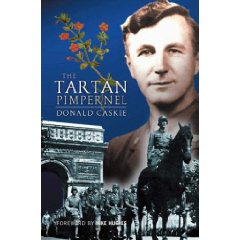
 The title of The Tartan Pimpernel hearkens back to the The Scarlet Pimpernel, the imaginary but legendary rescuer of those unfairly appointed to death during the French Revolution. In this case, however, the rescuer was a very real Scottish pastor in France during World War II.
On the brink of the German invasion of Paris, Donald Caskie, pastor of the Scots Kirk there, led his people in considering Psalm 46:1, “God is our refuge and strength, a very present help in trouble,” and Matthew 24: 6-8: “And ye shall hear of wars and rumours of wars: see that ye be not troubled: for all these things must come to pass, but the end is not yet. For nation shall rise against nation, and kingdom against kingdom: and there shall be famines, and pestilences, and earthquakes, in divers places. All these are the beginning of sorrows.” He commended them to God and told them good-bye: though he thought perhaps a minister might have met with some respect of enemy soldiers, he had publicly denounced Hitler more than once and knew his record might put him in danger. He decided to go back to Scotland to render service there and “take stock of [his] future.”
He joined the multitude of other refugees fleeing the city on foot, rejoicing whenever he could find a pile of straw to sleep on, a cow to sleep next to for warmth, or a grapevine from which to eat along the way. Days later, nearing exhaustion, receiving timely aid from a couple of good Samaritans, he finally reached the British Consulate only to decide he must stay in France. There was a ship available, but he felt the wounded men needed the space more than he, while his help was needed in his besieged adopted country.
Praying for guidance, he was led in a marvelous way to the abandoned British Seamen’s Mission in Marseilles and told he could aid seamen and civilians, but not soldiers, and to expect surveillance and raids to make sure he was keeping within those parameters. Caskie had a clear conscience about “going underground.” Though being closely watched, somehow he was able to hide and aid soldiers, becoming a major link in their escape route back to England. Food, clothing, false identification, guides, everything needed was marvelously provided time and again. The elaborate details needed to secretly get these men out of the country are amazing, especially in that time without the ease of communication we have these days with cell phones, GPS devices, etc. It is estimated some 2,000 sailors, soldiers, and airmen were aided by him in their escape back to England.
Donald was arrested and eventually sentenced to death, but a German pastor intervened for him. Though nearly starving and in solitary confinement for much of his imprisonment, he felt the interruption in his work, the worry his situation caused his mother, and the inability to minister help to those in prison were his crosses to bear. He remained a prisoner until liberation, when he again began to minister, reopening Scots Kirk, becoming a visiting minister to those in camps, prisons, and elsewhere, and aiding the British with his experience and knowledge of the area and the happenings during the war.
He was urged to write of his war-time experiences and finally did in the mid 1950s, using the book as a fund-raiser to rebuild the church, which had been damaged and decayed. (An interesting side note is that Eric Liddell preached in this church instead of running on Sunday during the Olympics, though a different church than this is actually shown in the film Chariots of Fire.)
Though words like “brave” and “inspiring” describe Caskie in the blurbs on the outside of this republished edition, he wrote the book in an unassuming, matter-of-fact way laced with quiet humor. Some sections are quiet suspenseful, as when a traitor is suspected in the ranks.
This book spoke to me on many levels, a couple of which I elaborated on in an earlier post, especially the quiet heroism and bravery of men and women who weren’t trying to be heroes, but had to stand up and do the right thing, as well as those behind the scenes who aided them.
Though the Lord’s hand is evident throughout, I would recommend the book more from a historical vantage point than a spiritual one, as I would disagree with Caskie on a few points, especially calling a works-based denomination “Christian.” A little odd is his claiming of a Celtic gift of “second sight,” an “uncanny ability to anticipate events.” I don’t know what to make of that, but as the introduction concludes, “The Tartan Pimpernel illustrates the tremendous height to which the human spirit can soar in the horrors of war and is a fitting legacy of a man of outstanding courage and integrity.”









 The folks at
  Stray Thoughts