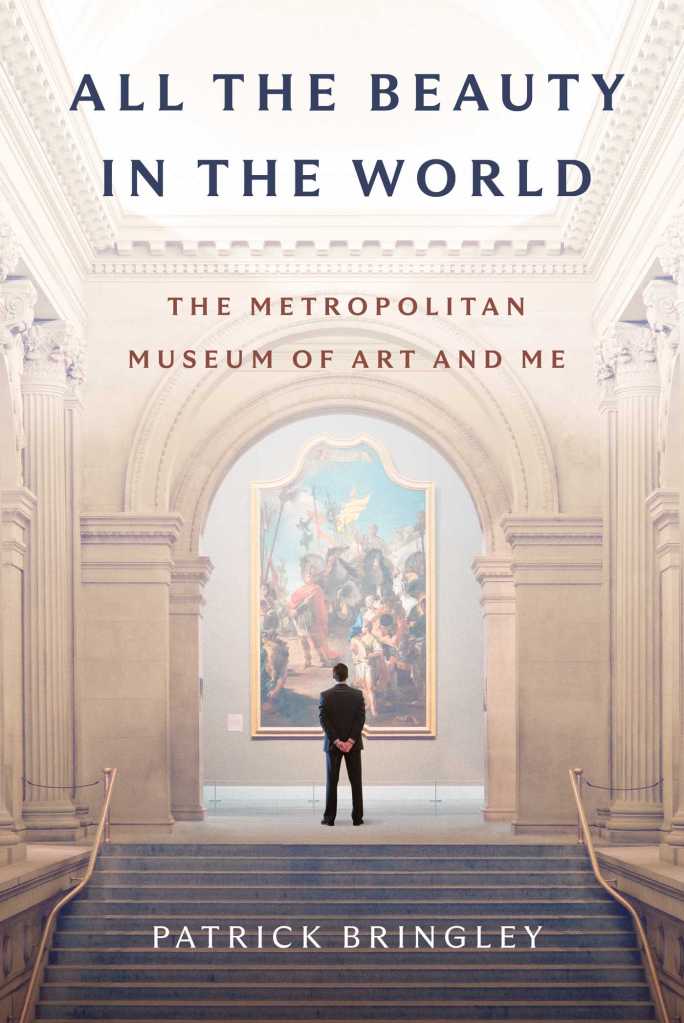
I don’t remember where I saw All the Beauty in the World: The Metropolitan Museum of Art and Me by Patrick Bringley recommended. I had somehow gotten the impression that the book was written from a Christian viewpoint. It was not.
I don’t restrict my reading completely to Christian sources. But I read and evaluate everything through Christian eyes. Wanting to avoid bad language and sexual elements doesn’t leave me a lot of secular choices. I understand that unbelievers are not going to act like believers. But I don’t want certain words and images floating around in my head.
There’s a smattering of bad language (3 uses of the f-word, taking God’s name in vain, and others) in this book. I almost set it aside a few times. But, for whatever reason, I kept reading.
The book is a memoir of the time Patrick Bingley worked as a guard at the Metropolitan Museum of Art. He had begun work at the New Yorker. But when his older brother, Tom, died of cancer, Patrick felt the need for a change. His mother had taken him to art museums when he was a child, and he had visited the Met then and in college.
When in June of 2008, Tom died, I applied for the most straightforward job I could think of in the most beautiful place I knew. This time, I arrive at the Met with no thought of moving forward. My heart is full, my heart is breaking, and I badly want to stand still awhile (p. 12, Kindle version).
Bringley worked as a guard at the Met for ten years. Part of the book tells details about what’s involved in being a guard, how the Museum is laid out, what’s on display in the different sections, what it’s like to work amidst the art, and the various people who come to see it. The backstory of his relationship with his family and Tom’s illness and decline are woven into the narrative.
But to me, the best parts of the book are the ones where he discusses some of the art that touched him. He describes some of it in great detail, often giving some background of the artist or the painting. But sometimes he just shares the feeling that overcame him when connecting with a great work of art:
I responded to that great painting in a way that I now believe is fundamental to the peculiar power of art. Namely, I experienced the great beauty of the picture even as I had no idea what to do with that beauty. I couldn’t discharge the feeling by talking about it—there was nothing much to say. What was beautiful in the painting was not like words, it was like paint—silent, direct, and concrete, resisting translation even into thought. As such, my response to the picture was trapped inside me, a bird fluttering in my chest. And I didn’t know what to make of that (p. 10).
I startle at the picture because I can’t believe he’s captured it—that feeling we sometimes have that an intimate setting possesses a grandeur and holiness of its own. It was my constant feeling in Tom’s hospital room, and it’s one that I can recover on these church-mouse quiet mornings at the Met (p. 17).
When we adore, we apprehend beauty. When we lament, we see the wisdom of the ancient adage “Life is suffering.” A great painting can look like a slab of sheer bedrock, a piece of reality too stark and direct and poignant for words (p. 33).
I was struck by how often Bringley used words like “sacred” and “holy” in connection with art. He speaks of some visitors who regard the Met as a “secular church” (p. 70). I don’t think he was talking about idolizing or worshiping the images, but rather the experience of looking at something which takes us out of ourselves. Bringley speaks of a photograph of Georgia O’Keefe:
There’s a frame around her, putting space between her sacred beauty (an older meaning of the word sacred is “set apart”) and the profane, mundane world. I think that sometimes we need permission to stop and adore, and a work of art grants us that (p. 80).
I think God has put in the human heart a longing for something transcendent. That’s Russ Ramsey’s theme in Rembrandt Is in the Wind–that truth, goodness, and beauty are attributes of God. He points out that as Christians, we look for and emphasize truth and goodness, but often neglect beauty. “This is the gift of beauty from an artist to their community—to awaken our senses to the world as God made it and to awaken our senses to God himself (p. 14).
A couple of other quotes from Bringley’s book that stood out to me:
Art often derives from those moments when we would wish the world to stand still. We perceive something so beautiful, or true, or majestic, or sad, that we can’t simply take it in stride. Artists create records of transitory moments, appearing to stop their clocks. They help us believe that some things aren’t transitory at all but rather remain beautiful, true, majestic, sad, or joyful over many lifetimes—and here is the proof, painted in oils, carved in marble, stitched into quilts (p. 177).
I am sometimes not sure which is the more remarkable: that life lives up to great paintings, or that great paintings live up to life (p. 88).
In the Kindle version of this book, there is an appendix titled “Artwork Referenced in the Text.” Chapter by chapter, works of art referred to are listed with a link to them at the Met’s website. I wish the publishers had included these links in the text, like a footnote. It would have much more enjoyable and seamless to click on the link to the art right there while reading about it rather than having to go back and forth from the text to the appendix.
I enjoyed reading about Bringley’s experiences and observations.