Laudable Linkage

Here are some of the latest good reads discovered this week:

God Is Eager to Forgive You. “God promises to show favor at the faintest whisper of a cry. He promises to answer ‘as soon as He hears.’ No probation. Just the ear of God, listening to the cry of a penitent sinner’s heart. He doesn’t see you as ‘damaged goods,’ a ‘second-class citizen,’ or a blight on His church. The sinner who has turned to Christ in forgiveness has the righteousness of the Savior credited to his account. It’s this righteousness, not the black mark of sin, that the forgiving Father sees.”

Emphasizing What The Bible Emphasizes. “When our issue of the moment begins to dominate our thoughts and conversations—to the exclusion of other healthy, worthy topics—what is missing is balance and proportion.”

Are You Casual with the Holiness of God? HT to Challies. “Imagine that, after suffering a loss on the battlefield, an American army general decided to galvanize his troops by taking the Declaration of Independence into battle. Sounds a little farfetched, I know. What kind of general would play so fast and loose with one of the most precious artifacts in the nation’s history? Though it may not seem likely to happen with American soldiers, this scenario actually did play out in Israel as the era of judges came to a close.”

To Rejoice with Those Who Rejoice, HT to the Story Warren. “As we pondered what we’d both seen, we concluded that often the people of God are better at mourning than rejoicing. Leaning into support, lifting up in prayer, and bringing a meal are actually easier than being a champion for, celebrating, and truly finding joy in someone else’s experience of blessing.”

The Ministry of the Pew: Sunday Morning for Normal Christians. “May I introduce you to what others have called the ministry of the pew? Ministry that you — normal Christian — perform every Lord’s day. Such is the ministry of the Not-Up-Fronts, the army sitting facing the pulpit.”

Anything Worth Doing, Is Worth Doing Badly, HT to Challies. “As Christians we should be those who work most excellently, because we are serving a better, more worthy, Master. And yet, I’m afraid this ideal of excellence often causes well meaning Christians to stop ‘doing’ altogether. They turn the adage into, ‘If it can’t be done well, don’t do it at all.’ And that is unbiblical.”

Willing Spirit, Weak Flesh: The Real Meaning of Matthew 26:41, HT to Knowable Word. “If willingness alone can’t overcome the weakness of our flesh, what will?”

Tagless, HT to Challies. A modern day parable with a good lesson.

Laudable Linkage

Here are several good online reads found this week:

7 Things Moms Will Always Need to Hear. “Throughout my mothering journey, I think I’ve learned more from fellow moms who are further down the parenting path than from any other source of wisdom besides the Bible.”

Counsel for Those Struggling with Assurance. “Christians wrestle with nagging doubts about their standing with God. In this article, I would like to define what assurance is, explain why Christians might lack assurance, and offer counsel for those who are struggling with worries about their salvation.” If you struggle with assurance of salvation, I invite you to read of my own battle with this in Blessed Assurance.

3 Powerful Ways the Holy Spirit Is Active In Our Bible Study. “Why do some Christians talk so much about Bible study? If we are truly led by the Spirit (Rom 8:13–17), some may ask, what need is there for something as dry and cognitive as study? Could we be in danger of quenching the Spirit and trusting our own efforts if we focus too much on rigorous, academically responsible study of the Scriptures? I cannot capture in a single blog post the sum total of the work of God’s almighty, infinite, and eternal Spirit. But perhaps I can highlight a few of the exceptionally clear and certain ways God has shown his Spirit to be at work in and through the Scriptures.”

Honour the King? HT to Challies. “‘I don’t understand how a Christian can agree to a proclamation declaring somebody other than Jesus to be our only king’. Well, it’s really not very hard. Jesus has the title ‘king of kings’ (Rev 17:14), not ‘the king who obliterates kings’! Jesus calls the kings of the earth to kiss him in Psalm 2, not to repent of their failure to introduce democracy. It’s very possible to be both in authority and under authority at the same time (e.g. the centurion in Matt 8:9). So, Jesus’ kingship isn’t an excuse to look at the British crown and say: ‘Not my king!'”

When Leaders Fall. “Then a few days later, I heard of allegations against another Christian leader – one I am less familiar with but whom I had respected from what I knew of him and his teaching. It brings up all kinds of questions: Why is this happening with so many Christian leaders? How many more? Who else? And how can we know who to trust? There is a lot I don’t know, and I’m still processing it all, but, here are a few things I do know.”

Please Don’t Weaponize Good-Faith Disagreement, HT to Challies. “In this new world, Christians seem increasingly unable to critique without canceling. We don’t see in our disagreements an opportunity to pursue truth together—to argue by appealing to Scripture, logic, reason, and tradition. Instead, disagreements devolve into quarreling. All heat, no light.”

A Plea for Fewer Metaphors in Children’s Talks, HT to Challies. Why teaching from metaphors isn’t effective for those under age nine and some alternative suggestions.

The Theology of Work, HT to Redeeming Productivity. “Many people today find themselves in opposite gutters along the highway of Biblical work; those gutters being laziness and idleness on the one side and workaholism on the other. Some people spend their lives chasing meeting after meeting or shift after shift and others spend their lives binging show after show, or scrolling reel after reel on their phones.”

Love Me, Love My Food. Very interesting article about how learning to love (or at least eat without a show of distaste) another culture’s food is a way of showing love to them.

When Mother’s Day Hurts. It can, for several reasons. But God sees, knows, loves, and helps.

Laudable Linkage

Links of interest to Christians

Here’s my latest list if laudable links to good, thought-provoking, beneficial reading.

Staying on Your Feet is Really All About Grace. “God is not asking you to single-handedly plan a VBS, execute elaborate parties for your children, or maintain a spotless house.  He is not impressed by heroic efforts or long days or endless lists. He wants you to bend your knees.  He wants you to relax into the rhythm of his keeping.”

A Few Thoughts about Daily Devotions. “Taking time every day to draw near to God through His Word and prayer might be one of the most life-changing disciplines we can cultivate. Below are a few thoughts that I pray will help you develop the discipline of daily devotions.”

Read the Bible in Bigger Chunks, Too, HT to Challies. “Reading the Bible exclusively, or primarily, in small chunks is like that. When we do this, we’re spending our time focusing on the trees. And not only the trees, but the branches, and individual leaves of the trees. And we’re right to do this, of course. Those ‘small’ details matter. But when that’s all we focus on, if we don’t zoom out once in a while, we can miss the forest.”

7 Biblical Truths Countering the False Gospel of “Emotional Health and Wealth,” HT to Challies. We hear a lot about what’s wrong with the “prosperity gospel,” the false idea that God blesses those who obey Him with health and wealth. But sometimes we falsely believe that if we do everything “right,” God will take away any emotional distress as well.

Ten Diagnostic Questions for the Potential Ideologue, HT to Challies. “While boiling political positions and strategies down to binary choices may make for effective political campaigns, biblical faithfulness may not be so easily reduced.” Though this is mainly about handling differing political viewpoints with fairness and grace, the principles hold true for differences of opinion in any category.

When Your Kids Make Poor Parenting Choices, Do You Feel Like a Failure? “We forget that fulfillment for our kids and grandkids will be found only in obedience to God and not elsewhere. This may require that we get out of God’s way and trust his perfect parenting of our adult children.”

Laudable Linkage

It’s been a super-busy week, so I have just a few links for you. But I think they’re good ones.

Why We Follow Some Old Testament Laws But Not Others, HT to Challies. “Critics accuse Christians of conveniently picking and choosing from Old Testament laws. We’re quick to ‘clobber’ gay people with verses from Leviticus, they say, yet we don’t keep kosher ourselves. The complaint, though, is based on a misunderstanding about the Mosaic Covenant that even Christians fall prey to.”

Where Is Your Faith?” HT to Challies. “How do you cling to belief amidst such turmoil of the heart? How do you survive the death of a child? I can tell you, it is not what happens in that moment of complete darkness or even in the months and years that follow. Survival is forged in the pew every Sunday. It is built on the truths of Scripture that you fill your mind with day by day. It comes through knowing Who God is.”

We’re Missing It. “He wants time to love us that way and it can’t happen if He is a ‘to do’ list item, or in sound bites only throughout our day, or only while we grab coffee on our way out the door.”

Well-Worn Boots. Lessons from a pair of faithful old work boots.

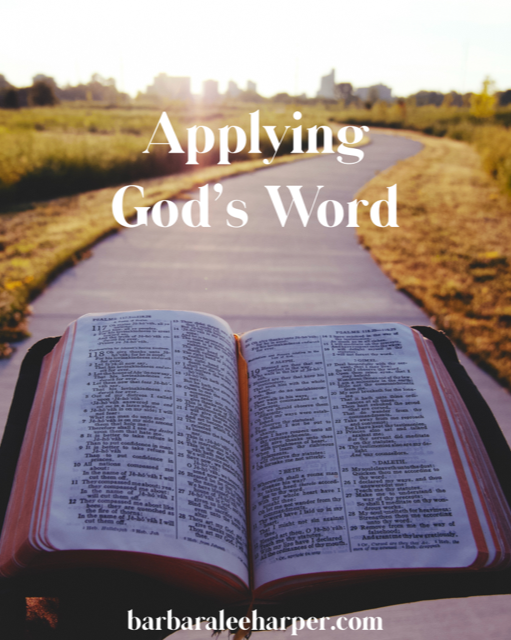
Applying God’s Word

The Bible tells us to be doers of the Word, not just hearers (James 1:22, Matthew 7:21, Luke 6:46, Romans 2:13).

But sometimes it’s hard to know what we’re supposed to do with some parts of the Bible.

Some verses are easy to understand how to put into practice. For instance, Ephesians 4:28 says, “Let the thief no longer steal, but rather let him labor, doing honest work with his own hands, so that he may have something to share with anyone in need.” The thief needs to stop stealing, obviously. But the instruction doesn’t stop with a “don’t.” It continues with a “do” to replace the “don’t”: work hard and give to others who have a need.

But what do we do with passages that don’t explicitly contain instructions about what to do or not do?

I read somewhere about a man who, after reading the creation account in Genesis 1 and 2, felt that in response he needed to clean out his garage. Well, yes, God is orderly, and to some extent He wants us to be orderly as well. But I’m not sure that’s what the creation account is in the Bible to tell us.

Here are a few tips I’ve found helpful to understand how to apply Scripture.

Pray. We need God’s wisdom to know how to put His Word into practice.

Observe and interpret first. Observation, interpretation, and application are the three sides of Bible study. If we’re off on the first two, we’ll be off on the third.

Part of observation is seeing who said what to whom in the passage. Sometimes a command or promise is given to one person or group of people in the Bible, but they are not meant for all people or all time. However, God included those passages for a reason and there’s something He wants us to learn from them.

For instance, the Old Testament law in the first five books of the Bible was given partly to express God’s holiness and partly to show people that they could never earn righteousness by keeping it, because no one could keep it completely. New Testament writers take pains to explain that Jesus fulfilled all the law in our place and we’re not under it any more. But we learn about the cost and pervasiveness of sin in Leviticus and see symbols of Christ in the sacrifices (I wrote more about what we can get out of Leviticus in Where Bible Reading Plans Go to Die.)

Study the context. Mark 14 tells of a woman who broke open an expensive alabaster box and poured the costly perfume on Jesus. I read an article years ago where the writer compared the alabaster box to a girl’s virginity, something rare and precious that she could only give once. While I appreciated the parallel the author was trying to make, she completely missed the point of the passage. Instead, she made the passage mean something it didn’t mean. This demonstration was an outpouring of the woman’s love and a foreshadowing of Jesus’ death and burial. Jesus Himself said she had “done what she could; she has anointed my body beforehand for burial” (14:8). Imagine the girls who read that article associating it with virginity for the rest of their lives and missing the extravagant love of this woman as well as the reference to Jesus’ death.

Prescriptive or descriptive? Part of interpreting the Bible (which I wrote more about here) is determining whether the passage is describing something we should emulate. Just because the Bible records people doing things in Scripture doesn’t mean it’s approving what they do or saying we should follow their example. Some of the historical passages are descriptive: they just tell us what people did. We can still make observations, but the passage isn’t there to give us an example to follow.

A prescriptive passage, though, is one that “prescribes” a certain behavior. Much of Proverbs and the epistles are prescriptive, though prescriptive passages are throughout Scripture.

I’ve seen people use Abraham’s example of looking for a wife for his son, Isaac, to say that we should promote courtship rather than dating among young people. Some said that fathers should choose spouses for their adult children, or at least be heavily involved in the process. The courtship vs. dating debate has been a hot topic that I don’t want to get into any more here; I just wanted to say that this passage in particular doesn’t teach it. We can learn from it the necessity to be careful and prayerful in finding a spouse, to look for one of the same faith, to trust God and seek His direction. But nowhere in the Bible are we told to find spouses for our children in the same way Abraham did.

Find principles to draw on. A former pastor once read an OT passage about oxen to the congregation. Then he asked, “Do any of you own oxen?” No one did. He asked, “How many of you have ever even seen an ox?” A couple of people raised their hands. The pastor said, “So this doesn’t apply to us. We just turn the page and move on, right?” We didn’t think so, and he agreed. Then he brought out several principles from the passage. An ox who accidentally gored someone was handled one way. But if the ox was known to be cantankerous and try to gore people, and the owner didn’t take any means to keep the animal penned in, the owner was more liable if the animal hurt someone. We can see the parallel with dogs prone to bite. If someone saw their neighbor’s ox wandering far from home, he wasn’t supposed to ignore it. He was supposed to help his neighbor.

Romans 14 lists several principles involving meat offered to idols. Some of the early Christians felt that meat was okay to eat, because the idol is a false god and the sacrifice didn’t taint the meat. Others felt it was wrong to eat that kind of meat because of the association with idol worship. Even though we don’t deal with this issue in most of the world today, several issues apply to actions like this where the Bible doesn’t give any clear teaching: do whatever you do as unto the Lord; be fully convinced in your own mind; don’t judge the brother who handles the meat differently than you would; don’t do anything that would cause another to stumble.

Some responses are inward. One source I read years ago said that we should end every time of Bible reading with an action item, a plan to put into practice what we read.

To be sure, if we’re convicted from the passage we’re reading that we need to confess something to the Lord or apologize to someone, we need to act as soon as possible.

But some parts of Scripture are there to promote wonder, awe, and worship of God and faith in His ability and power and wisdom. Those passages will affect our actions, but they’re concerned with the condition of our hearts.

And some passages can’t be obeyed just by checking off an action item. Say, for instance, we read the passage about loving our neighbor. We think about our literal next-door-neighbor, an elderly widow living alone. We decide next time we have the mower out, we’ll cut her grass as well as ours. And maybe we’ll make some banana bread and take a loaf over to her. And we brush our hands and think, “There! I’ve loved my neighbor.”

But did God put that command in Scripture to inspire random acts of kindness to check off our to-do list? Yes, love will manifest itself in thoughtfulness and actions. But love is more than an action item. It’s an attitude of heart to carry with us all the time. Like when another neighbor’s backyard party is too loud and long. Or when he keeps borrowing your tools and returns them broken and dirty, if he returns them at all. Or when a neighbor child rings the doorbell just after you finally got the baby to sleep. Passages like the one about the Good Samaritan teach us that our neighbors are not just the friendly ones and that ministering to others can be inconvenient and costly. But what a picture of Christ, who sacrificed Himself for us while we were yet sinners.

Much more could be said about applying Scripture. But one last point I want to make is that the more we read the whole Bible, the more we’ll understand it and know how to apply it.

What tips have you found to help you put Bible teaching into practice?

(I often link up with some of these bloggers.)

Laudable Linkage

Some of the thought-provoking reads found this week:

So You Want to Be a Woman of the Word? “Women of the Word resist the world’s distractions and dedicate time to regular Bible study.”

Can Satan Put Thoughts into Our Heads? HT to Challies. “Yes, he can and he does. And of course, the urgent questions then are, How do we recognize them? And how do we resist them and not get controlled by them?”

Midlife, Christ Is. HT to Challies. This is very encouraging for those of us who are “middle-aged.”

The Wisdom of Avoiding Strife. “Sometimes Christians think God wants them to become punching bags. And at other times, perhaps in rejection of the punching-bag approach, Christians harden themselves to the point of arrogance and condescension toward their opponents. But what does it mean to fight like a Christian in situations of strife?”

I Just Need Something New! HT to Challies. “We know this right? It’s the gospel we have been told—perhaps for years. Yet we can so easily forget it. We get distracted by the shiny and new, and before we know it the false hope of man-centered change can push Christ to the background. We wonder if the novel is what we really need. This new Bible reading plan will get my act together. That new book will finally fix my parenting struggles. These new habits will refocus my heart through the day. Nehemiah 13 reminds us that mastery over outward disciplines just isn’t enough (Col. 2:23).”

Fear After Grief, HT to Challies. “Perhaps you’ve been walking through seasons of grief, as you mourn especially deep pain. The dark clouds have begun to shift, but you’re not sure if you can bear to greet the sun, lest you have to return to the dark.”

Yes, a Loved One Is Watching From Heaven, HT to Challies. “How has the Lord assured you he’s near in the deep grief that accompanies loss? The evidence of his presence is there if we look, but let’s not get confused about who’s watching over us. Look beyond your loved one to see and experience the love and kindness of our great God.”

Behind-the-Scenes: Endorsements. A look at why publishers require endorsements, what they mean, how to regard them.

We Need Time Alone with God

In a recent magazine article, a Christian college professor expressed concern that his students weren’t Biblically literate even though they read their Bibles every day and even had parts of it memorized. His solution was that people should shift away from private, personal time in the Bible to communal times.

I don’t want to dissect and discuss the article here. However, I wanted to focus on the concept of communal vs. private times in God’s Word.

Do we need time together in the Bible? Yes. Reading and studying the Bible with others helps us get more out of the passage, encourages us, and (hopefully) keeps us from going off on tangents due to misinterpretation.

But I’m concerned that, in the battle against individualism and people pulling away from church attendance, we might go too far the other way and de-emphasize our personal walk with God.

God is the heavenly Father of all those who believe in Him. But we don’t relate to Him only as a group. Wise human fathers spend time with the family all together but also with individual members one-on-one. Our Father in heaven is even wiser. Though He created us to interact with and encourage each other, He also has a personal relationship with each of His children. And relationships thrive on communication.

When I was in college, we were sometimes reminded a Christian university was one of the easiest places to grow cold in our walk with God. Even though we heard the Word of God regularly in classes, in chapel, and in prayer groups, we couldn’t just coast on the spiritual atmosphere. We shouldn’t let Bible classes take the place of our personal time in Scripture.

Our time with others informs our personal time with God. And our time alone in His Word informs our time all together.

The psalms were sung in the congregation. Yet they are full of personal singular pronouns.

I sought the LORD, and he answered me and delivered me from all my fears (Psalm 34:4).

He drew me up from the pit of destruction, out of the miry bog, and set my feet upon a rock, making my steps secure. (Psalm 40:2).

O God, you are my God; earnestly I seek you; my soul thirsts for you; my flesh faints for you, as in a dry and weary land where there is no water (Psalm 63:1).

My soul will be satisfied as with fat and rich food, and my mouth will praise you with joyful lips, when I remember you upon my bed, and meditate on you in the watches of the night; for you have been my help, and in the shadow of your wings I will sing for joy. My soul clings to you; your right hand upholds me (Psalm 63:5-8).

As much as we need each other, sometimes we have to stand alone with God.

David “encouraged himself in the Lord” (1 Samuel 30:6) when the men of Israel were ready to stone him.

Joseph spent years as the only apparent believer in the one true God that he knew when he was a slave in Egypt. His witness did seem to spread to others. But he had to remind himself of God’s truth on his own.

Two turning-point meetings with God in Jacob’s life happened when he was alone.

Daniel had friends of the same faith, but he faced the lion’s den alone, received visions alone, and prayed alone.

Paul ministered with companions but sometimes was alone.

Jesus dealt with crowds of people yet sought His Father alone.

We’ll each give account of ourselves personally to God. “For we must all appear before the judgment seat of Christ, so that each one may receive what is due for what he has done in the body, whether good or evil” (2 Corinthians 5:10).

If we’re reading the Bible regularly and still don’t know much about it, there are ways to improve. Jen Wilkin’s book, Women of the Word, was written for just that reason. I’m trying to write a book on the same topic. There are aids all over the Internet to improve our devotional time, or quiet time, or time in God’s Word. I’ve written about several aspects here.

But let’s keep things in balance. Meet with other believers to read and study God’s Word. But meet with Him alone as well.

(I often link up with some of these bloggers.)

Laudable Linkage

Here are some of the posts that especially resonated with me this week:

If God Would Outsource His Sovereignty. “I want you to imagine that, at least for a time, the Lord would see fit to involve us in selecting the providences we would receive from his hand. I want you to imagine that through one of his deputies—an angel perhaps—he would approach us to ask how we would prefer to serve him.”

Struggling with the Struggle. “The main feeling that is overwhelming me right now is guilt. After all, shouldn’t I be overjoyed that God is teaching me intense lessons right now? And then I judge myself harshly for thinking that hard times are actually hard and not much fun.”

There Is Something Better Than Never Suffering, HT to Challies. “To suffer, with Christ, is a vastly superior to a life of comfort without him. And if he has saved you through his death, manifesting all his divine power in his own human weakness unto death, do you not think he can be your power in your suffering?”

It All Holds True, HT to Challies. “We want to shield our kids from pain. We want them to learn perseverance and endurance and real, personal faith without having to go through anything hard. That’s not quite how it works in the Christian life. Perseverance is cultivated in adversity.”

He Is Not an It: Understanding the Person of the Holy Spirit. “The Holy Spirit is not a force, feeling, or phenomenon. He is not a ghost or an “it.” He is a Person that we should know and love.”

On Being the Main Character in Your Own Sermon. I can identify with this, even though I am not a preacher. “I pray for the humility to go unseen, unacknowledged, and unremembered, so long as Christ is seen, acknowledged, and remembered. In fact, I pray that Christ would be so present and so visible that people would fail to think of me at all.”

Where Do You Get That From the Text? HT to Knowable Word. “This matters because not every comment in every bible study is of equal worth. Not every application of scripture is a valid application of scripture.”

Why Read If You Forget Most Everything Anyway? HT to Challies. “If you can’t remember most of what you read, why even bother? Aren’t there better ways to use your time?”

God's Word is a treasure

Be Patient: Waiting on God in Difficult Times

Job is not an easy book to read. The first two chapters and the last one aren’t bad, but all that bickering between Job and his friends in the middle is hard to follow. But taking it a section at a time with my ESV Study Bible and Be Patient (Job): Waiting on God In Difficult Times by Warren W. Wiersbe helped.

Job’s suffering was extreme. He lost all of his wealth and his ten children in one day. Then he lost his health. The person closest to him, his wife, was not much support (but then, she was grieving, too). Job’s friends came and sat with him in his grief for a whole week. They were better friends to him then than when they opened their mouths. They all wondered the same thing: Job, what in the world did you do to bring such suffering on yourself? God blesses the righteous and punishes the wicked, right? So you must have really done a number to warrant all this.

Job tried to point out, several times, that the wicked aren’t always punished–at least not in the time or way we would think. Therefore the opposite is true: people who do right sometimes suffer for no apparent reason.

God had said in the beginning that Job was an upright man. He didn’t allow Satan to torment Job for punishment. Rather, Satan had accused that Job only followed God because God had blessed him. Basically, he said God bought Job’s allegiance by all He had blessed him with. Take away all that, and “he will curse you to your face.”

Job never cursed God. He maintained his integrity and faith. Yet at times, knowing he was in the right caused him to question whether God was doing right in His treatment of His faithful servant.

In the end, God set straight the three friends plus Job.

Here are some of the insights Dr. Wiersbe offered:

In times of severe testing, our first question must not be, “How can I get out of this?” but “What can I get out of this?” (p. 24).

The problem with arguing from observation is that our observations are severely limited. Furthermore, we can’t see the human heart as God can and determine who is righteous in His sight. Some sinners suffer judgment almost immediately, while others spend their lives in prosperity and die in peace (Eccl. 8: 10–14) (p 37).

Nothing that is given to Christ in faith and love is ever wasted. The fragrance of Mary’s ointment faded from the scene centuries ago, but the significance of her worship has blessed Christians in every age and continues to do so. Job was bankrupt and sick, and all he could give to the Lord was his suffering by faith; but that is just what God wanted in order to silence the Devil (p. 52).

Beware of asking God to tell others what they need to know, unless you are willing for Him to show you what you need to know (p. 60).

Now Job had to put his hand over his mouth lest he say something he shouldn’t say (Prov. 30: 32; Rom. 3: 19). Until we are silenced before God, He can’t do for us what needs to be done (p. 186).

I especially appreciated what Wiersbe said at the conclusion of Job’s trials, after God had restored him: “Job’s greatest blessing was not the regaining of his health and wealth or the rebuilding of his family and circle of friends. His greatest blessing was knowing God better and understanding His working in a deeper way” (p. 192).

If you’d like even more resources on Job, I can recommend Beyond Suffering: Discovering the Message of Job by Layton Talbert and The Misery of Job and the Mercy of God, a poetic rendering of Job by John Piper (linked to my reviews of them). Also, I wrestled a few years ago with Where Is God’s Compassion and Mercy in Job?

Laudable Linkage

Here’s a list of some of the good reads found online this week:

The Scariest Thing Jesus Ever Said, HT to Challies. “Both Jesus and James are putting a spotlight on our inclination to replace Jesus’ call to deny ourselves, take up our crosses, and follow him. We replace his call with a self-serving path in which we deny our neighbors, take up our comforts, and follow our dreams. When we do this, we exchange true faith for a counterfeit.”

Don’t Be a Fig Leaf, HT to Challies. “The inadequate fig leaves of ‘don’t beat yourself up,’ ‘you did your best,’ or ‘It’s okay’ pale in comparison to the robe that Christ puts on us.”

Hurt, Injustice, and Dealing with Reality, HT to Challies. “As much as I don’t want to diminish the reality of bad experiences, I also think there is some balance needed in how we think about these things. None of what I am about to say is meant to undercut real experience of hurtful things. None of what I am about to say is intended to say that when people have hurt us it isn’t real. But, nevertheless, I did want to make some broad observations.

Bible Engagement for Those Who Struggle to Read, HT to Challies. “When I first became a Christian, I was told that reading the Bible was like food and prayer was like breathing. That was great advice, but there was a problem. I’m not a good reader. I have gotten better over the years, but I wouldn’t say I’m a great reader even now. So how do I and others like me get the Bible into our minds, hearts and spirits?”

Whining vs. Biblical Complaint in Caregiving, HT to Challies. Though the context is caregiving, the principles can apply to distinguish whining vs. Biblical lament in any situation.

The Grandmother Who Helped a Child See. I’ve read and heard hymn writer Fanny Crosby’s biography, but don’t remember anything about her grandmother’s influence. I’m glad someone shared about her.

Never Underestimate the Power of a Handwritten Note, HT to Challies. “We live in a day and time where life is lived digitally more than ever before. We communicate primarily through apps, texts, and emails. Businesses increasingly send advertisements, bills, and communications via email than snail mail. Even birthday cards are now sent virtually. This means, a handwritten note is a rare gift.” Christina includes some tips for what to write in notes.