We Need Time Alone with God

In a recent magazine article, a Christian college professor expressed concern that his students weren’t Biblically literate even though they read their Bibles every day and even had parts of it memorized. His solution was that people should shift away from private, personal time in the Bible to communal times.

I don’t want to dissect and discuss the article here. However, I wanted to focus on the concept of communal vs. private times in God’s Word.

Do we need time together in the Bible? Yes. Reading and studying the Bible with others helps us get more out of the passage, encourages us, and (hopefully) keeps us from going off on tangents due to misinterpretation.

But I’m concerned that, in the battle against individualism and people pulling away from church attendance, we might go too far the other way and de-emphasize our personal walk with God.

God is the heavenly Father of all those who believe in Him. But we don’t relate to Him only as a group. Wise human fathers spend time with the family all together but also with individual members one-on-one. Our Father in heaven is even wiser. Though He created us to interact with and encourage each other, He also has a personal relationship with each of His children. And relationships thrive on communication.

When I was in college, we were sometimes reminded a Christian university was one of the easiest places to grow cold in our walk with God. Even though we heard the Word of God regularly in classes, in chapel, and in prayer groups, we couldn’t just coast on the spiritual atmosphere. We shouldn’t let Bible classes take the place of our personal time in Scripture.

Our time with others informs our personal time with God. And our time alone in His Word informs our time all together.

The psalms were sung in the congregation. Yet they are full of personal singular pronouns.

I sought the LORD, and he answered me and delivered me from all my fears (Psalm 34:4).

He drew me up from the pit of destruction, out of the miry bog, and set my feet upon a rock, making my steps secure. (Psalm 40:2).

O God, you are my God; earnestly I seek you; my soul thirsts for you; my flesh faints for you, as in a dry and weary land where there is no water (Psalm 63:1).

My soul will be satisfied as with fat and rich food, and my mouth will praise you with joyful lips, when I remember you upon my bed, and meditate on you in the watches of the night; for you have been my help, and in the shadow of your wings I will sing for joy. My soul clings to you; your right hand upholds me (Psalm 63:5-8).

As much as we need each other, sometimes we have to stand alone with God.

David “encouraged himself in the Lord” (1 Samuel 30:6) when the men of Israel were ready to stone him.

Joseph spent years as the only apparent believer in the one true God that he knew when he was a slave in Egypt. His witness did seem to spread to others. But he had to remind himself of God’s truth on his own.

Two turning-point meetings with God in Jacob’s life happened when he was alone.

Daniel had friends of the same faith, but he faced the lion’s den alone, received visions alone, and prayed alone.

Paul ministered with companions but sometimes was alone.

Jesus dealt with crowds of people yet sought His Father alone.

We’ll each give account of ourselves personally to God. “For we must all appear before the judgment seat of Christ, so that each one may receive what is due for what he has done in the body, whether good or evil” (2 Corinthians 5:10).

If we’re reading the Bible regularly and still don’t know much about it, there are ways to improve. Jen Wilkin’s book, Women of the Word, was written for just that reason. I’m trying to write a book on the same topic. There are aids all over the Internet to improve our devotional time, or quiet time, or time in God’s Word. I’ve written about several aspects here.

But let’s keep things in balance. Meet with other believers to read and study God’s Word. But meet with Him alone as well.

(I often link up with some of these bloggers.)

Laudable Linkage

Here are some of the posts that especially resonated with me this week:

If God Would Outsource His Sovereignty. “I want you to imagine that, at least for a time, the Lord would see fit to involve us in selecting the providences we would receive from his hand. I want you to imagine that through one of his deputies—an angel perhaps—he would approach us to ask how we would prefer to serve him.”

Struggling with the Struggle. “The main feeling that is overwhelming me right now is guilt. After all, shouldn’t I be overjoyed that God is teaching me intense lessons right now? And then I judge myself harshly for thinking that hard times are actually hard and not much fun.”

There Is Something Better Than Never Suffering, HT to Challies. “To suffer, with Christ, is a vastly superior to a life of comfort without him. And if he has saved you through his death, manifesting all his divine power in his own human weakness unto death, do you not think he can be your power in your suffering?”

It All Holds True, HT to Challies. “We want to shield our kids from pain. We want them to learn perseverance and endurance and real, personal faith without having to go through anything hard. That’s not quite how it works in the Christian life. Perseverance is cultivated in adversity.”

He Is Not an It: Understanding the Person of the Holy Spirit. “The Holy Spirit is not a force, feeling, or phenomenon. He is not a ghost or an “it.” He is a Person that we should know and love.”

On Being the Main Character in Your Own Sermon. I can identify with this, even though I am not a preacher. “I pray for the humility to go unseen, unacknowledged, and unremembered, so long as Christ is seen, acknowledged, and remembered. In fact, I pray that Christ would be so present and so visible that people would fail to think of me at all.”

Where Do You Get That From the Text? HT to Knowable Word. “This matters because not every comment in every bible study is of equal worth. Not every application of scripture is a valid application of scripture.”

Why Read If You Forget Most Everything Anyway? HT to Challies. “If you can’t remember most of what you read, why even bother? Aren’t there better ways to use your time?”

God's Word is a treasure

Be Patient: Waiting on God in Difficult Times

Job is not an easy book to read. The first two chapters and the last one aren’t bad, but all that bickering between Job and his friends in the middle is hard to follow. But taking it a section at a time with my ESV Study Bible and Be Patient (Job): Waiting on God In Difficult Times by Warren W. Wiersbe helped.

Job’s suffering was extreme. He lost all of his wealth and his ten children in one day. Then he lost his health. The person closest to him, his wife, was not much support (but then, she was grieving, too). Job’s friends came and sat with him in his grief for a whole week. They were better friends to him then than when they opened their mouths. They all wondered the same thing: Job, what in the world did you do to bring such suffering on yourself? God blesses the righteous and punishes the wicked, right? So you must have really done a number to warrant all this.

Job tried to point out, several times, that the wicked aren’t always punished–at least not in the time or way we would think. Therefore the opposite is true: people who do right sometimes suffer for no apparent reason.

God had said in the beginning that Job was an upright man. He didn’t allow Satan to torment Job for punishment. Rather, Satan had accused that Job only followed God because God had blessed him. Basically, he said God bought Job’s allegiance by all He had blessed him with. Take away all that, and “he will curse you to your face.”

Job never cursed God. He maintained his integrity and faith. Yet at times, knowing he was in the right caused him to question whether God was doing right in His treatment of His faithful servant.

In the end, God set straight the three friends plus Job.

Here are some of the insights Dr. Wiersbe offered:

In times of severe testing, our first question must not be, “How can I get out of this?” but “What can I get out of this?” (p. 24).

The problem with arguing from observation is that our observations are severely limited. Furthermore, we can’t see the human heart as God can and determine who is righteous in His sight. Some sinners suffer judgment almost immediately, while others spend their lives in prosperity and die in peace (Eccl. 8: 10–14) (p 37).

Nothing that is given to Christ in faith and love is ever wasted. The fragrance of Mary’s ointment faded from the scene centuries ago, but the significance of her worship has blessed Christians in every age and continues to do so. Job was bankrupt and sick, and all he could give to the Lord was his suffering by faith; but that is just what God wanted in order to silence the Devil (p. 52).

Beware of asking God to tell others what they need to know, unless you are willing for Him to show you what you need to know (p. 60).

Now Job had to put his hand over his mouth lest he say something he shouldn’t say (Prov. 30: 32; Rom. 3: 19). Until we are silenced before God, He can’t do for us what needs to be done (p. 186).

I especially appreciated what Wiersbe said at the conclusion of Job’s trials, after God had restored him: “Job’s greatest blessing was not the regaining of his health and wealth or the rebuilding of his family and circle of friends. His greatest blessing was knowing God better and understanding His working in a deeper way” (p. 192).

If you’d like even more resources on Job, I can recommend Beyond Suffering: Discovering the Message of Job by Layton Talbert and The Misery of Job and the Mercy of God, a poetic rendering of Job by John Piper (linked to my reviews of them). Also, I wrestled a few years ago with Where Is God’s Compassion and Mercy in Job?

Laudable Linkage

Here’s a list of some of the good reads found online this week:

The Scariest Thing Jesus Ever Said, HT to Challies. “Both Jesus and James are putting a spotlight on our inclination to replace Jesus’ call to deny ourselves, take up our crosses, and follow him. We replace his call with a self-serving path in which we deny our neighbors, take up our comforts, and follow our dreams. When we do this, we exchange true faith for a counterfeit.”

Don’t Be a Fig Leaf, HT to Challies. “The inadequate fig leaves of ‘don’t beat yourself up,’ ‘you did your best,’ or ‘It’s okay’ pale in comparison to the robe that Christ puts on us.”

Hurt, Injustice, and Dealing with Reality, HT to Challies. “As much as I don’t want to diminish the reality of bad experiences, I also think there is some balance needed in how we think about these things. None of what I am about to say is meant to undercut real experience of hurtful things. None of what I am about to say is intended to say that when people have hurt us it isn’t real. But, nevertheless, I did want to make some broad observations.

Bible Engagement for Those Who Struggle to Read, HT to Challies. “When I first became a Christian, I was told that reading the Bible was like food and prayer was like breathing. That was great advice, but there was a problem. I’m not a good reader. I have gotten better over the years, but I wouldn’t say I’m a great reader even now. So how do I and others like me get the Bible into our minds, hearts and spirits?”

Whining vs. Biblical Complaint in Caregiving, HT to Challies. Though the context is caregiving, the principles can apply to distinguish whining vs. Biblical lament in any situation.

The Grandmother Who Helped a Child See. I’ve read and heard hymn writer Fanny Crosby’s biography, but don’t remember anything about her grandmother’s influence. I’m glad someone shared about her.

Never Underestimate the Power of a Handwritten Note, HT to Challies. “We live in a day and time where life is lived digitally more than ever before. We communicate primarily through apps, texts, and emails. Businesses increasingly send advertisements, bills, and communications via email than snail mail. Even birthday cards are now sent virtually. This means, a handwritten note is a rare gift.” Christina includes some tips for what to write in notes.

Tips for Getting Out of a Devotional Rut

Tips for getting out of a devotional rut

Do you ever chafe at the routine things you have to do?

Some days I am irked at having to take a shower. I know, I know, people didn’t always bathe every day, and I don’t have to. But if I don’t, I won’t be able to stand myself before the day is over.

Then we unload and reload the same dishes in the dishwasher, wash the same clothes, buy the same groceries only to have them disappear.

Sometimes that sense of sameness can creep into my time with the Lord as well. I’ve mentioned before that I like to start with what we call “the Lord’s prayer” and expand my prayer time from there. But when I see those same words every day, it’s easy to run through them without even thinking.

We know reading God’s Word and talking with Him in prayer are precious privileges. What can we do when they seem just part of the day’s routine?

Here are some ideas:

Pray. Ask God to help you treasure time with Him and give you wisdom to keep it fresh.

Change the order of what you do. If you normally pray and then read, reverse the order. Or pray as you read, letting the Scripture prompt your prayers.

Change your time or location. If you normally have your quiet time in a comfy living room chair, try the kitchen table or the patio or the park.

Listen to the passage instead of reading or while reading. Some Bible apps have the ability to hear the passage read.

Go back to basics. Journals, markers, commentaries, etc., can all aid in Bible study. But sometimes we get more caught up in the aids than the Word itself. Just pick up the Bible sometimes and ask God to speak to you through it rather than looking at your time with God as a homework assignment to get through.

Use a study Bible or commentary. I don’t mean to contradict what I just said. But if you are used to just reading through a passage, then a study Bible can shed new light or bring in insights with background information or connection to other passages.

Use a different aid. If you use the same aids all the time, ask a trusted friend for recommendations of others.

Vary how much you read. If you usually read a chapter or two a day, try slowing down and digging all you can out of a few verses. Or, if you like to go slowly, try reading through a whole chapter or book. We benefit from both the larger overview reading and camping out in one place for a time.

Start with a hymn or psalm. Some people like to sing during their devotional time. But even just reading through the words of a hymn can spur our hearts to worship. And the psalms remind us God is interested in our hearts.

Read from a different translation. I see things I didn’t notice before when I read from a translation I am not used to. Or a familiar verse won’t sound familiar and I’ll question, “Is that what it really says,” prompting further study.

Have a Bible reading project. Some years ago, I heard someone say that Jesus never claimed to be God. I knew that wasn’t true, but I also knew He didn’t stand on a mountaintop and proclaim His identity to the world in a public way. So as I read through the gospels, I put a “C” by every verse where Jesus claimed something about Himself. That was such a rich study. It woke me up in my reading since I was looking for particular things. You could also go through the gospels and put a “P” by every verse which fulfills a prophecy from the Old Testament. Someday I’d like to note every verse which speaks about creation and what we learn from it.

Take a break from the book you are in. I like to read through a book of the Bible rather than hopping around at random. You get the context of the overall message that way and see how the individual points fit together. But some books, like Leviticus and Chronicles, can be a little dry. Take a break one day and read a few psalms or a short epistle like Philippians.

Build in a free day. The church we attended the last few years had a Bible reading plan that spanned five days of the week. We discussed the week’s reading on Sunday. Saturday was a catch-up day. Since I didn’t usually need to catch up, and I didn’t want to get ahead of where we were reading as a group, I used Saturdays to work through a different Bible study book or Christian nonfiction book. I benefit more from those kinds of books when I set aside time to dig in; I can’t just pick them up at random and read a few paragraphs like I can other books (at least I can’t get as much out of them that way). I’ve come to treasure my different routine on Saturdays. I read from Daily Light on the Daily Path every day, so I am getting something directly from God’s Word even if I don’t read a whole chapter.

Remind yourself of the benefits. It helps to get through routine tasks when I remind myself of their benefits. On occasional days I don’t make my bed, I am reminded that the room does look more neat when the largest item in it is neat. When the room is neat, I feel less cluttered mentally. I remind myself to be thankful that I can take a shower easily: in some eras and cultures, that wasn’t always possible. Though going to the grocery store is tiring, we’re blessed to have food readily available.

There are almost innumerable benefits to reading the Bible and praying. God’s Word sheds light, gives wisdom, peace, comfort, teaches us who and how great God is, and so much more.

Read and pray anyway, even if you don’t particularly feel like doing so. The worst thing we can do on those days is avoid the Bible and prayer or just give them short shrift. God’s Word revives us, so if we avoid it, we’re avoiding the very means God can use to enliven our hearts and renew our love for His Word. “Unless thy law had been my delights, I should then have perished in mine affliction. I will never forget thy precepts: for with them thou hast quickened me” (Psalm 119:92-93, KJV). One of our former pastors said that one of his best times of prayer happened when he had to start out confessing that he didn’t feel like praying.

Every meal is not a Thanksgiving feast, but every meal nourishes us. In the same way, some times with the Lord in His Word will be special and deeply meaningful. Other times may not feel that way, but they still nourish our souls and help us grow spiritually.

What have you found to help when your devotional time is in a rut?

Your testimonies are my delight and counselors. Psalm 119:24

(I often link up with some of these bloggers.)

Laudable Linkage

Here are some of the good reads found this week:

Do You Want to Be Well? “Jesus specialized in asking simple, straightforward questions.  They weren’t designed to trick people and went straight to the heart of the matter.  They invited people to pause and look deep inside at their aching spiritual poverty. John 5:6 says, ‘would you like to get well?’ or ‘wilt thou be made whole?’ Well, of course we want to be well.  Why would He even ask?” Plus, Linda links to this printable of verses that share Who Am I in Christ?

How to Transform Your Personal Bible Study with an Easy Perspective Shift. “I tossed my Bible aside in frustration. What on earth did Jeroboam, Rehoboam, Abijam, Asa, Nadab, and a series of other kings whose names I couldn’t pronounce have to do with me?

How Can We Avoid Putting a Band-Aid on Others’ Grief and Pain? “A reader recently asked me a searching question about this scene from Mark’s Gospel: ‘Mark describes Jesus as greatly distressed and troubled, sorrowful to death. If Jesus felt this way, why do we, as Christians, often just try to put a band-aid on others’ grief and pain?'”

Learning a Lesson from Scandals Close to Home. “Though we would never wish for a scandal to take place and make its way into the headlines, and while we should always regret the circumstances that bring one about, a scandal does offer the opportunity for personal introspection. A wise man will heed its lessons, for it inevitably provides the context to consider whether sin is sneaking up on us as it has on someone else, to practice the biblical admonition ‘let anyone who thinks that he stands take heed lest he fall’ (1 Corinthians 10:12).”

“No Celebrities Except Jesus”: How Asbury Protected the Revival, HT to Challies. Interesting article about how school officials responded and some of the behind-the-scenes logistics.

More Than Music: How the Congregation Plays a Part in Every Element of Worship, HT to Challies. “We equate worship with music because we have been trained to think that singing is the only way in which congregations actually participate in worship. But Scripture is clear: corporate worship encompasses much more than music. In fact, every element of Christian worship involves the active participation of the entire congregation.”

Weaknesses: Our Unlikely Ally, HT to Challies. “If you want to turn the world’s wisdom on its head completely, this is it. The Apostle Paul says he will boast about his weaknesses (2 Cor. 12:9). We do not boast of weaknesses; we hide them because they hold us back from being who we should be. They threaten our competence. They are faults and defects. Instead, we boast of accomplishments, skills, talents, and abilities, but biblical wisdom says this is backward.”

Thoughts on Lent. I appreciate the balanced approach here.

Split or Stay: Encouragement for Anglican Pastors, HT to Challies. Though the context here is Anglican pastors, the principles about considering separation from one’s denomination or church are very helpful.

This as as good a time as any for my occasional reminder that a link here does not mean 100% endorsement of everything on the site.

Laudable Linkage

Here are some great reads found this week:

God’s Word and a Scalpel. “God’s word can be comforting. We often buy wall art and home decor plastered with passages about God’s love and care for us. We create or share memes for social media with verses about God’s good plans for us or encouragement to be strong and courageous. And I would never want to diminish these expressions of God’s great grace and mercy for us. But we can’t grasp on to the tender promises and ignore the instruction and conviction the Bible contains.”

Surviving the Winter of Suffering, HT to Challies. “During a blizzard of suffering, I drew the blinds down in my heart. I pulled inward so I could survive. I eked out a small corner for myself and gave the bare minimum to the world. I didn’t know any other way forward. I met the needs of my family, I checked off the homekeeping list, and then I crawled back into the darkness.”

Shepherds Feed the Sheep, HT to Challies. “This is something you hear over and over in certain kinds of churches and discipleship cultures—the notion of self-feeding. ‘You need to learn to self-feed.’ Do maturing Christians need to take responsibility for their personal growth? Do they need to take ownership (as it were) of their spiritual disciplines? Absolutely. You aren’t saved or sanctified by somebody else’s faith. But in the dim light of modern evangelicalism, I still find it glaringly clear in John 21 that Jesus does not say to Peter, ‘Teach my sheep to self-feed.’ He says, ‘Feed my sheep.'”

On What Are You Basing Your Value, Your Hope, Your Being? “What challenging circumstances are you navigating today that seem to have altered your life to the point where it’s unrecognizable? Do you ever question your value because your productivity is ‘unacceptable?’ (At least by your own standards…)”

Keep the Romance Alive in Your Relationship. “Knowing how to keep the romance alive in your relationship or marriage on a day to day basis can be hard. You know, when the washing machine is broken again, the kids are playing up and work hours are long and exhausting. Sometimes it can feel like we are ships that pass in the night, only coming together when both partners are tired and maybe feeling just a tad grumpy.”

The Resilient Mother: How We Bend Without Breaking. “When mothers are brittle and fragile, we snap, and the sharp edges of our breaking wound our families and leave us full of regret. Perseverance in strong habits of holiness keeps us connected with God’s word and rooted in what is true about God’s character.”

Laudable Linkage

I’m finally caught up on my blog reading! For now. Here are some of the best posts discovered in the last week.

More Than Jumper Cable Christianity, HT to Challies. “We use jumper cables when our car’s battery is depleted, dead, and in need of a jump from another battery to get going. We connect jumper cables to another car, get some juice, and then go about our day and way. I fear far too many of us approach “abiding” in Christ this way. We do some Bible reading, read a devotional book, get some spiritual voltage and roll out.”

Feeding our Longing, HT to Challies. “Have you ever felt like there was more to life than this? Known some sense of longing for the future?”

How to Think About God Promoting His Own Glory, HT to Challies. “Many people misinterpret God’s character when looking at his demands and actions in history because they imagine what they would think of a fallen human being who did the things God has done, and they recoil. Failing to picture God as he is, they picture instead what they’re familiar with—a sinful, human tyrant imposing his preferred laws on people by force, destroying nations, or demanding worship.”

Units of Thought in Narrative Scripture. “One of the most important observations to make in a passage is the structure. And the way to observe structure is to first identify the parts of the passage (the units of thought) so that you can figure out how those parts relate to one another. In this post I’ll show you some of the ways to recognize the units of thought in a narrative.”

Flaunting Your Faithfulness: The Dangers of Conspicuous Christianity. “Conspicuous Christianity is the practice of seeking to appear more godly, not out of devotion to Christ or the love of others, but purely for the sake of winning the approval of other people. Conspicuous Christianity can come in many different forms, but it usually has some of the following characteristics . . .”

Keep Doing the Small Things, HT to Challies. “What if your greatest spiritual growth does not come through some cataclysmic event. What if the most important spiritual breakthroughs in your life are slow and methodical? Are you going to be OK with that?”

All My Not-Enoughness, HT to Challies. “I’m confronted with my not-enoughness a lot lately. As I get dressed, as I parent, as I’m faced with yet another important thing I’ve forgotten. When I try to write and the words won’t come. When I feel so tired that every inch of me longs to slink to the floor and crawl back into bed.”

The Hidden Super-Stars of Missions, HT to Challies. “I coach new missionaries as they prepare to go overseas. I’ve found I can often predict how quickly they’ll be able to raise support based on one crucial factor: whether they have an advocate who will come alongside them.”

Words That Lead, HT to Challies. Loved this post on the myths and responsibilities of writing.

On Reading Widely: Are You Stuck on One Shelf? “Root your thinking in the Word of God first, but be informed about the world around you. Resist being spoon fed by others. Do your own reading and research to form your own opinions.”

Be Committed: Commentary on Ruth and Esther

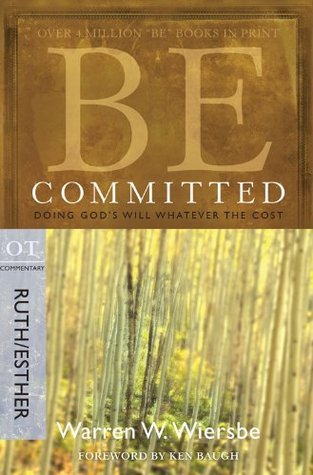
The books of Ruth and Esther are the only ones in the Bible named for women. The two women lived in different times and came from very different backgrounds. So why did Warren Wiersbe group them together in his commentary, Be Committed (Ruth and Esther): Doing God’s Will Whatever the Cost? He says:

Why do we bring these two women together in this study? Because, in spite of their different backgrounds and experiences, both Ruth and Esther were committed to do the will of God. Ruth’s reply to Naomi (Ruth 1: 16–17) is one of the great confessions of faith found in Scripture, and Esther’s reply to Mordecai (Est. 4: 16) reveals a woman willing to lay down her life to save her people. Ruth and Esther both summon Christians today to be committed to Jesus Christ and to do His will at any cost (pp. 15-16).

And then Dr. Wiersbe says something he has repeated in many of his commentaries: “Faith is not believing in spite of evidence but obeying in spite of consequence” (p. 16).

Ruth lived during the time of the judges, before Israel had kings. She was from Moab, people who were enemies to Israel. But her in-laws had come to Moab from Israel during a time of famine. Ruth had married one of their sons, but over time her father-in-law, husband, and brother-in-law all died. Ruth had come to believe in Naomi and Israel’s God, and she traveled with her mother-in-law, a bitter and broken, Naomi back to Israel.

The only recourse the women had for food was for Ruth to glean in someone else’s fields. The law at that time told farmers not to harvest every single piece of produce they grew, but to leave some for the poor. Ruth “happened” upon the fields of kind Boaz (one of my favorite OT people), who told his workers to leave some extra on purpose for her.

Near relations had the right to redeem the land of their deceased relatives, but part of the deal was marrying the widow. The nearest relation to Ruth’s husband was not willing to do this. But Boaz was the next nearest relation, and he was willing. Thus Ruth and Naomi were taken care of, and Naomi’s joy returned with the birth of her grandson–who became the grandfather of King David.

There’s much that could be said about this wonderful book. One point Wiersbe makes is this:

It is encouraging to see the changes that have taken place in Naomi because of what Ruth did. God used Ruth to turn Naomi’s bitterness into gratitude, her unbelief into faith, and her despair into hope. One person trusting the Lord and obeying His will can change a situation from defeat to victory (p. 43).

Esther lived hundreds of years after Ruth. Israel went through several kings, most of whom did not follow God. After much warning and preaching, with little response, God sent His people into exile in Babylon, which was later conquered by Persia. After 70 years, many Israelites were permitted to go back to their land. But Esther and her cousin, Mordecai, were among many Jews still in Persia.

Mordecai raised Esther because her parents had died. The pagan king, Ahasuerus, dismissed his wife for reasons found in Esther 1. His advisors encouraged him to gather the virgins of the land and . . try them out, and then choose from among them a new bride. Esther was one of the young women, and she happened to be chosen as the new queen.

Neither Esther nor Mordecai were known to be Jews at first. Wiersbe talks about the possibility that this may have meant they were not living according to God’s laws, because even the dietary laws would have separated them from other people in the land. We don’t know if this means they weren’t being faithful or if there were other reasons their nationality was not known. There also would have been problems with Esther, as a Jew, marrying a Gentile, and of course with her sleeping with the king before they were married (though she may not have had a choice about that).

At any rate, one person knew Mordecai was a Jew: Haman. Haman was a high official and hated that Mordecai would not bow to him like everyone else did. He was so angry, he plotted to kill not only Mordecai, but all the Jews. When he proposed this to the king, oddly, the king agreed without much discussion.

One interesting thing about the book of Esther is that God’s name is not mentioned once. But His fingerprints are all over the book. The suspense and irony of how God delivered the Jews from destruction is one of the most exciting stories in the Bible.

The highlight of the book is when Esther goes before the king to petition his protection for her people. According to the law of the land, if she came uninvited to see him, and he refused her, she could have been killed. But after fasting and praying for three days and asking others to do the same, she determined to go. Her “if I perish, I perish” (Esther 4:16) has rung through the centuries as an example of doing what’s right and what’s best for others despite what happens to us.

Both of these books show God’s guiding hand in the lives of His people, individually and as a nation. One encouragement to me was that God did this despite and even through a pagan king and an enemy to His people.

Finally, there is a powerful personal message in the book of Esther; for Esther, like Ruth, is a beautiful example of a woman committed to God. Ruth’s “Whither thou goest, I will go” (Ruth 1: 16 KJV) is paralleled by Esther’s “And if I perish, I perish” (Est. 4: 16 KJV). Both women yielded themselves to the Lord and were used by God to accomplish great things. Ruth became a part of God’s wonderful plan for Israel to bring the Savior into the world, and Esther helped save the nation of Israel so that the Savior could be born (p. 79).

We must never think that the days of great opportunities are all past. Today, God gives to His people many exciting opportunities to “make up the hedge, and stand in the gap” (Ezek. 22: 30 KJV), if only we will commit ourselves to Him. Not only in your church, but also in your home, your neighborhood, your place of employment, your school, even your sickroom, God can use you to influence others and accomplish His purposes, if only you are fully committed to Him (p. 80).


Laudable Linkage

I’m still catching up with blog reads from the last few weeks, but here are a few good ones I came across.

A Friend Just Lost an Unbelieving Loved One to Death: What Do I Say, Think, and Do? HT to Challies. “How on earth is anyone supposed to be perfectly ‘balanced’ as they traverse this seemingly impossible canyon? With God’s help, it is possible to be faithful to His Word and your friend simultaneously, but this ability does not equate to ease or an absence of deep distress.”

You Can Understand the Bible, HT to Knowable Word. “I’ve battled to get through the census records in Numbers. I’ve labored through the kidneys, livers, and “entrails” of the Levitical laws. I’ve grown weary of the repetitive failures of Israel in 1–2 Kings. I’ve sometimes struggled to see what Hebrews sees in the Old Testament. Much of the imagery of Revelation is still a mystery to me. And so, I regularly find these clear and accessible words from Paul all the more meaningful and encouraging: ‘Think over what I say, for the Lord will give you understanding in everything’ (2 Timothy 2:7).”

Why I Stayed in the Church. “So when I offer these reasons for why we stayed in the church, I do so as a woman who has wrestled with the church’s messiness–and my own. In the end, they may not answer your questions fully, but at least they’ll be a place to start:”

Hedgerows and Big Yellow Trucks, HT to Challies. I loved this. “A hard rain was falling that afternoon, and I was eager to get home. After a long day of doctor appointments in the city for my son Ben, I loaded up the car with groceries and headed up the twisting road to our home in the mountains. Only a few miles up, however, a large yellow County Roads Department truck suddenly pulled out in front of me, making me hit the brakes in frustration. I stewed and fumed as the big truck ground upwards at 20 mph instead of my usual 45.”

Risks and Benefits of Age-Specific Ministry. HT to Challies. “Reflecting on that season of ministry, I’m freshly reminded of the two sides of the age-specific ministry coin. On one hand, the junior high and senior high ministries were incredibly fruitful in their own right (not to mention other age-segregated ministries in between). The ability to hone in on age-specific needs and opportunities served everyone in a personal and powerful way. On the other hand, the combined events were reminders that there are many riches to be discovered with cross-generational ministry. There is a massive benefit to an integrated ministry approach that unleashes the saints to do the work of ministry with everyone in the church, rather than a small segment of it. We all have much to learn from—and much to offer—brothers and sisters who are in different seasons of life.”

An Encouragement to Young Husbands, HT to Challies. “I wanted to do this Christian marriage thing right. As a couple who felt called to missions among the unreached, I wanted us to discipline and focus everything about our lifestyle toward that end. I desired for us to be an example of a sacrificial, Jesus-centered marriage. These desires were not bad. In fact, I would say they were God-given. However, they were also paired with a rushed time-line, anxiety, and pressure. During this newlywed period I was missing what should have been a major emphasis of that time – helping my new bride to simply rest securely in my love for her.”

4 Biblical Truths to Help You Use Time Wisely. “Like Frosty, I saw time melting away, and I wondered if I’d done anything worthwhile with my life. What if I’d wasted weeks and months chasing after worthless things? What if I’d fretted away my days with endless worries over inconsequential things? Had I misspent my minutes, pondering and procrastinating, but never progressing? Had I missed the things that matter?”

A Certain Kind of Evangelical Christian, HT to Challies. This is a Twitter thread that starts: “There once was a certain kind of evangelical Christian I felt free to make fun of. I was pastoring a fast growing church in an urban environment, and a spirit of elitism had infected us. No one would correct me on it because they made fun of them too.”

The Comedy Wildlife Photography Awards, HT to Challies. These are always fun.