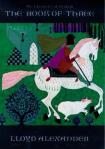
Book Review: The Book of Three

The Book of ThreeThe Prydain Chronicles by Alexander Lloyd are well-known children’s classics, but somehow I had never heard of them until the last few years. I saw them mentioned favorably at various blogs, so when I saw the first three books either on sale or free (I forget which) for the Kindle app, I got them.

The first in the five part series is The Book of Three. Young Taran lives with a retired soldier named Coll and an old “enchanter” named Dallben. He has ambitions to do great, heroic things, but in the meantime he is made Assistant Pig-Keeper. The pig he is charged with keeping is not just any old farm pig, however: this one, called Hen Wen, is a white oracular pig: she can tell prophesies and help information come to light. Taran fails at his first major responsibility when Hen Wen runs away. He sets out to find her even though he has been told not to leave the farm.

While searching for the pig, Taran is startled to see the dreaded Horned King, the champion of Arawn Death-Lord ride by with his soldiers. One throws a sword at him which wounds him, but not fatally. After running for his life and passing out, he awakens to find his wounds being treated by none other than Prince Gwydion in disguise.

Gwydion and Taran face unexpected battle and are captured. Taran escapes but is sure that Gwydion has died when the castle where they were held collapses. He decides he must go to warn the king of the advancing army of the Horned King. Along the way he is joined by a minor king named Fflewddur Fflam who is moonlighting as a bard and whose harp strings break whenever he stretches the truth, Princess Eilonwy, who talks a lot and has been learning magic, and Gurgi, sort of between man and beast who refers to himself in the third person and speaks in rhymes (“crunchings are munchings,” his reference to food,””sneakings and peekings,” “smackings and whackings,” etc.).

In his quest Taran has to come face to face with his own shortcomings and learn that heroism is not only not easy, but it isn’t always displayed in mighty public acts.

The books are somewhat loosely based on Welsh mythology (with which I am not familiar). The author grew to love the land and language of Wales when he was stationed there during WWII while in the army.

A few of the notable quotes from the book:

“Neither refuse to give help when it is needed,… nor refuse to accept it when it is offered.”

“It is not the trappings that make the prince, nor, indeed, the sword that makes the warrior.”

“I have studied the race of men. I have seen that alone you stand as weak reeds by a lake. You must learn to help yourselves, that is true; but you must also learn to help one another.”

I enjoyed some of the humor in the story, such as this exchange:

“By all means,” cried the bard, his eyes lighting up. “A Fflam to the rescue! Storm the castle! Carry it by assault! Batter down the gates!”

“There’s not much of it left to storm,” said Eilonwy.

“Oh?” said Fflewddur, with disappointment. “Very well, we shall do the best we can.”

I have to admit it took me a while to get into the story, and I didn’t like it at first. I didn’t really care for the princess: I hate when girls continually take things said in innocence and twist them around to mean something else and get offended by them, and the princess here did that quite a lot. Then again, she is young as well, so possibly her maturing will come about in one of the next books.  I thought the idea of an oracular pig was silly, and the story seemed to resemble The Lord of the Rings a little too closely in the beginning with the undead Cauldron Born soldiers a little too similar to the Ring Wraiths, and Gurgi sounding very much like Gollum. As the story went on, however, Gurgi developed into quite a different personality than Gollum and the story took on its own direction and feel.

I do like coming of age “quest” stories where the protagonist has to reach beyond his abilities and learn about himself and life in the process, and this story fits that bill nicely.  The author says in his after-word, “Most of us are called on to perform tasks far beyond what we can do. Our capabilities seldom match our aspirations, and we are often woefully unprepared. To this extent, we are all Assistant Pig-Keepers at heart.”

(This will also be linked to Semicolon‘s Saturday Review of Books.)
What did you read as a kid?


Carrie had someone ask this question in her comments, and she answered yesterday. My response grew into several paragraphs, so I figured it would be better to form them into my own blog post rather than posting a full-fledged post in her comments.

Since I am in my mid-fifties, my childhood was a long time ago. I don’t remember whether my mom read to me, though I assume she did. I LOVED reading in school. The first book I remember reading from is A Child’s Garden of Verses by Robert Louis Stevenson. I must have read several Little Golden Books, because they were familiar to me when I started reading them to my kids. I remember checking out a biography of Martin Luther from the school library in maybe the second grade. My dad did not read much at that time (though he did after he retired), and he thought I was being lazy if I was sitting around reading much. I remember being admonished about that a number of times, so I must have been reading a lot, but it doesn’t seem to have dimmed my enthusiasm. Since I was the oldest of six kids, whatever children’s books we had did not survive the long run through everyone’s use.

I never heard of Anne of Green Gables until I was a young adult (when the Megan Follows films came out) or Narnia until less than 15 years ago. When someone in our church talked about acting in a local production of The Lion, the Witch, and the Wardrobe, I was suspect. 🙂 I think it was probably then that I checked the series out and loved it. I think it’s been in that time frame that I discovered The Hobbit and LOTR, too.

Somehow I even missed Nancy Drew and The Babysitters Club! I do remember reading Little Women  and its sequels many times, and I must have read some of the Little House books, because they were familiar to me later. Then in high school I discovered and loved Dickens with David Copperfield. Somewhere along the way I read Great Expectations and Oliver Twist and didn’t like those quite so well, and attempted A Tale of Two Cities several times over the years before finally getting through it and then instantly rereading it and deeming it my favorite novel. I remember some book from the Scholastic book paper about a girl getting pregnant (and my dad was very angry I was reading that) and one called The Endless Steppe about a girl in Russia

I remember studying a different Shakespeare play each year in high school but not getting much out of it. My sophomore English class was memorable because we made a film, but I don’t remember what we read. That was the early 70s, just coming off the hippie era, and my teacher that year “fit” into that era well.

It was in college that I first discovered missionary biographies, and that was nurtured by the church I attended for the first 14 yeas we were married which had in the monthly ladies’ meetings a librarian who talked briefly each meeting about a book and had them there to check out.

Early married years were when I first discovered Christian fiction with Janette Oke. In high school I had read Not My Will by Francena Arnold, which was kind of a precursor of modern Christian fiction, and it spoke to my heart.

I know we explored good literature in three of my college literature classics, but all I can remember is discovering and loving Anne Bradstreet and then Jane Austen’s Emma. A lady professor who attended my church taught a class on Shakespeare that I really wanted to take, but just couldn’t work it in.

Since I’ve started a blog I’ve purposed to read through some of the classics. I’ve read all of Austen’s books, Les Miserables, The Count of Monte Cristo, and many others. I’m enjoying discovering them as an adult, though I am sorry I missed being exposed to them at a younger age. I also enjoy rereading some of the ones I had read earlier, like Little Women and the Little House books and Dickens. I’ve had fun exploring children’s classics that I missed along the way, like all of the Anne books, Narnia, Caddie Woodlawn, Five Little Peppers and How They Grew (a favorite, though I need to reread it again). And I continue on with biographies, “real-life” stories, Christian fiction and non-fiction, and an occasional secular fiction or non-fiction.

Some favorites I read to my own kids when they were small were the Francis books, Curious George, Clifford, the Little Bear series by Else Holmelund Minark, the Jesse Bear series by Nancy White Carlstrom, Mike Mulligan, The Little Engine That Could, Robert McCloskey books (Make Way for Ducklings and Blueberries for Sal), Dr. Seuss, P. D. Eastman, Keep the Lights Burning, Abbie by Peter Roop one of my all-time favorites, about a girl who has to keep the lighthouse lamps burning when her father is delayed from getting back home due to a storm), The Puppy Who Wanted a Boy by Jane Thayer, the Snipp, Snapp, and Snurr books by Maj Lindman, and of course the Little Golden Books. One of their favorites was Gus the Bus, who goes frolicking off his usual route when his tires get overfilled. We kept that even though it is taped together.

So…what did you read when you were a kid?

(Graphic Courtesy of Grandma’s Graphics.)