Book Review: Dying to Read

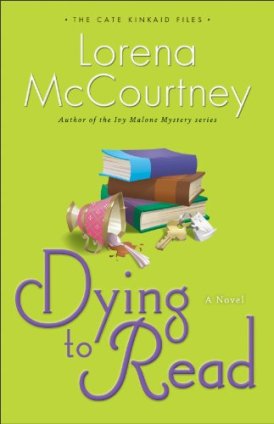
In Lorena McCourtney’s novel, Dying to Read, Cate Kinkaid is nearly 30 and at a crossroad. She’s helping out her private investigator uncle until another job opens up. Her first assignment is simply to verify that a particular woman lived at a certain address. But things get complicated when Cate finds a disgruntled book club and a dead body rather than the woman she’s looking for.

Then Cate’s uncle falls off a ladder and needs hip surgery, so she’s on her own. She decides the least she can do is try to get more information about the woman she was originally looking for. But, though she has no PI training, something about the dead woman’s case and the book club nags at her. Before long she finds herself deep in suspects and danger.

I don’t read many mysteries. I got this on a Kindle sale because of the title and the book club aspect. It took me a little while to get into the book, but I was engaged before too long. Cait is a little quirky. I wouldn’t call the writing funny, exactly, but there are some witty moments. But it’s not exactly a comedy: there are several twists and turns and some dangerous moments. The author did a good job presenting several plausible suspects while keeping the real murderer a surprise until nearly the end.

This book is the first in a trilogy. If you like clean, cozy mysteries with a Christian main character, I think you’d like this book.

(Sharing with Carole’s Books You Loved, Booknificent Thursday)

Book Review and Giveaway: The Shop Keepers

The Shop Keepers by Nancy Moser is the third book in her Pattern Artist series. The first two books, The Pattern Artist and The Fashion Designer, tell the story of Annie Wood, who came from a difficult family background to become a maid to the Summerfield family of Nancy’s Manor House series. (Annie’s backstory in included in Christmas Stitches.) In the first two books, Annie had a knack for sewing and designing, but the other women in charge of that work took credit for hers. On a trip to America, Annie left her position and found a job first at Macy’s Department Store, then at the Butterick Pattern Company, then in her own dress shop. She met, fell in love, and married Sean Culver.

This third book takes place in New York in 1919, just after the first World War. Annie has two young daughters by now, but her husband has not returned from the war. He’s missing. Her shop, Unruffled, is not doing well. People had to buckle down during the war, and no one felt like buying fashionable yet practical clothes. The country is still in recovery mode. Most of the shop is decked out in black mourning dresses. One of Annie’s partners suggests they go into wedding dresses to help those who had been waiting for sweethearts to return. The prospect raises hope not only for new business but for a brighter shop and outlook.

At just the right time, a salesman from a local fabric shop offers them beautiful fabrics just right for weddings at deep discounts. Full of charm, he tempts the customers in Annie’s shop with his samples. This boon helps set the shop on a new, welcome trajectory. But something about this man bothers Annie, especially when he turns his charm her direction.

Henrietta, Annie’s bookkeeper and long-time friend. feel fortunate that her husband has returned home from the war. But he doesn’t seem totally back. He spends most of the day sitting in a chair looking out the window at the sky. She can’t seem to interest him in herself, their sons, or life in general.

Maude, who had been with Annie since her Butterick days, had married widower Antonio Ricci in the last book. Maude could not have children of her own, but welcomed Antonio’s two children. Now the oldest, Gela, is an independent-minded teenager who finds an unexpected talent. Maude is concerned where Gela’s gifts will take her in her naivete, especially when an unsavory character from Maude’s past comes on the scene.

It took me just a little bit to remember who the characters were and their backgrounds. This book could be read as a stand-alone, but I think it would be a much richer experience for those who have read the first two books.

I enjoyed this book for several reasons. I’ve often read books set during the world wars, but the time of adjustment after after WWI is a fascinating era that few focus on. There were threads of intrigue with the salesman, the man from Maude’s past, and a seeming presence in the shop workroom. Henrietta’s husband’s condition, Annie’s missing husband, and Maude’s concerns lent strands of pathos. Those were woven together with needs for forgiveness, patience, hope. I always enjoy Nancy’s afterwords with details that went her story, historical elements that were true, etc. And I love the book cover.

Once again, I found myself with both a paperback and Kindle copy of this book. I read the Kindle version, and I’d like to give the paper copy away to one of you. Just leave a comment on this post if you are interested in being part of the drawing for this book. (I’ll take all comments on this post as entries unless you let me know you’re not interested.) I’ll draw a name a week from today. I’m sorry, due to shipping costs I can only send the book to US addresses.

Have you read much from the post-WWI era?

(Sharing with Worth Beyond Rubies, Carole’s Books You Loved, Booknificent)

The giveaway is closed: the winner is Linda!

Book Review: Promise Me This

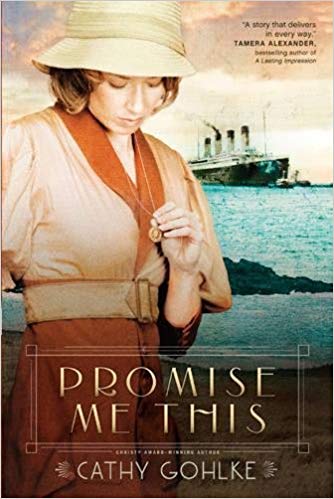
In the novel Promise Me This by Cathy Gohlke, Owen and Annie Allen have been raised by their manipulative Aunt Eleanor in England ever since their parents died. Now Owen has trained himself as a gardener and is about to set off for a new life in New Jersey with their aunt and uncle on their father’s side. He can’t take Annie with him yet, which makes her furious. But he removes her from Aunt Eleanor’s house to a school until he can send for her.

As Owen gets ready to sail on the Titanic in a week, he meets a young street kid, Michael Dunnagan. Owen has compassion on him, shares his food, and gives him odd jobs until time to leave.

Michael picks up another job making deliveries to the Titanic. He muses that in a ship that size, he could hide away and escape from his abusive uncle.

Within just a few days at sea, Owen discovers Michael and takes him into his quarters. He shares his food as well as his plans and dreams to start a new life in New Jersey and send for Annie as soon as possible.

Then comes the fateful night the Titanic hits the iceberg. Owen sends Michael off with the women and children and wraps him in the jacket where he had sewn his precious seedling samples in the lining. Michael fights with everything he has to stay with Owen, but Owen insists and bodily pushes Michael to safety.

After a series of events, Michael finds his way to Owen’s aunt in New Jersey and tells her all that has happened. She takes him in and tells him about the trouble she faces which Owen had not yet heard. In their grief, they decide to try to make a go of Owen’s plans. Michael is determined to bring Annie home.

Annie is devastated, angry, and bitter, not only that Owen died, but that Michael lived instead. Back in Aunt Eleanor’s clutches, Annie finds herself responding in kind and becoming more like her.

When Michael first writes to Annie, she sends the letter back. But soon a tentative friendship begins. Annie trains as a nurse while she waits to go to NJ. And then WWI breaks out.

My thoughts:

When I reviewed Cathy’s Saving Amelie, which became one of my top ten books of last year, I mentioned wanting to read more of Cathy’s books. A couple of people mentioned this story. When I discovered it was partially based on the Titanic, I planned to start it in conjunction with our visit to the Titanic museum.The book did enhance my visit and vice versa.

Cathy mentions in her afterword that there was a Titanic passenger named Owen Allum who was a gardener, but not much else was known about him. I enjoyed reading how she created his and Annie’s stories and what influenced her.

The Titanic section is just the first part of the book, however. I loved the example of laying down one’s life for another as Owen did. And then Michael and Annie each had to learn what it meant to love others and to receive love.

Some of my favorite quotes:

No matter what pain, what hard things come to us in life—and pain and trouble come to all of us—no matter what dark roads we walk or poor choices we make, it is not the end of the story.

It’s no good being fearful. Worry won’t change the future a whit, and it misses the joy of this glad day.

Each morning, when we wake—if we wake—we pick up whatever it is we’ve been given to carry for that day, with the sweet Lord Jesus in the yoke beside us to tote the load. Each night we lay it down, giving it into God’s hands. If it’s still there in the morning, we pick it up and begin again. If the burden is gone or if there is something different, we know where to start.

“Growing is a patient thing, lad,” Daniel explained. “You must give all living things time to adjust to their new surroundings, their new soil, then time to grow, as well.”

Does your hate make you happy, my dear, or does it continually eat through you, a cancer of its own making? Does the constant fueling of that angry fire not exhaust you and take away from living the wonderful life you’ve been given?

I loved the characters (including some not mentioned here) and the story. I loved how Cathy pulled us in to empathize with them in their anger, pain, and hope. Highly recommended.

(Sharing with Global Blogging, Senior Salon, Carole’s Books You Loved, Booknificent)

Book Review: Christmas Stitches

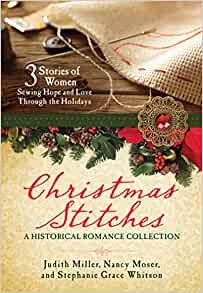
Christmas Stitches: A Historical Romance Collection: 3 Stories of Women Sewing Hope and Love Through the Holidays, contains three stories, one each by Judith Miller, Nancy Moser, and Stephanie Grace Whitson. As the subtitle says, they have in common some kind of sewing or needle arts. They’re also all set in the late 1890s-early 1900s.

A Seamless Love by Judith Miller takes place in Pullman, Illinois. Hannah Cushman had once been romantically interested in her longtime friend, Daniel Price, but Daniel wanted to remain only friends. Years later, Hannah’s working at the Pullman Dressmaking and Millinery Shop. Her special talent in embroidering bead work has come to the attention of Mrs. Pullman, who asks her to work on some special projects for her. She’s being courted by Louis Nicholson, who lives in Chicago. But her old friend Daniel wants to work for the Pullman Car Company and move closer to Hannah. Something about Louis doesn’t sit right with Daniel. And he’s finally ready to move beyond friendship with Hannah, but is it too late?

Nancy Moser’s story, Pin’s Promise, takes place in Summerfield, England. Penelope Billings, nicknamed Pin, has loved Jonathan Evers as long as she can remember. They promised each other as teenagers that they’d marry after his six years of education training to be a doctor. Now he’s back, trying to find his place with his new ideas in his father’s old-fashioned practice. Pin is an accomplished seamstress and teaches others to sew. She’s driven while Jonathan is laid back. She runs ahead, sure of herself, while Jonathan likes to take his time and think.

Pin becomes aware that a local girl, Annie, who sells eggs in the village has some serious needs. As she tries to help, she learns the family is in poverty because the father is a drunkard who abuses his children.

A tragedy involving Annie’s family pulls Pin and Jonathan apart. Are their differences too great to keep their teenage promises to each other?

One fun aspect of this story was that some of the characters appear in others of Nancy’s books. I’ve only read book in her Summerfield series, but Annie was the main character in The Pattern Artist and The Fashion Designer.

Stephanie Grace Whitson‘s story, Mending Hearts, takes place in small Lost Creek, Nebraska. Rachel Ellsworth’s pastor father has just died and Rachel has to move out of the parsonage in St. Louis. She’s engaged to Landis Grove, but she has nowhere to go before their wedding except to two older single aunts in small Lost Creek, Nebraska. Rachel is an artist looking forward to the Grand Tour on her honeymoon. But for now, she puts her artistic talents to work at the local quilting bees.

Her aunts help take care of the children of a widower, Adam Friesen. Adam had offered to marry his wife to help her out of a bad situation. Though their relationship had grown, he is wracked with guilt that he didn’t really love her as he should have before she died. He’s in a haze of pain since his loss, but he keeps busy in the community.

Rachel receives a letter from home which changes her whole future. At a loss now herself, she struggles with finding God’s will for her life now.

I enjoyed all three of these stories. I’ve loved needle arts for decades, so that aspect was fun for me. But mostly I sympathized with each woman in her situation and her struggles to trust God and apply His truth to her situation.

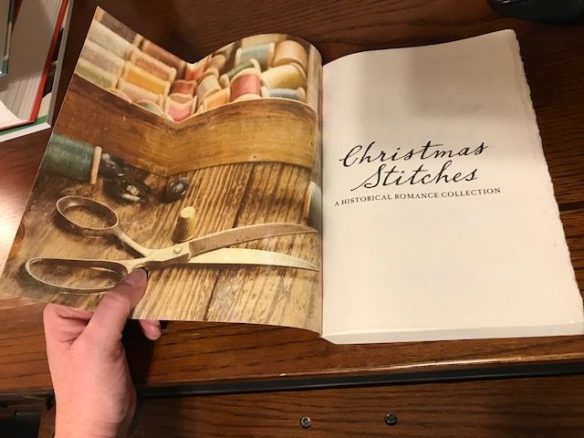
In addition, the cover is gorgeous and the inside opens out for even more lovely artwork.

I highly recommend this one.

(Sharing with Carole’s Books You Loved, Booknificent)

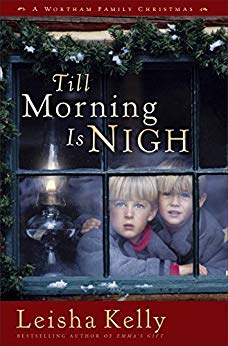
Book Review: Till Morning Is Nigh

Till Morning Is Nigh: A Wortham Family Christmas by Leisha Kelly comes about in the middle of her six-book series about the Wortham family. I finished the series back in September but wanted to save the Christmas story until now.

The Wortham family had been down and out during the Depression. With their last hope of a job fallen through, they hit rock bottom. They took shelter in an abandoned house, then got the idea that perhaps the owners would let them stay there in exchange for fixing up the place. The owner was an elderly woman named Emma who took a chance on the family. She had not been able to live home alone, but the Worthams eventually moved her back into her home with them, and she became a grandmother and mentor to the family. That was back in Book 1, Julia’s Hope.

This story opens several years later. Emma has passed away as has the Wortham’s neighbor, Mrs. Hammond, a mother of ten children. George Hammond had been devastated and unstable after his wife’s death, and the Hammond children often spent as much time at the Wortham’s house as their own.

George had seemed to settle down for a while. But now it’s the first anniversary of his wife’s death, and he’s missing. The older children think perhaps he has drowned his sorrows in a drinking binge, but they fear worse. Some of the middle children are angry. The younger children are just sad and afraid. The Worthams take them all in and try to help. On top of everything else, some of them have the flu.

While nursing the various sick ones, keeping everyone fed, praying and worrying, Samuel and Julia Wortham try to prepare a meager Christmas and discuss what they should do if the worst has happened to George.

When a friend tells Julia, “I don’t know how you do it,” Julia responds, “I don’t. Whatever you think I’m accomplishing, I really can’t manage at all. Nothing but the good Lord could have gotten me through this holiday.”

Someone suggests that they make a Nativity scene out of what materials they have. The project starts out as a diversion but eventually becomes meaningful in various ways to different ones.

This story is a reminder that not all Christmases are giddy parties. Sometimes deep grief and stark need prevent the usual Christmas we’ve come to expect. But joy, love, and light can shine in and touch hearts.

I think this book could be read easily as a stand-alone. Enough of the back story is explained that readers new to the series wouldn’t feel lost. But the story is richer for having read the rest of the Worthams’ books. I enjoyed them all, so I recommend them all to you.

(Sharing with Grace and Truth, Carole’s Books You Loved, Booknificent)

Book Review and Giveaway: Catching Christmas

 In Terri Blackstock’s novel, Catching Christmas, Finn Parrish is a grumpy cab driver called to the house of an old woman named Callie. First he’s put out to make a residential call, as he needs money and can make more in the city or at airports. Then he finds the old woman alone and asleep in her wheelchair. She wakes up and introduces herself—and continues to fall asleep, wake up, and introduce herself for the rest of their time together. When she is awake, she makes unfiltered comments on the people she sees.

Finn takes her to her doctor’s office and tries to explain to the distracted receptionist. He leaves for a few hours, but can’t get his mind off Callie. He drives back by the doctor’s office to check on her, and finds her asleep right where he left her. He makes a fuss insisting that they see her now and waits for her, then takes her home. He leaves his card in case she needs help and wonders what kind of loved ones she has, that they would leave her in such a state.

Callie’s granddaughter, Sydney, is a lawyer in a firm that is downsizing. Her job is hanging by a thread, dependent on her current ridiculous case, one she doesn’t believe in. On top of the extra work created by layoffs, her grandmother suddenly seems to be not quite in her right mind. She wished she could have accompanied her to the doctor, but they both need her job.

The next day Finn gets an early call from his dispatcher. A customer has requested him by name. He’s thrilled until he finds out it’s Callie. She wants him to take her several places in town. He doesn’t want to be stuck with her all day, doesn’t want to be responsible for her, and can’t afford to spend his day on one fare. But he goes. Callie has a way of talking people into what she wants, and she has a secret mission.

This book is outside Terri’s usual suspense dramas (though there’s a touch of suspense when a black limousine shows up). But I’m so glad she wrote it. It’s a sweet and touching story, just right for the holidays. Finn and Sydney don’t have much of a spiritual foundation, but they’re impacted by Callie and some of the people in her life. The faith element is not spelled out quite as much as I’d like: Finn and Sydney are just beginning to understand what it means. But it’s a strong undercurrent.

I also enjoyed reading Terri’s afterword about the influences that went into the story.

I’d like to give away my gently-used copy of this book. If you’d like to enter a drawing to win it, leave a comment on this post. I’ll draw a name on Wednesday morning, Dec. 18, the same day as my giveaway for The Carousel Painter. You can enter both giveaways but only win one: if you’d like to enter both but have a preference of one over the other, let me know. Due to mailing costs, I can only ship to continental US addresses. I’ll count all comments on this posts as entries for Catching Christmas unless you ask me not to.

Even if you don’t win, I hope you’ll check out this great book.

(Sharing with Global Blogging, Senior Salon, Carole’s Books You Loved, Booknificent)


(Update: The giveaway is closed and the winner is Becka. Congratulations, Becka!)

Book Review and Giveaway: The Carousel Painter

In the novel The Carousel Painter by Judith Miller, Carrington Brouwer has just traveled from France to Ohio. Her artist father has died and Carrington needs to find a means to support herself. She had befriended a young American women visiting France named Augusta, who had invited her to Ohio. But now Augusta’s mother, preoccupied with climbing the social ladder, is clearly not pleased. When Carrington learns that Augusta’s kindly father owns a carousel factory and needs an artist to paint the horses, Carrington assures him she could perform the job.

He hires her, but it’s uncommon for a woman to work in a factory full of men in 1890. Some protest and complain; some of the wives accost Carrie in public to try to scold her into quitting. Some men go so far as to quit or sabotage her work. Her supervisor, Josef, is not happy to have her there, but he can only abide by the boss’s wishes. The fact that Carrie is a friend of the boss’s daughter, and Carrie goes to their house every weekend, doesn’t sit well with the men, either.

Eventually Carrie’s talent speaks for itself. But a new enemy arises in the form of Augusta’s suitor, who has eyes for Carrie. Then some of Augusta’s mother’s jewelry is stolen, and Carrie is blamed.

Carrie’s mother had taken her to church, but her father “said God was for weak people who needed a crutch to get through life. Mama didn’t agree. She said believers were the strong ones because they had faith in something beyond what they could see and feel. I tended to agree with Mama. At least until she died.” Part of Carrie’s journey is realizing she has issues with besetting sins like pride.

I enjoyed the story and they way some of the relationships developed over the course of the book. Josef ended up being my favorite character. I also liked learning the background of how carousels were manufactured and painted. I guess they are probably made of molded and dyed plastic now. The old ones were individual works of art. I loved the cover.

Somehow I ended up with both a paperback and Kindle copy of this book. I read the Kindle version, so I’d like to give away the paperback. If you’d like to be entered in the drawing for the book, just leave a comment on this post. (I’ll take all comments here as entries unless you let me know you’re not interested in receiving the book). I’m afraid I can only ship to US addresses due to shipping costs. A week from today, Wednesday, Dec. 18, I’ll draw a name from the entries to determine the winner.

(Update: The giveaway is closed and the winner is Vickie. Congratulations!)

(Sharing with Carole’s Books You Loved, Booknificent)

Book Review: Canteen Dreams

 Canteen Dreams is a novel based on author Cara Putman’s own grandparents. It was her first book, released eleven years ago. But Cara wanted to fine-tune and re-release it. This edition came out on 2017.

The story opens December 6, 1941. Audrey Stone attends a dance in her home town of North Platte, Nebraska, and is asked to dance by local rancher’s son, Willard Johnson. Willard is interested and wants to get to know Audrey better.

Then Sunday morning, the Japanese attack Pearl Harbor, and everything changes.

Willard’s brother, Andrew, was in the Navy. While the family waits to hear about Andrew, Willard would like nothing better than to enlist immediately.

But Willard’s father won’t let him. Farming and ranching are exempted occupations, since the country needs their work. Willard’s father feels he needs Willard’s help more than the military needs him.

Since North Platte is a railroad hub, and lots of troops come through on their way to service, someone gets the idea to offer the boys food and coffee during their brief stop. The young men are so encouraged and appreciative of the effort that the train stop refreshments grow into a canteen, with a nearby building, music, sandwiches, and a friendly atmosphere.

Audrey throws herself into working the canteen, on top of her full-time job as a teacher. She has little time for anyone or anything else, which doesn’t help her budding relationship with Willard.

Willard’s dissatisfaction with not being able to enlist grows into resentment and jealousy of the young soldiers at the canteen, which further impacts things with Audrey.

Both Willard and Audrey are believers and struggle with seeking God’s will for their lives. I liked their pastor’s counsel, especially these bits:

Let the sure hope we have in Christ build a bedrock of faith in your life. It’s the only way to survive a storm like the one your family has entered.

He is the vine, and we are the branches. We cannot expect to have the strength to lay down our lives, our rights, for others until we are firmly growing in a deep relationship with Christ. A superficial relationship is not sufficient. Without more, we will fail every time in our attempts to die, because we attempt to do it without the strength and love God gives.

This was a sweet story in itself, but knowing it was based on a real couple made it even more enjoyable.

(Sharing with Literary Musing Monday, Carole’s Books You Loved, Booknificent)

Book Review: Jessie’s Hope

 In Jennifer Hallmark’s debut novel, Jessie’s Hope, Jessie is a young woman who lives with her grandparents. An accident that claimed her mother’s life left Jessie in a wheelchair since childhood. Jessie’s father abandoned the family.

Jessie is engaged to Matt and looks forward to their marriage. But she wrestles with several issues. Does Matt really love her, or does he just feel sorry for her? Though she longs to be independent, she worries that she won’t be able to be the wife Matt needs. And she wonders about her father and whether she should try to look him up.

Jessie’s grandfather, Homer, wants to provide Jessie with a beautiful wedding, but funds are limited. He goes to a ritzy wedding shop to see what can be done, but can feel their scorn towards a poor farmer in overalls who couldn’t possibly afford anything in their shop.

The course to a perfect wedding never did run smooth (apologies to Shakespeare), and a variety of problems crop up before the big day.

A secondary story line involves Angeline. She works at the ritzy wedding shop and had a crush on Matt, but he rebuffed her. She’s jealous of Jessie and feels Jessie views her as an enemy. But then they are thrown together in unexpected ways.

This is a sweet story with a number of underlying themes: the difficulty and necessity of forgiveness, the need to yield to God’s control instead of our own and to walk with Him by faith, the need to help others.

I love the strong sense of place Jennifer created. The contemporary Southern setting is distinct without being overly romanticized. The dialogue is just what I grew up with:

“What can I do you for?’

“If it tweren’t one thing, it was another.”

The cover is lovely and fits in well with the story.

My only quibble is that when Jessie us talking with another girl about becoming a Christian, the conversation revolves around accepting God as one’s Father. I think probably the author put it that way because both girls had father issues, and even though earthy fathers fail and forsake us, our heavenly Father never will. However, there are people who call on God as Father who do not trust Christ as Savior. Jesus and his death on the cross isn’t even mentioned in the conversation. Perhaps the author felt this character had been exposed to other aspects of the gospel in earlier encounters with Christianity. But I wish this had been a little more clear.

Otherwise, this is an excellent book. At the moment it’s on sale for the Kindle app for $3.99. You can learn more about Jennifer at Alabama Inspired Fiction.

(Sharing with Carole’s Books You Loved)

Book Review: Like a Flower in Bloom

 In the novel Like a Flower in Bloom by Siri Mitchell, Charlotte Withersby’s father is a botanist in Chesire, England, in the 1850s. Her mother was a botanist as well, and Charlotte loves to study and illustrate plants. Since her mother died, Charlotte has been her father’s assistant, secretary, and all around right-hand person.

But Charlotte is now 22, and her uncle, the Admiral, thinks it’s high time for her to go into society and find a husband. Charlotte has no interest in either society or matrimony. She loves her work, and she doesn’t think her father can possibly do without her.

But then a long-time correspondent, a Mr. Edward Trimble from New Zealand, shows up on the Withersby’s doorstep. He seems the ideal solution: he can assist Charlotte’s father so the Admiral can introduce Charlotte to society.

Besides Charlotte’s lack of interest, being presented to society is fraught with another  major problem. Charlotte’s father has never had any interest in society. He has always been the somewhat eccentric absent-minded professor type. With only her father as her main companion for life, Charlotte doesn’t know how to dress or act. Fortunately she finds a friend in Miss Templeton, who likes Charlotte’s quirky ways. Miss Templeton is younger but also tasked with finding a husband, something she dislikes as much as Charlotte, but for different reasons.

Charlotte hatches a plan. Since she can’t seem to escape her fate, she’ll go after a husband just to make her father realize that he can’t do without her. Then he’ll call off this nonsense.

But Mr. Trimble proves himself an able assistant, so that her father seems to be able to get along without her very well. And her plan to attract suitors, assisted by Miss Templeton, succeeds only too well.

I’m afraid I didn’t like Charlotte at first. Even the person who came to love her called her “the most maddening, most vexing, most exasperating woman I have ever met.” I didn’t mind the fact that she didn’t know how to fit in society, and I even agreed with her that some conventions seemed silly. But at first she seemed to see only her own viewpoint. Yet, as I got to know her, and as she broadened her horizons and learned a little humility, she grew on me.

One of my favorite quotes from the book:

Conversation, my dear Miss Withersby, is a very fragile creature. You must nourish it if you would have it survive. Its favorite food is a question.

Siri Mitchell’s books are far more than romances. I loved her note at the end of the novel where she explained the different influences that went into this story: women who contributed to the study of botany but could not be published under their own names, the conflicting views of botany between scientists and religious people, the eccentricity of botanists, the unusual collections and plant projects of the times, the Opium wars between Britain and China, the nature of introverts, the concept of a helper in the Bible, Victorian gender roles and expectations. She wove all of these together seamlessly, with warmth and humor. Above all the book illustrates the main theme of being who God created you to be.

(Sharing with Literary Musing Monday, Carole’s Books You Loved, Booknificent)