Review: Mist of Midnight

Mist of Midnight

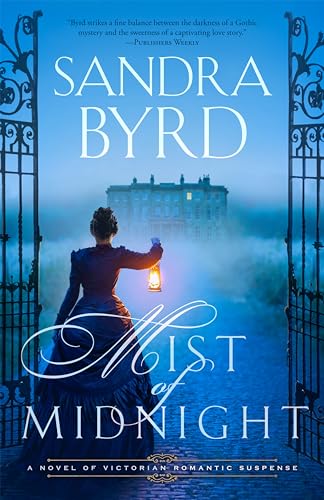
Mist of Midnight by Sandra Byrd is a “novel of Victorian Romantic Suspense.” Rebecca Ravenshaw is English but has lived most of her life in India with missionary parents. However, they died in the Indian Uprising of 1857, and Rebecca escaped just with the clothes on her back. She is interred with other refugees until passage for England can be arranged. She looks forward to the safety and peace of her family’s home in Hampshire.

When she arrives, however, she discovers that someone claiming to be her had come some months before her, and died, apparently by her own hand. The servants all seem to think Rebecca is the imposter.

The house is occupied by a Captain Luke Whitefield, a distantly-related cousin. He insists on Rebecca staying in the house while he moves to the guest house until all is sorted out. The family solicitor is called in, but he didn’t know Rebecca or her parents–he is taking over for his deceased father. He’ll have to contact the mission agency in India, but with the upset after the uprising, it may take months to hear from them.

Captain Whitefield generously allows Rebecca funds for clothing and a ladies’ maid and anything else she might need. Rebecca promises to pay him back when her claim is verified. If it’s not, she doesn’t know what she’ll do.

In the meantime, they just wait. Whitefield had some social events already on the calendar, which he invites Rebecca to. Most of the townspeople have never known Rebecca and look at her with suspicion. But they seem standoffish with Whitefield, too.

The more Rebecca learns of her imposter’s death, the more suspicious it sounds. Several people seem to have ulterior motives–Whitefield, her maid, the servants.

I had missed the description of this book as romantic suspense. I was confused at first wondering what type of book it was. Then I reread the description on Amazon and saw mention of Gothic themes. I did get Jane Eyre vibes–not from the imposter and the time in India, but the mysterious master of the house, the odd things going on, the wing of the house she wasn’t supposed to go down. The mists arising from the grounds each night added to the mysterious Gothic feel. I felt the author went a little overboard in telling us the mists were a metaphor for Rebecca’s life–I got that without her having to state it obviously.

There were a few things that didn’t make sense to me. Rebecca questions her sanity at several points, but there doesn’t seem to be a reason to. Something will happen, and she’ll immediately question, “Did that just happen, or did I imagine it?” Of course, she’s undergone several layers of trauma, so maybe that accounts for it. But that didn’t seem to arise organically from the story–it seemed tossed in to make it more Gothic-ish.

Then there are situations like some red flags about her maid. Yet when her maid prepares laudanum for Rebecca one night without being asked, Rebecca wonders if it is safe, but takes it anyway.

The plot is kind of a slow burn, but I liked how it ended up. I appreciated that Scripture and faith elements were brought in naturally, as you’d think would be normal for a daughter of missionaries, though I thought one verse was misapplied. All the questions and mysteries that arise through the story are satisfactorily settled.

I didn’t like that one character seemed to be a supernatural visitor after she left.

I’ve not read Sandra Byrd before. I saw the audiobook was free at Audible at the time (very nicely read by Elizabeth Sastre), so I decided to try it. The audiobook doesn’t include any author notes, but I found this interview with her. I was surprised to read that she had not been to India. This book is the first in a series of three. But I am not that into Gothic novels, so I probably will not read any more.

(Sharing with Between the Bookends)
Dracula

I’ve never been much into horror or “monster” stories, except for an afternoon TV program that was popular when I was a teenager (what is it with teens and vampires?)

But last spring, my oldest son told me about Dracula Daily. Dracula by Bram Stoker is epistolary novel, made up of dated notes, letters, telegrams, and journal entries. Dracula Daily sent out excerpts from the book on the dates of the letters, etc., so the reader got them in “real time.” There would be weeks with nothing, but then there would be several journal entries on one day when something major was happening.

I decided it might be fun to experience the novel that way, so I signed up. I didn’t think to mention it in my end-of-month posts where I listed my current reading, I guess because it wasn’t in my usual reading format.

The story begins with Jonathan Harker, a new solicitor, traveling from England to Transylvania with some paperwork for a Count Dracula, who has just bought property in England. After some weird and frightening occurrences, Jonathan finally makes it to Dracula’s castle. The Count seems nice enough, but the remoteness of the castle, the wildness of the land, the howling of wolves nearby, all seem spooky.

Over several days Jonathan notices weird things about the Count himself. He never eats. He sleeps during the day and is awake at night. He has very sharp, canine-like teeth.

Things just keep getting weirder and more horrible. And then Jonathan discovers he is imprisoned. When he finally escapes, he lands in a mental asylum for a time.

Meanwhile, back in England, Jonathan’s fiance, Mina, wonders why she has not heard from him. Mina travels to be with her lifelong friend, Lucy Westerna, whose mother is seriously ill. Lucy receives three proposals of marriage in one day, but she loves one man: Arthur Godalming.

But after a while, Lucy begins sleepwalking, and then exhibiting strange symptoms, and then becomes anemic.

Jonathan makes it home, and he and Mina get married. He doesn’t tell her all that has happened to him, but he writes it down. He tells Mina where it is and invites her to read if it she wants, but she decides not to—yet. And then one day while Jonathan and Mina are in town, Jonathan sees Dracula.

Meanwhile, Dr. John Seward, one of Lucy’s rejected suitors, is called to check on her. He calls in his friend, Van Helsing, who suspects he knows what Lucy’s problem is. He orders a blood transfusion and other measures, but doesn’t say why or what he’s thinking. Things might have gone better if he had, because people who didn’t understand accidentally sabotaged his efforts. But then, he probably would not have been believed.

Finally Van Helsing does tell the others about the Count, and they all team up together to find and destroy him.

As it happens, the Literary Life Podcast started doing a series on Dracula on Oct. 31 (appropriately). I’ve only listened to the introductory episode so far, but it was pretty fascinating and enlightening. According to those doing this podcast, in Victorian times (when Stoker wrote Dracula), monsters in stories represented the devil. (Dracula, The Strange Case of Dr. Jekyll and Mr. Hyde, and The Picture of Dorian Gray were all written within ten years of each other). Stoker even chose the name Dracula because he thought it meant devil. These were classic good vs. evil stories in which evil must be defeated.

The podcasters say it wasn’t until after Freud that people began to sympathize with the monster, wondering what in his background made him like he was, seeing him as the victim instead of the victimizer. And in our day, people try to infuse modern sensibilities into old stories. But I agree with the podcasters that to truly understand what writer meant, we have to understand the context and times in which he or she wrote.

They also share some interesting tidbits that I would never have picked up on my own. For instance, Jonathan is traveling into Transylvania on the eve of St. George Day. That evening was something like our Halloween, and in those times, superstitious folks thought evil creatures were free to roam the earth that one night.

Then the meticulous record keeping later on is supposedly a nod to the Enlightenment–that even though this is a fantastic tale, they’re going to handle it in a very scientific manner. Yet there’s also a nod to Shakespeare’s quote in Hamlet: “There are more things in heaven and earth, Horatio, Than are dreamt of in your philosophy”–there are things that enlightened science and technology can’t explain or handle.

The podcasters (one of whom is a literature teacher) also said that Stoker was not the first to write a vampire story, but he established some of the tropes of vampire lore that still hold today. Yet the modern vampire story is very different from his. They said the idea of the mysterious sensual stranger vampire came from a story written by Lord Byron, which he wrote when he hosted a party in which the participants were challenged to write a scary story. Mary Shelley wrote Frankenstein then. Byron left his story unfinished, but his friend and doctor, John Polidori, wrote a similar one based on Byron. Byron was angry with him and terminated him, and then Polidori published his novel in revenge (You can read more about that here).

I thought Dracula was very well-written. It was both suspenseful and scary, yet with a thread of hope throughout.

Some of my favorite quotes from the book:

We learn from failure, not from success!

How good and thoughtful he is; the world seems full of good men—even if there are monsters in it.

Loneliness will sit over our roofs with brooding wings.

Though sympathy alone can’t alter facts, it can help to make them more bearable.

She is one of God’s women, fashioned by His own hand to show us men and other women that there is a heaven where we can enter, and that its light can be here on earth. So true, so sweet, so noble, so little an egoist—and that, let me tell you, is much in this age, so sceptical and selfish.

It is in trouble and trial that our faith is tested—that we must keep on trusting; and that God will aid us up to the end.

We believe that God is with us through all this blackness, and these many dark hours. We shall follow him; and we shall not flinch.

I’m looking forward to learning more from the Literary Life Podcast.

The text of Dracula is available at Project Gutenberg. Dracula Daily also has their missives in the archives.

I’m counting this book for the Mystery/Crime/Detective category of the Back to the Classics Challenge. Even though it’s both a horror and a Gothic novel, I think it fits as a mystery because who the Count is and what’s going on with him and then with Lucy, are all mysteries to the other characters. The Count does commit crimes. And then the measures to find him all fit with a detective story.