Laudable Linkage

IMG_0195

Here’s some interesting reading discovered recently:

What Is Inductive Bible Study?

How To Be a Friend to Someone Who Has Breast Cancer. The tips here are great for a friend with almost any illness.

I Got Pregnant. I Chose to Keep My Baby. And My Christian School Humiliated Me. “My school could have made an example of how to treat a student who made a mistake, owned up to it, accepted the consequences, and is now being supported in her decision to choose life. But they didn’t.” This is a difficult situation. I understand Christian schools not wanting to appear to be condoning certain behaviors, but I think a girl in this situation needs to be affirmed for doing the right thing in having her baby rather than having an abortion.

A Theology of the Home, HT to Challies.

Check Your Privilege, HT to Challies.

A Patient Perseverance: a mother’s prayers for a wayward son.

And finally, this is me. 🙂

Or this is even more my style, minus the spa.

Happy Saturday!

Laudable Linkage

It’s a busy time of year, but I’ve discovered several thought-provoking reads online the last couple of weeks. Perhaps some of them will pique your interest as well.

Weep, Groan, Wail: The Need to Lament. “How is it possible to grieve, mourn, and wail but still know God is good?”

Even If He Doesn’t. “When the bad things come, when the kind of rescue we think we need just isn’t part of our story, will we be able to testify before a watching world that God can do it, that He will do it, but even if He doesn’t, we won’t turn away.”

Immanuel. From a friend’s whose 25 year old daughter is fighting yet another setback in her cancer battle. God is with us, even in the hard places, even in bad news.

5 Reasons to Read the Bible When You Feel Absolutely Nothing. I kept thinking Yes! all throughout reading this.

Jesus Isn’t Threatened by Your Christmas Gifts. Loved the practicality and balance in this. “The implicit messaging is that Christmas is a kind of either/or proposition in which we can either emphasize Jesus or emphasize gifts. But one always threatens to displace the other. I disagree with this.”

Miracles at Midnight.

5 Ways We Stunt Our Spiritual Growth.

Seekest Thou Great Things For Thyself? HT to Challies.

It’s Time to Take Your Medicine. “As we read the letters of Paul we find he always frames things this way: ‘God has done this for you in Christ, therefore you should respond in the following ways.’ ‘Thus the motivation, energy, and drive for holiness are all found in the reality and power of God’s grace in Christ.'”

Words That Shimmer. “For Christians, isn’t it amazing that our gracious God chose something as powerful as words to communicate to us His glorious truth? Everything pertaining to life and godliness (2 Peter 1:3). What a gift! What a treasure! Collectors of words take heart:”

Praying Biblical Prayers.

(Re)Remembering What We Mean. “Fairy tales employ the tool of the fantastic to jar us back to a truer vision that sees that all things are fantastic. Wonder is an appropriate response to all things because all things are wonderfully made.”

On parenting:

Should Parents Lay Down The Law Or Give Grace? “Grace is not rejecting authority. Grace is not walking away from the need of my children to have boundaries in their life—grace is about the way that I do that.”

My Changing Thoughts On Being a Mother. I wrestled with many of the same things mentioned here.

On writing:

Why Backstory Is Better Than Flashbacks.

And finally, I loved this video of a deer and rabbit playing. At least the deer is playing – it takes a while for the rabbit. Someone posted this on Facebook with the caption “Bambi and Thumper are real!”

Happy Saturday!

Laudable Linkage

Here are some good reads discovered recently:

Women: Trade Self-Worth For Awe and Wonder. Yes!

Trouble, We’ve Been Expecting You. Excellent.

Stop Trying to Make the Bible Relevant to Teenagers, HT to Challies, by which he means, you don’t have to present it in a way to try to make it “cool” to them. Its truth relates to all of us: just show them how it speaks to their needs.

Back to the Early Church? Excellent. Sometimes people idealize the early church in Acts, but it had its problems, too.

On Bible study:

What Is Bible Study?

4 Reasons Why Every Bible Reader Should Do Word Studies.

On prayer:

The Busy Mom’s Guide to Prayer. Good tips not just for moms.

4 Ways to Keep a Fresh Prayer Life.

On caregiving and dealing with aging parents:

What I’ll Say to My Children If I’m Diagnosed With Alzheimer’s.

What Caregivers Know and You Can, Too.

Her New Happy.

On parenting:

As Seemed Best to Them. Yes! Parenting is not a one-size-fits-all endeavor.

Why We Don’t Punish Our Kids. Not advocating not dealing with sin, but explaining the difference between punishment and discipline.

And to end on a smile…I saw this on Pinterest and cracked up:

Lego

Happy Saturday!

Save

Laudable Linkage

Here is my periodic round-up of notable reads discovered the last week or so:

Ignore the Pundits and Keep Praying.

Divine Appointments. Neat account!

An Introduction to the Family Advent Art and Reading Guide. “I wanted us to think about Jesus and the nativity, but I had not provided a sense of his pending arrival. Meanwhile, everywhere we went, my kids were told Santa was on his way. Fortunately, I had a couple thousand years of church tradition to back me up, if only I knew how to draw on it. It was time to learn about Advent.”

9 Things You Should Be Doing to Support Your Pastor’s Wife.

12 Steps to Avoid Disappointment This Holiday Season.

28 Reasons Not To Hate Winter, HT to Lisa Notes. I come pretty close to hating it, especially in January, so this is a help.

Have a great weekend! I am behind visiting with blog friends – hope to catch up some time this weekend.

31 Days With Elisabeth Elliot: Several Short Quotes

Elisabeth Elliot2

As I knew would happen, there were many more quotes from Elisabeth that I wanted to share than there were days in October for the Write 31 Days project. I decided to put a few of the shorter ones together in one post:

From A Lamp For My Feet.

To listen to one word and go out and obey it is better than having the most exalted “religious experience.” “The man who has received my commands and obeys them–he it is who loves me: and he who loves me will be loved by my Father; and I will love him and disclose myself to him” (Jn 14:21). There is the order: hear, do, know.

From Keep a Quiet Heart:

If my life is once surrendered, all is well. Let me not grab it back, as though it were in peril in His hand but would be safer in mine!

IMG_1393

Convicting, isn’t it? And it is so silly that we do this, but too often we do.

I don’t know which of Elisabeth’s writings this came from, but it is short and sweet and very helpful:

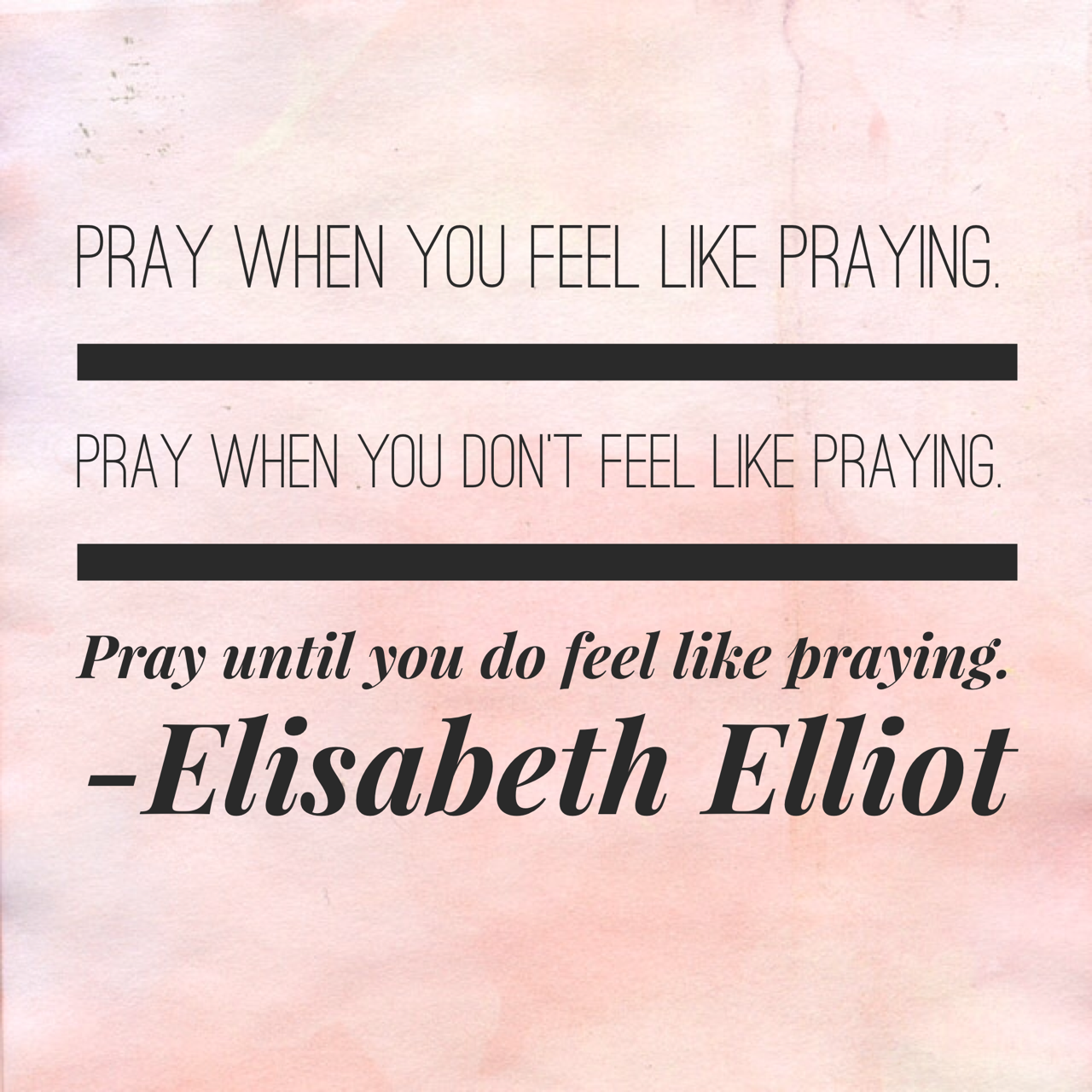
“Pray when you feel like praying. Pray when you don’t feel like praying. Pray until you do feel like praying.”

IMG_1392

From a chapter titled “God’s Curriculum” in  Keep a Quiet Heart:

An angry retort from someone may be just the occasion we need in which to learn not only longsuffering and forgiveness, but meekness and gentleness; fruits not born in us but borne only by the Spirit.

Too often I fail to learn that lesson and react in a fleshly manner instead of a spiritual one, so I am thankful for this reminder to seek the Spirit’s help in reacting in a right way.

I don’t know the source of this one, either:

A surrendered mind is not one which is no longer in operation. It is, rather, a mind freed from rebellion and opposition. To be Christ’s captive is to be perfectly free.

From Keep a Quiet Heart in a section on self-image:

If I’m so beautiful and lovable, what was Jesus doing up there, nailed to the cross and crowned with thorns? Why all that hideous suffering for the pure Son of God? Here’s why: There was no other way to deliver us from the hell of our own proud self-loving selves, no other way out of the bondage of self-pity and self-congratulation. How shall we take our stand beneath the cross of Jesus and continue to love the selves that put Him there? How can we survey the wondrous cross and at the same time feed our pride? No. It won’t work. Jesus put it simply: If you want to be My disciple, you must leave self behind, take up the cross, and follow Me.

Finally, this is from a chapter titled, “Nevertheless We Must Run Aground” in Love Has a Price Tag:

Heaven is not here, it’s There. If we were given all we wanted here, our hearts would settle for this world rather than the next. God is forever luring us up and away from this one, wooing us to Himself and His still invisible Kingdom, where we will certainly find what we so keenly long for.

Someone suggested that I share a list of Elisabeth’s books, so I will do that tomorrow, along with a video shown at her memorial service.

See all the posts in this series here.

_____________________________________________________

This is the last day to enter DaySpring.com’s contest for Write 31 Days readers. To enter to win a $500 DaySpring shopping spree, just click on this link & follow the giveaway widget instructions by October 30. Best wishes, and thanks for reading!

31 Days With Elisabeth Elliot: Devotional Time

Elisabeth Elliot2
These excerpts come from the chapter “The Song of the Animals” in Elisabeth’s book, On Asking God Why. The chapter title might seem odd one for talking about time with God, but it comes from one part where she talks about all creation praising God by doing what He created them to do. She also discusses her father’s example of rising early to spend time alone with God. One thing I love about this except is that she is so transparent, ordinary, and normal here.

Few people know what to do with solitude when it is forced upon them; even fewer arrange for solitude regularly. This is not to suggest that we should neglect meeting with other believers for prayer (Hebrews 10:25), but the foundation of our devotional life is our own private relationship with God…

Christians may (and ought to) pray anytime and anywhere, but we cannot well do without a special time and place to be alone with God. Most of us find that early morning is not an easy time to pray. I wonder if there is an easy time….

The Bible is God’s message to everybody. We deceive ourselves if we claim to want to hear his voice but neglect the primary channel through which it comes. We must read his Word. We must obey it. We must live it, which means rereading it throughout our lives…

We read that our Heavenly Father actually looks for people who will worship him in spirit and in reality. Imagine! God is looking for worshippers. Will he always have to go to a church to find them, or might there be one here and there in an ordinary house, kneeling alone by a chair, simply adoring him?…

When I stumble out of bed in the morning, put on a robe, and go into my study, words do not spring spontaneously to my lips–other than words like, “Lord, here I am again to talk to you. It’s cold. I’m not feeling terribly spiritual….” Who can go on and on like that morning after morning, and who can bear to listen to it day after day?

I need help in order to worship God. Nothing helps me more than the Psalms. Here we find human cries–of praise, adoration, anguish, complaint, petition. There is an immediacy, an authenticity, about those cries. They speak for me to God–that is, they say what I often want to say, but for which I cannot find words.

Surely the Holy Spirit preserved those Psalms in order that we might have paradigms of prayer and of our individual dealings with God. It is immensely comforting to find that even David, the great king, wailed about his loneliness, his enemies, his pains, his sorrows, and his fears. But then he turned from them to God in paeans of praise.

He found expression for praise far beyond my poor powers, so I use his and am lifted out of myself, up into heights of adoration, even though I’m still the same ordinary woman alone in the same little room.

Another source of assistance for me has been the great hymns of the Church, such as “Praise, My Soul, the King of Heaven,” “New Every Morning Is the Love,” “Great Is Thy Faithfulness,” “Glorious Things of Thee Are Spoken,” and ”O Worship the King.” The third stanza of that last one delights me. It must delight God when I sing it to him:

Thy bountiful care, what tongue can recite?
It breathes in the air, it shines in the light;
It streams from the hills, it descends to the plain,
And sweetly distills in the dew and the rain.

That’s praise. By putting into words things on earth for which we thank him, we are training ourselves to be ever more aware of such things as we live our lives. It is easy otherwise to be oblivious of the thousand evidences of his care. Have you thought of thanking God for light and air, because in them his care breathes and shines?

Hymns often combine praise and petition, which are appropriate for that time alone with God. The beautiful morning hymn “Awake, My Soul, and With the Sun” has these stanzas:

All praise to Thee, who safe hast kept,
And hast refreshed me while I slept.
Grant, Lord, when I from death shall wake,
I may of endless light partake.
Direct, control, suggest, this day,
All I design, or do, or say;
That all my powers, with all their might,
In Thy sole glory may unite.

Adoration should be followed by confession. Sometimes it happens that I can think of nothing that needs confessing. This is usually a sign that I’m not paying attention. I need to read the Bible. If I read it with prayer that the Holy Spirit will open my eyes to this need, I soon remember things done that ought not to have been done and things undone that ought to have been done.

Sometimes I follow confession of sin with confession of faith–that is, with a declaration of what I believe. Any one of the creeds helps here, or these simple words: “Christ has died; Christ is risen; Christ will come again. Lord, I believe; help my unbelief.”

Then comes intercession, the hardest work in the world–the giving of one’s self, time, strength, energy, and attention to the needs of others in a way that no one but God sees, no one but God will do anything about, and no one but God will ever reward you for.

Do you know what to pray for people whom you haven’t heard from in a long time? I don’t. So I often use the prayers of the New Testament, so all-encompassing, so directed toward things of true and eternal importance, such as Paul’s for the Christians in Ephesus: ”…I pray that you, rooted and founded in love yourselves, may be able to grasp…how wide and long and deep and high is the love of Christ” (Ephesians 3:17, 18). Or I use his prayer for the Colossians, “We pray that you will be strengthened from God’s boundless resources, so that you will find yourselves able to pass through any experience and endure it with joy” (Colossians 1:11)…

My own devotional life is very far from being Exhibit A of what it should be. I have tried, throughout most of my life, to maintain a quiet time with God, with many lapses and failures. Occasionally, but only occasionally, it is impossible. Our Heavenly Father knows all about those occasions. He understands perfectly why mothers with small children bring them along when they talk to him.

Nearly always it is possible for most of us, with effort and planning and the will to do his will, to set aside time for God alone. I am sure I have lost out spiritually when I have missed that time. And I can say with the psalmist, “I have found more joy along the path of thy instruction than in any kind of wealth” (Psalms 119:14).

IMG_0023

See all the posts in this series here.

_____________________________________________________

DaySpring.com is celebrating all of the amazing Write 31 Days readers who are supporting nearly 2,000 writers this October! To enter to win a $500 DaySpring shopping spree, just click on this link & follow the giveaway widget instructions by October 30. Best wishes, and thanks for reading!


Exceeding abundantly, but unseen

In one of those “one thought leads to another” progressions, a line in girltalk’s post this morning, “No Grace For Your Imagination,”  stood out to me: “But for today’s sufficient trouble there is God’s more-than-sufficient grace.” That reminded me of Ephesians 3:20: “Now unto him that is able to do exceeding abundantly above all that we ask or think, according to the power that worketh in us.” That, in turn, got me to thinking that we tend to associate “exceeding abundantly” as “big and dramatic,” but often the process of God’s working is barely perceptible. We also tend to associate it with material needs, and it can apply to those, but look at the prayer requests that proceeded this tribute to God:

For this cause I bow my knees unto the Father of our Lord Jesus Christ, Of whom the whole family in heaven and earth is named, That he would grant you, according to the riches of his glory, to be strengthened with might by his Spirit in the inner man; That Christ may dwell in your hearts by faith; that ye, being rooted and grounded in love, May be able to comprehend with all saints what is the breadth, and length, and depth, and height; And to know the love of Christ, which passeth knowledge, that ye might be filled with all the fulness of God. Now unto him that is able to do exceeding abundantly above all that we ask or think, according to the power that worketh in us,  Unto him be glory in the church by Christ Jesus throughout all ages, world without end. Amen.

This passage, along with Colossians 1:9-14 and Philippians 1:9-11, is one that I often pray for myself and my loved ones. The particular qualities mentioned are not only unseen and internal (though the results of them are seen), they’re also the kinds of things we don’t receive in a moment. They take time to grow and develop.So praying for them can often seem discouraging because we “don’t see anything happening.” Yet even in those, especially in those, we can trust God to work “exceeding abundantly.”

For years I had written Bible verses out at the bottom of my letters to my father. He never commented on them, so I just assumed he skipped over them, thinking, “There she goes again” while rolling his eyes. Yet he told the pastor who led him to the Lord that he had read them. My mother, as well, went from not wanting to hear about the things of the Lord to being very open to them at the end of her life. If I had asked her what caused the change or how it happened, she probably could not have told me. I’ve mentioned before a missionary who longed and prayed to be more loving, and turned from berating herself to instead meditating on God’s love for her, resulting in changes she wasn’t even aware of until people commented to her husband about the change in her. Many of us have experienced being given grace and strength for a trial that we didn’t “feel” so much at the time, but looking back, we wondered how we ever got through it and knew we could only have done so by God’s grace.

William Cowper says in his hymn, “God Moves in Mysterious Ways,”

Deep in unfathomable mines
Of never failing skill
He treasures up His bright designs
And works His sovereign will.

Even in the deepest recesses of hearts, we can trust Him to work “exceeding abundantly” to answer our requests and fulfill His will.

God-works-exceeding

Praying for the Lost Scripturally

Photo courtesy of pixgood.com

Photo courtesy of pixgood.com

My late pastor used to frequently emphasize that we not let our praying fall into “Christian cliches,” but that we pray Scripturally. That doesn’t mean we used prayers or phrases in the Bible as magic words or a magical formula, but by seeing examples in the Bible of how and what to pray, we can know we’re praying in line with God’s will.

One night at the beginning of a prayer meeting, he mentioned noticing that there didn’t seem to be many instances in the Bible of Christians praying for unbelievers to become believers, though there were examples of their praying for a number of other things. This wasn’t his message for the night or anything he studied out: if he were preparing a sermon he would have developed the thought more fully before mentioning it. It was more just a thought that had occurred that day that he was throwing out there. Of course it’s certainly not wrong to pray for unbelievers. Paul said in Romans 10:1, “Brethren, my heart’s desire and prayer to God for Israel is, that they might be saved.” But my pastor encouraged us to think of Scriptural ways to pray for them. This is something I am going to be watching for the next time I read through the New Testament, but here are a few thoughts along this line.

1. We can pray for God to send someone to tell them of Jesus. In Matthew 9:37-38, Jesus said, “The harvest is plentiful, but the workers are few. Therefore beseech the Lord of the harvest to send out workers into His harvest.” That was something I prayed for my mother often. She was not open to talking to me about her spiritual condition, we lived 1,000 miles apart, and she was not inclined to go to church, so I prayed God would send someone across her path, perhaps a coworker, who would be a good testimony to her. At her funeral, where my former pastor presented the gospel clearly, I heard a number of “Amens” behind me and was astonished at the number of people who evidently knew the Lord there. I don’t know exactly how they were able to share with my mom, but I was touched at how God had answered that frequent prayer.

2. We can pray for their hearts to be “good ground.” In what we call the parable of the sower in Matthew 13, Jesus talks about various people’s hearts as ground that the seed of the Word is dropped into. It doesn’t take root and grow in some because it’s snatched away, in others because their heart is stony, in others because thorns choke it out. But the one with “good ground is he that heareth the word, and understandeth it; which also beareth fruit.” Though we’re not specifically instructed to pray this way, I’ve prayed at times for hearts of lost loved ones to become good ground, for the stones to be removed, the bedrock underneath to be broken up, the thorns to be kept back, so that the seed of the Word can take root and bring forth fruit. I think God does that in some by bringing circumstances into their lives to soften them and by bringing them under the sound of the Word that they reject at first, but which gradually breaks down the stoniness. I think apologetics ministries are most helpful here: I’ve seen these types of ministries as well as creation-based ministries scorned a bit because they’re not the gospel.  Most, however, include the gospel and I think they help make way for the gospel.

3. We can pray for God to draw them to Himself. John 6:44 says, “No one can come to me unless the Father who sent me draws him. And I will raise him up on the last day.”

4. We can pray for the Word of God to have free course in their lives. 2 Thessalonians 3:1 says, “Finally, brethren, pray for us, that the word of the Lord may have free course, and be glorified, even as it is with you.” I love the term “free course” there – to me it conveys the idea of being unhindered.

I’ve also prayed that God would “open their eyes, so that they may turn from darkness to light and from the power of Satan to God, that they may receive forgiveness of sins and a place among those who are sanctified by faith in me” (Acts 26:18). Though in that passage that’s not part of a prayer, it’s what God says He will do through Paul, I don’t think it is too much of a stretch to ask God to do the same through others. I’ve also prayed that people would realize that whatever they’re trusting in is not dependable and will not satisfy in the long run, or that whatever is keeping them from salvation is not worth it: though I can’t think of an instance in the Bible where that kind of thing is recorded as a prayer, I don’t think those are unbiblical prayers: I think they’re in keeping with the tenor of Scripture.

What do you think? Are these valid ways of praying for unbelievers? Do you have Biblical ways you pray for them?

For this reason I bow my knees before the Father, from whom every family in heaven and on earth is named, that according to the riches of his glory he may grant you to be strengthened with power through his Spirit in your inner being, so that Christ may dwell in your hearts through faith—that you, being rooted and grounded in love, may have strength to comprehend with all the saints what is the breadth and length and height and depth, and to know the love of Christ that surpasses knowledge, that you may be filled with all the fullness of God.

Now to him who is able to do far more abundantly than all that we ask or think, according to the power at work within us, to him be glory in the church and in Christ Jesus throughout all generations, forever and ever. Amen.

Ephesians 3:14-21

Book Review: How I Know God Answers Prayer

How I Know God Answers PrayerI think I first read Rosalind Goforth’s first book, How I Know God Answers Prayer, maybe in my twenties, so about 30 years ago. I don’t remember how many times I have read it since. It is a testimony of how God has answered prayers both small and great in her life through the years, spurred by people’s occasional response that perhaps what seemed an answer to prayer was just a coincidence that would have happened anyway. She wanted to demonstrate through a lifetime of her walk with God that prayer is just a child of God asking her Father for what she needs, and seeing Him answer – not always just the way she originally wanted, but with love and wisdom nonetheless. Of her three books, including Goforth of China (a biography of her husband) and Climbing (a book she was asked to write concerning some of her own experiences and perspectives), Climbing is my favorite, but this book is very good as well.

Since I was reading it this time for Carrie’s  Reading to Know Classics Book Club, I tried to view it as others might who have not read it before.  For the first time I thought perhaps a little of the effect of what she relates might have been lost by the description of events taken out of context. For instance, when she writes near the end about finding “that the Lord could guide me even in trimming my hat to his glory,” some people might think, “What?” In Climbing, one of the difficulties she underwent was criticism of her dress when she would come home on furlough. There was no Internet, Facebook, or even Wal-Mart in those days to keep up with what was going on in the fashion world back home, and she had no idea what would be stylish or out of style or different from the last time she had been there. It is really ridiculous that people would criticize under such circumstances, but they do. Once when a lady offered to get new outfits for her when she was home, she was relieved, until the lady brought her garments entirely in black, which she evidently thought was appropriate for missionary ladies. Jonathan told her she looked like she was in mourning, but she felt she couldn’t refuse the gifts without causing offense. She didn’t necessarily want to be up-to-the minute in the latest styles (in fact, when Merry Widow hats were in style at one point, she thought they were ridiculous and tried to find a way not to wear them), but she didn’t want to be a distraction, either, as they visited churches and conferences. In that book she relates some of God’s leading and answers to prayer regarding that whole issue, represented here just by the sentences, “I found the Lord could guide me even in trimming my hat to his glory! That is, so that I could stand before an audience and not bring discredit to my Master.”

She mentions the anti-foreigner sentiments and some of the dangers involved, but I don’t know if readers will understand just how pervasive and dangerous it was. China was a very closed-off country then, and anything “foreign” was suspicious (one reason why Hudson Taylor advocated dressing like Chinese rather than British). She does mention here that one of the ways she and her husband tried to combat this was to hold “Open House” where they’d let their neighbors come in and tour the house so they could see there wasn’t anything dangerous about them. In one of her other books she writes that one of these times, someone saw her daughter’s dolls in her bed and spread the word that the Goforths kidnapped children and shrunk them. It seems ridiculous now that anyone would think that, but it was a very superstitious and suspicious time. Rumors like that could at the very least cause people to avoid them, and at the worst set off a powder keg of anger. Sudden mob violence was not uncommon, especially leading up to the time of the Boxer rebellion. I remember reading in another book (I forget whose) about a missionary having in her school a skeleton for educational purposes, and then trying to decide how best to dispose of it so people wouldn’t think they had killed someone. Trying to preach a gospel that the people were probably going to react negatively against at first in such a setting indeed required a lot of prayer and faith.

But even with some events taken somewhat out of context, she presents a testimony full of grace in how the Lord dealt with her. Some of the answers she relates were major –  a sudden breakthrough in her husband’s grasp of the language when he was discouraged and near giving up, found later to have happened right at the time that a group in his old college had met to pray for him, response in meetings found to have happened when others were praying (incidents that should remind and encourage us to pray for others), healing when all other help had been exhausted, protection from danger, especially in their escape during the Boxer rebellion. Of the last, she was asked why God spared them so miraculously but not others. She responded:

Truly a vital question, which could not lightly be set aside! Humbly and prayerfully we pondered this “Why” in the light of Scripture. In the twelfth chapter of Acts, we read of Herod’s succeeding in putting James to death by the sword, and directly after comes the story of how Herod was hindered in carrying out his intention to kill Peter who was delivered by a miracle. Then who could read that marvelous eleventh chapter of Hebrews with its record of glorious martyrdom and miraculous deliverances without being thrilled? In face of these and many other passages, while still unable to answer the “why,” we saw our Almighty God used His own prerogative to glorify His name whether in the glorious martyrdom of some or in the miraculous deliverance of other.

I referenced this a few months ago in a post on our pastor’s cancer, how God heals some but not others, for reasons only He knows.

Such big and dramatic answers to prayer can be thrilling, but what touched my heart even more were the smaller, “everyday” answers: a lost key found, provision for clothes, a gift of fresh fruit, the need for a telephone and a coat and help during a speaking engagement when she felt ill.

Some of the incidents were deeply personal, such as the time her husband wanted to go touring out among the people, and she said no at first, for the safety of the children (smallpox was rampant and the Chinese then had no thought of keeping sick people home). She had to learn that “‘the safest place’ for myself and the children ‘was the path of duty.'” Though several of her children died from other causes, none died during this time in their ministry once she yielded to the Lord about it. Another personal situation was finally understanding what it was to rest in the Lord and trust Him for salvation from the power of sin and not just the penalty of it, after feeling like she had been on something of a roller coaster spiritually for 40 years.

Something else I thought some people might have a problem with in reading her book were the times she mentioned prayer being hindered by a wrong attitude or bitterness on her part, or, in one instance, the fact that she felt God allowed something to bless her for responding in a right way. These days what we often hear is that God deals with us on the basis of His grace, not our “performance.” That is true. Yet there are instances in Scripture, even in the New Testament, of disobedience hindering. We’re told that some people are sick and some have died because of partaking of the Lord’s Supper in a wrong manner, that we should reconcile with our brother before offering a gift to God, that confession of sin is a part of praying for healing, that we can’t expect forgiveness if we don’t forgive. We’ll never be perfect, but we can’t expect the Lord’s blessing if we are hanging on to known sin. As to the other, does God ever do a special little something for us when we obey in some area or do the right thing? I don’t know – I can’t think of a Scripture reference that deals with that exactly in the New Testament. We tend to think, especially when reading the Old Testament, “Be good and God will bless me, mess up and He will come after me hard.” But even there Job experienced great calamity even though he was doing everything right, and the wicked seem to prosper even when they are not obedient. Ultimately everything that God allows comes from His wisdom, love, and grace. But I have felt at times, especially in my very early days as a Christian, that some blessing or answer to prayer came just after taking an important step in the right direction, not as a reward or as God patting me on the head for doing right, but just as a little encouragement from a Father to His child. Don’t we do the same for our children? When we see them struggle in an area and do the right thing, don’t we give them some kind of encouragement, even if it is just a smile or a nod or a thumbs up or a “Well done”? Of course, we need to do right even if no one seems to notice or care or no “blessing” comes in response. I don’t think this nullifies the fact that it all comes from God’s grace because we can only obey and make right decisions with His grace. (I’ve written earlier that grace does not nullify the need for obedience but rather enables it. See Of grace, law, commandments, rules, and effort and What grace does not mean). God blesses us far beyond our ability to obey as it is, and obedience should be an outgrowth of love and reverence for Him rather than a “work” to “earn” blessing. This is too involved a topic for this post, but I feel sure she isn’t advocating that prayer and obedience are like vending machines where we put in out part and then expect God to do His – not at all.

Since this is a testimony of answered prayer, naturally most of the anecdotes involve those answers. Yet she also shares some times when God didn’t answer, at least not in the way she prayed for. In one instance, years later she could see and was thankful for the fact that He hadn’t granted a particular request, one that would have changed the path of her life away from China. In other instances, like healing that did not come and the deaths of several of her children, she continued to trust even though she couldn’t understand.

I don’t think Rosalind shared any of these answers to prayer with the attitude, “Look at me and my wonderful answers to prayer. Aren’t I special?”  I think she would have been horrified that anyone would think that. I think rather, she just wanted to show forth His provision and willingness to take care of His dear children’s needs, like the psalmists, whose testimony was, “Hear what great things the Lord has done and how He delivered me.” Every Christian walking and talking with God would have a record like this whether written or not, though admittedly probably not with situations like being delivered from an angry mob on the list. But like the Ebenezers I mentioned a few weeks ago, we should all be able to look back on those times where God met with us, provided for us, and answered prayer for us in a way that only He could. It’s good to share things like this with our families, so they know God didn’t just meet people’s needs back in Bible times, but He still does today. Such things redound to His praise and encourage us in the Lord when “when I remember you upon my bed, and meditate on you in the watches of the night;  for you have been my help, and in the shadow of your wings I will sing for joy.  My soul clings to you; your right hand upholds me” (Psalm 63:5-8).

photo 3(2)

For the 31 Days writing challenge, I am sharing 31 Days of Inspirational Biography. You can find others in the series here.

Reading to Know - Book Club

(This will also be linked to Semicolon‘s Saturday Review of Books.)

“But if not…”

Since our pastor has been diagnosed with cancer and given only 6 months or so to live, he has had a couple of sessions of combined adult Sunday School classes in order to discuss with us some issues and some of his vision and burden for us. A couple of weeks ago he was feeling poorly enough not to be able to make it for Sunday School for one of these sessions. Our assistant pastors took that opportunity to share a bit of their perspective and then a few men prayed for the family. That time was greatly beneficial and therapeutic for me: outside of our own family and sharing of thoughts on blogs or Facebook with other members, I hadn’t really had a chance to partake of that kind of sharing and praying together. Though I’m sorry our pastor was feeling so sick that day, I think the time was very well spent.

Though those who prayed aloud mentioned varying aspects – the pastor’s physical needs, grace for his wife and family, his two daughters who were getting married in what was supposed to have been one of the best summers of their lives, direction for the youngest daughter scheduled for college in the fall, and many others – there was a recurring theme in several of them. They prayed for the miracle of healing (and it would take a true miracle) and promised to give God the glory for it, but, acknowledging that might not be God’s will, prayed for His grace for the family and our church.

I’ve known some who belittle the Christian faith to point to this kind of praying as a lack of faith, as providing an “out” if God doesn’t answer prayer the way we ask, or even a lack of evidence for God since we can explain away the lack of an answer with it’s not being God’s will. But that’s not why we pray that way. We have good Biblical precedent.

In Daniel 3, Shadrach, Meshach, and Abednego were threatened with being thrown in a fiery furnace if they did not bow down and worship the king’s golden image. They refused and replied, “Our God whom we serve is able to deliver us from the burning fiery furnace, and he will deliver us out of thine hand, O king.  But if not, be it known unto thee, O king, that we will not serve thy gods, nor worship the golden image which thou hast set up” (verses 17-18).

Jesus, in the garden of Gethsemane the night before He was crucified, prayed, “Father, if thou be willing, remove this cup from me: nevertheless not my will, but thine, be done” “Luke 22:42).

Someone once said, “Prayer is asking God to align you with His will rather than asking Him to be aligned with yours.”

Can God heal someone diagnosed with cancer and only months to live? Sure. Why doesn’t He do so every time we ask Him to? I don’t know.

In Goforth of China when Rosalind recounted their miraculous deliverance during the Boxer rebellion, she had been asked why God didn’t deliver all the missionaries in China at that time. Some were horribly murdered. She responded:

Truly a vital question, which could not lightly be set aside! Humbly and prayerfully we pondered this “Why” in the light of Scripture. In the twelfth chapter of Acts, we read of Herod’s succeeding in putting James to death by the sword, and directly after comes the story of how Herod was hindered in carrying out his intention to kill Peter who was delivered by a miracle. Then who could read that marvelous eleventh chapter of Hebrews with its record of glorious martyrdom and miraculous deliverances without being thrilled? In face of these and many other passages, while still unable to answer the “why” we saw our Almighty God used His own prerogative to glorify His name whether in the glorious martyrdom of some or in the miraculous deliverance of others (p. 129-130).

James was killed while Peter was delivered. Uriah was killed while David lived. Many Hebrew babies died while Moses was rescued. Not only was Moses answered “no” to his request to see the Promised Land, but God admonished him not to speak about it any more. Jesus escaped Herod while the rest of the children under 2 in Bethlehem were slaughtered. Many people were healed, but God answered Paul’s request for deliverance with a “No” and a promise of His grace instead. The people in the first part of Hebrews 11 experienced glorious deliverance: the people at the end experienced trials, mocking, imprisonment, stoning, being sawn asunder, homelessness, “being destitute, afflicted, tormented” – yet these were included with the rest as “having obtained a good report through faith” (verse 39) even though they weren’t delivered.

Sometimes there are reasons why prayer isn’t answered, or at least isn’t answered the way we’d like. God has many reasons for allowing suffering, but we can’t know all the reasons or see the big picture of what He is doing in the world or even in the life of any one person and his or her sphere of influence. But those who know Him can trust Him as a father. Even the best of fathers has to sometimes say “no.”

Why does God have to use such means to accomplish His purposes? Somewhere I read that Elisabeth Elliot wrote that, though she had heard many wonderful stories of how God used her husband Jim’s death in many people’s lives, that knowledge still didn’t really satisfy. Didn’t God save people and call them to His service through other means than someone’s death? Sure, all the time. Why was that required this time? She didn’t know, but she trusted that God had His reasons. In “Thy Calvary Still All Our Questions” in the book Rose From Brier, Any Carmichael wrestled with this:

This is a Why? of a different order from that of the little mosquito. It is immeasurable greater. It strikes at the root of things. Why is pain at all, and such pain? Why did God ask Satan the question which (apparently) suggested to the Evil One to deal so cruelly with an innocent man? Why do the innocent so often suffer? Such questions generally choose a time when we are in keen physical or mental suffering, and may (the questioner hopes will) forget our comfort. They seize us like fierce living things and claw at our very souls.

Between us and a sense of the pain of the world there is usually a gate, a kind of sluice gate. In our unsuffering hours it may be shut fast. Thank God, it is shut fast for tens of millions. But let severe pain come, and it is as though the torture in us touched a secret spring, and the door opens suddenly, and straight upon us pour the lava floods of the woe of a Creation that groans and travails together….

O Lord, why?

After considering several answers which did not really satisfy her, she wrote,

But, though, indeed, we know that pain nobly born strengthens the soul, knits hearts together, leads to unselfish sacrifice (and we could not spare from our lives the Christ of the Cross), yet, when the raw nerve in our own flesh is touched, we know, with a knowledge that penetrates to a place which these words cannot reach, that our question is not answered. It is only pushed farther back, for why should that be the way of strength, and why need hearts be knit together by such sharp knitting needles, and who would not willingly choose relief rather than the pity of the pitiful?

…What, then, is the answer? I do not know. I believe that it is one of the secret things of the Lord, which will not be opened to us till we see Him who endured the Cross, see the scars in His hands and feet and side, see Him, our Beloved, face to face. I believe that in that revelation of love, which is far past our understanding now, we shall “understand even as all along we have been understood.”

And till then? What does a child do whose mother or father allows something to be done which it cannot understand? There is only one way of peace. It is the child’s way. The loving child trusts.

I believe that we who know our God, and have proved Him good past telling, will find rest there. The faith of the child rests on the character it knows. So may ours, so shall ours. Our Father does not explain, nor does He assure us as we long to be assured… But we know our Father. We know His character. Somehow, somewhere, the wrong must be put right; how we do not know, only we know that, because He is what He is, anything else is inconceivable. For the word sent to the man whose soul was among lions and who was soon to be done to death, unsuccored, though the Lord of Daniel was so near, is fathomless: “And blessed is he whosoever shall not be offended in me.”

There is only one place we can receive, not an answer to our questions, but peace — that place is Calvary. An hour at the foot of the Cross steadies the soul as nothing else can. “O Christ beloved, Thy Calvary stills all our questions.” Love that loves like that can be trusted about this.

There are many strong and positive verses about prayer that we can rely on, yet we have to include “if it be Thy will” and trust that even if God doesn’t heal or deliver or provide like we wanted Him to, He is still good and wise and accomplishing His purpose.

God is doing good things in our own church and across the country through our pastor’s situation. One of our church members has shared some of those things. If you feel led, I’m sure all involved would appreciate your prayers. In addition, some are attempting to help raise funds for the family’s needs through https://www.idoitfor.org/Tom/.

tom