Review: Be Hopeful (1 Peter): How to Make the Best of Times Out of Your Worst of Times

Be Hopeful: Commentary on 1 Peter by Warren Wiersbe

The book of 1 Peter was written to the “elect exiles of the Dispersion in Pontus, Galatia, Cappadocia, Asia, and Bithynia” by Jesus’ disciple, Peter. Warren Wiersbe shares his commentary on 1 Peter in Be Hopeful (1 Peter): How to Make the Best of Times Out of Your Worst of Times.

The folks Peter wrote to were suffering. “At least fifteen times in this letter, Peter referred to suffering, and he used eight different Greek words to do so” (p. 22, Kindle version).

Some of these Christians were suffering because they were living godly lives and doing what was good and right (1 Peter 2: 19–23; 3: 14–18; 4: 1–4, 15–19). Others were suffering reproach for the name of Christ (1 Peter 4: 14) and being railed at by unsaved people (1 Peter 3: 9–10). Peter wrote to encourage them to be good witnesses to their persecutors, and to remember that their suffering would lead to glory (1 Peter 1: 6–7; 4: 13–14; 5: 10). But Peter had another purpose in mind. He knew that a “fiery trial” was about to begin—official persecution from the Roman Empire (1 Peter 4: 12) (p. 22).

Peter wanted to encourage these believers in their faith. “We have noted that the theme of suffering runs throughout the letter, but so also does the theme of glory (see 1 Peter 1: 7–8, 11, 21; 2: 12; 4: 11–16; 5: 1, 4, 10–11)” (p. 24).

Wiersbe notes that the word “grace” appears in every chapter of 1 Peter.

Grace is God’s generous favor to undeserving sinners and needy saints. When we depend on God’s grace, we can endure suffering and turn trials into triumphs. It is grace alone that saves us (Eph. 2: 8–10). God’s grace can give us strength in times of trial (2 Cor. 12: 1–10). Grace enables us to serve God in spite of difficulties (1 Cor. 15: 9–10). Whatever begins with God’s grace will always lead to glory (Ps. 84: 11; 1 Peter 5: 10) (p. 24).

Peter reminds his readers that they were “born again to a living hope through the resurrection of Jesus Christ from the dead” (1 Peter 1:3), and they have “an inheritance that is imperishable, undefiled, and unfading, kept in heaven for you” (verse 4). The “the tested genuineness” of their faith was “more precious than gold” and would “result in praise and glory and honor at the revelation of Jesus Christ” (verse 7).

He reminds them of their call to holiness and of the example of Christ in His suffering and submission.

He tells them not to be “be surprised at the fiery trial when it comes upon you to test you, as though something strange were happening to you. But rejoice insofar as you share Christ’s sufferings, that you may also rejoice and be glad when his glory is revealed” (4:12-13). “Therefore let those who suffer according to God’s will entrust their souls to a faithful Creator while doing good” (4:19).

Along the way, Peter has instructions to servants, husbands, wives, and shepherds—shepherds of God’s flock, His people. He reminds the flock that they need to be submissive to authority and each other.

Clothe yourselves, all of you, with humility toward one another, for “God opposes the proud but gives grace to the humble.” Humble yourselves, therefore, under the mighty hand of God so that at the proper time he may exalt you, casting all your anxieties on him, because he cares for you (1 Peter 5:5-7).

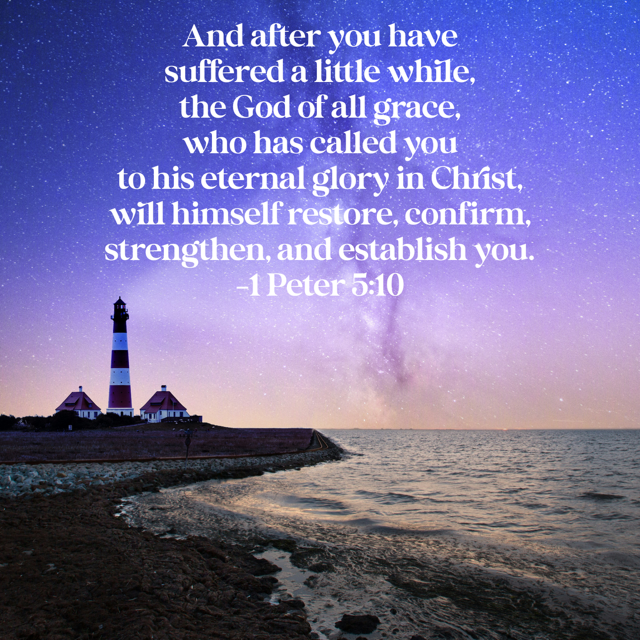
And, in one of my favorite verses in the book, Peter says, “And after you have suffered a little while, the God of all grace, who has called you to his eternal glory in Christ, will himself restore, confirm, strengthen, and establish you” (5:10).

More of Wiersbe’s comments:

Trials produce what he called “heaviness.” The word means “to experience grief or pain.” It is used to describe our Lord in Gethsemane (Matt. 26: 37) and the sorrow of saints at the death of loved ones (1 Thess. 4: 13). To deny that our trials are painful is to make them even worse. Christians must accept the fact that there are difficult experiences in life and not put on a brave front just to appear “more spiritual” (p. 34).

When God permits His children to go through the furnace, He keeps His eye on the clock and His hand on the thermostat (p. 34, emphasis mine).

How can we grow in faith during times of testing and suffering? The same way we grow in faith when things seem to be going well: by feeding on the Word of God (Rom. 10: 17). Our fellowship with Christ through His Word not only strengthens our faith, but it also deepens our love. It is a basic principle of Christian living that we spend much time in the Word when God is testing us and Satan is tempting us (p. 36).

We do not study the Bible just to get to know the Bible. We study the Bible that we might get to know God better. Too many earnest Bible students are content with outlines and explanations, and do not really get to know God. It is good to know the Word of God, but this should help us better know the God of the Word (p. 48).

What does it mean to “sanctify Christ as Lord” in our hearts? It means to turn everything over to Him, and to live only to please Him and glorify Him. It means to fear displeasing Him rather than fear what men might do to us. How wonderfully this approach simplifies our lives! It is Matthew 6: 33 and Romans 12: 1–2 combined into a daily attitude of faith that obeys God’s Word in spite of consequences. It means being satisfied with nothing less than the will of God in our lives (John 4: 31–34) (p. 97).

Christ is with us in the furnace of persecution (Isa. 41: 10; 43: 2). When the three Hebrew children were cast into the fiery furnace, they discovered they were not alone (Dan. 3: 23–25). The Lord was with Paul in all of his trials (Acts 23: 11; 27: 21–25; 2 Tim. 4: 9–18), and He promises to be with us “to the end of the age” (Matt. 28: 20 NASB). In fact, when sinners persecute us, they are really persecuting Jesus Christ (Acts 9: 4) (p. 132).

In my current trek through the Bible, going back and forth between OT and NT books, I would normally be in Thessalonians next. But our pastor is going through 1 Peter on Sunday mornings, so I thought it might be beneficial to study through that book during this time. It has been!

Wiersbe’s ” Be” books are about the same length. So a book like Isaiah, which has 66 chapters, would be discussed in much less detail. 1 Peter only has five chapters, so each chapter of Wiersbe’s only covered a few verses. Most of the epistles are so packed, it’s good to slow down through them.

All of God’s Word is good, important, needful, and helpful all the time, but I think 1 Peter will be especially applicable to us in the postchristian era of our country and in the days ahead.

“All Sunshine Makes a Desert”

"All sunshine makes a desert."

Rain can be awfully inconvenient.

Outdoor activities planned months in advance can be ruined, or at least need to be rearranged, when an unforeseen rainstorm blows in. Grocery shopping becomes a big mess when we have to cart our bags in and out in the rain. Rain makes roads slick, creating driving hazards.

Rain can also be gloomy when we haven’t seen the sun for days.

One of my worst rain experiences came when I was driving home alone. The rain fell so heavily, my windshield wipers couldn’t keep up. I literally could not see anything around me except the faint glow of other headlights. I somehow made it to the parking lot of a convenience store and waited til the showers abated, hoping no one would run into me.

And then there are thunderstorms with the potential to down power lines, send limbs crashing from trees, or strike lightning.

Yet, we need rain.

Rain softens the ground, making it easier to plant seeds. Then those seeds transform into flowers or food with more rain and sunshine.

Rain relieves the scorching heat of summer.

Rain provides water to drink and replenishes water tables for future needs.

Rain washed impurities out of the air.

F. B. Meyer wrote:

We all love the sunshine, but the Arabs have a proverb that ‘all sunshine makes the desert’; and it is a matter for common observation that the graces of Christian living are more often apparent in the case of those who have passed through great tribulation. God desires to get as rich crops as possible from the soil of our natures. There are certain plants of the Christian life, such as meekness, gentleness, kindness, humility, which cannot come to perfection if the sun of prosperity always shines. (1)

That’s true, isn’t it?

Just as I don’t like rain to interrupt my plans or make my tasks harder, I don’t like when trials and problems come up. They’re hard, painful, and sometimes costly. They take time and thought and energy from things I’d rather do.

But they have a good purpose.

When life is going well, we can get complacent. People who get everything they want and have everything just the way they like it sometimes start to feel entitled.

Though we know we need God’s grace and help in every circumstance, we feel our need of Him more during trials.

Trials soften us by humbling us. They show us our lack of strength and our need for His. They help us depend on Him more.

Trials help us grow. “We rejoice in our sufferings, knowing that suffering produces endurance, and endurance produces character, and character produces hope, and hope does not put us to shame, because God’s love has been poured into our hearts through the Holy Spirit who has been given to us” (Romans 5:3-5).

Trials help us to be grateful for what we have.

Trials can help wash impurities out as we search our hearts and confess wrong thoughts, deeds, and attitudes to God. Trials don’t always come because of sin, but when they do, they have a cleansing effect.

Trials point us to those unseen resources I mentioned last week. Hidden water tables of grace sustain us during dry periods.

God’s Word refreshes us with His promises:

And I will make them and the places all around my hill a blessing, and I will send down the showers in their season; they shall be showers of blessing (Ezekiel 34:26).

Sow for yourselves righteousness; reap steadfast love; break up your fallow ground, for it is the time to seek the Lord, that he may come and rain righteousness upon you (Hosea 10:12).

Let us know; let us press on to know the Lord; his going out is sure as the dawn; he will come to us as the showers, as the spring rains that water the earth (Hosea 6:3).

He did good by giving you rains from heaven and fruitful seasons, satisfying your hearts with food and gladness (Acts 14:17b).

One of my favorite childhood memories involves rain. My mom let us put on our bathing suits to go outside and play in a mild rain shower. I don’t know what time of year it was, but it had to have been during warm enough weather to get wet outside. Perhaps the rain was cooling on a hot summer’s day.

There was no thought of mess or inconvenience or disrupted plans. Instead, there was pure joy at the opportunity to do something so different and refreshing.

I can’t honestly say I dance for joy when trials come. But I am trying to learn to “Count it all joy, my brothers, when you meet trials of various kinds, for you know that the testing of your faith produces steadfastness. And let steadfastness have its full effect, that you may be perfect and complete, lacking in nothing (James 3:2-4). God has good purposes in trials and sends them in love and faithfulness.

Rain can be inconvenient, but also refreshing. All sunshine, as the saying goes, makes a desert. God keeps us from desert hardness and barrenness by sending trials our way. As William Cowper says in his hymn, “God Moves in a Mysterious Way“:

Ye fearful saints, fresh courage take;
the clouds ye so much dread
are big with mercy and shall break
in blessings on your head.

Hosea 6:3

(I often link up with some of these bloggers.)

________

(1) This quote comes from Our Daily Homily by F. B. Meyer. I’ve not read this book, but I have seen the quote in Warren Wiersbe’s book Be Satisfied as well as other places.

Life Doesn’t Always Turn Out Like We Thought It Would

Life doesn't always turn out like we thought it would.

Several years ago, two individuals from my college who were known for their close walk with the Lord found each other and began to date. They married and attended a local church, the same one we came to later, while the husband finished his graduate degree. He became an elder. The wife was active in the ladies ministry and teaching children. They had a couple of children.

After several years, they left to go to the mission field. There never seemed a family more perfect for missionary work.

After a few years, our pastor went to visit them on the field. He had nothing but positive things to say. He reported that the wife, in particular, seemed in her element.

A few years later, though, we received devastating news. The husband had been caught in infidelity. The family came home, and the elders met with the husband. He refused to repent, saying he loved his sin too much.

The wife was crushed. Not only had her husband turned into someone she didn’t know any more, but she lost the ministry she loved and was so suited for. Plus their coworkers back on the mission field had to pick up the pieces and minister to the people who were shattered by the fall of their leader.

I don’t know if the wife asked herself these questions, but in her place, I would have wondered if I made a mistake somewhere along the way. Had I married the wrong man? Had I missed signs that he had fallen away from the Lord? Had I failed him in some way that caused him to turn to someone else?

I do know that the pastor encouraged her that the situation was not her fault. Not that she was sinless, of course. No one is. But her husband’s sins were his own and he bore the responsibility of them. She was in the center of God’s will even with such things going on in her life.

It’s a shock that you can do everything “right,” so to speak, and end up with a life seemingly in shambles.

I imagine Joseph must have felt the same way, going from the favored son to being sold as a slave by his own brothers and then thrown into an Egyptian prison.

Or Job, described by the Lord as an upright man, yet he lost everything he owned as well as ten children all in one day.

Or John the Baptist. He was the forerunner of the Messiah, preparing the way for Jesus, pointing people to Him. Yet he ended up in prison, and ultimately was beheaded.

The Apostle Paul enjoyed a little over twenty years of public ministry. He took three long missionary trips, shared the gospel with who knows how many people, instructed and encouraged believers, and wrote several epistles which were incorporated into the canon of Scripture.

To be sure, life wasn’t all rosy. Paul experienced beatings, stonings, shipwrecks, sleeplessness, hunger, and more (2 Corinthians 23-28). But overall, his life could be considered a success in terms of being able to minister to large numbers of people.

But then Paul got arrested. He had not done anything wrong, but others supposed he had, and the resulting riot ended with Paul being taken into custody.

Paul was imprisoned for two years, released for a couple, then imprisoned again for a couple of years until he was beheaded.

Paul went from a leading apostle and well-known traveling preacher to a prisoner for many of his last years.

To the world, it might look like Paul’s life ended in failure.

But God encouraged Paul all through the book of Acts that he was on the right path.

And Paul’s ministry didn’t end just because he was in prison.

In the course of explaining why he was imprisoned, Paul was able to share his testimony before Felix, the governor of Judea, Festus, the governor who replaced Felix, and King Agrippa—all people he would not have been able to talk to under normal circumstances.

Paul wrote Ephesians, Philippians, Colossians, and Philemon during his first imprisonment and 2 Timothy during his second. Philippians is one of the most joyful books in the Bible, and Philippians and Colossians both have an emphasis on Thanksgiving—though they were written from prison.

Paul was chained to a Roman guard while imprisoned, so the guards heard all he had to say to his visitors. Paul tells the Philippians, “All the saints greet you, especially those of Caesar’s household” (Philippians 4:22). So evidently the gospel had filtered even into Caesar’s staff from Paul’s witness.

Friends were able to come talk with Paul and be taught or encouraged by him. Acts ends by telling us Paul “welcomed all who came to him, proclaiming the kingdom of God and teaching about the Lord Jesus Christ with all boldness and without hindrance” (Acts 28:30-31).

“Without hindrance.”

In 2 Timothy 2:9, Paul says, “I am suffering, bound with chains as a criminal. But the word of God is not bound!” Though Paul was bound, the word of God was not.

God can redeem and work in and through a life in shambles.

It was Paul who wrote of God’s strength in our weakness: “But he said to me, ‘My grace is sufficient for you, for my power is made perfect in weakness.’ Therefore I will boast all the more gladly of my weaknesses, so that the power of Christ may rest upon me. For the sake of Christ, then, I am content with weaknesses, insults, hardships, persecutions, and calamities. For when I am weak, then I am strong” (2 Corinthians 12:9-10).

And what God can do in our lives through suffering: “Not only that, but we rejoice in our sufferings, knowing that suffering produces endurance, and endurance produces character, and character produces hope, and hope does not put us to shame, because God’s love has been poured into our hearts through the Holy Spirit who has been given to us” (Romans 5:3-5).

And the glory that waits us after suffering: “So we do not lose heart. Though our outer self is wasting away, our inner self is being renewed day by day. For this light momentary affliction is preparing for us an eternal weight of glory beyond all comparison, as we look not to the things that are seen but to the things that are unseen. For the things that are seen are transient, but the things that are unseen are eternal” (2 Corinthians 4:16-18).

Others in the Bible found the same grace to endure.

Joseph was released from prison and became second to Pharaoh, eventually saving his own family, the future nation of Israel, from starvation.

Job’s fortune, family, and health were all restored to him, but most important of all, he encountered God in a way he never had before.

John was not spared in this life, but there was a place prepared for him in heaven.

The wife I mentioned at the beginning found God’s grace to sustain while she did the best she could in difficult circumstances.

We tend to equate spiritual success and God’s blessings with smooth sailing and positive circumstances. Saints through the ages have not found this to be the case. In fact, some whose lives seem to shine brightest for the Lord have experienced great trials—maybe because they have to seek the Lord and His strength to navigate their circumstances.

Meanwhile, God’s Word encourages us to “Rejoice in hope, be patient in tribulation, be constant in prayer” (Romans 12:12) because “after you have suffered a little while, the God of all grace, who has called you to his eternal glory in Christ, will himself restore, confirm, strengthen, and establish you” (1 Peter 5:10).

1 Peter 5:10

(I often link up with some of these bloggers.)

But I Did Everything Right

Why do things go wrong when I did everything right?

In my early Christian life, I’d get frustrated when problems crept up while I was attempting to do something for the Lord. Even getting to church Sunday morning could be a battlefield as breakfast burned, one child couldn’t find a shoe, another was bereft over his lost Bible, and the baby had a blowout diaper just before time to leave.

I’ve known people who were actively serving the Lord ministering to others when disaster struck: a serious accident, a cancer diagnosis, a child’s death. We might wonder why God allowed this to happen when these people seemed to be doing everything right.

Of course, we know we don’t really do everything right. We fight sin every day. Our motives aren’t always pure. Jesus said the greatest commandment is to love God with all our heart, soul, mind and strength—so the biggest sin would be failing to keep that commandment. And we all fail to do that daily.

But God, as a loving Father, chastens His children when they do wrong, cleanses them when they confess their sins to Him (1 John 1:9), and blesses obedience. Anything we receive from Him is due to His grace, not our “earning” His favor.

Most of us realize the “prosperity gospel” is wrong—the belief that if you obey God, especially in giving big offerings to their evangelists, you’ll be blessed with health, wealth, and prosperity.

But we unwittingly buy into a version of the same thought: if I am doing God’s will, then everything should work out. We don’t expect wealth or perfect health, but we feel there shouldn’t be any obstacles and God should bless us.

Job’s friends displayed the corollary of this idea. Since Job was suffering so severely, they reasoned Job must have done something really awful to deserve it. Much of their council tried to convince him to fess up to whatever he’d done wrong.

In Be Loyal (Matthew): Following the King of Kings, Warren Wiersbe wrote, “Many Christians have the mistaken idea that obedience to God’s will produces ‘smooth sailing.’ But this is not true. ‘In the world ye shall have tribulation,’ Jesus promised (John 16: 33).”

Trying circumstances aren’t always a sign that God is displeased with us.

How do we know this?

We see several Biblical people besides Job who suffered through no fault of their own: Daniel, Joseph, Paul, even Jesus.

Things might go wrong for any number of reasons.

We live in a world that’s been fallen since Genesis 3. That’s one reason Jesus said, “Do not lay up for yourselves treasures on earth, where moth and rust destroy and where thieves break in and steal, but lay up for yourselves treasures in heaven, where neither moth nor rust destroys and where thieves do not break in and steal (Matthew 6:19-20). Tires go flat, metal rusts, moths and termites and mold destroy.

We also have an active enemy who tries to trip us up. Satan will attempt to put obstacles in our way or damage our testimony when we get frustrated.

God allows suffering to produce something in us. “We rejoice in our sufferings, knowing that suffering produces endurance, and endurance produces character, and character produces hope, and hope does not put us to shame, because God’s love has been poured into our hearts through the Holy Spirit who has been given to us” (Romans 5:3-5). Suffering refines us, purifies us, increases our steadfastness, prunes us to produce more growth.

Some suffering is not for our sake, but for others. Jesus said one man was born blind not because he or his parents had sinned, “but that the works of God might be displayed in him” (John 9:3). Peter wrote “ In this you rejoice, though now for a little while, if necessary, you have been grieved by various trials, so that the tested genuineness of your faith—more precious than gold that perishes though it is tested by fire—may be found to result in praise and glory and honor at the revelation of Jesus Christ. (1 Peter 1:6-7). After Jesus told the disciples that He must go away soon, He said, “I do as the Father has commanded me, so that the world may know that I love the Father” (John 14:31).

Think of how Elisabeth Elliot and Joni Eareckson Tada and others have glorified God and helped multitudes through their trials.

Elisabeth Elliot wrote in Keep a Quiet Heart:

The disciples’ worst fears were about to be realized, yet He commanded (yes, commanded) them to be at peace. All would be well, all manner of things would be well–in the end. In a short time, however, the Prince of this world, Satan himself, was to be permitted to have his way. Not that Satan had any rights over Jesus. Far from it. Nor has he “rights” over any of God’s children… But Satan is permitted to approach. He challenges God, we know from the Book of Job, as to the validity of His children’s faith.

God allows him to make a test case from time to time. It had to be proved to Satan, in Job’s case, that there is such a thing as obedient faith which does not depend on receiving only benefits. Jesus had to show the world that He loved the Father and would, no matter what happened, do exactly what He said. The servant is not greater than his Lord. When we cry “Why, Lord?” we should ask instead, “Why not, Lord? Shall I not follow my Master in suffering as in everything else?”

Does our faith depend on having every prayer answered as we think it should be answered, or does it rest rather on the character of a sovereign Lord? We can’t really tell, can we, until we’re in real trouble (emphasis mine).

The Warren Wiersbe quote I referred to above doesn’t stop with Jesus’ promise that we’ll face tribulation. Dr. Wiesrbe goes on to say, “When we find ourselves in the storm because we have obeyed the Lord, we must remember that He brought us here and He can care for us.”

Asaph wrote in Psalm 73 that he was so confused and upset over the fact that the wicked seemed to prosper while the righteous suffered, it seemed like his attempts to do right were in vain (verse 13). “But when I thought how to understand this, it seemed to me a wearisome task, until I went into the sanctuary of God; then I discerned their end” (verses16-17). God will deal with them in His own time. Meanwhile, “The Lord is not slow to fulfill his promise as some count slowness, but is patient toward you, not wishing that any should perish, but that all should reach repentance” (2 Peter 3:9). God has “no pleasure in the death of the wicked, but that the wicked turn from his way and live” (Ezekiel 33:11).

God’s reckonings don’t all occur in this life. We’re not in heaven yet. Whatever we suffer here, whether minor irritations and obstacles or major disasters, God has promised to be with us and help us. And then, when He takes us up to be with Him, our troubles will seem light compared to “the eternal weight of glory beyond all comparison” that He is preparing for us (2 Corinthians 4:16-18).

The middle stanzas of William Cowper’s poem, “God Moves in a Mysterious Way,” bring out these truths:

Ye fearful saints, fresh courage take,
The clouds ye so much dread
Are big with mercy, and shall break
In blessings on your head.
 
Judge not the Lord by feeble sense,
But trust him for his grace;
Behind a frowning providence
He hides a smiling face.
 
His purposes will ripen fast,
Unfolding ev’ry hour;
The bud may have a bitter taste,
But sweet will be the flow’r.

When things go wrong even when, especially when we think we’re on the right track, God knows, God is with us, and He will give grace and help to deal with the situation.

In the world you will have tribulation. But take heart; I have overcome the world. John 16:33

(I often link up with some of these bloggers.)

Laudable Linkage

Laudable linkage

Here are some of the good reads found this week:

Jesus Said More About Hell Than Anyone in the Bible, HT to Challies. “What a wonderful thing it is that Jesus warns us. He does not leave us ignorant of the wrath to come. He not only warns. He rescues. This is the best effect of fear: it wakens us to our need for help and points us to the all-sufficient Redeemer, Jesus. Let it have this effect on you.”

Truth to Cling to When Nothing Makes Sense, HT to Challies. “Though there have been many precious years of walking with my Savior, the past several years has shaken my confidence as the road has continued to be dark, long, and painful. Though God has been faithful in so many ways (far more than we can probably see) I have been increasingly perplexed and unsettled by his ways.”

What’s the Temperature of Your Love Relationship with the Lord? “Whether you’re teaching, planning events, cleaning the church, or filling your days with service to your family, your love for what you do and for the people you are serving is an overflow of your love for God. In protecting and preserving that vertical relationship, there’s no substitute for time spent in his presence, soaking in the truth of his Word.”

Don’t Think About Elephants! HT to Challies. “There is more to the answer than saying, ‘don’t be anxious’. That doesn’t work; we then become anxious about whether we are doing a good job of not being anxious! Let me prove it to you. I want you to not think about elephants. Whatever you do, I don’t want the thought of an elephant to enter your mind. Don’t think about their size or their ears or their trunks. How are you going? What are you thinking about right now? I think I can guess!”

7 Meaningful Ways and Reasons to Be Kind to Yourself. We can beat ourselves up unmercifully when we make mistakes, but that’s destructive. Jeanne shares better ways to respond.

On Short-Term Missions, Part 4: Semper Gumby. “When you’re ministering cross-culturally, you’re dealing with people who are different from you all day long. They think differently, they do things differently; they’re offended by different things, they laugh at different things. In that kind of environment, it’s possible for you to be highly offensive, even with the best of intentions. So you need to adjust your thinking.” This is good advice even in business or other situations where we interact with people from another culture.

Greet with a Holy Kiss? Applying an Uncomfortable Command, HT to Challies. Some good ways to think about and apply the passages referring to a “holy kiss.”

The Blessings of Boredom. “Anytime we feel the slightest hint of boredom, we look for the closest novelty to alleviate that feeling. That usually means grabbing our phones, checking social media, playing a game, reading the news, or otherwise finding something to occupy our minds. The result, however, is that we find ourselves dashing from room to hallway, room to hallway, never fully pacifying that feeling of boredom and never very much enjoying the distraction either. The sad thing is that this is a form of self-sabotage.”

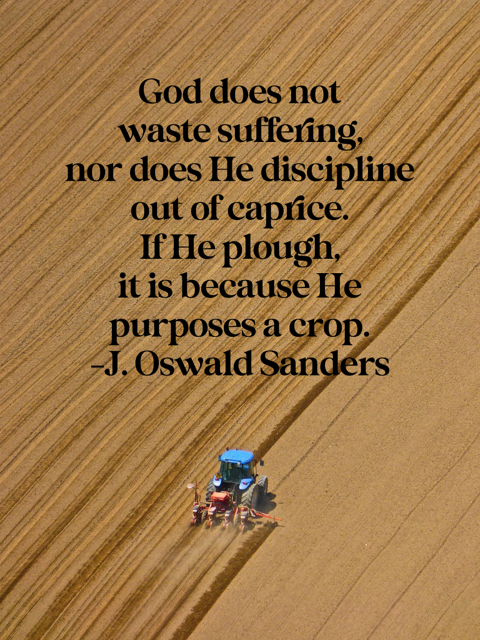
God does not waste suffering, nor does He discipline out of
caprice. If He plough, it is because He purposes a crop. -- J. Oswald Sanders

God does not waste suffering, nor does He discipline out of caprice.
If He plough, it is because He purposes a crop. — J. Oswald Sande
rs

Laudable Linkage

Here are some of the posts that especially resonated with me this week:

If God Would Outsource His Sovereignty. “I want you to imagine that, at least for a time, the Lord would see fit to involve us in selecting the providences we would receive from his hand. I want you to imagine that through one of his deputies—an angel perhaps—he would approach us to ask how we would prefer to serve him.”

Struggling with the Struggle. “The main feeling that is overwhelming me right now is guilt. After all, shouldn’t I be overjoyed that God is teaching me intense lessons right now? And then I judge myself harshly for thinking that hard times are actually hard and not much fun.”

There Is Something Better Than Never Suffering, HT to Challies. “To suffer, with Christ, is a vastly superior to a life of comfort without him. And if he has saved you through his death, manifesting all his divine power in his own human weakness unto death, do you not think he can be your power in your suffering?”

It All Holds True, HT to Challies. “We want to shield our kids from pain. We want them to learn perseverance and endurance and real, personal faith without having to go through anything hard. That’s not quite how it works in the Christian life. Perseverance is cultivated in adversity.”

He Is Not an It: Understanding the Person of the Holy Spirit. “The Holy Spirit is not a force, feeling, or phenomenon. He is not a ghost or an “it.” He is a Person that we should know and love.”

On Being the Main Character in Your Own Sermon. I can identify with this, even though I am not a preacher. “I pray for the humility to go unseen, unacknowledged, and unremembered, so long as Christ is seen, acknowledged, and remembered. In fact, I pray that Christ would be so present and so visible that people would fail to think of me at all.”

Where Do You Get That From the Text? HT to Knowable Word. “This matters because not every comment in every bible study is of equal worth. Not every application of scripture is a valid application of scripture.”

Why Read If You Forget Most Everything Anyway? HT to Challies. “If you can’t remember most of what you read, why even bother? Aren’t there better ways to use your time?”

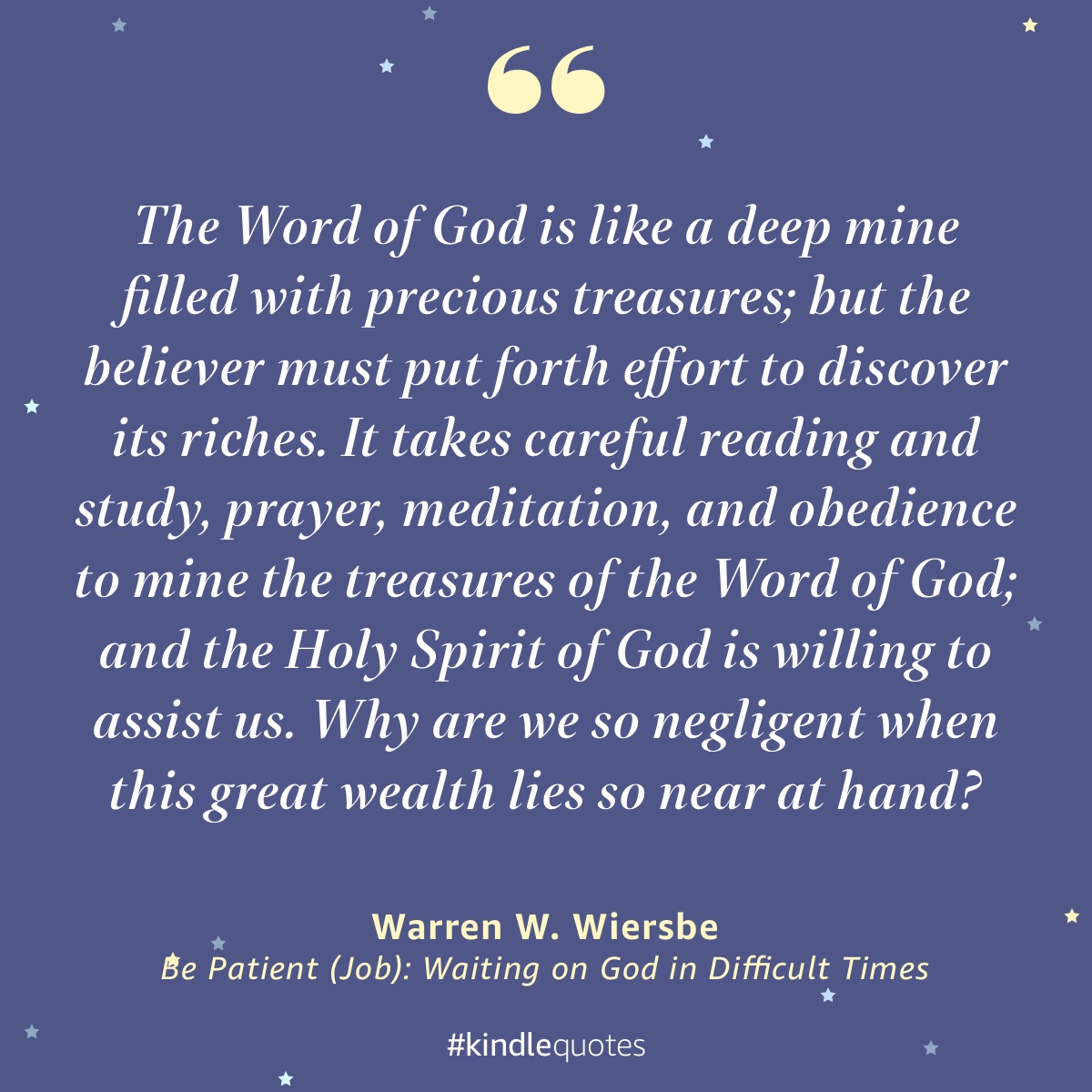
God's Word is a treasure

Be Patient: Waiting on God in Difficult Times

Job is not an easy book to read. The first two chapters and the last one aren’t bad, but all that bickering between Job and his friends in the middle is hard to follow. But taking it a section at a time with my ESV Study Bible and Be Patient (Job): Waiting on God In Difficult Times by Warren W. Wiersbe helped.

Job’s suffering was extreme. He lost all of his wealth and his ten children in one day. Then he lost his health. The person closest to him, his wife, was not much support (but then, she was grieving, too). Job’s friends came and sat with him in his grief for a whole week. They were better friends to him then than when they opened their mouths. They all wondered the same thing: Job, what in the world did you do to bring such suffering on yourself? God blesses the righteous and punishes the wicked, right? So you must have really done a number to warrant all this.

Job tried to point out, several times, that the wicked aren’t always punished–at least not in the time or way we would think. Therefore the opposite is true: people who do right sometimes suffer for no apparent reason.

God had said in the beginning that Job was an upright man. He didn’t allow Satan to torment Job for punishment. Rather, Satan had accused that Job only followed God because God had blessed him. Basically, he said God bought Job’s allegiance by all He had blessed him with. Take away all that, and “he will curse you to your face.”

Job never cursed God. He maintained his integrity and faith. Yet at times, knowing he was in the right caused him to question whether God was doing right in His treatment of His faithful servant.

In the end, God set straight the three friends plus Job.

Here are some of the insights Dr. Wiersbe offered:

In times of severe testing, our first question must not be, “How can I get out of this?” but “What can I get out of this?” (p. 24).

The problem with arguing from observation is that our observations are severely limited. Furthermore, we can’t see the human heart as God can and determine who is righteous in His sight. Some sinners suffer judgment almost immediately, while others spend their lives in prosperity and die in peace (Eccl. 8: 10–14) (p 37).

Nothing that is given to Christ in faith and love is ever wasted. The fragrance of Mary’s ointment faded from the scene centuries ago, but the significance of her worship has blessed Christians in every age and continues to do so. Job was bankrupt and sick, and all he could give to the Lord was his suffering by faith; but that is just what God wanted in order to silence the Devil (p. 52).

Beware of asking God to tell others what they need to know, unless you are willing for Him to show you what you need to know (p. 60).

Now Job had to put his hand over his mouth lest he say something he shouldn’t say (Prov. 30: 32; Rom. 3: 19). Until we are silenced before God, He can’t do for us what needs to be done (p. 186).

I especially appreciated what Wiersbe said at the conclusion of Job’s trials, after God had restored him: “Job’s greatest blessing was not the regaining of his health and wealth or the rebuilding of his family and circle of friends. His greatest blessing was knowing God better and understanding His working in a deeper way” (p. 192).

If you’d like even more resources on Job, I can recommend Beyond Suffering: Discovering the Message of Job by Layton Talbert and The Misery of Job and the Mercy of God, a poetic rendering of Job by John Piper (linked to my reviews of them). Also, I wrestled a few years ago with Where Is God’s Compassion and Mercy in Job?

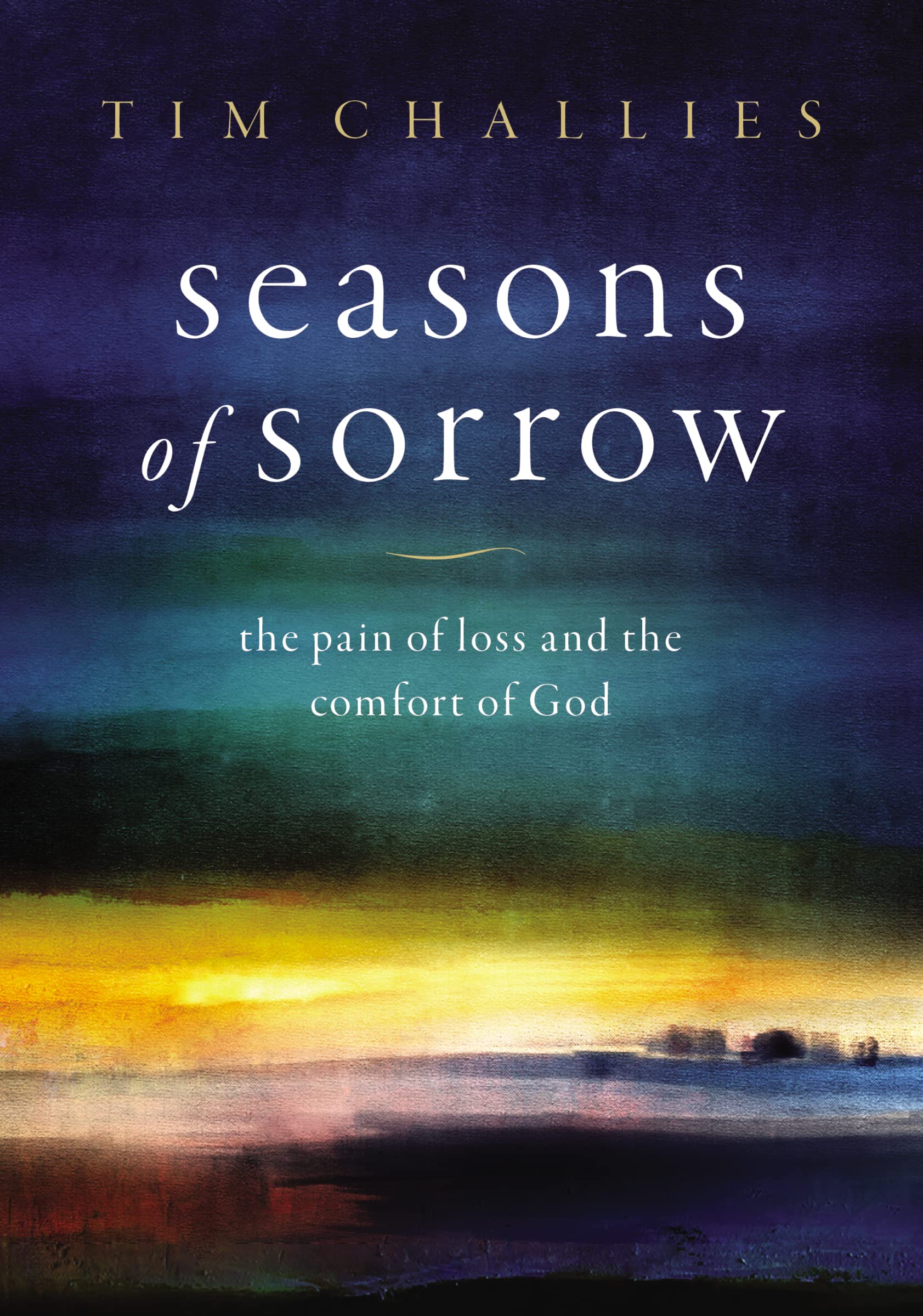
Seasons of Sorrow

One November day in 2020, Tim and Aileen Challies learned the stunning news that their 20-year-old son, Nick, had suddenly died. He had not been ill. There were no known congenital health issues. He was playing a game with his sister and their friends at college when he suddenly collapsed. Efforts to revive him failed.

Though grief never goes completely away, it is probably at its most intense the first year. Like many of us who write, Tim processed what he was thinking and feeling by writing. Some of what he wrote was published on his blog. But much was not. He gathered his writings from the year into a book titled Seasons of Sorrow: The Pain of Loss and the Comfort of God. The book is laid out across seasons, beginning with fall, when Nick died, through winter, spring, summer, and then fall again on the first anniversary of Nick’s passing.

Nick was a young man training for gospel ministry. This is not the first time I have wondered why would God take someone with so much potential to heaven instead of allowing them to do His work here. We don’t know all the answers. But we do know our times are in His hands. Anyone’s death, but especially that of one so young, reminds us that we’re not guaranteed a certain number of years. By all accounts, Nick used his time here well. May God give us grace to do with same, with a heart fixed on eternity.

Even though the book deals with the recent loss of an adult child, much of it can be applied to any loss. I found help and comfort in dealing with the seventeen year loss of my mom, who died seemingly (to us) too early at 68.

One of the things I appreciated most about Tim’s testimony was his desire to honor God in the midst of his grief. There is nothing wrong with grief and tears. Jesus wept with his friends at the loss of Lazarus, even while knowing He was about to raise him from the dead. We don’t go off on a season of grieving and then come back to faith in and peace with God. Tim demonstrates that we can trust Him through and in the midst of grief.

Tim wrestles honestly with what he knows of the goodness of God in circumstances that don’t seem good.

One aftermath of loss is fearing more loss.

I, whose son collapsed and died, cannot fall asleep in the evening until I have received assurance that both my daughters are still alive and cannot be content in the morning until I am sure both have made it through the night. Nick’s death has made us face mortality and human fragility in a whole new way. My children may as well be made of glass. I’m just so afraid that if Providence directed I lose one, it may direct that I lose another. If it has determined I face this sorrow, why not many more?

How, then, can I let go of such anxiety? How can I continue to live my life? The only antidote I know is this: deliberately submitting myself to the will of God, for comfort is closely related to submission. As long as I fight the will of God, as long as I battle God’s right to rule his world in his way, peace remains distant and furtive. But when I surrender, when I bow the knee, then peace flows like a river and attends my way. For when I do so, I remind myself that the will of God is inseparable from the character of God. I remind myself that the will of God is always good because God is always good. Hence I pray a prayer of faith, not fatalism: “Your will be done. Not as I will, but as you will”  (p. 76).

Another section that particularly spoke to me was when Tim found his longings for heaven mixed up with seeing Nick again as much, and sometimes more, than seeing Jesus. He confessed this to a friend, ending with the thought that he must sound like a pagan. The friend replied, “No, you sound like a grieving father” (p. 122).

And I’m content to leave it there. It was God who called me to himself and God who put a great love for himself in my heart. It was God who gave me my son, God who gave me such love for him, and God who took him away from me. The Lord knows I love the Lord, and the Lord knows I love my boy. I’ll leave it to him to sort out the details (p. 122).

Ecclesiastes 7:2 tells us, “It is better to go to the house of mourning than to go to the house of feasting, for this is the end of all mankind, and the living will lay it to heart.” God doesn’t condemn feasting and gladness: He incorporated such into Israel’s calendar year and tells us the joy of the Lord is our strength (Nehemiah 8:10). But we do tend to learn deeper lessons through mourning. I appreciate Tim’s sharing what he experienced and learned with us.

(I often link up with some of these bloggers.)

Laudable Linkage

Here are some great thought-provoking reads found recently:

Bored With Christianity? HT to Challies. “In a world that offers such multitudinous choices and options for life and happiness–why persist in this same old religion with the same old book?”

Christ’s Crucifixion Isn’t Child Sacrifice, HT to Challies. “Many professing Christians are uncomfortable with God killing his Son as the penalty for our crimes. They see this as child sacrifice. From their perspective, it’s impossible for such a doctrine to be consistent with God’s character when it’s so clear that God abhors the killing of innocent children.”

Unfathomable. “Give them a taste of this big, wild, wonderful world that was made by a bigger, wilder, more wonderful God. It won’t make any of your problems, or theirs, disappear. But I have a strong hunch that in the presence of something so large, they will be reminded of the One who is Unfathomable himself.”

Cosmic Significance Therapy. “For Moses, the aim of considering the brevity of life isn’t hopelessness, but a proper outlook—an eternal perspective. And this perspective shapes how we live and work today.”

When You’re Up to Your Neck in Mud—Sing! HT to Challies. “Singing in adversity gives hope and lifts spirits. If that’s true in general terms, how much truer wouldn’t that be if we were up to our necks in mud and singing songs that actually spoke of hope, songs like psalms and biblical hymns?”

I’m Not an “Angel Mommy,” and Here’s Why. “As a follower of Christ and a mother who suffered three miscarriages, I have a vastly different view of what my babies are experiencing. People who die don’t earn angel wings.”

The Delight and Distress of Preaching, HT to Challies. I’ve experienced what this writer discusses, even though I am not a preacher and have done little speaking. By the way, I would much rather hear a preacher or teacher who feels like this than one who is brash and overconfident.

Knowledge Is Not a Bank, HT to Challies. “Knowledge is not a bank. It’s more like a garden. Truths and skills that are planted in our minds can bear good fruit in our lives. But just as a neglected garden will run wild with useless weeds, so our minds can easily become a wilderness of distractions, anxieties, and trivialities that choke out the good and productive knowledge we’ve accumulated before it gets the chance to take root and grow into real applications in our real lives.”

Reject the Algorithm, HT to Challies. This isn’t written from a Christian perspective, but makes some good points for being genuine rather than trying to get the most clicks.

Song of Suffering: A Short Film Featuring Joni Eareckson Tada, HT to Challies. This video is well worth 13 minutes of your time.

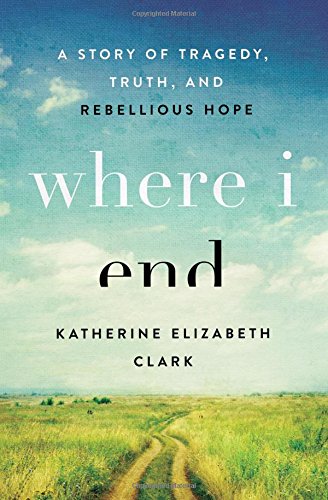
Where I End

Katherine Clark was visiting her son’s school, playing tag with some children on the playground. One boy climbed up on the jungle gym and jumped off onto Kate’s head. They both fell to the ground. The boy’s arm was fractured, but Kate’s neck was broken, and she was instantly paralyzed from the neck down.

Kate tells her story in Where I End: A Story of Tragedy, Truth, and Rebellious Hope. She writes, “Strictly speaking, this is not an autobiography, nor is it a piece of journalism about a particular event. Rather, it is a series of reflections—broadly but not strictly chronological—in the wake of an event that has shaped my story as well as the stories of those who love me” (p. 10).

I appreciate that she says her story does not have a fairly-tale ending and she’s not a fairy-tale heroine. “It’s a tale penned in grief and sorrow. But is also a story abounding in hope, beauty, and the miraculous. It is at times humiliating” (p. 13).

Kate intersperses the details of what happened to her on that fateful day and the aftermath of surgery and physical therapy with reflections of the effects of her injury on her children, the inevitable “why” question, coming to terms with the label “quadriplegic,” wrestling with God’s will and His mysteries, and so on.

Her doctors had said she would never walk again. But as her healing surpassed what was expected, she felt almost guilty that she was progressing while so many others she had met in the hospital were not. When someone urges her to tell her story in a small group, often the next person will say something like, “Well, I don’t have anything to follow that,” as if testimonies were a contest. Kate writes, “I hate when the story severs discussion. I hate when the story culminates in a comparison of cross bearing, and as a result, a chasm between us” (p. 198). Kate didn’t want to draw attention to herself, yet her injury and partial recovery were part of her story, her life now. Her history was divided between before and after the accident. As one friend told Kate’s husband, “The only faithful response to living this story is to tell it’ (p. 9).

When one suffers an injury such as Kate’s, the big question is whether the patient will walk again. If that milestone is reached, the patient is thought to be healed. But the patient can still experience life-altering symptoms. In one chapter, Kate details the symptoms she still experiences and the things she still can’t do. She had been in good shape before the accident, a runner, and could no longer count on the body she was once so sure of.

It wasn’t until this chapter that I realized some parallels between my situation and Kate’s. When I had transverse myelitis, I could walk again after a few months of physical therapy and a lot of prayer. But I still have balance issues and numbness in both lower legs and my left hand. I knew exactly what she was talking about when she mentioned her hands feel like she has gloves on all the time, making fine motor skill difficult (though in my case it’s just my left hand, which is not my dominant one, thankfully).

Kate writes also of the mix of feelings she experiences: joy for the amount of healing she has recovered, yet lament for the loss. “I live in the midst of this tension—gratitude and grief—every day” (p. 212).

Though grief remains a part of us, we should not need nor should we desire to be continually affirmed in our sadness. That doesn’t mean we won’t sometimes speak of our sorrow or that we won’t continue to grieve. Some wounds we bear until heaven. It merely means that grief takes its proper place in our stories, and its role is never that of the star, nor does it play the part of the savior.

We live in the shadow, dear reader, but the darkness cannot overcome the light (p. 127).

God shined His light through His Word and His people as they came alongside to help in various ways and to share truth.

I so appreciated Kate’s testimony of God’s grace in hard circumstances.

This book fits the Medical Memoir category of the Nonfiction Reader Challenge.