Review: Cyrano de Bergerac

Cyrano de Bergerac is a play written by Edmond Rostand in 1897 but set in 1640 Paris. It became an instant success and has remained so ever since. In one sense it’s a throwback to “France’s golden age—a time when men were musketeers, women were beautiful heiresses, and the wit flashed as brightly as the swordplay” (according to SparkNotes), represented in stories like The Three Musketeers, which was published 50 years before Cyrano. Cyrano even references The Three Musketeers in places. In another sense it’s a parody of such stories. Part comedy, part tragedy, the main focus is its title character, Cyrano.

Cyrano excels in almost every area. He’s witty, an excellent poet, a superb swordsman, and he commands the respect of almost all who know him. The one area where he lacks confidence is romantic relationships, and that’s due primarily to his extremely oversized nose. He thinks no woman would find him attractive or even give him a chance, especially his cousin, Roxanne, whom he confesses to one friend that he loves. When Roxanne sends him a message that she wants to meet with him privately, he begins to hope that perhaps she could love him, and he pours out his heart in a letter to her. But when they meet, he learns that she loves a handsome young man in his regiment, Christian, and she asks him to watch over Christian.

He agrees, and when he tells Christian that he is Roxanne’s cousin, Christian confesses that he loves her but he can’t approach her. Roxanne loves “flowing words,
Bright wit,” and Christian is tongue-tied and inarticulate. The men each lament their deficiencies:

CHRISTIAN:
Oh, to express one’s thoughts with facile grace!. . .

CYRANO:
. . .To be a musketeer, with handsome face!

Then Cyrano hits on an idea: they can combine their talents. He can teach Christian what to say, and that will give him an outlet for his own heart. He gives Christian the letter he had just written to Roxanne but left unsigned and tells Christian to send it to her in his name.

What could possibly go wrong with that plan?

The rest of the play shows how they each progress and carries them through various scenes, but I don’t want to give away any more details.

Some of the comedic sections are priceless, such as a lengthy exchange with Cyrano and another man who is trying not to look at or comment on Cyrano’s nose and then is questioned by Cyrano (“Is there anything extraordinary about it?…Is it soft and swinging like an elephant’s trunk? Is there a wart on the end of it? Or a fly?…Is it a phenomenon?”) When Christian, hoping for a kiss, wants to speak to Roxanne himself and can’t seem to come up with anything except, “I love thee,” Roxanne responds, “‘Tis the theme: embroider it,” and later “Gather up your scattered eloquence.” Here are just a few more samples:

Tradesman: You are not Samson!
Cyrano: I will be, my dear sir, if you’ll lend me your jaw.

Cyrano: Whom I love? Come now, reflect. The dream of being loved, even by a homely girl, is one forbidden me. Forbidden by this nose of mine that precedes me everywhere by fifteen minutes.

I enjoyed the comedy and the swashbuckling, but most of all I enjoyed the more earnest parts, such as when Cyrano is trying to coach Christian when they’re half hidden in the darkness under Roxanne’s balcony (reminiscent of Romeo and Juliet‘s balcony scene). Getting frustrated with the process, Cyrano pushes Christian out of the way and then speaks from his heart. The last few scenes, when Cyrano goes to visit Roxanne some fourteen years after the action in the previous scenes, is masterfully written. The time of day, the season, the double meaning to Cyrano’s words, and the development of the conversation all come together to form once of my favorite sections of literature with one of my favorite lines (which I can’t tell, or else you’d know the ending!)

I looked at SparkNotes and Shmoop‘s analysis a bit, and disagreed with Shmoop’s especially. They seemed to think the main theme was Cyrano’s lack of self-esteem, that if he had not been hung up on his one defect, he could have had a life of love (see the Shmoop heading “Why Should I Care?” for more on this).

But I think the theme has to do with the self-sacrificial nature of real love. A couple of times Cyrano had an opening to confess his love, but he abstained, for the happiness and then the honor of another. All the characters grow in their understanding of love, finding that it goes beyond handsome faces, stolen kisses, and “embroidered” words, but Cyrano embodies it the most.

I did not investigate translations like I did before reading Don Quixote, and I wish I had. I looked around a bit afterward and learned that one by Brian Hooker is considered the best. I was primarily looking for an audiobook version that read the actual play rather than an audio performance of it, and found that here, translated by Howard Thayer Kingsbury, and enjoyed it very much. It says it is narrated by Flo Gibson, but it is actually narrated by Grover Gardner, who did an excellent job. I also got this Kindle version translated by Charles Renauld and looked around it and the Gutenberg version, and didn’t like either of them as much, at least, as far as I compared them, which wasn’t much. For instance, where in the audiobook Roxanne tells Christian to “embroider” his words, the Gutenberg version says to “vary” them, and the Renauld version just says, “Amplify!” I don’t know which is closest to the original, but “embroider” sounds a lot better to me. But I do appreciate Renauld’s introduction and preface detailing some of the difficulties of translation, not only from a different language, but from the poetry in which the play was originally written, and his reasons for making the choices he did, ending with the admonition that those who would be critical should “Try the task!” While looking up information on translations, I came across this fascinating discussion with some examples of how different translations handle one of Cyrano’s speeches and this great article.

One place where translations differ greatly is near the end when Cyrano speaks of the one thing he can take with him when he dies that no one can take away from him. Some translations say “plume,” others say “panache.” The audiobook said “plume,” and I admit it didn’t make sense to me at first. Renauld says in his introduction:

Now, what is this panache upon which “Cyrano” sets such a high value? To understand it is to appreciate, to miss it is to miss the meaning of the play. An explanation of it is, therefore, not out of place in this introduction.

The panache is an external quality which adds colour and brilliancy to internal things already worth having for their own intrinsic value. Its main justification is personal bravery…The panache is literally a high plume, or bunch of plumes, that waves high above a commander’s head-gear…There is magnetism in the panache…Henry the Fourth said to his soldiers; “you will find it always on the path of honour and duty.” The panache, too, is essentially joyful. “Cyrano” is joyful, in spite of a life that would breed discouragement and bitterness in almost any heart but his.

That sheds light on this earlier speech of Cyrano’s when someone criticizes his clothes:

It is my character that I adorn.
I do not deck me like a popinjay ;
But though less foppish, I am better dressed :
I would not sally forth, through carelessness.
With an insult ill wiped out, or with my conscience
Sallow with sleep still lingering in its eyes.
Honor in rags, or scruples dressed in mourning.
But I go out with all upon me shining,
With liberty and freedom for my plume,
Not a mere upright figure ; — ’tis my soul
That I thus hold erect as if with stays,
And decked with daring deeds instead of ribbons.
Twirling my wit as it were my moustache,
The while I pass among the crowd, I make
Bold truths ring out like spurs.

And it also sheds light on one place where they are battling Spain, and a cadet comes in with “a collection of shabby hats spitted on his sword, their plumes bedraggled and holes through the brims,” “spoils of war” he gathered from the enemy’s camp.

So it does look like the theme has to do with panache, brave, magnetic, joyful flair. But I still think it has to do with love as well.

There are multiple film versions of the play – I’d love to check out Jose Ferrer’s, one of the most famous ones, if I can find it. I did find this scene of it:

I had seen this play at least once, maybe a couple of times, years ago, and remembered the basic story line, but I am so glad I read (or listened to) it now. There was so much to enjoy about it, and I feel sure I’ll read it again in the future.

(Sharing with Semicolon‘s Saturday Review of Books, Literary Musing Monday, Carole’s Books You Loved)


Book Review: Fierce Convictions

I really didn’t know anything about Hannah More when I first saw Fierce Convictions: The Extraordinary Life of Hannah More – Poet, Reformer, Abolitionist by Karen Swallow Prior making the rounds a couple of years ago, but so many bloggers spoke positively of it that I requested it for the next gift-giving occasion. It turns out I am in good company: in his preface to this book, Eric Metaxas said he hadn’t know much about her, either, until doing research for his book on William Wilberforce, and then he got so excited, he tried to include as much about her as he could. When he met Prior and found out her doctoral dissertation was on More, he urged her to write a book.

Hannah was born to a family of five daughters in 1745. Her father being a teacher and her own thirst for learning led to her receiving an education beyond the norm for girls in that era. She and her sisters established a school together as they got older. Hannah wrote some plays for the students that were well-received. She was engaged for a long period of time, but the marriage never went forward. In a transaction common for the day, her former fiance offered her an annuity “sufficient to allow More to pursue a literary vocation as compensation for the time she devoted to him” (p. 37).

An influential friend sent a copy of one of her plays to David Garrick, a famous actor of the day; thus “the door to the literary capital of England was opened” (p. 49). Hannah became friends with a number of Londoners, including Garrick and his wife, Horace Walpole, Samuel Johnson, William Wilberforce, and a host of others. She was so close to Wilberforce that one of her anonymous publications was thought to be his. She was included in the Bluestocking Circle begun by “one of the wealthiest and most influential women of the day” (p. 76), Elizabeth Montagu. More’s influence and literary career grew.

But for various reasons, More became disenchanted with life in London and moved to Cowslip Green in between two villages.

More had always been bemused–and sometimes amused–by the excesses and superficialities she witnessed [in London]. So while the glistening of the fashionable life grew ever duller over several years, hints of More’s doubts about this fool’s gold can be found even from her earliest seasons there. It is clear that she was undergoing a greater sense of calling to more serious work, to more devotion in her faith, and with it to ministry in serving others (p. 95).

She was given a book of John Newton’s letters which she described as “full of vital, experimental religion” – vital meaning, according to Prior, “‘full of life,’ so opposite the stale, dead religion found in many Church of England members” (p. 105).

The word experimental alluded to the growing emphasis during the eighteenth century on the importance of individual experience in religious practice, the need of each person to have an authentic and personal faith rather than simply to adhere to rote tradition (p. 105).

Wilberforce had originally “thought that being a sincere Christian required withdrawing from the corrupt corners of human business” and was inclined to “retreat from public life in favor of a course devoted to piety.” John Newton encouraged him to “stay at his post, and neither give up work, nor throw away wealth; wait and watch occasions, sure that He, who put him at his post, would find him work to do” (p. 113). Later Wilberforce’s “influence dissuaded [Hannah] from her growing inclination to shrink from the world” (p. 117). Thank God that both of these people “stayed at their post.” “Even John Wesley sent Hannah a message through her sister: ‘Tell her to live in the world; there is the sphere of her usefulness; they will not let us come nigh them” (p. 203). The bishop of London asked her, “Where can we find any but yourself that can make the ‘fashionable world’ read books of morality and religion, and find improvement when they are only looking for amusement?” (p. 202).

More joined with Newton, Wilberforce, and others involved in fighting the slave trade.

As a goldfish swimming in a bowl doesn’t know what water is, so a person living in eighteenth-century Great Britain–immersed in an economic and social structure built on the slave trade–could not easily, if at all, see slavery for what it was. To do so required, it seemed, a certain kind of perceptiveness of mind and spirit. Hannah More was one of the few who possessed it (p. 108).

Even Wilberforce acknowledged that the fight against slavery could not by won in Parliament alone, that “more is to be done out of the House than in it,” that “changing the minds in Parliament would require changing the heart of the nation first” (p. 128).

The battle against slavery was, in many ways, led by the poets–and other writers and artists–who expanded their country’s moral imagination so it might at last see horrors too grave for the rational mind to grasp (p. 128).

Hannah used her influence and her pen to fight against slavery, a fight which took over forty years. She also used it to encourage education, especially for girls and for the poor, and to provide edifying reading material. Prior explained that tracts or pamphlets at that time were like blog posts today, and Hannah used them for educational, religious, and sometimes political causes, eventually leading to the establishment of Cheap Repository Tracts.

But she did more than write. She and her sisters started a number of schools for the poor, financed by Wilberforce, fighting against the opinion of the time that the poor should not be educated or taught to read (some thought the poor would have no use for it: others thought it might disturb the order of things). She became one of the few female members of what was called the Clapham Sect – not a sect as we think of it today, but a group of influential “like-minded believers, ‘bound together by shared moral and spiritual values, by religious mission and social activism, by love for each other, and by marriage,’ [who] changed history as they sought to serve God in every area of their lives, personal and public, at home and abroad” (p. 167). “The efforts of the Clapham community were three-pronged: they aimed at alleviating the suffering and oppression of the lower classes, reforming the excessive and negligent behaviors of the upper classes, and advancing Christianity at home and throughout the world” (pp. 173-174).

She was not flawless. Some of her views would have modern readers scratching their heads, and Prior does an excellent job explaining them in the context of Hannah’s times. But she yielded herself, her influence, her energy, her finances, and her pen to God and was used mightily by Him. One quoted source said, “What Wilberforce was among men, Hannah More was among women” (p. 240).

Somewhere between Birrell’s hatred and Roberts’s hagiography is a woman who was at once ordinary and remarkable. She was a woman with virtues and flaws, faith and fears, vision and blind spots. But she was also one whose unique gifts and fierce convictions transformed first her life and subsequently her world and ours (p. 253).

To Walpole, More was testimony, in the words of one of her early biographers, that “the most implicit faith and the most devoted zeal in Christianity could consist with the highest mental attainments; and that the most devoted piety was no obstacle to cheerfulness and humor” (p. 170).

In the epilogue Prior also shares some reasons why More is not more well-known today, among them the modernist movement, which “rejected the values that most defined the Victorian age: duty, family, piety” (p. 252). In addition, her one novel “is practically unreadable for most readers today. tastes have changed, and the art of the novel has progressed toward more nuance and complexity than the plain didacticism of More’s novel” (p. 235). But I am glad that Prior brought her to our attention and shared her life with us.

It took me just a little while to truly get into the book. I am not sure if it took that long to get into the rhythm of Prior’s style or if it just got more interesting to me around the time that Hannah went to London, and more so when she decided to leave. I especially appreciated Prior’s couching everything into its historical setting so that we weren’t getting just the facts, but truly understanding how historical events and beliefs affected Hannah and how she in turn affected them.

And on a completely separate note, one of Prior’s explanations helped me better understand Jane Austen’s Sense and Sensibility:

During the so-called long eighteenth century (1660-1830), a “cult of sensibility” arose that exalted the outward manifestations of emotional sensitivity–weeping, fainting, and the like–as the marks of morality and refined character, to the point that sensibility became more important than benevolent or moral actions (p. 185).

In context, Prior said this about More’s writing concerning animal cruelty. She sought to raise awareness of some of the brutal practices of the day in order to stop them yet did not devolve into “emotional indulgence” and “inordinate affection” the “cult of sensibility” employed towards animals (p. 197).

I’ll close with a few favorite quotes from More herself:

It should be held as an eternal truth, that what is morally wrong can never be politically right (p. 136).

I am at this moment as quiet as my heart can wish. Quietness is my definition of happiness (p. 69).

Atrocious deeds should never be called by gentle names (p. 205).

God can carry on his own work, though all such poor tools as I were broken (p. 247).

The more I see of the ‘hounoured, famed, and great,’ the more I see of the littleness, the unsatisfactoriness of all created good; and that no earthly pleasure can fill up the wants of the immortal principle within.

Bible Christianity is what I love…a Christianity practical and pure, which teaches holiness, humility, repentance and faith in Christ; and which after summing up all the Evangelical graces, declares that the greatest of these is charity (p. 155).

(Sharing with Semicolon‘s Saturday Review of Books, Literary Musing Monday, Carole’s Books You Loved)

Save

Save

Book Review: The Strange Case of Dr. Jekyll and Mr. Hyde

Jeckyll and HydeIn a way it’s too bad that most modern readers know the premise behind The Strange Case of Dr. Jekyll and Mr. Hyde by Robert Louis Stevenson. We miss a lot of the build-up of the mystery the other characters are trying to solve. But it’s still an enjoyable story.

It begins in Victorian-era London when a lawyer, Mr. Utterson, is taking a walk with his cousin when they pass a door that stirs a memory for the cousin, Mr. Enfield. Once Enfield was walking in the same area when he witnessed a young girl being trampled by a man. He and the crowd around them insisted that the man pay the girl immediately for damages, and the man went into the particular door they’re now passing to obtain a check written on the account of a reputable man in the city. Enfield describes the man negatively, saying he seemed deformed, though Enfield couldn’t put his finger on exactly what was wrong with him. When he mentions that the man’s name is Hyde, Utterson stops him, for he knows who Hyde is and wishes to avoid gossip.

But the incident increases Utterson’s concern. His friend and client, Dr. Jekyll, has just changed his will to leave everything to Hyde, and Utterson feels sure that the account Hyde drew on was Jekyll’s. He fears Hyde may be blackmailing Jekyll, but Jekyll says Hyde is no one to worry about.

Some time later, a maid witnesses Hyde killing a man in the street who turns out to be a member of Parliament and another of Utterson’s clients. Hyde seems to disappear after that, and Jekyll says he has cut off ties with him. But then all of a sudden Jekyll stops going out and receiving visitors. One day when Utterson happens to see him through a window and stops to talk for a while, Jekyll seems glad to see him at first, and then suddenly with a look of horror slams down the window. Then one night Jekyll’s butler, Poole, come to Mr. Utterson to say that something is terribly wrong: his master has been locked in his laboratory for days and now doesn’t sound like himself. Utterson comes with Poole, and they decide to break down the door. What they find I will leave you to discover, but a couple of letters left for Utterson explain what has been going on.

As most readers know (and if you don’t know and don’t want to, skip this paragraph!), Hyde and Jekyll are the same man. What’s perhaps the most interesting aspect of the book to me is Jeckyll’s reasons for his experimentations. He had struggled with the conflicting parts of himself wanting to do good or evil, and decided to see if he could separate them – not in order to filter out the bad and therefore conquer it, but so the bad side could do what it wanted without restraint and without consequences such as marring the good name of Jekyll.

I had learned to dwell with pleasure as a beloved daydream on the
thought of the separation of these elements. If each, I told myself, could be housed in separate identities life would be relieved of all that was unbearable: the unjust might go his way delivered from the aspirations and remorse of his more upright twin and the just could walk steadfastly and securely on his upward path doing the good things in which he found his pleasure and no longer exposed to disgrace and penitence by the hands of this extraneous evil.

When Jekyll becomes alarmed at how far Hyde has gone and resolves not to let him out any more, Stevenson masterfully describes incomplete repentance which isn’t true repentance.

It was Hyde, after all, and Hyde alone, that was guilty. Jekyll was no worse; he woke again to his good qualities seemingly unimpaired; he would even make haste, where it was possible, to undo the evil done by Hyde. And thus his conscience slumbered.

Yes, I preferred the elderly and discontented doctor, surrounded by friends and cherishing honest hopes; and bade a resolute farewell to the liberty, the comparative youth, the light step, leaping impulses and secret pleasures, that I had enjoyed in the disguise of Hyde. I made this choice perhaps with some unconscious reservation, for I neither gave up the house in Soho, nor destroyed the clothes of Edward Hyde, which still lay ready in my cabinet.

As the first edge of my penitence wore off, the lower side of me, so long indulged, so recently chained down, began to growl for licence.

I sat in the sun on a bench; the animal within me licking the chops of memory; the spiritual side a little drowsed, promising subsequent penitence, but not yet moved to begin.

Elisabeth Elliot once wrote that she was dealing with guilt over something she had done and was astounded by it, thinking, “That’s just not me.” She was brought up short by the realization that it was indeed her fault, that she couldn’t blame it on provocation or circumstances. Even if she had been provoked, she could have looked to God for help to respond rightly. That jarred me, because I was too prone to blame my bad reactions on the circumstances that caused them rather than my innate sinfulness. It’s telling that Jekyll blamed Hyde’s wrongdoings on Hyde alone as if he were a separate being rather than actually himself. The first step in gaining any kind of victory over the Hyde in each of us is to recognize and own the fact that he is us.

I don’t know much about Stevenson himself. A quick perusal of the Wikipedia article about him says he grew up in a religious home but declared himself an atheist in his twenties. He recognized just how horrible what the Bible calls our “old man” or “flesh” could become, and seemed to realize that it couldn’t be reigned in just with conscience. I don’t know if he ever knew that we could be completely liberated from its penalty and power only through Christ: “O wretched man that I am! who shall deliver me from the body of this death? I thank God through Jesus Christ our Lord” (Romans 7:24-8:1a).

This is a short book: paperback copies are less than 100 pages, and the audiobook I listened to was only 2 hours and 19 minutes. So for those who might like to read classics but are intimidated by their length, this one might be good to try. Even though I knew the basic story, I gained much by reading the book. I started out listening to an audiobook, but though the narrator was fine in the narrative, he was terrible with the character’s voices, so I switched to the 99 cent Kindle version. I chose it for the horror/Gothic category of the Back to the Classics challenge. I’m not into horror at all and thought I might skip this category until I read Rebekah’s review of this book. I am thankful for both of those influences leading me to read a book that I would have been unlikely to pick up otherwise.

(Sharing with Inspire Me Monday, Semicolon‘s Saturday Review of Books, Carole’s Books You Loved)

Save

Save

Save

Laudable Linkage

IMG_0195

Here are a few good reads discovered this week.

But I Begged God.

There Is a Better Way to Experience Sexuality, and Christian Parents Need to Be Talking About It. In response to a popular teen magazine telling young girls how to have anal sex and assuring them it’s “normal.”

Five “Fake News” Stories That People Believe About Early Christianity, HT to Challies.

The Advice Young Moms Really Do Need.

Hospitality Is Not Just For Home, HT to Jessica.

3 Reasons Preachers Shouldn’t Publicly Contradict a Bible Translation. Though this is addressed to preachers, I think some of the advice is good for all of us. I’ve seen people be very offensive and abrasive over their chosen version and just kill opportunities for any more meaningful conversations.

Anticipating the Right-Side Up World Through Imagination.

Christians Sharing Fake News. Though this is from over a year ago and the specific stories are no longer going around, the advice in the latter part of the article is invaluable, especially “Don’t Post What You Can’t Confirm.” The Bible has a lot to say about false witnesses.

And, finally, these were the weighty words of wisdom from a recent fortune cookie that had me scratching my head: 🙂

19958955_10212983701644270_6786578479749603053_n

Happy Saturday!

Save

Friday’s Fave Five

It’s Friday, time to look back over the blessings of the week with Susanne at Living to Tell the Story and other friends.

Here we are almost at the midpoint of July! And here are my favorite parts of the last week:

1. An excursion downtown with Melanie. We explored the Mast General Store and then ate an early lunch at Coolato Gelato. The latter is primarily known as a gelato/dessert/coffee place, but it serves really good paninis as well as quiche (which I am going to try there someday!) and salads. And Jason, Mittu, and Timothy stopped in as well, so I was glad they all got to meet each other. I’m not usually the one driving downtown when we go, but driving this time helped give me confidence that I could do it again and deal with finding parking and such (even though I inadvertently took us on a scenic route at first…but it all turned out all right.)

2. Garden gifts. I am just not up to dealing with gardening, but I have neighbors who regularly share some of their abundance with us. They gave us some huge zucchini last week.

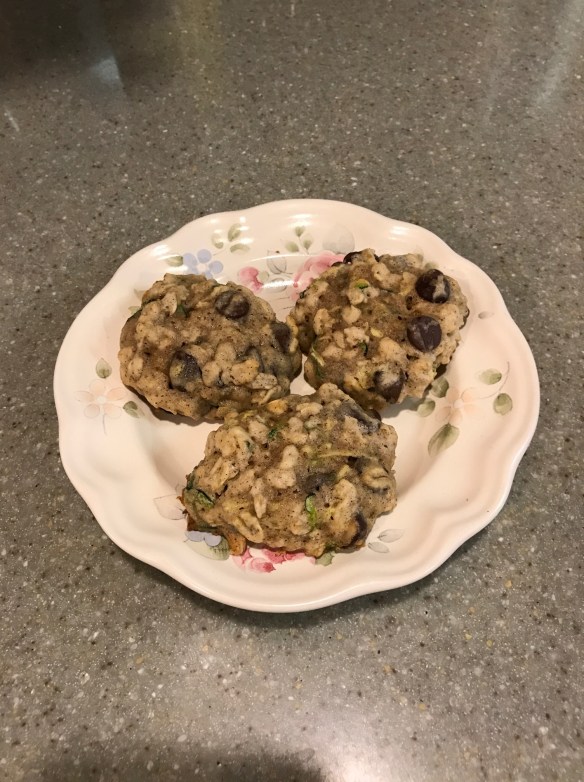
3. Zucchini Oatmeal Chocolate Chip cookies. The first time I ever went to Coolato Gelato, they had some wonderful zucchini cookies half-dipped in chocolate. I asked them about them when we were there, and they said they only had them one winter (I hope my inquiry spurs them to think about serving them again!) I searched for zucchini cookie recipes and discovered Zucchini Oatmeal Choclate Chip Cookies, which sounded good even though they’re different from what I was looking for. Since I had some fresh zucchini on hand, I decided to try them. So good! The only thing I’d do differently next time is try a different grater to see if I could grate the zucchini a little more finely.

IMG_0272

4. Benadryl Cream. The evening of July 4th, we went outside to watch some fireworks that were being set off around the neighborhood, and I came back with 22 little bug bites on my chest! Since one cluster of them is right next to where the neckline of my dress was, I think some little bug got under there and then couldn’t get out. Oddly, I didn’t feel it happening and didn’t notice them until changing clothes, and then they didn’t itch at all unless I brushed across them. But after that I started having I can’t stand it itching. Cortisone cream didn’t help much, but Benadryl cream had been keeping it mostly manageable. They’re fading, so hopefully they’ll be gone soon.

5. Two meals Mittu made for us this week. Yum!

Have a great weekend!

Save

More stray thoughts

The last time I did a post like this, someone suggested I should make it a regular feature, especially considering my blog name. 🙂 I don’t know if it will be a regular feature, but it will probably be an occasional one. So here are some of the things running through my brain lately, from the trivial to the more serious:

  • Have you seen those pans for brownies or bar cookies that look like a maze and are designed so that all the pieces come out like edge pieces? The edge pieces are my least favorite – mine tend to get much harder than the middle. But I guess some people like crunchy brownies – or are better bakers than I am and don’t get the outside edges too hard.


  • I’m working on a poll about blogging that I hope to have up in the next week or two.


  • Have you seen that there is a trend now to stop capitalizing pronouns referring to God? This post explains some of the reasons for it. I admit the middle part of it is too technical for me, but I do understand some reasons for it: those pronouns are not capitalized in the original manuscripts and even some of the oldest translations, like the KJV, don’t capitalize pronouns referring to God. Still, it has been a tradition for years, one that many people (myself included) see as respectful of God. And I think it does help clarify a sentence to have He vs. he (especially if you’re referring to another he and him in the same sentence). It’s not a hill to die on, but I hate to see it changed.


  • One day last week I was trying to get something done on the computer while doing laundry, and I was getting aggravated at having to get up every 30-40 minutes to change loads. Then I got ashamed of myself. We have about the easiest way to do laundry of anyone in the world. A day or two later I saw photos on Facebook from a group in our church on a short-term medical mission trip to another country. They’re in an area of dire poverty where whole families live in the city dump. I’m sure the people love to have access just to clean water. A washing machine and dryer would seem like pure luxury to them. So while it would probably help to rearrange my tasks so that I am not doing something require a steady train of thought on laundry day, I hope I remember to count my blessings.


  • I think I have mentioned that I have a medical procedure coming up called an ablation which is supposed to take care of the atrial fibrillation I’ve been experiencing. It was originally supposed to be next week, but Monday I got a call from the doctor’s office that they needed to move it back into August. I was so disappointed. I’ve been counting down the days to getting the procedure itself over with, not to mention being relieved of the afib. I don’t know if doctor’s offices realize what it means to a patient when this happens – not just the disappointment and living more days with a condition that needs surgery, but rearranging of days off for Jim and care for my mother-in-law. I know it can’t be helped sometimes, and I’m reminding myself that ultimately God is in control and there may be a good reason I shouldn’t be in surgery on the original day.


  • This is the latest card I’ve made, this one for Jim’s mom’s birthday earlier in the month.

I hadn’t originally intended to use both the rickrack and the lace trims. I put the rickrack on first, and it was thin enough that the plaid could be seen through it, and I just didn’t like how it came out. But I didn’t want to take it up and risk tearing the paper underneath. So I was going to put the lace one over it, but it wasn’t quite big enough to cover it completely. In fiddling with it I got the idea to layer them a bit, and I really liked how that turned out. The yellow and white scalloped circles were done with two different hole punches.

  • Speaking of Jim’s mom, some of you have said that you like to hear how she’s doing from time to time. There have not been any major changes, but we continue to see a gradual decline. Her hands have been contracted for some time, and though her caregiver keeps her fingernails cut short, now we have to keep a small sock rolled up under her fingers so that her fingernails don’t dig into her palms. One finger is contracted to the side and looks like it would be painful, but the only time it seems to bother her is when it is washed. She was having physical therapy for this a few years ago, but it was all pain and no gain, so it was discontinued. In addition, the times when we can tell from her eyes that she recognizes us and is following what we’re saying is less and less. It’s heartbreaking to watch in many ways. Jim has described it as watching someone die one brain cell at a time. But she seems calm and content, and we’re trying to keep her as comfortable as possible until God takes her home.

That’s about it for now. Yesterday I enjoyed lunch with Melanie downtown, but I’ll say more about that on tomorrow’s Friday’s Fave Five.

Book Review: Until We Reach Home

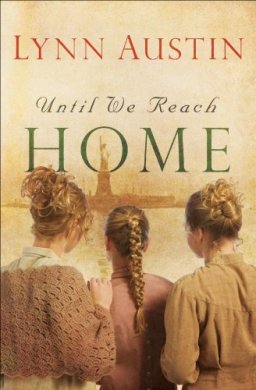
Until We Reach Home by Lynn Austin is the story of three sisters from Sweden in 1897. Their mother died, then their father committed suicide, which in that time and culture went beyond its own tragedy to be considered a disgrace to the family. An aunt and uncle move in to “help” but ended up taking over the farm. To protect her sisters from a danger which only she knows about, oldest sister Elin accepts another uncle’s invitation to come to America.

Elin is the take-charge mother hen of the group. The danger she wants to keep them from has made her wary, nervous, and sad, which irritates her sisters because they don’t know what’s behind it.

Kirsten is the free-spirited, adventurous, independent middle child. She doesn’t want to move to America at first, but when she learns that her relationship with a young man will never advance because of her father’s disgrace, she breaks up with him and wants to leave.

Sophia is the shy youngest, attached to the farm and thoroughly unwilling to go to America. She often visits her mother’s grave and wants to stay near it. But she doesn’t want to be separated from her sisters, either.

The trip via trains, ferries, and finally a ship, is harrowing, especially in the crowded conditions of steerage. Seasickness hits them all, and then a mysterious disease breaks out. Then their arrival is not what they had anticipated when two of them are detained at Ellis Island and even when they finally get to their aunt and uncle’s home. Almost entirely on their own, they have to scramble to find work and a place to live.

Elin and Kirsten both carry weighty secrets from their past. When Sophia is faced with the one thing she fears most, she rediscovers the faith of her mother.

Will they all find release from their burdens? Will life always be a hardscrabble struggle, or will they ever find their new start in this new land? Will they ever find a true home?

My thoughts:

New beginnings are almost never easy, even when they’re excitedly anticipated. But starting over under the conditions that they did and at the time they did made it all the harder. So many immigrants came from hard conditions to make a better life and faced so many hardships both in travel and then supporting themselves once they got here. Like the pioneers, persevering through hardships made hardy stock of them – or maybe they were to begin with. This book was quite enlightening, and I enjoyed it very much. As one character says, “Life with God is often very difficult. But life without Him is unendurable.”

(Sharing with Semicolon‘s Saturday Review of Books, Carole’s Books You Loved)

Save

Save

Book Review: Don Quixote

The only thing I really knew about Don Quixote by Miguel de Cervantes was the famous tilting at windmills scene. When one of the categories for the Back to the Classics challenge was a classic published before 1800, as I searched titles, this was one of only a couple that I was interested in. I was dismayed to see that the audiobook was 36 hours! One paperback copy I saw was 992 pages! But I plunged in.

Don Quixote starts out as nobleman Alonso Quixano in Spain. He loves reading about tales of chivalry to the point that he loses his senses, believes the stories to be true, and decides to bring back knighthood by becoming a knight errant himself, much to the dismay of his niece and housekeeper. He chooses the name Don Quixote for himself (or Don Quixote de La Mancha in full) and finds an old suit of armor and cleans it up. When he discovers the helmet has pieces missing, he constructs them out of pasteboard. He renames his old horse Rocinante. Every knight has to have a lady love, so he chooses a farm girl from a neighboring village, unbeknownst to her, and renames her Dulcinea del Toboso (at the beginning it is said that he was once in love with her, but later he confesses that he has never even seen her).

Thus he sets off to seek adventure. But most of his encounters meet with little success. People think he is crazy, so some of them fight against him. Other times he mistakes what’s going on, like thinking windmills are giants or sheep are an army of invaders. Once he got so caught up in a puppet show that he began to think the action was real and slaughtered the villainous puppets. When confronted with reality, he concludes that some enemy enchanter changed things, like making the giants into windmills at the last moment.

Along the way he also encounters other people and hears their stories. My favorite one of these involved a well-to-do woman renowned for her beauty. All sorts of men fell in love with her, but she wouldn’t have them and went off to live alone as a shepherdess. She’s thought to be cruel since she won’t return anyone’s affection. Don Quixote comes upon a funeral of a shepherd who died over his love for this woman and her lack of love for him. While the other shepherds are telling the story, the beautiful shepherdess comes upon the scene and delivers what I have dubbed The Lament of Beautiful Girls Everywhere, saying, in the modern vernacular, “Look, I can’t help it if I am beautiful. God made me that way: it’s through no effort of mine. I can’t fall in love with someone just because he falls in love with me, so give me a break already!” One of the more famous of these is the tale of Lothario, who was unwillingly drafted by his friend to woo his wife, thinking that if she passed this test, he would be sure of her love. Lothario resists at first, then lies saying he has made attempts when he has not, and finally the inevitable happens and he falls in love with his friend’s wife, leading to a “lothario” in our day meaning a man who seduces women.

The book we have today contains two parts. Cervantes wrote the first and was in no particular hurry to write the second, until someone else wrote a book about Quixote. Then he wrote the second part in which he makes many digs at this interloper and his work and ends it in such a way that no one can credibly write any more about his character. Nowadays both parts are published in one book.

Quixote takes three journeys, or sallies, two in the first part and one in the second. He goes alone the first time, but for the second two he takes a farmer as a squire, Sancho Panza. Sancho goes back and forth between admiring Quixote in some ways, particularly his bravery, to wondering about his sanity. He stays with him, though, mainly because Quixote has promised his an island to govern at some point.

The story is told by a narrator as if studying the works of a Cide Hamete Benengalie and his research on Quixote, lending a supposed air of authenticity to the story.

My thoughts:

It’s obvious that the story is meant as a farce. Just the mental picture of what translator Ormsby calls the “unsmiling gravity” of Quixote in old banged up armor with a pasteboard helmet (and later a barber’s bowl for a helmet) on an old horse talking in lofty language like a knight of old is comical, as are Sancho’s lamentations over what Quixote is doing or wants him to do and Sancho’s constant stringing together of proverbs.Cervantes even pokes fun at himself: in one scene, Quixote’s friends are going through his books and getting rid of the books of chivalry most likely to cause the Don the most problems and come across one by Cervantes and comment on it. Then in the second part, he addresses some mistakes in the first part tongue in cheek (like Sancho’s mule, Dapple, being stolen and then appearing in Dapple with no explanation) by saying it was a mistake of the printer, and so on. I enjoyed this kind of humor.

I particularly liked some of the phrasing. Cervantes, in the scene above describing his book that Quixote supposedly read, is said to have “more experience in reverses than verses.” Quixote is often described as lean, even gaunt, and one line speaks of “cheeks that seemed to be kissing each other on the inside.” One girl “did not measure seven palms from head to foot, and her shoulders, which overweighted her somewhat, made her contemplate the ground more than she liked.” My absolute favorite line is: “With a blunt wit thou art always striving at sharpness.”

But a lot of the humor is not to my taste. For instance, in one chapter, Quixote and Sancho and another man are sleeping in something like a stable of an inn. The other man is waiting for a woman to join him. Quixote sees her come in and thinks she is there to test his virtue, so he sets her down beside him to tell her why he must remain true to Dulcinea. The other man sees the Don holding the woman there apparently against her will and starts fighting him. Quixote thinks it is an enemy and fights back. The woman is thrown onto Sancho’s bed, and he, being startled, starts punching her, not realizing she’s a woman. It ends up a free-for-all, Three Stooges style. In fact, there is quite a lot of beating up in the first part.

In both parts there is a lot of setting Quixote up for situations and then laughing at him behind his back, but it’s more concentrated in the second part. Just about all the major characters in the book, even Sancho and the Don’s closest friends, have no trouble deceiving him and laughing at him. In fact, when a friend comes to deceive Quixote into coming home for a year in the hopes that his “madness” might thereby be cured, he is told by someone else, “May God forgive you the wrong you have done the whole world in trying to bring the most amusing madman in it back to his senses. Do you not see, senor, that the gain by Don Quixote’s sanity can never equal the enjoyment his crazes give? … if it were not uncharitable, I would say may Don Quixote never be cured, for by his recovery we lose not only his own drolleries, but his squire Sancho Panza’s too, any one of which is enough to turn melancholy itself into merriment.” And this laughing at someone who is impaired plus setting him up for further laughs is not my kind of humor, either.

It’s a little crude in a couple of places.

Don Quixote seems pretty foolish at first, but by the end of the book I had grown quite fond of him. More than anyone else in the book, he maintains his integrity. He has his flaws, but he operates under the laws and ideals of chivalry unwaveringly, even when it costs him. As is said of him near the end of the book, he “was always of a gentle disposition and kindly in all his ways, and hence he was beloved, not only by those of his own house, but by all who knew him.”

So while the book will probably never go down as one of my all-time favorites, I am glad to have read it. I enjoyed much of the writing. It’s nice to know the full story now, especially as cultural references to Quixote abound. I’m listening to Cyrano de Bergerac now, and even that references Quixote. And then there is this recent cartoon from xkcd:

When I was trying to discern which translation would be best to read, I came across this discussion, which said that a newer one might be more accessible to the modern reader, but an older one like John Ormsby’s catches more of the nuances of the original language. And if I am going to read a classic like this, I want those nuances. 🙂 I found a Kindle version of Ormsby’s translation which I would highly recommend, especially his preface. He also gives a brief biography of Cervantes, telling how his travels supplied some of the characterizations and scenes and how he he was a captive in Algiers for a time, which comes out in the character of a soldier in the same situation in the book. He describes how even the geography of La Mancha, for those who know it, lends itself to the irony of the book with what he calls its monotonous landscape with “nothing venerable” about it as being an unlikely place for launching a glorious hero.

I primarily listened to the audiobook narrated superbly by Roy McMillan, with some dipping into the Kindle version already mentioned. The only thing that would have made it better would have been if it had been read with a Spanish accent – that would have enhanced the Spanish flavor of the book. But he did a wonderful job with the different characters’ voices and perfectly portrayed the “unsmiling gravity” of Don Quixote.

(Sharing with Semicolon‘s Saturday Review of Books, Carole’s Books You Loved)

Save

Save

Save

Mentoring Is More Than Affirmation

Sometimes over the years I have read the question from younger women, “Where are the older, godly, Titus 2 women?”

I’ve also read many sentiments from younger women, especially younger moms, that they don’t want anyone to criticize them or tell them they should be doing anything differently. They just want to be encouraged and told they’re doing a good job.

Granted, older women have a reputation for being critical. We should take great pains to affirm and encourage younger women. We shouldn’t be talking behind our hands to our friends about the younger generation (or anyone else). We need to be open to the fact that many things about Christian womanhood can look different for different people and situations and not insist that everything should be done like we did it 20-40 years ago.

On the other hand, though, is mentoring just about affirmation? Does a classroom teacher or athletic coach or job supervisor only affirm and encourage? Do they not sometimes correct and instruct?

Once I looked up the Greek word translated “teach” in the famous Titus 2 passage about older and younger women. It’s the only time this particular word is used in the NT, and, according to BibleStudyTools.com, it means:

1. restore one to his senses

2. to moderate, control, curb, disciple

3. to hold one to his duty

4. to admonish, to exhort earnestly

Are we actually looking for that kind of interaction with older women?

I know it’s hard sometimes when you get conflicting or thoughtless or inappropriate or “out of touch” advice. Here are some thoughts:

1. Manage your expectations. No one on the planet, even a wise, godly older woman, is going to hit the nail on the head every time. We’re all sinners; we won’t always get it right; we won’t always be available when we should be. We want to be the ideal older woman, but we’ll fail. Your mentors won’t be gurus or fairy godmothers: they’ll be very human. But that’s even better, because we can learn from God’s grace in their mistakes as well as their shining moments.

2. Even though God wants these kinds of relationships, don’t seek them before Him. Seek Him first for any problem, and ask Him to direct you to whom to talk to if that is His will.

3. Attribute the best motives. Once in the mall with our young baby in a stroller, one older lady from our church stopped us and told us he needed to be covered up more so he didn’t get a chill. Just a few minutes later, another older lady from our church told us to uncover him so he wouldn’t get hot and sweaty. It’s easy to want to roll our eyes behind people’s backs sometimes, but tell yourself that they mean well and at least showed an interest.

4. Glean. Sometimes you’ll get different opinions from different older women whom you respect and who both love the Lord. This was hard for me as a young mom until I hit upon the idea of gleaning – kindly listening and then taking from their advice what would best work for our family and leaving the rest.

5. Observe. In every stage and season of my life, God has placed ladies just ahead of me that I have learned much from just by observing.

6. Interact with older ladies, whether going to ladies’ meetings, talking with them at baby showers, asking them over for lunch or dinner, etc. Sometimes older women feel unwanted by the younger: let them know that you do want to know them. Sometimes you can glean a lot just by being around them.

7. You may need to take the initiative and go to an older woman whose advice you would like to receive. Some are reticent because they don’t know how to mentor or they are afraid of offending. Feel free to ask questions. They’re much more willing to share when they know their thoughts are wanted.

8. Don’t be offended. I read a post years ago about a woman who was rebuked in a harsh way by an older lady over a modesty issue. To her credit, the younger woman took it to the Lord and came to believe that the woman was right, even though the woman had gone about it in a totally wrong way. That doesn’t excuse the older woman, but we’re also not excused from something God might be trying to tell us through an imperfect vessel.

9. Don’t be oversensitive. Don’t mistake advice or a suggestion as criticism. Some years ago I was with a younger lady who had just received a gift of a parenting book after her child was born. This was pretty common when I was a young mom, and we welcomed it – we knew we needed all the help we could get. I knew the giver, and she had discussed this book with me once and mentioned that she liked to give it to new moms because it had been such a help to her. But this new mom was hurt, interpreting the gift as an indication that the giver thought she wasn’t going to be a good parent. Likewise, I’ve heard women sound hurt when someone tells them, “You have your hands full!” and take it as a jab for having an active child or more than one child. More often than not it is said by someone who has also had their hands full parenting in the past and who know what younger parents are going through.

10. Don’t assume that you know the motives behind what another woman is saying. Ask questions to clarify if need be.

It’s hard for older women to know how to go about mentoring unless we’re in an actual position of authority (parent, Sunday School teacher, pastor’s wife). Even then it can be touchy. For most of us, in our everyday interactions it wouldn’t go over well to just stop a younger women in her tracks and start “teaching” her. But here are a few considerations:

1. Pray. If there is someone on your heart, pray much before approaching her, pray much about how to approach her, pray much about whether to approach her at all. If someone asks you a question on the spot, send up a quick prayer for wisdom and possibly even ask for time to think and pray about their question and get back to them.

2. It’s generally best not to offer advice unless asked.

3. Even when offering advice, we need to couch it in suggestive rather than authoritarian tones. I often say, “You might think about…” or “Something that helps me is…” rather than “You ought to…”

4. Don’t contradict a woman’s doctor or pediatrician unless a moral issue is involved. Obviously if a woman’s doctor is advocating abortion, we’d want to try to help her see another view. But in just the little everyday parts of child care, I was amazed at how much had changed between what I was taught as a young mother and what my daughter-in-law was instructed to do with my grandson. It’s probably best never to use the phrase, “Back in MY day…”

5. Don’t contradict a woman’s husband unless there are moral, sinful, or abusive issues. If he wants her to work while she wants to stay home, pray with her, possibly suggest ways she can approach him about it, but don’t incite rebellion.

6. Don’t major on the minors. There are so many divisive issues among women: getting married or remaining single; working vs. staying at home; breastfeeding or bottle feeding; home school vs. public school vs. private school, whether to use a pacifier or not, and on and on and on. Most of these are secondary issues that the Bible does not give specific commands or instruction about. You may have specific principles you’ve drawn after much study in the Word. That’s as it should be. “Each one should be fully convinced in his own mind” (Romans 14:5). The whole tenor of Romans 14 is that believers can have differing opinions about even such things as what days to celebrate and what’s permissible to eat without judging each other or having divisive arguments. Take a stand where the Bible does but allow for differences where the Bible does.

7. It’s best to mentor in the context of relationship. Don’t just look at someone as a “project.” Look at them as sisters or daughters in Christ. Have them over, develop a relationship, truly care about the other person. If some kind of advice or a different perspective is needed, it will go over better coming from a loving relationship.

8. Don’t be a busybody. Don’t overstep or go too far.

9. Don’t belittle.

10 Don’t assume. Sometimes when you see part of a situation, you may not understand the whole of it or what has lead up to it. One off reaction might be just one off reaction rather than characteristic of a whole personality. “Let every person be quick to hear, slow to speak, slow to anger” (James 1:19, ESV).

11. Be careful of your example. Some time ago I was at a table of women at a church event, and the oldest woman at the table started talking about things her husband did. It was all quite funny, but I cringed at the negativity couched in humor. Would he have thought it funny if he had been there? The other women may have chuckled in sympathy, but did they get an example of reverencing their husbands? I’m not saying we have to put on a front and pretend everything is perfect in our homes, but we can present godly ways to deal with conflicts. By contrast, once I was with an older woman at church as she and her husband were preparing for an event for a group they headed up. The woman came into the kitchen looking for something or trying to figure something out, and was not exactly rattled (like I would have been), but pressured in getting everything ready. Her husband came in at that moment with another issue. Her back was to him, and I saw her just close her eyes a moment and then gently answer him. She probably wasn’t even aware that I was there or had observed that moment, but it spoke volumes to me.

12. Don’t be afraid to share your mistakes and what you’ve learned from them.

13. Do encourage that God will give them strength and wisdom, that the “terrible twos” don’t last forever, that they can go through their children’s teen years with their relationship intact, that God is using them and will give them grace in every moment, to keep on instructing and disciplining their children even if it seems nothing is getting through.

14. “Let no corrupting talk come out of your mouths, but only such as is good for building up, as fits the occasion, that it may give grace to those who hear.” Ephesians 4:29, ESV.

I’m not saying that older woman should start looking for things to correct and advise on. Rather, I urge them to look for ways to encourage and help younger women. And I urge younger women to look for more than affirmation from older women. Pray over advice, filter it, discuss it with your husband.

Also, these truths apply to more than marriage and motherhood, but that’s my realm, so that’s where my examples come from. Obviously women who are single or who are in the workplace can apply these same principles.

How about you? Have you ever received advice from an older woman that was particularly helpful? What are some other ways older women and younger women can help each other?

(Sharing with Inspire Me Monday, Literary Musing Monday, Woman to Woman Word-filled Wednesday, Tell His Story, Faith on Fire)

Save

Laudable Linkage

img_0021

Here are a few of the good reads discovered lately:

The Greatest Work You Can Do, aimed at college students but good for all of us.

Fictitious Forgiveness: Why We Cannot Forgive Ourselves, HT to Challies. “Feeling bad about ourselves over undealt with offenses is God’s objective expression of love, not a feeling to be drowned out by self-actualization and self-pampering.”

Implications or Applications: Biblical Narratives, HT to Proclaim and Defend. Written for preachers but good advice for reading and knowing how to apply Biblical narratives.

Altar of the Feels.

Act Your Age. This is aimed at young men needing to “grow up,” but has some good thoughts for all of us.

Go to Bed for the Glory of God.

6 Surprises Every Premarital Counselor Should Cover, HT to True Woman

Dashing Little Ones Against the Rock HT to Challies. Thoughts on one of the most difficult passages of Scripture.

A few about parenting:

What Your Kids Need Is Your Authentic Christian Life.

Spurgeon’s Secret for Raising Godly Children, HT to Challies. I’d disagree with #8, but otherwise agree with the list.

Teaching Our Children About Work.

And finally, this from Pinterest made me smile.

Happy Saturday!

Save