Labels and Lenses

When I was in college, a story made the rounds about a student who asked a preacher who was a frequent chapel speaker to meet with him. The young man wanted permission to date the preacher’s daughter—not in the sense of taking her to lunch or a basketball game, but in the sense of pursuing a serious relationship.

As the student and the preacher sat down together, the preacher said, “Well, son, are you a Big B baptist?”

The young man responded, “Well, sir, I am a Big C Christian.”

The preacher was not amused.

I don’t know whether the guy got to date the girl or not.

That story may have been the campus version of an urban legend. But it stuck with me because I have known “Big B Baptists.” Some friends, associations, institutions were not only distinctively Baptist, but aggressively Baptist.

In one group discussion about doctrines that Christians could differ on, one man had a hard time placing mode of baptism in that category. All of us in the discussion felt that immersion was the best mode and most in line with Scriptural teaching, but we agreed this wasn’t a decision that would make us question a person’s salvation. We understood how people could believe in other modes, even though we didn’t agree with them. But this man struggled with that thought, though he finally conceded.

I’ve known people who were “Big R Reformed” Christians or “Big C Calvinists.” My first introduction to Calvinism was from college Bible majors who constantly wanted to debate election vs. free will. One was even asked to leave campus, not because of his beliefs, but because he was “sowing discord among brethren” (Proverbs 6:19), constantly stirring up debates. I know some on Facebook like that now.

Of course, not all Reformed people are that way. But I’ve seen some that do not speak of the Christian community, but the Reformed community. They only buy books from Reformed publishers and only quote Reformed writers and preachers.

These defining labels aren’t limited to theological persuasions. I’ve unfollowed some sites that were “Big I Introvert” sites, even Christian ones. Reading about introversion has helped me understand the way I am made and the way I think and react. But some sites are so immersed in looking at life as an introvert that they can seem antisocial. I can lean that way, so I needed to stop feeding that tendency into my thoughts.

And, of course there are many other labels through which people define themselves and look at life. There are “Big R Republicans” and “Big S Sports fans” and “Big E Enneagram” experts (followed by numbers and wings). There are “Big M Moms” who can talk about nothing but motherhood, making single women feel left out of the conversation.

Labels aren’t bad in themselves. My husband’s father worked in a grocery store and was allowed to bring home cans which were missing labels. When Jim’s mom said she was making a surprise for dinner, she wasn’t kidding.

When my husband and I looked for a church to attend here, we wished that church websites would label themselves more distinctly. We put our preferences in our browser’s search bar and got hundreds of responses. The ones we looked into sounded almost the same, even down to their statement of faith and constitution. If they were trying to make themselves sound generic, they were going to disappoint some who came and found they held certain positions. They were also going to miss out on those who wanted to find churches that held particular positions.

So labels are helpful, even good and necessary. I use some of these labels myself.

But labels can lead to two problems.

One problem is looking at everything, especially Scripture, through the lens of our label instead of looking at our label through the lens of Scripture. I’ve known people who did not come to their positions from their reading of Scripture, but from books they read and sermons they listened to. Then they began trying to fit Scripture into their theological grid rather than adapting their theology to Scripture.

In one book I read about introversion in the church, the author said that the reason Jesus climbed into a boat once to speak to the crowd was because, as an introvert, He wanted to put some distance between Himself and the people. That would have been the author’s motivation in the same circumstances, and he projected his thinking onto Jesus’ actions (even though he later wrote that Jesus was the perfect balance of introvert and extrovert). I think that Jesus chose that venue rather because it was the best place for the crowd to see and hear Him.

The second problem is this: what label do we want to be known by first and foremost? When people see our names, do we want their first thought to be, “Oh, yeah, she’s an Enneagram 6” or “staunch Republican” or whatever?

Before people know my personality type or theological persuasion, they need to know that I love God and want them to know and love Him, too. Though I have several sub-labels, I want my biggest labels to be “Christian,” “Christ-follower,” “child of God.”

“See what kind of love the Father has given to us, that we should be called children of God” (1 John 3:1a).

(I often link up with some of these bloggers.)

Laudable Linkage

I have just a short list this week of good reads found online:

What Questions Do You Have About Your Faith? HT to Challies. “It can be uncomfortable to wrestle with hard-to-answer questions, can’t it? A child is still figuring life out, so that seems more palatable. But what about us as adults? How do we perceive asking questions about what we believe? Is it a lack of faith when we put words to our confusion about what God is doing in our lives? Is there value in voicing our questions?”

Even the Darkness, HT to Challies. “It doesn’t matter how you find your way into darkness. You may be suffering with chronic pain. You may have succumbed to the same sin over and over and now realize you’ve backed yourself into a dark corner with no conceivable way out. You may just be under a heavy cloud of despair, unsure where it’s come from. Whatever it is, wherever it’s come from, you can take courage that God sees your situation from a different perspective.”

Which Sins Are Feeding Your Sin of Lust, HT to Challies. The sin we’re most discouraged about may have others that contributed to it.

Thinking Sensibly About Ourselves, HT to Challies. “When walking the narrow road of the Christian life, many of us fall into one of two traps when it comes to our gifts: viewing ourselves too highly or too lowly. Some of us have permanently taken up residence in one of these ditches and refuse to move.”

Friday’s Fave Five

I’m thankful we’re at the last Friday of July. I know we have several weeks before temperatures start cooling off, but each day brings us closer! We pause on Fridays with Susanne at Living to Tell the Story to think over the past week and commemorate the blessings, large or small. Otherwise, we’d too easily overlook or forget them.

1. Lunch with a friend at Red Lobster. Great fellowship and wonderful food.

2. Gift cards from my family that I save up for lunches with friends.

3. A good haircut. I go to a walk-in place because it works better for me to go when I can rather than making an appointment. But even when the same person cuts my hair several times in a row, and even though I’ve had the same style for eons, the haircuts can vary. I was especially pleased with this one.

4. Good weather. Last weekend, my weather app showed potential thunderstorms every day this week. Thankfully, we’ve only had one, and it wasn’t bad.

5. Providence. My oldest son’s good friend went to the ER, and the doctor who “happened” to be there that day was an expert in the young man’s particular issues. It was a situation that could have gone undiagnosed and gotten much worse before anyone figured it out. Though the situation is quite serious, getting immediate help and treatment is a major blessing.

What’s one good thing from your week?

July Reflections

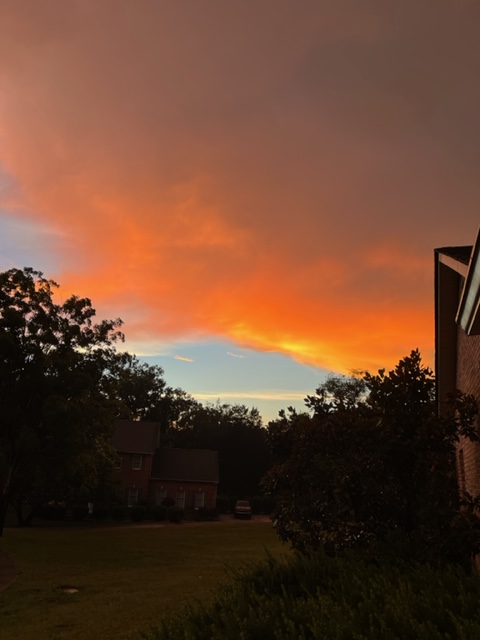
This July has been one of the stormiest months I can remember. Our days seemed to oscillate between over-100 degree heat indexes or storms. I took this picture of the sky right after a storm early in the month.

I didn’t quite capture the beauty I wanted to. But I love the light at the edge of the cloud, which shows more brightly on my phone than it does here. I thought it was a poignant symbolic reminder that storms may seem to come between us and God, but He is always there.

In-between the heat and storms, we had fun celebrating the birthday of our country plus the birthday of my middle son a couple of weeks later.

I mentioned this a few times already this month, but in case you missed it, I had an interview with Kurt and Kate Mornings on Moody Radio Florida to talk about my blog post on regret. Here’s a link to the interview. I started out with some technical glitches, but thankfully everything worked out.

I mentioned on my last Friday’s Fave Five that my husband had discovered this weird but fascinating creature on our patio. It looked like a cross between a bee, a hummingbird, and a moth. My son looked it up, and it’s a hummingbird moth, also sometimes called a hawk moth. Jim took a video, but I can’t upload videos directly unless I invest in the next tier of paid WordPress blogs. But I did manage to capture this photo from the video.

Timothyisms

My daughter-in-law texted me that she asked my grandson, Timothy, where he got his cuteness. He answered, “Mommy.” She said, “Annnd?” meaning, I think, and Daddy. But Timothy said, “And Grandma.” I’m honored to be considered a contributor to his cuteness. 🙂

One night we were playing Uno at our house. Timothy noted that our Uno cards looked different from his. I explained that ours were an older set. Someone else said, “These are classic Uno cards.” Timothy said, “That’s what classic means”–older. 🙂

Creating

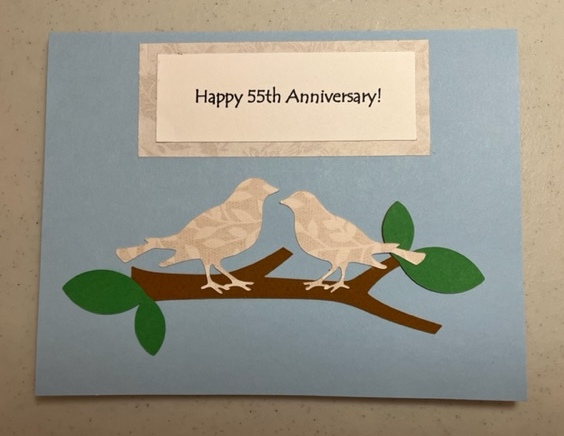
This card was for a couple in our church celebrating their 55th wedding anniversary:

The birds, branches, and leaves were made with the Cricut.

This was for Jason’s birthday:

I had an interesting time with this one. I try to incorporate something of the recipient’s interests when I can instead of just making a generic card. All I could think of for Jason is that he liked his family, the Mandalorian, and electric cars (and coffee, but I’ve used that motif in cards several times before). I looked up electric cars in the Cricut image data base, but they didn’t have much of a selection. This one was originally part of a design that had several tiny pieces that I was growing frustrated trying to piece together, then gave up. I tried a couple of other ideas that were ok, but I wasn’t thrilled with. I picked up a scrap that had this part cut out–this was the paper left after I took out the designed part–and I decided I liked it as it was. So I cut it out again and placed it in a better and then cut out the bolt after seeing that incorporated in another design.

This is for a great nephew’s wedding coming up this weekend. I meshed together a couple of ideas I had seen on Pinterest.

The embossing was done with the Cuttlebug. I printed out the “Mr. and Mrs.” on the computer and colored the edges by tapping a foam brush on a silver ink pad and brushing it against the edge of the cardstock.

Watching

I’ve thought about eliminating this category, but I enjoy when others share what they have watched. If you have any good, clean movie or series recommendations, let me know!

Jim likes WWII movies, so we’ve watched a few. One movie we really enjoyed was The Courageous Heart of Irena Sendler, based on the true story of a Polish social worker who worked with the Polish Underground Resistance and smuggled over 2,000 Jewish children out of the Warsaw ghetto and placed them with other families until the war was over.

We also watched a few old ones. I remember seeing The Great Escape when I was a kid, and it was interesting to watch it with adult eyes now. The Bridge on the River Kwai was good until its very frustrating ending. The Eagle Has Landed was a bit of a disappointment. If I had known it was fictional, based on a novel about German paratroopers trying to kidnap Churchill, I probably would not have watched it. It also had a bit of language, which is not usually a problem with older films. With all of these, it was kind of fun to see actors in their younger days that I had only seen when they were older.

Reading

I’ve enjoyed several good books this month. Since last time I have finished (linked to my reviews):

I’m currently reading:

  • Where I End: A Story of Tragedy, Truth, and Rebellious Hope by Katherine Elizabeth Clark
  • The Stranger by Melanie Dobson
  • O Love That Will Not Let Me Go: Facing Death with Courageous Confidence in God compiled by Nancy Guthrie (not that any of us is facing imminent death, as far as we know. But I saw several quotes from this in Aging With Grace and loved Nancy’s other compilations).
  • Lady Almina and the Real Downton Abbey: The Lost Legacy of Highclere Castle by the Countess of Carnarvon

Blogging

Besides the regular Friday Fave Fives, Saturday Laudable Linkage, and book reviews, I’ve posted these since last time:

We have a lot to look forward to in August, which my oldest son’s birthday and visit and my birthday.

How was your July?

Be Courageous (Luke 14-24)

The gospel of Luke is so full of good things that Warren Wiesrabe divided his commentary on Luke into two books. I mentioned the first, Be Compassionate (Luke 1-13): Let the World Know Jesus Cares, earlier in the month. Its companion is Be Courageous (Luke 14-24): Take Heart From Christ’s Example.

Luke 14 drops us right in the middle of Jesus’ ministry, with His healing of a man and then teaching through several parables. The next several chapters continue in much the same way. In addition to parables, Jesus teaches His disciples about the need to take up their cross and follow Him. In chapter 21, Jesus prophesies about the future.

Up to this point, the Pharisees, scribes, etc., have been keeping a close eye on Jesus, trying to trip Him up with questions, challenging His actions. In Chapter 22, things escalate with Judas offering to betray Jesus.

The narrative slows down in the next few chapters to focus on the events leading up to Jesus’ death. He celebrates the Passover with His disciples, institutes the Lord’s supper, is arrested, tried, and is found innocent, yet He is still given over to be crucified. Chapter 23 tells of His crucifixion and burial, and chapter 24 tells of His resurrection, appearance to the disciples, and ascension back to heaven..

There’s a lot in each of those chapters. In our discussion of five chapters at a time at church, we could only hit a few highlights in each one.

Luke’s books were written to his friend, Theophilus, to provide “an orderly account . . . that you may have certainty concerning the things you have been taught” (Luke 1:3-4).

Wiersbe ably explains things along the way, shares insights, and harmonizes Luke’s account with that of the other gospel writers. Some of his comments:

Our modern world is very competitive, and it is easy for God’s people to become more concerned about profit and loss than they are about sacrifice and service. “What will I get out of it?” may easily become life’s most important question (Matt. 19: 27ff.). We must strive to maintain the unselfish attitude that Jesus had and share what we have with others (pp. 21-22, Kindle version).

What does it mean to “carry the cross”? It means daily identification with Christ in shame, suffering, and surrender to God’s will. It means death to self, to our own plans and ambitions, and a willingness to serve Him as He directs (John 12: 23–28). A “cross” is something we willingly accept from God as part of His will for our lives (p. 26).

This chapter makes it clear that there is one message of salvation: God welcomes and forgives repentant sinners. But these parables also reveal that there are two aspects to this salvation. There is God’s part: The shepherd seeks the lost sheep, and the woman searches for the lost coin. But there is also man’s part in salvation, for the wayward son willingly repented and returned home. To emphasize but one aspect is to give a false view of salvation, for both the sovereignty of God and the responsibility of man must be considered (see John 6: 37; 2 Thess. 2: 13–14) (pp. 31-21).

Sin promises freedom, but it only brings slavery (John 8: 34); it promises success, but brings failure; it promises life, but “the wages of sin is death” (Rom. 6: 23). The boy thought he would “find himself,” but he only lost himself! When God is left out of our lives, enjoyment becomes enslavement (p. 36).

Peter’s self-confident boasting is a warning to us that none of us really knows his own heart (Jer. 17: 9) and that we can fail in the point of our greatest strength (p. 129).

I never noticed this before, but both the ESV Study Bible and Wiersbe point out that Luke begins and ends in the temple. In the first chapter, the birth of John the Baptist, the forerunner of Christ, is announced to his stunned father, Zechariah. In the last, Jesus’ followers “worshiped him and returned to Jerusalem with great joy, and were continually in the temple blessing God.

May we follow in their footsteps, joyfully worshiping and blessing Him.

Aging with Grace

In Aging with Grace: Flourishing in an Anti-Aging Culture, Sharon Betters and Susan Hunt “want readers to ask, ‘What if aging, though challenging, is not a season of purposelessness, but rather an opportunity to discover our true identity in a way we couldn’t in the first half of life? What if we purposefully prepare for the afternoon of life while we are in the first half of life?'” (p. 18, Kindle version). The book is helpful for those already in their later years as well as those wanting to prepare for them adequately.

Susan writes, “The world tells us aging is our enemy, and we should fight it; the Bible says it’s our friend: ‘Wisdom is with the aged, and understanding in length of days'” (Job 12: 12)” (p. 27).

God promises the righteous “still bear fruit in old age; they are ever full of sap and green” (Psalm 92:14). Susan acknowledges that, with the physical problems that often accompany getting older, we don’t always feel fruitful, full of sap, and green. But “this promise of growth does not mock my physical reality; it transcends it” (p. 28).

The gospel imperative to “grow in the grace and knowledge of our Lord and Savior Jesus Christ” (2 Pet. 3: 18) does not have an age limit. The same grace that gives us new life in Christ empowers that life to develop, mature, and flourish. We never finish growing. There is always more grace to experience and more to know of Christ’s love. This growth is gradual. We don’t produce it, but as we trust and obey God’s word, we can anticipate it (p. 28).

Susan and Sharon alternate chapters. Some chapters delve into the Bible’s teaching about getting older, particularly Psalm 92 and 71. The chapters in-between take a closer look at some of the older women in the Bible: Anna, The “matriarchs of the exile,” Elizabeth, and Naomi.

Anna was the older widow who came up when Mary and Joseph brought baby Jesus to the temple in Luke 2. At first the elderly Simeon rejoiced that he had lived to see “the Lord’s Christ” and prophesied about Him. Part of that prophesy was to Mary, that “a sword will pierce through your own soul also” (Luke 2:35). I hadn’t thought about it this way before, and the Bible doesn’t specifically say that Anna spoke to Mary, but Sharon proposes that Anna’s coming right at that moment helped comfort Mary.

Simeon told Mary the hard reality that a sword would pierce her soul. Can you sense Mary holding her baby boy a little tighter, her throat constricting and tears welling up? This young mother needed a tangible touch of God’s tender love. At this intense moment we meet eighty-four-year-old Anna. God providentially met Mary’s need through an old woman who hoped in God. At exactly the right moment, Anna shows up (p. 48).

The exile Sharon refers to occurred after Israel had repeatedly rejected God and turned to idols. God had sent prophets and sometimes delivered his people into the hands of their enemies. But even if they repented for a while, they eventually turned away from God again. So God allowed Nebuchadnezzar to remove them from their land and take most of them to Babylon for 70 years. God tells the people as a whole in Jeremiah 29 to settle down, plant, build, marry, and pray for the land of their exile. The older people would have realized they would die in exile and never see their country again. Again, I don’t think the Bible specifically mentions the older women in this scenario, but Sharon posits what they might have done.

Though the elderly women might not be able to physically build houses, their status in the family gave them a key opportunity to influence the attitudes and stability of their households. They could be life-givers or life-takers. They could choose to joyfully embrace God’s call to cultivate a godly, peaceful community or they could choose bitterness, whining, and complaining, and so can we (p. 84).

A few of the other quotes that stood out to me:

There are many things we can no longer do as we age, but age does not keep us from fulfilling our purpose to glorify and enjoy God. An ever-growing knowledge of God’s undeserved love—his grace—changes our motivation: “The love of Christ controls us” (2 Cor. 5: 14)” (p. 39).

Repenting women who find rest in Jesus become life-giving women who flourish as gatherers. When our heart is Christ’s home, we can become homey places for troubled hearts to find refuge,” (p. 70).

The world equates flourishing with activity and productivity. A biblical perspective does not mean we do more; it means we become more like Christ. We mature in faith, hope, and love” (p. 98).

As counterintuitive as it sounds, flourishing is a slow and progressive death that brings abundant life. Our new heart has new desires. Even as our physical bodies grow old, God causes our new desires to flourish as they are fertilized by his word and Spirit, and we die to self-centered desires, dreams, and demands (p. 99).

As life slows down, we can become controlling and critical, or we can reflect on God’s sovereign love that chose and planted us in his house. The more we live in the light of the reality of his presence, the more we flourish as his Spirit fills us with sap to nurture and encourage others to flourish (p. 105).

One joy of aging is a stillness of soul that helps us see the small moments as sacred moments when we can reflect God’s glory to someone else (p. 145).

The plot of dirt where we die [to self] is also the place where we flourish (p. 146).

To me, flourishing means gratefully accepting the past and present trials God gives me, and looking for opportunities to use what I have learned to help others. . . Whatever situations we find ourselves in as we age, there are nuggets of gold in our past that we can pass on to others. God never wastes a trial, a grief, or a wilderness wandering. We flourish when we give to others the lessons God has taught us (p. 151).

Naomi did not know her ordinary little family would become an extraordinary link to the coming Messiah. In fact, she died without knowing how her seemingly insignificant life fit into God’s magnificent eternal tapestry (p. 154).

At the end of each chapter, the authors include testimonies from older women in various circumstances who share how they found God’s grace to flourish. 

I very much enjoyed this book and it’s encouragement that we can keep growing and flourishing at any age. I’m pretty sure I’ll be reading it again in years to come to keep reminding me of its truths.

Updated to add: I forgot to mention that I’ve been reading this book in conjunction with InstaEncouragements. They’ve been going through the book and summarizing chapters each Tuesday the last few weeks. The comments have been enlightening as well. This book was on my to-read list anyway, and when I saw they were going through it, I jumped in. Reading with a group helps reinforce what I learn plus draws out things I missed. So, if you read this book, you might want to check out those posts as well.

Stricter Standards Do Not Always Equal Legalism

When I became a Christian at age 16 or 17, the pastor of the church I attended at that time taught that women should not wear pants. I had only been in church sporadically before this time, and I was also new to reading my Bible regularly and systematically. I had never heard this taught before.

Around this time, I saw an episode of The Big Valley in which the daughter wore pants, and it was A Really Big Deal in the community. I thought maybe modern society had just gotten away from the idea.

It wasn’t terribly hard to switch to wearing only dresses. The hardest part was trying to explain it to family members who thought it was odd.

Fast forward several years. In one of my college courses, the teacher happened to mention the verse that many people believe teaches that women shouldn’t wear pants, Deuteronomy 22:5: “A woman shall not wear anything that pertains to a man, nor shall a man put on a woman’s garment, for all who do so are an abomination to the Lord your God” (NKJV). She pointed out that both men and women wore robes in Bible times, so this was not talking about pants.

The more I thought about it, the more I realized my teacher was right. I believed that the Bible taught as a general principle that men should look like men and women like women. But that wasn’t necessarily defined by pants.

By that time, though, I had gotten used to wearing dresses and skirts. I had some pants for PE, for our childbirth classes (because I had to be on the floor for some of our exercises), and for the gym. But I felt comfortable in dresses as well as modest and feminine (though of course there are modest pants and immodest dresses, and femininity is not always manifested in dresses).

Fast forward another few decades. We were visiting Cade’s Cove on a late autumn day. It was incredibly cold, and I was tromping around foresty areas with bare calves. I thought, this is ridiculous. So I bought a couple of pairs of pants for such occasions.

Through all of this, I’ve been surprised to come across the sentiment that those who held to the belief that women shouldn’t wear pants were legalists. In most Christian circles, that’s almost the worst thing you can call someone.

But difference of interpretation that results in stricter standards and practices is not legalism.

At its most basic, legalism is the belief that I have to keep the OT law to be right with God. There’s also a sense in which trusting in rule-keeping to get or keep right with God is legalism.

Jesus’ death set us free from the law of Moses that people in the OT were under. Of course, the moral law carries over and is repeated in the NT (loving God first, not lying, stealing, killing, etc.). But the minutiae of the law given to Israel, which no one could keep anyway (Acts 13:38-39; 15:10-11), was kept perfectly by Christ in our stead. His laying down His life for us paid for all our failures. So we have a wonderful sense of freedom when we believe in Christ.

But this freedom doesn’t mean we can do whatever we feel like. “For you were called to freedom, brothers. Only do not use your freedom as an opportunity for the flesh, but through love serve one another. For the whole law is fulfilled in one word: ‘You shall love your neighbor as yourself.’ But if you bite and devour one another, watch out that you are not consumed by one another.” (Galatians 5:13-15).

I used to think that, since all Christians are indwelt by the same Holy Spirit, we all ought to come out on the same page about various issues. But that’s not what the Bible says.

There are some fundamental Biblical issues for which there is no wiggle room: the Deity of Christ, salvation by grace through faith, etc. But Romans 14 has instructions for those who come to different conclusions about what the Bible teaches in those areas that aren’t fundamental to the Christian faith. (Though the passage is discussing weaker brethren, I think some of these overarching principles apply.)

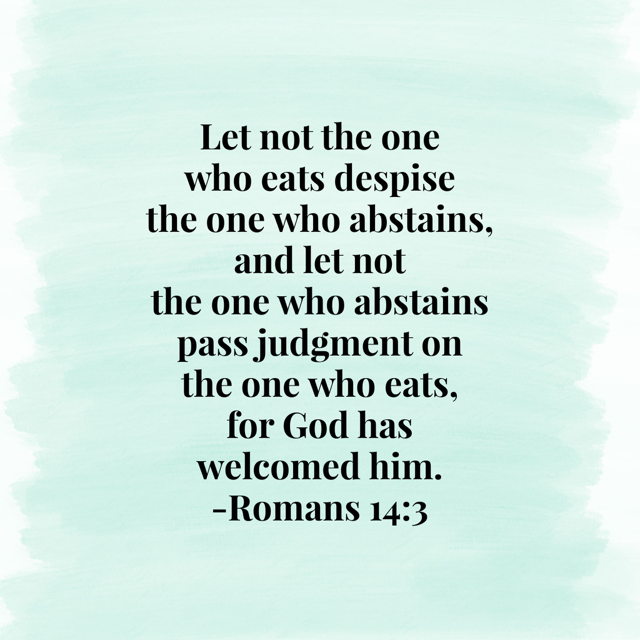
In Romans 14, people came down exactly opposite in their convictions and practices on some matters. Paul told them that each should do whatever they do as unto the Lord (verse 6), not judging or condemning each other, (verses 3, 10,13), being fully persuaded in their own minds (verses 5, 22), remembering they’re accountable to the Lord (verse 12), not being contentious about it (verses 1, 17-19), not to “quarrel over opinions” (verse 1).

One of the issues in Romans 14 was eating meat—not just meat that had been offered to idols as was the case in other passages. “One person believes he may eat anything, while the weak person eats only vegetables” (verse 2). Scripture actually sides with the meat-eaters in this case. God told Noah after the flood, “Every moving thing that lives shall be food for you. And as I gave you the green plants, I give you everything” (Genesis 9:3). Jesus declared all foods clean (Mark 7:18-19). In Peter’s vision, he was told that all food was clean. Paul warned against those “who forbid marriage and require abstinence from foods that God created to be received with thanksgiving by those who believe and know the truth. For everything created by God is good, and nothing is to be rejected if it is received with thanksgiving, for it is made holy by the word of God and prayer” (1 Timothy 4:3-5). Some may choose not to eat meat for other reasons, but it was not unclean any more as far as OT law went. Even still, in Romans 14, Paul advised people not to judge or quarrel over eating meat.

So we need to avoid “accusing” someone of legalism if they don’t believe in women wearing pants, if they do believe in women wearing head coverings, if they don’t believe in Christians drinking alcohol, if they have a stricter understanding of the role of women in church, or any other area in which you feel you have freedom that they don’t feel. Freer standards do not always equal spiritual superiority. Stricter standards do not always indicate legalism or weakness. They may just mean that someone has a different understanding of Scripture than you do.

These principles don’t mean we can never discuss these issues with others. But we need to avoid a “set them straight” mentality. First we must be swift to hear, slow to speak, and slow to wrath (James 1:19). We need to understand where the other person is coming from in their thinking. We need to assess whether the issue really even needs discussion. Is it really harming anyone? Is it something that will likely correct itself with time, growth, and maturity? Is it something we can agree to disagree about and move on? And if we feel that the other person actually is wrong in their interpretation and understanding, or they are operating from a feeling of conforming to a culture’s rules rather than the freedom of Scripture, we need to remember that “the Lord’s servant must not be quarrelsome but kind to everyone, able to teach” (2 Timothy 2:24).

(I often link up with some of these bloggers.)

Laudable Linkage

Here’s another list of good reads found this week:

We Need More Holy Fools: How God Awakened Me to Eternity, HT to The Story Warren. “A man is trapped in a car, rushing down a hill toward a cliff. The doors are locked. The brakes are out. The steering barely works. Far ahead, he can see other cars hurtling into the abyss. How far they fall, he does not know. What they find at the bottom, he cannot imagine. But he does not seek to know; he does not try to imagine. Instead, he paints the windshield, climbs into the back seat, and puts in his headphones.”

God Will Turn You Every Which Way But Loose. HT to Challies. “Do not believe the lies that say God wants your life to be as smooth as possible. That he desires for you to have a problem-free existence if only you would have enough faith.”

Being Domineering as a Pastor Doesn’t Require Skill, HT to Challies. Though this is written to pastors, it’s good advice for anyone in any leadership role.

3 Myths of the Good Old Days. “I’m guessing every generation has uttered this phrase, which makes me question: If my good old days were the previous generation’s not-so-good days, and on and on backwards, then when were the real good old days?”

The Indispensable Ministry of Disability, HT to Challies. “Our more recent experiences with Ben have opened my eyes to the realization that people with disabilities in our congregations are not just objects of ministry. They are gifted just like the rest of us, though often in ways that we haven’t realized.”

Rolls and Circles in Women’s Ministry: Why You Need Both. “When you think of discipleship in your church, women’s ministry, or small group, how do you picture the chairs being arranged? Do you picture the chairs in rows, facing a teacher in the front? Do you picture the chairs in circles, where small groups of women gather? Or do you think of discipleship as a single chair, where a woman opens her Bible and hears from God directly?”

When You’ve Given Your Troubles to God—But Still Can’t Sleep. “Insomnia is horrible. It is a form of suffering that lays us utterly bare before the Lord. We completely depend on him to show up. Sometimes he shows up by letting us fall asleep; sometimes he shows up by stripping us of self-sufficiency, making us see that he takes weary people and sustains them even when all earthly things fail them.”

Take the Chance. “It seemed like the ideal opportunity. Crouching in the darkness of the cave, David saw his enemy alone and vulnerable. It looked like the chance he had been waiting for.”

Friday’s Fave Five

Here we are at another Friday. Time to pause for a few moments with Susanne at Living to Tell the Story to think over the past week and remember the good parts.

1. Jason’s birthday. Always a joy to celebrate his arrival into this world.

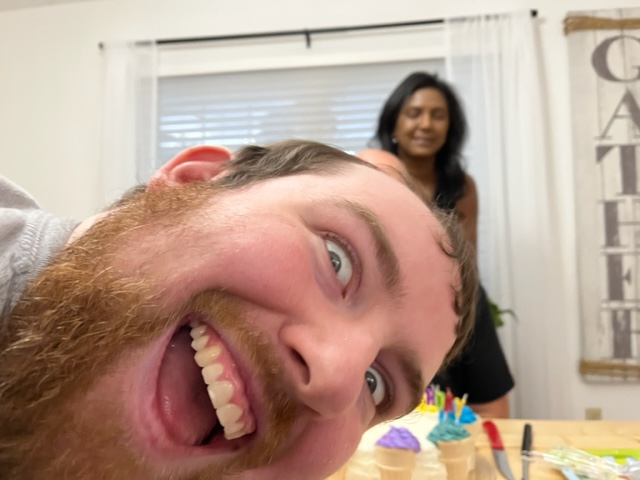
Mittu made the cake. Isn’t it cute?

And, because this is the kind of family we are, I have to include Jesse’s photo bomb. 🙂

2. Lunch with a friend. I think this is the first time I’ve gone out with this friend since last fall—because she had a baby in the meantime. 🙂 We’ve been in touch and seen each other at church, but it was good to have an extended visit.

3. A technology fix. My toolbar on my blog went missing, and every time I replied to a comment on my blog, it made me log in again. I asked my oldest son about it, and he sent me this article about Firefox’s Total Cookie Protection. I had gotten a notice from them asking if I wanted to turn off sites’ ability to use tracking cookies. Well, sure. But evidently it’s a little too aggressive. The article showed me how to disable it for individual sites, so I did that on my blog. My tool bar came back and I was able to comment normally again. Plus it seemed to fix the problems I was having commenting on a few sites. It’s definitely a first-world problem, but an annoying one, and it’s such a relief to have it fixed.

4. Safety and electricity. Wednesday night, we had one of the most intense storms I’ve experienced in a long time. Torrential rains and almost constant flashes of lightning, but not much thunder. We lost power for almost 24 hours. A neighbor’s fence was damaged on one side of his yard. A lot of people reported downed trees and branches and flooded roads on our community Facebook page.

We’re pretty well set when the power goes out. Jim has all kinds of camping equipment, and he powered up the RV Thursday morning with its generator for a few hours in order to do some work and have access to make breakfast, dry hair, etc. But it’s still a relief to have everything back on and back to normal.

I’m also thankful he was here. He was due to travel this week, but his trip got canceled.

5. A new discovery. Jim was on the patio one day when he noticed a weird bug flying around and sipping from some flowers in one of the planters. He filmed it in slow motion and showed the rest of us later. It looked like a cross between a hummingbird, a bee, and a moth. Jason looked it up, and it’s a hummingbird moth. I had never heard of them before. Ours was a pretty good size and had clear wings and looked like the ones in these pictures. I wish I could put Jim’s video up, but this is one I found on YouTube:

It’s fun to discover wonders in your own back yard!

Bonus: We watched Timothy for a few hours Monday night while Jason and Mittu had a meeting. He and Granddad enjoyed some Kinect Sports (video game) competitions.

How was your week?

Shadows In the Mind’s Eye

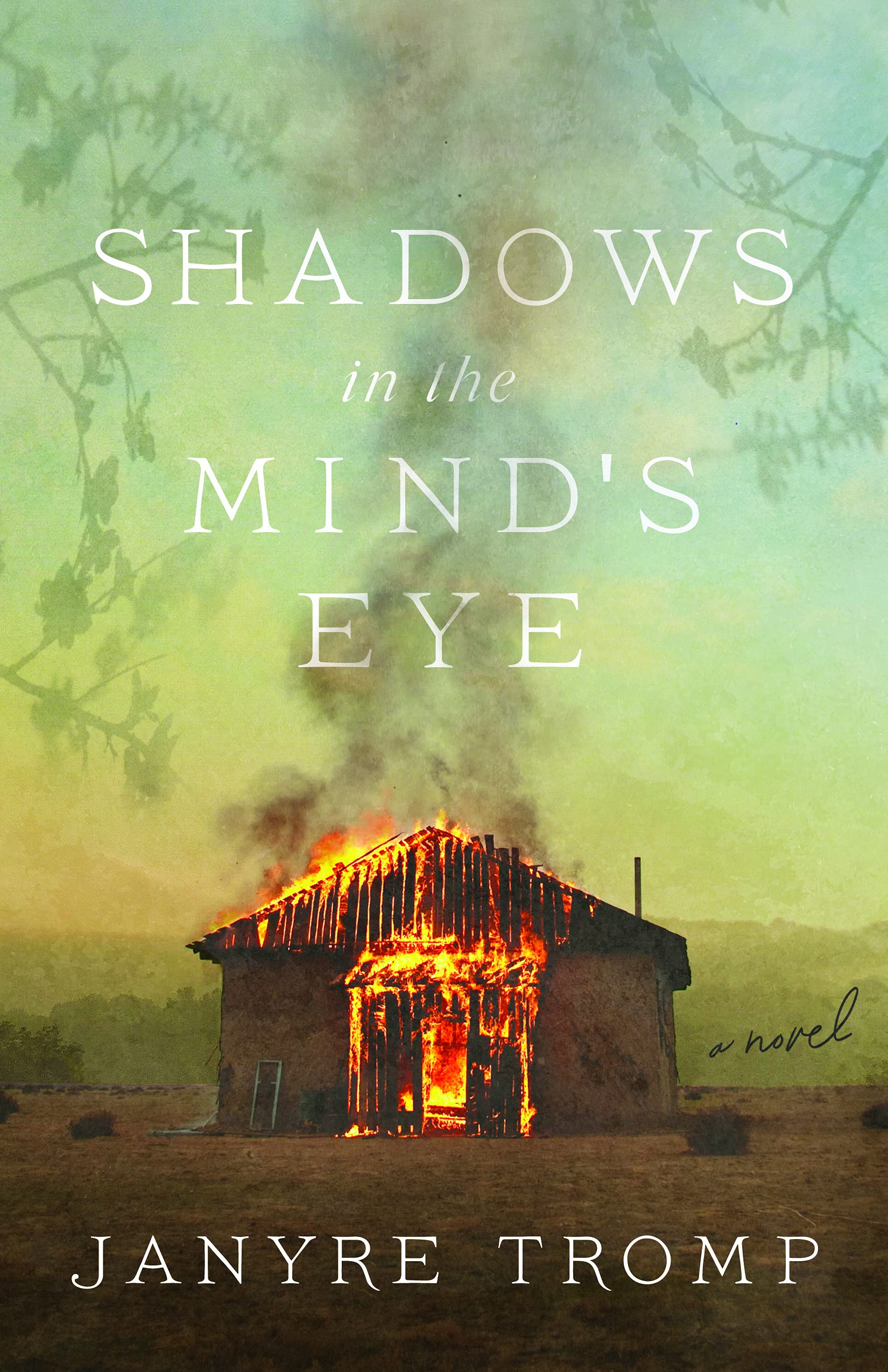
In Janyre Tromp’s novel, Shadows in the Mind’s Eye, Sam Mattas is on his way home from WWII. He’s changed and scarred physically and mentally by what he has experienced, seen, and had to do. He jumps at loud sounds. He’s not always sure what’s real and what’s imagined.

But he’s going home. Back to his dear wife, Annie, and Rosie, the daughter he’s looking forward to getting to know. Good, hard, familiar work on the farm and peace and quiet will set him right soon. He hopes.

Annie has dealt with trauma of her own even before her marriage. Her abusive father was a corrupt judge. When she was a girl, she found her dead mother in a lake. But Sam rescued her from all that. Life was hard while he was away. She had to scrabble for supplies, do all the farm work herself, and take in her mother-in-law.

But Sam is on his way home. She knows, from what her mother-in-law told her about her husband’s return from war, that it might take a while for things to return to normal. But everything will be all right.

Except everything is not all right.

Much has changed, and their wounds run deep. They have to learn new rhythms and ways of relating.

Then Sam starts seeing things. Lights in the woods, men in the shadows. Sam is convinced that something nefarious is happening out there, and he must protect his family. However, his delusions only put them in harm’s way.

But what if he is not actually hallucinating?

The chapters switch back and forth between Sam’s and Annie’s points of view. Their mistakes and learning how to deal with each other is interwoven with the suspense of what’s actually happening behind their house, not knowing whom to trust, and everything not seeming as it appears.

I had not heard of Janyre Tromp until Anita interviewed her about this book on a podcast, Working Through Trauma in Literature and Real Life. Janyre’s experience with caregiver trauma and her grandfather’s experiences after the war led her to study PTSD. Her book was not out yet at that time, but I pre-ordered it then.

Some of the quotes that stood out to me:

Happily ever after don’t happen lessen each person in marriage works. It’s like a team of horses, They both have to carry their own load (p. 155).

Once you let yourself start feeling, it all breaks loose (p.147).

I stood quiet, soaking in her peace. Every motion was calm, sure, She knew where she belonged, and that sent her roots deep into the ground, able to weather whatever life threw at her (p. 122).

You’d think holding joy right up against sadness would shatter a body. But it don’t. Joy…it sneaks in all around where things is broke, sticks it all together and finds a way to make you whole. It’s where things is broke that joy shows through.

My one criticism is that characters say “Lord Almighty” and such. In my book, taking the name of the Lord of glory and using it as an expression is taking His Name in vain. If something is done in vain, it’s useless; it hasn’t accomplished the purpose for which it was meant. God’s name in meant to be reverenced, used in prayer, in worship, or in talking about Him.

Other than that, I really enjoyed the book. Parts near the end were quite suspenseful. I liked the realistic way Sam and Annie reached out to each other yet made mistakes as well.