As July speeds by, it’s time to pause with Susanne and friends to note and appreciate some of the highlights of the week.
1. Jason’s birthday. We love opportunities to celebrate each other, and I am thankful for Jason’s special day.
2.Chocolate Cheesecake. Mittu made this for Jason’s birthday, and I love the decoration she found for the top. If you can’t read it, it says “Happy Quarantine Birthday.”
3. Thoughtfulness. Jason wanted Indian food for his birthday dinner. Knowing that’s not my favorite, Mittu make a sausage/zucchini/pasta dish for me. I appreciated that she went through the extra work to make a separate entree, in addition to the other three entrees she makes for an Indian food dinner .
4. Conversations with Timothy. I love that sometimes he’ll seek me out to talk, like when I’m in the kitchen and everyone else is in the living room. When they camped out in the yard a few weeks ago, Timothy came into the bathroom while I was fixing my hair, played with my makeup mirror, commented on how his mom’s blow dryer was different from mine, etc. It had been a long time since I had little person company there!
5. Patient portals. Our doctor’s office has an online portal through which we can access our account, look at lab results, or send in a question. I don’t know why, but I much prefer using this rather than calling in. So I am glad that’s an option for things that aren’t urgent.
In Hurricane Season by Laura K. Denton, Betsy and Jenna grew up as very different sisters. Their parents were both professionals and distant. Betsy was the responsible one who did all the right things. Jenna was free-spirited, willful, and apt to make a mess of things. But they loved each other fiercely, and Betsy was Jenna’s greatest advocate and protector.
As adults, Betsy married dairy farmer Ty, and they work together to make a go of the business and home that had been passed down through generations in Alabama. Their biggest sorrow is their inability to have children.
Jenna is a single mom to two young girls and a coffee shop manager. An old friend urges Jenna to go to an artist’s retreat in Florida to revive her dormant love of photography. At first it seems impossible. But a scholarship and her sister’s agreement to watch the girls for two weeks enable Jenna to go.
Betsy’s fragile peace with her childlessness is threatened by having two children full time, but she thinks she can hold on for two weeks. But then Jenna calls. She has an opportunity to stay past the initial two weeks, possibly even for the rest of the summer.
Besides the potential storms brewing internally, a hurricane threatens the Gulf of Mexico.
The point of view shifts back and forth between Betsy, Ty, and Jenna. Their current circumstances and their past histories are shaped by their perspectives and personalities. Probably no one person has the entire perspective of a family. We need each other’s viewpoints and narratives to understand the whole.
I enjoyed each sister’s bumpy journey. My mind raced ahead to different ways the plot might go, but it ended up working our differently than I had thought it would—a good thing!
When I bought this book, I thought it was Christian fiction. Though there are a few mentions of God, prayer, church, etc., I can’t say a faith message was overt. For that reason, I’d label it inspirational fiction.
This is the second of four novels by USA Today best-selling author Denton. Have you read any of her work? What did you think?
A university building used for student housing is about to be torn down, and those who lived there are invited for a reunion. Four former roommates find their way back to Carrington, Oregon. They used to be close but they haven’t spoken in 25 years.
Hope James stayed in the area, running a coffee shop. She was considered the quiet glue that kept them connected while they were students.
Ireland Jayne used to be the one that called them to prayer. But she has walked away from her faith and turned her concerns towards environmentalism and activism. She is a professor, but her job is presently hanging by a thread. She has not seen her son in years.
Jenna Savage has been a stay-at-home mom, but her triplets just fled the nest. She had cried and prayed and tried so long to become pregnant, and then loved her three so much, that she doesn’t know what to do with herself now that they’re gone. She has a penchant for food and not for exercise.
Vickie Cambridge has a worldwide ministry and TV show for women, but she has neglected her own family.
Somehow the latter three end up on a survival trip in the Cascades with an older woman named Glenda, described by one as a “mountain woman.” Jenna wants the challenge. Ireland and Vicky want the escape.
None of them has any experience, and the trip is rougher than expected. (When Glenda vetoes Vicky’s butane curling iron, Vicky quips, “This must be what persecuted missionary wives feel like.”)
But then a series of disasters tests them beyond their limits and brings out the best and worst in each one.
The chapters alternate between the different women’s points of view, giving us a window into their inner struggles and their differing views of their situations and each other.
One thing this book taught me: I do not ever want to go on a survivalist trip into any wilderness or forest of any kind. Even without the disasters.
But besides that, I thought the women’s stories and journeys were so well told. I ached with each of them in their troubles and rooted for them in their triumphs.
I loved Christina’s phrasing:
The sun beats down on us and makes me feel like a loaf of over-kneaded bread in the oven.
Vicky snivels on the other side of me. I’m in an emotional sandwich. And it’s making me swirl with unease. The lightning looks like a safer companion.
Saving nature and surviving it are two very different things. We are not saviors in the wilderness. We are intruders.
The next thing she says is a muffle of grunts. Great, we’ve lost the perky one. We’re doomed.
“How do you think the pioneers got their soap?” “They bought it before they left.”
Maybe this is God’s provision. It never looks like I imagine.
I also like that the story doesn’t end with their getting out of the woods, but continues on with the aftermath of everything that happened.
All in all, a great book. I look forward to reading more by Christina.
I never heard Handel’s Messiah until I was in high school.
I had not grown up listening to either classical or religious music. (I grew up hearing “Your Cheatin’ Heart” and other such lovely little ditties). So while I was impressed with the beauty and grandeur of Handel’s oratorio, I can’t say I got much out of it. It was like drinking from the proverbial fire hydrant.
But my college performed selections from the Messiah frequently. And the church we attended the first fourteen years we were married did the same. I even got to be in the choir at church some of those years, so I learned the songs in more detail. Plus, I had become a Christian in later high school, so I could understand more of the spiritual significance and message of the piece.
When I learned that The Messiah had been composed during the Baroque era, with its “excessive ornamentation or complexity,” I understood why it was written the way it was.
As a result of hearing The Messiah over and over, becoming more familiar with it, learning more about it, and growing in the Lord, I came to love this piece of music. I anticipated each section just like I would rereading a favorite book or rewatching a favorite movie.
And then, just from growing familiarity with the music, I began to notice details. For instance, I had always thoughts of Isaiah 53:6 as somber and sad: “All we like sheep have gone astray; we have turned—every one—to his own way; and the Lord has laid on him the iniquity of us all.” But the tune Handel put to this verse seemed almost jaunty to me at first. Then one day I noticed the notes on the word “astray” were going astray.
Further into that piece, on “We have turned,” the notes are turning over and over.
Isaiah 40:4 says, “Every valley shall be exalted, and every mountain and hill shall be made low: and the crooked shall be made straight, and the rough places plain.” In the song based on this passage, the notes on the word “crooked” go up and down—they would look crooked on the sheet music. And the melody on “straight” and “plain” is mostly straight. The notes on “exalted” go up.
The melodies illustrate the words! And I had listened to and sung this I don’t know how many times before that clicked. In fact, I just caught “exalted” going up watching this video.
In many ways, my journey with the Bible parallels my journey with this piece of music.
I had attended church occasionally growing up. I knew some basic Bible truths and narratives. But I didn’t start reading the Bible myself until high school. The church I started attending when I was sixteen strongly encouraged its people to read the Bible through in a year. So I did.
And it was like trying to drink from a fire hydrant.
But I am so thankful for that emphasis at the outset of my Christian life. That grounded me more than anything else and set me off with good habits.
I didn’t understand everything I read. Similarly, in church, I couldn’t have told you the main points of the sermon afterward. But I got enough to chew on and to nourish me. The Bible speaks of those young in the faith as taking in milk from the Word. So I took in and digested what I could, and my life was changed.
When I got to something I didn’t understand, I’d just keep going.For instance, Psalm 60:4-5 says:
Thou hast given a banner to them that fear thee, that it may be displayed because of the truth. Selah. That thy beloved may be delivered; save with thy right hand, and hear me.
And I would think, “Wow, that’s good!” Then the next few verses listed a bunch of names I didn’t know. And then I came to verse 8: “Moab is my washpot; over Edom will I cast out my shoe: Philistia, triumph thou because of me.”
And I thought, “Huh?”
And then I’d keep going to verses 11 and 12: “Give us help from trouble: for vain is the help of man. Through God we shall do valiantly: for he it is that shall tread down our enemies.” And I’d think, “Wow, so good!”
I don’t know if that’s the best way for a new Christian to go about Bible reading. But no one had told me what to do about the parts I didn’t understand. I had never heard of study Bibles in those days. Still, the Lord met me in those times with His Word.
And as I kept reading in the 40+ years since (though not through the whole Bible in a year any more), I understood more and more. I saw how individual verses and books fit within the whole. I know what Moab and Edom and Philistia are now. There are parts that are as familiar as any favorite, much-read book. There are parts holding dear memories of God giving me just the right words in an hour of need. I anticipate what’s coming next in a passage. But I am still learning new things even from old, familiar stories and chapters.
So, why am I telling you this today?
I want to encourage you to get into a habit of reading your Bible, if you’re not already doing so.
And I want to encourage you to read all of it. Maybe not in a year. There are two-year plans and five-year plans and almost any kind of plan you could think of. But if we just keep turning to our old favorite passages, we’ll miss so much.
And if you’re discouraged because there is so much you don’t understand, I want to encourage you to keep reading. You’ll “get” more and more of it the more you read it. Someone has said that the Bible is shallow enough for a child to wade in, but deep enough for an elephant to swim in. God can speak to you and minister to you even if you don’t understand every little thing in the passage. In fact, we’ll never exhaust the Bible in this lifetime.
The Bible says to “long for the pure spiritual milk, that by it you may grow up into salvation” (1 Peter 2:2-3), and then to go on to solid food (1 Corinthians 3:1-2) as we “ mature, for those who have their powers of discernment trained by constant practice to distinguish good from evil (Hebrew 5:11-13).
But even more than spiritual food, the Bible provides spiritual fellowship. We don’t read the Bible as an end in itself, but to get to know God better. The Bible is the primary way God speaks to us. From the time God’s words were first written all the way through until the end of time, God expected His people to read and follow it.
His divine power has granted to us all things that pertain to life and godliness, through the knowledge of him who called us to his own glory and excellence, by which he has granted to us his precious and very great promises, so that through them you may become partakers of the divine nature, having escaped from the corruption that is in the world because of sinful desire (2 Peter 1:3-4).
What a treasure trove we have in the Bible! May we partake of it every day.
Your words were found, and I ate them, and your words became to me a joy and the delight of my heart,for I am called by your name, O Lord, God of hosts (Jeremiah 15:16).
Here another list of noteworthy reads from the last week:
Why We Shouldn’t Speak Flippantly or Joke About Hell, HT to Challies. “The reason why we shouldn’t speak flippantly or joke about hell is because the biblical authors never do. The biblical authors are crystal clear about hell. It is a real place . . .”
Seeing the World in Black and White, HT to Challies. “But as real as my initial frustration was, and as pure as sympathizers’ comments and reshares might be, we would have conspired in an injustice against that little old lady. Further, it would have deepened in me (and others) a mindset that I am convinced enslaves those who hold to it.”
Pure for You, But Not for Me. “Too often, it’s tempting to judge another believer for watching ‘that show’ on TV, when ‘my show’ may be just as poisonous to my soul, even though it lacks explicit content. Perhaps then we would be wise to invest less energy into casting judgment and more energy into learning what is impure for us contextually.”
A ‘Sober Curious’ Quarantine Broke My Perfectionism, HT to Proclaim and Defend. “No longer is sobriety seen as just the last resort for people whose lives are falling apart. Many in the sober curious set would not label themselves as traditional alcoholics, but they do wonder if their drinking is a problem and recognize the benefits of ditching the booze.”
How Early Christianity was Mocked for Welcoming Women, HT to Proclaim and Defend. “So, what do we make of the fact that early Christianity was mocked for being pro-women? Well, it certainly turns the tables on the over-used criticism in the modern world that early Christianity was a patriarchal, misogynistic religion that was hostile to women.”
The Jesus Movement Followed 1968. What Will Follow 2020? HT to Challies. The late 1960s were remarkably similar to our times, including a pandemic. Many are praying God will use current events to turn people’s hearts to Him. While acknowledging “The Jesus Movement was far from perfect,” “Let us pray in faith, Lord, do it again; greater, broader, and deeper than ever before.'”
It’s Friday again! Time to pause with Susanne and friends to note the good things of the week, lest they slip by without notice. Here are some highlights of my week:
1. A meal I didn’t cook. I always appreciate when my daughter-in-law texts to see if they can come over and make dinner, but especially when I was just thinking I didn’t feel like cooking that night.
2. Taking care of plants. I don’t do that as often as I should. But our front planters have some ivy that likes to take over, and our roses badly needed deadheading and pruning. I kept planning to go out early before it got hot, but never made it. So one evening when Jim had to go somewhere after dinner, I did some work with the plants then. Plus I took a houseplant Jason and Mittu had given me and replanted it outside. It still had some green leaves, so hopefully it will do better out there than it did inside. Nice to get those things taken care of.
3. Root beer floats are my reward for getting hot and sweaty working outside. 🙂 We get these mini cans of root beer that are just the right amount for our glasses. And thankfully lactose-free ice cream is available now.
4. Air conditioning and ceiling fans. I don’t know how people survived 90+ degree temperatures and 80+% humidity without them.
5. A Zoom visit. I had not been able to get together with a friend that I sometimes go to lunch with since before the coronavirus started. We decided to have our own Zoom meeting. It was fun to catch up while seeing each other.
Herman Melville’s last novel, Billy Budd, was set on an English ship in the late 1700s. Billy had worked on a merchant ship, but was impressed—forced—into the British navy. He went willingly and cheerfully, however. Billy was young, good-looking, well-liked, and basically a moral, upright man.
The master-at-arms on the ship, John Claggart, took an instant dislike to Billy. The biggest factor was probably envy, but Melville seems to attribute Claggart’s dislike to his own nature, which was bent toward evil. Billy, bent toward good and a little naive, didn’t recognize the signs of Claggart’s dislike and didn’t believe it when told.
Billy accidentally kills Claggart. His captain is put in a hard position. He believes Billy was the better man and didn’t kill Claggart on purpose. But naval laws at that time were strict in the wake of a couple of severe mutinies. Justice had to be meted out swiftly and decisively to maintain order and serve as a warning.
Billy Budd was unfinished at Melville’s death, and his wife and biographer tried to piece his work and guess his intentions. Their attempts were largely considered inferior. A later biographer was given the original manuscript and notes and came up with a better version. But different versions are still circulating. I listened to the audio version at Libravox which didn’t identify which manuscript was used. But it must have been an older one, because it had a different name for the ship, and the online version includes a preface which Wikipedia says was cut in later versions.
Because Melville hadn’t finished the book, it’s hard to know his intent in writing it. Was it a basic good vs. evil conflict, in which the good doesn’t always win out in this life? Was it a reaction against naval laws, a warning that they needed clarification? It’s hard to say. it’s interesting that Billy’s old ship was named The Rights of Man, and as Billy leaves it, he calls out, “Goodbye to you, old Rights of Man.” Perhaps this is symbolic.
Billy is presented as innocent to the point that, when the chaplain calls on him, Billy listens out of politeness but doesn’t “receive” the message. The chaplain concludes that “innocence was even a better thing than religion wherewith to go to judgment” and leaves off. But no man is so innocent that he can face judgement without Christ.
I chose this book for the Abandoned Classic category (one you started but never finished) of the Back to the Classics challenge. Reading Billy Budd was an assignment for a college class, but I never finished it—odd, since it’s a short book. I was docked points for not finishing the reading assignment, and have rarely thought about it since. But it was one of only two classics that I could remember not finishing.
It was an interesting story. Many consider it a masterpiece for Melville second only to Moby Dick. It’s not the type of story I’d generally gravitate to. But that’s one thing I like about the Back to the Classics challenge: it expands my reading horizons. I’m glad to be acquainted with Billy story which, as most classics do, provides much food for thought.
Have you ever read Billy Budd? What did you think.
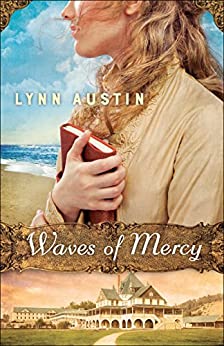
In Lynn Austin’s novel, Waves of Mercy, 67-year-old Geesje de Jonge is asked to write some of her experiences immigrating from the Netherlands for Holland, Michigan’s 50th anniversary celebration. She’s reluctant to delve back into the hardships and struggles of faith that accompanied her journey, but her son and neighbor finally persuade her to.
Meanwhile, young socialite Anna Nicholson had accidentally stumbled into a Chicago church that was unlike any she had known before, which stirred up questions about faith and God. But her fiance had not approved of this new church and forbid her to go back to it. Their disagreement was so severe that they broke up. Anna gets away to a hotel on Lake Michigan with her mother to think and recover. A storm on the way causes a recurring nightmare to resurface in which she and her mother fall into the sea during a storm.
On her long walks on the beach, Anna meets a young seminary student who tries to answer her questions. Her mother is no help at all, since she doesn’t think polite people talk about such things as religion. Her fiance wants to get back together, and her parents encourage their reunion. But Anna feels she needs to get some things settled in her heart first.
As the Amazon description says, “Neither Geesje nor Anna, who are different in every possible way, can foresee the life-altering surprises awaiting them before the summer ends.”
I enjoyed this book a lot. The Netherlanders had left their home to escape religious persecution arising from their wanting to pull away from the state church. America was a land of freedom and opportunity. They knew it would be hard to build a community from scratch, but they were willing to work for their and each other’s freedom.
However, they had no idea the difficulties and heartbreak that would be involved. Anna often struggled with despair, even rage. While I agree that we can be honest with God about our feelings, doubts, and questions, I disagree with Geesje telling someone who had suffered a loss, ““You have every right to be angry with God right now.” However, she does go on to tell this person, “No matter what, don’t ever stop trusting Him. I believe that God is as grieved . . . as we are.”
I enjoyed Anna’s story as well. She’s often tempted to give up her questions and go along with the pressure of her parents’ and fiance’s expectations. But something keeps propelling her forward.
The sequel to this book, Legacy of Mercy, continues Anna and Geesje’s stories. I’m putting it on my birthday wish list!
There are twelve minor prophetical books in the Bible. They are not called minor because they are any less important than the major prophets: they are just shorter books. Warren Wierbe divides his “Be” commentaries on the minor prophets into three different books. He didn’t group them in the order in which they are listed in the Old Testament. Be Concerned (Minor Prophets): Making a Difference in Your Lifetime covers Amos, Obadiah, Micah, and Zephaniah.
Wiersbe gives a little background of each of these prophets, the times they lived, the kings who were in power at the time, and the prophets’ major messages and concerns. Then he offers a suggested outline of the books and his commentary.
A few words about each of these prophets:
Amos was a shepherd and caretaker of sycamore trees. He was a layman, not a member of the religious establishment. For those reasons, he would not have been respected or easily accepted. At this time, Israel and Judah were abounding in luxury, but also in sin and injustice. They performed religious rituals that did not touch their heart. Amos had to warn them that judgment was coming if they didn’t turn from their ways.
Obadiah’s book is short, just one chapter of 21 verses. He prophecies mostly to Edom, the nation that descended from Esau, Jacob’s brother. God deals with them about their treatment of Israel (Jacob’s descendants).
Micah’s preaching helped lead to a reformation under Hezekiah (Jeremiah 26:18-19). But at this time, some of the wealthy of the land were buying up the smaller lands of the poor in defiance of Jewish law. Micah rebuked them, foretold the coming judgment under Assyria, and called the Israelites back to true worship of their God. But they didn’t repent. Micah 7 is one of my favorite chapters in the OT, especially verses 8-10 and 18-20. Micah’s name means “Who is like the LORD,” and that’s echoed in 7:18: “Who is a God like you, pardoning iniquity and passing over transgression for the remnant of his inheritance? He does not retain his anger forever,because he delights in steadfast love.”
Zephaniah mainly preaches about the day of the Lord, a time of coming judgment. Many of the prophets do, but this day is a major theme in Zephaniah and Joel. Zephaniah 3:17 is another favorite passage.
One advantage of a commentary like this is the background information it provides that you wouldn’t pick up just from reading the text. For instance:
Eight times Amos used the phrase “for three transgressions and for four,” a Jewish idiom that means “an indefinite number that has finally come to the end” (Location 135).
Micah used a series of puns based on the names of the cities similar in sound to familiar Hebrew words. For example, “Gath” is similar to the Hebrew word for “tell.” Thus he wrote, “Tell it not in Gath.” Beth Ophrah means “house of dust.” Thus he wrote, “Roll in the dust.” The people of Shaphir (“ pleasant, beautiful”) would look neither beautiful nor pleasant as they were herded off as naked prisoners of war (Location 1438).
The prophets call people to repentance from their oppression, hypocrisy, idolatry:
To seek the Lord doesn’t mean simply to run to God for help when our sins get us into trouble, although God will receive us if we’re sincere. It means to loathe and despise the sin in our lives, turn from it, and seek the fellowship of God and His cleansing. “A broken and a contrite heart—these, O God, You will not despise” (Ps. 51: 17 NKJV) (Location 679).
Wiersbe warns, “Whenever a prophet foretold the future, it was to awaken the people to their responsibilities in the present. Bible prophecy isn’t entertainment for the curious; it’s encouragement for the serious (Location 1672).
It’s true in our day as well as theirs that “It’s indeed a great privilege to have God speak to us, but it’s also a great responsibility. If we don’t open our hearts to hear His Word and obey Him, we’re in grave danger of hardening our hearts and incurring the wrath of God. ‘Today, if you will hear His voice, do not harden your hearts’ (Heb. 3: 7–8 NKJV; see Ps. 95: 7–11)(Location 321).
The way we treat God’s Word is the way we treat God, and the way we treat God’s messengers is the way we treat the Lord Himself (John 15: 18–21). “God … has in these last days spoken to us by His Son. … See that you do not refuse Him who speaks” (Heb. 1: 1–2; 12: 25 NKJV) (Location 642, emphasis mine).
Most of the prophets say that, despite fierce and righteous judgment coming on God’s people, He will leave a faithful remnant. Wiersbe concludes with a chapter titled “The Company of the Concerned,” with advice for the faithful in our day.
Malachi 3: 16 is a good description of the kind of “company” God is looking for: “Then those who feared the LORD spoke to one another, and the LORD listened and heard them; so a book of remembrance was written before Him for those who fear the LORD and who meditate on His name” (NKJV) (Location 2341).
I’m not talking about people motivated by anger so much as by anguish. Certainly there’s a place for righteous anger in the Christian life (Eph. 4: 26), but anger alone may do more harm than good. “For the wrath of man does not produce the righteousness of God” (James 1: 20 NKJV). When righteous anger is mingled with compassion, you have anguish; and anguish is what the “company of the concerned” feel as they behold the moral and spiritual decline of the nation. “Rivers of water run down from my eyes, because men do not keep Your law” (Ps. 119: 136 NKJV). “Trouble and anguish have overtaken me, yet Your commandments are my delights” (v. 143 NKJV) (Location 2311).
As always, I appreciate Wiersbe’s help in understanding these books.
There’s a lot to be concerned about in this life, isn’t there? Making a living, maintaining a marriage, raising children, getting along with coworkers and neighbors, car and house repairs, health concerns, preparing for retirement, church ministries, political discord, the latest negative news. And that was before a global pandemic and rioting in the streets. We truly have a lot to occupy our thoughts and time. Sometimes we feel we can’t keep up with it all.
But the cares of this life can have a detrimental impact in unexpected ways.
In Mark 4:1-9, Jesus told a parable of a sower—a planter—planting seeds. Only a few of the seeds took root and grew. Some were eaten by birds, some landed on rocky ground, some were choked out.
The disciples asked Jesus the meaning of this parable in Mark 4:10-20. He said that the seed was the word of God. The seed being eaten by birds is a picture of Satan snatching the word away before it can germinate from people who don’t understand (Matthew 13:19). The rocky ground represents a stony heart that might have soil enough for a plant to sprout, but not enough to nourish the plant. Some people seem to believe, but then never progress because they never dealt with the bedrock in their hearts. Then some of the word is choked by “the cares of the world and the deceitfulness of riches and the desires for other things” (verse 19). The ESV Study Biblenotes say, on the account of this parable in Matthew 13, “Competing for nutrients from the soil, weeds choke out the good plants, which are then unable to reach maturity and bear fruit.”
Some say that this parable is about the gospel, not the whole word of God. Even if that’s the case, we can choke out the word of God in general when we’re distracted, can’t we? I’ve experienced not being able to take in or rest in God’s promises because my attention is on my cares.
In Luke 21, Jesus mentions the cares of this life again, along with “dissipation and drunkenness.” These distractions can preoccupy people from warnings to prepare for His coming, and then that day will “come upon you suddenly like a trap.”
How can we keep the cares of this life, this world, from distracting us from more important things?
“Casting all your care upon him; for he cares for you” (1 Peter 5:7, NKJV; other versions say “anxieties” or “worries”). The word for “care” is the same Greek word as “cares” in the two passages above:
But before we can cast our cares on Him, we have to back up to the verses that come before this:
Clothe yourselves, all of you, with humility toward one another, for “God opposes the proud but gives grace to the humble.” Humble yourselves, therefore, under the mighty hand of God so that at the proper time he may exalt you,casting all your anxieties on him, because he cares for you (1 Peter 5:5b-7, ESV).
We have to humble ourselves before God, acknowledge Him for who He is and ourselves for who we are. He’s our sovereign Lord. He made us. He redeemed us through Christ’s death on the cross. He is wise. He has the right to call the shots. But He is also love. He is kind. He is our provider. He cares for us.
Then we “cast our cares” on Him. The Greek word for cast means “to throw upon; to place upon.” In prayer and in faith, we place them on Him, knowing He loves us, knowing He can take care of the problems and meet our needs.
How do we know these things? From His word.
Psalm 1 tells us that the person whose “delight is in the law of the Lord”and who “meditates day and night” on it is “like a treeplanted by streams of waterthat yields its fruit in its season,and its leaf does not wither.”
Instead of our cares choking out the Word, we sink our roots deep into it. When concerns swirl in our minds, we take our thoughts captive and remind ourselves of God’s truth.
I don’t think it’s going too far to say that spending time with God is the most important thing we can do each day. Some seasons of life, we may have half an hour to an hour to spend with the Bible. Other seasons, we’re doing good to get five minutes. But I like what Sue Donaldson says here: “I figure if I can’t give God five minutes anytime on any given day, I’m not taking Him and our relationship seriously. ”
Psalm 1 speaks of not just reading, but delighting in and meditating in God’s word. We can write a verse out that spoke to us and keep it before our eyes through the day. We can listen to the Bible itself or to Christian music, sermons, podcasts while we’re driving, cooking, etc., setting our “minds on things that are above, not on things that are on earth” (Colossians 3:1-2).
Some years ago, I attended a ladies retreat where, on the last day, the speaker had us write down a concern, burden, or prayer request on a small piece of paper. Then she asked us to fold the paper and turn it in. She collected all the papers and put them into a bag, then tied the bag onto a collection of helium-filled balloons. Then we all went outside. I think she prayed, giving all the concerns we had collected to the Lord. Then she released the balloons, symbolizing releasing these concerns to God.
Honestly, at the time I thought it was a little silly. And I wondered what the person who eventually found the little bag would think.
But a few days later, something I had written on my little paper came to mind. I don’t even remember what it was now. But as I turned it over in my thoughts, suddenly I remembered: “I gave this to the Lord. I don’t need to keep worrying about it.”
Perhaps some physical way of handing our cares over to Him might help cement the idea in our minds. I don’t think releasing more balloons would be good for the environment. One friend used to cup her hands and raise them up to the Lord while praying, physically reminding herself that she was giving her concerns to Him. Maybe a prayer journal would be a concrete way to note the concerns and requests we’ve given over to God.
Giving concerns to Him doesn’t mean we never pray about them any more. But when we do, we remind ourselves that He invites us to place on Him all our cares, and He’s the only one who can take care of them. Some prayer requests last a lifetime. But when God does answer others, we can record how and when. What an encouragement to faith to look back over that record.


 As July speeds by, it’s time to pause with Susanne and friends to note and appreciate some of the highlights of the week.
 2.Chocolate Cheesecake. Mittu made this for Jason’s birthday, and I love the decoration she found for the top. If you can’t read it, it says “Happy Quarantine Birthday.”







 Stray Thoughts