Unknown's avatar

About Barbara Harper

https://barbarah.wordpress.com

Laudable Linkage

A collection of good reading online

Some good reads from this week:

Bible Study From the Outside In. How to work from the big picture to the smaller details.

The Wisdom in Restraining Our Lips, HT to Challies. When I respond in the heat of the moment, I usually regret it. “There is wisdom in letting our words slowly bake and simmer in our hearts and minds before making them known.”

Intellectual Disabilities and the Church, HT to Challies. I like the step beyond inclusion to integration.

Watching What I Invest in Evaporate, HT to Challies. So much of what we do is fleeting, needing to be repeated the next day or week. But “What you do—the conversations you have, the games you play, the emails you write, the projects you work on, the loads of laundry you do—are the strands of life that when woven together build into something larger than the fleeting moments they represent.”

A Wild Harvest, HT to Challies. Neat story of fruition during persecution in China and a daughter’s return to her roots.

The Word You Can Use Once a Year (and No More)

Two Truths and a Lie about Family Devotions, HT to Story Warren. In a recent radio program with Elisabeth Elliot, she said that when we feed children physically, it’s a messy process at first. And, she said, it’s the same spiritually. It’s not going to be perfect, but it is still useful.

I’ve seen a few of these videos with Olive and Mabel. Pretty cute.

Happy Saturday!

Friday’s Fave Five

On Fridays I like to pause for a few moments with Susanne and friends
to reflect on some of the blessings of the week.

Here we are at another Friday, and another opportunity to recount the blessings of the week.

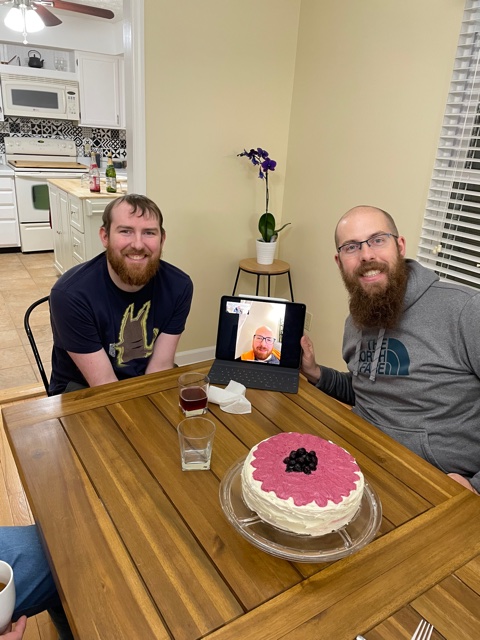
1. A big surprise. One afternoon, Jason texted to ask if he and Timothy could come over after dinner. Mittu had not been feeling well, and I assumed he just wanted to give her a bit of time to herself. When he came in, he handed me a card and gift bag but told me I couldn’t open them yet. I thought that was odd, as it’s not my birthday or any other gift-giving occasion. Then he proceeded to set up a FaceTime call with both Jeremy and Mittu, and then Jesse came in from his room. I wondered what in the world was up.

The package turned out to be an Apple watch that they had all pitched in to get for me. After my last afib episode, they discussed getting me an Apple watch because it has the ability to do an EKG reading and to alert you if your heart goes into an abnormal rhythm.

I was so touched by their thoughtfulness, and sad that I had made them worry.

Jason helped me get the watch set up and showed me the basics, and I’ve explored it more since then. I like it!

2. Flowers from Timothy.

3. Getting my fall decorations up, finally. I almost skipped it—somehow I just wasn’t as into it this year. But I do enjoy them, and I like decorating to some degree with the change in seasons. Once I got started, I got more into it, and I was glad I got them out.

Special thanks also to Jesse, who fetched the boxes down from the attic and put them back again. He joked that after he moves out, whenever he comes to visit I am probably going to ask him to take things to and from the attic for me. He might be right…:)

4. Discount prescription coupons. One of my new prescriptions came from the pharmacy with a note that a manufacturer’s coupon might be available for that medication. We investigated and filled out the information to receive the discount card. When I used it for the refill, it knocked our part of the payment from $60 to $10. It does make you wonder—if the manufacturer is willing to give out these discounts, why don’t they just lower the price by that amount? I don’t know, but I am glad I found out about them.

5. Roast. Jason and Mittu asked us to watch Timothy while they voted. She brought over a roast in the Instant Pot to cook while they were gone, and we all enjoyed it for dinner after they got back. Then she left a bunch of the leftovers with us. Yum!

That’s my week! What’s something good from yours?

Book Review: True Strength

I don’t read many celebrity biographies or memoirs. But we had seen Kevin Sorbo in a couple of things, then noticed he starred in Christian-based movies the last several years (he portrayed the atheist professor in God’s Not Dead). And he seems to have become more outspoken about his Christian faith on Twitter and Facebook. I became interested in his story. So when I saw his book, True Strength: My Journey from Hercules to Mere Mortal—and How Nearly Dying Saved my Life, come out on a Kindle sale, I got it.

He grew up in Mound, Minnesota, with small-town values and a strong work ethic. He got some modeling jobs to help pay bills in college, then starting acting in commercials. Soon he got the starring role in three Hercules movies, which then transitioned to a TV series, becoming one of the top shows in its day.

Just as things were going well, Kevin noticed a lump on his shoulder. It turned out to be not cancer, but an aneurysm. A chiropractic maneuver released hundreds of blood clots in his arm and a few in his brain, triggering three mini-strokes. At first, the doctors’ main concern was saving his arm. But Kevin experienced a host of symptoms, from vision loss to lack of balance to buzzing and vibrating in his brain to headaches. The only treatment seemed to be physical therapy and time. Doctors called his health crisis “one in seventy-five million.”

Both because Kevin was a private person, plus he and the producers didn’t want his Hercules persona to be tarnished, the full extent of his condition was not made public. He filmed the rest of the series with minimum camera time, creative use of a body double, and plots that worked around his situation.

Kevin talks about faith in the book, but there’s no real conversion point or switchover. It’s more like he reached back for the faith he had been brought up with and started praying and relying on God to see him through. He rejected the “hellfire and eternal flames of misery on us sinners” that his childhood pastor preached. That in the Bible, but his pastor seems to have used it as a club to beat over people’s heads rather than an invitation. Kevin did believe in a “loving, forgiving God” and acknowledged that:

Before my illness I was fully preoccupied with the material side of life. Moving at the speed of light, I ignored the spiritual side, the unseen. God created this world, but I was determined to live in it to the fullest, to get the most out of it. I figured He would want that

Through his illness, he realized:

My illness made me special—in a way that I never wanted nor expected, yes, but if I was to be special, then I was going to do something with that gift. I wasn’t a half-god or any part god. I was a mere mortal, with human limitations and problems, but I was determined not to behave like a victim anymore.

His dear wife deserves an MVP award: they were engaged when Kevin’s illness struck, and she was his main support all through it.

There are some crude spots in the book, some sexual encounters (though not explicit), and a bit of bad language (though some of it is disguised comic strip-style with keyboard characters).

Even though our situations were very different, my experience with transverse myelitis helped me identify with-some of the neurological issues and the long recovery.

It was also interesting reading about some of the behind-the-scenes aspects of the film industry.

I appreciate Kevin’s sharing his story and wish him and his family all the best.

(Sharing with Carole’s Books You Loved)

Book Review: Termination Zone

Termination Zone is the sequel to Adam Blumer‘s thriller, Kill Order (linked to my review).

In the first book, pianist Landon Jeffers had surgery for a brain tumor. After he recovered, he began waking up with partial memories of things he wouldn’t normally do. He found out an organization had implanted a chip in his head in order to control him and have him do their bidding. And he discovered he was not the only one.

Landon has been in hiding in the months since the last book, but he is discovered. His method of jamming his implant’s signals is no longer working. He’s on the run again. But an unexpected help directs him home: his mother is in danger.

Landon learns the organization behind the implants is called the Justice Club. He’s also told that a covert group is trying to thwart and disable the organization. His contact tells Landon they want him to work from inside the club. It’s a dangerous prospect, and Landon is not sure whom to trust. But he decides to work with the Justice Club’s hidden opponents. Landon tries to discern what the Justice Club is up to, but their aim is bigger than he imagined. Will he find out in time? Can he do anything about it? Will it endanger the woman he loves?

This sequel starts off with a bang and grabbed me from the first page. Fast-paced action and mystery kept me riveted.

Landon had become a Christian in the last book, and he struggles realistically in this book to learn to yield to God, to pray, to seek God for discernment and guidance.

Adam has pledged to readers to keep his novels clean. There are no sexual scenes, bad language, or gore. He proves that an excellent, thrilling novel can be written without all that. There are bad guys who are out for people’s lives, but there’s nothing gratuitous.

Once again, Adam has done a superb job. The fact that thrillers aren’t my usual reading fare, yet I eagerly await Adam’s every new book, should tell you something about his writing.

Update: Here is a trailer for the book which I just became aware of:

(Sharing with Carole’s Books You Loved, Booknificent Thursday)

Alone with God

Community is a great gift. Many of us have come to appreciate it now more than ever, since gathering with others has been restricted for several months. There’s nothing like being with, singing with, exercising the “one anothers” of the Bible, encouraging and being encouraged by God’s people.

So many have fallen away from regular church attendance, leaders have stressed the importance and benefits of Christian community in the last several years. But as often happens, the pendulum sometimes swings too far the other way. Some admonishments have overstated the importance of community. In one tweet I saw, some advocated changing the pronouns in hymnbooks from singular to plural!

I believe strongly in Christian community, in gathering regularly together as believers. I wrote about it here and here and here and here.

But some of the most poignant moments of life occur between the individual and God alone.

Joseph spent years isolated from a believing community after he was sold into slavery before his family came. If he had not known how to walk with God alone, his story would have come out very differently.

Two of the major events in Jacob’s life occurred when God met with him alone. One was in a dream on his journey to his uncle’s house; the other occurred when he wrestled with the angel of the Lord on the way back home to face Esau.

Daniel had three friends, but he faced the lion’s den alone, received visions from God alone, and prayed for his nation alone.

David spent much time alone and used much of it to write psalms.

The psalmists speak of remembering God’s word, work, and character and communing with Him alone in the middle of the night.

Elijah met with God alone after the great victory over Jezebel’s priests.

Paul traveled and ministered with companions, at times he had to stand alone.

Jesus ministered to crowds, small groups, and individuals, but sought time with His Father alone.

One of the blessings of the Christian life is that we have access to God directly. “For through him we both have access in one Spirit to the Father” (Ephesians 2:18). We don’t have to go through a priest or anyone else to get to Him. And, though sometimes we come with others, there are times we interact with Him alone.

God formed us individually. Psalm 139:13-16 tells about God forming us, knitting us together in our mother’s wombs, making us in secret.

We’re born again individually. Someone might be with us; someone might have explained what salvation meant and prayed with us. But we’re saved when we individually believe on Christ. No one can do that for us.

We’ll give account of ourselves. “For we must all appear before the judgment seat of Christ, so that each one may receive what is due for what he has done in the body, whether good or evil.” (2 Corinthians 5:10)

We have our own relationship with God. I wrote recently that the Christian life is a relationship with God, not a set of rules and rituals. We have a relationship all together as a family. But most families don’t relate to each other just as a group all the time. Each individual child has a relationship with the Father.

We meet with God individually. As vital as it is to meet together to hear God’s Word preached and explained, we need to partake of it on our own. Many verses compare God’s Word to food. We don’t eat just one or two times a week. We’d be pretty malnourished spiritually if we did. When I attended a Christian college, students were often reminded that it was an easy place to get away from the Lord. It was easy to coast on the atmosphere, to read the Bible for class assignments, to attend many Christian meetings, etc., without personally meeting with the Lord.

We walk with God individually. Just as we’re saved in a one-on-one exchange with God, so also our obedience, growth, and sanctification occur between us and God. Again, others help, teach, encourage. But they can’t obey and grow for us. They might help us resist temptation, but we need to apply the Word of God and yield to Him in our own hearts.

We encourage ourselves in the Lord. Other Christians are a great source of encouragement, and I have leaned on them many times. Yet sometimes we have to stand alone. David experienced one such instance when everyone was against him, even threatening to stone him. But David “encouraged himself in the Lord” (1 Samuel 30:6). So many of his psalms were written when he was alone, or at least they were written about being alone. Yes, the psalms were sung congregationally. Some dealt with God’s people as a whole. But many of the situations written about were experienced individually, written down, and sung with the congregation so that they then could individually be encouraged and apply the truth of them.

We can pray individually. Yes, Jesus said, “For where two or three are gathered in my name, there am I among them.” (Matthew 18:20). But He also said, “But when you pray, go into your room and shut the door and pray to your Father who is in secret (Matthew 6:6a). He’s not forbidding public prayer in the latter verse, but illustrating that it’s not something we do for “show” (compare with verses 1-5). I’ve often requested prayer from the whole church body or texted a Christian friend with an urgent prayer request. But have you ever noticed how many times in the Bible people prayed alone? Take as just one example Elijah, of whom James says “Elijah was a man with a nature like ours, and he prayed fervently that it might not rain, and for three years and six months it did not rain on the earth. Then he prayed again, and heaven gave rain, and the earth bore its fruit” (James 5:17-18). Kevin Schaal says in This Is No Time for Timid Prayers:

Sometimes we minimize the power of the prayer of a Christian individual. We tend to view prayers like votes—ours is only one among many millions and God somehow looks at the collection of prayers before Him instead of the heartfelt cry of an individual. The Bible never presents prayer like that. James 5 does not say “the effectual fervent prayers of a large group of righteous people accomplishes a lot.” The individual prayer of one righteous person can change the world.

I’ve read in some missionary biographies of great victories that were followed a few weeks later by a note from some faithful supporter saying, “I felt strongly led to pray for you on this date. Was anything in particular going on?”

We worship God individually. Even when we’re worshiping with a congregation, we worship and praise in our own hearts. And we can and should worship and praise when we meet with God alone.

Meeting with God isn’t meant to happen either alone or with a group. We need both. Our time alone with God will inform and enrich our time with each other, and our time with each other should do the same for our individual walk with God.

I’ve appreciated the creative ways people have developed to keep in touch with each other through this pandemic. Let’s use all of those ways as much as possible. But be encouraged: you can pray, worship, serve, and walk with God in any circumstance, alone or with a group.

I could not do without Thee,
I cannot stand alone,
I have no strength or goodness,
No wisdom of my own;
But Thou, belovèd Savior,
Art all in all to me,
And perfect strength in weakness
Is theirs who lean on Thee.

I could not do without Thee!
No other friend can read
The spirit’s strange deep longings,
Interpreting its need;
No human heart could enter
Each dim recess of mine,
And soothe, and hush, and calm it,
O blessèd Lord, but Thine.

I could not do without Thee,
For years are fleeting fast,
And soon in solemn loneness
The river must be passed;
But Thou wilt never leave me,
And though the waves roll high,
I know Thou wilt be near me,
And whisper, It is I.

From “I Could Not Do Without Thee” by Frances Ridley Havergal

Psalm 62 God alone

(Sharing with Hearth and Soul, Selah, Sunday Scripture Blessings, Scripture and a Snapshot, Inspire Me Monday, Senior Salon, Remember Me Monday, Tell His Story, Purposeful Faith, InstaEncouragement, Recharge Wednesday, Share a Link Wednesday, Let’s Have Coffee, Heart Encouragement, Grace and Truth, Blogger Voices Network)

Laudable Linkage

IMG_0195

Here are some noteworthy reads from the last week or two:

The Do Not Depart site is focusing on “Snap Shots of Bible Study” this month. Each writer will share the tips they’ve found most helpful. The two articles so far have been good.

How to Influence Your Teenager’s Quiet Time With God. Good tips here.

Small and Holy, HT to Challies. For those who lament not knowing the exact time of their salvation, “It is not only a beginning date, but our following, stumbling, and returning to God that matters.”

Don’t Quarrel Over Opinions but Welcome One Another, HT to Challies. “Our commitment to unity is only really put to the test when something comes up that we have different and strong opinions about. One way to maintain unity would be to eject the minority who think differently. That would leave a very united congregation! But it would be the artificial unity of the cults, where everyone has to think the same on every issue. Gospel unity looks very different – that’s where we bear patiently with one another, love one another and strive to think the very best of one another.”

FAQ: Aren’t Missionaries Really Just Colonists? HT to Challies. “It is more than a little ironic that the Americans leveling colonization accusations argue based on American presuppositions. They attack missionaries across an ocean, assuming they know what is best for the Africans. Were they to come, sit down, and discuss the issues with our neighbors, they would walk away with a very different perspective.”

Acedia: the lost name for the emotion we’re all feeling right now, HT to Rachelle. Many have mentioned kind of a listless, can’t get thoughts together feeling since the pandemic started.

This is a cute video about a baby who gets very excited about paint samples. (Maybe an HGTV show is in his future!) HT to Steve Laube, who said if books were substituted for paint samples, book lovers would have the same expressions.

Happy Saturday!

Friday’s Fave Five

On Fridays I like to pause for a few moments with Susanne and friends
to reflect on some of the blessings of the week.

Somehow this week has gone fast. They all do these days, but this one got to the end much sooner than expected! Here are some highlights from it.

1. Our ladies’ Bible study met in a home rather than outside due to rain, but had a Zoom option for those who didn’t feel comfortable meeting inside. I was the only one to Zoom in, but it all went well.

2. Tutorials. I mentioned last week frustration with the new WordPress editor. After neatly pulling my hair out trying to do Monday’s post, I decided I needed to dedicate some time to figuring this out. I looked up a few WP articles as well as some tutorials from others on YouTube. And I told my brain that learning new things was good for it. 🙂 I got a handle on the basics, which is probably all I will need (I told my family it was like someone created a high end camera with ten lenses and scores of bells and whistles when most people just want to point and shoot). I especially appreciated finding out here that if I revert to a “classic block,” the beloved toolbar that I had been missing will show up.

3. Family time and games. My son and daughter-in-law invited us over Sunday evening for grilled cheese sandwiches, tomato soup, chocolate cake, and games. One we tried was Pictionary Air, which integrates with an iPad. I don’t draw well on paper, so I figured drawing in the air would be even worse. But I found I was decent at it! It was a fun night.

4. Early voting. I appreciate the privilege we have to vote in our country. There was a long line, extending out the building and around the corner. But it moved pretty quickly, and everyone was masked and distanced. The time we waited outside, it was a nice temperature with a pleasant breeze. We had fill-in-the-box ballots rather than the usual electronic screen. But everything went efficiently and everyone was pleasant.

5. Takeout pizza. We got done voting right around the time I usually start dinner, and Little Caesar’s was on the way home. 🙂 And I had loaded and run the dishwasher in the afternoon, so no cooking or kitchen clean-up that night—always a fave.

I hope your week went well!

Book Review: A Song Unheard

A Song Unheard is the second of Roseanna M. White’s Shadows Over England series set during WWI. The series involves a group of young people who were orphaned or abandoned as children, found each other, and formed their own family. They support themselves by stealing, but they have a strict code to steal only from those who won’t miss the loss.

Willa Forsythe had found an abandoned violin as a child and discovered she could make it sing. She had a natural talent to play beautifully by ear.

She’s approached by the mysterious Mr. V., who gave a job to her sister, Rosie, in the previous book, A Name Unknown. Mr. V. has some connection with the British government, but they are not sure what exactly it is or whether it is in an official capacity. But he pays well. He wants Willa to travel to Wales and pretend to be an old school chum of a couple of sisters who are aiding a group of musicians from Belgium. They are trying to gather relief efforts for the folks back home. Her specific job: get to know acclaimed violist Lukas De Wilde and find a cypher that he carries with him. Lukas’ father, now deceased, had been a talented cryptographer. V. wants the cypher to aid Britain in the war.

Lukas is worried sick about his mother and sister. He had been shot in an attempt to find them and get them out of Belgium. He knew their home had been destroyed, but he didn’t know their whereabouts or status. His face and his father’s work were both well-known enough that he can’t risk going back to Belgium. Meanwhile, he tries to hide his injury and work with the orchestra while trying to figure out what to do.

He and Willa are intrigued with each other, but he’s a known flirt, so she doesn’t take him seriously. She knows they are from two different worlds, and he would never respect her if he knew what she was. But the more she gets to know him, the more she regrets that she will have to betray him. And unknown dangers lurk just beyond her awareness.

My thoughts:

I loved this book as much as the first one. The story, the history, and the characters were all wonderfully written. During the last few chapters, I wished I could set aside everything else just to find out what would happen.

One of the things I most appreciate about this author is that she is not afraid to be clear about spiritual matters. So many Christian writers are so subtle these days about the faith element in their stories that, unless you already understood what Christianity is, you’d never figure it out in their books. Roseanna proves that you can talk about Christianity normally and clearly without sounding preachy or strained or artificial.

The sister in the previous book had come to know the Lord. In a family of thieves, a conversion will necessitate some changes. Even though the sister is non-judgmental and still a loving part of the family, Willa feels a little betrayed. This is something that’s not often dealt with in Christian fiction, and I am glad Roseanna explored it.

Both of Willa’s parents had abandoned her, and she transfers her feelings about them to God. She felt He was someone who either wasn’t there or didn’t care about her. I loved her journey.

I listened to the audiobook read by Liz Pearce. I thought her narration was a little too blustery in the last book. But either I got used to her style, or her characterizations for this book were much more pleasant. At any rate, I enjoyed it and look forward to Book 3!

(Sharing with Carole’s Books You Loved, Booknificent Thursday)

Book Review: Be Obedient

Be Obedient (Genesis 12-25): Learning the Secret of Living by Faith by Warren W. Wiersbe is the second in his three-part commentary on Genesis. These chapters cover the life of Abraham.

Humanity had not had a good track record so far In Genesis: sinning in paradise, murder, drunkenness, immorality, and rebellion. But in His longsuffering, God continued working with man.

In this section, God called Abraham to leave his family, his country, and his idols and go to the land where God sent him. God promised Abraham He would bless him, make his name great, make of him a great nation, and through him bless “all the families of the earth” (Genesis 12:1-3).

Abraham and his wife, Sarah, were not sinless examples of living by faith. While I am not happy when anyone makes wrong choices, I am encouraged that even towering figures like Abraham were not perfect, and we can confess our sin, be forgiven, pick up, and go one. Abraham and Sarah are both listed in what is sometimes called the “Hall of Faith” in Hebrews 11.

Ultimately, Abraham’s story is about God showing grace and faithfulness and setting aside a line of people through whom the promised Messiah would eventually be born.

In the last chapter, Wiersbe lists several ways “all the nations of the earth” are blessed through Abraham.

  • “Abraham left us a clear witness of salvation through faith.” Romans 15:3: “Abraham believed God, and it was counted to him as righteousness.”
  • “Abraham also leaves us the example of a faithful life. James used Abraham to illustrate the importance of proving our faith by our works (James 2:14-26). Wherever Abraham went, he pitched his tent and built his altar, and he let the people of the land know that he was a worshiper of the true and living God.”
  • “From Abraham, we learn how to walk by faith.”
  • “Abraham gave the world the gift of the Jewish nation; and it is through the Jews that we have the knowledge of the true God plus the Word of God and the salvation of God (John 4: 22).”
  • “Finally, because of Abraham, we have a Savior.” Matthew 1:1 begins, “The book of the genealogy of Jesus Christ, the son of David, the son of Abraham.”

Here are a few of the other quotes that stood out to me in this book:

Living by faith means obeying God’s Word in spite of feelings, circumstances, or consequences. It means holding on to God’s truth no matter how heavy the burden or how dark the day, knowing that He is working out His perfect plan. It means living by promises and not by expectations.

“The victorious Christian life,” said George Morrison, “is a series of new beginnings.”

God alone is in control of circumstances. You are safer in a famine in His will than in a palace out of His will.

When you disobey the will of God, the only right thing to do is to go back to the place where you left Him and make a new beginning (1 John 1: 9).

God’s remedy for Abraham’s fear was to remind him who He was: “I am thy shield, and thy exceeding great reward” (Gen. 15: 1). God’s I AM is perfectly adequate for man’s “I am not.”

The Hebrew word translated “believed” means “to lean your whole weight upon.” Abraham leaned wholly on the promise of God and the God of the promise. We are not saved by making promises to God but by believing the promises of God.

In times of testing, it is easy to think only about our needs and our burdens; instead, we should be focusing on bringing glory to Jesus Christ. We find ourselves asking “How can I get out of this?” instead of “What can I get out of this that will honor the Lord?” We sometimes waste our sufferings by neglecting or ignoring opportunities to reveal Jesus Christ to others who are watching us go through the furnace.

Once again, I am indebted to Dr. Wiersbe for his helpful insights.

(Sharing with Worth Beyond Rubies, Grace and Truth,
Carole’s Books You Loved, Booknificent Thursday)

What Grace Does

Most Christians are familiar with the word “grace.” If asked about it’s meaning, we could come up with something about “unmerited favor.” Pressed further, we’d explain that grace is God giving us what we don’t deserve: salvation first of all, then answered prayer and abundant blessings. We could differentiate grace from mercy: God not giving us what we do deserve: anger and punishment. We know that we’re saved by grace through faith: “For by grace you have been saved through faith. And this is not your own doing; it is the gift of God”. (Ephesians 2:8)

Yet for the first time, I was struck this weekend not just by what grace is, but what it does. Thanks to Jen Wilkin in her book In His Image, who shared these first two points in chapter 6, “God Most Gracious,” and sparked a mini-study and a lot of thought.

Grace teaches:

For the grace of God has appeared, bringing salvation for all people, training us to renounce ungodliness and worldly passions, and to live self-controlled, upright, and godly lives in the present age, waiting for our blessed hope, the appearing of the glory of our great God and Savior Jesus Christ, who gave himself for us to redeem us from all lawlessness and to purify for himself a people for his own possession who are zealous for good works.

The NIV and KJV and a few other versions say “teaching” instead of “training.” Others say “instructing.”

And what does God’s grace teach us? “To renounce ungodliness and worldly passions, and to live self-controlled, upright, and godly lives in the present age” (verse 12). Since Jesus “gave himself for us to redeem us from all lawlessness and to purify for himself a people for his own possession who are zealous for good works,” His grace enables us to obey and live for Him and say no to self. This is one reason why the thought that grace will encourage people to sin because they can “get away with it” is so erroneous. That’s not what grace teaches.

This paragraph also demonstrates that good works come after and from salvation. Our good works don’t count for our salvation.

Grace strengthens:

You then, my child, be strengthened by the grace that is in Christ Jesus. (2 Timothy 2:1)

Do not be led away by diverse and strange teachings, for it is good for the heart to be strengthened by grace, not by foods, which have not benefited those devoted to them. (Hebrews 13:9)

Grace gives comfort and hope:

Now may our Lord Jesus Christ himself, and God our Father, who loved us and gave us eternal comfort and good hope through grace, comfort your hearts and establish them in every good work and word. (2 Thessalonians 2:16-17)

Grace makes sufficient:

And God is able to make all grace abound to you, so that having all sufficiency in all things at all times, you may abound in every good work.

Grace enables:

But he said to me, “My grace is sufficient for you, for my power is made perfect in weakness.” Therefore I will boast all the more gladly of my weaknesses, so that the power of Christ may rest upon me.

In addition, Paul often mentions how God’s grace enabled him to do what God called him to. One example: “But by the grace of God I am what I am, and his grace toward me was not in vain. On the contrary, I worked harder than any of them, though it was not I, but the grace of God that is with me.” (1 Corinthians 15:10)

Grace helps:

Let us then with confidence draw near to the throne of grace, that we may receive mercy and find grace to help in time of need. (Hebrews 4:16)

The entire Godhead is involved with grace: The Father: 2 John 1:3, Philippians 1:2; The Son of God, full of grace and truth: John 1:14; The Spirit of grace: Hebrews 10:29.

Thankfully, grace is something we can grow in (for more information, see What does it mean to grow in grace?. 2 Peter 2:18 says “But grow in the grace and knowledge of our Lord and Savior Jesus Christ. To him be the glory both now and to the day of eternity.” And who does He give His grace to? “God opposes the proud but gives grace to the humble.” (James 4:6)

And where does this grace come from? It’s not a separate entity: it comes from God. What a marvelous gift we have in God’s grace!

’Twas grace that taught my heart to fear,
And grace my fears relieved;
How precious did that grace appear
The hour I first believed.

John Newton

(Sharing with Senior Salon, Hearth and Soul, Remember Me Monday, Tell His Story, InstaEncouragement, Legacy Link-Up, Recharge Wednesday, Worth Beyond Rubies,
Let’s Have Coffee, Heart Encouragement, Faith on Fire,
Grace and Truth, Blogger Voices Network)