Unknown's avatar

About Barbara Harper

https://barbarah.wordpress.com

Biblical Reasons for Suffering

Biblical reasons for sufferingA little boy falls and scrapes his knee. His father runs to him and . . . gives him a science lesson about velocity and gravity and a lecture on safety. Right?

No, of course not. The father comforts his child and tends his wounds.

I’ve heard some people say that’s all they want when they’re suffering. They don’t need to know the why behind it: they just want their heavenly Father’s comfort and assurance of His love.

But some of us do want to know why. The question of why God allows suffering is one of the biggest issues people wrestle with.

Some think it’s wrong to ask God “Why?” Elisabeth Elliot said in her book, On Asking God Why:

I seek the lessons God wants to teach me, and that means that I ask why. There are those who insist that it is a very bad thing to question God. To them, “why?” is a rude question. That depends, I believe, on whether it is an honest search, in faith, for his meaning, or whether it is a challenge of unbelief and rebellion. The psalmist often questioned God and so did Job. God did not answer the questions, but he answered the man–with the mystery of himself.

When we lived in GA, a man in our church had Von Hippel-Lindau disease, which caused tumors to grow throughout his body. The tumors weren’t cancerous, but their growth caused multiple problems, especially when they began in his spine and brain. He once said, “I could bear this if I knew God had a reason for it.”

We may never know exactly why God allows hard things to happen in our particular cases. But the Bible gives some general reasons why God allows suffering and how He uses it.

Sin

No, suffering doesn’t mean the person experiencing it is being punished for sin. Job’s friends mistakenly thought that of him and God soundly rebuked them. When Jesus’ disciples asked him whether a certain man was blind due to his own or his parents’ sin, Jesus said neither (John 9:1-3).

But sin and suffering entered the world when sin did. Man’s inhumanity to man falls here. Sin, sorrow, sickness, etc., will be eliminated for believers when they get to heaven (Rev. 21:4), but not before. So some degree of suffering is just due to living in a fallen world. That doesn’t mean it’s random: God still is in control over what He allows.

Yet sometimes God does chasten His children, and He may use suffering to do it. Proverbs has a lot of corollaries about the consequences of certain actions. Discipline is actually a proof of our sonship. The psalmist said affliction helped him learn and obey God’s Word. Hebrews 12:1-12 says: “all discipline seems painful rather than pleasant, but later it yields the peaceful fruit of righteousness to those who have been trained by it.

In Revelation, God brings calamities to get people’s attention and accuses, “yet you still did not repent.” At least one purpose behind the events was an attempt to bring them to repentance.

Growth

One of the most meaningful metaphors concerning suffering for me is described in John 15. Jesus said He is the true vine, His Father is the vinedresser, and we’re branches in Him. “Every branch in me that does not bear fruit he takes away, and every branch that does bear fruit he prunes, that it may bear more fruit” (verse 2).

I’m not good with plants. But even in my limited experience, I’ve learned that some plants grow fuller when they are cut back. I’m told that expert rose pruners don’t just cut off the dead blooms: they remove perfectly good blossoms as well. Energy and nutrients are redirected to where they are most needful.

Somehow, when God “prunes” something in our lives, we grow in ways we would not have otherwise. Romans 15:3-4 says our suffering produces endurance, character, and hope. Ecclesiastes 7:2-4 says sorrow teaches our hearts things that could not be learned by feasting and laughter.

Refining

James 1:3-4 says, “The testing of your faith produces steadfastness. And let steadfastness have its full effect, that you may be perfect and complete, lacking in nothing.”

Malachi 3:2-3 speaks of God refining and purifying the sons of Levi. The Hebrew word for “refine” there means to smelt, to apply heat to separate impurities from the ore. Hebrews 12:25-29 speak of God shaking the earth “in order that the things that cannot be shaken may remain” (Spurgeon has a wonderful devotional on this here). Trials and suffering have a way of clarifying what’s important, of burning off any excess in our lives. 

That we may learn who God is

Nebuchadnezzar went through an extensive trial through which he learned that God was God and Nebuchadnezzar was not. Though Job knew God, after his ordeals, he knew Him in a much more intimate way. Many people testify that, although they would not have chosen their trials, they don’t regret them because of how much better they knew God after  the process.

That we may learn what we are and what we trust in

Moses told the children of Israel that “the Lord your God has led you these forty years in the wilderness, that he might humble you, testing you to know what was in your heart, whether you would keep his commandments or not. And he humbled you and let you hunger and fed you with manna, which you did not know, nor did your fathers know, that he might make you know that man does not live by bread alone, but man lives by every word  that comes from the mouth of the Lord” (Deuteronomy 8:2-3). God knew what was in their hearts, but He had to bring it out so they could see it.

One of the reasons God caused the events in Exodus was to get people’s attention and to show that their gods were no gods, that He alone was God. He did get their attention, and there are signs some believed (Exodus 18:5-11; Exodus 14:18; 14:31; 11:9).

Sometimes we don’t realize we’re trusting in something other than God until God removes it. Though that process is painful, it’s ultimately kind in turning us from a false hope to the only true God.

To humble us

As mentioned above, part of God’s purpose for bringing Israel through the wilderness was to humble them. Nebuchadnezzar had to be humbled before he would see his need of God. Paul’s “thorn” mentioned in 2 Corinthians 12:7 was partly to keep him from being too proud because of all the revelations he had received.

For the sake of others

Hereby perceive we the love of God, because he laid down his life for us: and we ought to lay down our lives for the brethren” (1 John 3:16). Paul mentions several times that some of his suffering were for others:

  • Therefore I endure everything for the sake of the elect, that they also may obtain the salvation that is in Christ Jesus with eternal glory.” (2 Timothy 2:10).
  • And most of the brothers, having become confident in the Lord by my imprisonment, are much more bold to speak the word without fear” (Philippians 1:14).
  • If we are afflicted, it is for your comfort and salvation; and if we are comforted, it is for your comfort, which you experience when you patiently endure the same sufferings that we suffer.” (2 Corinthians 1:6).
  • “As for you, always be sober-minded, endure suffering, do the work of an evangelist, fulfill your ministry. For I am already being poured out as a drink offering, and the time of my departure has come” (2 Timothy 4:5-6).
  • Always carrying in the body the death of Jesus, so that the life of Jesus may also be manifested in our bodies. For we who live are always being given over to death for Jesus’ sake, so that the life of Jesus also may be manifested in our mortal flesh. So death is at work in us, but life in you” (2 Corinthians 4:10-12).

Joni Eareckson Tada has suffered for 50+ years since her diving accident. God may have had reasons unknown to us for allowing this, but her suffering has opened a ministry to untold numbers of people.

To glorify God

I mentioned earlier Jesus telling the disciples that a certain man wasn’t born blind due to sin. He went on to say that the man was born blind “that the works of God might be displayed in him” (John 1:3). When Jesus heard that Lazarus was sick, He said this illness was “for the glory of God, so that the Son of God may be glorified through it” (John 11:1-4).

I admit I have wrestled with this one. When I was about 38, I read about the man who had been paralyzed for 38 years and imagined his being paralyzed my whole lifetime. Part of me wondered how God could ask this of him. But 38 years is not that long compared to eternity. Paul said, “For this light momentary affliction is preparing for us an eternal weight of glory beyond all comparison, as we look not to the things that are seen but to the things that are unseen. For the things that are seen are transient, but the things that are unseen are eternal” (2 Corinthians 4:17-18). Paul didn’t use the word “light” lightly: he had been speaking of excruciating suffering earlier in the chapter. But compared to the “eternal weight of glory,” it was light.

It’s like pregnancy: expectant mothers go through a range of discomfort all through pregnancy, culminating in the pain of childbirth. But they count all the suffering worth having that little one in their arms (John 16:21).

After speaking about the inheritance laid up for us in heaven, Peter says: “In this you rejoice, though now for a little while, if necessary, you have been grieved by various trials, so that the tested genuineness of your faith—more precious than gold that perishes though it is tested by fire—may be found to result in praise and glory and honor at the revelation of Jesus Christ” (1 Peter 1:6-7).

For it is all for your sake, so that as grace extends to more and more people it may increase thanksgiving, to the glory of God.” (2 Corinthians 4:15).

That the world may be shown what love and obedience mean

I’m grateful to Elisabeth Elliot for this one. In John 14:27-31, Jesus said, as he was preparing for the cross, “I do as the Father has commanded me, so that the world may know that I love the Father.” Elizabeth wrote in Keep a Quiet Heart:

The disciples’ worst fears were about to be realized, yet He commanded (yes, commanded) them to be at peace. All would be well, all manner of things would be well—in the end. In a short time, however, the Prince of this world, Satan himself, was to be permitted to have his way. Not that Satan had any rights over Jesus. Far from it. Nor has he “rights” over any of God’s children… But Satan is permitted to approach. He challenges God, we know from the Book of Job, as to the validity of His children’s faith.

God allows him to make a test case from time to time. It had to be proved to Satan, in Job’s case, that there is such a thing as obedient faith which does not depend on receiving only benefits. Jesus had to show the world that He loved the Father and would, no matter what happened, do exactly what He said. The servant is not greater than his Lord. When we cry “Why, Lord?” we should ask instead, “Why not, Lord? Shall I not follow my Master in suffering as in everything else?”

Does our faith depend on having every prayer answered as we think it should be answered, or does it rest rather on the character of a sovereign Lord? We can’t really tell, can we, until we’re in real trouble.

Paul said that somehow “through the church the manifold wisdom of God might now be made known to the rulers and authorities in the heavenly places” (Ephesians 3:8-10). So we don’t display His working and wisdom only to other humans, but to beings in the heavenlies.

To learn that His grace is sufficient

Paul had asked God to remove something troubling in his life that he called a thorn. God said No. Instead, God said, “My grace is sufficient for you, for my power is made perfect in weakness.” Paul responded, “Therefore I will boast all the more gladly of my weaknesses, so that the power of Christ may rest upon me. For the sake of Christ, then, I am content with weaknesses, insults, hardships, persecutions, and calamities. For when I am weak, then I am strong” (2 Corinthians 12:7-10).

I believe it was Corrie ten Boom who said, “When all you have is Christ, you find that Christ is all you need.” The times in my life when anything I normally depended on was taken away and I felt the rug pulled out from under me were the  times I came to know by experience that Christ truly was sufficient for every need.

As children grow up, they depend on their parents less and less until they are able to stand alone. But Christians grow more and more dependent on God as they mature.

To spare us from something harder

We tend to overlook this part of Israel’s journey from Egypt. Exodus 13:17-18 says God didn’t bring Israel a nearer way through the land of the Philistines because the people might be tempted to turn back when they saw war. Instead, He led them through the wilderness to the Red Sea—where they were stuck between the sea and Pharaoh’s army. God already knew how He was going to deliver them, and they should have been able to trust Him for that trial.

To teach us to depend on His Word

In Deuteronomy 8:2-3, mentioned earlier, God says He led Israel through the wilderness and gave them manna partly to “make you know that man does not live by bread alone, but man lives by every word that comes from the mouth of the Lord.” Psalm 119:67 says: “Before I was afflicted I went astray: but now have I kept thy word.”

To identify with Christ

This is one of Scripture’s mysteries. I have several passages on this topic, but since this post is long already, I’ll just share a couple:

  • “For it has been granted to you that for the sake of Christ you should not only believe in him but also suffer for his sake” (Philippians 1:29).
  • “Indeed, I count everything as loss because of the surpassing worth of knowing Christ Jesus my Lord. For his sake I have suffered the loss of all things and count them as rubbish, in order that I may gain Christ and be found in him, not having a righteousness of my own that comes from the law, but that which comes through faith in Christ, the righteousness from God that depends on faith— that I may know him and the power of his resurrection, and may share his sufferings, becoming like him in his death” (Philippians 3:8 10).
  • “Who now rejoice in my sufferings for you, and fill up that which is behind of the afflictions of Christ in my flesh for his body’s sake, which is the church” (Colossians 1:24).

Conclusion

These truths from Scripture help, but in some ways they don’t satisfy. Elisabeth Elliot said once, in a source I have not been able to retrace, that even though God accomplished great things through her first husband’s death, he didn’t necessarily have to die to accomplish those things. God calls people to salvation and service all the time without requiring someone’s death. Yet He chose to work that way in this case.

Even when we don’t know why, we know God. We are “afflicted in every way, but not crushed; perplexed, but not driven to despair” (2 Corinthians 4:8). We know His character. We know He is wise and good. We know He is with us (Isaiah 43:2; Daniel 3:24-25) and loves us. He is “our refuge and strength, a very present help in trouble” (Psalm 46:1). He promises His grace is sufficient. and He will bring good out of everything He allows. As Joni Eareckson Tada says, God permits what He hates to accomplish what He loves.”

For the Lord will not cast off forever, but, though he cause grief,
he will have compassion
according to the abundance of his steadfast love;

for he does not afflict from his heart or grieve the children of men.
(Lamentations 3:31-33).

When through the deep waters I call thee to go,
The rivers of sorrow shall not overflow;
For I will be with thee, thy troubles to bless,
And sanctify to thee thy deepest distress.

When through fiery trials thy pathway shall lie,
My grace, all sufficient, shall be thy supply;
The flame shall not hurt thee; I only design
Thy dross to consume, and thy gold to refine.

From “How Firm a Foundation,” attributed to “K”

(Revised from the archives)

(Sharing with Inspire Me Monday, Global Blogging, Senior Salon, Hearth and Soul,
Happy Now, Tell His Story, Purposeful Faith, InstaEncouragement,
Recharge Wednesday, Worth Beyond Rubies, Share a Link Wednesday,
Let’s Have Coffee, Heart Encouragement, Grace and Truth)



Laudable Linkage

IMG_0195

I usually share these on Saturday, but I needed to wrap up the Laura Ingalls Wilder Reading Challenge yesterday. Here are some great reads if you have time:

Who Is the Holy Spirit? “If your ideas about the Spirit are divorced from the clear truths of Scripture, you will go astray into all kinds of error and ultimately damage the cause of Christ.”

The Benefit of Yielding to Jesus. Two different meanings of the word “yield,” and one leads to the other.

The Way He Should Go. “I heard the same proverb referenced by all sorts…What I didn’t frequent hear was what ‘the way they should go’ consists of.”

What’s To Be Done? Potentially, Nothing Else., HT to Challies. “In the end, there may not be anything more to do beyond the ongoing, slow Word-based ministry and giving the Spirit enough room to move without our insistence on more and more stuff to do.”

The Most Frightening Three Words, HT to Challies. A well-meaning “How are you?” can unsettle those suffering with a long-term illness or chronic pain. They don’t want to overload you, and they may not feel like going into it. Kimberly shares a better approach.

Cameraman, Lend a Hand,” HT to Challies. I’ve often wondered, when watching a video of a child crying or someone in distress, why the person filming doesn’t put down the phone and help.

Seven Questions to Ask in Evaluating Online Pundits, HT to Challies. “The digital revolution has made knowledge more accessible, the flow of information more diverse, and the ability to make your voice heard easier than ever before. The same revolution has also made invincible ignorance more sustainable, pervasive crankery more common, and the ability to discern what voices are worth listening to harder than ever before.”

Should “Broken” Genes Be Fixed? My daughter changed the way I think about that question, HT to Proclaim and Defend. “We believe the world is a better place for having kids like her in it, and we want the world to think hard about whether it really wants to go down a path of engineering a world where there are no Ruthies.”

Here’s What Iconic Historical Figures Would Look Like Today. This is strangely fascinating. An artist has rendered historical figures with modern hair styles and makeup to show what they would look like if they lived now.

I was reminded of the song, “See the Destined Day Arise” a couple of weeks ago and planned to share it during Easter week. Then I thought—why wait? As our church celebrated communion last week, as we look every Sunday, every day to the cross, we grieve at the cost of our salvation but rejoice that an able and willing Savior accomplished it. The first two stanzas were written by Venantius Fortunatus (c.530-600) and translated by Richard Mant (1837). The last stanza, chorus, and music were written by Matthew Merker. (I don’t know the church in the video: I just thought this was a nice, clear rendition.)

Laura Ingalls Wilder Reading Challenge Wrap-up for 2020

The end of February closes the Laura Ingalls Wilder Reading Challenge. I hope you had fun with it, and I look forward to hearing about what you read!

A week from today I’ll use random.org to draw a name from the comments on this post to win either The Little House Cookbook compiled by Barbara M. Walker, Laura’s Album: A Remembrance Scrapbook of Laura Ingalls Wilder by William Anderson, The Little House Coloring Book, or a similarly-priced book related to Laura. A week should give some who are still reading time to finish up and post. You don’t have to have a blog to participate: you can tell us what you read in the comments here. If you have a blog, you can either let us know what you read in the comments or share the links back to any reviews or challenge-related posts from your blog or even from Goodreads if you review books there. Due to shipping costs, I’m afraid I can only ship to those in the US.

I only read one book this year: Old Town in the Green Groves by Cynthia Rylant about the two years Laura left out of the Little House Books.

Old Town in the Green Groves about Laura Lingalls Wilder's lost years
The book I had originally planned to read was actually about Little Women rather than Little House, so I’ll save it for Tarissa’s Louisa May Alcott Reading Challenge in June.

As I mentioned earlier this year, this will be the last Laura Ingalls Wilder Reading Challenge hosted here, for a number of reasons. Thanks so much to those who have participated at any point during the last nine years. I’ve thoroughly enjoyed delving into books by and about Laura, discussing them with you, and hearing what you’ve read.

Remember, leave a comment on this post about what you read or did for the challenge before Saturday of next week to be eligible for the drawing.

Update: The winner is Tarissa! Congratulations!

Friday’s Fave Five

It’s Friday, time to look back over the blessings of the week
with Susanne at Living to Tell the Story and other friends.

I may be jumping the gun a bit with the spring FFF graphic, but I’d rather see flowers than snow right now. Here are a few of my favorite things from the last week:

1. Visiting the Biltmore House and the Downton Abbey exhibit. I wrote more about it here. This was my daughter-in-law’s request for her birthday in lieu of presents.

2. Daffodils blooming, the first sign of spring around here! I’ve seen some robins in the yard as well.

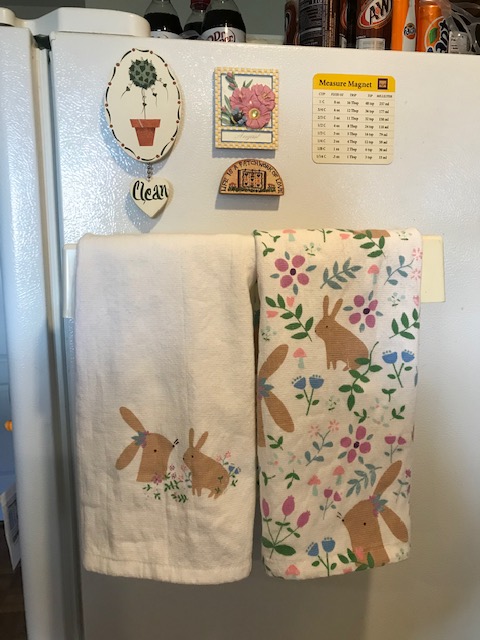
3. New spring dish towels. I like dish towels that are pastel colors and fluffy rather than flat. It’s hard to find both features. I found these at Kroger. They are not as fluffy as I usually like, but they are really absorbent. The flat kind get soaked after just a couple of uses.

4. Ready-made sandwiches. I don’t have diabetes, but my blood sugar will drop in the mornings if I don’t have something substantial for breakfast. It’s not usually a problem in the afternoon. But one day this week while at a grocery store, I felt like my blood sugar was plummeting. I usually keep some cheese sandwich crackers on hand to tide me over if that happens, but I had eaten them while on our Biltmore trip. Thankfully the store had some sandwiches packaged and ready at their deli counter. I got one and ate half of it in the car and was fine. (Yes, my doctor has known about this for years and keeps an eye on it.)

5. Safety. All of us were on the road in some capacity this week, some several times. The weather and road conditions are iffy this time of year, but Thankfully we were all safe and had no trouble.

What’s a favorite thing from your week?

February Reflections

FebruaryThank you so much for your encouragement and kind comments on last month’s post when I wondered if I should continue my end-of-month wrap-ups. I enjoy doing them, and I am happy to hear you enjoy reading them.

February was a nice mixture of quietness and busyness. We always enjoy Valentine’s Day around here. It has become a tradition to make what we call Meat Hearts for that day’s dinner: Li’l Cheddar Meat Loaves (minus the mustard and with much less sugar) made in heart shapes rather than ovals. And I also make heart-shaped cupcakes from a gluten-free mix. We’ve always made the day about the whole family. Then we enjoyed celebrating my daughter-in-law’s birthday with dinner and cake here one night and then an outing to the Downton Abbey Exhibit at the Biltmore estate last Saturday. Fun!

The weather has been up and down as well: some bitterly cold days, some warmer than usual, many in the 40s. Even though this has not been a severe winter, I’m read for it to be over. Spring is coming!

Timothyisms

I know my grandson’s funny observations are the favorite part of these posts for some of you. But I don’t have anything new this month besides what I already mentioned at the Biltmore visit. I did want to share this funny-to-me picture, though. There’s been much talk of going camping in the spring. So when we watched Timothy a couple of weeks ago during his parents’ date, he wanted to go “pretend camping” with Granddad while I made dinner. They put drinks in a cooler, turned off the living room lights, turned on lanterns, made a pretend fire, had Alexa play forest noises first, then a babbling brook. I mentioned earlier that Timothy was impressed when Granddad got out his real camping pans to cook their toy fish. Timothy had rediscovered a little tent stuffed in a closet that he had played in a lot when he was two or three. He got that out and set it up. He was too big to fit, of course, but otherwise he seemed pretty cozy.

When he got tired of that, he turned it into a port-a-pottie. 🙂

Creating

With Valentine’s Day this month, I spent much of one week in the craft room. I let the Cricut do a lot of the heavy lifting this time for the main images.

This was my husband, Jim’s:

The Cricut even did the writing and the drawing for the lace. I would’ve used more masculine colors, but I was afraid the writing wouldn’t show up on maroon or red cardstock. The background is scrapbooking paper.

This is Jeremy’s:

The fox is a multi-layered sticker. The hearts came from a piece of scrapbooking paper that had several hearts in colors other than pink and red.

This is Jason’s:

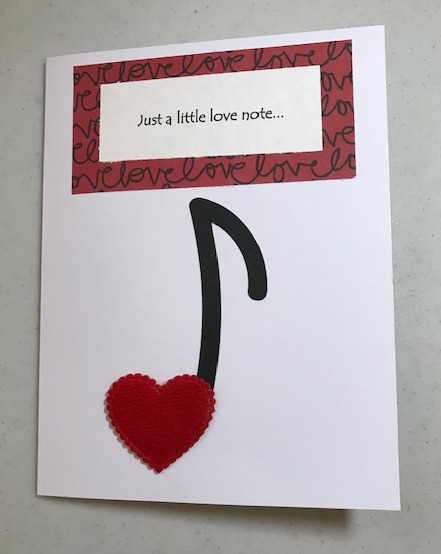
I had seen a similar idea on Pinterest and used the Cricut for the musical note. I rummaged through my heart shapes, hoping I had one already the right size, and I was delighted to find this puffy one.

This is Mittu’s, who likes purple:

The “love” and corner decorations are stickers.

This is my grandson, Timothy’s:

And this is Jesse’s:

A similar design on Pinterest caught my eye because he has a black truck. Some of the hearts were stickers, other were cut with punches.

And this was for Mittu’s birthday, as she loves tea:

I ended up getting the cup a bit bigger than I wanted, but by that point I didn’t want to start all over.

Watching

While riding my exercise bike, I finished the Amazon prime series called Home Fires, about the British Women’s Institute during WWII. It ended up being a little soap-operaish, which I didn’t care for. There were a few incidents of people sleeping with people they weren’t supposed to, but nothing explicit was shown. Other than that, it was a good series. I was surprised it ended with a cliffhanger without being renewed. It’s based on a book called Jambusters, which I have not read but which I understand is more like a documentary.

I just started a series called Dickensian. It has Dickens characters all living in the same town and interacting. Marley is still alive and working with Scrooge. Miss Havisham (Great Expectations) has not yet been jilted but has suffered an estrangement from her brother over their father’s will. Fagin and Bill Sikes lurk in the shadows. Little Nell lies sick in The Old Curiosity Shop. Inspector Bucket (Bleak House) investigates a murder. It’s intriguing, though dark: I haven’t seen any of Dickens’ humor yet. (Update: Unfortunately, some nudity was displayed in episode three. I didn’t think to check on that kind of thing because this is Dickens, after all. Argh! So I stopped watching and can’t recommend this after all.)

We haven’t watched any movies together as a family yet, but I want to see It’s a Beautiful Day in the Neighborhood. I will probably have to keep a supply of tissues nearby. Mr. Rogers was about the only TV show we let our kids watch for a long time.

Reading

This month I finished (titles link to my reviews):

I’m currently reading:

  • The Last Castle: The Epic Story of Love, Loss, and American Royalty in the Nation’s Largest Home by Denise Kiernan about the Biltmore House.
  • Be Reverent (Ezekiel): Bowing Before Our Awesome God by Warren Wiersbe
  • Doctor Thorne by Anthony Trollope (audiobook)
  • The Mother-Daughter Book Club by Heather Vogel Frederick
  • The Women of Easter: Encounter the Savior with Mary of Bethany, Mary of Nazareth, and Mary Magdalene by Liz Curtis Higgs

Blogging

You may have noticed a different url than usual. I just transitioned from the free version of WordPress to the paid, which comes with a free domain name. Unfortunately, just my first and last name plus .com was already taken by a realtor in Charleston. I’ve been thinking about taking this step for some time, both to increase storage space and to get rid of ads. When I couldn’t upload pictures earlier this week because I didn’t have any storage left, I figured it was time. Thankfully links under the old domain name still seem to work.

I’ve thought, off and on, ever since starting this blog of changing the name. Since “Stray Thoughts” isn’t in the domain name, I could easily change it. That’s the only name I could think of when I first started the blog. I keep think I should come up with something more creative. But after 13+ years, maybe it’s better to leave it the same.

At any rate, besides the Friday’s Fave Fives, book reviews, and occasional Saturday Laudable Linkages, February has seen these blog posts here:

Writing

I’ve gotten several good session in with my work-in-progress. I’m about ready to tackle my hardest chapter—hard because I have a lot of information to try to cover in as concise and interesting a way as possible. I’d appreciate your prayers.

And that about wraps up February here. How was yours?

(Sharing with Grace and Truth, Create, Bake, Grow, and Gather, Global Blogging,
Senior Salon, Hearth and Soul, Shannan, Happy Now, InstaEncouragement,
Worth Beyond Rubies)

Book Review: Old Town in the Green Groves

Laura Ingalls Wilder originally wrote out the story of her life in Pioneer Girl. When that manuscript was rejected several times, acting upon suggestions from editors, Laura reframed her narrative into a story for children about a pioneer family traveling west (p. 31). She left out a year that the family traveled back east due to the grasshopper infestations that twice ruined their crops and hopes in Plum Creek, although she had told of it in Pioneer Girl. Pamela Smith’s Hill’s notes on this section in Pioneer Girl: The Annotated Autobiography says:

She deliberately chose not to depict this part of her family’s experiences in her fiction. “It is a story in itself,” Wilder explained to Lane in 1937, “but does not belong in the picture I am making of the [fictional Ingalls] family (LIW tp RWL, [Dec. 1937 or Jan. 1938], Box 13, file 193, Lane Papers). Moving the fictional family east and not west would have undermined Wilder’s optimistic portrait of their resilient pioneer spirit. Furthermore, her experiences in Burr Oak were more urban, gritty, even edgy. Although Wilder introduced some adult ideas and themes into her later novels, she waited until the fictional family had moved west once more into Dakota Territory, where her main character was a more mature adolescent. Wilder herself was just nine years old when the family moved to Burr Oak (p. 95, note 99).

I’ve seen some criticism of Laura for leaving out the events that take place in Burr Oak. But I would defend her decision for several reasons. Everything I have read about memoirs and autobiographies says you can’t share everything. She did include this era in her original autobiography. The Little House books were fictionalized, focusing on the life and progress of a pioneer family. The time in Burr Oak might have seemed a stop or even a setback to the action. Plus the family’s proximity to a saloon and the unsavory behavior they saw and heard might not have seemed suitable to an audience of children at the rime she was writing.

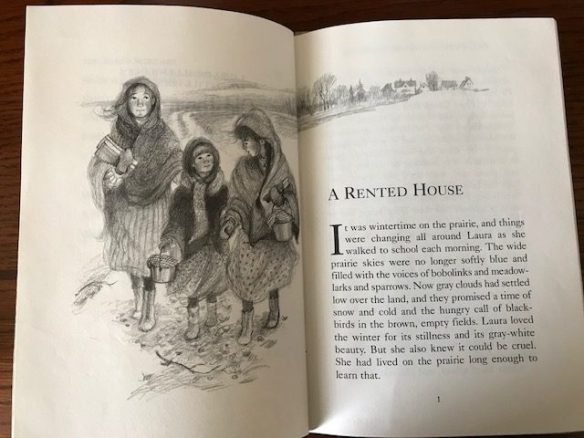
Old Town in the Green Groves about Laura Lingalls Wilder's lost yearsBut readers are curious about the “lost years” in the LH narrative. So Cynthia Rylant was asked to write what was known about the family’s story during this period in the style of the LH books. Her book is Old Town in the Green Groves.

The story begins back in Plum Creek, where the family contentedly moved from their winter rental house back to their farm. Baby brother Freddie was born. Ma was severely ill for a while, but recovered. Then the second wave of grasshoppers returned and destroyed everything growing. Pa declared he’d had enough of the “blasted country.” He had debts to pay, and the crop that would have paid them was ruined. Pa sold the farm to pay off the debts and lined up a job at a hotel in Burr Oak in Iowa.

On the way, the family stayed with their aunt and uncle and cousins, Peter and Eliza Ingalls and their children. They helped in various ways around the farm until ready to move on. Sadly, brother Freddie died there.

One chapter describes meeting with a kind beekeeper who was also planning to move since the bees couldn’t thrive without flowers. (Hill’s note on p. 96 of her book says Charles and this beekeeper kept in touch with each other for years).

When they arrived in Burr Oak, they lived above the hotel. Life was hectic: Ma helped with cooking and cleaning, and the girls all had to help, too. The saloon next door was loud, people were constantly coming in and out. Laura missed the quiet of her home and the prairie.

The book goes on to describe the various people they encountered and things that happened in Burr Oak before they decided to head west again.

I think Rylant did a good job. Just glancing over this section again in Pioneer Girl, I can see how Rylant took the narrative and fleshed it out. It’s more or less in the style of the LH books, but it’s not Laura: it couldn’t be.

I was glad to see the illustrations by Jim LaMarche in my library copy were also similar to the Garth William’s illustrations of the Little House.books. Like the words, they were not quite the same, but they seemed a similar style and spirit.

The book cover shown above is the one on my library copy. I’ve seen another illustrated cover here that makes Laura seem a little older and a photographed cover here that I didn’t care for at all.

I share my friend Ann‘s concern over the placement of the book on the back cover. The top says “Read all the Little House books.” The covers of all the books are shown, with this book set in-between On the Banks of Plum Creek and By the Shores of Silver Lake. I’m assuming this was done to show that the action in this book takes place between those two. But, as fine as this book is, I would regard it as supplemental and wouldn’t include it as part of the set or as one of the LH books.

Though this book describes some of the hard times the family went through, it also shares their resilience and hope. It’s a good story in its own right, but especially for fans of the Little House books.

(Sharing with Carole’s Books You Loved, Booknificent)

The Biltmore Estate and Downton Abbey Exhibit

My husband and I have visited the Biltmore Estate in Asheville, NC, a handful of times. I believe the last time we went was for our 25th anniversary fifteen years ago. I had pretty much decided there was probably no need to return—once you’ve seen it in different seasons, there’s nothing new to see, I thought.

And then I heard they were going to have an exhibition of the Downton Abbey television show at the Biltmore!

Then the question was—how should I go about seeing it? My daughter-in-law and I loved the show, but my husband and youngest son had never seen it. I think Jason, Mittu’s husband had seen at least some episodes, but I don’t know if he was as into it as I was. So should I go by myself? Should I see if Mittu wanted to take a day trip with me? Should I ask a friend? Should I ask my husband even though he wasn’t familiar with the show?

The dilemma was solved when Mittu asked if we could go to the exhibition in lieu of presents for her birthday this year. We went last Saturday.

We got into Asheville around 11 and ate lunch at Farm Burger, as its online menu showed it had gluten free options for Mittu and Timothy. I didn’t want anything heavy or greasy, so I tried the build-your-own chicken burger. It was pretty good. I also snagged a few of Jason’s garlic parmesan fries, and they were great.

Unfortunately, the DA exhibits were in two different buildings and not in the Biltmore house itself. You have to choose a time when you buy tickets, so we needed to go in to see the house when we first arrived.

If you’re not familiar with the Biltmore, it’s the largest home in America, built by George Washington Vanderbilt. He had visited the Asheville area in 1887 and liked it so well, he began buying up land to build a home. Construction began in 1889. He was a bachelor at the time and planned to being his mother to live at the house and to host family and friends. He didn’t marry until 1898, when he was 35. The estate wasn’t even entirely finished then, but it was livable.

I’m reading The Last Castle: The Epic Story of Love, Loss, and American Royalty in the Nation’s Largest Home by Denise Kiernan about the Biltmore House. I had hoped to finish it before visiting, but was only halfway done. Still, what I read enhanced the visit, and and I am sure that the visit will enhance the remaining reading.

One of the things that impressed me the most was that the land had been fairly depleted before building began. Frederick Olmsted, a landscape architect whose long list of credits includes Central Park, was asked to do the landscaping at Biltmore. He had to take into account not only what the land would like like at the time, but how things would grow over time.

The second impressive thing about the estate, besides the sheer size, is the detail in every single aspect. This is the right half of the house as we’re coming from from where the shuttle dropped us off:

Biltmore estateI have many more pictures that one post will hold, but this is what is called the Winter Garden, just inside the front doors and to the right:

Biltmore Winter GardenOne of my favorite rooms is the library. Vanderbilt was known for being well-read, even buying unbound manuscripts so he could have them bound the way he liked them.

Biltmore Library

You can see a bit of the painted ceiling. One of my favorite moments occurred when we were all exclaiming. “Look at the painting! Look at all the books! Look at the spiral staircase in the corner!” And Timothy (almost age 6) said, “Look at the security camera!” 🙂

My second favorite room was Mrs. Vanderbilt’s bedroom. I didn’t like the black bedcoverings so much, but I loved the ceiling. We didn’t get a picture, but you can see a glimpse here.

We got to go up an elevator that was original to the building. Unfortunately it only went between the first and second floors. The design was all wrought iron, but at some point they put plexiglass behind it for safety purposes. We didn’t get pictures of it, but someone else’s video is here.

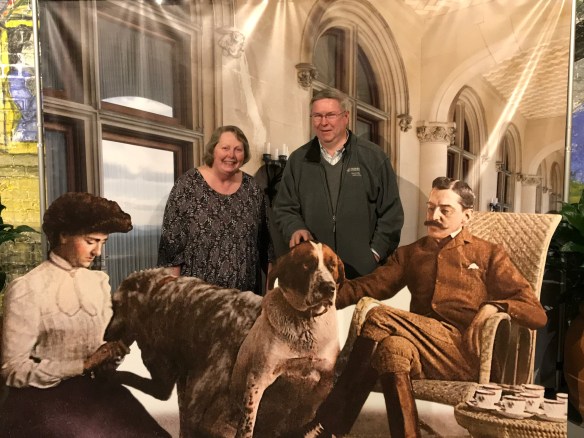
One room I didn’t remember seeing before was called the Halloween room, painted by George’s daughter Cornelia. There they offered a photo opportunity with George and Edith. 🙂

The tour includes the downstairs area, where the bowling lanes, kitchen, laundry, and servant’s rooms are. Another funny moment here: we tried to explain to Timothy what the chamber pots were for. When he heard someone else commenting on them, he called them “Thunder pots.”

Just outside the house is a group of little shops and eateries. We enjoyed a snack before heading down to the DA exhibit. Unfortunately, we didn’t have time to explore the little shops if we wanted to catch the DA exhibits before they closed.

The first part of the exhibit was in a new building called Amherst at Deerpark. While waiting to get in, we asked what the building was normally used for. The attendant said that once the exhibit was over, the building could be rented for special events, wedding receptions, etc.

This part of the exhibit was called interactive, but that’s probably because there are life-sized videos of Carson speaking to the guests as if he can see them. There are also some artifacts behind glass or in drawers covered with glass. When you first walk in the hallway, there is a massive picture of the DA cast in costume. Then there is a stop to watch a video. Then we stepped into a room where we saw larger than life-sized pictures of half the faces of the cast (not half the cast—half the face of each cast member).

Just to show you a couple of representative displays, pictures and text like this were on walls and tables discussing all the characters and different aspects of the times.

Downton Abbey exhibitOther displays held letters, props, jewelry, etc.

This is where I have a wee bit of complaint. This area was extremely crowded, and there was not a direct flow of traffic. It was very hard to get around to look at anything, much less take time to read the displays. I got around the whole room and glanced at almost everything, but was so claustrophobic, I just wanted to get out as soon as possible. This would have been better in a larger area, or even scattered around in some of Biltmore’s more open areas.
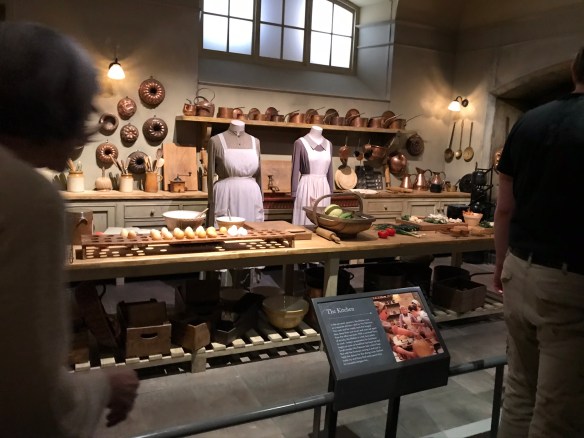
The next section was a lot more fun. It included sets from the show. I didn’t see any information which specified, but I am assuming these were the actual sets (if not, they were very good recreations).

Mr. Carson’s office:

Downton Abbey butler officeThe kitchen:

The bells:

They also had the formal dining room and Lady Mary’s bedroom.

Then we had to take another shuttle to Antler Hill Village to see the costumes. I enjoyed this quite a lot. Even without remembering who wore which clothes, we found ourselves guessing which dress went with which character just by its style. I have multitudes of pictures but will just share a couple.

Downton Abbey costumes

I had mentioned at the beginning feeling like there was no need to go back to Biltmore and see the same things again. What i didn’t know was that the Antler Hill Village area was all fairly recent, plus a few new rooms had been opened up. Plus, in all the times we’ve been there, we’ve never seen the greenhouse or Biltmore Village. The latter was built by Vanderbilt for workmen and employees. I’ve been reading in the book I mentioned about All Souls Cathedral, also built by Vanderbilt, and its stained glass windows dedicated to George’s mother and close friends and other family who passed away. I had hoped to catch a glimpse of it, but by the time we were done, we were tired and needed to get back on the road. So some day I’d be up for another visit to see some of these areas.

Jason and Mittu did stay overnight and went back the next day to see the greenhouse and some other areas. Timothy was a little trooper and seemed to enjoy himself. We were glad there were some grassy areas in-between buildings where they allowed people to walk and kids to run. He was looking forward to the pool at the hotel. 🙂

All in all, it was a fun visit. I enjoyed seeing the Biltmore again and loved seeing the Downton Abbey sets and costumes. If you’re a fan of the show, I hope you get a chance to see the exhibit. It’s at the Biltmore until April 7. I’m assuming the house and exhibit would be a lot less crowded on weekdays: I’d recommend going then if you can.

Have you visited the Biltmore or see the Downton Abbey exhibit?

When Not To Be Minimalist

When not to be minimalistI enjoyed reading Joni Eareckson Tada’s Spectacle of Glory devotional book a couple of years ago. One quote from the book that came back to me many times after reading it was from the August 9 entry, which commented on Ephesians 3:8 about “the unsearchable riches of Christ”:

We can study all we want, but Jesus will always be a greater Savior than what we think He is. He is more ready to forgive than you can imagine asking Him. He is more willing to supply your wants and needs than you are to declare them. He is so much more ready to give than you are to receive. Don’t ever tolerate low thoughts of a barely adequate, minimalist Savior who might “keep you going” but not much more. Jesus has riches to bestow on you right now. He will not only give you heaven above, but heaven-hearted joy in serving Him here on earth.

Lord, my thoughts about You are too small, too lean, too sparse, too thin, too colorless. Paul writes about your unsearchable riches, but on some days, I barely even approach the treasuries. My mind is filled with too many smaller things. I’m in the trees and can’t see the mountains. Lift my gaze to your greatness and majesty today (p. 242, emphasis mine).

The phrase “minimalist Savior” especially jumped out at me, since minimalism is such a byword these days. I don’t want to comment on the current notions of minimalist lifestyles or practices, but I began to think of other ways we should not be minimalists.

In thoughts of our Savior

Joni wasn’t saying Jesus lived extravagantly while on earth. He was born into a poor earthly family. He didn’t own a home as an adult. One former pastor used to say that Jesus was “born from a borrowed womb and buried in a borrowed tomb.”

But, contrary to the “prosperity gospel,” all blessings are not material. God promises to supply our needs, but He doesn’t promise physical riches to His followers. Rather, “according to the riches of his glory” (Ephesians 3:16), He “is able to do far more abundantly than all that we ask or think” (Ephesians 3:20. The KJV says “exceedingly abundantly.”)

In prayer

Couched between Ephesians 3:16 and 18, based on those riches of Christ, this is what Paul prays for:

According to the riches of his glory he may grant you to be strengthened with power through his Spirit in your inner being, so that Christ may dwell in your hearts through faith—that you, being rooted and grounded in love, may have strength to comprehend with all the saints what is the breadth and length and height and depth, and to know the love of Christ that surpasses knowledge, that you may be filled with all the fullness of God.

Sometimes when I find myself suggesting to God ways that He might answer, I remind myself of this: He can do far more than I can ask or even think, according to Ephesians 3:20.

In worship

In Mark 14, a woman came into the house where Jesus was a dinner guest. John 12:1-8 identifies her as Mary of Bethany, whose brother, Lazarus, Jesus had raised from the dead (Matthew 26:6-13 also records this incident). She “came with an alabaster flask of ointment of pure nard, very costly, and she broke the flask and poured it over his head.

That might seem weird to us in our time. I went on a bit of a rabbit trail trying to discover what anointing meant and why it was done in that day. The best explanation I found so far is here. Anointing was a mark of respect and also a way of setting apart a prophet, priest, or king. Christ is referred to an anointed in other passages. Perhaps Mary was showing her gratefulness for Jesus having raised her brother. Perhaps she had some of these other aspects in view. But Jesus took her actions as anointing his “body beforehand for burial.” Whether Mary did this unwittingly or whether she caught what so many of the other disciples missed when Jesus foretold His death, I don’t know. Others criticized her actions, pointing out that this expensive ointment could have been sold and given to the poor. But Jesus said, “Leave her alone. Why do you trouble her? She has done a beautiful thing to me” (verse 6). And He promised that “wherever the gospel is proclaimed in the whole world, what she has done will be told in memory of her” (verse 9).

A similar incident occurs in Luke 7. We know this is a different situation because the event, timing, host, woman, actions, critics, criticisms, purpose, and response from Jesus are all different. The woman in this case is known as sinful. She wet Jesus’ feet with her tears, dried them with her hair, and anointed them with the expensive ointment. The host, a Pharisee, criticized Jesus in his heart, saying, “If this man were a prophet, he would have known who and what sort of woman this is who is touching him, for she is a sinner.” Jesus then told of two debtors. One owed a large amount and one owed a small amount. Both debts were forgiven. Jesus asked which of the debtors would love the lender more. The Pharisee answered, “The one, I suppose, for whom he cancelled the larger debt,” (verse 43). Jesus said of the woman, “Therefore I tell you, her sins, which are many, are forgiven—for she loved much. But he who is forgiven little, loves little” (verse 47). Her actions were extravagant both because of the cost of the ointment, but also because she loved so much that she risked ridicule and shame from others to show her great love to Him.

Have we thought recently about the greatness of our sins and how much it cost Jesus to forgive them? Have we meditated on His goodness and greatness enough to be overawed?

In giving

We’ve already seen from these two women that their love and worship led to costly actions. Does that mean we need to get some expensive perfume to bring to church or pour out when we read our Bibles? No. But generosity should be part of our character. King David once said, “I will not offer burnt offerings to the Lord my God that cost me nothing” (2 Samuel 24:24).

When Paul sought financial help for needy saints, he told the Corinthians:

Whoever sows sparingly will also reap sparingly, and whoever sows bountifully will also reap bountifully. Each one must give as he has decided in his heart, not reluctantly or under compulsion, for God loves a cheerful giver (2 Corinthians 9:6-7).

He wasn’t speaking just to the rich Corinthians. He referred earlier to the Macedonians, who first gave themselves to the Lord and then to the apostles, and who begged for the opportunity to give out of their extreme poverty (2 Corinthians 8:2-5).

I’ve seen a lot of criticism of the rich online recently, and a lot of judgment about what they do with their wealth. But we’re not accountable for them. We’re accountable for ourselves. The Macedonians were in extreme poverty yet begged to be allowed to give to help others.Jesus commended a poor widow who only offered two small coins because that was her all (Luke 21:1-4).

Giving abundantly doesn’t necessarily mean we need to sell everything we have and give it to the poor. Jesus only told one man to do that, because he knew that man’s wealth was a problem for him. 1 Corinthians 16:2 tells us to give as God has prospered us.

Sometimes we save to be able to give. Another former pastor once advised his people to have a “benevolence” section in their budget, to put aside a little bit of money every paycheck so that when they become aware of a need, they would have some on hand to give.

We should give wisely, of course. There is a type of giving that enables people to continue on in their sin. Sometimes we have to say no. Sometimes God says no, because what we’re asking isn’t good for us or isn’t the right time.

And we don’t just give money. Our time, schedules, attention, homes, all belong to God, to be used as He directs.

We don’t give for show, as Ananias and Sapphira and the Pharisees did. But we give as God directs out of a grateful heart for what He has given us.

And we can’t outgive God. Jesus said, “Give, and it will be given to you. Good measure, pressed down, shaken together, running over, will be put into your lap. For with the measure you use it will be measured back to you” (Luke 6:38).

In love

1 Peter 1:22 tells us to “love one another with a pure heart fervently.” Other translations say “deeply” or “earnestly.” Biblical love could take another whole post (or several) to expound upon, but it’s aptly summed up in 1 Corinthians 13. Verses 4-8a say:

Love is patient and kind; love does not envy or boast; it is not arrogant or rude. It does not insist on its own way; it is not irritable or resentful; it does not rejoice at wrongdoing, but rejoices with the truth. Love bears all things, believes all things, hopes all things, endures all things. Love never ends . . .

My heart is full, thinking of God’s great generosity to me, inspired to be generous towards others, overflowing into even more ways to be generous rather than minimalist: thankfulness, praise, patience, and more.

How about you? I’d love to hear your thoughts in the comments.

(Sharing with Inspire Me Monday, Global Blogging, Senior Salon, Hearth and Home, Literary Musing Monday, Purposeful Faith, Happy Now, Tell His Story, InstaEncouragement, Anchored Abode, Recharge Wednesday,
Worth Beyond Rubies, Share a Link Wednesdays, Let’s Have Coffee,
Heart Encouragement, Grace and Truth, Faith on Fire,
Blogger Voices Network. Linking does not imply 100% agreement)

Laudable Linkage

These are some noteworthy reads discovered this week:

To Redeem ‘Cancel Culture’, There Must Be Room for Redemption, HT to Challies. “But now to the most apparent deficiency of secularism as a religion: the absence of any explicit provision for redeeming and restoring to acceptance by the community those judged guilty of violating its moral code.”

Peace in the Beforehand. “If I dread an upcoming difficulty, as well as suffer through it, I’ve doubled my misery.” And, Sandy goes on to say, if we dread something, but then everything goes fine, we’ve wasted all that angst. Such a helpful perspective.

My Heart Is a Featherweight. I’ve enjoyed Laura Ingalls Gunn’s blog for many years. Yes, she’s related to the real LIW. But this might be my favorite post: a true story about how God brought two people to the exact same spot, one with a longtime desire, one looking for just the right person to give a treasured item to.

Dear Teenage Daughter: You Aren’t Entitled.

Protecting Digital Accounts After Death.

And a thought for the day:

. . . or sunrises or seasons or growth.

Happy Saturday!

Friday’s Fave Five

friday fave five 12It’s Friday, time to look back over the blessings of the week
with Susanne at Living to Tell the Story and other friends.

And another week is nearly down for the count. Time passes so quickly, I enjoy slowing it down for just a bit by pausing to remember some of the best parts of the previous week.

1. A successful new recipe. This was actually from the previous week, but I forgot to mention it. I wanted to make something different for a church potluck, searched online, and tried Crockpot Honey Teriyaki Meatballs. I used frozen gluten-free meatballs, as we have a number of gluten-intolerant folks. I only used half the sugar called for and used canola oil instead of sesame oil (the latter was expensive, and I didn’t want to buy a whole bottle for one teaspoon). It tasted great and was easy to put together. There were only half a dozen meatballs left, so I consider it a success. I’m looking forward to making it again some time.

2. Valentine’s Day. One of my favorite holidays.

3. My husband making a return. I just hate taking things back to stores. My husband had errands to run in the vicinity of a store I needed to make a return to, and I asked him if he’d mind taking care of it for me. He gladly did so. As much as I LOVE the cards, flowers, candy, balloons, gifts, and expressions of love on Valentine’s Day, these kinds of things show love to me even more. In addition, Friday I walked into the laundry room to discover an odor like something burning. To me it smelled like rubber or a belt with too much friction. Thankfully my husband was working from home that day and came over to investigate. He spent Saturday morning taking the dryer apart, checking out all its parts, vacuuming out the lint.

4. Sleeping in Saturday. I woke up about 2:30 a.m. Saturday with a raging headache. Once I finally got back to sleep, I didn’t wake up til after 7. That’s rare for me: I’m usually up between 5 and 6 even without an alarm clock. I stayed in my pjs til mid-morning and basically took it easy. It took all day for the headache to abate. The only downside was missing our every-other-month ladies’ Bible study. Thankfully I had gotten a lot done earlier in the week, so I could rest up without feeling I needed to take care of other things.

5. Christian music and programming. Thursday I woke up around 4:10 a.m. and couldn’t get back to sleep. I had a good time of prayer, but later in the morning was in a funk—unusual for me. I couldn’t pinpoint what was wrong. Everyone else was out, so I couldn’t blame another person. I usually listen to an audiobook while getting ready in the morning, but decided to finish the last of the Revive Our Hearts podcast series with Valerie Elliot Shephard, Elisabeth Elliot’s daughter. I turned on the Christian radio station while peeling potatoes for the crockpot. I came across this post in my Feedly account talking about the use of music in our quiet time. I clicked on several of my favorites and a couple that were new to me. All of that worked together to tenderize my heart and change my perspective. Later in the afternoon I got a bit of a nap in and felt much better, so lack of sleep was probably a major factor. But I was still thankful for the variety of means available to minister to my spirit.

Bonus: My daughter-in-law’s birthday! Actually, as I am writing on Thursday afternoon, we haven’t celebrated yet. So this is an anticipatory fave. Their family is coming over tonight for dinner and cake, if the “wintry mix” we received today doesn’t cause problems. Then we have some special plans over the weekend that I look forward to telling you about next week.

Update: the snow and slush did melt and we were able to get together. Always a joy to celebrate Mittu’s special day. Timothy, as you can see, is at the age of mugging for the camera. 🙂

And that’s my week. How was yours?