Unknown's avatar

About Barbara Harper

https://barbarah.wordpress.com

Whispers from the Shadows

Whispers from the Shadows is the second novel in Roseanna M. White’s Culper Spy Ring series.

The story opens some 35 years after the Revolutionary War. England and the United States are once again battling each other, this time in the War of 1812.

So Gwyneth Fairchild can’t understand why her father is sending her away from England to America, to his old friends, the Lanes. How can crossing a sea filled with pirates and combatants be safer than England?

But her father is insistent. As they’ve said their good-byes, Gwyneth turns to the carriage and her guardians. But she runs back to ask her father one last thing—only to witness his murder. His last whisper as he sees her is, “Run.”

So Gwyneth runs. On the two-month long voyage, she can’t sleep more than two hours at a time. Seasickness, insomnia, and sorrow reduce her health and well-being to frightening levels. For some reason, she does not tell her guardians what happened.

When their vessel is overtaken by American privateers, they are delivered to Thaddeus Lane in Baltimore, the son of Winter and Bennet. Thankfully Thad’s parents are there when Gwyneth arrives.

Gwyneth slowly recovers from her ordeal, but still tells no one what happened to her father. Everyone suspects that her state is due to more than severe seasickness. Gwyneth takes refuge in drawing, and somehow Thad discerns that she has faced some kind of severe trauma.

On the surface, Thad is a merchant who knows almost everyone in Baltimore. Secretly, he’s a key member of the revived Culper Ring.

As Gwyneth and Thad discover each other’s secrets, the British invasion increases. In the midst of it all, Gwyneth can’t help but wonder if her father’s murderer will come after her, too.

I loved this book on so many levels. It was fun that Winter and Bennet from the first book were such a big part of this one as well. I enjoyed Gwyneth and Thad, their personalities and journey and especially Gwyneth’s growth. I loved Thad’s kind but non-nonsense cook, Rosie, who was a niece of Freeman from the first book.

There was also so much edge-of-your-seat intrigue.

I don’t know if I have ever read another book set during the War of 1812. So many write WWII novels, which is fine—I loved Roseanna’s books set then. But it’s nice to learn about other eras as well.

Wikipedia only details the Culper Ring activity through the Revolutionary War. Roseanna shared in her afterword of the first book that a CIA member said in an interview that “The Culper Ring may or may not still exist.” It’s fun it imagine that they continued on behind the scenes for so many years.

The next novel is set during the Civil War, and one more novella comes before. I am looking forward to them.

The Forgotten Life of Eva Gordon

The tag line for The Forgotten Life of Eva Gordon by Linda MacKillop is “Eva wants to run away from her life–if only she could remember how.”

Eva has been moved from her long-time cozy home in Cape Cod to the city of Boston to live with her granddaughter, Breezy. And Eva hates it. She hates the city, she misses the familiarity of her own home and town, she’s an introvert who has a hard time with the constant stream of students and friends in Breezy’s house. Breezy’s neighbor, Mabel, tries to keep an eye on Eva, but Eva feels Mabel is intrusive.

Then, on top of everything else, Breezy announces that she’s getting married to her boyfriend, Ian, and they’re all going to live in Ian’s old fixer-upper family farm with his elderly uncle.

It’s all overwhelming for Eva, but she’s stuck. She can’t count on her memory any more. Even when she works out what seems like a perfectly logical plan, she ends up getting into trouble.

I was first attracted to this book because I identified a lot with Eva. I’d probably feel the same way in her situation.

But as the story unfolds through flashes of Eva’s memories, there’s more to Eva than the desire for solitude and independence. She’s been pretty awful, driving her husband and children away, saying negative things without thinking (even before dementia). I wish we’d gotten a little better idea of why Eva was the way she was. The only clue I caught was that her dad tended to speak to her the same harsh way.

I think all of us would like to live independently, mentally and physically capable, til we’re 100. But reality doesn’t always work out that way. One poignant piece of advice Mabel offers is, “When the time come to release the last smidge of life, Eva, you want to have kissed the most important things good-bye already. Getting old like us involves lots of little deaths to prepare for the big one—like saying good-bye to loved ones, your home, your health” (p. 249). I’m tucking that away for later.

I can’t say I warmed up to Eva like I have other curmudgeonly characters. But I did come to appreciate her struggles, empathize with her, and understand her better. There’s no grand climax of eye-opening for her, but a gradual realization that she has treated people badly and needs to accept them and life circumstances more graciously.

I was curious about what inspired the author to write this book, so I searched a bit and found this interview, which helped me understand the story a little more. I especially liked this sentence: “The characters in the novel decide to move toward Eva without being put off by her abrasive personality, giving her the opportunity to decide whether she’ll receive their love and acceptance.”

I liked the theme of second chances. Even in old age, even in dementia, steps can be taken to heal relationships and accept love.

Called to Sacrifice

called to sacrifice

Several years ago, a man in our church who had spent much of his life as a missionary in Africa spoke of not liking the word “sacrifice” in reference to his service. He said it was his privilege to serve the Lord and not at all a sacrifice.

David Livingstone said something similar:

People talk of the sacrifice I have made in spending so much of my life in Africa. Can that be called a sacrifice which is simply paid back as a small part of a great debt owing to our God, which we can never repay? Is that a sacrifice which brings its own blest reward in healthful activity, the consciousness of doing good, peace of mind, and a bright hope of a glorious destiny hereafter? Away with the word in such a view, and with such a thought! It is emphatically no sacrifice. Say rather it is a privilege. Anxiety, sickness, suffering, or danger, now and then, with a foregoing of the common conveniences and charities of this life, may make us pause, and cause the spirit to waver, and the soul to sink, but let this only be for a moment. All these are nothing when compared with the glory which shall hereafter be revealed in, and for, us. I never made a sacrifice. Of this we ought not to talk, when we remember the great sacrifice which HE made who left His Father’s throne on high to give Himself for us. (Speech to students at Cambridge University, December 4, 1857.)

I understand what these dear men meant. God did so much for us, and loves us so much. How can we help but lovingly serve Him in return?

Yet the Bible calls us to sacrifice.

We don’t sacrifice as people did in the Old Testament. The sacrifices for sin were fulfilled in Christ. The book of Hebrews goes into great detail about how so much of the OT sacrificial system symbolism comes to fruition in Jesus.

And according to Galatians (as well as many other places in the NT), we are no longer under the OT law.

But 1 Peter 2:4-5 tells us: “As you come to him, a living stone rejected by men but in the sight of God chosen and precious, you yourselves like living stones are being built up as a spiritual house, to be a holy priesthood, to offer spiritual sacrifices acceptable to God through Jesus Christ.

What are these spiritual sacrifices?

A broken and contrite heart. In David’s psalm of repentance, he says, “For you will not delight in sacrifice, or I would give it; you will not be pleased with a burnt offering. The sacrifices of God are a broken spirit; a broken and contrite heart, O God, you will not despise” (Psalm 51:16-17). Even under the OT system, God didn’t want His people to simply go through a rite. He wanted their hearts.

Our bodies. Romans 12:1-2 tells us, “I appeal to you therefore, brothers, by the mercies of God, to present your bodies as a living sacrifice, holy and acceptable to God, which is your spiritual worship. Do not be conformed to this world, but be transformed by the renewal of your mind, that by testing you may discern what is the will of God, what is good and acceptable and perfect.” We don’t just yield our hearts or souls, but our very bodies. “So whether you eat or drink, or whatever you do, do it all for the glory of God” (1 Corinthians 10:31).

Praise. Hebrews 13:15 says, “Through him then let us continually offer up a sacrifice of praise to God, that is, the fruit of lips that acknowledge his name.” Why would praising Him be considered a sacrifice? Perhaps because we’re turning our thoughts and words away from selfish pursuits to think of Him. Perhaps because some situations are hard to praise God for. Praising Him reminds us of His power, His care, His wisdom even when life is hard.

Service and giving to others. Hebrews 13 goes on to say, “Do not neglect to do good and to share what you have, for such sacrifices are pleasing to God” (verse 16). When the Philippians sent a gift to Paul, he wrote back, “I am well supplied, having received from Epaphroditus the gifts you sent, a fragrant offering, a sacrifice acceptable and pleasing to God” (Philippians 4:18).

Love. “And walk in love, as Christ loved us and gave himself up for us, a fragrant offering and sacrifice to God” (Ephesians 5:2). When we love others, we set aside our own desires and needs to minister to them.

When you minister to people, sometimes you feel spent. That’s because you have been. Paul wrote to the Philippians, “ Even if I am to be poured out as a drink offering upon the sacrificial offering of your faith, I am glad and rejoice with you all.” We pour out, and it’s okay to feel drained. Paul reminds us later in chapter 4 that God will supply all our needs (verse 19) and we can do all things through Him who strengthens us (verse 13).

What makes a sacrifice a sacrifice? Definition.org has this as one meaning of sacrifice: “Forfeiture of something highly valued for the sake of one considered to have a greater value or claim.” When David was repentant for taking a census that he wasn’t supposed to in 1 Chronicles 21, God told him to “go up and raise an altar to the Lord on the threshing floor of Ornan the Jebusite” (verse 18). When David tried to pay for the threshing floor, Ornan wanted to give it to him. But David replied, “I will not take for the Lord what is yours, nor offer burnt offerings that cost me nothing” (verse 24). Sacrifices cost something.

But God doesn’t want us to moan and groan or whine about sacrificing to Him. Nor does He want us to be prideful about it. Our definition of sacrifice above says we give something of value “for the sake of one considered to have a greater value.” We give to Him not only because He gave to us, but also because we love and value Him.

We appreciate more than we can say the soldiers, firefighters, and policemen who endanger themselves for others, even to the point of giving their lives. But dying physically is not the only way to lay down our lives. Soldiers also sacrifice time with their families and normal comforts for our protection. We admire missionaries and mission workers who work much more than a 9 to 5 job in places far from home.

Yet sacrifice does not occur only in the big things. We lay down our lives, dying to our own will, being poured out in everyday love and service. We seek grace to welcome an interrupter kindly when we longed for a few moments alone. A husband works hard to provide for his family. A mom wakes up at night to feed or comfort her children. A friend makes time for a long phone call. Volunteers at a church work day give up leisure or family time to pull together on a project.

Missionary and writer Elisabeth Elliot often used the phrase, “My life for yours.” We give ourselves to Him first of all, and then serve Him by serving others.

So we don’t have to shy away from the word “sacrifice.” God calls us to it. All that we are and have belongs to Him anyway. But when we yield everything back to Him, “such sacrifices are pleasing to God” (Hebrews 13:16).

spiritual sacrifices

(I often link up with some of these bloggers.)

Laudable Linkage

It’s been a super-busy week, so I have just a few links for you. But I think they’re good ones.

Why We Follow Some Old Testament Laws But Not Others, HT to Challies. “Critics accuse Christians of conveniently picking and choosing from Old Testament laws. We’re quick to ‘clobber’ gay people with verses from Leviticus, they say, yet we don’t keep kosher ourselves. The complaint, though, is based on a misunderstanding about the Mosaic Covenant that even Christians fall prey to.”

Where Is Your Faith?” HT to Challies. “How do you cling to belief amidst such turmoil of the heart? How do you survive the death of a child? I can tell you, it is not what happens in that moment of complete darkness or even in the months and years that follow. Survival is forged in the pew every Sunday. It is built on the truths of Scripture that you fill your mind with day by day. It comes through knowing Who God is.”

We’re Missing It. “He wants time to love us that way and it can’t happen if He is a ‘to do’ list item, or in sound bites only throughout our day, or only while we grab coffee on our way out the door.”

Well-Worn Boots. Lessons from a pair of faithful old work boots.

Friday’s Fave Five

It seems like April just got here, and now it’s half over. The days fly so fast, I am grateful for a weekly time to stop and think about favorite parts of the week before they fade out of memory. Susanne at Living to Tell the Story hosts us every Friday.

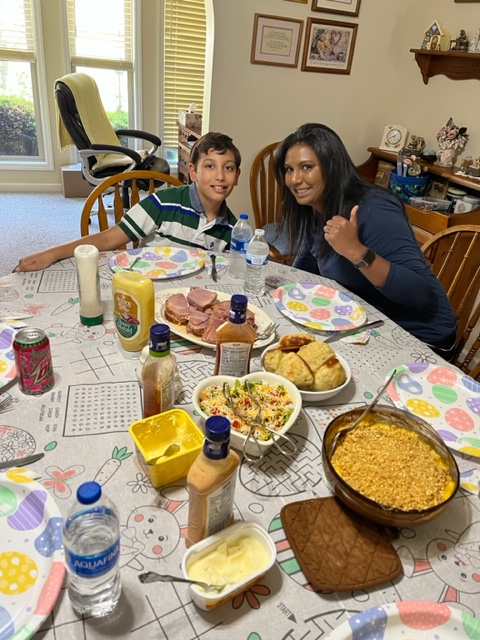
1. Easter, of course, has to be #1 this week, remembering Jesus’ death for us and the hope of the resurrection. I made an Easter playlist on my phone that I enjoyed listening to while getting ready in the morning. Church was really good. We had an Easter feast, then an egg hunt, then ate some delicious spice cake Mittu had made.

2. Family weekend. It’s not unusual for us to get together some time over the weekend. But last weekend, Jason and Mittu had us over for an impromptu dinner Friday, then came over here for hot dogs Saturday, as well as Easter festivities Sunday.

3. Dogwoods are blooming all over town. So pretty.

Pink dogwoods in our back yard
White dogwoods lining a road in the neighborhood.

4. An Amazon gift card won at Susan’s place.

5. Time with Timothy. Jason and Mittu asked us to watch Timothy last night. They brought over dinner and some pretty pink tulips. After they left, we watched some dam videos Timothy wanted to show us (it’s amazing how much he knows about dams), played checkers, talked, and watched a few episode of Bluey.

How was your week? Hope it was a good one.

Seven Words You Never Want to Hear

The Seven Words You Never Want to Hear that Denise Wilson writes about are from Jesus: “I never knew you; depart from me” (Matthew 7:23). Those are frightening words indeed. I struggled with them when I was unsure of my salvation. Thankfully, as Denise’s subtitle indicates, she doesn’t stop there: she tell How to Be Sure You Won’t hear those words.

Those words of Jesus occurred in what we call the Sermon on the Mount in Matthew 5-7. The full paragraph is as follows:

Not everyone who says to me, ‘Lord, Lord,’ will enter the kingdom of heaven, but the one who does the will of my Father who is in heaven. On that day many will say to me, ‘Lord, Lord, did we not prophesy in your name, and cast out demons in your name, and do many mighty works in your name?’ And then will I declare to them, ‘I never knew you; depart from me, you workers of lawlessness.’ (7:21-23).

It’s possible to “do many mighty works in your name” and yet still miss salvation, miss knowing Jesus personally.

Denise discusses several ways that could happen. One is praying “the sinner’s prayer” without faith or repentance. Another is growing up in a Christian atmosphere without ever believing on Christ personally. Or one could be deceived by the prosperity gospel or a works-based religion. Perhaps we haven’t counted the cost of discipleship and only wanted passage to heaven rather than a life of denying ourselves, taking up our cross, and following Him.

People might need to examine their hearts if they say they have been saved yet their life has not changed. We won’t be perfect after salvation. We’re forgiven and cleansed, but we still have an old nature and still need to grow. We’ll still battle with sin—yet if we’re not battling it, but letting it have full sway on our lives, something is amiss.

Denise points out that Jesus did not use a cookie-cutter approach in dealing with people. Years ago I attended classes where we were trained in how to lead someone to the Lord using the “Romans Road,” a series of verses in Romans that explain salvation. That approach is fine as far as it goes. But leading someone to the Lord is not just a matter of getting them to allow you to read them a handful of verses and then you getting them to pray. We need to be open to the Lord’s leading as we speak to people. Only He knows what obstacles to salvation are in their hearts.

Denise includes several testimonies from the Bible, from history, and from modern times. Some of them, she points out, don’t look like what we think salvation looks like. Take the thief on the cross next to Jesus. He knew he was guilty and Jesus was innocent. He asked, “Jesus, remember me when you come into your kingdom” (Luke 23:39-42). Was anyone else ever saved using those words? I don’t know. But one thing I learned in my own struggle was that becoming a Christian was not a matter of saying the “right” words, like a magic formula or an initiation rite. It’s a matter of repentance and faith in Jesus.

2 Corinthians 13:5 tells us to, “Examine yourselves, to see whether you are in the faith.” Denise provides helps to do that in this book.

Ring of Secrets

Ring of Secrets by Roseanna M. White is the first in her Culper Ring series, fiction based on the real-life spy network set in motion during the Revolutionary War.

When Winter Reeves’ mother died while her father was fighting with the Patriots, her grandparents came to take her to their home in New York City. Her grandparents had never forgiven her mother for marrying outside their station and political affiliations, and they took their anger out on Winter. They instructed that she would say her father was dead, that she would not express any Patriot leanings, and she would marry the man of their choosing as soon as possible so they could get her out of their responsibilities and home.

Since Winter could not be who she really was, she played the part of a beautiful but witless society lady. Her persona gave her a great cover, though, for overhearing information from the Loyalist officers in their social circles. She passed along any useful information to her childhood friend, Robbie Townsend, a mercantile owner who was a vital link in the Culper Ring network.

Bennet Lane was a new arrival in the city. He would not have been considered a catch among the highest society there due to his professorship at Yale, teaching chemistry. But now he was set to inherit a large English estate, making all the tittering mamas in town set their sites on him as a potential son-in-law. Though Bennet usually got tongue-tied and awkward around women, he thought the apparent pursuit of a wife would be a good cover for his real mission: to discover information about a hidden Patriot spy ring.

When Bennet met Winter, he perceived that there was intelligence and spunk underneath the silly exterior she presented to the public. He wanted to know more.

Roseanna has become one of my favorite authors over the last few years, and this novel lived up to the others I read. There are so many layers to this story: the political intrigue and danger, the growing attraction between Winter and Bennet despite their differences, the pursuit of Winter by a Loyalist officer, Isaac Fairchild, Winter’s deep faith and Bennet’s lack of belief in anything he can’t see and test. As I read, I thought, “There is only one way I can see this working out.” The plot did go that direction, but with some surprises along the way.

I thought all the characters were well-drawn. I especially loved Freeman, a free Black man who had been one of Winter’s father’s closest friends and who pledged to protect Winter, and Viney, a poor but faith-filled woman Winter encounters.

Even though I love Roseanna’s writing and knew I’d get to this series eventually, I didn’t like the covers, which put me off the series a bit. It looks like this series was first published in 2019 and then the second edition in 2021. There are two covers for each book. I had this one in my Kindle library. But Audible currently has the books for free with an Audible subscription. I’m thankful they did and I finally got to them. I’ve already started the sequel.

I had not realized when I got the audiobooks that there were novellas in-between the books, not on audio. They are currently packaged together here. The first one, Fairchild’s Lady, takes place just before the French Revolution breaks out. General Fairchild from the first book is in France on two missions: to gather information and to locate a countess and her daughter and bring them to England before the Revolution makes travel impossible. He meets a beauitful woman, Julienne, at a masquerade ball, only to discover later that she is the young woman he is looking for. A dangerous French courtier has laid claim to Julienne, though.

This novella was just as good as the first book. Fairchild was a likeable, honorable character, even though he was on the other side, politically. It was fun to see his story continue.

Roseanna notes in her afterword of Ring of Secrets that the Culper Ring members were not professional spies. They were everyday people seeking to promote the cause of the fledgling United States of America. There were women in their ranks as well as men. The main characters in these books are fictional, but historical characters are mentioned as well.

I’m looking forward to see what else happens with the Culper Ring.

Be Joyful

Paul’s theme of joy in Philippians is remarkable when you consider that he wrote the letter from prison.

He wrote believers in the city of Philippi to thank them for a gift, let them know how he was, and encourage them in their walk with God.

Paul didn’t have much to correct among the Philippians. He mentioned dissension among a couple of members and encouraged unity. Otherwise, the Philippian church seemed a healthy one.

He let them know that “what has happened to me has really served to advance the gospel” (1:12). In addition, other believers increased in boldness and confidence. You’d think the opposite would happen, that Paul’s imprisonment would make them afraid lest the same thing happen to them. But perhaps seeing that Paul flourished and that God used even imprisonment to accomplish His will helped them go forward.

Most of us would chafe in imprisonment, eager to get out and back to business. But Paul knew that “to me, to live is Christ and to die is gain” (1: 21). He says later that he had learned contentment in good or bad circumstances, knowing that God would give him strength to face anything (4:10-13).

Paul encourages the Philippians to “let your manner of life be worthy of the gospel of Christ” (1:27), pointing to the example of Christ’s humility and selflessness (2:1-11).

Warren Wiersbe’s commentary, Be Joyful (Philippians): Even When Things Go Wrong, You Can Have Joy, helped as a companion to Philippians.

In some of Wiersbe’s other commentaries, he combines several shorter books together. Philippians has only four chapters, so I expected to find its commentary bundled with others. However, Wiersbe gave Philippians its own book.

Because Wiersbe wrote so much about this book of the Bible, and my ESV Study Bible had copious notes as well, I decided to slow down through this book and follow Wiersbe’s chapter divisions, which each covered only a paragraph or two of Philippians. It’s easy to zoom through this short book of the Bible and not retain much. So I was glad for this slower focus on it.

These are some of the quotes that stood out to me:

What was the secret of this joy? The secret is found in another word that is often repeated in Philippians: It is the word mind. Paul uses mind ten times, and also uses the word think five times. Add the time he uses remember and you have a total of sixteen references to the mind. In other words, the secret of Christian joy is found in the way the believer thinks—his attitudes. After all, outlook determines outcome (p. 18).

When you have the single mind, you look on your circumstances as God-given opportunities for the furtherance of the gospel, and you rejoice at what God is going to do instead of complaining about what God did not do (p. 42).

We Christians are the citizens of heaven, and while we are on earth we ought to behave like heaven’s citizens (p. 53).

It takes more than an example on the outside; it takes power on the inside (p. 73).

The Christian life is not a series of ups and downs. It is rather a process of “ins and outs.” God works in, and we work out (p. 73).

The verb “work out” carries the meaning of “work to full completion,” such as working out a problem in mathematics (p. 74).

Like most religious people today, Paul had enough morality to keep him out of trouble, but not enough righteousness to get him into heaven. It was not bad things that kept Paul away from Jesus—it was good things. He had to lose his religion to find salvation (p. 96).

Once again, I am thankful for Dr. Wiersbe’s insights.

Resurrection Hope Beyond Easter

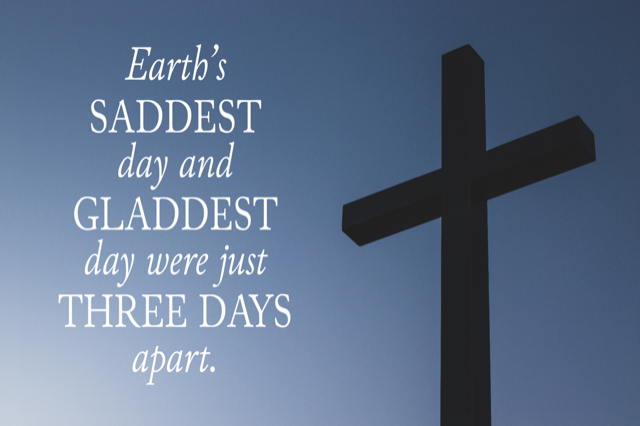
We think of Easter as the joyful end of a long period of sadness. Even if we don’t formally practice Lent, we spend the time leading up to Easter contemplating the last week of Jesus’s life, His trial, and His crucifixion. We mourn over our sinfulness, which required such a price for atonement.

But then we burst forth into joy and praise on Easter Day. Christ is risen! He overcame death and the grave!

And then Monday we go back to our normal routine. We don’t think much about the resurrection again until next Easter or until someone dies. Then we’re encouraged that we’ll see our missing loved ones again.

But the resurrection changed everything. It touches our lives much more than one day a year.

Here are some ways resurrection hope affects our lives:

Testifies that Jesus is the Son of God. Jesus “was declared to be the Son of God in power according to the Spirit of holiness by his resurrection from the dead” (Romans 1:4).

Dismantles our fear of death. Hebrews 2:14-15 tells us, “Since therefore the children share in flesh and blood, he himself likewise partook of the same things, that through death he might destroy the one who has the power of death, that is, the devil, and deliver all those who through fear of death were subject to lifelong slavery.”

In Isobel Kuhn’s books, she cites that many Lisu people came to faith in Christ due to the resurrection. Their previous beliefs held no hope after the grave. They thought death was the end of the body, soul, and spirit. Some mourned inconsolably at a loved one’s grave or cowered in abject terror at the thought of their own end. Learning who Jesus was, the salvation He accomplished for their forgiveness, and the hope of eternal life transformed them.

Jesus told Martha, “I am the resurrection and the life. Whoever believes in me, though he die, yet shall he live, and everyone who lives and believes in me shall never die. Do you believe this?” (John 11:25).

Allows Christ to live in us. Paul said part of the ministry given to him was to preach “the riches of the glory of this mystery, which is Christ in you, the hope of glory” (Colossians 1:27). We not only have His fellowship, comfort, and so much more, we have His power to live. “I have been crucified with Christ. It is no longer I who live, but Christ who lives in me. And the life I now live in the flesh I live by faith in the Son of God, who loved me and gave himself for me” (Galatians 2:20).

Assures justice will be done. When the King comes to reign, everything will be as it should be.

Removes death’s sting. 1 Corinthians 15:54-57 says:

When the perishable puts on the imperishable, and the mortal puts on immortality, then shall come to pass the saying that is written:

“Death is swallowed up in victory.”
“O death, where is your victory?
    O death, where is your sting?”

The sting of death is sin, and the power of sin is the law. But thanks be to God, who gives us the victory through our Lord Jesus Christ.

Jesus’ death breaks the power of sin in our lives. We still have to fight the old nature and resist the devil, but they have no more authority over us.

Gives meaning to our labor. 1 Corinthians 15 is the great “resurrection chapter.” After 57 verses about the resurrection, Paul says, “Therefore, my beloved brothers“—because of all he had said about the resurrection up til now—“be steadfast, immovable, always abounding in the work of the Lord, knowing that in the Lord your labor is not in vain.” We can be steady in our labor for God, even if we don’t see any results. Galatians 6:9 puts it another way: “And let us not grow weary of doing good, for in due season we will reap, if we do not give up.”

Gives comfort and hope in our sorrow. Our grief when a loved one dies is tempered by the fact that we’ll see them again.

But we do not want you to be uninformed, brothers, about those who are asleep, that you may not grieve as others do who have no hope. For since we believe that Jesus died and rose again, even so, through Jesus, God will bring with him those who have fallen asleep. For this we declare to you by a word from the Lord, that we who are alive, who are left until the coming of the Lord, will not precede those who have fallen asleep. For the Lord himself will descend from heaven with a cry of command, with the voice of an archangel, and with the sound of the trumpet of God. And the dead in Christ will rise first. Then we who are alive, who are left, will be caught up together with them in the clouds to meet the Lord in the air, and so we will always be with the Lord. Therefore encourage one another with these words (1 Thessalonians 4:13-18).

We still grieve and miss them sorely, but we have great joy to look forward to.

Gives perspective to our sufferings. When we’re suffering, our pain can take over our minds and emotions. Suffering seems endless. It outweighs everything else. But as heavy as suffering is, in heaven, our time of suffering will seem “light” and “momentary.” “So we do not lose heart. Though our outer self is wasting away, our inner self is being renewed day by day. For this light momentary affliction is preparing for us an eternal weight of glory beyond all comparison” (2 Corinthians 4:16-17). Romans 8:18 puts it this way: “For I consider that the sufferings of this present time are not worth comparing with the glory that is to be revealed to us.”

Provides a new address. Philippians 3:20 tells us, “But our citizenship is in heaven, and from it we await a Savior, the Lord Jesus Christ.” Warren Wiersbe says in his commentary on Philippians, Be Joyful, “We look at earth from heaven’s point of view” (p. 95). Our time here is relatively brief, and eternity is long.

Promises reward for our service. The Bible speaks of crowns that will be rewarded to various believers. Jesus said that when we have a feast, we should not only invite friends and loved ones. We should gather in those who can’t repay us, “and you will be blessed, because they cannot repay you. For you will be repaid at the resurrection of the just” (Luke 14:14).

Shows forth God’s power. One of the things Paul prays that the Ephesians might know is “the immeasurable greatness of his power toward us who believe, according to the working of his great might that he worked in Christ when he raised him from the dead and seated him at his right hand in the heavenly places” (Ephesians 1:19-20). Paul’s burning desire was “that I may know him and the power of his resurrection, and may share his sufferings, becoming like him in his death, that by any means possible I may attain the resurrection from the dead” (Philippians 3:10-11).

Gives focus for our daily walk. 1 Corinthians 4:18 says, “as we look not to the things that are seen but to the things that are unseen. For the things that are seen are transient, but the things that are unseen are eternal.” Paul says, “But one thing I do: forgetting what lies behind and straining forward to what lies ahead, I press on toward the goal for the prize of the upward call of God in Christ Jesus” (Philippians 3:13-14).

Because of the resurrection, we know this life is not all there is. “If then you have been raised with Christ, seek the things that are above, where Christ is, seated at the right hand of God. Set your minds on things that are above, not on things that are on earth. For you have died, and your life is hidden with Christ in God. When Christ who is your life appears, then you also will appear with him in glory” (Colossians 3:1-4). One of our former pastors used to frequently quote from a little chorus by Al Smith, “May I do each day’s work for Jesus, With eternity’s values in view.”

I love this stanza in “I’ve Found a Friend” by James G. Small:

I’ve found a friend, O such a friend!
All power to Him is given,
To guard me on my onward course,
And bring me safe to Heaven.
The eternal glories gleam afar,
To nerve my faint endeavor;
So now to watch, to work, to war,
And then to rest forever.

May the “eternal glories” that “gleam afar” nerve our own “faint endeavors.” May we carry resurrection hope in our hearts every day.

(I often link up with some of these bloggers.)

Laudable Linkage

I don’t observe Lent in a formal way. But I do like to spend some time in the weeks leading up to Easter by reading either the gospel accounts of Jesus’ death and resurrection or a book on the subject.

I had just read the gospel of John recently, so I didn’t want to go through it again so soon.

A couple of my favorite books for this time of year are The Women of Easter by Liz Curtis Higgs and Jesus, Keep Me Near the Cross compiled by Nancy Guthrie. But I wasn’t inclined to pick up one of those again, and I didn’t have any new material I wanted to read. I’m in a number of books already and didn’t want to start something lengthy.

Then I saw that Revive Our Hearts recently posted about the seven last sayings of Christ on the cross. That series just fit my needs this year. If you have some time today and tomorrow, you might want to look at a few of them to prepare your heart for Easter:

Here are some of the other good reads I found this week:

You Know What’s Crazy? HT to Challies. “I had 13 hours to sit and think about the drama we’d just been involved in. I thought, ‘It’s crazy that this guy still thought he was all right to fly.  He was totally irrational. Any normal person could see that he was in a bad way. But he couldn’t see it. He thought he was fine.’ The thought occurred to me that this is a lot like the irrationality of sin and sinners.”

Intentional Gardening–and an Intentional Life–in Partnership with God. “Standing or stooping in my garden, I portray the work that’s required for spiritual cultivation, for I believe God is pleased when I come to spiritual disciplines with the same fervor I bring to the elimination of ragweed between my tomato plants.”

The Shadow Is a Small and Passing Thing, HT to Challies. “One evening, while Frodo slept and Sam watched, Sam looked up at a single star in the sky above Mordor. Thinking on that star, Tolkien wrote, ‘the thought pierced him that in the end the Shadow was only a small and passing thing: there was light and high beauty for ever beyond its reach.'”

The Unexpected Beauty of Babel, HT to Challies. “It seems as if, as he so often does, God has chosen to bring beauty through judgment, a greater grace and glory than would have existed had the judgment never taken place. After all, this is the logic of the cross and salvation history. Yes, judgment falls. Yet amazingly God’s grace shines even brighter for it. Should we be surprised that God delights to also do this with the arc of language history?”

Overcome Your Enemies by Dying. “What do you do when people turn against you? When those who reject the Lord Jesus Christ come after you for daring to follow him? When nitpicking and backstabbing are the standard operating procedure in the workplace? When family members use guilt and pressure to manipulate you into doing what they want?”

Protect Teens from Sextortion, HT to Challies. “Last month, international law enforcement agencies released a warning: ‘In 2022, the FBI received thousands of reports related to the financial sextortion of minors, primarily boys, representing an exponential increase from previous years. Unfortunately, the FBI is also aware of more than a dozen suicides following these incidents.”