Unknown's avatar

About Barbara Harper

https://barbarah.wordpress.com

Laudable Linkage

Here’s another list of good reads found this week:

We Need More Holy Fools: How God Awakened Me to Eternity, HT to The Story Warren. “A man is trapped in a car, rushing down a hill toward a cliff. The doors are locked. The brakes are out. The steering barely works. Far ahead, he can see other cars hurtling into the abyss. How far they fall, he does not know. What they find at the bottom, he cannot imagine. But he does not seek to know; he does not try to imagine. Instead, he paints the windshield, climbs into the back seat, and puts in his headphones.”

God Will Turn You Every Which Way But Loose. HT to Challies. “Do not believe the lies that say God wants your life to be as smooth as possible. That he desires for you to have a problem-free existence if only you would have enough faith.”

Being Domineering as a Pastor Doesn’t Require Skill, HT to Challies. Though this is written to pastors, it’s good advice for anyone in any leadership role.

3 Myths of the Good Old Days. “I’m guessing every generation has uttered this phrase, which makes me question: If my good old days were the previous generation’s not-so-good days, and on and on backwards, then when were the real good old days?”

The Indispensable Ministry of Disability, HT to Challies. “Our more recent experiences with Ben have opened my eyes to the realization that people with disabilities in our congregations are not just objects of ministry. They are gifted just like the rest of us, though often in ways that we haven’t realized.”

Rolls and Circles in Women’s Ministry: Why You Need Both. “When you think of discipleship in your church, women’s ministry, or small group, how do you picture the chairs being arranged? Do you picture the chairs in rows, facing a teacher in the front? Do you picture the chairs in circles, where small groups of women gather? Or do you think of discipleship as a single chair, where a woman opens her Bible and hears from God directly?”

When You’ve Given Your Troubles to God—But Still Can’t Sleep. “Insomnia is horrible. It is a form of suffering that lays us utterly bare before the Lord. We completely depend on him to show up. Sometimes he shows up by letting us fall asleep; sometimes he shows up by stripping us of self-sufficiency, making us see that he takes weary people and sustains them even when all earthly things fail them.”

Take the Chance. “It seemed like the ideal opportunity. Crouching in the darkness of the cave, David saw his enemy alone and vulnerable. It looked like the chance he had been waiting for.”

Friday’s Fave Five

Here we are at another Friday. Time to pause for a few moments with Susanne at Living to Tell the Story to think over the past week and remember the good parts.

1. Jason’s birthday. Always a joy to celebrate his arrival into this world.

Mittu made the cake. Isn’t it cute?

And, because this is the kind of family we are, I have to include Jesse’s photo bomb. 🙂

2. Lunch with a friend. I think this is the first time I’ve gone out with this friend since last fall—because she had a baby in the meantime. 🙂 We’ve been in touch and seen each other at church, but it was good to have an extended visit.

3. A technology fix. My toolbar on my blog went missing, and every time I replied to a comment on my blog, it made me log in again. I asked my oldest son about it, and he sent me this article about Firefox’s Total Cookie Protection. I had gotten a notice from them asking if I wanted to turn off sites’ ability to use tracking cookies. Well, sure. But evidently it’s a little too aggressive. The article showed me how to disable it for individual sites, so I did that on my blog. My tool bar came back and I was able to comment normally again. Plus it seemed to fix the problems I was having commenting on a few sites. It’s definitely a first-world problem, but an annoying one, and it’s such a relief to have it fixed.

4. Safety and electricity. Wednesday night, we had one of the most intense storms I’ve experienced in a long time. Torrential rains and almost constant flashes of lightning, but not much thunder. We lost power for almost 24 hours. A neighbor’s fence was damaged on one side of his yard. A lot of people reported downed trees and branches and flooded roads on our community Facebook page.

We’re pretty well set when the power goes out. Jim has all kinds of camping equipment, and he powered up the RV Thursday morning with its generator for a few hours in order to do some work and have access to make breakfast, dry hair, etc. But it’s still a relief to have everything back on and back to normal.

I’m also thankful he was here. He was due to travel this week, but his trip got canceled.

5. A new discovery. Jim was on the patio one day when he noticed a weird bug flying around and sipping from some flowers in one of the planters. He filmed it in slow motion and showed the rest of us later. It looked like a cross between a hummingbird, a bee, and a moth. Jason looked it up, and it’s a hummingbird moth. I had never heard of them before. Ours was a pretty good size and had clear wings and looked like the ones in these pictures. I wish I could put Jim’s video up, but this is one I found on YouTube:

It’s fun to discover wonders in your own back yard!

Bonus: We watched Timothy for a few hours Monday night while Jason and Mittu had a meeting. He and Granddad enjoyed some Kinect Sports (video game) competitions.

How was your week?

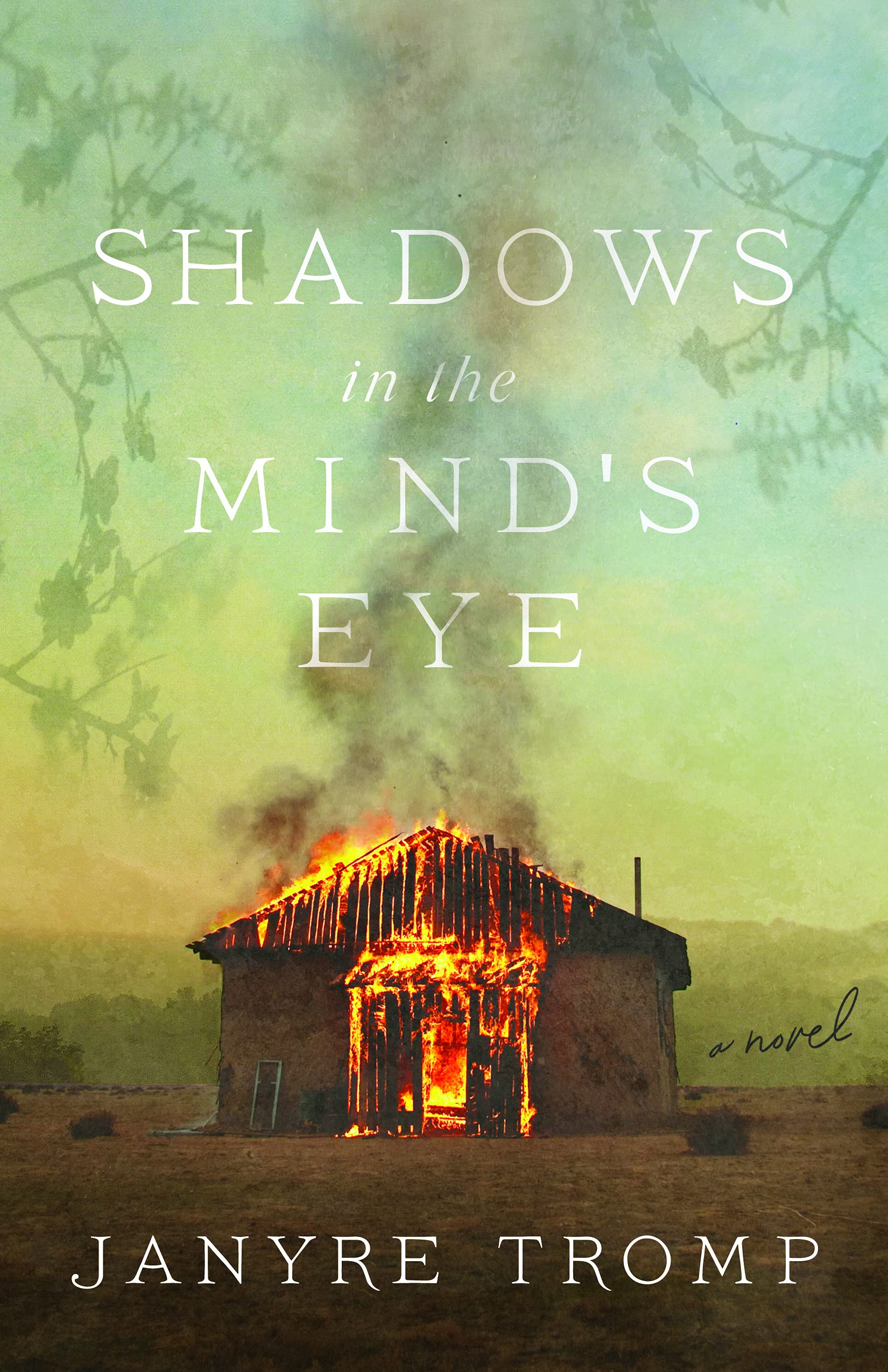
Shadows In the Mind’s Eye

In Janyre Tromp’s novel, Shadows in the Mind’s Eye, Sam Mattas is on his way home from WWII. He’s changed and scarred physically and mentally by what he has experienced, seen, and had to do. He jumps at loud sounds. He’s not always sure what’s real and what’s imagined.

But he’s going home. Back to his dear wife, Annie, and Rosie, the daughter he’s looking forward to getting to know. Good, hard, familiar work on the farm and peace and quiet will set him right soon. He hopes.

Annie has dealt with trauma of her own even before her marriage. Her abusive father was a corrupt judge. When she was a girl, she found her dead mother in a lake. But Sam rescued her from all that. Life was hard while he was away. She had to scrabble for supplies, do all the farm work herself, and take in her mother-in-law.

But Sam is on his way home. She knows, from what her mother-in-law told her about her husband’s return from war, that it might take a while for things to return to normal. But everything will be all right.

Except everything is not all right.

Much has changed, and their wounds run deep. They have to learn new rhythms and ways of relating.

Then Sam starts seeing things. Lights in the woods, men in the shadows. Sam is convinced that something nefarious is happening out there, and he must protect his family. However, his delusions only put them in harm’s way.

But what if he is not actually hallucinating?

The chapters switch back and forth between Sam’s and Annie’s points of view. Their mistakes and learning how to deal with each other is interwoven with the suspense of what’s actually happening behind their house, not knowing whom to trust, and everything not seeming as it appears.

I had not heard of Janyre Tromp until Anita interviewed her about this book on a podcast, Working Through Trauma in Literature and Real Life. Janyre’s experience with caregiver trauma and her grandfather’s experiences after the war led her to study PTSD. Her book was not out yet at that time, but I pre-ordered it then.

Some of the quotes that stood out to me:

Happily ever after don’t happen lessen each person in marriage works. It’s like a team of horses, They both have to carry their own load (p. 155).

Once you let yourself start feeling, it all breaks loose (p.147).

I stood quiet, soaking in her peace. Every motion was calm, sure, She knew where she belonged, and that sent her roots deep into the ground, able to weather whatever life threw at her (p. 122).

You’d think holding joy right up against sadness would shatter a body. But it don’t. Joy…it sneaks in all around where things is broke, sticks it all together and finds a way to make you whole. It’s where things is broke that joy shows through.

My one criticism is that characters say “Lord Almighty” and such. In my book, taking the name of the Lord of glory and using it as an expression is taking His Name in vain. If something is done in vain, it’s useless; it hasn’t accomplished the purpose for which it was meant. God’s name in meant to be reverenced, used in prayer, in worship, or in talking about Him.

Other than that, I really enjoyed the book. Parts near the end were quite suspenseful. I liked the realistic way Sam and Annie reached out to each other yet made mistakes as well.

God Uses Flawed People

Recently I was praying for someone who had walked away from church and possibility Christianity. Humanly speaking, he had good reason. Christians aren’t always the best representatives of what they are supposed to believe.

A parachurch organization that reached out to teens in my public high school was an important influence in God’s drawing me to Himself. Years later, my understanding of Biblical doctrine led me to a place that I could no longer support them.

My husband and I had a discussion last week about an institution we had both been a part of. There were glaring problems in the policies as well as in the prevailing attitudes of individuals.

Yet my sense during my time there was not, “Ugh, this is such an awful place.” I was aware of some problems, and came to understand others later. Yet God used that place to ground me in my faith and draw me closer to Himself. How can that be?

How can it be that an organization or group of people can be used of God while so flawed?

As our church has studied through the first few books of the OT, we’ve seen that God’s people have never been a showcase of pristine saints. One man in another church we were in, when asked in Sunday School what he was learning from the OT narratives, said, “If God can use and have mercy on those rascals, there’s hope for me.”

Some of the Biblical people that God used in a major way failed spectacularly.

This doesn’t mean we set the bar low. Our goal is not to be like the lowest examples in the Bible of those who followed God. Our goal is to be like Christ. We’ll never reach that goal this side of heaven. But as we behold Him in His Word, we should be growing in grace more and more like Him.

And depending on Him, filled with His Spirit, we can show His grace and patience to those who fail and falter.

Yes, there are times to walk away from a particular person or church or institution that strayed far from what it should be and will not listen to counsel. But if we “cancel” everyone who doesn’t live and believe perfectly, we’ll have no one left.

When we stand before God some day, we’ll give an account of ourselves, not anyone else. Though others will have to give an account of their failures, we won’t be able to blame them for our own. God has promised His grace for every trial, His way of escape for every temptation, His strength in our weakness. If everyone we ever knew failed us, He never will. “And God is able to make all grace abound to you, so that having all sufficiency in all things at all times, you may abound in every good work” (2 Corinthians 9:8).

When people talk about forsaking institutional religion because it’s so flawed, I want to ask, “Have you ever read Corinthians?” Talk about a messed-up church. Yet neither God nor His apostle forsook it. They took time to correct and admonish. If the Corinthians had refused to hear and rebelled, that would have been a different story. But they took the apostle’s warnings to heart. They made some changes immediately, but I am sure their overall growth was probably a slow process.

Isn’t that the way for us as well? If we’re still growing in grace and the knowledge of the Lord, we should be farther along now than we were a few years ago. But we still mess up. We still stumble over besetting sins. On our worst days, we’re far from the shining testimony we should be.

This is not an excuse. We’re accountable when we offend someone or make them stumble. We need to walk circumspectly and confess our sins to God and those we sin against.

Yet we also don’t forsake God’s people as a whole because of their flaws. The church is Christ’s bride, our brothers and sisters in Him. We don’t excuse or ignore flaws. Sometimes confrontation is necessary. But we also look for the grace. Instead of writing someone off or retaliating when they fail, we pray for them and seek to point them in the right direction, remembering we’re part of the same family. We love and serve and encourage and forgive and forbear. Because He did that for us.

Peter denied Jesus. James and John jockeyed for position and wanted to call down fire from heaven on those who didn’t run in the same circles. They fell asleep instead of supporting Him, argued with Him, thought they knew better than Him. But Jesus kept working with them, and look at them a few years later. That transformation is what we long for and pray for, for ourselves and others. Thank God for His longsuffering and mercy and grace.

Put on then, as God’s chosen ones, holy and beloved, compassionate hearts, kindness, humility, meekness, and patience, bearing with one another and, if one has a complaint against another, forgiving each other; as the Lord has forgiven you, so you also must forgive. And above all these put on love, which binds everything together in perfect harmony. And let the peace of Christ rule in your hearts, to which indeed you were called in one body. And be thankful (Colossians 3:12-15).

Let us hold fast the confession of our hope without wavering, for he who promised is faithful. And let us consider how to stir up one another to love and good works, not neglecting to meet together, as is the habit of some, but encouraging one another, and all the more as you see the Day drawing near (Hebrews 10:23-25).

(I often link up with some of these bloggers.)

Laudable Linkage

I just have a short list today—I’m behind on my blog reading. But I hope you’ll find something to encourage you here.

Bulletproof, HT to Challies. “As time passed, I gathered up frightening moments, storing them like scalding stones in a knapsack, hefting them with me moment-by-moment through life, and right into my early days of motherhood. As long as I remembered what could happen, and kept on the lookout for any potential dangers, maybe I could keep my little family safe. An exhausting way to live, I tell you. But after so many years it felt normal.”

Church Hurt. “Anyone who has been involved in a faith community over a long period of time sadly may know the very painful feelings of rejection, criticism, and disillusionment. Church hurt can stings like no other. Why is that?”

Shining a Light in the Darkest of Times. “My most recent fascination holds me captive at dusk. Sweet childhood memories delightfully dance across my mind’s eye as the fireflies gaily float across the lawn. Lately returned to our area after several years absence, they offered more than reminiscent delight. Visible only as darkness approaches, their light speaks a truth needful for today: that of shining a light in the darkest of times.”

Outside the Camp, Part 3: What It Means. Dan Olinger gives insight on what it means that Jesus was crucified “outside the camp” and why we’re told to go to Him “outside the camp” as well.

Give to Those Who Ask. “If someone were to walk up to you today, declare their poverty, and ask you for help, what should you do?”

Friday’s Fave Five

Time just keeps ticking away. Funny how it always does so at the same rate, but feels fast or slow. I’m thankful Susanne at Living to Tell the Story started this tradition of pausing for just a bit on Fridays to think through the blessings of the last week. If we don’t deliberately look for them, we too often miss or forget them.

Here are a few of my favorite moments of the last week.

1. The radio interview I mentioned last week went well despite scaring me by starting off with some technical glitches. Thankfully everything suddenly started working right (thank you, Lord!), and the interview was able to continue. Here’s a link to the interview, recorded by my oldest son.

2. A visit. Mittu texted one night that Timothy said he “really needed to see Gran and Grams,” so they asked of they could come over and bring chicken fried rice and banana bread. Well, of course! The banana bread was more like banana cake, with chocolate chips and a glaze on top. So good! Then another night they brought some gourmet popcorn and flavoring.

3. Indulgences. Jim has been very nice to acquiesce to my requests for takeout when I’ve been busy, tired, or very hot.

4. Sweet gestures. When Jim came in from the yard one day, he brought one of these little flowers because the darker pink looked like a heart, and I like heart-shaped things. I put it on my desk these week, and have enjoyed marveling at how detailed it is.

5. Relief. I’ve had some kind of weird off and on headache this week. At first I thought it felt like a sinus infection, but it hasn’t been behaving like one. It’s lessening a little each day, but still fades in and out a little.

How about you? Have you had highlights in your week?

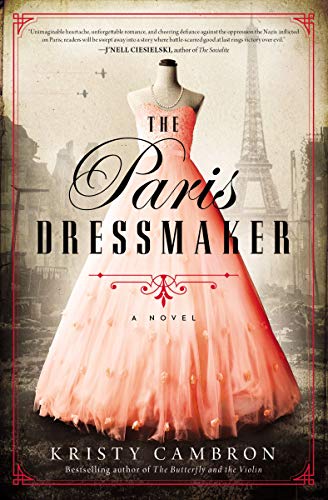
The Paris Dressmaker

The Paris Dressmaker by Kristi Cambron is a tale of two women in WWII Paris.

Lila de Laurent is a dressmaker and budding designer for Chanel. But the salon closed its doors as Nazis took over Paris. Working odd jobs for a while, Lila is surprised by a call from an old friend from Chanel who has become a collaborator with the Germans. She needs a gown for a party and knows Lila’s style. At first Lila is repulsed, but then decides this opportunity affords her the chance to pick up information for La Resistance.

As Lila flees from danger one night, she runs into the man she once loved, whom she thought was dead. But whose side is he on now? Can she trust him with her secrets?

Sandrine Paquet’s husband is a French soldier, and she lives with her son and mother-in-law. The place where she works is taken over by the Nazis, who demand that the employees catalog and crate art work the Nazis have stolen from French Jews. The German captain, von Hiller, has taken an interest in her. To refuse his attention outright would be fatal, but she takes pains to be cooperative while keeping him at a distance so things don’t get too personal. Neighbors misunderstand, however, and accuse her of being a collaborator. What they don’t know is that she and her boss are working for La Resistance as well, right under the Nazi’s noses. Though their shop doesn’t deal with textiles, one of the items that came to them was a beautiful blush Chanel gown. In a few moments alone, Sandrine searches the gown and finds a cryptic note initialed LDL sewn in the hemline.

Kristy Cambron is one of the best storytellers around. She weaves historic and personal details into the lives of these two women with suspense, pathos, and a touch of humor. The faith element is subtle but vital.

I miss the days of linear stories that start at the beginning and unfold until the end. But that’s not the fashion these days. The scenes alternate between the two women at different times in their lives, before and during the war. It was a little hard to keep up with at first until I learned to pay attention to the dates at the beginning of each chapter.

The author’s afterword shares which elements were historical and which were fiction, something I love to see in historical novels.

The Kindle version of this book is free with Amazon prime membership at the moment, and I got the audiobook at a 2-books-for-one-credit sale. With the Whispersync function, it was nice to delve into whichever one worked best for me in a given situation and pick up where I left off in the other.

Kristy has written another winner, in my opinion.

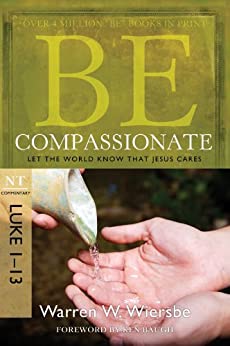
Be Compassionate (Luke 1-13)

In the gospel bearing his name, Luke, “having followed all things closely for some time past,” undertakes “to write an orderly account for you, most excellent Theophilus, that you may have certainty concerning the things you have been taught” (Luke 1:3-4).

Luke is a doctor and very detailed in his account. He is also a Gentile, and he emphasizes the availability of the gospel to everyone.

Luke begins before Jesus’ birth with the prediction of John the Baptist’s birth. Luke progresses the angel’s announcement to Mary that she would bear the long-awaited Messiah, the well-known Christmas story, Jesus’ ministry and teaching, death, burial, resurrection and ascension.

Because the book of Luke is so full, Warren Wiersbe divided up his commentary on Luke into two books. The first is Be Compassionate (Luke 1-13): Let the World Know Jesus Cares.

Wiersbe says Luke’s “key message is, ‘For the Son of man is come to seek and to save that which was lost’ (Luke 19: 10). He presents Jesus Christ as the compassionate Son of Man, who came to live among sinners, love them, help them, and die for them” (p. 16).

In the passage about Jesus’ temptation, Wiersbe says:

Satan questioned the Father’s love when he tempted Jesus to turn stones into bread. He questioned His hope when he offered Jesus the world’s kingdoms this side of the cross (see Heb. 12: 1–3). Satan questioned the Father’s faithfulness when he asked Jesus to jump from the temple and prove that the Father would keep His promise (Ps. 91: 11–12). Thus, the enemy attacked the three basic virtues of the Christian life—faith, hope, and love (p. 52).

I’ve often heard that this passage shows Satan tempting Jesus with “the lust of the flesh, and the lust of the eyes, and the pride of life” that 1 John 2:16 describes. I think that’s true as well as Wiersbe’s viewpoint.

In response to Jesus answering Satan’s temptation with Scripture, Wiersbe says:

Jesus balanced Scripture with Scripture to get the total expression of God’s will. If you isolate verses from their contexts, or passages from the total revelation of Scripture, you can prove almost anything from the Bible. Almost every false cult claims to be based on the teachings of the Bible (p. 53).

Some of the other quotes that stood out to me:

It was our Lord’s custom to attend public worship, a custom His followers should imitate today (Heb. 10: 24–25). He might have argued that the “religious system” was corrupt, or that He didn’t need the instruction, but instead, He made His way on the Sabbath to the place of prayer (p. 54).

Jesus was not teaching that poverty, hunger, persecution, and tears were blessings in themselves. If that were true, He would never have done all He did to alleviate the sufferings of others. Rather, Jesus was describing the inner attitudes we must have if we are to experience the blessedness of the Christian life (p. 80).

Life is built on character, and character is built on decisions. But decisions are based on values, and values must be accepted by faith (p. 81).

There is a difference between doubt and unbelief. Doubt is a matter of the mind: We cannot understand what God is doing or why He is doing it. Unbelief is a matter of the will: We refuse to believe God’s Word and obey what He tells us to do. “Doubt is not always a sign that a man is wrong,” said Oswald Chambers. “It may be a sign that he is thinking.” In John’s case, his inquiry was not born of willful unbelief, but of doubt nourished by physical and emotional strain (p. 93).

There are many people today who criticize the church for not “changing the world” and solving the economic, political, and social problems of society. What they forget is that God changes His world by changing individual people. History shows that the church has often led the way in humanitarian service and reform, but the church’s main job is to bring lost sinners to the Savior. Everything else is a by-product of that. Proclaiming the gospel must always be the church’s first priority (p. 94).

Power is the ability to accomplish a task, and authority is the right to do it, and Jesus gave both to His apostles (p. 117).

It is impossible to be wrong about Jesus and right with God (p. 121).

We must first say no to ourselves—not simply to pleasures or possessions, but to self—and then take up our cross and follow Christ daily. This means to be identified with Him in surrender, suffering, and sacrifice (p. 122).

[After the transfiguration] As wonderful as these experiences are, they are not the basis for a consistent Christian life. That can come only through the Word of God. Experiences come and go, but the Word remains. Our recollection of past experiences will fade, but God’s Word never changes. The farther we get from these events, the less impact they make on our lives. That was why the Father said, “Hear him!” and why Peter made this same emphasis on the Word in his report (2 Peter 1: 12–21). Our own personal “transfiguration” comes from inner renewal (Rom. 12: 1–2), and that comes from the Word (2 Cor. 3: 18) (pp. 125-126).

I appreciate Dr. Wiersbe’s insights and commentary on the Scriptures.

Radio Interview Tomorrow

Tomorrow morning (Tuesday, July 12), I’m scheduled for an interview with Kurt and Kate Mornings on Moody Radio Florida at 8:10 a.m. EDT. They’re the folks who interviewed me a couple of times before. They want to discuss my post on What to Do with Regret.

The top of their program page has a “Click to Listen Live” button. I’d love to invite you to tune in if you’re able and interested.

Most of all, I’d appreciate your prayers that all would go well: that the technology would work well with no glitches, that there won’t be any health issues, that God would give me what He wants me to say and help me not to blank out, and that He would be glorified and listeners would be ministered to.

Updated to add: Here’s a link to the interview, recorded by my oldest son. There was some kind of audio problem at the beginning where they couldn’t hear me, and they had me in Nashville instead of Knoxville. 🙂 But I am thankful things started working and the interview could continue.

Objectionable Elements in Books and Film

Christians vary widely in what they consider objectionable material.

On one side are those who don’t restrict themselves from reading or watching just about anything. Any suggestion that some material might not be appropriate is met with accusations of legalism and censorship.

On the other side are those who, if they applied their preferences to everything they read, would not even be able to read their Bibles.

Most of us are somewhere in-between.

The difficulty is that the Bible doesn’t give us specifics such as: these words are okay, these words are not, these words are tolerable up to three times. Only this amount of skin is acceptable. These sins are okay to read about, but these are off limits.

So we have to draw from other truths and principles in the Bible. But we have to make sure we’re not pulling one thread and disregarding others.

Some would immediately go to Philippians 4:8: “Finally, brothers, whatever is true, whatever is honorable, whatever is just, whatever is pure, whatever is lovely, whatever is commendable, if there is any excellence, if there is anything worthy of praise, think about these things.” A great verse. Our mental health would be much better if we followed this verse.

But is this verse saying we can’t watch war movies? Or murder mysteries? Or any book that has sexual sin in it?

The Bible contains a great deal of violence. Here are just a few samples:

And Ehud reached with his left hand, took the sword from his right thigh, and thrust it into his belly. And the hilt also went in after the blade, and the fat closed over the blade, for he did not pull the sword out of his belly; and the dung came out (Judges 3:21-22).

At that time Menahem sacked Tiphsah and all who were in it and its territory from Tirzah on, because they did not open it to him. Therefore he sacked it, and he ripped open all the women in it who were pregnant (1 Kings 15:15).

So the angel swung his sickle across the earth and gathered the grape harvest of the earth and threw it into the great winepress of the wrath of God. And the winepress was trodden outside the city, and blood flowed from the winepress, as high as a horse’s bridle, for 1,600 stadia (Revelation 14:19-20).

The Bible tells us about sexual sin. Judah visited a prostitute, which was bad enough; but then he discovered she was his daughter-in-law. Amnon was guilty of both rape and incest when he assaulted his half-sister, Tamar. David called for the wife of Uriah, one of his mighty men, while Uriah was away in a battle. After committing adultery, impregnating Bathsheba, then trying to cover the whole affair up, David had Uriah put in the hottest part of the battle so he would be killed. Then David married Bathsheba. Solomon had 700 wives and 300 concubines.

And the Bible shows us an array of deception, injustice, and just about every kind of sin imaginable.

Some might say, there you go. All of this is in the Bible, so it’s okay to watch or read it in other venues.

Well, before we jump to that conclusion, we have a couple of things to consider.

The Bible is honest in reporting people’s sins because none of us is without sin. This honest acknowledgment of sin shows our need for a Savior.

But no sin in the Bible is there gratuitously, just for scintillation and excitement. Only the bare minimum of details is given to convey what happened. When sin is portrayed, it’s shown as wrong.

God often cites violence as one reason for His judgment. Have you ever noticed, for instance, that one reason for Noah’s flood was that “the earth was filled with violence”? (Genesis 6:9-14).

We don’t see details of David and Bathsheba or Amnon and Tamar in the bedroom. The warnings against the “strange woman” of Proverbs are enough to show her danger but not enough to cause one to lust just from hearing about her.

So just because a sin is cited in the Bible doesn’t mean it is okay. If you read the whole counsel of God, you see what He thinks about each one.

But because people do sin, the Bible tells us about it.

I heard someone say once that they didn’t read a certain book because two characters committed adultery.

Personally, I would not toss a book or movie just because there was adultery or murder in it. It would depend on how it was handled. Is the author presenting the sin as okay or wrong? Are there disturbing details that put negative images in my head? Is the need for forgiveness and redemption shown?

I don’t really care for books or shows where adultery is the main story arc. However, I have read books that show the devastating effects of adultery on the wife and children who were left behind in a broken marriage. I’ve read some that showed the hard work needed to come to a place of forgiveness. And I have seen redemptive stories where the broken couple worked through their issues and the marriage was restored. These things happen to real people in our world today. They can help us empathize with what people in such situations go through.

And the same could be said of most other sins in literature or shows. A murder mystery is more about figuring out the puzzle of “whodunnit” rather than glorifying murder. Most portray murder and violence as wrong: the whole purpose of the plot is finding the offender so he or she can be brought to justice. But there are shows and books that play up the violent part of such a story, seeming to delight in the gore or the perverted thinking of the perpetrator.

After the success of the 1985 film version of Anne of Green Gables, starring Megan Follows, a TV series called Road to Avonlea aired based on some other books of L. M. Montgomery. A friend was telling someone how much she enjoyed the series, when her companion said she didn’t watch it because of some characters’ tendency to gossip. I did not see the series. I know from reading many of L.M.M.’s books that gossip was a besetting sin of many characters in her stories. But gossip wasn’t presented as admirable or acceptable. In fact, innocent characters suffered due to gossip. So whether or not the author spelled out the wrongness of gossip, she showed it. On the other hand, if watching this program caused this woman to be tempted to gossip or to think lightly of it, then she was right in avoiding the show.

1 Corinthians 10:6 says, “Now these things took place as examples for us, that we might not desire evil as they did.” Paul then warns against the practices of some in the OT: idolatry, sexual immorality, putting God to the test, and grumbling (funny, but we don’t see people objecting to the latter in modern literature). Then he says in verse 11, “Now these things happened to them as an example, but they were written down for our instruction, on whom the end of the ages has come.” Just as the Bible teaches from both good and bad examples, so can stories in film or literature.

So how do we determine what’s acceptable or not in reading or viewing? How the wrong is handled is one factor. Is it written in a way to glorify the wrong, giving more details than necessary, showing no consequences? Does it cause me to sin in watching or reading? This is my objection to “steamy” scenes even in Christian fiction, not to mention secular works. Even if I can discern between right and wrong in the work, does the wrong lure me or put wrong words or images or desires in my head?

These principles guide me as well:

“All things are lawful,” but not all things are helpful. “All things are lawful,” but not all things build up (1 Corinthians 10:23).

“All things are lawful for me,” but not all things are helpful. “All things are lawful for me,” but I will not be dominated by anything (1 Corinthians 6:12).

If a show or book is tearing me down rather than building me up or bringing me under the power of wrong, I need to step away from it.

Another guideline is conscience. Conscience is not a perfect guide and needs to be trained by the Word of God. But we shouldn’t ignore conscience lest it become seared or numbed.

Of course, this topic could be expanded exponentially. We haven’t even touched on wrong philosophies. Reading the Bible and other books helps us develop discernment. But we don’t have to restrict our reading to what we agree with. We read everything with Christian eyes even if what we’re reading isn’t Christian. We evaluate as we go along. But if I sense a wrong philosophy is filtering into my thinking, it might be time to pull back.

Though I’ve been discussing secular books and shows, these same principles guide in Christian viewing and reading as well. Once I picked up a book aimed at helping teen guys battle lust. I scanned the first few pages to see whether I might bring the book home for my then-teen boys. But then I put the book back down. I felt if they didn’t have a problem with lust before they started, they would before they finished. The authors were way too explicit in describing the kinds of problems and situations they wanted to counsel guys to avoid.

These are some of the guidelines I use in evaluating what to watch or listen to. What are some of yours?

_______

I’m thankful to Dr. Ronald Horton, chair of the English department of my college when I was there and my Literary Criticism teacher, for a lecture on this topic when I was a student. What he taught formed the foundation of my thinking. Some years later, his lecture was turned into a booklet and sold in the university bookstore. When I was about 3/4 of the way through this post, I decided to see if he had posted his notes online anywhere. I found them here on A Biblical Approach to Objectionable Elements in a chapter from a larger volume titled Christian Education: Its Mandate and Mission. If you’re interested and have time, this is an excellent read. He goes into a lot more detail and nuance than I can here. 

(I often link up with some of these bloggers.)