Unknown's avatar

About Barbara Harper

https://barbarah.wordpress.com

The Last Chronicle of Barset

The Last Chronicle of Barset is the sixth and final novel in Anthony Trollope’s Chronicles of Barsetshire series.

There are several plot threads in this winding up of everyone’s stories. But the overarching plot involves Mr. Crawley, a curate who has been accused of stealing. Mr. Crawley was a minor character in Framley Parsonage, the fourth book in the series. He’s a curate in a small town who is very stern, proud of his poverty, critical of those who have wealth, especially other clergymen.

A twenty-pound check came into his possession, which he used to pay a bill. But then the check was found to have belonged to the lord of the manor house. The problem is, Mr. Crawley can’t remember how he got the check. First he thought Lord Lufton’s agent must have dropped it when he visited, then he thought his friend the dean must have given it to him. Unfortunately, the dean and his wife are out of the country, and Lufton’s agent insists he did not drop it.

Most people don’t think Crawly actually stole the check or confiscated it for his own use. They think it was a mix-up. But the case goes to court (not due to Lord Lufton. He would rather the whole thing had not come to light). Unfortunately, the bishop, or rather, the bishop’s wife, Mrs. Proudie, who wields actual control, thinks Crawley did steal the check and should be removed. Crawley himself almost wonders if he is going mad since he can’t remember for sure how he got the check.

Mr. Crawley was not one of my favorite characters, so at first I wasn’t terribly excited that much of the book focused on him. But after reflecting, I felt this plot line could not have worked with anyone else. And it is used to affect and bring out the personalities and motives of many other people.

The other major plot line is that Archdeacon Grantley’s son has fallen in love with Crawley’s daughter, Grace. The Grantleys are some of the wealthiest people in the area, and the thought of their son joining with a possible criminal’s daughter causes conflict between everyone involved.

Lily Dale from the fifth book, The Small House at Allington, shows up in this story as Grace’s friend. Lily had loved someone who jilted her for someone else richer and higher in society. But she still loves him. John Eames had loved her since childhood, but Lily only thinks of him as a brother. Then when Lily visits friends in London, she runs into the man who jilted her.

There is a totally unnecessary plot thread about a young artist’s flirtatious interactions with a married lady. Neither of them really care for each other romantically and consider their flirtations a game. But the relationship still causes problems when he falls in love with someone else and her husband begins to suspect something. The only connection between any of these people and the other characters is that the artist was a friend of John Eame’s. I don’t think flirting is a harmless game, especially among people married to others, so I could have done without this whole thread.

The Proudies, in all the books til now, have been almost humorous with him as a henpecked husband. They’re on the opposite sides of the fence politically and concerning church matters as many of the other people, and Mrs. Proudie is manipulative, so they’re ofttimes the “villains.” But things come to a very sad head for them.

Mrs. Crawley’s cousin, Mr. Toogood, a lawyer, has suspicions about where the check might have come from, and his pursuit reminded me a lot of Charles Dickens (who was a contemporary of Trollope).

Mr. Harding was the main character of the first book, The Warden. I think he may be the only clergyman in this series that doesn’t have a major flaw. He does tend not to stand up for himself even when he should, but whether that’s a flaw or not depends, I guess, on your point of view. It was said of him by his son-in-law, the Archdeacon: “He lacked guile, and he feared God,—and a man who does both will never go far astray. I don’t think he ever coveted aught in his life.” He has appeared throughout the series as a kindly older man. Now he is nearing his last days, and that all is handled in such a touching way.

Two of my favorite characters were the wives of difficult men in opposite circumstances: Mrs. Grantly and Mrs. Crawley. I would almost say they knew how to “handle” their husbands, but they were not manipulative like Mrs. Proudie. They each knew their husbands’ quirks and foibles and knew how to help them see reason and bring out their best. Mrs. Crawley knew her husband was very proud and unwilling to accept help, but she could find ways of accepting help without violating his desires. She didn’t complain of their poverty, though she had come from a more prosperous home. “She had been very strong through all her husband’s troubles,—very strong in bearing for him what he could not bear for himself, and in fighting on his behalf battles in which he was altogether unable to couch a lance; but the endurance of so many troubles, and the great overwhelming sorrow at last, had so nearly overpowered her.” Archdeacon Grantly is a blustery person, as well as a man of wealth and authority. Mrs. Grantly is about the only one who can speak plainly to him and point out where his thinking might be wrong, yet in a way that doesn’t disrespect him or undercut his authority. It was said after one of their encounters, “He knew very well that he could not get the better of her, and was apt at such moments to think that she took an unfair advantage of him by keeping her temper.”

I had wondered about the fact that Trollope doesn’t show his clergymen (who are the main characters in all most of the books) doing religious things. Mr. Crawley is shown in his religious duties more than anyone else, preaching, teaching in the school, visiting those in his parish. Evidently others wondered the same thing, “accusing” Trollope, “always without bitterness, and generally with tenderness—of having forgotten, in writing of clergymen,” to show “their professional duties, their high calling, their daily workings for the good of those around them.” Trollope answers that he had wanted to “paint the social and not the professional lives of clergymen,” just as he would write of lawyers’ and doctors’ lives without going deeply into their professions. Some also said all the clergymen in the books were flawed to some degree. Trollope answers, “Had I written an epic about clergymen, I would have taken St. Paul for my model; but describing, as I have endeavoured to do, such clergymen as I see around me, I could not venture to be transcendental.” But, he says, for his part, he would be happy to spend time with any of them.

Just a couple more samples of Trollope’s writing: He says of one Mr. Thumble, an ambitious lackey of Mrs. Proudie’s who hopes to take Mr. Crawley’s place, “who, having heard his own voice once, and having liked the sound, thought that he might creep into a little importance by using it on any occasion that opened itself for him.” One man’s wife dies in the book, and at the end of his story line, Trollope says, “We will now say farewell to him, with a hope that the lopped tree may yet become green again, and to some extent fruitful, although all its beautiful head and richness of waving foliage have been taken from it.”

The last couple of books had a similar feel to Mitford, Jan Karon’s books, except set in Victorian England. But it took the previous four books to get to this place.

I am very glad I read (or listened to) the last three books in succession. When I read the fourth, it had been a while since I read the previous books, and I had to remind myself who everyone was and how they were related. So I wanted to read the last three one after the other so I didn’t have to go through that process with each one.

My favorite of the series is Doctor Thorne, the third book. Wikipedia says it was that book that caused the series to take off. The site also says that Trollope didn’t originally intend to write a series. But he set later books in or near the same place as the first couple, and later on, publishers asked him for another book in the same area or with related characters. The last three novels were first released serially in magazines.

I listened to all the books via audiobook, all but the third wonderfully narrated by Simon Vance. Most, if not all of them, were included in my Audible subscription, so I didn’t have to use my credits on them. Most of the Kindle versions were free or 99 cents, so in some cases I would go back and forth between e-book and audio.

I’m sorry in many ways to see the series come to an end, and I’ll miss these characters. But I’m happy to become acquainted with Trollope and look forward to reading more of his books.

I’m counting this book for the “wild card classic” category of the Back to the Classics Challenge.


Be Encouraged: Wiersbe on 2 Corinthians

The church in Corinthians had lots of problems. 2 Corinthians is actually the fourth letter Paul wrote to the church at Corinth. His second letter to them is our 1 Corinthians. Some of Paul’s opponents had invaded the church and stirred up rebellion. A previous visit by Paul to deal with the issues had not gone well. Paul left and then sent by Titus a “severe” letter. He rejoiced that many in Corinth repented. So in this letter, Paul wanted to encourage those who had repented but warn those who had not.

He also had to defend his apostleship from various charges.

Plus, the Corinthians had promised some time before to send an offering for the poor in Jerusalem, but had not done so yet. Paul planned to pick up their donations to take along with what he had collected from other churches, so he encouraged them to give and give cheerfully. The offering would not only help meet material needs, but would help unite the Jewish and Gentile congregations.

Dr. Warren W. Wiersbe’s short commentary on 1 Corinthians is Be Encouraged (2 Corinthians): God Can Turn Your Trials Into Triumphs.

In the first chapter, Wiersbe writes:

One of the key words in this letter is comfort or encouragement. The Greek word means “called to one’s side to help.” The verb is used eighteen times in this letter, and the noun eleven times. In spite of all the trials he experienced, Paul was able (by the grace of God) to write a letter saturated with encouragement.

What was Paul’s secret of victory when he was experiencing pressures and trials? His secret was God. When you find yourself discouraged and ready to quit, get your attention off of yourself and focus it on God. Out of his own difficult experience, Paul tells us how we can find encouragement in God (p. 18).

Wiersbe also points out:

The words comfort or consolation (same root word in the Greek) are repeated ten times in 2 Corinthians 1: 1–11. We must not think of comfort in terms of “sympathy,” because sympathy can weaken us instead of strengthen us. God does not pat us on the head and give us a piece of candy or a toy to distract our attention from our troubles. No, He puts strength into our hearts so we can face our trials and triumph over them. Our English word comfort comes from two Latin words meaning “with strength.” The Greek word means “to come alongside and help.” It is the same word used for the Holy Spirit (“ the Comforter”) in John 14—16.

God can encourage us by His Word and through His Spirit, but sometimes He uses other believers to give us the encouragement we need (2 Cor. 2: 7–8; 7: 6–7) (p. 20).

Dr. Wiersbe also shares that “There are ten basic words for suffering in the Greek language, and Paul uses five of them in this letter” (p. 20).

I won’t go point by point through Corinthians–Wiersbe includes an outline as well as discussion. But some of the most well-known passages in this book of the Bible are these: God comforts us in all our affliction and we comfort others (1:2-7); when we behold God, we become more like Him (3:18), “we have this treasure in jars of clay, to show that the surpassing power belongs to God and not to us” (4:7-12), though outwardly we’re wasting away, inwardly we’re renewed day by day, and our “light momentary affliction” prepares for us “an eternal weight of glory beyond all comparison” (4:16-18), the ministry of reconciliation (5), Now is the day of salvation (6:2), we’re God’s temple and shouldn’t be yoked up with darkness (6:14-18), godly grief vs. worldly grief (7:5-12), grace giving (8:1-15), the cheerful giver, sowing and reaping (9:1-15), “God is able to make all grace abound to you, so that having all sufficiency in all things at all times, you may abound in every good work” (9:8), Paul’s thorn in the flesh, God’s strength in our weakness, (12:7-10), “Examine yourselves, to see whether you are in the faith” (13:5).

Some other quotes from Wiersbe that stood out to me:

The word sufficiency means “adequate resources within” (see Phil. 4: 11). Through Jesus Christ, we can have the adequacy to meet the demands of life. As Christians, we do need to help and encourage one another; but we must not depend on one another. Our dependence must be on the Lord. He alone can give us that “well of water” in the heart that makes us sufficient for life (John 4: 14) (p. 117).

God did not give Paul any explanations; instead, He gave him a promise: “My grace is sufficient for thee.” We do not live on explanations; we live on promises. Our feelings change, but God’s promises never change. Promises generate faith, and faith strengthens hope (p. 160).

How do people measure the ministry today? By powerful oratory or by biblical content? By what the media says or by Christian character? (p. 169).

Paul prayed for their perfection, which does not mean absolute sinless perfection, but “spiritual maturity.” The word is part of a word family in the Greek that means “to be fitted out, to be equipped.” As a medical term, it means “to set a broken bone, to adjust a twisted limb.” It also means “to outfit a ship for a voyage” and “to equip an army for battle.” In Matthew 4: 21, it is translated “mending nets.”

One of the ministries of our risen Lord is that of perfecting His people (Heb. 13: 20–21). He uses the Word of God (2 Tim. 3: 16–17) in the fellowship of the local church (Eph. 4: 11–16) to equip His people for life and service. He also uses suffering as a tool to equip us (1 Peter 5: 10). As Christians pray for one another (1 Thess. 3: 10) and personally assist one another (Gal. 6: 1, where “restore” is this same word perfect), the exalted Lord ministers to His church an makes them fit for ministry (pp. 170-171).

Sometimes the minister of the Word must tear down before he can build up (see Jer. 1: 7–10). The farmer must pull up the weeds before he can plant the seeds and get a good crop. Paul had to tear down the wrong thinking in the minds of the Corinthians (2 Cor. 10: 4–6) before he could build up the truth in their hearts and minds. The negative attitude of the Corinthians made it necessary for Paul to destroy, but his great desire was to build (pp. 171-172).

2 Corinthians closes with a well-known benediction: “The grace of the Lord Jesus Christ and the love of God and the fellowship of the Holy Spirit be with you all” (13:14).

Wiersbe says of this verse:

If each believer is depending on the grace of God, walking in the love of God, and participating in the fellowship of the Spirit, not walking in the flesh, then he will be a part of the answer and not a part of the problem. He will be living this benediction—and being a benediction to others! (p. 174).

Amen.

I Must Decrease: Devotional Book for Dieters

I Must Decrease: Biblical Inspiration and Encouragement for Dieters by Janice Thompson is pretty much just what the title says. Janice had lost over 100 lbs. over fourteen months. But she didn’t want to write a “how-to” manual or promote a specific plan. She wanted to share some tips and encouragement with a light-hearted approach.

The book is divided into three 21-day sections in which she compares the dieting (or healthy eating) journey to a horse race: the beginning, with eager anticipation; the middle, where we’re tired and need encouragement to keep going; and the end, when we realize the race isn’t really over, that healthy eating needs to be a lifestyle.

Each day’s devotional is divided into twelve sections, usually with a particular theme or emphasis for the day:

  • Ticklers: A humorous quote.
  • Tidbits: A bit of information.
  • Traps: e.g., quick snacks which are usually unhealthy, using food as a reward, etc.
  • Tricks: Little helps.
  • Treats: Healthy food ideas.
  • Testimonies from Janice and others: a paragraph of some aspect of healthy eating or a problem they faced.
  • Treasures: A Scripture reference.
  • Tips: Devotional thoughts on the Scripture for the day.
  • Trusting Him: A prayer about the day’s devotional.
  • Turning Your Focus: Ideas for ways to reach out to others.
  • Today’s Food Choices: A reminder to write down what you ate.
  • Thoughts on Paper: A reminder to journal about your experiences.

There are four recipes at the end.

Almost every “tidbit” section had a link in the ebook version I read, but of the half-dozen or so I tried to click on, none went to an active link.

Personally, I’m sorry to say that I didn’t get much from this book. I don’t think I came across a lot that was new to me. Humor is a subjective thing, and the humor here just didn’t jibe with me. The twelve sections every day seemed a little fragmented. I think I would have gotten more from a verse with some thoughts and a prayer each day and then tips and such all together at the back.

The book had mostly positive reviews on Amazon, so many people did benefit from it. You might like the humor and formatting. And if you’re new to dieting or would like reminders of truths you know, this book might be more helpful to you. At the moment, it’s only 99 cents for the Kindle app, not much to lose to give it a try.

Why Is the Resurrection of Jesus Christ Important?

Why is the resurrection of Jesus Christ important

Easter Day! Time for new, springy clothes, a ham dinner, brightly colored eggs, and chocolate bunnies.

And the celebration of Jesus’ resurrection.

I’m not against those other things. I enjoy them all. But I do fear that the resurrection gets lost in the shuffle except for a special church service and hymns.

Even as Christians, sometimes we’re so used to the resurrection, we forget how special, how life-changing, how dynamic it is.

Or we might be comforted by the resurrection when a loved one dies, but we don’t think it affects everyday life much.

So I thought I’d spend some time thinking about just why the resurrection of Christ is important.

The resurrection of Christ proves His deity.

Set apart for the gospel of God, which he promised beforehand through his prophets in the holy Scriptures, concerning his Son, who was descended from David according to the flesh and was declared to be the Son of God in power according to the Spirit of holiness by his resurrection from the dead, Jesus Christ our Lord (Romans 1:1b-4).

He has fixed a day on which he will judge the world in righteousness by a man whom he has appointed; and of this he has given assurance to all by raising him from the dead (Acts 17:31).

The resurrection of Christ validated what He said. He foretold many times that He would rise after three days in the grave. Here are just a few:

From that time Jesus began to show his disciples that he must go to Jerusalem and suffer many things from the elders and chief priests and scribes, and be killed, and on the third day be raised (Matthew 16:21).

As they were gathering in Galilee, Jesus said to them, “The Son of Man is about to be delivered into the hands of men, and they will kill him, and he will be raised on the third day.” And they were greatly distressed (Matthew 17:22-23).

And as they were coming down the mountain, he charged them to tell no one what they had seen, until the Son of Man had risen from the dead (Mark 9:9).

The resurrection is part of the gospel. When Paul spoke of sharing the gospel, the resurrection was an integral part of it.

Now I would remind you, brothers, of the gospel I preached to you, which you received, in which you stand, and by which you are being saved, if you hold fast to the word I preached to you—unless you believed in vain.

For I delivered to you as of first importance what I also received: that Christ died for our sins in accordance with the Scriptures, that he was buried, that he was raised on the third day in accordance with the Scriptures (1 Corinthians 15:1-4).

That is why his faith was “counted to him as righteousness.” But the words “it was counted to him” were not written for his sake alone, but for ours also. It will be counted to us who believe in him who raised from the dead Jesus our Lord, who was delivered up for our trespasses and raised for our justification (Romans 4:22-25).

Without the resurrection, we’re still in our sins.

And if Christ has not been raised, your faith is futile and you are still in your sins. Then those also who have fallen asleep in Christ have perished. If in Christ we have hope in this life only, we are of all people most to be pitied (1 Corinthians 15:17-19).

I’ve heard some say to the unsaved, “If I’m wrong and you’re right, I’ve lost nothing. But if I’m right and you’re wrong, you’ve lost everything.” But that’s not what the Bible says. “If in Christ we have hope in this life only, we are of all people most to be pitied.”

Since Christ was raised, we know we will be, too.

But in fact Christ has been raised from the dead, the firstfruits of those who have fallen asleep. For as by a man came death, by a man has come also the resurrection of the dead. For as in Adam all die, so also in Christ shall all be made alive (1 Corinthians 15:20-22).

For the Lord himself will descend from heaven with a cry of command, with the voice of an archangel, and with the sound of the trumpet of God. And the dead in Christ will rise first. Then we who are alive, who are left, will be caught up together with them in the clouds to meet the Lord in the air, and so we will always be with the Lord. Therefore encourage one another with these words (1 Thessalonians 4:16-18).

Jesus said to her, “I am the resurrection and the life. Whoever believes in me, though he die, yet shall he live” (John11:25).

Since we will all be raised, we will see our loved ones again.

But we do not want you to be uninformed, brothers, about those who are asleep, that you may not grieve as others do who have no hope. For since we believe that Jesus died and rose again, even so, through Jesus, God will bring with him those who have fallen asleep (1 Thessalonians 4:13-14).

The resurrection removes death’s sting. Death is still grievous. It is still an enemy (1 Corinthians 15:26). But knowing that we’ll live again afterward and can meet God forgiven, cleansed, and accepted takes away death’s sting.

When the perishable puts on the imperishable, and the mortal puts on immortality, then shall come to pass the saying that is written:

“Death is swallowed up in victory.”
“O death, where is your victory?
    O death, where is your sting?”

The sting of death is sin, and the power of sin is the law. But thanks be to God, who gives us the victory through our Lord Jesus Christ (1 Corinthians 15: 54-57).

Because Jesus died and rose again, Satan is defeated.

In him also you were circumcised with a circumcision made without hands, by putting off the body of the flesh, by the circumcision of Christ, having been buried with him in baptism, in which you were also raised with him through faith in the powerful working of God, who raised him from the dead. And you, who were dead in your trespasses and the uncircumcision of your flesh, God made alive together with him, having forgiven us all our trespasses, by canceling the record of debt that stood against us with its legal demands. This he set aside, nailing it to the cross. He disarmed the rulers and authorities and put them to open shame, by triumphing over them in him (Romans 11-15).

Since therefore the children share in flesh and blood, he himself likewise partook of the same things, that through death he might destroy the one who has the power of death, that is, the devil, and deliver all those who through fear of death were subject to lifelong slavery (Hebrews 2:14-15).

The “rulers and authorities” mentioned in the last verse are thought to refer to Satan and his minions, the unseen “rulers of darkness.”

God’s power in the resurrection is the same power with which He works on our behalf.

That you may know . . . what is the immeasurable greatness of his power toward us who believe, according to the working of his great might that he worked in Christ when he raised him from the dead and seated him at his right hand in the heavenly places, far above all rule and authority and power and dominion, and above every name that is named, not only in this age but also in the one to come. And he put all things under his feet and gave him as head over all things to the church, which is his body, the fullness of him who fills all in all. (Ephesians 1:19-23).

Because of the resurrection, we can walk in newness of life.

We were buried therefore with him by baptism into death, in order that, just as Christ was raised from the dead by the glory of the Father, we too might walk in newness of life (Romans 6:4).

For the death he died he died to sin, once for all, but the life he lives he lives to God. So you also must consider yourselves dead to sin and alive to God in Christ Jesus. Let not sin therefore reign in your mortal body, to make you obey its passions. Do not present your members to sin as instruments for unrighteousness, but present yourselves to God as those who have been brought from death to life, and your members to God as instruments for righteousness. For sin will have no dominion over you, since you are not under law but under grace (Romans 6:10-14).

Jesus’ resurrection gives hope and meaning to our suffering.

So we do not lose heart. Though our outer self is wasting away, our inner self is being renewed day by day. For this light momentary affliction is preparing for us an eternal weight of glory beyond all comparison, as we look not to the things that are seen but to the things that are unseen. For the things that are seen are transient, but the things that are unseen are eternal. (2 Corinthians 4:16-18).

For I consider that the sufferings of this present time are not worth comparing with the glory that is to be revealed to us (Romans 8:18).

Because He died and rose again, we come to a throne of grace.

Since then we have a great high priest who has passed through the heavens, Jesus, the Son of God, let us hold fast our confession. For we do not have a high priest who is unable to sympathize with our weaknesses, but one who in every respect has been tempted as we are, yet without sin. Let us then with confidence draw near to the throne of grace, that we may receive mercy and find grace to help in time of need (Hebrews 4: 14-16).

Because Jesus rose again, He is interceding for us.

Who is to condemn? Christ Jesus is the one who died—more than that, who was raised—who is at the right hand of God, who indeed is interceding for us (Romans 8:34).

Because of the resurrection, we can be steadfast. After spending 57 verses talking about the resurrection in 1 Corinthians 15, Paul says, “Therefore”—because of all that he said in those 57 verses—

Therefore, my beloved brothers, be steadfast, immovable, always abounding in the work of the Lord, knowing that in the Lord your labor is not in vain (1 Corinthians 15:58).

In Isobel Kuhn’s Nests Above the Abyss, she says the Lisu “have no hope beyond the grave.” She had heard their wail “for the dead and my heart could hardly stand the hopelessness of their agony.” One five-year-old child screamed incessantly when his beloved neighbor died and he understood death for the first time. When he became a young man, he admitted, “after that awful introduction to the fact of death, he could not come upon a grave on the mountainside without getting cold all over.” This, Isobel says, is “a typical scene.” Another “cried so hard and so long he was ill for days” upon learning about death. Some who bury loved ones “sometimes weep themselves blind, and some lose their minds.” Some harden themselves by trying to forget their dead loved one.

That first five-year-old boy grew up to become an evangelist. One time he related his story, then told how he heard one of the missionaries speak on John 11:25, where Jesus said, “I am the resurrection and the life. Whoever believes in me, though he die, yet shall he live.”

“As she explained that verse, suddenly the truth of it broke in on my understanding, and the fact of eternal life, a life after death, a hope beyond the grave, shone before me. I was thrilled through and through; faith and acceptance of the Saviour were born right then in my soul. It was that verse on the resurrection that brought me to Christ; and I have a feeling that I am not the only Lisu to become a believer because of this truth. All of you who were led to become Christians by the resurrection doctrine, hold up your hands.” Ans all over the building hands shot into the air and the glowing joy on their faces told its own story (pp. 16-18).

May those of us who have heard of the resurrection all our lives be impressed anew with its truth, its hope, its victory. May we come to love and appreciate it now more than ever. May the resurrection impact us not just at Easter, but every day.

And may those who have not yet believed do so soon.

(I often link up with some of these bloggers.)

Laudable Linkage

Here’s another collection of reads that especially caught my eye this week.

Meat From the Sky and the Resurrection’s Plausibility, HT to Challies. “No one knows for certain how a half-bushel of raw meat fell from the heavens. The very idea of a meat shower seems absurd. And yet there are good reasons to think it really happened. Two of them can also help us trust the veracity of Jesus’s resurrection.”

One of the Most Overlooked Arguments for the Resurrection, HT toChallies. “It is an often overlooked fact that provides the necessary context for the discussion. That fact is simply this: the earliest Christians came to believe, against all odds and against all expectations, that Jesus of Nazareth had been raised from the dead.”

More Than Doing: Categories for Applying God’s Word. “But how do we do Bible texts like those found in the book of Judges? How do we do narratives, historical accounts, chronologies, prophetic literature, or Old Testament laws written for the people of Israel? How do we apply God’s Word when there’s nothing in the passage for us to do?”

Was Jesus Punctual? HT to Challies. “The English phrase ‘don’t waste your time’ has an equivalent in Spanish: ‘no pierdas el tiempo’, which strictly translated means ‘don’t lose [the] time’. There is, nonetheless, a subtle difference between the English and the Spanish. Whereas a Westerner feels they can control time (by deciding whether to waste it or not), a Latin American feels they cannot control time (it gets lost).”

Seedlings Need the Weather, HT to Challies. “When we asked a gardener friend, he told us that the absence of difficulty was not the solution to their problem. It was the problem. The trouble for our seedlings—the trouble that made them weak—was that they had no trouble. Without at least some exposure to the elements, they would never grow strong.”

Who Will Speak Up for the Transgender Kid? HT to Challies. “This is the brutal reality of ‘gender affirming care.’ It’s not really gender affirming. It’s body destroying. And yet, our culture appears to be so under the spell of transgender propaganda that even some parents are going along with barbaric medical experiments performed on their own children. Some parents are manipulated into it against their better judgment after gender counselors put before them an ultimatum.”

Mother Yourself Out of a Job: Nurturing Children Toward Independence. “The journey from dependent child to independent adult is never without its pulling and stretching on both sides. As young adult children relinquish their need for hands-on parenting and take up responsibility for their own lives, there is a mirrored relinquishment for which we, as their loving parents, usually need plenty of grace.”

Finally, I don’t know who originally said this quote, but it’s one of my favorites this time of year:

Friday’s Fave Five

I hope you’ve had a special week remembering what Christ did for us over 2,000 years ago. The past several years I’ve read some kind of devotional book or other book leading up to Easter. I didn’t do that this year. But I spent some time going over verses about Jesus death on the cross for our sins and resurrection.

As always there are good things scattered like seed during the week. We join Susanne and others at Living to Tell the Story to share our blessings.

1. Timothy’s birthday. He has come such a long way since surprising us with an early arrival eight years ago. You’d never know to look at him that he was a preemie. I’m so thankful for him and pray God will always have His hand on him.

2. Not cooking. I know, I mention this often. But this week, I’ve only made dinner twice! One night was Timothy’s birthday celebration.One night we watched Timothy so Jason and Mittu could do things for his birthday, and Mittu made dinner for us that night. Three nights, either Jim or I had a hankering for some kind of take-out. And Sunday after church, Jim thought he had a free entree from one of those places where they punch a card every time you order. He realized when he checked out that he didn’t have said card–he must have used it the last time. I like the food we eat at home, but I also like something different sometimes as well as a night off from cooking, planning and clean-up.

3. Dogwoods blooming. We have a few in the back yard, but they are all over the neighborhood.

4. This B. C. comic about Good Friday. It reminds me of a phrase in the hymn “My Jesus Fair” by Chris Anderson. The chorus speaks about “joyful grief”—joy over my salvation, grief at what it cost.

5. This song, Calvary Invitation, has been on my mind for the last few days. The version I listen to is on the album Creator, Redeemer, and King by The Wilds Christian Camp. The repeating line, “Linger for a moment more,” goes along with Maree’s post about not rushing past the cross to get to Easter.

I hope you and yours have a wonderful Easter weekend.

Lamb of God

But he was pierced for our transgressions;
    he was crushed for our iniquities;
upon him was the chastisement that brought us peace,
    and with his wounds we are healed.
All we like sheep have gone astray;
    we have turned—every one—to his own way;
and the Lord has laid on him
    the iniquity of us all.

Isaiah 53:5-6

Years ago I heard a story about a guest preacher who was just getting ready to board his train after speaking at a church. A man hurried to him, saying he had been in the meeting and was anxious about his spiritual state. Could the preacher take time to talk to him?

The preacher’s train was the last of the night, and it was about to leave. All he had time to tell the man was to read Isaiah 53:6, and then to go in and the first “all” and come out at the last “all.”

The man was puzzled, but when he went home. he looked up Isaiah 53:6: “All we like sheep have gone astray; we have turned—every one—to his own way; and the Lord has laid on him the iniquity of us all.” As the man read the passage several times, understanding dawned. He was a sheep gone astray, stubbornly following his own way. But Jesus took his iniquity. If he trusted in Jesus, he would be saved and forgiven.

I don’t know if this is a true story, but the point it makes is true.

For Christ also suffered once for sins, the righteous for the unrighteous,
that he might bring us to God (1 Peter 3:18).

For God so loved the world, that he gave his only Son,
that whoever believes in him should not perish but have eternal life (John 3:16).

Stricken, smitten, and afflicted,
see him dying on the tree!
‘Tis the Christ, by man rejected;
yes, my soul, ’tis he, ’tis he.
‘Tis the long-expected Prophet,
David’s Son, yet David’s Lord;
proofs I see sufficient of it:
’tis the true and faithful Word.

Tell me, as you hear him groaning,
was there ever grief like his,
friends through fear his cause disowning,
foes insulting his distress?
Many hands were raised to wound him,
none would intervene to save;
but the deepest stroke that pierced him
was the stroke that justice gave.

If you think of sin but lightly
nor suppose the evil great,
here you see its nature rightly,
here its guilt may estimate.
Mark the sacrifice appointed,
see who bears the awful load;
’tis the Word, the Lord’s anointed,
Son of Man and Son of God.

Here we have a firm foundation,
here the refuge of the lost:
Christ, the Rock of our salvation,
is the name of which we boast;
Lamb of God, for sinners wounded,
sacrifice to cancel guilt!
None shall ever be confounded
who on him their hope have built.

Thomas Kelly, 1804

Isaiah 53:6

(I often link up with some of these bloggers.)

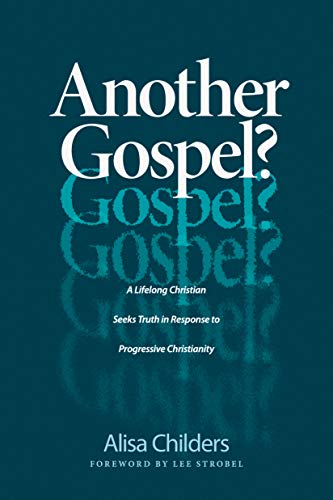
Another Gospel? A Lifelong Christian Seeks Truth in Response to Progressive Christianity

Alisa Childers’ faith wasn’t shaken by an atheist professor or a New Age neighbor.

Her beliefs were dismantled by her pastor.

She knew and trusted him. He had invited a select group of “out of the box thinkers” to a special class, a “safe zone to process our doubts and questions.” Alisa was surprised when he began to question and then to take apart the doctrines she had always believed.

“I wouldn’t hear the term progressive Christianity until years later. But it was clear that this group of people wanted to ‘progress’ beyond the Christianity they had known. They were going through what would practically become a rite of passage in this new and flourishing movement: deconstruction. In the context of faith, deconstruction is the process of systematically dissecting and often rejecting the beliefs you grew up with” (p. 24).

There were things that bothered Alisa about Christianity as it had always been presented, things like massive altar calls where people streamed forward. Did those people know what they were doing? Did their decision “stick?”

But those things didn’t cause her to question her foundational beliefs. Her pastor’s class did. She realized she knew what she believed, but not why. She had grown up in a Christian family who actively ministered to others. But her faith was “intellectually weak and untested” (p. 5).

“When progressive Christianity first entered the scene, its proponents raised some valid critiques of evangelical culture that the church needed to examine and reevaluate. But those progressives who reject essential teachings—like the physical resurrection of Jesus—can confuse unsuspecting Christians and kick the foundation out from under them” (p. 8).

This class led her into a dark pit, “a spiritual blackout—a foray into darkness like I’d never known” (p. 8). What if everything she had ever believed was false? Another girl in the class stood next to her in choir practice one day and said, “It’s funny that we’re all singing these songs and none of us have any idea what we believe!” (p. 28).

That wasn’t good enough for Alisa. “When I have doubts about my faith, or deep nagging questions that keep me up at night, I don’t have the luxury of finding ‘my truth’ because I am committed to the truth. I want to know what is real. I want my worldview (the lens through which I see the world) to line up with reality. God either exists, or he doesn’t. The Bible is his Word, or it’s not. Jesus was raised from the dead, or he wasn’t. Christianity is true, or it isn’t. There is no ‘my truth’ when it comes to God” (p. 10).

“I wanted to progress in my faith . . . in my understanding of God’s Word, my ability to live it out, and m relationship with Jesus. But I didn’t want to progress beyond truth” (p. 25).

Alisa prayed for God to send her a lifeboat. And He did, sending more than one. Alisa took time to study in detail the claims of the foundational doctrines of Christianity. It was a long process. Sometimes her study brought up more questions.

“Slowly and steadily, God began to rebuild my faith. The questions that had knocked the foundation out from under my beliefs—the ones I had never thought to ask, the ones I didn’t know existed—were not simply being answered. They were being dwarfed by substantial evidence and impenetrable logic so robust that I felt like a kid in a candy store—who had just found out that candy exists” (p. 227).

Her faith didn’t look exactly as it had before. She corrected some beliefs and determined some, while important, weren’t essential. But her beliefs in the fundamental truths of historic Christianity were now on a firm foundation.

Another Gospel: A Lifelong Christian Seeks Truth in Response to Progressive Christianity is Alisa’s testimony and the result of her study. She takes a great deal of information and distills it to its essentials in an understandable way.

She quotes from progressive Christianity’s authors to show what they believe and how it differs from historic Christianity. Then she draws from her extensive research to share why she believes the evidence supports historic Christianity.

There’s so much I wish I could tell you and quote from this book. But I’ll touch on just a few issues.

One big difference between historic and progressive Christianity is their views of Scripture. Alisa spends three chapters on the different threads of thought in regard to the Bible and the abundant proof that it is accurate and reliable and authoritative.

Other major differences involve who Jesus is and why He came. Some call the idea of Jesus dying for our sins “cosmic child abuse.” But Jesus said He willingly gave His life. Atonement wasn’t an idea borrowed from primitive religions. It was worked into the fabric of the OT sacrifices and symbols and came into fruition in Jesus’ death for our sins. Many NT books expound on it.

If more churches would welcome the honest questions of doubters and engage with the intellectual side of their faith, they would become safe places for those who experience doubt. If people don’t feel understood, they are likely to find sympathy from those in the progressive camp who thrive on reveling in doubt. In progressive Christianity, doubt has become a badge of honor to bask in, rather than an obstacle to face and overcome (pp. 51-52).

As I navigated through my faith crisis, I realized that it’s not enough to simply know the facts anymore . . . we have to learn how to think them through—to assess information and come to reasonable conclusions after engaging religious ideas logically and intellectually. We can’t allow truth to be sacrificed on the altar of our feelings. We can’t allow our fear of offending others to prevent us from warning them that they’re about to step in front of a bus (p. 11).

The progressive wave that slammed me against the Rock of Ages had broken apart my deeply ingrained assumptions about Jesus, God, and the Bible. But that same Rock of Ages slowly but surely began to rearrange the pieces, discarding a few and putting the right ones back where they belonged (p. 9).

Those of you who have read here for a while know that I am not given to gushy superlative statements. But this is one of the most important books I have ever read. I had seen some of the things Alisa described mentioned here and there, and her book helped those pieces click into the bigger picture.

These doctrines matter. There are many areas where we can differ from other Christians and give each other grace. But it’s not enough to have a nebulous belief in a generic Jesus. It’s vital that we know Who and what we believe in and why.

I strongly encourage you to read this book. It will help you discern the threads of progressive Christianity. It will strengthen your own faith and its foundations. It will help you minister to others.

(I often link up with some of these bloggers.)

What We’re to Be Before We Teach

When Titus 2 is taught in any women’s gathering, we almost always hone in on what older women are instructed to teach the younger: “to love their husbands and children, to be self-controlled, pure, working at home, kind, and submissive to their own husbands, that the word of God may not be reviled” (verses 4-5).

But we either lightly touch or skip over what Titus 2 says older women are to be in the verses preceding these.

But before we get there, let’s zoom out a bit to see the context. Paul is writing to one of his coworkers, Titus, whom he had left in charge of the church in Crete. Paul had directed Titus to ordain elders in the churches from among those with certain godly characteristics in Titus 1. Paul sums up that instruction with verse 9: “He [an elder] must hold firm to the trustworthy word as taught, so that he may be able to give instruction in sound doctrine and also to rebuke those who contradict it.”

Then Paul describes those who contradict sound doctrine: “insubordinate, empty talkers and deceivers . . . upsetting whole families by teaching for shameful gain what they ought not to teach . . . their minds and their consciences are defiled. They profess to know God, but they deny him by their works. They are detestable, disobedient, unfit for any good work” (1:10-15).

Remember there are no chapter divisions in the original text. When we study chapters individually, we sometimes forget to connect them to what came before. The very next paragraph in Titus begins, “But as for you”—in contrast to the kind of people he was just talking about—“teach what accords with sound doctrine” (2:1). Then Paul gives specific instruction to older men, older women, younger men and women, servants.

So these instructions aren’t just nice thoughts or ways to have a happy church or for everyone to get along. These behaviors that Paul wants taught are “in accord with sound doctrine.” Our beliefs and our behavior should work hand in glove. Our actions shouldn’t contradict our doctrine.

So what are older women to be like?

Reverent in behavior.” Most of the non-paraphrased translations use the word “reverent.” The KJV says, “in behaviour as becometh holiness.” The commentary at the bottom of this page says, “The Greek word rendered ‘in behaviour,’ or ‘in demeanour,’ includes dress, appearance, conversation, manner; includes an outward deportment dependent on something more internal. The elder Christian woman in her whole bearing should exhibit a certain dignity of sacred demeanour; there should be something in her general appearance, in her dress, in her speech, in her every-day behaviour, which the younger and more thoughtless sister could respect and reverence–an ideal she might hope one day, if the Master spared her so long, herself to reach.”

Being reverent or dignified or holy doesn’t mean one never has fun, laughs, or tells jokes. Joy is part of the fruit of the Holy Spirit. Proverbs 17:22 tells us “A joyful [merry, KJV] heart is good medicine, but a crushed spirit dries up the bones.” Richard Baxter said, “Keep company with the more cheerful sort of the godly; there is no mirth like the mirth of believers” (The Practical Works of Richard Baxter, p. 24). Henry Ward Beecher said, “A man without mirth is like a wagon without springs, in which everyone is caused disagreeably to jolt by every pebble over which it runs.”

There’s a joy and humor in keeping with reverence and holiness.

But a godly older woman knows the things of the Lord are serious. She takes care to honor God in her life and teaching, whether formal instruction or just sharing passing encouragement.

Not slanderers.” Some translations say “false accusers” or “gossips.” Obviously we shouldn’t spread anything that is untrue. Lying and slander are definitely not in keeping with a God of truth.

Gossip is a little harder to define. It’s not always wrong to talk about someone else’s wrongdoing. Paul mentions people by name in his epistles who have erred in various ways. Sometimes talking with another Christian is a way to process whether someone’s actions are right or wrong. As we’ve encountered problems in various churches we’ve attended (and there is no church without problems), we’ve discussed the issues with our family. But discretion is needed as to what is discussed with whom and how. There’s a difference between needful processing and just gossiping. Gossip seems to have malicious intent.

As an example, years ago a couple who had been members of our church went out as missionaries to another country. They seemed exemplary in every way, having a real fervor for the Lord. After some years of seemingly successful ministry, the husband was found in an adulterous relationship with another woman. Their mission board called them home. When the church leadership met with the man, he refused to repent, saying he loved his sin too much to give it up.

Of course, this situation sent shock waves through the community he left, his mission board, our church, and probably everyone at every level that he had ever dealt with. It wasn’t something that could be kept quiet. There was much discussion. How should we respond to him? How can we minister to his heartbroken wife? And most of all, how could this have happened?

We all needed to work through that kind of processing. But to talk about the situation just to talk would have been wrong.

I think we have to show restraint sometimes even in sharing good news that might not be ours to share. Once at a church committee meeting I attended, one newly-pregnant lady lamented that she didn’t even have a chance to tell her closest friends that she was expecting because word spread so quickly. That convicted me. There’s something delicious about being the one with news to share.

So if our motive for talking about situations is to feel important because we have news, or to feel superior because someone has done wrong, we’d better put the brakes on. We need much wisdom and Holy Spirit leading that our conversation would be edifying and not destructive.

Not slaves to much wine.” I think, in context, this phrase is not just saying older women shouldn’t be drunkards. This verse uses the word “likewise,” pointing back to what had been told to older men, that they should be “sober-minded, dignified, self-controlled, sound in faith, in love, and in steadfastness” (v. 1). Self-control is also mentioned to the younger women (verse 5) and younger men (verse 6) with another “likewise.” So I think the larger picture is that she shouldn’t be enslaved to anything, that she should live a life of self-control (another part of the fruit of the Holy Spirit in Galatians 5:22-23).

To teach what is good.” To teach what is good, one has to know what is good. We can’t teach subjects we don’t know, can we? We need to spend much time in the Word of God not only so that we know what He wants to teach us, but also so that, as we have opportunities to share with others, we can direct them the right way.

To “train the young women to love their husbands and children, to be self-controlled, pure, working at home, kind, and submissive to their own husbands, that the word of God may not be reviled” (verses 4-5), we have to have enough experience walking with God to be able to share His truth in these areas.

That makes the whole thing scary. None of us has lived in this way in perfection. But God knows that. He doesn’t ask us to teach from our perfection, but from His. Sharing our own failures and stumbles helps other women to know that God gives grace. Pointing, not to ourselves, but to Him helps others to look to the only One who can enable them.

Older women have a reputation for being cranky, crochety, and critical of anything that’s not done like it was “back in my day.” Thank God, most of the older women I have known have not been like that. God has put some sweet, godly women of stellar character in my path over the years.

May we all seek His grace, whatever our ages, to please Him and to be a godly influence on those around us.

Some of my past posts related to these subjects:

(I often link up with some of these bloggers.)

Laudable Linkage

Here’s another round of good reads:

Do Christians Still Have Evil Desires? HT to Challies. “So, is the ground of judgment the acting out of sins, beyond merely harboring the impulse within? Or is this very tendency in us, a diminished but still present earthly desire towards sin’s allure, also ground for eternal judgment? Or is putting to death sin the complete eradication of evil desires from in us? Or is it (by grace) tamping down those desires that will always be there, but not acting out consistently on those impulses? If so, how would that apply to not just the acted-out sins, but specifically to ‘evil desires’?” John Piper answers these in a very helpful way.

Are You an Addict? “Chemicals are one of the ways that people, even God’s people, unbiblically cope with life’s trials. Others might immerse themselves in gaming, sex, or fantasy entertainment. Others use exercise, current events, food, dieting, obsession with sports teams, and even sleeping to escape from life’s realities. Many of these are good things, but they are being used in the wrong way. I had to take a long look at myself, and I found some unpleasant things that I had not even considered a problem before. I had to ask myself some difficult questions.”

Is There an Easy and Transformational Way to Study the Bible? “My dad was a kind man, but he demanded respect and obedience. When he spoke, he didn’t mean, ‘Hear my words, but do whatever you want.’ He meant, ‘Hear my words, understand what I’m saying, and respond in proper obedience.’ Our kind heavenly Father calls us to the same, if not a greater, level of hearing.”

6 Wrong Ways to Approach Difficult Passages, HT to Knowable Word. “It doesn’t take long for a Christian who’s studying the Bible to come across challenging passages. When we do, we should always remember the basics of interpretation: looking for the author’s intended message, reading it in context and with the whole of Scripture in view, even considering how believers throughout history have interpreted it. But following those principles isn’t enough. There are still common mistakes we can make when we study—or seek to teach from—difficult texts in Scripture.”

The Mustard Seed Mum: Pressured to Be Perfect? HT to Challies. “It’s not a competition, even if it feels like it. So what if your child’s best friend’s mother bakes brownies better than you? You’re the best mama for your kids. God put you in a position to look after these precious children. You can trust Him to help you do it.”

Looking for Contentment? It’s Not What You Think. “The more I reflect upon Paul’s letters, the more the Lord continues to refine my incomplete notions of contentment. Paul is not carefree, unburdened, and surrounded by trouble-free relationships. In fact, considering the larger picture of Paul’s ministry gives me a fuller picture of what contentment is by gaining insight into what it is not.”

Is There Such Thing As Random? How God Orchestrates People In His Perfect Timing. HT to Challies. “We don’t choose our moments of suffering, or the times we are pressed into service; they usually come on suddenly and without warning.”

Touch This Tree and You’ll Want to Die, HT to Challies. An interesting and awful natural phenomenon and a good object lesson.

How to Turn a Clique Inside Out, HT to Challies. “Close friendships are a wonderful blessing. But who are they blessing? In a clique, the blessings of friendship stay locked inside a tight circle of friends. The friends themselves tend not to notice, because they are too busy enjoying their own close relationships with each other. But for the people looking in from the outside, the view is not as pretty. They see backs, not faces.”

A Time to Hustle and a Time to Stroll. We tend one way or the other, but there’s a time for each.

And to end with a smile, I had not seen this particular Geico commercial about living in a Victorian house until Karen Wittemeyer shared it.

Happy Saturday!