Why Listen to Audiobooks?

IMG_1096

Like most avid readers, I like the tactile experience of a book in my hand and turning pages while taking in the story, though I’ve gotten used to e-readers since so many free and discounted books can be found for it, and there are features of it I like. But my first preference is still an actual book made of paper and ink. Why, then, would I listen to an audiobook? Listening, after all, is a different experience than reading.

I first sought out audiobooks when we moved here. As I have mentioned before, where we used to live, the places we needed to go most often were only five minutes away. Going “across town” only took maybe 15 minutes. When we moved to our present location outside a larger city, it took longer to get most places. I’m not a person who likes to spend time in the car: “going for a drive” is not on my list of fun things to do, and I chafed at the “wasted” time driving, even with a Christian radio station and an abundance of music to listen to. I decided to try a trial subscription to Audible.com: if I remember correctly, the introductory offer at that time was one free book, with the option of canceling the monthly fee at any time. I was hooked immediately. Driving became an enjoyable experience rather than just a chore. Then I also began to listen while getting ready in the morning, doing housework, and exercising. Of course, I listen when I am alone or when other members of the family are occupied in others rooms: since my children are older and are usually otherwise occupied, that affords me more listening time than I would have had when they were younger and usually with me.

Though I have listened to a variety of genres of audiobook, for me they work best for classics that I might not otherwise read. I’m currently halfway through War and Peace, a book I probably never would have tackled in print just because I wouldn’t want the sheer length of it to monopolize my reading time for so long. Plus the meandering narrative or excessive descriptions of classics are easier to take if I am doing something else while listening than if I am trying to slog my way through it by reading. They also work best for fiction or biography for me. With non-fiction, even for the print version I have to reread or review sections to get the most out of them, which doesn’t work as well for audiobooks, plus my attention wavers much more listening to non-fiction than fiction.

Some of the advantages of audiobooks:

  • They allow you to do something useful with your mind while your hands are busy.
  • I don’t usually think in the accent of the country the book is set in, and hearing it read with an accent increases the enjoyment of the setting.
  • Hearing the inflections of the author draws out meanings or points I might have glossed over.
  • I can get through more books than I can just by reading physical ones.

There are some disadvantages as well:

  • You can’t skim through a boring part.
  • If your attention wavers or you need to go back and refresh your memory about a person or incident, it’s harder to flip back through to the part you need. The app I use does have a button to go back 30 seconds or go back to the beginning of the chapter, but I can’t always get to it if I am driving or cooking.
  • I miss the tactile sensation of holding a book and knowing about where physically a favorite part is.
  • Audiobooks often do not include the acknowledgments page or author’s afterword.

Personally I feel the advantages outweigh the disadvantages.

Many Audible books work in sync with Kindle version of the book, and often if you buy one, you can get the other for a discounted price. With classics you can often get a free or very inexpensive Kindle version, and if you leave off at a place in the audiobook, you can pick up at the same place in the Kindle version and vice verse. If I don’t have a Kindle version, sometimes I’ll get the print version from the library just so I can mark places (though the Audible app does have a way to bookmark certain spots) or go back through a passage I feel I need to go over again to understand better.

I don’t think I could get much from a nonfiction audiobook that is not a story or biography: with those books I underline, mark places, and place sticky tabs all through and still feel  sometimes like I haven’t quite grasped the whole thing.

I’ve mentioned Audible.com because that is primarily what I use (I am not affiliated with them and will not receive compensation from them for mentioning them). The monthly charge is $14.95 a month for one credit, which usually equals one book. That might sound high, but a longer classic runs 20-30 hours, and there is not much else I could do for $14.95 that will give me that many hours of use and pleasure (especially comparing it to the price of going to see a 2-hour film with someone). But in addition to the monthly credit, they have sales for members throughout the year where I have gotten books for $1.95 to $6.95. They also release a free book around Christmastime (past free books have included A Christmas Carol, The Cricket on the Hearth, The Snow Queen, and The Wizard of Oz). They have an app that makes it very easy to buy, download, and listen to a book. I also like that you can play decent sized samples of the book before buying: sometimes they’ll have several editions of a book with different narrators, and I’ll listen to several before choosing which one I like best. Narrators can really make or break the listening experience, especially since you’ll be spending so much time listening to one and they shape the way you experience the book. In over four years of listening to audiobooks, I’ve found only a small handful of truly bad or just flat narrators, but it is worth the time to decide between the okay or good narrators and the best.

But there are a few places where one can get free or inexpensive audiobooks. Some public libraries have them. A few other places are LibriVox (free) and ChristianAudio.com (discounted). Audiobooks.com is the same price as Audible.com. ITunes has some as well. LearnOutLoud.com is a subscription service as well with different prices for different types of subscription but they do have some free selections. GoBible.com does not charge a monthly subscription, but the few books I looked at on their front page were quite a bit more expensive. I think they offer one free audiobook download per month – at least they used to. I haven’t gotten their mailings in a while. Sync offers a free young adult or classic audiobook once a week, I believe, from May through the summer. I got my first Incorrigible Children of Ashton Place book through them and got subsequently hooked not only on the stories but also on Katherine Kellgren’s narration. I have used a couple of these but don’t remember which ones other than Sync. Others I have read of but have not tried are AudiobooksForFree and OpenCulture.

You do have to be watchful when buying or downloading an audiobook to make sure you’re getting the unabridged version rather than an abridged or “dramatization” (unless that’s what you want). Dramatizations are usually cut down like movies are, but they have the advantage of different actors for the different characters, so it is a little more like listening to an old-time radio drama. You won’t get all the nuances of the book, but for a longer classic that you might not otherwise delve into because of the older styles of language or writing, an abridged or dramatized version might give you the basic idea of the story.

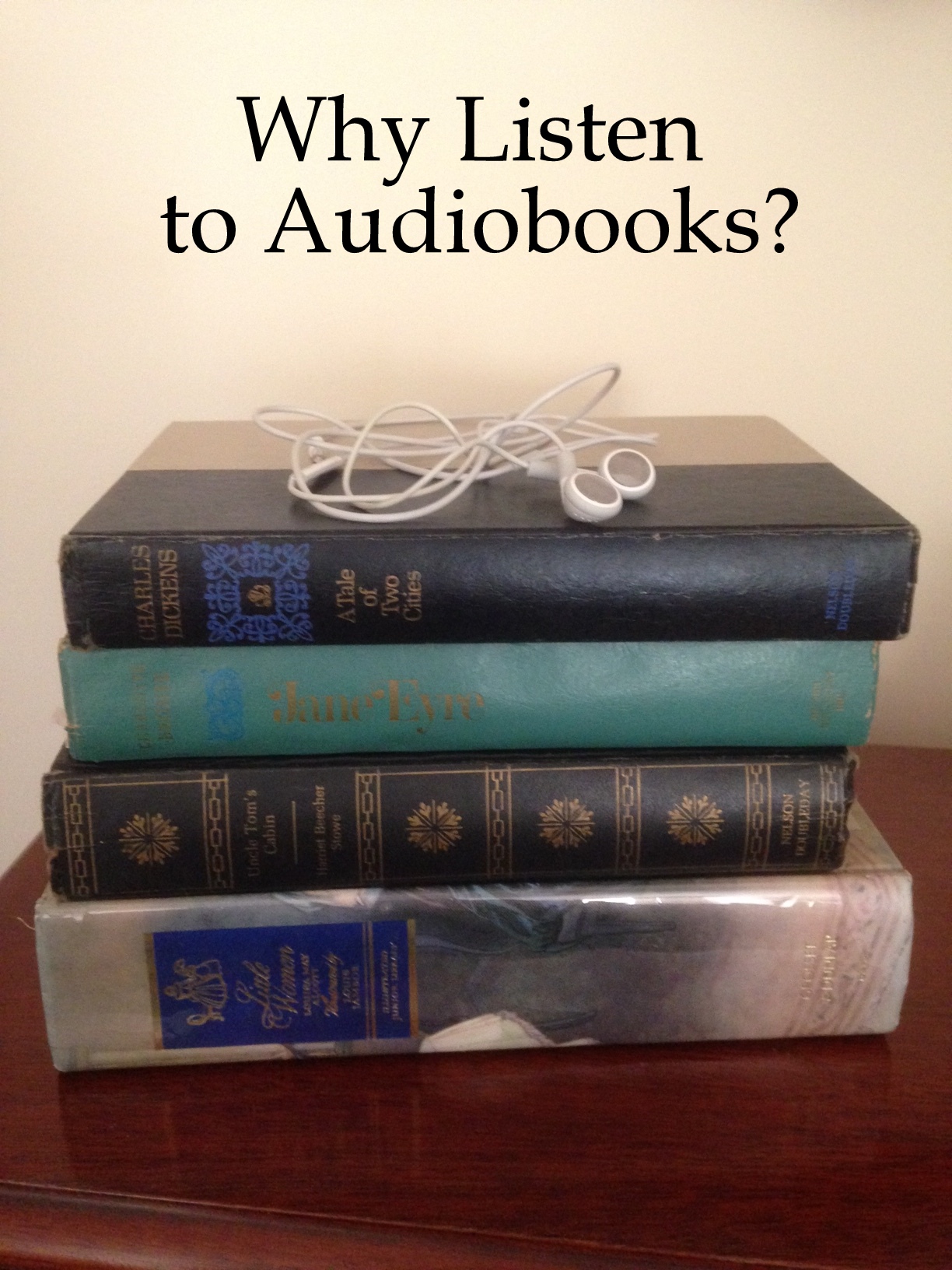
On a practical note, I am not a big fan of ear buds, but I do use them when listening while walking. In the car I have an adapter that plugs into my iPhone and then into the tape player (yes, my car is old enough that it only plays cassette tapes) so that the sound comes through the speakers; my youngest son’s newer car has a built-in plug-in for phones that does the same thing. Otherwise I listen with the phone on the counter or in my pocket.

What is your experience with audiobooks? Do you enjoy them? What are your sources?

See also:

Why Read? Why Read Fiction? Why Read Christian Fiction?

Why Read Biographies?

Finding Time to Read.

(Sharing with Booking Through Thursday.)

btt  button

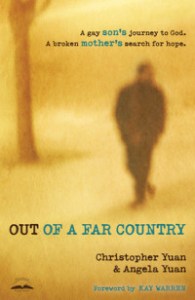
Book Review: Out of a Far Country: A Gay Son’s Journey to God. A Broken Mother’s Search for Hope

Far CountryI’ve been wanting to read Out of a Far Country: A Gay Son’s Journey to God. A Broken Mother’s Search for Hope by Christopher and Angela Yuan ever since seeing it recommended by Tim Challies, and I am glad to have finally done so. I’m predicting it will be one of my top ten books of the year.

Christopher and Angela take turns with the chapters, describing events from their different points of view. They open the book with Chris’s coming out to his parents that he was gay. Angela did not object on Biblical grounds: she was an atheist who hated Christians. I don’t think the book ever explains just why she was against his homosexuality, except that they had hoped he would follow in his father’s footsteps and become a dentist, and patients would probably avoid a dentist who had the potential to be HIV positive. Maybe it just didn’t fit in with her idea of a perfect family, but it was devastating to her.

Angela had come from an unhappy home and had put great stock into having a good family. But over the years her husband grew cold and distant, her oldest son rebelled, and now Christopher was going in a direction completely unacceptable to her.  She gave him an ultimatum between his family and his homosexuality, and, believing he had no choice in his orientation, he left home to be with friends who would accept him as he was. Angela crumpled to the ground in despair, feeling she had nothing left to live for. She made plans to end her own life, but wanted to talk to a minister first. Though he was kind, nothing really changed in her heart. He gave her a booklet which she later read, and her eyes were opened to the truth that her lifelong desire for belonging could be fulfilled in belonging to God. It was even a relief to know and admit that she was a sinner, that though she was far from perfect, God still loved her. “I had not been seeking God, but I was found by him” (p. 19).

Chris, for his part, was glad to get away from the “Chinese-mother guilt-trip drama” (p. 8). Coming out to one’s parents and the inevitable negative reaction was a rite of passage among his friends. He finally felt free to live as he wanted to. He “started going to gay clubs and began tending bar” (p. 23) at night while attending dental school during the day. Eventually the party scene took over his life. While feeling low after a broken relationship, he accepted someone’s offer of the drug Ecstasy, and within a very short time started selling drugs to support his own habit, then became a popular and leading seller in his area and even across the country. His schooling suffered to the point that he was eventually expelled, but it no longer mattered since he was making money hand over fist and enjoying life and popularity.

Until he was arrested.

During this time Angela had been growing in her own faith and her husband Leon had come to the Lord as well. At first she tried various things to get through to Chris but finally realized that she could not “fix” him. She could only fast, pray, show him love, and not shield him from the consequences of his actions. She and her husband did not intervene when Chris was threatened with expulsion from school and after he was arrested asked the judge to give him a sentence just long enough to bring him to God. Once after reading Psalm 46:1, “Be still, and know that I am God,” she knew “as hard as it was, I knew I had to quit striving and trying to make things work my way. But rather, I had to let God do things his way and in his timing” (p. 73). “It may have just been easier for us to give up on our son, but God said, Wait! He gave us faith to hope against all the evidence we saw and to trust he had a plan, Leon and I committed to focus not on hopelessness but on the promises of God” (p. 109). She “prayed specifically that God would do whatever it took to bring our son to him — not to us, not out of drugs, not out of homosexuality…but to the Father” (p. 159).

With Christopher’s arrest, his popularity vanished. None of his “friends” wanted any more to do with him. One day in prison, he saw a Gideon’s New Testament on top of some trash, and he took it back to his cell and began to read mainly just as a way to pass the time. Over time, both with reading the Bible on his own and studying it with others, Chris came to believe on Christ.

Being in prison had taken care of getting Chris off drugs and out of the party scene, and he came to admit they were both wrong and he needed to stay away from them once he got out. When he talked with a chaplain about his homosexuality, he was told that the Bible did not condemn homosexuality and gave Chris a book explaining that view. That sounded wonderful to Chris, but as he read the book and then studied the Bible, he felt the book did not line up with what the Bible taught. He did discover that in “Leviticus 18:22 and 20:13 — passages normally used to condemns gays and lesbians…God didn’t call lesbians and gay men abominations. He called it an abomination. What God condemned was the act, not the person. For so long, I had gotten the message from the Christian protestors at gay-pride parades that the God of the Bible hated people like me, because we were abominations. But after reading these passages, I saw that God didn’t hate me; nor was he condemning me to an inescapable destiny of torment. But rather, it was the sex he condemned, and yet he still wanted an intimate relationship with me” (p. 186). Being gay had been a major part of his identity, but as he continued to study the Scriptures, he “began to ask myself a different question: Who am I apart from my sexuality?” (p. 187). He details his thought processes and conclusions in a chapter called “Holy Sexuality.” One conclusion was:

God’s faithfulness is proved not by the elimination of hardships but by carrying us through them. Change is not the absence of struggles; change is the freedom to choose holiness in the midst of our struggles. I realized that the ultimate issue has to be that I yearn after God in total surrender and complete obedience (pp. 168-169).

This book touched me on so many levels. What a joy to see the journey of how God brought both Christopher and his parents to Himself.

Christopher’s testimony from a documentary is here:

You can read more of Christopher’s life and ministry at his web site, www.christopheryuan.com.

(This review will also be linked to Semicolon‘s Saturday Review of Books.)


Book Review: My Emily

My EmilyMy Emily by Matt Patterson is a family’s story of a young daughter born with Down’s Syndrome who is then diagnosed with leukemia at the age of two.

After the joy of Emily’s birth, the Pattersons were shocked to learn that she had Down’s Syndrome. Once they had a chance to absorb that, though, they found it didn’t really change anything. Emily was a little behind other children in her development, but she was developing, and “she did possess two characteristics many Down’s children are blessed with – a never-ending smile and a heart so very full of love.”

But a late-night run to the ER for a fever when Emily was two, and a question about some dots on her leg, led to blood tests which revealed Emily had acute lymphoblastic leukemia.

Matt relates what Emily and the family went through as she underwent a 100-day course of chemotherapy with its attendant side effects, went into remission, relapsed, and had a bone marrow transplant.

A major part of a journey like this is wrestling with God about why He allowed it, especially for a little child, and Matt shares some of that as well.

Perhaps He sent this little, unassuming angel to instruct me and many others about what’s truly important in life. I believe she taught us not to take one single day for granted, showing a greater appreciation for family, faith, and friends and all that we have been given and blessed with.

…Some would look at Emily’s life and think that a child born with Down’s syndrome has little hope for a meaningful life. Throw in the diagnosis of leukemia and that little hope turns into no hope whatsoever.

I disagree.

Emily’s life, with all its imperfections, had great meaning. Because of how many people she touched, I realize that we are far more than what we can accomplish. We are the very thumbprints of God.

Matt goes on to say:

Incidents in our lives – big or small – develop our character. The Bible says, “We know these troubles produce patience. And patience produces character.”

Our lives, as short as they may be, are a test. And one of the biggest tests we can endure is how we respond to those moments when we don’t feel the presence of God in our lives. I believe deeply that one of God’s greatest gifts is to teach us there is a purpose behind every single one of our trials and problems.

Treat them as a gift, an opportunity to to move forward and draw closer to God. Problems often times compel us to look to God and count on Him rather than ourselves.

This is a very short book at 98 pages and at the moment is available for free for the Kindle app. I was touched at many points in the book and the quote about every life with its imperfections having meaning and purpose and that we “are more than what we can accomplish” particularly spoke to me.

(This review will also be linked to Semicolon‘s Saturday Review of Books.)

Two Books: I Deserve a Donut and Taste For Truth

DonutI first became aware of I Deserve a Donut (And Other Lies That Make You Eat) by Barb Raveling through my friend Kim. It originally started out as a list of questions and Bible verses Barb put together for her own use. When she shared some of it with a group of teenagers she was teaching, one suggested it should be an iPhone app. Since she had a son who created iPhone apps for a living, he helped her to do that. Then, realizing that not everyone has an iPhone, she put these truths into book form, both paperback and digital.

The study is based on Romans 12:2: “And be not conformed to this world: but be ye transformed by the renewing of your mind, that ye may prove what is that good, and acceptable, and perfect, will of God.” The book is divided up into reasons – or lies – that cause us to eat and different emotions that can lead us to eat. For example, under the first section are categories like Entitlement eating (“I deserve this”), Garbage Disposal Eating (“I don’t want this to go to waste”), Good Food Eating (“That looks good. I should eat it.”), and Social Eating (“She’s eating. I should eat.”) The next section lists just about every emotion that could lead you to eating, with the understanding that the problem there is not just eating for the wrong reasons, but dealing with the underlying emotions as well.

Then, after you look up whatever situation or emotion is causing you to want to eat, you’ll find a series of questions concerning that situation or emotion, a list of Bible verses, and some tips. For example, a couple of questions under Entitlement Eating are “What do you feel like eating? Why do you feel like you have a right to eat in this particular situation? Do you think God would agree with your outlook?” plus six more. There are about six Bible verses listed, among them Philippians 4:11: “Not that I speak in respect of want: for I have learned, in whatsoever state I am, therewith to be content.” There are about five short paragraphs of tips, including:

The best way to break free from entitlement eating is to adopt a biblical perspective of life. God never said, “You deserve the good life, and of course you have a right to eat.” Instead, He said, “If you want to follow me, you have to be willing to give up everything.”

TasteOfTruthTaste For Truth: A 30 Day Weight Loss Bible Study by Barb Raveling was one I saw recently again at my friend Kim‘s blog, and it works hand-in-glove with I Deserve a Donut (which is why I wanted to review them together.) They overlap a bit, but that is not a problem because renewing one’s mind takes place daily, reminding ourselves over and over of God’s truth, especially in response to the wrong thinking we’re prone to.

The first chapter talks about our part in making changes. I have the tendency to just ask God to change my thinking, which is necessary, but that’s just the starting place, not the stopping place. He has given us specific instructions, such as in II Corinthians 10:3-5 about casting down imaginations and bringing our thoughts into obedience to Christ, in John 8:31-32 about continuing in His Word, and of course Romans 12:2. One of my favorite quotes from the book comes from this section:

“The Greek word for abide used in John 8: 31-32 and John 15: 4-5 is the same word that’s used for living in a house. The idea is that we don’t just visit the Word for 10 minutes a day. We live in the Word. Meditate on it. Chew on it as we walk through the day. Let it fill us and change the way we think about life. Let it fill us and change the way we think about our habits. And even let it fill us and change the way we think about ourselves” (pg. 11).

The rest of the chapters are Bible studies with a place to answer questions about various topics related to breaking control of the hold eating has on us, such as “I Hate Boundaries,” “The Anatomy of a Habit,” Is Overeating a Sin?,” “When You’re Not Losing Weight,” and “I. Need. Chocolate.”

Here are a few more quotes that stood out to me:

God is not all about “do what you want when you want.” On the contrary, God is all about “love me with all your heart, soul, mind, and strength.” One of the ways we love Him well is to hold His gifts with open hands, willing to give them up if they get in the way of loving Him (pp. 12-13).

(After discussing how a fence keeps children safe in a yard even though it limits them) That doesn’t mean the fence is bad. On the contrary, the fence makes their lives better because it protects them from harm. The same is true for us. Lifelong boundaries in the area of food make our lives better because they keep us safe. Yes, they cramp our style, but you know what? Our style needs to be cramped because there are consequences to eating what we want when we want (p. 13).

In many ways it’s like a home improvement project: You don’t know what you’re getting into. You uncover problems you didn’t know you had. You have to make multiple calls to your friend, the Carpenter, for help. And it usually takes longer than you think it will take (p. 61).

The renewing of the mind, like a home improvement project, is a taking off and putting on. You take off the old self. You put on the new self. You takes off the lies. You put on the truth. You take off a cultural perspective. You put on a Biblical perspective. You take off what you learned growing up. You put on what you learned in the Bible (p. 61).

Unfortunately, it will take more than one conversation to unlearn the lies we learned growing up. We learned those lies situation by situation, and I am afraid we’ll have to unlearn them the same way (p. 62).

I found both of these books very helpful and very convicting. I appreciate Barb’s matter-of-fact style. She assures that our thinking can and will change over time as we renew our minds, though the same temptations can come up again any time and we need to keep bringing our thoughts captive to God’s truth.

My friend Kim is taking the study very slowly, taking more than one day for each lesson so as to savor and steep in the truths there. That is probably the better way to go. I tended to get to the end of one lesson, see the title of the next one, and think, “Oh! I need that, too,” and I’d sometimes do two in a day – maybe even three on a few days. But I knew that no matter how slowly or quickly I went through the lessons, I was still going to have to go over and over them once I finished. Sometimes I tend to get to the end of a book, or even a word study like some I have done on anger and fear, and think, “There! Done!” But going through those truths once doesn’t renew our minds: we need to bring them to bear on our thinking often.

Barb has applied this same process of questions and Bible verses to other areas of her life, particularly procrastination. I am thinking of doing the same – just this morning I was struggling with a particular area of thinking and reminding myself of God’s truth pertaining to the matter, and thought I should probably write these out both for my own instruction and to have them as a ready reference next time it comes up.

(This review will also be linked to Semicolon‘s Saturday Review of Books.)

Book Review: Better To Be Broken

Better_to_Be_BrokenBetter to Be Broken is the testimony of Rick Huntress. The book opens with a horrific accident: while on a training mission on an Air Reserve base in GA, the locking system for the two-ton cargo bay door of an airplane where Rick was supervising a cargo load failed, and the door came crashing onto his head, shattering three vertebrae which severed his spinal cord, leaving him a paraplegic.

The next chapter goes back to Rick’s previous life. He had accepted Christ as his Savior at a young age, but early on he loved “praise and accolades.” “Because I had no understanding at that age where my gifts came from, the deadly sin of pride thrived in fertile soil…It made me think I was something special, and that attitude only served later to alienate me from my peers.” He developed a drive to be on top, out front, well thought of, and so he hid his personal weaknesses and his real self. He served in the Air Force, married, attended college, and started a good job all with the same mentality. After a while things began to deteriorate, especially in his marriage.

The next chapter picks back up to the time right after the accident and the ensuing weeks in a hospital. Between pain, drugs, confusion, and fear, finally his walls started breaking down. He tells not only of the progress in his condition but also the progress in his soul as he began to face reality.

I wouldn’t say that God caused my accident to happen, but He did allow it to happen. During the weeks after my surgery, as my body was physically healing, God knew that what I needed most was spiritual healing. That could only be accomplished by His direct hand. He brought me to a place in which rescue was possible only by complete trust in Him. It had been so long since I had trusted in Him that I had forgotten how. But from the moment of the accident, the journey had begun.

Verse 17 of Psalm 51 says, “The sacrifices of God are a broken spirit: a broken and a contrite heart, O God, thou with not despise.” I, too, was broken, and it was the best thing that ever happened to me. My broken back is a blessing from God. He used it to bring me back to Himself. I have heard it said, “God sometimes puts us flat on our back, so we can learn to look up at Him.” That certainly was true for me.

Rick continues to tell of physical and mental adjustments once he was well enough to go home, adjustments to the house, to life in a wheelchair, to not being able to do what he always did. It was hard to navigate the “new normal.” But eventually he came to peace with the differences and found new ways to serve, especially ministering to others in similar circumstances. He once even organized a memorable trip to Israel for several disabled people.

Rick concludes, “If it took a wheelchair for me to have a close relationship with my heavenly Father, then I would choose it all again” and “This is not a sob story about my broken body, it is my sincere attempt to give God the glory for breaking my stubborn will. It is the best thing that ever happened to me.”

Though I winced at several of the things Rick had to go through, I was greatly blessed and challenged by his story, and I highly recommend it to you.

(This review will also be linked to Semicolon‘s Saturday Review of Books.)

Laura Ingalls Wilder 2015 Wrap-Up

It’s the last day of February and so it is time to wrap up our Laura Ingalls Wilder Reading Challenge. If you’ve read anything by, about, or related to Laura this month, please share it with us in the comments. You can share a link back to your book reviews, or if you’ve written a wrap-up post, you can link back to that (the latter might be preferable if you’ve written more than one review — the WordPress spam filter tends to send comments with more than one link to the spam folder. But I’ll try to keep a watch out for them.) If you don’t have a blog, just share in the comments what you read and your thoughts about it. We’d also love to hear if you’ve done any “Little House” related activities.

I like to have some sort of drawing to offer a prize concluding the challenge, and as I thought about it this year, I decided to offer one winner the choice of:

The Little House Cookbook compiled by Barbara M. Walker

OR

Laura’s Album: A Remembrance Scrapbook of Laura Ingalls Wilder by William Anderson

OR

A CD (hard copy or digital) of music based on songs from the Little House Books: Happy Land: Musical Tributes to Laura Ingalls Wilder OR Arkansas Traveler: Music from Little House on the Prairie. (Thanks, Susan, for telling me about them!)

If none of those suits you, I can substitute a similarly-priced Laura book of your choice. To be eligible, leave a comment on this post by Friday telling us what you read for this challenge. I’ll choose a name through random.org. a week from today to give everyone time to get their last books and posts finished.

For myself, this month I read (linked to my reviews):

By the Shores of Silver Lake

The Long Winter

I also wrote Happy Birthday, Laura Ingalls Wilder with some fun facts and favorite moments and quotes from her books.

I had planned to read the newly published Pioneer Girl, Laura’s first book that had never been published before now. But they quickly ran out of all they printed at first and had to print more, and so far I have not received it.

Thanks for participating! I hope you enjoyed your time “on the prairie” this month. It always leaves me with renewed admiration for our forebears and renewed thankfulness that I live in the times I do.

<strong>The giveaway is closed and the winner is Bekah! Congratulations! I will leave the comments open for those still finishing up their reading and posts for the challenge.</strong>

Book Review: The Long Winter

The Long WinterThe Long Winter by Laura Ingalls Wilder starts out in the summer. The Ingalls family has lived in their little claim shanty through the spring, and Pa is cutting down hay. When Pa comes across a big muskrat house made bigger and thicker than he has ever seen, he takes that as a sign that this coming winter will be a particularly hard one. An early blizzard in October and an Indian’s prediction convinces Pa and other homesteaders that they need to move into town for the winter. Pa had built a building in town in the last book and rented it out. The claim shanty was too flimsy to stand up against a blizzard, and being in town would keep them close to supplies.

But then blizzards start coming one right after another with only a day or so in-between, some times only half a day. Supplies run out and the trains can’t get through. Almanzo comes up with a plan, but it is a dangerous long shot.

This book isn’t a fun read, but it is a good one mainly to see the ingenuity and character of the family in this crisis. But there are a few lighter moments. When the family moves to town, Laura and Carrie have to go to school: they’re frightened at first (though Laura tries not to show it), but eventually they make friends and enjoy their studies. There is still a lot of singing in the evenings, along with other ways of entertaining themselves.

There are also glimpses of the times and culture. When Laura wants to help hard-working Pa to get the hay in, Ma was reluctant. “She did not like to see women working in the fields. Only foreigners did that. Ma and her girls were Americans, above doing men’s work.” But Pa could use the help, so she agreed. I was amused that Ma thought girls “above doing men’s work,” when usually we see “women’s work” demeaned. (And there is a bit of that as well – Almanzo considers cooking women’s work, but since he and his brother are bachelors and have to eat, he pitches in. Maybe each gender thought they had the best of it, though they all were industrious and hard-working). I was interested to read Almanzo’s justification for lying about his age in order to stake a claim. The land agent evidently got that he was underage, yet winked at him and gave him the necessary papers. I did have to smile when he commented once that “Three o’clock winter mornings was the only time that he was not glad to be free and independent” when he had to rouse himself up to do something, when at home his father would do that. Ma’s sending ginger water out when Pa and Laura are working in the hot sun on the hay makes me wonder if the recipe is in the Little House cookbook – it sure sounds refreshing. I’ve mentioned before Ma’s not politically incorrect feelings towards Indians, one of her few flaws grown primarily from fear. It is mentioned in passing again here. Laura has an interesting conversation with Pa when she asks how the muskrats know about the coming  winter, and Pa replies that God tells them. Laura asks why God didn’t tell people, and that leads into free will, independence, the differences in the way God deals with animals and people (he could have said, but didn’t, that one way God did give clues to people was through observation of things like muskrat houses).

I like that Laura is honest about her feelings and faults. “Sewing made Laura feel like flying to pieces. She wanted to scream. The back of her neck ached and the thread twisted and knotted. She had to pick out almost as many stitches as she put in.” She and Mary quarrel some times and she flies off the handle sometimes, but family discipline is such that she does this less often than one might expect.

There are interesting comments about how progress can actually make us less able to cope than our forebears:

“We didn’t lack for light when I was a girl, before this newfangled kerosene was ever heard of.”

“That’s so,” said Pa. “These times are too progressive. Everything has changed too fast. Railroads and telegraph and kerosene and coal stoves — they’re good things to have but the trouble is, folks get to depend on ’em.”

When the train can’t get through, they reason, “We survived without trains before.” Thankfully both Pa and Ma come up with some old tricks to help along the way. But as dependent as I am on electricity modern appliances, and creature comforts, I agree that I would have a hard time surviving in that setting.

A lot of this book is about endurance, and that might not be fun reading for some, but it is important. I think for most of us, our endurance would have run out long before theirs did, and we see some cracks in their armor due to the strain of constant storms, being trapped inside, dwindling food, and monotonous tasks just to keep alive. One of the first times I read this book, it made me quite ashamed that I feel tired of winter and gloomy about the lack of warmth, sunlight, and color – and I have always lived in the southeast, where, though we do have freezing temperatures and bad winter weather, it’s not nearly as bad as what others have to face. As it happened, the several days that I was reading this story this time, we had some of our severest winter weather, and while reading this story reminded me that I have nothing to complain about, in some ways it oddly did add to that feeling of winter weariness. But there is always hope that spring will indeed come again.

(This review will also be linked to Semicolon‘s Saturday Review of Books.)

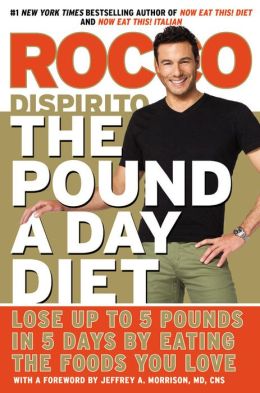
Book Review: The Pound a Day Diet

Pound a Day DietI picked up The Pound a Day Diet by Rocco DiSpirito not so much for the pound a day part, but rather because I had seen Rocco as a chef on shows like “The Biggest Loser” and “Extreme Weight Loss.” On one of them he mentioned that people often feel that when they want to lose weight, they can’t eat anything except grilled chicken and salads, and anyone would get tired of that after a while. That resonated with me, so I wanted to see what else he had to say and hopefully glean some ideas from him.

Part of his interest in lower calorie but tasty foods came from his own need to lose weight. When he became a chef and was working with great food all day, he packed on the pounds. When he decided to lose weight, he used his culinary skills to create recipes that were filling and flavorful yet lower in calories. Sometimes that involved substitutions for the higher-calorie counterparts; sometimes it involved using fresh foods and avoiding higher calorie ingredients. (You can see a before and after photo of him here.) He has created a whole series of books including some of these recipes and ideas.

In this book he advocates losing weight by consuming 850 calories on weekdays and 1200 on weekends in Phase 1. He gets away with the 850 calories by having a protein smoothie in the morning. He quoted a few studies saying that losing weight more quickly than the usually recommended pound or two a week is beneficial because the progress keeps one encouraged: when weight is coming off slowly, combined with the inevitable plateaus, people get discouraged and quit.

He advocates a Mediterranean diet, which involves a lot of fruits and vegetables, whole grains, fewer and leaner meats, and a lot of his general information about what kinds of foods to eat is common sense and similar to what you might read in other healthy eating plans (like eating carbs but choosing nutrient-dense, lower calorie versions rather than the calorie-dense lower nutrient versions). He also talks about benefits of exercise, different types, etc. Probably my favorite chapter was the next-to-last one, about healthier ways of cooking, ways to boost flavor without adding empty calories, the benefits of preparing one’s own food and buying locally (pointing out that food that has traveled 5,000 miles to get here is not going to be as nutritious as what you can get locally), etc.

The bulk of the book (some 140 pages) is recipes. In the reviews I saw of the book, several of them criticized his use of things like artificial sweeteners, powdered proteins, etc.  Though there is a lot of that kind of thing in the smoothies and desserts, most of the entrees and side dishes are just regular foods and spices. Though Rocco advocates preparing meals for yourself, he does include recommendations of ready-made foods that are close to the the recipes.

I marked several recipes I want to try and had wanted to do so before reviewing the book, but that didn’t happen. I was going to try the protein smoothie: I don’t have diabetes (my fasting blood sugar the last few times has been in the “slightly elevated, not enough to say diabetes, but enough that you need to make some adjustments” readings), but I do have a tendency to low blood sugar. If I just have cereal (even cream of wheat) and fruit in the mornings, within an hour or so I am dizzy and shaky and lightheaded and need  to eat something else. Over time I’ve figured out that I have to have something with protein for breakfast for it to last at all, so I wondered if a protein shake might help. As I started to look for the ingredients in the smoothies, I couldn’t find them locally. I did find them online, but as I added up all I would need, I decided that before investing in all that I should probably try a ready-made protein shake and see if I even liked it and if it worked. I liked it well enough, but it still had me just on the edge of feeling dizzy and shaky, even with eating fruit in addition to it. I don’t think I could use them every day – I’d miss the regular smells, tastes, and textures of breakfast foods – but they’d be ok for an occasional supplement. They did work well when I was recovering from oral surgery.

I like Rocco’s focus on foods and recipes because in so many of these weight-loss shows, the focus is on the workouts and the “drama,” with very little said or shown about food. Yet food is the major part of a diet, and if people can’t find a variety of things they like to eat, they’re not going to stick with any healthy eating plan long term. So I appreciate his efforts to provide not just healthy but also tasty alternatives. I’m still wary of 850 calories a day and foods that are made primarily of powdered ingredients (the high-protein chocolate breakfast shake has psyllium husk powder, fiber powder, protein powder, and egg-white powder besides the cocoa and monk fruit extract), but the general principles and a lot of the other recipes sound good. In fact, I received from my Christmas “wish list” his Now Eat This!: 150 of America’s Favorite Comfort Foods, All Under 350 Calories to glean some more ideas for pared-down favorites. You can check out some of his recipes here, and he has various YouTube videos as well.

(This review will also be linked to Semicolon‘s Saturday Review of Books.)

What’s On Your Nightstand: February 2015

 What's On Your NightstandThe folks at 5 Minutes For Books host What’s On Your Nightstand? the fourth Tuesday of each month in which we can share about the books we have been reading and/or plan to read.

It’s been a colder than usual February here, and you’d think that would have lent itself to cozy days curled up on the couch with a throw blanket and a book. There were a few moments like that, though not as many as I would have liked. Here’s what my reading situation is currently:

Since last time I have completed:

Emily Climbs by L. M. Montgomery for Carrie‘s L. M. M. Reading Challenge this month and her Reading to Know Classics Book Club, reviewed here. Not my favorite.

By the Shores of Silver Lake by Laura Ingalls Wilder, 5th in her Little House series for my Laura Ingalls Wilder Reading Challenge this month, reviewed here.

Becoming More Than a Good Bible Study Girl by Lysa TerKeurst, reviewed here. Excellent!

A Promise Kept by Robin Lee Hatcher, reviewed here. Very good.

I Deserve a Donut (And Other Lies That Make You Eat) by Barb Raveling. Excellent, but I am waiting to review it together with the other Raveling book I am currently reading.

I’m currently reading:

The Long Winter by Laura Ingalls Wilder, also for the LIW Reading Challenge.

Taste For Truth: A 30 Day Weight Loss Bible Study by Barb Raveling, recommended by my friend Kim.

The Pound a Day Diet by Rocco DiSpirito. Almost done.

A Million Little Ways: Uncover the Art You Were Made to Live by Emily Freeman

War and Peace by Leo Tolstoy, audiobook. I’m about 1/3 of the way through. Progress!

Next up:

Pioneer Girl by Laura Ingalls Wilder has not come in yet and I have gotten a notice that it will be delayed even more, but I’m looking forward to it when it finally does arrive.

 Out of a Far Country: A Gay Son’s Journey to God. A Broken Mother’s Search for Hope by Christopher & Angela Yuan, recommended by Tim Challies.

To See the Moon Again by Jamie Langston Turner

Better to Be Broken by Rick Huntress

I also wrote about finding time to read, as I often get asked how I do. I invite you to check out that post and let me know if there are ways you find time to read that I hadn’t thought of.

Happy Reading!

Book Review: A Promise Kept

PromiseKeptIn A Promise Kept by Robin Lee Hatcher, Allison Kavanagh moves into her aunt’s cabin in the woods of Idaho after a divorce that she did not want, prayed against, and was certain that God would prevent. In fact, she had been fairly sure that God had impressed upon her that He would heal her marriage. Tony was an alcoholic and his drinking had grown more out of control until it threatened the safety of their family, particularly their daughter. Allison had issued an ultimatum – and Tony had left. Now Allison’s not certain whether she knows how to ascertain His voice and leading at all, and she feels like a failure as a wife and a Christian.

Allison discovers a hope chest with photos, her aunt’s journals, and a wedding dress. She decides to pass the long winter nights by organizing the photos and reading the journals. A number of photos of her single aunt show her in close company with a handsome young man when they were both in their twenties. Did Aunt Emma have a beau that no one had known about?

As Allison settles into small town life and her “new normal,” she begins to heal emotionally and spiritually. Getting to know a new friend and getting back into church and her Bible help along those lines. Thanks largely to her daughter, she has several encounters with Tony and notices apparent changes in him, but after the numerous cycles they went through in their marriage, she is wary of trusting that the changes are permanent. And then when she least expects it, God shows her that His way and timing of keeping His promises may be different from hers, but He does keep them.

This story was largely based on author Robin Lee Hatcher’s own life. It’s not an exact replication, and there are differences between the circumstances and personalities of all involved. Oddly, some of the points of the story that some have criticized as “fairy-taleish” are the most true parts. I appreciated Robin’s note to readers at the end with a bit of a window into her own story, and I am thankful she and her husband were willing to share their story with others.

I wanted to read this book because I enjoy Robin’s books, especially her contemporary stories; because her stories are usually set in Idaho, and my husband is from ID; and because my own father was an alcoholic. My own parents’ story was closer to Emma’s than Allison’s or Robin’s; their marriage was not healed, but I am thankful God did heal my father of his alcoholism and save him, also in a time and way totally unexpected but shining forth with His grace. And I am thankful for the reminder Allison’s mother gave to her that while “God hated divorce, He did not hate the divorced. God loved her and wanted His best for her. Her life was not over. God still had a purpose and a plan for her. All she had to do was trust Him.”

(This review will also be linked to Semicolon‘s Saturday Review of Books.)