When the props are removed

Have you ever felt like the rug has been completely pulled out from under you? Or have the props you leaned on been pulled away? Are the things you always depended on just not there for you any more?

Those hard times of life contain some of the greatest potential for spiritual growth.

Here are some of my prop-removal times:

Family

When I was fifteen, my mother left my father and took us children to Houston. My parents’ marriage had been floundering for some time, so I knew something was bound to happen. But the family break-up was still a shock to my system.

We also moved from a very small town (less than 200 people) to a teeming metropolis of over a million. The culture shock hit me the worst when I went to register at the local high school. I left without registering.

To further complicate matters, these were the days before Internet and cell phones. We had moved during the summer. I had no way to make new friends and couldn’t afford land line long distance calls to my old ones.

So there I was in a new and vastly different city, a new family situation, facing a new school I did not want to go to. I felt alone and cast adrift.

Ours had not been a church-going family, but my parents had let me attend services with my aunt and grandfather or friends. I didn’t know a lot, but I knew I could go to God for help. I prayed.

God answered by leading us to a Christian school and laying it on someone’s heart to pay my tuition for two years. I started attending the church connected to the school and started reading my Bible at the pastor’s urging. I had prayed and asked the Lord to save me several times over the years, but this time I finally understood and believed. My life turned totally around.

Marriage

Fast-forward four years. God provided for me to go to a Christian college, where I met my husband. When we were first married, I still had one semester left and he had two. We went to school together and worked together. I guess I thought that blissful togetherness would continue!

But I graduated, he went back to school, and we had separate jobs. I spent a lot of time at home alone. Then he took a third shift job, and I was a basket case home alone at night. Then, after graduation, his jobs required traveling. With two different moves, while kids finished their school year, my husband worked in the town we were moving to during the week and came home on weekends. Before the last move, we lived like that a whole year.

I cried and wailed to the Lord. It’s not supposed to be like this. I didn’t get married to spend so much time alone.

It’s natural to want companionship and to depend on a spouse. But God wants us to know our ultimate source of companionship, provision, protection, and security come from Him. A few years ago I shared some of what I learned through this experience in Coping When a Husband Is Away, and that has been my most-viewed post several years in a row.

Health

I’d had some health issues, but most were fixed by surgery and/or medication. But when I was 38, one morning my left hand felt numb, like I had slept on it wrong. Within three hours, my left arm and both legs were numb, I couldn’t walk, and I was having trouble using the restroom. I thought I was having a stroke.

After eight days in the hospital and multitudes of tests, the diagnosis came back: transverse myelitis. A virus attacks the spine, and the body’s autoimmune system attacks the myelin sheath around the nerves as well as the virus. Symptoms vary depending on where the virus hits the spine. Some have mild numbness and tingling; on the other end of the spectrum, some are paralyzed and ventilator-dependent.

I was fortunate that my symptoms were somewhere in the middle. With physical therapy and much prayer, I progressed from a wheelchair to a walker to a cane, and finally to my own wobbly gait.

But the body I had always depended on was changed. Continuing numbness, weird nerve signals, balance and urinary issues plagued me the first few years. My neurologist told me whatever I didn’t gain back, I’d get used to. No way, I thought. I could never get used to this.

But I did. And in the meantime, I had to draw close to God in the midst of uncertainty and limitations. In the early days, it was hard to make plans because I never knew how I would be feeling. Any outing or exertion would set me back for a day or two. I often asked God for complete healing, pleading that I could serve Him so much better without the distractions and frustrations my body experienced.

But Elisabeth Elliot’s words about limitations helped me. “My limitations…become, in the sovereignty of God, gifts. For it is with the equipment that I have been given that I am to glorify God. It is this job, not that one, that He gave me.” Limitations didn’t hinder my ministry; they defined it.

I’ve always loved this poem, which I found in Amy Carmichael of Dohnavur by Frank Houghton:

Two glad services are ours,
Both the Master loves to bless.
First we serve with all our powers —
Then with all our feebleness.

Nothing else the soul uplifts
Save to serve Him night and day,
Serve Him when He gives His gifts —
Serve Him when He takes away.

C. A. Fox

Other health issues have sprung up over the last couple of decades, reinforcing my dependence on God day by day.

Pandemic

When this pandemic first started, I was shaken. We know much more about it now, and the recovery rate is high for most. But at first, I felt like I was taking my life in my hands any time I left the house. I’d seen shortages of bread and milk before a snow forecast, but nothing like store shelves completely empty of paper products. I was grateful for directives to stay home, but worried about the economy.

Our total way of life had been affected by an unknown invader.

I had to remind myself of lessons learned before: God is in control. He’s not taken by surprise. He has promised to take care of His children.

Our church has been reading through the Old Testament prophets. God often had to deal with His people’s trust in everything else but Him. Some objects of their trust were bad, like false gods and despicable religious practices. Some were not wrong in themselves, like other nations or their own wealth and military might; but those things could and did fail them. Some were even wonderful things, like the fact that they were God’s people, and they had the temple and the holy city. But they didn’t realize that they were trusting in everything except God Himself.

Family, a spouse, a healthy, capable body, and our normal routines are not sinful things: they are God’s good gifts. There’s nothing wrong with depending on them and enjoying them.

But sometimes, instead of seeing God worth through those “props,” we lean on them instead of Him. God weans us away from depending on anything instead of Him, because nothing else will satisfy or help in the long run, and because He alone is capable and worthy.

The eternal God is your dwelling place, and underneath are the everlasting arms. Deuteronomy 33:27

The Lord is my light and my salvation; whom shall I fear? The Lord is the stronghold of my life; of whom shall I be afraid? Psalm 27:1

God is our refuge and strength, a very present help in trouble. Psalm 46:1

And we know that for those who love God all things work together for good, for those who are called according to his purpose. Romans 8:28

Trust in the Lord with all your heart, and do not lean on your own understanding. In all your ways acknowledge him, and he will make straight your paths. Proverbs 3:5-6

Blessed is the man who trusts in the Lord, whose trust is the Lord. He is like a tree planted by water, that sends out its roots by the stream, and does not fear when heat comes, for its leaves remain green, and is not anxious in the year of drought, for it does not cease to bear fruit. Jeremiah 17:7-8

When our props are pulled away, we’re shaken for a bit til we remember the One who never fails. He may not answer prayer just the way we’d like, but we learn to trust His will. When we know God and rely on Him, we find Him abundantly faithful and capable. Then we come to know Him better and our faith grows even more.

Have you ever struggled with the loss of something you depended on and learned to lean more on God? I’d love to hear about it in the comments.

IMG_0653

(Sharing with Global Blogging, Senior Salon, Hearth and Home, Inspire Me Monday,
Purposeful Faith, Tell His Story, InstaEncouragement, Anchored Abode,
Recharge Wednesday, Worth Beyond Rubies, Share a Link Wednesday,
Let’s Have Coffee, Grace and Truth, Faith on Fire, Blogger Voices Network)

(On a side note: The original graphic I had here showed feet with clouds underneath and a building off to the side. I wanted to convey the idea of free-falling, the way we sometimes feel when props are taken away. It didn’t occur to me until Facebook showed only a grey area in place of the picture that perhaps that image might have been disturbing to some. It was obviously photoshopped and edited by the person who originally made it (I found it in the WordSwag app). But it could have conveyed the idea of jumping off a building. We knew a family whose son committed suicide that way. I didn’t realize that connotation at first, and I apologize if that was a trigger or unsettling for anyone. Also, if the graphic you clicked on to get here had a different picture than the one above, this is why I decided to change it.)  
Real Life Prayer

IMG_2234 ?ver2A couple of weeks ago I wrote about #RealLifeDevotions, which often look different from Instagram-worthy ideals. That post focused on Bible reading, but the other half devotions, or quiet time, or “God and I” time, or whatever we want to call the time we meet with the Lord, is prayer. Just like Bible reading, we often neglect to pray until we can set aside a certain amount of time or set up prayer time the way we think is ideal.
Like Bible reading, my prayer time has varied through different seasons of life. For a while I had a regimented system of what to pray for on certain days. Another season, I used the acronym ACTS: Adoration, Confession, Thanksgiving, Supplication (requests). That seemed a little artificial (who else do we talk to in acronyms?), but it did help me to include other elements besides requests. When my children were young, I prayed while rocking or nursing or falling asleep.

I used to think I hadn’t officially prayed for something unless I brought it before God during devotional time. But then I reasoned that real life conversations aren’t crammed into one 10-15 minute segment of the day. We speak to those closest to us throughout the day as well as setting aside special times to talk.

The Bible is the best textbook on prayer. God gives us instruction about prayer, more than can be included in one blog post (avoid vain repetitions, empty phrases, praying for “show,” ask in faith, confessing known sin, etc.).

Not only does God give us specific instructions about prayer, but He also gives us examples of how and when people prayed and what they prayed for.

Prayer isn’t a ritual: it’s a conversation with God. Like any other relationship, we need one-on-one time, with everything else set aside. Daniel had set times to pray. Jesus’ life on earth was incredibly busy, but He got up early in the morning to be alone with His Father or prayed through the night. His prayer time was interrupted, just as ours sometimes is.

But Jesus and others Bible people also prayed “in the moment.” One of my favorite prayers in the Bible is Nehemiah’s quick appeal sent up to God right after the king asked him a question. So I began praying for a need as soon as I heard it, or thanking God for something just as it happened, or asking for wisdom, forgiveness, guidance, strength, etc., all through the day.

The psalms give us examples all over the spectrum, from the highest praise to the deepest lament. The epistles share some of the deepest prayer requests I’ve seen. For a long time, I had a sheet of Paul’s prayers typed out and tucked in my Bible, and I would pray through them for myself and loved ones. One of my favorites is Colossians 1:9-12:

And so, from the day we heard, we have not ceased to pray for you, asking that you may be filled with the knowledge of his will in all spiritual wisdom and understanding, so as to walk in a manner worthy of the Lord, fully pleasing to him: bearing fruit in every good work and increasing in the knowledge of God; being strengthened with all power, according to his glorious might, for all endurance and patience with joy; giving thanks to the Father, who has qualified you to share in the inheritance of the saints in light.

We’re not restricted to Biblical language, but Biblical prayers help us know we’re praying God’s will. But, really, we can turn almost any Scripture into prayer. We can ask God to help us heed the warning we’ve read, obey the command, trust in the promise, etc.

Usually I speak to God off the top of my head with whatever I’m thinking or concerned about at the moment. But sometimes I feel the need of structure to corral my wandering thoughts. The acronym mentioned above helps, but often I like to use what we call “the Lord’s prayer” in Matthew 6 as a basis. I first saw this idea in a book by Anne Ortland. It might go something like this.

Our Father

Thank you for being my Father. Thank you for drawing me to yourself and making me your child. Thank you for your tender love and care for me.

Which art in heaven

I’m grateful that You are not just my father, but my heavenly Father. You are all-wise, all-knowing, all-powerful.

Hallowed be thy name.

Help me to honor your name in everything I say and think and do. May the nations come to know you and consecrate your name.

Thy kingdom come

I look forward to the day when your kingdom comes, when sin is done away, when all wrongs will be made right.

Thy will be done in earth, as it is in heaven.

Help me to know and do your will. Help me to trust, when the world seems so far from you, when circumstances seems most antithetical to your will, that you are working all things together for good behind the scenes. I pray that you would turn people’s hearts toward you, open their eyes, that they might clearly understand who you are and believe on you.

Give us this day our daily bread.

Thank you that you have always supplied all that I needed and much that I wanted. I ask and trust you for today’s needs.

And forgive us our debts

Please search my heart and show me anything I need to confess to you, anything I need to turn from or make right.

As we forgive our debtors.

Help me to remember I have no right to ask your forgiveness if I am not willing to forgive others (Matthew 6:14-15). Help me not to hold grudges or resentment, but to forgive as freely and fully as you have forgiven me.

And lead us not into temptation

You know what’s ahead today. You know my weaknesses. Please strengthen me and help me to remember your truth to combat the devil’s lies.

But deliver us from evil

I’m trusting you for protection, spiritually, physically, emotionally, and mentally.

For thine is the kingdom, and the power, and the glory, for ever. Amen.

Then there are times in life we just don’t have the words. “Likewise the Spirit helps us in our weakness. For we do not know what to pray for as we ought, but the Spirit himself intercedes for us with groanings too deep for words. And he who searches hearts knows what is the mind of the Spirit, because the Spirit intercedes for the saints according to the will of God” (Romans 8:26-27). A favorite from the OT that I love is when Jehoshaphat says, “We do not know what to do, but our eyes are on you.” I’ve had to say something like that often.

The more we know what the Bible says about prayer, the more we can pray confidently, asking God to “do as you have spoken” (2 Samuel 7:25). “And this is the confidence that we have toward him, that if we ask anything according to his will he hears us” (1 John 5:14).

I saw a Twitter post once that spoke of “throwing the promises of God back in His face.” It’s good to base prayer on God’s promises, but not like this. Some have advocated storming heaven and demanding God answer a certain way. No, we approach Him in humility. That doesn’t mean we’re not honest or fervent. But we’re not belligerent or demanding. We don’t remind Him of His promises because He doesn’t remember them. He does. We plead them to be in accord with His will and to pray in faith.

You’ve heard the phrase “Prayer changes things.” Sometimes it does. More often, prayer changes us. Elisabeth Elliot once said, in answer to the question, “Does prayer work?”:

The answer to that depends on one’s definition of work. It is necessary to know what a thing is for in order to judge whether it works. It would be senseless, for example, to say that if a screwdriver fails to drive nails into a board it doesn’t “work.” A screwdriver works very well for driving screws. Often we expect to arrange things according to our whims by praying about them, and when the arrangement fails to materialize we conclude that prayer doesn’t work. God wants our willing cooperation in the bringing in of his kingdom. If “Thy kingdom come” is an honest prayer, we will seek to ask for whatever contributes to that end. What, after all is said and done, do you want above all? Is it “Thy will be done”? If so, leave it to Him.

Is it “My will be done”? Don’t waste your time and God’s by praying. Have it your way (A Lamp for My Feet).

Even knowing how beneficial prayer is, sometimes we just don’t feel like praying. A former pastor once said that one of his best times of prayer started out with confessing to the Lord that he didn’t want to pray. J. Sidlow Baxter has an almost amusing story of praying despite his emotions until they came along.

Elisabeth Elliot wrote of starting prayer time saying, “Lord, here I am again to talk to you. It’s cold. I’m not feeling terribly spiritual,” but then finding help in the psalms and hymns.

The point of praying isn’t to have an Exhibit A of ideal form. It isn’t about impressing God. It’s about getting to know Him, growing in our love for Him and likeness to Him. The more we read His Word, the more we talk to Him, the more natural and effectual prayer will be.

Has your prayer life changed through the years? Has prayer been a struggle? What has helped you learn to pray?

(Sharing with Inspire Me Monday, Global Blogging, Senior Salon, Hearth and Soul,
Purposeful Faith, Tell His Story, InstaEncouragement, Anchored Abode,
Recharge Wednesday, Worth Beyond Rubies, Share a Link Wednesday,
Let’s Have Coffee, Grace and Truth, Faith on Fire,
Blogger Voices Network. Links do not imply 100% agreement.)

Why Doesn’t God Explain?

Why doesn't God explain?I promised myself that I would not be the kind of mom to say, “Because I said so.”

I believed in discipline and obedience. But I also believed in helping children understand what was requested of them. Understanding would make everyone happy and make life easier.

So I thought. Until I actually had children.

Have you ever tried to explain to a three-year-old why they can’t have dessert before dinner? Why they really do need a nap? Why they can’t stay at their friend’s or the playground for the rest of the day?

Children have an uncanny ability to find loopholes or come up with alternatives. They don’t have the frame of reference to understand why their parents won’t allow what seems perfectly reasonable.

No parent is infallible. We all learn that some of the things we insisted on really didn’t matter in the long run. But usually we do the best with what we know. And sometimes we have to play the authority card.

Sometimes we want to say, “My dear child. I’ve been around the block a few times. I know you. I know how life works. I have your best interests in mind, really. I know you don’t understand, but just trust me on this. It will make sense when you’re older.”

As Christians, our heavenly Father doesn’t always explain Himself. He doesn’t have to, of course. He is God.

Still, we often want to offer our own suggestions. Or we want to dig in our heels and wail until everything is explained to our understanding.

I think one reason God doesn’t always explain what He is doing because He wants us to trust Him. He tells us plenty in His Word. He gives us some reasons He allows and even ordains suffering. He’s given us multiple narratives that show how He worked behind the scenes to bring everything together to fulfill a promise or to deliver His people. The more we get to know Him, the more we realize He knows what He is doing, the more we can rest in His wisdom and love and care.

But I think sometimes He doesn’t explain because we wouldn’t get it if He did. His thoughts are as high above ours as the heavens are higher than the earth (Isaiah 55:8-9). “Man’s goings are of the Lord; how can a man then understand his own way?” (Proverbs 20:24, KJV). We don’t see the big picture. We don’t have His frame of reference. No matter how much He explained, we still wouldn’t understand some things.

John Piper has said, “God is always doing 10,000 things in your life, and you may be aware of three of them.”

I’ve always felt a bit frustrated that nobody ever told Job what went on in the heavenlies that led to all his suffering. God didn’t explain, but He did manifest Himself. And that satisfied Job. His glimpse of God’s power, majesty, wisdom, and care was enough.

There are songs that say we’ll understand everything better in heaven. I don’t know if that’s actually the case. He is God, and we are not and never will be. Though we’ll understand much more then than we do now, we still won’t know and understand everything He does. But in heaven, we probably won’t care. We won’t see through a glass darkly any more. Our sin nature will have been left behind. Our faith will be turned to sight. We’ll behold the King in His beauty. We may not understand all there is to understand. But we’ll wonder why we ever questioned Him.

It’s not wrong to ask why. Many Biblical people did. A lot depends on whether we’re asking our of defiance, challenge, contempt, or pain and confusion. God might answer. He might not. We might not be able to understand His answer, anyway. But the better we know Him, the more we can trust Him.

Amy Carmichael wrote in Rose From Brier, a book to suffering people from her own experience of suffering:

What, then, is the answer? I do not know. I believe that it is one of the secret things of the Lord, which will not be opened to us till we see Him who endured the Cross, see the scars in His hands and feet and side, see Him, our Beloved, face to face. I believe that in that revelation of love, which is far past our understanding now, we shall “understand even as all along we have been understood.”

And till then? What does a child do whose mother or father allows something to be done which it cannot understand? There is only one way of peace. It is the child’s way. The loving child trusts.

I believe that we who know our God, and have proved Him good past telling, will find rest there. The faith of the child rests on the character it knows. So may ours, so shall ours. Our Father does not explain, nor does He assure us as we long to be assured… But we know our Father. We know His character. Somehow, somewhere, the wrong must be put right; how we do not know, only we know that, because He is what He is, anything else is inconceivable. For the word sent to the man whose soul was among lions and who was soon to be done to death, unsuccored, though the Lord of Daniel was so near, is fathomless: “And blessed is he whosoever shall not be offended in me.”

There is only one place we can receive, not an answer to our questions, but peace — that place is Calvary. An hour at the foot of the Cross steadies the soul as nothing else can. “O Christ beloved, Thy Calvary stills all our questions.” Love that loves like that can be trusted about this.

Trust in the Lord with all your heart, and do not lean on your own understanding. In all your ways acknowledge him, and he will make straight your paths (Proverbs 3:5-6).

I love Ron Hamilton’s song, “Abba Father” (lyrics here). It tenderly ministered to me after transverse myelitis, especially the line, “Help me when I can’t see Your will is best for me.”

(Sharing with Inspire Me Monday, Global Blogging, Senior Salon, Hearth and Home,
Tell His Story, InstaEncouragement, Recharge Wednesday, Worth Beyond Rubies,
Share a Link Wednesday, Let’s Have Coffee, Grace and Truth, Blogger Voices Network)

Real Life Devotions

I’m sure you’ve seen Facebook or Instagram photos of ideal quiet times with the Lord. A beach at sunrise. A sunny deck and a glass of lemonade. A comfy chair, throw blanket, and steaming mug of coffee. A reading plan tidily checked off.

I admit I like having a plan and a routine. And there’s nothing wrong with those kinds of inspirational photos. It’s lovely when the setting comes together beautifully with devotional time. Maybe those pictures document the settings specifically  because they are so rare.

But I think sometimes we set ourselves up for failure because we don’t reach that ideal. When we struggle to stay awake, when we can’t find a quiet minute in the day, when the kids clamor for attention any time we sit down, when we hit the ground running with meetings all day and our attention span is shredded at night … what then? We often give up on our quiet time because it won’t look like we think it shoud.

But Bible reading isn’t just a nice thing to do when we can fit it in, when we can do all the things we think a quiet time requires. It’s vital to our walk with God. It’s our spiritual nourishment. We have our flesh and an enemy of our souls to fight against.

I’ve written before about finding time for Bible reading, so I won’t go into all that here. I just want to encourage you that real life devotions won’t always look ideal. God can speak to my heart in my comfy chair with a half hour set aside. But He can also speak through His Word (and has) when I am tired, rushed, ill, nursing a baby, traveling, or only have a few scattered minutes through the day.

With that in mind, I started a hashtag on Instragram and Twitter for #reallifedevotions. The idea was to show what real Bible reading time “in the trenches” was like.

Here’s my usual spot:

I used to be the comfy couch and throw blanket person, but then I too easily dozed off. So I moved here. My desk is cluttered, my inbox is stuffed, there’s a sprinkling of dust. My drawer is hanging open for easy access to pens, pencils, and sticky tabs. I do believe in dusting and straightening. 🙂 But if I waited to get everything else done before I read my Bible, well, I’d never get to it.

This is my second real life devotions photo:

I used to journal quite a bit, but then it seemed like I was spending more time writing my thoughts rather than reading God’s. For years I didn’t write anything. I guess some of my blog posts are processing what I have read. But lately I’ve started almost a bullet journal, just jotting down a summary, sometimes just a sentence. Sometimes I’ll write more if I need to process something. I look back at what I have written at the end of my quite time for that day, but rarely after that. (DL stands for Daily Light on the Daily Path, a devotional book I first discovered in missionary biographies and have read for years.)

With my mix of printing and cursive, I don’t know if others could even read my notes. (My handwriting has never been good, and trying to take notes in college lecture classes made it worse.) But they’re not meant for others to read. These aren’t the literary quality of The Journals of Jim Elliot or David Brainerd’s diary.

Nor are my journal entries decorative. I love to see what artistic people do with their devotional jottings, like Karla Dornacher. They can probably whip up beautiful art in journals or Bible margins in no time. I know for many, this is a way to meditate on God’s Word. But for me, trying to be artistic would be a distraction, a frustration, and one more thing to do. Their way works for them; my way works for me.

All of that to say, don’t feel like you have to have a beautiful, artistic, calligraphic journal with a pretty cover to jot down notes from your Bible reading time. You don’t even have to write anything down at all. If you do, great!  If it’s lovely, wonderful! But if it’s merely functional, a way to remember or think through what you’ve read, that’s fine, no matter what it looks like.

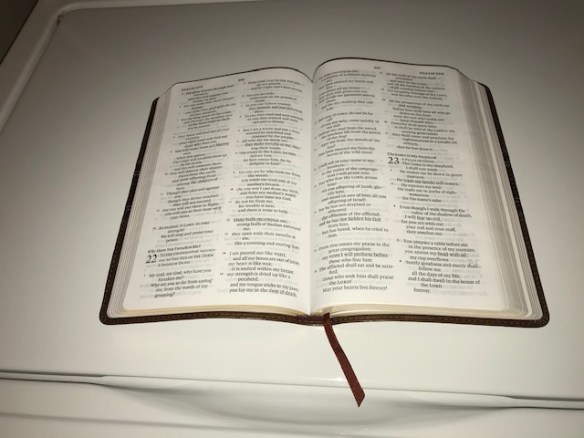
This third photo is staged because this has not been my practice. It’s in memory of a neighbor from decades ago who had three little stairstep children in a row, all under the age of five. Her washing machine was in her kitchen, and she left her Bible on top of it to get a few minutes reading in as she could.

As I wrote in Encouragement for Mothers of Small Children, the time when my children were little was the most challenging to try to carve out any quiet time, much less to read the Bible in a coherent manner. Yet I suffered spiritually when I didn’t read. It’s important to both read and study the Bible, but some seasons, it’s hard to do either. When I truly only had a few moments, God met with me and fed my soul in that time.

Moses met with God on a mountain. Daniel met with God in captivity. David met with God in pasture while shepherding, in a cave while hiding from enemies, and in a palace. Jonah met with God in the belly of a whale. We can meet with God any time, anywhere.

How about you? What does your real life devotional time look like? How has it changed through the different seasons of life? What was your most unusual devotional setting?

(Sharing with Purposeful Faith, Tell His Story, InstaEncouragement, Anchored Abode,
Recharge Wednesday, Worth Beyond Rubies, Let’s Have Coffee, Heart Encouragement,
Faith on Fire, Grace and Truth, Inspire Me Monday, Global Blogging, Senior Salon,
Hearth and Home)

How do you know if God is displeased with you?

How to know if God is displeased with youAs I skimmed through Twitter recently, I saw a tweet from someone I didn’t know who asked, “How do you know if God is displeased with you?”

I didn’t have time to read all 60+ responses, but I scrolled through several. I was astonished to see that no one appealed to the Bible or prayer.

One mentioned a sinking feeling in the pit of their stomach. Another cited a vague uneasiness. One said that everything going wrong in life was a sure sign of God’s displeasure. But those can all be caused by any number of things.

God uses our consciences to convict us sometimes, but conscience has to be trained. Some people have no conscience about cannibalism or genocide. Others’ consciences trouble them over every little thing.

So how do you know if God is displeased with you?

Ask Him. “Search me, O God, and know my heart! Try me and know my thoughts! And see if there be any grievous way in me, and lead me in the way everlasting!” (Psalm 139:23-24).

Read His Word. There He tells us what’s right and wrong. Of course, we have to be careful to read in context, consider who is saying what to whom, and interpret it with some common sense principles.

Paul says, “Yet if it had not been for the law, I would not have known sin. For I would not have known what it is to covet if the law had not said, “You shall not covet” (Romans 7:7b). The Bible gives us the ten commandments (Exodus 20), a list of things God hates (Proverbs 6:16-19), lists of things to put off and put on (Ephesians 4:17-32), the difference between the works of the flesh and the fruit of the Spirit (Galatians 5:16-26), as well as other instructions.

The Bible doesn’t just tell us what not to do: it also tells us what we should be doing. So we could also displease God by failing to do good in some area.

The more we read the Bible and grow in the Lord, the more we grow in our understanding. For instance, we might read early on that we shouldn’t steal. That seems pretty straightforward: don’t take anything that belongs to someone else. Then later we realize that if we goof off on the job, we’re stealing from our boss the work he has paid us for. Then even later we come across Ephesians 4:28: “Let the thief no longer steal, but rather let him labor, doing honest work with his own hands, so that he may have something to share with anyone in need.” We realize that not stealing isn’t an end in itself: we need to replace theft with honest work not only to provide for ourselves, but to help others.

Besides general right and wrong, the Bible shares some specific things that God is pleased with:

Faith. “And without faith it is impossible to please him, for whoever would draw near to God must believe that he exists and that he rewards those who seek him” Hebrews 11:6).

Fear (reverence): “The Lord takes pleasure in those who fear him, in those who hope in his steadfast love” (Psalm 147:11).

Spiritual sacrifices: “Through him then let us continually offer up a sacrifice of praise to God, that is, the fruit of lips that acknowledge his name. Do not neglect to do good and to share what you have, for such sacrifices are pleasing to God” (Hebrews 13:15-16).

Obedience: “Has the Lord as great delight in burnt offerings and sacrifices, as in obeying the voice of the Lord? Behold, to obey is better than sacrifice, and to listen than the fat of rams” (1 Samuel 15:22). Wait a minute—I just mentioned sacrifices were pleasing to God, and now I am saying they are not? The sacrifices in this verse were part of the OT system of worship. Too often people fell into religious ritual without their hearts being in it (we still do that, though our rituals are different). God was saying through Samuel that it doesn’t do any good to perform religious rites without obeying Him. That’s the height of hypocrisy.  But the spiritual sacrifices that please God, mentioned above in Hebrews, were ministry to others at cost to ourselves from a heart of love and worship of God.

Jesus: “This is my beloved Son, with whom I am well pleased; listen to him” (Matthew 17:5). “And he who sent me is with me. He has not left me alone, for I always do the things that are pleasing to him” (John 8:29). Jesus is more than just an example, but God does want us to listen to Him and live like Him. “Therefore be imitators of God, as beloved children. And walk in love, as Christ loved us and gave himself up for us, a fragrant offering and sacrifice to God” (Ephesians 5:1-2).

One problem with trying to please God is that we can’t in our flesh.

For those who live according to the flesh set their minds on the things of the flesh, but those who live according to the Spirit set their minds on the things of the Spirit. For to set the mind on the flesh is death, but to set the mind on the Spirit is life and peace. For the mind that is set on the flesh is hostile to God, for it does not submit to God’s law; indeed, it cannot. Those who are in the flesh cannot please God (Romans 8:5-8).

That’s dire. What’s the remedy?

You, however, are not in the flesh but in the Spirit, if in fact the Spirit of God dwells in you. Anyone who does not have the Spirit of Christ does not belong to him. But if Christ is in you, although the body is dead because of sin, the Spirit is life because of righteousness. If the Spirit of him who raised Jesus from the dead dwells in you, he who raised Christ Jesus from the dead will also give life to your mortal bodies through his Spirit who dwells in you (Romans 8:9-11).

How does that happen? When we believe on Jesus Christ as Lord and Savior and turn from our sin and trusting in ourselves or anything else, Jesus and the Holy Spirit live within us. Jesus lived a perfect life of righteousness, which we could never do. He took our sins on Himself on the cross, so that when we repent and believe on Him, He puts His righteousness on our account.  We could never be good enough on our own to please God. Even if we could from this moment forward, we have a past of not pleasing God. The only way He can be completely pleased with us is through Christ.

We can be saved in a moment. But then it takes a lifetime to grow in grace and Christlikeness. One former pastor used to say that “work out your own salvation with fear and trembling” (Philippians 2:12) meant not to work for salvation, but to work it out like a math problem: take all those lofty truths and principles and work them into your everyday life.

But we do stumble and fail. When we believe in Christ, God becomes our Father.

As a father shows compassion to his children, so the Lord shows compassion to those who fear him. For he knows our frame; he remembers that we are dust” (Psalm 103:13-14).

Over and over in the Bible, God is described as longsuffering, slow to anger, merciful, ready to forgive, ready to help. If our heart is with Him and our desire is to walk with Him and do His will, we don’t need to walk around with a vague feeling of spiritual uneasiness. As a loving Father, He will show us right from wrong, forgive us when we fail, and enable us to live for Him.

But some walk in blatant disregard of the Bible yet think God is well-pleased with them. Or they think they know who God is and what the Bible says, but they’re misinformed. We shouldn’t be presumptuous. How we need to read His Word, come to Him with a humble spirit, and seek His grace to live for Him.

Early in my Christian walk, I probably had more of that vague uneasiness that something was wrong spiritually. A former pastor used to say that when we come to God and ask Him to search our hearts, then we wait and deal with whatever He brings to mind. He likened it to opening a box, dealing with what’s there, opening another box, until there are no more boxes—nothing else that God brings to mind. I still do that sometimes. But now, after 45 years of reading His Word and walking with Him, usually conviction is immediate. Often, right after I do or think something wrong, God will remind me of what His Word says about what I just did or thought. Then I try to immediately ask His forgiveness. But it’s still good to ask Him to search our hearts in case we’re overlooking something.

Sometimes it takes a while to sort through whether we’re feeling false guilt over a man-made principle that goes beyond the Bible. But the more we read His Word and walk with Him, the more familiar we’ll be with what pleases and displeases Him.

 Now may the God of peace who brought again from the dead our Lord Jesus, the great shepherd of the sheep, by the blood of the eternal covenant, equip you with everything good that you may do his will, working in us that which is pleasing in his sight, through Jesus Christ, to whom be glory forever and ever. Amen (Hebrews 13:20-21).

(Sharing with Inspire Me Monday, Global Blogging, Senior Salon, Hearth and Soul,
Purposeful Faith, Tell His Story, InstaEncouragement, Anchored Abode,
Recharge Wednesday, Worth Beyond Rubies, Share a Link Wednesday,
Let’s Have Coffee, Heart Encouragement, Faith on Fire,
Grace and Truth,
Blogger Voices Network)


Come, let us return to the Lord

IMG_2191?ver2God pictures His relationship to His wayward people in the prophet Hosea’s relationship to his adulterous wife, Gomer. Gomer didn’t just drift away, nor was she seduced unaware. Chapter 2:5-7 says she pursued other lovers. She had children by men other than her husband. She thought they would give her “my bread and my water, my wool and my flax, my oil and my drink” (2:5).
However, God declared, “she did not know that it was I who gave her the grain, the wine, and the oil, and who lavished on her silver and gold, which they used for Baal” (2:8). She not only didn’t acknowledge God, didn’t even thank Him for His gifts, but she used His gifts to worship a false god.

Later God likened Israel as a child whom He loved and taught to walk, yet “they did not know that I healed them” (11:3).

The Bible says God “richly provides us with everything to enjoy.” (1 Timothy 6:17). “He makes his sun rise on the evil and on the good, and sends rain on the just and on the unjust” (Matthew 5:45). “The God who made the world and everything in it, being Lord of heaven and earth, does not live in temples made by man, nor is he served by human hands, as though he needed anything, since he himself gives to all mankind life and breath and everything…In him we live and move and have our being” Acts 17:24-28).

God gives us everything we have, even our very breath. Do we acknowledge Him? Thank Him? Or use His gifts in wrong pursuits?

Warren Wiersbe says, “The essence of idolatry is enjoying the gifts but not honoring the Giver” (Be Amazed (Minor Prophets): Restoring an Attitude of Wonder and Worship).

Romans tells us:

For his invisible attributes, namely, his eternal power and divine nature, have been clearly perceived, ever since the creation of the world, in the things that have been made. So they are without excuse. For although they knew God, they did not honor him as God or give thanks to him, but they became futile in their thinking, and their foolish hearts were darkened (Romans 1:20-21).

The chapter goes on to say that since people persisted in living without acknowledging God,

  • “Therefore God gave them up in the lusts of their hearts to impurity” (1:24).
  • “For this reason God gave them up to dishonorable passions” (1:26).
  • “Since they did not see fit to acknowledge God, God gave them up to a debased mind to do what ought not to be done” (1:28).

Wiersbe says, “One of the greatest judgments God can inflict on any people is to let them have their own way.”

Fortunately, God doesn’t give people up easily. Further in the Acts passage that we looked at earlier, Paul says God  “made from one man every nation of mankind to live on all the face of the earth, having determined allotted periods and the boundaries of their dwelling place, that they should seek God, and perhaps feel their way toward him and find him. Yet he is actually not far from each one of us” (Acts 17:26-27).

Back in Hosea, God disciplines His people and then shares these “I will” promises:

  • “I will allure her, and bring her into the wilderness, and speak tenderly to her” (2:14).
  • “I will give her her vineyards and make the Valley of Achor a door of hope” (2:15).
  • “For I will remove the names of the Baals from her mouth, and they shall be remembered by name no more” (2:17).
  • “I will make for them a covenant on that day” (2:18a)
  • “I will abolish the bow, the sword, and war from the land, and I will make you lie down in safety” (2:18b).
  • “I will betroth you to me forever. I will betroth you to me in righteousness and in justice, in steadfast love and in mercy. I will betroth you to me in faithfulness. And you shall know the Lord” (2:19-20).
  • “I will answer” (2:21).
  • “I will sow her for myself in the land” (2:22).
  • “I will have mercy” (2:23).

God draws us with “cords of kindness, with the bands of love” (Hosea 11:4). He seeks out the lost sheep.

From Wiersbe’s book one more time:

The key word is return (Hos. 3: 5), a word that’s used twenty-two times in Hosea’s prophecy. When Israel repents and returns to the Lord, then the Lord will return to bless Israel (2:7–8). God has returned to His place and left Israel to herself (5:15) until she seeks Him and says, “Come, and let us return to the Lord” (6:1 NKJV).

Sometimes the return we need to make is a simple confession of loss of focus, lack of acknowledgement, thankfulness, or love. Sometimes it’s a full-blown 180-degree change of direction.

That’s the essence of repentance: turning from our way to God’s way (for more on repentance, see here). That happens at salvation, but it also needs to happen throughout our Christian walk. As we learn more of His will and Word, we continually adjust ourselves to them as we walk with Him.

May we return to His gracious love quickly and wholeheartedly.

(Sharing with Inspire Me Monday, Global Blogging, Senior Salon, Hearth and Soul,
Purposeful Faith, Tell His Story, InstaEncouragement, Anchored Abode,
Recharge Wednesday, Worth Beyond Rubies, Share a Link Wednesday,
Let’s Have Coffee, Instant Encouragement, Grace and Truth,
Faith on Fire, Blogger Voices Network)

Help for the Fainthearted

Help for the fainthearted, encouragement to endureThere are at least 25 fillers for the saying “____________ is not for the faint of heart.”

Add pandemics and quarantine to the list.

By this time, most of us are tired of it all. The concerns about whether we or our loved ones will get COVID-19, others in public not taking precautions, what the best next steps should be, finding supplies, canceled plans, not being able to go places or see loved ones or friends in person—it all takes a toll.

In Warren Weirsbe’s commentary on Galatians, Be Free, I was especially taken with a section about not “fainting” based on Galatians 6:9. That led me to do a mini word study on “faint” and “fainting.” What I found encouraged me, so I thought I’d share it with you.*

Here are some things that might might help that weary, exhausted, tired out—faint— feeling.

Nourishment. We feel faint physically when we don’t get enough food or the right kinds of food. We’re faint spiritually when we don’t feed our souls. We need spiritual nourishment to stand strong.

Hungry and thirsty, their soul fainted within them. Then they cried to the Lord in their trouble, and he delivered them from their distress…he satisfies the longing soul, and the hungry soul he fills with good things. Psalm 107:5-6, 9

Man shall not live by bread alone, but by every word that comes from the mouth of God. Matthew 4:4

I have treasured the words of his mouth more than my portion of food. Job 23:12

Companionship. We often face trouble better with support. But it’s hard when we’re alone or even when we just feel alone. Though God often graciously gives human companionship, there are times in life when we find His presence is all we need.

When my spirit faints within me, you know my way! In the path where I walk they have hidden a trap for me. Look to the right and see: there is none who takes notice of me; no refuge remains to me; no one cares for my soul. I cry to you, O Lord; I say, “You are my refuge, my portion in the land of the living.” Psalm 142:3-5

Remembering God’s past dealings. Many of David’s psalms were written when someone was after him. There’s nothing like an active enemy to make you feel drained and weary. We can feel the same way with this virus. When it first began, I felt like I was taking my life in my hands every time I went out.

For the enemy has pursued my soul; he has crushed my life to the ground; he has made me sit in darkness like those long dead. Therefore my spirit faints within me; my heart within me is appalled. Psalm 143:3-4

David’s response:

I remember the days of old; I meditate on all that you have done; I ponder the work of your hands. I stretch out my hands to you; my soul thirsts for you like a parched land.

Answer me quickly, O Lord! My spirit fails! Hide not your face from me, lest I be like those who go down to the pit. Let me hear in the morning of your steadfast love, for in you I trust. Make me know the way I should go, for to you I lift up my soul.Deliver me from my enemies, O Lord! I have fled to you for refuge. Psalm 143:5-9

Confession and repentance. Any number of illnesses can make us feel weak and faint. In Isaiah, God likened his sinful, rebellious people to someone with a fatal illness.

They have forsaken the Lord, they have despised the Holy One of Israel, they are utterly estranged. Why will you still be struck down? Why will you continue to rebel? The whole head is sick, and the whole heart faint. From the sole of the foot even to the head, there is no soundness in it, but bruises and sores and raw wounds; they are not pressed out or bound up or softened with oil. Isaiah 1:4a-6

The remedy:

Wash yourselves; make yourselves clean; remove the evil of your deeds from before my eyes; cease to do evil, learn to do good; seek justice, correct oppression; bring justice to the fatherless, plead the widow’s cause.

Come now, let us reason together, says the Lord: though your sins are like scarlet, they shall be as white as snow; though they are red like crimson, they shall become like wool. If you are willing and obedient, you shall eat the good of the land; but if you refuse and rebel,  you shall be eaten by the sword; for the mouth of the Lord has spoken. Isaiah 1:16-20

Right motives*

People in Malachi’s time tried to cut corners on God’s requirements (Malachi 1:6-14) and called it all a weariness (v. 13). The church in Ephesus was commended by God for their work, their doctrinal stand, their endurance (Revelation 2:1-7). But, God said:

But I have this against you, that you have abandoned the love you had at first. Remember therefore from where you have fallen; repent, and do the works you did at first. Revelation 2:4-5

All through the Bible we’re called to love God with our heart soul, mind, and strength, to love Him above all else. When that love seems to wane, we should “go back to our first love”: remind ourselves “God shows his love for us in that while we were still sinners, Christ died for us” (Romans 5:8). He has shown His love for us by saving us, drawing us to Himself, providing for us, answering prayer. He declares His love for us over and over.

The Lord appeared to him from far away. I have loved you with an everlasting love;    therefore I have continued my faithfulness to you. Jeremiah 31:3

But God, being rich in mercy, because of the great love with which he loved us, even when we were dead in our trespasses, made us alive together with Christ—by grace you have been saved—and raised us up with him and seated us with him in the heavenly places in Christ Jesus. Ephesians 2:4-6

Let His love for us rekindle our love for Him.

The Thessalonians had the right combination with their “work of faith and labor of love and steadfastness of hope in our Lord Jesus Christ” (1 Thessalonians 1:3).

Persistent, humble prayer

And he spake a parable unto them to this end, that men ought always to pray, and not to faint. Luke 18:1 (ESV says “lose heart”).

Then Jesus told a parable about a widow who kept coming to an unjust judge to plead her case until the judge finally helped her. God is just and gracious: how much more will He answers His children’s prayers?

Then Jesus told a parable about a Pharisee who prayed boastfully, trusting in his good works, and a tax collector who had none:

 But the tax collector, standing far off, would not even lift up his eyes to heaven, but beat his breast, saying, ‘God, be merciful to me, a sinner!’ I tell you, this man went down to his house justified, rather than the other. For everyone who exalts himself will be humbled, but the one who humbles himself will be exalted. Luke 18:9-14

Centuries earlier, Jonah said in repentance:

When my life was fainting away, I remembered the Lord, and my prayer came to you, into your holy temple. Jonah 2:7

Hope

We get discouraged when we look at circumstances. But we can look ahead in hope:

I had fainted, unless I had believed to see the goodness of the Lord in the land of the living. Wait on the Lord: be of good courage, and he shall strengthen thine heart: wait, I say, on the Lord. Psalm 27:14-15, KJV

And let us not be weary in well doing: for in due season we shall reap, if we faint not. Galatians 6:9

Inward renewal

Paul says:

For which cause we faint not; but though our outward man perish, yet the inward man is renewed day by day. For our light affliction, which is but for a moment, worketh for us a far more exceeding and eternal weight of glory 2 Corinthians 4:16-17, KJV

How is our inward self renewed?

Looking to Jesus

Therefore, since we are surrounded by so great a cloud of witnesses, let us also lay aside every weight, and sin which clings so closely, and let us run with endurance the race that is set before us, looking to Jesus, the founder and perfecter of our faith, who for the joy that was set before him endured the cross, despising the shame, and is seated at the right hand of the throne of God. Consider him who endured from sinners such hostility against himself, so that you may not grow weary or fainthearted. Hebrews 12:1-3

The more we behold His glory, the more we’re changed to be like Him:

And we all, with unveiled face, beholding the glory of the Lord, are being transformed into the same image from one degree of glory to another. For this comes from the Lord who is the Spirit. 2 Corinthians 3:18

Waiting upon the Lord

Have you not known? Have you not heard? The Lord is the everlasting God, the Creator of the ends of the earth. He does not faint or grow weary; his understanding is unsearchable. He gives power to the faint, and to him who has no might he increases strength. Even youths shall faint and be weary, and young men shall fall exhausted; but they who wait for the Lord shall renew their strength; they shall mount up with wings like eagles; they shall run and not be weary; they shall walk and not faint. Isaiah 40:28-31

May these truths renew your spirit today.

_____

*The definition for one Greek word translated “faint” is “To weaken, relax, exhaust; to have one’s strength relaxed, to be enfeebled through exhaustion, to grow weak, grow weary, be tired out; to despond, become faint hearted.” Other Greek and Hebrew words I looked up that the KJV or ESV translate as “faint” say similar things. Sometimes those words are translated “weary,” “longing,” or “give up.”

*Thanks to Wiersbe for the thought about weariness that stems from lack of love (p. 147 in the Kindle version of Be Free.

* Verses not labeled are from the ESV.

(Sharing with Inspire Me Monday, Global Blogging, Senior Salon, Hearth and Home,
Purposeful Faith, Tell His Story, InstaEncouragement, Anchored Abode,
Recharge Wednesday, Worth Beyond Rubies, Share a Link Wednesday,
Welcome Heart, Heart Encouragement, Grace and Truth, Faith on Fire,
Blogger Voices Network)

Stray Thoughts from Isolation

coping with pandemicNormally, I have a more focused, devotional or Bible study type of post on Mondays. Today I just want to share some “stray thoughts” about coping during this pandemic.

When we were first told to stay home to avoid spreading the coronavirus, many people felt that at least they’d have time to get things done around the house—home repairs, decorating, writing, or whatever.

How often I have wished for a cleared schedule in order to get more done. But, somehow, I wasn’t getting much done besides the bare everyday tasks.

Over the weeks I’ve seen people mention a strange lethargy, malaise, ennui, brain fog. Many of us are having trouble getting our minds in gear for long or for anything deep.

I think this state of mind is probably due to several things. Most of us have never lived through anything like this current pandemic. When I first heard of it, I had to battle panic regularly, especially since my husband and I are in at-risk groups. I was concerned about the virus itself, finding supplies, the economy in general, my husband’s and children’s jobs, and so much more. God ministered to me through His Word, and I remembered I needed to feed my soul truth. God is the same, and He has promised to be with us and meet our needs. I listen to uplifting music filled with truth. I remind myself, too, that if I worry and fret, I’m wasting that energy if nothing happens and doubling my misery if it does.

Then there was just a general unease due to normal routines being disrupted, sorrow over disappointments and canceled plans. All of those concerns above still pop up, but now there’s a weary wondering how long this will last.

At first it helped to remind myself that all of this isn’t as bad as it could be, except for those who have the virus, have loved ones with it, or have lost weeks of work and pay. For too many, this virus and its effects have been devastating. My heart goes out to those who have been battling the virus firsthand.

But for many of us, I told myself, this is not as bad as the Spanish flu epidemic, the black plague, the Depression, the Jews packed like sardines in small spaces hiding during WWII. We have safe places to stay and plenty of means to keep busy and entertain ourselves. It does help to focus on the positives even as we acknowledge the negatives and to shift perspective, as in safe at home rather than stuck at home.

But just because a problem isn’t as big as others doesn’t mean it’s not still a problem.

I’ve had a broken little toe before. Sure, it wasn’t as bad as a crushed ankle or amputation. But it still hurt severely and needed time and care to recover from.

So, whatever amount of strain or unease we’re going through, it still takes a toll. I think some part of our brains are still taken up with the pandemic and all its concerns even when we’re not actively thinking about them.

It’s okay to lament, to say it hurts. Ecclesiastes 3 talks about “a time to weep, and a time to laugh; a time to mourn, and a time to dance.” The psalms are full of people pouring out their hearts to God during trouble, then reminding themselves of God’s love and character. Most of them come to a place of peace even though the circumstances have not yet changed.

In our childbirth class for our first pregnancy, the instructor had a couple from a previous class who had their baby come back and tell of their experience. The new mother said said if she began to think during labor, “What if I have to do this for many more hours? Or days,” she would feel defeated and tired. But if she focused on just one contraction at a time, she had the energy and strength to get through it. That has stuck with me ever since. If we focus on just riding out one wave at a time, getting through just this day or this moment, eventually we’ll be done.

I still feel better if I accomplish something useful rather than fall into YouTube rabbit holes (though I’ve done a bit of that). I relax in the evenings, but I try to get needed things done during the work day. So sometimes I’ve pushed through that moving-through-molasses feeling even when I don’t feel like it, even if I don’t get as much done as usual. I’ve thought of a few “mindless” tasks I’d love to get to, like cleaning out some files, pulling out clothes I want to give away, etc. I’m thankful for all sorts of offerings online, from free courses to museum tours to operas, to various artists giving free mini-concerts or presentations online. I haven’t had as much time to engage in that kind of thing as I would like. But I’m glad they are available, and I hope to get to more of them.

And I think, for many of us, we have to remember our emotions may be up and down. The general anxiety is less for me than it was at first. I had acknowledged and processed the sadness of canceling my oldest son’s flight here and celebrating Easter and my grandson’s birthday virtually instead of in person. We’d had a good, if subdued, Easter day. But for some reason, that night I got suddenly weepy. I didn’t tell my husband, because I didn’t want to have to explain it when I couldn’t. I guess that undercurrent of emotion just needed a release. And that’s ok. The next day, I was fine. My little grandson had a similar experience. His family has made it a point to play outside a lot since they can’t go to his usual favorite places, and they’ve had many happy days. Then he had a couple of emotional ones. I think overall he’s doing okay.

It also helps not to compare. I have a friend who works full time from home yet gets all kinds of house projects done. I can admire her energy and zest without shaming myself for not doing the same.

So, for me, I’m trying to maintain balance. Keeping up with current news, but not so much that it keeps me stirred up. Acknowledging that my emotions are a little tender, but not giving way to panic. Giving myself grace if I am not accomplishing a much as I’d like to, but not becoming a total couch potato. Continuing to feed on His Word. Bringing concerns before the Lord for wisdom for the future. Reminding myself that He instructed us to pray for daily needs. Taking one day at a time. Waiting in hope.

How are you holding up? What things are helping you cope through this pandemic?

(Sharing with Inspire Me Monday, Global Blogging, Senior Salon, Hearth and Soul,
Tell His Story, Happy Now, InstaEncouragement, Recharge Wednesday,
Worth Beyond Rubies, Anchored Abode, Share a Link Wednesday,
Heart Encouragement, Grace and Truth, Blogger Voices Network,
Faith on Fire)


Waiting in Hope

IMG_2165?ver2

Bible people spent a lot of time waiting. Some waited well. Others, not so well.

Abraham waited 25 years between the promise that God would make of him a great nation (Genesis 12:1-3) and the arrival of the son of that promise, Isaac. Though he believed God despite the advanced ages of himself and his wife, he sometimes tried to manipulate the circumstances and “help God.” He suggested his servant could become his heir. Then he had a son by another woman. But this child was not the son of promise.

Moses “supposed that his brothers would understand that God was giving them salvation by his hand” (Acts 7:25) when he defended one of them by killing his Egyptian attacker. Instead, Moses ended up fleeing for his life to Midian. He apparently put thoughts of his people behind him. Some 40 years later, God had to have a long conversation with Moses to convince him of God’s call and enablement. (Exodus 3).

The children of Israel waited over 400 years before they were delivered from captivity in Egypt. The people welcomed news of their deliverer at first (Exodus 4:29-30), but complained through much of their way and even wanted to go back when things got hard.

David humbly waited from the time he was anointed king to the time he could actually claim his kingdom. He showed respect to God’s anointed and never marched into the throne room declaring his “rights.”

Mary’s waiting was interrupted. While dreaming and planning of her upcoming wedding to her betrothed, she received the most startling news that she was to be the mother of the Messiah. Her response: “Behold, I am the servant of the Lord; let it be to me according to your word,” (Luke 1:38), even though she didn’t know how her fiance or others would respond or what it would cost her.

Simeon “was righteous and devout, waiting for the consolation of Israel, and the Holy Spirit was upon him,” and Anna “began to give thanks to God and to speak of him to all who were waiting for the redemption of Jerusalem” (Luke 2:25-38). These were blessed to see and recognize the Son of God in His infancy.

The disciples waited three days between the crucifixion and resurrection. But they had forgotten or never quite understood the promise that Jesus would rise again in three days. Imagine what sorrow, despair, regret they felt.

Hebrews 11 mentions many who “died in faith, not having received the things promised, but having seen them and greeted them from afar.” Even though they didn’t receive their answers in their lifetimes, they looked ahead to that “better country, that is, a heavenly one” (Hebrews 11:13-16).

So there are right and wrong ways to wait. We can manipulate our own answers or go back on, or forget, God’s promises. Or we can wait humbly and faithfully even when circumstances seem to go against everything we hope for.

Who knows how long we’ll have to wait in isolation before covid-19 is conquered. There are plenty of things to do while we wait.

Many of the psalms give us encouragement while waiting. Here are just a few:

Indeed, none who wait for you shall be put to shame; they shall be ashamed who are wantonly treacherous. Make me to know your ways, O Lord; teach me your paths. Lead me in your truth and teach me, for you are the God of my salvation; for you I wait all the day long …

My eyes are ever toward the Lord, for he will pluck my feet out of the net.Turn to me and be gracious to me, for I am lonely and afflicted. The troubles of my heart are enlarged; bring me out of my distresses. Consider my affliction and my trouble, and forgive all my sins.

Oh, guard my soul, and deliver me! Let me not be put to shame, for I take refuge in you. May integrity and uprightness preserve me, for I wait for you. (Psalm 25:3-5, 15-18, 20-21).

I believe that I shall look upon the goodness of the Lord in the land of the living! Wait for the Lord; be strong, and let your heart take courage; wait for the Lord! (Psalm 27:13-14).

From Lamentations 3:24-26:

“The Lord is my portion,” says my soul, ‘therefore I will hope in him.” The Lord is good to those who wait for him, to the soul who seeks him. It is good that one should wait quietly for the salvation of the Lord.

Paul shares in Romans 8:18-19, 22-25:

For I consider that the sufferings of this present time are not worth comparing with the glory that is to be revealed to us. For the creation waits with eager longing for the revealing of the sons of God ... or we know that the whole creation has been groaning together in the pains of childbirth until now. And not only the creation, but we ourselves, who have the firstfruits of the Spirit, groan inwardly as we wait eagerly for adoption as sons, the redemption of our bodies. For in this hope we were saved. Now hope that is seen is not hope. For who hopes for what he sees? But if we hope for what we do not see, we wait for it with patience.

Other passages give us instruction:

… Be like men who are waiting for their master to come home from the wedding feast, so that they may open the door to him at once when he comes and knocks. Blessed are those servants whom the master finds awake when he comes (Luke 12:36-37a)

Therefore, beloved, since you are waiting for these, be diligent to be found by him without spot or blemish, and at peace (2 Peter 3: 14)

I hope our waiting in isolation is not long. But meanwhile, “I wait for the Lord, my soul waits, and in his word I hope; my soul waits for the Lord more than watchmen for the morning, more than watchmen for the morning (Psalm 130:5-6).

(Sharing with Inspire Me Monday, Global Blogging, Senior Salon, Hearth and Soul,
Purposeful Faith, Tell His Story, Happy Now, InstaEncouragement,
Recharge Wednesday, Worth Beyond Rubies, Anchored Abode,
Let’s Have Coffee, Heart Encouragement, Faith on Fire,
Grace and Truth, Blogger Voices Network.


Songs to Celebrate the Resurrection

songs to celebrate the resurrectionI wrote a post a few years ago about “The Perfect Christmas” and how disappointed we are when our celebration doesn’t meet whatever criteria makes it perfect in our estimation. I compared that to the first Christmas, which was so different from ours: a tired couple, a crowded city, no decorations, no Christmas cookies, unexpected unusual visitors. Yet that first Christmas produced our Savior.

I feel the same about Easter this year. For most of us, this Easter is a stripped-down version of our usual celebrations. What’s usually one of the most special services of the year will be on Zoom or YouTube. We probably won’t wear new clothes for it. We’ll have a good dinner and Easter baskets, but without extended family.

Yet, as As Gretchen Ronnevik tweeted, “Maybe huddling together as a small group of disciples in a home, wondering what God is doing, and what will happen next, and where do we go from here… is the most Easter-y of all Easter things to do.” I don’t think there’s anything wrong with the way we celebrate Easter now, but they didn’t have all those things the first Easter. Yet that Easter changed the world and the ones who first heard and told of it. Maybe our circumstances this year will help us refocus our attention on the reality, the miracle, the joy of it all.

Music is one my my main ways of feeding my soul truth. I shared some of my favorite songs about Christ’s death for us a few days ago, and I wanted to share some of my favorite Easter songs today.

For decades now, The Majesty and Glory of the Resurrection CD by Tom Fettke and Billy Ray Hearn has been has been my Easter morning breakfast-making companion. I love using that time to think about what the day means and to prepare my heart for the service. I like the mix of old and new and the majestic way they handle the music. The songs cover the death of Christ as well the big picture of Who God is. I think if you click here, the whole album automatically plays. But the individual tracks are on YouTube, and the album is available on iTunes.

This is one of my favorites from that album, especially “The Strife Is Over” and the second “I Know That My Redeemer Lives.”

This is a medley of four different hymns:

I never heard “The Easter Song” by Annie Herring until I found it on the end of the above medley, and I was struck by the pure joy of it. I’m glad the Eversons recorded the whole thing:

“Weep No More,” to the tune of the folk song, “Down By the Sally Gardens,” is on the Pettit’s CD Higher Ground:

“The One Who Lives Again is a new one by Matt Collier and Matt Taylor of the Wilds Christian Camp (words here):

He Is Risen is also on the Wilds Camp’s “Risen” CD, but I can’t find who wrote it.

“Christ Is Risen, He Is Risen Indeed” by Keith & Kristyn Getty:

Many songs cover both the crucifixion and resurrection. “Mercy Tree,” mentioned last time, is one.

And, of course, there are multitudes more.

I hope you can celebrate the resurrection of Jesus and all it means whether alone in your kitchen, with your family, and/or virtually with your church.

Happy Easter! He is risen!

(Sharing with Inspire Me Monday, Global Blogging, Senior Salon, Hearth and Soul,
Happy Now, Tell His Story)