Why Study Doctrine?

Doctrine can seem like a cold, dry concept, something stuffy theologians fuss over when they should be trying to reach others. We’re more excited by a group study on relationships or parenting or womanhood or just about anything rather than a doctrinal study. We don’t usually approach our time in the Bible or church rubbing our hands eagerly anticipating what doctrine we’ll learn about today. We’re usually looking for help, encouragement, affirmation. We want to feel something. But feelings don’t last. If I get a warm fuzzy spiritual feeling in my devotions, that can dissipate in seconds when someone crosses me or something goes wrong. Winsome sermons and books may inspire me for a short while, but unless there is meat to them, that inspiration won’t last.

But doctrine is vital. You can hardly read a NT epistle without coming across a mention of doctrine and warning against false doctrine. If we think of sound doctrine as a manifestation of God’s truth and character, we can in turn worship Him by knowing and sharing the doctrines of His Word.

A.W. Tozer once wrote that “there is scarcely an error in doctrine or a failure in applying Christian ethics that cannot be traced finally to imperfect and ignoble thoughts about God.”

So what are some advantages to studying right doctrine in the Bible?

Doctrine leads us to true worship. When we don’t worship God for Who He truly is, then we are worshipping a god of our own making, and that is idolatry. Now, of course, all of us are imperfect in our knowledge of Him and are, or should be, ever growing in Him, and He’ll correct our understanding along the way. But that is different from not knowing Him for Who He is due to neglect or misapplication of the Word.

Doctrine increases our intimacy with God. We can’t know Him aright apart from what He has revealed of Himself in His Word. As we learn more of Him, we love Him and worship Him more, and what seemed like “dry doctrine” then does become something that warms and thrills our hearts as the Holy Spirit brings that truth to mind.

Doctrine protects against error and therefore the wrong path. For example, years ago when cult leader David Koresh was in the news, I watched an interview with someone from his compound. I was shocked to hear her say that she was impressed that he knew his Bible so well. Nearly everything he brought from the Bible, he twisted. Knowing doctrine would have kept this person and others from being deceived by him and others like him.

Doctrine bolsters our faith and confidence in God.  Recently I was troubled by a question I had no answer for that cast doubts on God’s character. I still don’t have an answer for it, but I rested on the previously studied truth that He is good, righteous, kind, and merciful.

Doctrine meets our deepest needs at the most basic level. If I am feeling lonely, what most helps except the truth that God is present everywhere, even with me? If I am afraid, what helps most but meditating on God’s power? When a trial comes and people feel forsaken, what most comforts but the precious truth that God will never forsake us? If I am feeling ashamed, sinful, and unworthy, my only help is turning to the only One who can wash away my sin and remind me that I am in Him and beloved by Him.

Doctrine is stabilizing. “So that we may no longer be children, tossed to and fro by the waves and carried about by every wind of doctrine, by human cunning, by craftiness in deceitful schemes” (Ephesians 4:14, ESV). I’ve known women and read women who do just this, float around with whatever is popular with little discernment. 2 Timothy speaks of “silly women laden with sins, led away with divers lusts, Ever learning, and never able to come to the knowledge of the truth” who are “lead captive” by a whole host of wrongdoers in the “perilous last days” (2 Timothy 3:1-7, KJV). By contrast, Titus 2 exhorts us to “speak thou the things which become sound doctrine” (v. 1, KJV).

Doctrine determines deeds. Our beliefs affect our behavior. When a lie seems the only way out of a tough situation, what keeps us from it but the knowledge that it will displease a God whose essence is truth? Even the Titus 2 admonition to older men and women is couched in the context of sound doctrine.

Doctrine honors God. He is the one who determined what sound doctrine us. If we love Him we should want to know what He says and live accordingly. It’s so important to Him, He inspired John to write, “Everyone who goes on ahead and does not abide in the teaching of Christ, does not have God. Whoever abides in the teaching has both the Father and the Son. If anyone comes to you and does not bring this teaching, do not receive him into your house or give him any greeting, for whoever greets him takes part in his wicked works” (1 John 1:10, ESV).

Doctrine is not an end in itself. If it is, then it does become dry and stale. The point of doctrine isn’t to line up our beliefs in neat, orderly systems and leave them there. The point is to know God better, serve Him in the ways He desires, and minister His truth to others.

People concerned about right doctrine can seem pesky and picky, and, true, it’s too easy to be that way. We shouldn’t be nitpicky just to be so. But we should “Be diligent to present yourself approved to God as a workman who does not need to be ashamed, accurately handling the word of truth” (2 Timothy 2:15, NASB), and as kindly and gently as possible bring His truth to bear in our conversations and interactions. We have to remember to let our speech be always “with grace” (Col. 4:6) and to speak the truth in love (Eph. 4:15). We don’t need to “pounce” on every comment or reference another person might make, but graciously seek what the Lord might have us say. We also have to distinguish between clear doctrine and those areas where good people can differ or personal preferences.

II Corinthians 3:18: “But we all, with open face beholding as in a glass the glory of the Lord, are changed into the same image from glory to glory, even as by the Spirit of the Lord” (KJV). We “behold Him” through His Word. And, the more we behold Him, the more we are changed into His likeness.

Learning doctrine doesn’t necessarily mean digging up systematic theology books, though some might like to do so. In our everyday reading and Bible study, it means looking for the truth about God when we read. The Bible is so much more than moralistic stories (“Be like Joseph and Daniel; don’t be like Jonah and Judas”). Look at what God is doing in the passage, what we see of His character and wisdom in what He is doing.

So, don’t be dismayed by that word “doctrine.” II Timothy 4: 3-4 says, “For the time will come when they will not endure sound doctrine; but after their own lusts shall they heap to themselves teachers, having itching ears; And they shall turn away their ears from the truth, and shall be turned unto fables.” That is a warning to us not to turn away from sound doctrine, but also possibly an admission that sound doctrine needs to be “endured.” Learning doctrine may not always feel warm and fuzzy, but the Holy Spirit will use it in our lives in blessed ways.

(Sharing with Inspire Me Monday, Literary Musing Monday, Wise Woman, Tell His Story, Woman to Woman Word-filled Wednesday, Faith on Fire)


Book Review: A Place of Quiet Rest

Quiet RestThe subtitle of A Place of Quiet Rest by Nancy Leigh DeMoss (now Wolgemuth) is “Finding Intimacy With God Through a Daily Devotional Life,” and that sums up perfectly the aim and emphasis of the book.

“Devotions,” for those who might not be familiar with the term, is what we call spending time alone with God in the Bible and prayer. Some people use the terms “God and I time” or “quiet time” or other phrases as well.

In Nancy’s introduction she tells a bit of her own and her family’s history, especially her father’s example of making time to spend with God, her struggles, and finally her conclusion that:

I have come to believe with all my heart that this is something worth fighting for. I have come to understand that one of the reasons it is such a battle is that the Enemy of my soul knows if he can defeat me here, he will ultimately be able to defeat me in every other area of my spiritual life.

Satan hates God, and he works tirelessly to convince Christians that they can operate on their own, independently of God. If we concede the battle to him, he knows that we will end up defeated, frustrated, barren, and useless to God. Worse, we will end up doubting God, despairing of His goodness, in bondage to our flesh, resisting His will.

…I have come to see that “devotions” is not so much an obligation of the Christian life, as it is an incredible opportunity to know the God of the universe. He has issued to you and to me an invitation to draw near to Him, to walk right into the “Holy of Holies” to enter into an intimate love relationship with Him (p. 16).

She discusses the challenges of setting apart that time in a busy schedule, the examples from the Bible of those who drew near to God, the wrong motivations for having devotions, the inward and outward purposes of devotions, elements of a quiet time, preparing for it, the high value of the Word of God, different approaches to it, questions to ask of the text, journaling, resources, our responses to what we read, prayer, and the influence our time with the Lord will have on the rest of our lives. She quotes many Christians of past years and closes each chapter with tips for making the information personal as well as the testimony of another woman, some famous (Elisabeth Elliot, Joni Eareckson Tada), some not.

I have multitudes of places marked, but here are just a few quotes that especially stood out to me:

A carefully structured quiet time with the Lord is good, but a growing life of devotion to the Savior is more – much more – that “Do A, B, or C and you will know Him better” (p 9, forward by Joni Eareckson Tada).

Developing intimacy with the Lord Jesus requires a conscious, deliberate choice. It is a choice to spend time sitting at His feet and listening to His Word, even when there are other good things that are demanding our attention. It is a choice to put Him first, above all our other responsibilities and tasks (pp. 42-43).

“Your company means more to Me than your cooking. You are more important to me than anything you can do for me” (p. 43, from a paraphrase of what Jesus was trying to get across to Martha).

Setting aside time for devotional activity, in and of itself, does not necessarily make us any more spiritual. (The Pharisees were renowned for their “devotional habits,” but they were far from spiritual.) Neither is a quiet time some sort of good luck charm that gets God on our side, guarantees our day will go better, and keeps us from having problems. Daily devotions are not a way of bartering or negotiating with God (p. 52).

Keep in mind that it is not enough that we should just read the Word. The object is that the words that are printed on the page would become indelibly written on our hearts. God never intended that we should merely get onto His Word – His intent is that the Word should get into us.

I cannot set aside time for God sporadically, whenever I can squeeze Him into my schedule, and hope to enjoy a vital, growing friendship with Him. That isn’t possible in human relationships, and it is no more possible in our relationship with God (p. 92).

Don’t let yourself get hung up in the mechanics. The particular Bible reading and study methods that are most helpful to someone else may not be as useful to you. The important thing is to make sure that you are getting into the Word and that the Word is getting into you. Find out which methods work best for you, and use them (p. 185).

There was one teeny little area where I wasn’t sure I agreed with the author: when she discussed Jesus’ example of making time to spend alone with His Father, she used phrases like, “This is where He discovered the will of God for His life” (I would say He knew that before He came); “This is where He gained the resources to do battle against Satan”; “This is where He received grace to love the unloveable and power to do the impossible” (p. 29); “Jesus had compassion on the multitudes and gave of Himself sacrificially to minister to their needs. But He knew that He could not meet their needs if He did not draw upon His relationship with His Father” (p. 101). I believe that when Jesus was in a human body on earth, He was still fully God as well as fully man (which I know Nancy believes as well), and some of these things were inherent in His nature as God, so I am not sure that His spending time with His Father was as much of a filling up after being depleted like we would need. But I hadn’t quite considered it this way before, so I need to think about and study it more.

I especially appreciated the emphasis on seeking intimacy, a close relationship with God. Making our way through the Bible, learning truth, learning doctrine, memorizing verses, are all important, but need to be exercised under the overarching purpose of getting to know Him better and drawing closer to Him in our hearts, not as an end in themselves.

The book is highly readable and I think it would be good for both beginners who haven’t really established regular devotional habits yet as well as those who have been having time set apart with God for years.

Even though many of these truths and tips were familiar to me, and even though making time for Bible reading has, by God’s grace, been a settled thing for me for some time now, I still find books like this valuable. I do learn some new things, but they reinforce what I have come to believe over the years and inspire me to keep on.

(Sharing with Semicolon‘s Saturday Review of Books, Faith on Fire, Carole’s Books You Loved), and Literary Musing Monday)

Books you loved

lmml-button-2-6

Save

Save

Save

Save

Save

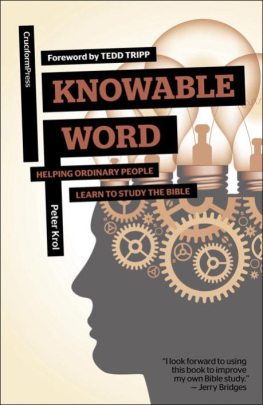
Book Review: Knowable Word

knowable-wordKnowable Word: Helping Ordinary People Learn to Study the Bible by Peter Krol lives up to its title. It begins with a section about why to study the Bible (to get to know the Person behind it). It concedes that Bible studies and commentaries and such are valuable in many ways, but promises to give the tools for the reader to mine from the Bible on their own and to get to know God better.

Sometimes…we seek a mountaintop experience where we can behold His glory and see Him face to face. We want to hear His voice speaking with clarity and power. We long to be wowed from on high. The apostle Peter had such an experience with Jesus, and he concluded that you and I don’t need to have to same experience.

“We were eyewitnesses of his majesty. For when he received honor and glory from God the Father, and the voice was borne to him by the Majestic Glory, ‘This is my beloved Son, with whom I am well pleased,’ we ourselves heard this very voice borne from heaven, for we were with him on the holy mountain. And we have the prophetic word more fully confirmed, to which you will do well to pay attention as to a lamp shining in a dark place.” (2 Peter 1:16b-19a) (pp. 13-14).

After a brief discussion of a few off-base approaches to Bible study, Krol dives into the method he advocates and teaches, which is not new but today goes by the acronym OIA:

  1. Observation – what does it say?
  2. Interpretation – what does it mean?
  3. Application – how should I change? (p. 16)

He discusses each in more detail, explains why each is important, illustrates it from everyday conversation and from Jesus’ teaching when He brought out truth from the OT. He reminds us that no method or set of tools replaces our dependence on the Holy Spirit to guide and illuminate us.

The next several chapters discuss each of these steps in more detail and shows how to use them by applying them to Genesis 1 and 2. Observation, for example, means that we don’t bring in preconceived notions or gloss over familiar passages because we think we know what they say. Observation involves considering genre, the author, repeated words, grammar, structure, and mood or tone. He similarly delves into more detail with interpretation and application.

This a short book at 117 pages, but it is densely packed and contains little to no fluff. I have sticky tabs and markings on almost every other page.

One area where I would disagree with Krol just a bit is in application. I agree that we need to be doers of the Word and not just hearers (James 1:22) and we need to be specific rather than vague. He does admit that he delves into this more in the book for illustration and that in reality he would just take one or two specific applications. I agree that we need to apply the Bible inwardly as well as outwardly, and as he advocates, apply it to head, hands, and heart. The point where I have a problem is in coming up with measurable actions steps from each day’s reading. Sometimes that might be the case. As we read, we need to be asking God for wisdom in applying what He teaches us and we need to act on anything He convicts us about. But I imagine a scenario like this: I’m convicted about my need to be more loving (often) and my need to get out of myself and reach out to others. So after reading a Bible passage about Christian love, I might sit and think of ways to show more love to others and interest in them. So I decide I’ll bake some cookies for my neighbor and make my husband’s favorite dinner. And that may be exactly what I need to do. But in my thinking, after I have done those things, I can check “be more loving” off my list because I have done my good deeds for the day. On the other hand, if I ask God’s help to carry the reminder to be more loving with me throughout the day, He can guide me into situations that I didn’t know were going to come up and apply it all day. (Actually I have found that telling myself to “be more loving” focuses on my lack and inability. But if I remind myself to “love as Jesus loved me,” that removes the focus from me to Him, from my lack to His fullness.) There are points in the day I know I will desperately need that reminder, like when someone interrupts me at the computer and I lose my train of thought for the paragraph I am writing, and I have to remind myself that people are more important than tasks. Or when I go in to change my mother-in-law. Since she’s not verbal and often groggy, it’s easy to fall into just doing the task at hand and forget the person. But I have to remind myself to look her in the eye, smile, speak even if she doesn’t respond, show love and care and interest in her as a person. As I read about loving as Christ loved, those two examples come to mind first. But I’ll need to apply that truth in multiple ways, not just the two I thought about while considering application. I think Krol would agree with this: he’s not advocating just generating lists to check off. And measurable action steps are not necessarily a bad result of Bible reading. I just don’t know that I would end every Bible reading time with such a list.

One other section that had me scratching my head a bit described his church hiring a brand new preacher who made some mistakes in his first sermon, realized it, and braced for some criticism from the leadership. I agreed with them in dealing with the issues but assuring him that Jesus had died for him, including these issues, and they’d rather he “give it his all, making a few mistakes in the process, than that he hold back out of fear of imperfection. He was free to live out his calling as a preacher with confidence that he was accepted by God and already approved” (p. 96). But what I thought odd was that, under the idea of “If you’re going to make a mistake, make a big one,” the author said, “So let’s study (and especially apply) the Bible with such great confidence that we can ‘sin boldly,’ as Martin Luther once advised his student Philip Melanchthon, ” and then he shares this quote from Luther: “Be a sinner, and let your sins be strong, but let your trust in Christ be stronger, and rejoice in Christ who is the victor over sin, death, and the world. We will commit sins while we are here, for this life is not a place where justice resides. We, however, says Peter (2. Peter 3:13) are looking forward to a new heaven and a new earth where justice will reign.” I don’t know the context of Luther’s quote, and I do know that “where sin abounded, grace did much more abound” (Romans 5:20), and I agree that we should “give it [our] all, making a few mistakes in the process, [rather] than…hold back out of fear of imperfection.” But still – I don’t see any encouragement in the Bible to “sin boldly” because we’re under grace.

As I said, I have multiple places marked in the book, but I’ll try to share just a few of the quotes I found most helpful:

Careless presumption will kill your Bible study. It will strangle observation and bear stillborn application. It will make you look like the stereotypical, narrow-minded Christian, and it will diminish your influence for the Lord. By strengthening your confidence in questionable conclusions, presumption will cloud your relationship with Jesus and your experience of his grace. When it comes to Bible study then, guard yourself against every form of unexamined presumption (p. 47).

Since we’ll continue observing new things in God’s Word until Jesus returns, our observations could be infinite in number. But interpretations are not infinite (though our grasp of them may mature over time). Biblical authors had agendas, and we are not authorized to add to those agendas. We investigate the facts of the text until we’re able to think the author’s thoughts after him. And since biblical authors wrote God’s very words, good interpretation trains us to think God’s thoughts (p. 49).

Don’t use minor details to make the text say what you want it to say. Don’t build a theology from one unclear verse (p. 51).

Ancient authors didn’t waste space with meaningless details. Every word has a purpose. Every sentence captures an idea. Every paragraph advances the agenda. And every section has a main point. The accumulation of these points promotes the goal of bringing the audience closer to the Lord. And once we understand how that main point directed the original audience toward the Lord, we’ll be ready to consider how it should shape us (p. 59).

I’d highly recommend this book to anyone, whether a new reader of the Bible or one who has read it multiple times for years.

Genre: Nonfiction
Potential objectionable elements: A couple of minor areas of disagreement.
My rating: 9 out of 10

(Sharing at Semicolon‘s Saturday Review of Books and Carol‘s Books You Loved )

Books you loved 4

Save

Save

Save

Save

Save

Wiersbe “BE” Commentaries

I’ve mentioned before that I like reading the Bible through, for a number of reasons, but I don’t do it in a year’s time any more. I like to be able to stop when I want to spend more time digging in.

I like to really slow down in the NT epistles especially. Many of them are so short, they could easily be read in one sitting. But they’re so densely packed with truth you wouldn’t want to do that. Previously when I’ve come with them I’ve read the same one over several days in a row until I felt I had gotten a grasp on it.

For the past year or so a couple of friends have been posting when one of Warren Wiersbe’s “BE” Commentaries has come up on a sale for the Kindle app. I really enjoyed his 50 People Every Christian Should Know and With the Word: The Chapter by Chapter Bible Handbook , so I thought I’d look into these. He has written one for every book of the Bible. For larger books, like Genesis, he has taken 2-3 books to cover them. He has combined smaller ones together in one volume. I don’t have them all, but I’ve collected several.

Unfortunately I forgot I had them in my current trek through the epistles until I had already read a number of them.

I wish I had reviewed each one, but at the time, I thought, “How do you review a commentary?” But these are the ones I have read with some stand-out quotes from each:

be-readyBe Ready (1 & 2 Thessalonians): Living in Light of Christ’s Return

The Christian who is feeding others must be careful not to feed on the wrong things himself.

Paul also comforted them. This word carries the same idea of “encouragement,” with the emphasis on activity. Paul not only made them feel better, but he made them want to do better. A father must not pamper a child; rather, he must encourage the child to go right back and try over again. Christian encouragement must not become an anesthesia that puts us to sleep. It must be a stimulant that awakens us to do better.

How does God cause our love to “increase more and more”? By putting us into circumstances that force us to practice Christian love. Love is the “circulatory system” of the body of Christ, but if our spiritual muscles are not exercised, the circulation is impaired. The difficulties that we believers have with one another are opportunities for us to grow in our love.

The purpose of Bible prophecy is not for us to make a calendar but to build character.

Any teaching that encourages us to disobey another divine teaching is not Bible teaching.

be-faithfulBe Faithful (1 & 2 Timothy, Titus, Philemon): It’s Always Too Soon to Quit!

But many prefer the “vain jangling” (1 Tim. 1:6) of those who teach novelties rather than the pure Word of God that produces holiness in lives.

It is not enough for a local church to teach sound doctrine and to proclaim the gospel. The church must also defend the faith by exposing lies and opposing the doctrines of demons (1 Tim. 4:1).

The purpose of prayer is not to get man’s will done in heaven, but to get God’s will done on earth.

Not all unity is good, and not all division is bad. There are times when a servant of God should take a stand against false doctrine and godless practices, and separate himself from them. He must be sure, however, that he acts on the basis of biblical conviction and not because of a personal prejudice or a carnal party spirit.

“That they may lay hold on eternal life” (1 Tim. 6:19) does not suggest that these people are not saved. “That they may lay hold on the life that is real” would express it perfectly. Riches can lure a person into a make-believe world of shallow pleasure.

What germs are to a physical body, false teaching is to a spiritual body, the church.

Note his emphasis on the person of Christ: “I know whom I have believed.” Salvation is not the result of believing certain doctrines, though doctrines are important. A sinner is saved because he believes in a Person—Jesus Christ the Savior. Paul had deposited his soul in the care and keeping of the Savior, and Paul was sure that Jesus Christ would faithfully guard that deposit.

be-matureBe Mature (James): Growing Up in Christ

The epistle of James was written to help us understand and attain spiritual maturity: “… that ye may be perfect and entire, wanting nothing” (James 1: 4). I like the way J. B. Phillips puts it: “… and you will find you have become men of mature character, men of integrity with no weak spots.”

In the Bible, patience is not a passive acceptance of circumstances. It is a courageous perseverance in the face of suffering and difficulty.

“A temptation is an opportunity to accomplish a good thing in a bad way, out of the will of God.

Christian love does not mean that I must like a person and agree with him on everything. I may not like his vocabulary or his habits, and I may not want him for an intimate friend. Christian love means treating others the way God has treated me. It is an act of the will, not an emotion that I try to manufacture. The motive is to glorify God. The means is the power of the Spirit within (“ for the fruit of the Spirit is love”). As I act in love toward another, I may find myself drawn more and more to him, and I may see in him (through Christ) qualities that before were hidden to me.

be-hopefulBe Hopeful (1 Peter): How to Make the Best Times Out of Your Worst Times

Hope is not a sedative; it is a shot of adrenaline, a blood transfusion. Like an anchor, our hope in Christ stabilizes us in the storms of life (Heb. 6: 18–19), but unlike an anchor, our hope moves us forward, it does not hold us back.

The Word reveals God’s mind, so we should learn it; God’s heart, so we should love it; God’s will, so we should live it.

We do not study the Bible just to get to know the Bible. We study the Bible that we might get to know God better. Too many earnest Bible students are content with outlines and explanations, and do not really get to know God. It is good to know the Word of God, but this should help us better know the God of the Word.

It is necessary to understand that God is not going to replace suffering with glory; rather He will transform suffering into glory. Jesus used the illustration of a woman giving birth (John 16: 20–22). The same baby that gave her pain also gave her joy. The pain was transformed into joy by the birth of the baby. The thorn in the flesh that gave Paul difficulty also gave him power and glory (2 Cor. 12: 7–10). The cross that gave Jesus shame and pain also brought power and glory.

I’m currently working through Be Real (I John): Turning From Hypocrisy to Truth.

I’ve been going through a study Bible this year, so I’ll read one chapter of the epistle with the study Bible notes. Then the next day I’ll read the corresponding chapter in Wierbe’s book. If it takes him more than one chapter in his book to cover a chapter in the epistle, I’ll read one a day (sometimes half of one a day) until I finish with with however many chapters in his book it takes to cover that chapter in the epistle.

So, for example, on Monday I’d read the introductory material on 1 John from the study Bible, and on Tuesday I’d read the first chapter of 1 John with the notes from it. Wiersbe takes two chapter to cover 1 John 1, so I’d read those on Wednesday and Thursday – or I’d take longer if I need to. The important thing isn’t that I finish a chapter in a day, but rather that I take the time to read carefully and understand what I am reading.

So I feel this has worked well to slow me down in those short epistles and really take time to soak in them and put them together as a whole rather than reading isolated chapters.

I appreciate that Wiersbe’s tone is, as one preface says, “theologically sound but not overly academic.” He tends to take the passages in sections, explains what they’re about, relates them to the rest of the book, sometimes provides cross references and illustrations or examples.

My only criticisms are that some chapters do get a bit long and might have benefited from being broken down even further, and I wish that, as he discusses the chapter in smaller sections of a few verses at a time, he’d put those verses at the beginning of that section. It would just make it easier than having to go back and forth between the Bible and the commentary.

I haven’t yet used one of his commentaries on a longer book, but I am especially looking forward to the one on Ecclesiastes after reading Hope’s review of it. That book is a little different from the rest, so I’d appreciate his expertise in studying it. Incidentally, she has a Facebook page where she lists free or sale books for the Kindle at Worthwhile Books.

I think when I finish 1 John I might try to review it: if not I may just share pertinent quotes then.

At any rate, I wanted to make you aware of these resources. I’ve found them very helpful.

(Sharing at Semicolon‘s Saturday Review of Books and Literary Musing Monday)

literacy-musing-mondays-300x300

Save

Save

Principles For Interpreting the Bible

IMG_0039

Have you ever wondered why two people can take the same Bible passage and come up with different meanings for it? Have you ever heard anyone say, “Oh, you can make the Bible say anything you want it to say,” especially when you’re trying to bring spiritual truth to bear on a situation? It’s true that people wrest Scripture to make is say something it wasn’t meant to say. Whole false religions have been created by doing just that. How can we guard against doing that ourselves? By applying good principles of interpretation, called hermeneutics.

 “Biblical hermeneutics is all about finding the correct interpretation of the inspired text. The purpose of biblical hermeneutics is to protect us from misapplying Scripture or allowing bias to color our understanding of truth.” (http://www.gotquestions.org/Biblical-hermeneutics.html).

Some of you might think something like, “I will never be a preacher; I’m not even a teacher—so what does it matter how I interpret Scripture?”

It matters, first of all, because we’re instructed to “Study to shew thyself approved unto God, a workman that needeth not to be ashamed, rightly dividing the word of truth.” (II Timothy 2:15). Even though that verse was written as instruction to a preacher, it’s also God’s inspired Word to us. Really, is there anyone who shouldn’t rightly divide the Word or study it aright? We want to understand what God said to us and not be led stray by misunderstanding His Word.

It matters, secondly, because each of us has a sphere of influence. Whether we ever stand in front of a classroom or audience or not, we come across people in our daily walk, we have relatives, friends, neighbors. What we read and how we read Scripture forms our understanding of spiritual matters (and our spiritual understanding of practical matters) and will influence our views, which in turn will affect our conversations and character and witness and influence.

Besides paying attention to the words themselves and how they are put together grammatically, like you would do with any reading, here are a few principles for rightly interpreting Scripture:

  • Pray. In Psalm 119:18, the psalmist prayed, “Open thou mine eyes, that I may behold wondrous things out of thy law.” Several times he asked for God to give him understanding or teach him. In How to Master the English Bible, James Gray said, “The most important rule is the last. Read it prayerfully. Let not the triteness of the observation belittle it, or all is lost. The point is insisted on because, since the Bible is a supernatural book, it can be studied or mastered only by supernatural aid. … Who is so well able to illuminate the pages of a given book as the author who composed it?” (I don’t know anything about the author or book than this, but thought the last two lines especially good.
  • Take the passage literally unless it’s obviously not meant to be literal. Someone once said about understanding the Bible, “When common sense makes good sense, seek no other sense.” There are some who “spiritualize” much of the OT, saying that the creation account, among other things, is just a myth and there was no real historical Adam. But the Bible presents creation and OT history as literal events in the lives of real, literal people. In Genesis 1, there is no reason to interpret the days of creation as anything other than 24-hour days. But when Jesus speaks of eating His flesh and drinking His blood, we know He is speaking figuratively, partly because of the reaction of the disciples—or lack of reaction they would have had if they thought he was speaking literally.
  • Context, context, context. Taking a verse or passage out of context is one of the biggest violators of its meaning. Just one example: You can find nice plaques or Pinterest quotes that take Exodus 14:13-14 (“And Moses said unto the people, Fear ye not, stand still, and see the salvation of the Lord, which he will shew to you to day: for the Egyptians whom ye have seen to day, ye shall see them again no more for ever. The Lord shall fight for you, and ye shall hold your peace”) and condense it down to a pithy saying like, “Be still! Your God will fight for you.” But in the very next verse, God says, “Wherefore criest thou unto me?” And then He tells them what to do. Later, though there were times God supernaturally gave Israel the victory, most of the time they had to take up swords, spears, and shields, and fight. They still couldn’t win unless they were depending on Him rather than their own strength, but they trusted God to work through them.

Sometimes even good people will defend a stand or draw a good principle from a passage that isn’t teaching that principle. If the person you’re speaking with then does go back to look up the passage mentioned, your whole position is weakened if the context doesn’t support it. If the principle arises from the context, however, it is all the stronger and more enriching.

  • Don’t imprint your thoughts onto the text, but let the text reveal its meaning. A former pastor used to say that when he first started preaching, as he studied the passage he was going to preach on, he would ask himself, “What can I say about this passage?” After some time he realized that was the wrong question. The right one was, “What does this passage say?” For example, for years I heard that the people’s surprise at Peter’s release at the prayer meeting in Acts 12 was evidence that they weren’t praying in faith. But Dr. Layton Talbert, in his book Not By Chance: Learning to Trust a Sovereign God, brings up a different viewpoint. We don’t know that they were praying for Peter’s deliverance from prison. He points out that the text doesn’t say. James was killed by Herod earlier in the chapter: since he was not delivered they may not have expected Peter to be, either. “The only precedent we have for the church’s prayer under similar circumstances is in Acts 4:23-30. There, in the face of recent imprisonment, persecution, and renewed threats, the church made only one request. And it wasn’t for deliverance from prison or persecution; it was for boldness in the face of both (4:29)” (p. 203).
  • Compare Scripture with Scripture. The Bible is the best commentary on itself. One of the most important reasons for reading it through is to keep balanced and to keep the “big picture” in mind. A lot of theological error comes from emphasizing one part of a truth and neglecting or deemphasizing of the rest of it. Sometimes seemingly contradictory passages balance one another out or present different sides of the same truth. For instance, Proverbs 26:4-5 says, “Answer not a fool according to his folly, lest thou also be like unto him. Answer a fool according to his folly, lest he be wise in his own conceit.” Those sound like two different instructions, but there is a time to answer and a time it would be unwise to answer, and we need God’s wisdom to discern when and how.
  • Consider the genre. Though all the Bible is inspired and true, we would read Deuteronomy, Proverbs, Ecclesiastes, Romans, and Revelation all a bit differently, taking into account the different kinds of literature each is as we seek to understand them.
  • Consider the historical setting or culture of the passage. Understand that OT Israel was under a theocracy and was given specific promises (like the promise of a particular piece of land) and were under certain restrictions that New Testament believers are not (Acts 15:1-31). Even though some situations discussed in the Bible, even in the NT, are not ones we have to deal with today (like eating meat offered to idols), it’s still important to read them and discern the principles involved.
  • Note the difference in passages of direct instruction and passages of example. I once heard a message that used Abraham’s seeking out a bride for his Isaac as a springboard for telling parents how to find spouses for their children. While there are good principles to glean (like seeking a godly spouse, praying, seeking God’s guidance, etc.), it doesn’t mean that since Abraham found a wife for Isaac, parents today need to find spouses for their children. That was the culture then (see #7), but nowhere in the Bible are parents instructed to find spouses for their children in this way.
  • Note what is said to whom, determine what it meant then, and then determine how it applies to us today. For instance, as a younger Christian I wrestled with whether what Jesus said to the “rich young ruler” in Matthew 19:16-26 about selling his possessions and giving to the poor was something every Christian should do. But then I realized no on else wads told to do that. Though the Bible has a lot of instruction about our possessions (“compare Scripture with Scripture”), that particular admonition was to convict that particular man about his core problem.
  • Don’t “surface” read. Take time to read carefully and meditate on the passage. Biblical meditation isn’t an emptying of your mind, but rather thinking over and over a passage and “chewing” on it.

There is much more that could be said. In fact, every time I come back to this post I think of something else to add. Whole books have been written about this, so I can’t possibly cover every aspect in one blog post. But this gives us plenty to ponder.

Even with these principles in mind, sometimes good people can differ in their interpretations. There are some mysteries that we won’t be able to resolve until we get to heaven. We need to pray, study it out for ourselves, and consult commentaries of those who have had more time and tools to study. Where the Bible speaks clearly, we need to stand firm. But in those areas that are less clear but aren’t a matter of heresy, we need to give grace to those who might not see it exactly like we do.

I’ve wondered through the years why God did not spell everything out so there could be no mistaking the meaning or application of it. Perhaps one reason is to test our own hearts, to encourage our study, our dependence on Him, and grace toward each other.

(Sharing with Inspire Me Mondays, Literary Musing Mondays, Works For Me Wednesday, Woman Word Filled Wednesday, Thought-Provoking Thursday)

Save

Save

Save

Save

Save

Save

Communicating With God As a Person

IMG_1783

One of my passions is to encourage women to get into the Word of God for themselves. It’s not that I don’t think women read their Bibles, but we could all use the encouragement. Sometimes we struggle with making time for devotions either due to busy schedules or having small children at home; or, if we have a regular time, we can be tempted to go through the motions without really being “tuned in” and engaged.

It helps me to look at our having devotions from a communication or relationship angle. We’re told when we first become Christians that Christianity is not just a list of rules or a system of activities: it’s a relationship with God. But sometimes we can lose that focus and end up just doing things rotely. Remembering that we’re communicating with a Person can transform our viewpoint.

The Bible says that the marriage relationship pictures that of Christ and the church. So let’s compare the two in the realm of communication. Husbands understand if a wife has a super-busy day or if she is tired. But if that happens all the time, if he just wants to spend some time with her, and she is frantically running around taking care of children, housework, even outside ministries, and never has time to just sit down with him, he’s not going to feel loved and wanted. If she spends the time they do talk in losing focus, daydreaming, pondering what to put on her grocery list, he is not going to feel heard. If the only time she communicates with him is on the run while doing other things or when she needs him to do something, or if their only conversation is in the last few  minutes before sleep when they’re drifting off in mid-sentence, their relationship is going to suffer. Sometimes couple just need one on one time with each other.

There is nothing wrong with those types of communication in and of themselves — we are to pray without ceasing, all through the day, even while doing other things, and He wants us to come to Him with our needs, and ending the day talking with Him is lovely. But there needs to be some times of just pure focus on Him, on worship and learning from Him. Even though God doesn’t “need” us in the same sense a husband does, He wants to fellowship with us, and He knows we need to hear Him.

We can see this in other parallels, too: a hostess who prepares a sumptuous meal that no one shows up for, or, if they do, they rush through it; a parent whose child only wants “things” from him; a friend whose friend is drifting away because of a lack of time spent together.

Relationships are built on and maintained by communication. May we keep in mind that our time in prayer and the Word of God is not just one of the duties on out to-do list: it is communication with the One who loves us more than anyone else could and desires our fellowship and worship. May our desire and prayer be along the lines of Joe Zichterman’s hymn, “A passion for Thee, O Lord, set a fire in my soul and a thirst for my God. Hear Thou my prayer, Lord, Thy power impart. Not just to serve, but to love Thee with all of my heart.”

 O God, thou art my God; early will I seek thee: my soul thirsteth for thee, my flesh longeth for thee in a dry and thirsty land, where no water is. Psalm 63:1

I will delight myself in thy statutes: I will not forget thy word. Psalm 119:16

In the secret of His Presence
How my soul delights to hide!
Oh, how precious are the lessons
Which I learn at Jesus’ side!
Earthly cares can never vex me,
Neither trials lay me low;
For when Satan comes to tempt me,
To the secret place I go,
To the secret place I go.

When my soul is faint and thirsty,
’Neath the shadow of His wing
There is cool and pleasant shelter,
And a fresh and crystal spring;
And my Savior rests beside me,
As we hold communion sweet:
If I tried, I could not utter
What He says when thus we meet,
What He says when thus we meet.

Only this I know: I tell Him
All my doubts, my griefs and fears;
Oh, how patiently He listens!
And my drooping soul He cheers:
Do you think He ne’er reproves me?
What a false friend He would be,
If He never, never told me
Of the sins which He must see,
Of the sins which He must see.

Would you like to know the sweetness
Of the secret of the Lord?
Go and hide beneath His shadow:
This shall then be your reward;
And whene’er you leave the silence
Of that happy meeting place,
You must mind and bear the image
Of the Master in your face,
Of the Master in your face.

 ~ Ellen L. Goreh, 1883

(I didn’t know until trying to find a video of this hymn that there was a new tune to it. The one I am familiar with is this one, only done a bit slower and more meditatively.)

(Sharing with Inspire Me Monday, Testimony Tuesday, Woman to Woman Word-Filled Wednesday, Works For Me Wednesday)

Save

Save

Book Review: Knowing God

Knowing GodEven though I’ve been posting weekly summaries of my reading from Knowing God by J. I. Packer, I still wanted to do a general review, partly for those who did not want to keep up with the weekly readings, and partly for me to have a general review to link back to.

Even though this book has been considered a classic and has been in print for over 40 years, somehow I had never gotten around to reading it before, though I had heard of it and wanted to.

Packer says the most basic definition of a Christian is that he or she is a person who has God as Father. We are not all God’s children: we become His when we believe on Jesus Christ as our Lord and Savior.

Packer begins with the virtues of studying about God as well as the warning not to stop with just the academics, but to use what we learn to get to know God personally.

To be preoccupied with getting theological knowledge as an end in itself, to approach Bible study with no higher a motive than a desire to know all the answers, is the direct route to a state of self-satisfied self-deception. We need to guard our hearts against such an attitude, and pray to be kept from it (p. 22).

The psalmist [of Psalm 119] was interested in truth and orthodoxy, in biblical teaching and theology, not as ends in themselves, but as means to the further ends of life and godliness. His ultimate concern was with the knowledge and service of the great God whose truth he sought to understand (pp. 22-23).

He talks about what it means to know God, how knowing Him differs from knowing others, the different analogies the Scriptures use to illustrate our relationship to Him.

John 17:3: “And this is life eternal, that they might know thee the only true God, and Jesus Christ, whom thou hast sent.”

Knowing God is more than knowing about him; it is a matter of dealing with him as he opens up to you, and being dealt with by him as he takes knowledge of you. Knowing about him is a necessary precondition of trusting in him (‘how could they have faith in one they had never heard of?’ [Romans 10:4 NEB]), but the width of our knowledge about him is no gauge of the depth of our knowledge of him (pp. 39-40).

He discusses the need to know God as He truly is, not as our mental picture of Him is nor as He has been falsely portrayed by others.

All speculative theology, which rests on philosophical reasoning rather than biblical revelation, is at fault here [emphasis mine here]. Paul tells us where this sort of theology ends: “The world by wisdom knew not God” (1 Cor 1:21 KJV). To follow the imagination of one’s heart in the realm of theology is the way to remain ignorant of God, and to become an idol-worshipper, the idol in this case being a false mental image of God, made by one’s own speculation and imagination (p. 48).

He discusses what it means to believe that Jesus is God Incarnate and yet also fully man, the person and ministry of the Holy Spirit, the truth of the Bible, the need for and nature of propitiation, what the Bible means by adoption, how God guides us, why we still have trials if we know Him and He loves us, and His full adequacy to handle whatever He allows in our lives. He covers in great detail several of God’s attributes: His immutability (His unchanging nature), His majesty, wisdom, love, grace, judgment, wrath, goodness, severity, and jealousy. Each of those topics is the subject of a whole chapter, and it’s impossible to give an overview of them here, but they were quite beneficial and helpful.

As I said in one week’s summaries, sometimes in the middle of a given chapter, it was easy to get occupied with the individual topics or chapters and forget that they are there in connection with how we know God, so it helped me to stop periodically and remember to tie the individual chapters back to the main point of the book. They do all have that connection even though it might not seem like it from the titles.

Though I didn’t agree with every single little point, especially those emphasizing a Calvinistic viewpoint, I did benefit from and can highly recommend the book. I appreciate that it is not full of theologicalese – terminology that only an academic could understand. I wouldn’t call it simple reading: there were a few places that were a little hard to follow. But for the most part I think an average reader could handle it fairly easily.

I am glad I finally made time for this book and thoroughly understand why it is considered a Christian classic. There were multitudes of places I marked and many memorable and helpful quotes in the book, many more than I can possibly recount here. But I’ll close with this one:

In the New Testament, grace means God’s love in action toward people who merited the opposite of love. Grace means God moving heaven and earth to save sinners who could not lift a finger to save themselves. Grace means God sending his only Son to the cross to descend into hell so that we guilty ones might be reconciled to God and received into heaven (p. 249).

For more information, my thoughts on a couple of chapters a week are as follows:

Chapters 1 and 2, “The Study of God” and “The People Who Know Their God”
Chapters 3 and 4, “Knowing and Being Known” and “The Only True God”
Chapters 5 and 6: “God Incarnate” and “He Shall Testify”
Chapters 7 and 8: “God Unchanging” and “The Majesty of God”
Chapters 9 and 10: “God Only Wise” and “God’s Wisdom and Ours”
Chapters 11 and 12: “Thy Word Is Truth” and “The Love of God”
Chapters 13 and 14: “The Grace of God” and “God the Judge”
Chapters 15 and 16: “The Wrath of God” and “Goodness and Severity”
Chapters 17 and 18: “The Jealous God” and “The Heart of the Gospel” (Propitiation)
Chapters 19 and 20: “Sons of God” and “Thou Our Guide”
Chapters 21 and 22: “These Inward Trials” and “The Adequacy of God”

(This review will also be linked to Semicolon‘s Saturday Review of Books.)

31 Days With Elisabeth Elliot: Devotional Time

Elisabeth Elliot2
These excerpts come from the chapter “The Song of the Animals” in Elisabeth’s book, On Asking God Why. The chapter title might seem odd one for talking about time with God, but it comes from one part where she talks about all creation praising God by doing what He created them to do. She also discusses her father’s example of rising early to spend time alone with God. One thing I love about this except is that she is so transparent, ordinary, and normal here.

Few people know what to do with solitude when it is forced upon them; even fewer arrange for solitude regularly. This is not to suggest that we should neglect meeting with other believers for prayer (Hebrews 10:25), but the foundation of our devotional life is our own private relationship with God…

Christians may (and ought to) pray anytime and anywhere, but we cannot well do without a special time and place to be alone with God. Most of us find that early morning is not an easy time to pray. I wonder if there is an easy time….

The Bible is God’s message to everybody. We deceive ourselves if we claim to want to hear his voice but neglect the primary channel through which it comes. We must read his Word. We must obey it. We must live it, which means rereading it throughout our lives…

We read that our Heavenly Father actually looks for people who will worship him in spirit and in reality. Imagine! God is looking for worshippers. Will he always have to go to a church to find them, or might there be one here and there in an ordinary house, kneeling alone by a chair, simply adoring him?…

When I stumble out of bed in the morning, put on a robe, and go into my study, words do not spring spontaneously to my lips–other than words like, “Lord, here I am again to talk to you. It’s cold. I’m not feeling terribly spiritual….” Who can go on and on like that morning after morning, and who can bear to listen to it day after day?

I need help in order to worship God. Nothing helps me more than the Psalms. Here we find human cries–of praise, adoration, anguish, complaint, petition. There is an immediacy, an authenticity, about those cries. They speak for me to God–that is, they say what I often want to say, but for which I cannot find words.

Surely the Holy Spirit preserved those Psalms in order that we might have paradigms of prayer and of our individual dealings with God. It is immensely comforting to find that even David, the great king, wailed about his loneliness, his enemies, his pains, his sorrows, and his fears. But then he turned from them to God in paeans of praise.

He found expression for praise far beyond my poor powers, so I use his and am lifted out of myself, up into heights of adoration, even though I’m still the same ordinary woman alone in the same little room.

Another source of assistance for me has been the great hymns of the Church, such as “Praise, My Soul, the King of Heaven,” “New Every Morning Is the Love,” “Great Is Thy Faithfulness,” “Glorious Things of Thee Are Spoken,” and ”O Worship the King.” The third stanza of that last one delights me. It must delight God when I sing it to him:

Thy bountiful care, what tongue can recite?
It breathes in the air, it shines in the light;
It streams from the hills, it descends to the plain,
And sweetly distills in the dew and the rain.

That’s praise. By putting into words things on earth for which we thank him, we are training ourselves to be ever more aware of such things as we live our lives. It is easy otherwise to be oblivious of the thousand evidences of his care. Have you thought of thanking God for light and air, because in them his care breathes and shines?

Hymns often combine praise and petition, which are appropriate for that time alone with God. The beautiful morning hymn “Awake, My Soul, and With the Sun” has these stanzas:

All praise to Thee, who safe hast kept,
And hast refreshed me while I slept.
Grant, Lord, when I from death shall wake,
I may of endless light partake.
Direct, control, suggest, this day,
All I design, or do, or say;
That all my powers, with all their might,
In Thy sole glory may unite.

Adoration should be followed by confession. Sometimes it happens that I can think of nothing that needs confessing. This is usually a sign that I’m not paying attention. I need to read the Bible. If I read it with prayer that the Holy Spirit will open my eyes to this need, I soon remember things done that ought not to have been done and things undone that ought to have been done.

Sometimes I follow confession of sin with confession of faith–that is, with a declaration of what I believe. Any one of the creeds helps here, or these simple words: “Christ has died; Christ is risen; Christ will come again. Lord, I believe; help my unbelief.”

Then comes intercession, the hardest work in the world–the giving of one’s self, time, strength, energy, and attention to the needs of others in a way that no one but God sees, no one but God will do anything about, and no one but God will ever reward you for.

Do you know what to pray for people whom you haven’t heard from in a long time? I don’t. So I often use the prayers of the New Testament, so all-encompassing, so directed toward things of true and eternal importance, such as Paul’s for the Christians in Ephesus: ”…I pray that you, rooted and founded in love yourselves, may be able to grasp…how wide and long and deep and high is the love of Christ” (Ephesians 3:17, 18). Or I use his prayer for the Colossians, “We pray that you will be strengthened from God’s boundless resources, so that you will find yourselves able to pass through any experience and endure it with joy” (Colossians 1:11)…

My own devotional life is very far from being Exhibit A of what it should be. I have tried, throughout most of my life, to maintain a quiet time with God, with many lapses and failures. Occasionally, but only occasionally, it is impossible. Our Heavenly Father knows all about those occasions. He understands perfectly why mothers with small children bring them along when they talk to him.

Nearly always it is possible for most of us, with effort and planning and the will to do his will, to set aside time for God alone. I am sure I have lost out spiritually when I have missed that time. And I can say with the psalmist, “I have found more joy along the path of thy instruction than in any kind of wealth” (Psalms 119:14).

IMG_0023

See all the posts in this series here.

_____________________________________________________

DaySpring.com is celebrating all of the amazing Write 31 Days readers who are supporting nearly 2,000 writers this October! To enter to win a $500 DaySpring shopping spree, just click on this link & follow the giveaway widget instructions by October 30. Best wishes, and thanks for reading!

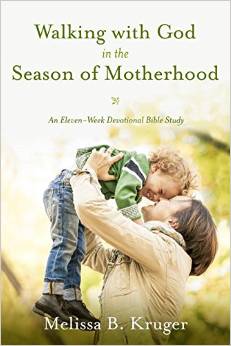
Book Review: Walking With God in the Season of Motherhood

Walking With GodI first saw Walking With God in the Season of Motherhood by Melissa B. Kruger when someone linked to her blog, and I saw this story of how the book came to be written. I thought it might be a good book to pass along to young moms, but I found much for my own heart, though my children are all grown.

This study grew out of Melissa’s desire for “a Bible study that intersected who I was as a believer with the role I had been given as a mother.” It’s not necessarily a “how to be a better parent” study. It’s more of a “how to walk with God and then let that relationship impact your ministry to your children” study.

She begins with our purpose – to glorify God and enjoy Him forever – then reminds us of our responsibility to teach the same to our children and our inability to do so for ourselves or for them on our own. Succeeding chapters discuss walking in faith, wisdom, prayer, carefulness, and then each facet of the fruit of the Spirit, ending with a discussion of the Perfect Mom Syndrome.

The study is laid out over eleven weeks, with four days of study per week and a fifth wrap-up summary of the truths covered in that week. I really like that the Bible verses are included within the study, so a busy mom trying to feed a baby or grab a few minutes of study while waiting for piano lessons or ball practice to end has everything needed right there within the book. There is an additional study guide at the back that would be great for a group study but is also helpful for personal use.

I have several quotes marked but will try to pull out just a few:

It is important to assess regularly whether my family is suffering from an overly busy calendar. However, rather than simply removing activities, my greatest need is to add one particular meeting to my schedule. Every day I need time with Jesus. While it seems counterintuitive, the addition of this one meeting promises to positively affect every other part of my day (pp. 30-31).

When impatience, anger, or discontent well up in our hearts, these are signs that we are mothering in our own strength. Rather than dealing only with our outward behavior, we need the Lord to renew and recharge our hearts…our souls find renewed energy only by abiding in Jesus. Without this time we will find ourselves depleted, discouraged, and unable to bear fruit (p. 33).

[Re the Proverbs 31 woman], We can view her as an older woman to learn from rather than a standard against which to measure ourselves (p. 73).

An additional benefit of a home at peace is that it overflows into loving care and service for our community. The goal is not to create a place to escape or avoid the world but to carefully build our home so that it is a light to the world, shining the grace of Christ to those who are without hope. A peaceful home offers a place of respite and care in the midst of a weary world (p. 76).

When we receive the abundant love of Christ, we are free to pursue others with love, not to gain their affection but to give back what we have already received (p. 93).

True joy does not discount real suffering; it shines all the greater in the midst of it (p. 115).

The ability to extend kindness requires an other-awareness. We are apt to miss the needs of those around us if we remain self-focused. Helping children to see the needs of others will bless them with perspective on their own lives, as well as propel them toward good works that display the kindness of God (p. 157).

God uses these moments to grow our hearts in grace. We can only bear the fruit of patience when we have something to be patient about (p. 164).

In Jesus the performance pendulum stops — both the pride of success and the despair of failure are absorbed by grace (p. 208).

I cannot protect my children from my weaknesses. As hard as I may try, at some point my sin will affect their lives. However, the way I deal with my failure can provide an example for them to follow. I am a sinner raising sinners. Each of my children will face the weight and sorrow of his or her own sins. Just as we teach daily hygiene habits like brushing teeth, our children need instruction on how to find cleansing for their souls. By teaching our children about confession and repentance as well as grace and forgiveness, we bless their lives for years to come (p. 213).

At some points the study seemed a bit long, both in number of weeks and in how long it took to complete the day’s reading and answer the questions. But it’s not, really – eleven weeks is a good length of time for a study. I went through the book in less time than that because I used it six days a week and went on to the next chapter after finishing one rather than reading one chapter per week, but I think the latter would be the better course, to really soak in the truths for that week before going on. And each day’s lesson only took about fifteen minutes. One could spend longer – I tend to answer the basic questions in writing but answer some of the more thoughtful ones in my head. If one did more with the writing sections, one could spend more time with each lesson. And if a day’s reading and questions take more time than one has, there is no reason you can’t take a couple of days or whatever time is needed to complete it. It’s better to go at one’s own pace and really dig into it than barrel through just to get it done. Melissa’s summaries at the end of each week’s lessons really help to review the material and help tie it all together.

I really enjoyed going through this study, found it very beneficial, and am happy to recommend it to you in whatever season you are in.

(This review will also be linked to Semicolon‘s Saturday Review of Books.)

Finding Time to Read the Bible

IMG_1218

In a recent blog post I read (I’ve forgotten where), the blogger mentioned that the book she was reading on Bible study didn’t discuss where to find the time. I had the same thought with a book I am reading on the subject. I guess the authors feel that once we are assured of the importance of Bible reading and study, we’ll make it a priority and make time. And I think that’s pretty much what it comes down to. If by finding time we mean we want a time that magically opens up with the solitude and inclination we need without a dozen other things crowding in…I just don’t think that’s going to happen, at least not regularly. Years ago our assistant pastor spoke of struggling to make time for Bible reading, and said to our senior pastor, an older, godly man, “I guess you don’t have trouble making time for Bible reading any more, do you?” He just laughed.

Finding the time is always going to be a struggle. There are always duties, distractions, and people clamoring for that time, and even an Enemy of our souls fighting against it. Instead of getting discouraged about it, we can just accept that it is a common problem and  prayerfully seek ways to deal with it. Perhaps reminding ourselves of reasons to read the Bible will renew our motivation.

We need to remember, too, that making time to read the Bible isn’t just about ticking off another duty. Every relationship thrives on communication. If we went for days without talking with our husbands except in the briefest necessary exchanges, we’d feel the effects pretty soon and realize we need some time alone together. Though sometimes we need to set up routines to establish good habits, taking time to read the Bible shouldn’t be a matter of rigid schedules, but rather of taking time to meet with the One Who loves us best.

So with these things in mind, here are some suggestions for carving time out to meet with the Lord:

1. Get up earlier or stay up later. I can hear you groaning. But for many of us, that’s the only way to get some time alone.

2. Keep the Bible handy. One friend with three small children close in age kept her Bible out in her kitchen. She couldn’t set aside a longer period of solitude, but she could read in smaller snatches through the day.

3. Listen. Some people like to listen to recorded versions of the Bible while driving, exercising, making dinner, etc.

4. Plan for it after a natural break in the day. It’s hard for many of us to stop in the middle of a morning or afternoon and put everything aside to read, but a break in the routine, when we’re shifting gears anyway, can help us work in some time for reading, like after a meal, after taking the kids to school, etc.

5. Meal time, especially if you eat alone.

6. Waiting time. We usually pull out our phones or a book if we have to wait at a doctor’s office or in car line at school, but that can be a good time for some Bible reading.

7. Establish a routine. Once we get used to setting aside a certain time for Bible reading, it’s not such a scramble to look for that time every day.

8. Don’t wait for perfection. One problem with a routine is that we can’t always figure out how to function when the routine is disrupted, like when we’re traveling or someone is sick or we have small children at home. I wrote a post some time back called Encouragement for mothers of young children about the topic of trying to find time for devotions with little ones in the house. Though I normally like getting up early and having solitude and quietness for Bible reading, that just didn’t work with little ones. Yet God enabled me to read and profit from it while they kept me company or played near me, even though usually I couldn’t concentrate under those circumstances.

9. Anything is better than nothing. Normally I like a good amount of time for Bible reading or study, but when a few moments was all I truly had, God often gave me just what I needed in those few moments in just a verse or two.

10. Talk with your husband, roommates, siblings, whoever you live with. Years ago I caught part of a radio program where the preacher was scolding women who wanted to spend early morning time to have devotions, saying the husband as the leader should have that time, since the wife had “all day” in which she could have devotions. The man obviously had not spent a whole day at home alone with kids. That mentality is so wrong on many levels. Not long after that a missionary speaking at our church mentioned protecting that time for his wife, a much better example of servant leadership and love. If the only way either parent can have devotions is for one of them to watch the children, then they can do that for each other. If a particular time of day is the best time for two people in a house, they can work out different locations if they get too distracted in the same room. Whatever conflict there might be about time and place preferences, talk with each other to work out the best solution for both and be willing to compromise.

11. Pray. In the blog post I referred to earlier, I mentioned that sometimes I’d get to the end of the day and lament to the Lord that I had no idea when I could have read my Bible that day. I began instead to pray at the beginning  of the day for wisdom and alertness for those moments when I could, and that made a profound difference.

12. Set something aside. If we have times to read other books, peruse Facebook, watch TV, or play games on our phones, we have time to read the Bible. I admit, if I sit down to relax for a few minutes with a book and realize I haven’t read my Bible yet that day, I don’t always have the best attitude about laying down my book and picking up my Bible. But when I confess that to the Lord and then go ahead, He graciously speaks to me through His Word. We do need time to relax as well, but that shouldn’t come at the expense of time in God’s Word. He knows our needs, and we can ask Him for both time to spend in His Word and for some down time.

What about you? What ways have you found to make time for Bible reading?

Sharing at Thought-Provoking Thursday and Works For Me Wednesday.