More songs about God’s way

When I wrote about wanting my own way yesterday, the old hymn, “Have Thine Own Way,” seemed a fitting ending. But the last day or two that I was working on my rough draft, other songs on the topic drifted to mind. Here are a few:

“Let Him Have His Way With Thee” by Cyrus S. Nusbaum is one we used to sing often, but I haven’t heard it in a while. The chorus goes:

His pow’r can make you what you ought to be;
His blood can cleanse your heart and make you free;
His love can fill your soul, and you will see
’Twas best for Him to have His way with thee.

I have not heard these two in years.

Thy Way, Not Mine

Thy way, not mine, O Lord,
however dark it be;
lead me by thine own hand,
choose out the path for me.

Smooth let it be or rough,
it will be still the best;
winding or straight, it leads
right onward to thy rest.

I dare not choose my lot;
I would not if I might:
choose thou for me, my God,
so shall I walk aright.

The kingdom that I seek
is thine, so let the way
that leads to it be thine,
else I must surely stray.

Take thou my cup, and it
with joy or sorrow fill,
as best to thee may seem;
choose thou my good and ill.

Choose thou for me my friends,
my sickness or my health;
choose thou my cares for me,
my poverty or wealth.

Not mine, not mine, the choice
in things or great or small;
be thou my guide, my strength,
my wisdom, and my all.

~ Horatio Bonar, 1857

In looking for this song on YouTube, I found it to several tunes I had never heard before. I don’t know these folks, but this is the melody I am familiar with.

Submission

The path that I have trod,
Has brought me nearer God,
Though oft it led through sorrow’s gates .
Though not the way I choose,
In my way I might lose
The joy that yet for me awaits.

(Refrain)
Not what I wish to be,
Nor where I wish to go,
For who am I that I should choose my way?
The Lord shall choose for me,
‘Tis better far, I know,
So let him bid me go, or stay.

The cross that I must bear,
If I a crown would wear,
Is not the cross that I should take;
But since on me ’tis laid,
I’ll take it unafraid,
And bear it for the Master’s sake.

Submission to the will
Of him who guides me still
Is surety of His love revealed;
My soul shall rise above
This world in which I move,
I conquer only when I yield.

~ Charles Austin Miles (1868-1946)

I especially love the last line. Again, I don’t know this singer, but this is the melody I know for this song:

“His Way Is Perfect” by Betsy Kistler is newer (1997). We used to sing this often in choir, and I heard it numerous times as solos. I always wished I knew the story behind it. It’s cast a bit sadder than the others, but that’s often when we most need to reassurance, as the last line repeats, that His way is best.

Scripture-soaked hymns and songs help us meditate on truths of God’s Word. May these be a blessing to you.

Are you familiar with these? Are there other songs that encourage you to yield to God’s will?


Wanting My Own Way

We’re born wanting our own way.

Babies, of course, don’t know any better than to demand that their universe revolves around their needs. That’s all they know at first.

But even when children make their first conscious, deliberate choices, they demonstrate a “me first” mentality. If they want a toy another child is holding, they grab it. If they don’t want their food, they spit it out or throw the plate on the floor. They scream or cry at any displeasure.

We recognize such responses as immaturity and understand why God gave kids parents. We try to patiently teach them that the universe does not revolve around them, they have to sometimes acquiesce to others, it’s rude to grab things from away from people, they sometimes have to do things they don’t like to do (and can’t do things they would like to do). As they get older, we teach the concept of taking turns, negotiation, and compromise. It’s a sign of growth and maturity when they can take the next steps to give sacrificially: to let someone else play with the toy they want, to give someone else the last cookie, to let someone else choose what movie to watch.

Even as adults, we note and dislike signs of selfishness in others and in ourselves.

Yet we’re still prone to want our own way.

Wanting our own will isn’t always bad. I think God gives us certain innate desires and tendencies that guide our futures. Someone who hates math will probably not be an accountant. Sometimes God nudges us out of our comfort zones, even out of our natural gifting, to cause us to depend on Him more and to show that the results could only have come from Him.

The problem comes when what we want conflicts with what He wants.

For the flesh desires what is against the Spirit, and the Spirit desires what is against the flesh; these are opposed to each other, so that you don’t do what you want (Galatians 5:17, CSB).

Some years ago, I did a study of phrases like “own way,” “own thoughts,” own heart,” etc., in order to find plenty of fuel to remind me that my way is not usually best. I ended up with four pages of types verses. Here are just a few:

All we like sheep have gone astray; we have turned every one to his own way; and the LORD hath laid on him the iniquity of us all (Isaiah 53:6).

Every way of a man is right in his own eyes: but the LORD pondereth the hearts (Proverbs 21:2).

Therefore shall they eat of the fruit of their own way, and be filled with their own devices (Proverbs 1:31).

What’s so wrong with wanting our own way? Sometimes nothing. But if our will clashes with God’s, then guess Who is right?

What? know ye not that your body is the temple of the Holy Ghost which is in you, which ye have of God, and ye are not your own? (I Corinthians 6:19).

For they got not the land in possession by their own sword, neither did their own arm save them: but thy right hand, and thine arm, and the light of thy countenance, because thou hadst a favour unto them (Psalm 44:3).

One of the worst things God can do to us is give us up to our own ways.

Hear, O my people, while I admonish you! O Israel, if you would but listen to me! … But my people did not listen to my voice; Israel would not submit to me. So I gave them over to their stubborn hearts, to follow their own counsels (Psalm 81:8, 11-12, ESV).

Because they hated knowledge and did not choose the fear of the Lord, would have none of my counsel and despised all my reproof, therefore they shall eat the fruit of their way, and have their fill of their own devices (Proverbs 1:29-31, ESV)

Wherefore God also gave them up to uncleanness through the lusts of their own hearts, to dishonour their own bodies between themselves (Romans 1:24).

And he gave them their request; but sent leanness into their soul (Psalm 106:15).

When I struggle with wanting my own way, I try to remember these things:

God has a right to call the shots.

He’s the creator. He made me; He made this world. Everything I have, my life, my breath, even my righteousness, is from Him. “And be found in him, not having mine own righteousness, which is of the law, but that which is through the faith of Christ, the righteousness which is of God by faith” (Philippians 3:9).

He is wise. He knows best.

He is kind. He is loving.

If He allows bumps in the road, delays, frustrations, unpleasantness, and even outright pain, He has a purpose. He promised His “grace to help in time of need” (Hebrews 4:16).

Therefore, I should:

Trust in the Lord with all your heart,
    and do not lean on your own understanding.
In
all your ways acknowledge him,

    and he will make straight your paths.
Be not wise in your own eyes;
    fear the Lord, and turn away from evil.
It will be healing to your flesh
    and refreshment to your bones. (Proverbs 3:5-8, ESV)

Neither yield ye your members as instruments of unrighteousness unto sin: but yield yourselves unto God, as those that are alive from the dead, and your members as instruments of righteousness unto God (Romans 6:13).

Elisabeth Elliot said, “To pray, ‘Thy will be done,’ I must be willing, if the answer requires it, that my will be undone.” That’s not always easy.

But I am heartened that our Lord Jesus, in His human nature, prayed in Gethsemane, “Father, if thou be willing, remove this cup from me: nevertheless not my will, but thine, be done” (Luke 22:42).

He taught His disciples, and practiced Himself: “If any man will come after me, let him deny himself, and take up his cross daily, and follow me. For whosoever will save his life shall lose it: but whosoever will lose his life for my sake, the same shall save it” (Luke 9:23-24).

And what was the result when He yielded to His Fathers will? Besides obeying, pleasing, and glorifying His Father, He accomplished what was needed to save multitudes of people.

It’s one of those seeming paradoxes of Scripture that “Whosoever shall seek to save his life shall lose it; and whosoever shall lose his life shall preserve it” (Luke 17:33). Whatever we want to hold onto for ourselves we will eventually lose. What we yield to Christ He will keep for us and give back so much more.

Love is patient and kind; love does not envy or boast; it is not arrogant or rude. It does not insist on its own way; it is not irritable or resentful…(1 Corinthians 13:4-5, ESV)

Have thine own way, Lord! Have thine own way!
Thou art the potter, I am the clay.
Mold me and make me after thy will,
while I am waiting, yielded and still.

Have thine own way, Lord! Have thine own way!
Search me and try me, Master, today!
Whiter than snow, Lord, wash me just now,
as in thy presence humbly I bow.

Have thine own way, Lord! Have thine own way!
Wounded and weary, help me I pray!
Power, all power, surely is thine!
Touch me and heal me, Savior divine!

Have thine own way, Lord! Have thine own way!
Hold o’er my being absolute sway.
Fill with thy Spirit till all shall see
Christ only, always, living in me!

Adelaide A. Pollard (1906)

I was blessed by more songs about God’s way here.

(Sharing with Inspire Me Monday, Global Blogging,
Senior Salon, Hearth and Home, Purposeful Faith,
Tell His Story, Happy Now, InstaEncouragement,
Anchored Abode, Recharge Wednesday,
Worth Beyond Rubies, Share a Link Wednesday,
Literary Musing Monday, Let’s Have Coffee,
Heart Encouragement, Grace and Truth,
Faith on Fire, Blogger Voices Network.
Links do not imply 100% agreement)

Biblical Self-Talk

I once heard a preacher say that sometimes he had to sit himself down and have a talk with himself. Have you ever felt that way?

For years after I had transverse myelitis, I struggled with panic attacks and extreme fears. I didn’t realize until fairly recently that, just as I had to recover from the physical effects of the disease, I also had to recover emotionally and mentally from the trauma of the disease itself.

We all know anything can happen any time. We’re not guaranteed our next breath. But then when something catastrophic does happen, it can throw us for a loop. Our foundations are shaken, our security is threatened. Looking back now, it’s no wonder I had panic attacks. Unfortunately, some of the things I feared were psychiatrists and psychiatric drugs, so I didn’t tell anyone what I was going through. I was given Xanax for a while in the hospital, but no one explained why. I heard it was addictive, so I didn’t take it when I got home. I even wondered if they thought my symptoms were in my head.

If I had it to do over again, I’d talk to my neurologist, who was primarily in charge of my care at the time. I’d ask why I was given Xanax, explain what was going on, see what he had to say, and evaluate the options. That’s what I would advise anyone else to do.

Instead, I read what I could about anxiety and panic attacks. I learned that breathing in slowly through my nose and out through my mouth had a calming effect. I would think through or sing through hymns to get my thoughts on another track. And I would remind myself of truth and common sense, which I later learned was self-talk.

For instance, on our way to the church we attended at the time, we almost always got caught at a red light on an overpass. This overpass was one that trembled when an 18-wheeler passed, which happened often. When a visiting speaker’s wife mentioned that this overpass scared her, my own fears escalated. We knew no other way to get to church than this route. So I would tell myself, “Seriously, how often do you hear of these things falling down? Not very often. It’s more likely not to happen than to happen. If it does happen, there’s nothing you can do about it. You’ll either go straight on to heaven, or God will help you through whatever happens just as He did with TM. Don’t ruin or waste your day by worrying about something that is not likely to happen.” Then I’d sing hymns to myself not only to guide my thoughts away from scary things, but also to remind myself of God’s care and promises.

That helped with things not likely to happen. But what about things that could very well happen? TM was a one-time occurrence with lasting ramifications. But one form of it did cause repeat occurrences. And sometimes what was thought was TM was actually found to be MS when repeated attacks occurred. My TM had started with one hand feeling a little funny, like I had slept on it wrong. Within three hours, my whole left arm and both legs were numb and I couldn’t walk on my own. So every time a limb fell sleep, every time I had a funny, not-quite-right feeling, every time symptoms flared up, so did the fears of a repeat attack. I had to remind myself that this probably was not another attack, but just a flare-up. If it was another attack, God would help me just as He did the first time. Eventually, after multitudes of flare-ups without another full-fledged attack, and after a significant amount of healing, I learned to just roll with the symptoms and eventually to hardly notice them.

Sometimes we have to talk to ourselves over spiritual issues, too, don’t we? A tragedy occurs, and we feel like maybe God doesn’t love us like we thought He did. We remind ourselves that God loves us “with an everlasting love” (Jeremiah 31:3), that He loved us even when we were His enemies. Or we feel worthless and remind ourselves we are accepted in the Beloved.

We have several instances of Scriptural self-talk in the psalms. The psalmist asks himself three times, “Why are you cast down, O my soul, and why are you in turmoil within me?” (Psalm 42:5, 11; 43:5, ESV). Then he answers himself, “Hope in God; for I shall again praise him, my salvation and my God.” David tells himself to “Bless the Lord, O my soul”  in Psalm 103 and then reminds himself why he could do so. He reminds himself about God’s character, what He had done for Israel in the past, what He had done for David himself.In Psalm 57, David is hiding in a cave from Saul. After pleading for God’s mercy and reminding himself of God’s power, love, and faithfulness, David tells himself to wake up and praise God:

My heart, O God, is steadfast, my heart is steadfast; I will sing and make music. Awake, my soul!  Awake, harp and lyre! I will awaken the dawn. (Psalm 57:7-8, NIV).

Other psalms don’t employ that exact language, but they show the writer coming to God with a problem or an issue: Where are you? Why are you not acting? The wicked are faring better than Your people. I’m hurting here. People are persecuting me for no reason.

And then the writer reminds himself of truths about his God: He’s here. He loves us. He cares. The wicked will face their consequences some day if they don’t repent. God will strengthen me and help me.

I shared this quote before from David Martyn-Lloyd Jones in Spiritual Depression, but I love it:

Have you realized that most of your unhappiness in life is due to the fact that you are listening to yourself instead of talking to yourself? Take those thoughts that come to you the moment you wake up in the morning. You have not originated them but they are talking to you, they bring back the problems of yesterday, etc. Somebody is talking. Who is talking to you? Your self is talking to you. Now this man’s treatment [in Psalm 42] was this: instead of allowing this self to talk to him, he starts talking to himself. “Why art thou cast down, O my soul?” he asks. His soul had been depressing him, crushing him. So he stands up and says, “Self, listen for moment, I will speak to you.”

Instead of being at the mercy of our thoughts, we challenge them and correct them. We need to take our thoughts captive (2 Corinthians 10:5). We set aside wrong thoughts and actively pursue truth. We steady our souls with God’s truth. We fill our minds with God’s Word so the Holy Spirit can remind us of it.

Have you ever had to give yourself a good talking-to?

(Sharing with Inspire Me Monday, Global Blogging, Senior Salon, Hearth and Soul, Purposeful Faith, Tell His Story, Happy Now, InstaEncouragement, Anchored Abode, Recharge Wednesday, Worth Beyond Rubies, Share a Link Wednesday,
Let’s Have Coffee, Heart Encouragement, Faith on Fire, Grace and Truth,
Blogger Voices Network, Literary Musing Monday)

You don’t have to choose a word for the year

If you read many blogs, you’ll find a lot of people writing about a word they’ve chosen for the year. I don’t know how long this has been a thing, but I’ve been reading about it for several years now.

For many, choosing a word for the year replaces a list of resolutions. That one word gives them focus for the year. Christians who do this usually pray about it leading up to the new year and feel this word has been given them or impressed on them by God. They often plan their Bible study around their word.

Many share that this emphasis has been a great blessing to them. Some have been amazed at how God intersects their study and circumstances around their word. Some, like my friend Lisa, purposefully read several books involving their word over the course of a year. Others, like Crystal, plan activities to incorporate their word.

But perhaps you’ve never felt led to choose a word for the year and you wonder if you’re missing out. Or perhaps you’ve chosen one in the past but, like a soon-forgotten New Year’s resolution, it faded out of memory.

I just want to assure you of a few truths.

God never tells anyone in the Bible to choose a word, a theme, or even a verse for the year. That doesn’t mean the practice is wrong. It’s just one method of focus and of studying and applying God’s Word.

God may lay on your heart to study a certain topic, truth, characteristic, etc. from the Bible, and that may or may not coincide with January 1 and may or may not last a year.

Psalm 119:105 says “Your word is a lamp to my feet and a light to my path.” Commentary I’ve read for that verse said that with the lighting they had in Bible times, they could only see a step or two ahead. God may well prepare you for something that only He knows is ahead through a word for the year. But often you don’t have that much notice. God’s guidance and provision is often moment by moment, day by day.

What’s more vital than a word for the year is daily seeking God in His Word.

I’ve never felt led to choose a word for the year. I’ve often said that God usually has more to say to me than one word. And, to be fair, those who choose a word for the year don’t claim that’s the only thing God wants them to deal with. They do read other books and other parts of God’s Word as well.

A topical Bible study on a certain word or concept can be highly valuable. But we also need the daily reading of Bible passages in context. Drew Hunter says:

If you received a three-page letter from a distant friend, you wouldn’t just read page 2. You could spend all day “studying” that page, but until you read pages 1 and 3, you will not fully (or perhaps even rightly) understand your friend’s message.

The human authors of the Bible organized their books intentionally. So, we step back and think through the author’s flow of thought. Studying the Bible involves thinking paragraph-by-paragraph, section-by-section, and seeing how everything fits into the overall structure and flow of the book.

We need the panoramic lens to take in the beauty and wonder of the big picture of God’s Word. We also need the macro lens for close-ups, for camping out with a verse at a time and mining its truths. Tim Challies calls these reading for familiarity (reading longer passages in a sitting) or intimacy (slowing down and meditating on or studying shorter passages) and says we need both approaches. Kelly Collier calls these two methods plow work (which “moves through large portions of Scripture more quickly,” like reading the Bible in a year or two) and trowel work (“taking a passage or verse of Scripture and settling in to dig for a long time,” like inductive Bible Study).

Choosing a word for the year shouldn’t replace contextual Bible study.

There are many who choose and study a word for the year and employ both these other methods of studying the Bible in context. That’s ideal. For some, the word for the year is their close-up, slowed-down study. That’s fine.

While many people find great value in choosing a word for the year, those who don’t use that method shouldn’t feel they’re missing out or somehow not as spiritual.

Jesus said, “Man shall not live by bread alone, but by every word that comes from the mouth of God” (Matthew 4:4). Let’s be faithful to partake of that bread every day.

Morning by morning he awakens; he awakens my ear to hear as those who are taught (Isaiah 50:4).

Your words were found, and I ate them, and your words became to me a joy and the delight of my heart, for I am called by your name, O LORD, God of hosts.  (Jeremiah 15:16)

____________________________________________

(Sharing with Inspire Me Monday, Global Blogging, BOSS Blog Share, Hearth and Soul, Happy Now, Tell His Story, InstaEncouragement, Anchored Abode,
Recharge Wednesday, Worth Beyond Rubies, Share a Link Wednesday,
Let’s Have Coffee, HeartEncouragement, Grace and Truth, Faith on Fire)

A Perfect Christmas

(Photo courtesy of Bev Lloyd-Roberts at the stock.xchng.)

Most of us have a vision in our minds of the perfect Christmas: family gathered around, a clean and sparkling house, a beautifully adorned Christmas tree with piles of lovingly chosen presents underneath, a feast for the eyes and the table, scents of roasting turkey or ham, pumpkin pies, apple cider, everyone marvelously getting along like the end of a made-for-TV movie.

But what if that’s not reality this year?

What if one member is in prison? Or the hospital? Or overseas or across the country? Or in heaven?

What if a lost job or a major medical expense has led to a depleted bank account and bare cupboards?

What if grief overshadows joy?

Is Christmas then ruined?

Let’s go back to that first Christmas.

Mary and Joseph away from home in a strange city. They did not have a beautifully decorated house: they did not even have a hotel room. The only scents of the season were those of nearby animals. Mary, as a young, first-time mother, did not have the blessing of a modern hospital and sanitary conditions, a skilled nursing staff and childbirth training. Giving birth was painful and messy. If Joseph was her lone attendant, he would have been out of his element helping a woman deliver a baby. Perhaps he was dismayed or frustrated that he could not provide better for her in her moment of need. And after the blessed relief of a healthy child safely born, there was little acknowledgment of this Child. The shepherds, Simeon and Anna, and, later on, the wise men rejoiced in who He was. But soon the young parents would face the danger of a king bent on killing the Child in their care. Mary’s reputation would suffer as many thought her Child was illegitimate. The ominous promise hung over her head that a sword would pierce through Mary’s own soul.

What did Mary and Joseph have then, that lonely, uncomfortable, smelly night? They had the Child of promise. A Child whom they were told to name Jesus, which means “Jehovah saves.” His very name is a promise. He would reconcile them to God by taking care of their greatest need: He would “save His people from their sins.” They had the realization that this Child was the long-awaited and longed-for Messiah, the King, the Son of the Highest. What cause for joy and wonder! They had no idea how it would all work out. But they had the promise, and because of the promise, they had hope.

It’s certainly not wrong to enjoy a decorated tree, presents, wonderful food, and family gathered. But we can celebrate Christmas even all of those elements are missing or less than ideal. We can celebrate in our own hearts and with those around us that same promise, that same hope. Like Mary, we can treasure these things and ponder them in our hearts. Like the shepherds, we can make “known the saying that had been told them concerning this child” and go back to daily life “glorifying and praising God for all they had heard and seen, as it had been told them” (Luke 2: 17-20). If all we have is faith in Jesus’ fulfillment of the hope and promise of that first Christmas, we are blessed indeed.

(Revised from the archives)

(Sharing with Inspire Me Monday, Global Blogging, Senior Salon, Hearth and Soul,
Happy Now, InstaEncouragement, Anchored Abode, Grace and Truth, Faith on Fire)

God With Us

Our church is reading through Matthew this month. Luke’s account of Christ’s birth is more detailed than Matthew’s compact version. But one thing that stands out to me in Matthew’s telling is at the end of chapter one.

After reassuring Joseph that Mary is still pure and her pregnancy is of the Holy Spirit, the angel says: “She will bear a son, and you shall call his name Jesus, for he will save his people from their sins.” Then Matthew adds this comment:

All this took place to fulfill what the Lord had spoken by the prophet: “Behold, the virgin shall conceive and bear a son, and they shall call his name Immanuel” (which means, God with us).

Jesus was to be the baby’s name, but He would also be called Immanuel. The prophecy Matthew quoted was from Isaiah 7:14, written around 700 years before Matthew’s book.

We often zip by that phrase to get to the next part of the narrative. But the fact that God is with us is so significant, I want to ponder it for a moment.

God was with His people in full fellowship and harmony in the garden of Eden. But then they sinned and were sent out of the garden. Sin separates from God. He is always omnipresent, everywhere at all times. But that complete, harmonious fellowship was broken. He made a way for people to be reconciled to Him through Christ, but Jesus’ sacrifice would not take place for thousands of years. People in the OT looked ahead to what God would do to redeem them. People in the NT and our day look back.

God told Isaac: “I am the God of Abraham your father. Fear not, for I am with you and will bless you” (Genesis 26:3).

Israel became God’s chosen people, known especially because their God was with them. He was not a block of wood or brass set up in a tent. He was a Spirit who led and protected them. After one of Israel’s most grievous sins in the wilderness, before they came to the promised land, God sent them on ahead with Moses. God promised to make the way for them into Canaan, but He would not go with them “lest I consume you on the way, for you are a stiff-necked people.” Moses pleaded:

 Moses said to the Lord, “See, you say to me, ‘Bring up this people,’ but you have not let me know whom you will send with me. Yet you have said, ‘I know you by name, and you have also found favor in my sight.’ Now therefore, if I have found favor in your sight, please show me now your ways, that I may know you in order to find favor in your sight. Consider too that this nation is your people.”

And [God] said, “My presence will go with you, and I will give you rest.”

And he said to him, “If your presence will not go with me, do not bring us up from here. For how shall it be known that I have found favor in your sight, I and your people? Is it not in your going with us, so that we are distinct, I and your people, from every other people on the face of the earth?” (Exodus 33:1-16).

Have you ever felt like Moses? “Don’t send me if You’re not going with me. I can’t go forward without You.”

Before Moses died, he assured the people, “Be strong and courageous. Do not fear or be in dread of them, for it is the Lord your God who goes with you. He will not leave you or forsake you. (Deuteronomy 31:6).

When Moses died and Joshua was appointed to take Israel on to the promised land, God reassured him, “Have I not commanded you? Be strong and courageous. Do not be frightened, and do not be dismayed, for the Lord your God is with you wherever you go” (Joshua 1:9).

The psalmist rejoiced, “God is our refuge and strength, a very present help in trouble. . . The Lord of hosts is with us; the God of Jacob is our fortress” (Psalm 46:1, 4, 11).

David declared, “I have set the Lord always before me; because he is at my right hand, I shall not be shaken. . . You make known to me the path of life; in your presence there is fullness of joy; at your right hand are pleasures forevermore” (Psalm 16:8,11).

The prophets, who so often had to point out the people’s sins, also reminded them that God had nor forsaken them and was with them. “Then Haggai, the messenger of the LORD, spoke by the commission of the LORD to the people saying, ‘I am with you,’ declares the LORD. . . all you people of the land take courage,’ declares the LORD, ‘and work; for I am with you,’ declares the LORD of hosts” (Haggai 1:13; 2:4).

Through Isaiah, God promised His people: “When you pass through the waters, I will be with you; and through the rivers, they shall not overwhelm you; when you walk through fire you shall not be burned, and the flame shall not consume you” (Isaiah 43:2). Notice He didn’t say “if” you pass through water and through fire. He said “when.” Trouble’s going to come. But God is with us in it. Earlier Isaiah had quoted God, “Fear not, for I am with you; be not dismayed, for I am your God; I will strengthen you, I will help you, I will uphold you with my righteous right hand. . . For I, the Lord your God, hold your right hand; it is I who say to you, ‘Fear not, I am the one who helps you'” (Isaiah 43:10,13).

When Jesus took on flesh, He was with His people in a physical way. Before He ascended back to heaven, He promised them, “Behold, I am with you always, to the end of the age” (Matthew 28:20).

Those verses we often lean on in anxiety in Philippians 4 are predicated by “The Lord is at hand; do not be anxious about anything, but in everything by prayer and supplication with thanksgiving let your requests be made known to God. And the peace of God, which surpasses all understanding, will guard your hearts and your minds in Christ Jesus”(Philippians 4:5b-7).

We can trust God for our provision. “Keep your life free from love of money, and be content with what you have, for he has said, ‘I will never leave you nor forsake you’” (Hebrews 13:5).

At the end of life, if we know Him, we can rest in the fact that “Even though I walk through the valley of the shadow of death, I will fear no evil, for you are with me; your rod and your staff,  they comfort me”( Psalm 23:4). Then we’ll be “absent from the body, and to be present with the Lord” once again in full fellowship unhindered by a sin nature (2 Corinthians 5:8).

An old song said God is watching us from a distance. No, He is very close. “But now in Christ Jesus you who once were far off have been brought near by the blood of Christ” (Ephesians 2:13). Because Jesus was God’s Son, born of a virgin, lived a sinless life, died on the cross for our sins, and rose again, we can be forgiven, redeemed, close to Him. In overcoming and need, in anxiety and danger, in everyday life and our walk with God, and finally in death, we can rest and rejoice in the fact that God is with us.

For thus saith the high and lofty One that inhabiteth eternity, whose name is Holy; I dwell in the high and holy place, with him also that is of a contrite and humble spirit, to revive the spirit of the humble, and to revive the heart of the contrite ones. (Isaiah 57:15).

Immanuel

Written by C. H. Spurgeon at the age of 18

When once I mourned a load of sin;
When conscience felt a wound within;
When all my works were thrown away;
When on my knees I knelt to pray,
Then, blissful hour, remembered well,
I learned Thy love, Immanuel.

When storms of sorrow toss my soul;
When waves of care around me roll;
When comforts sink, when joys shall flee;
When hopeless griefs shall gape for me,
One word the tempest’s rage shall quell–
That word, Thy name, Immanuel.

When for the truth I suffer shame;
When foes pour scandal on my name;
When cruel taunts and jeers abound;
When “Bulls of Bashan” gird me round,
Secure within Thy tower I’ll dwell–
That tower, Thy grace, Immanuel.

When hell enraged lifts up her roar;
When Satan stops my path before;
When fiends rejoice and wait my end;
When legioned hosts their arrows send,
Fear not, my soul, but hurl at hell
Thy battle-cry, Immanuel.

When down the hill of life I go;
When o’er my feet death’s waters flow;
When in the deep’ning flood I sink;
When friends stand weeping on the brink,
I’ll mingle with my last farewell
Thy lovely name, Immanuel.

When tears are banished from mine eye;
When fairer worlds than these are nigh;
When heaven shall fill my ravished sight;
When I shall bathe in sweet delight,
One joy all joys shall far excel,
To see Thy face, Immanuel.

(Sharing with Inspire Me Monday, Global Blogging, Senior Salon, Hearth and Soul, Purposeful Faith, Happy Now, InstaEncouragement, Anchored Abode,
Worth Beyond Rubies, Recharge Wednesday, Let’s Have Coffee,
Faith on Fire, Grace and Truth)

Musings Of A Tired Mummy


Organic Mentoring

What does mentoring mean to someone desiring to be mentored? Sometimes women have a specific area where they feel they need help. Some just want to have an older go-to person to ask questions.

Dictionary.com defines mentor as “a wise and trusted counselor or teacher; an influential senior sponsor or supporter.” But how do people work mentoring out into real life? Classes? Regular meetings? Shadowing?

The word “mentor” is not in the Bible—at least, not in the KJV or ESV. Probably the closest the Bible comes to the concept is discipling. The classic passage for women disciplining women is Titus 2: 3-5:

Older women likewise are to be reverent in behavior, not slanderers or slaves to much wine. They are to teach what is good, and so train the young women to love their husbands and children, to be self-controlled, pure, working at home, kind, and submissive to their own husbands, that the word of God may not be reviled.

It’s always important to look at the context of a Bible passage, and the context here is teaching and relating life to sound doctrine (verse 1). Then the character of a teacher or mentor is addressed. Several translations describe this older woman as reverent; others use the word holy. She’s trustworthy: she doesn’t spread gossip. Your secrets are safe with her. And she’s self-controlled, not given to excess.

I’ve written before about different ways to mentor. And I shared that mentoring is more than affirmation and suggested thoughts for both mentor and mentee.

What I’d like to suggest now is that mentoring doesn’t have to be a formal arrangement. You may have one person that you go to with every question and concern. That’s fine if you have such a person. But I have found that God has sent different women across my path with just a word in season that I needed at the moment. I’d like to tell you about a few of them.

Mr. and Mrs. B. were the pastor and wife we were under in our college days and then our first few married years. They were an older couple. Mrs. B. was kind, warm, wise. But she also laid things on the line. When I was struggling with some issue and finally ready to do whatever it took to deal with it, Mrs. B. was the person I would go to. I knew she would give it to me straight, yet kindly.

Mrs. C. was a lady whose family came to our church while I was away at college. When I came home for the summer, the family invited me over for dinner several times. They soon became a second family to me. I don’t remember Mrs. C. ever specifically trying to teach me anything, but I learned so much from her example, her character, her response to her husband, her homemaking.

These two relationships were long-term, but sometimes God had an older friend say something helpful in passing. For instance, once while working in the church nursery, another lady mentioned that she had hit the highest emotional highs and the lowest lows in the context of mothering. That stopped me in my tracks, because I had thought something similar, but hadn’t quite put it into words. I don’t think we discussed it any further, but her comment let me know that my feelings were normal. Another time, I was putting up a church bulletin board with a lady who had teenagers while my children were younger. She gave me some off-the-cuff advice not to dread the teen years. She said teens don’t all go through rebellious phases, and if the relationship has been good all along, there’s no reason it can’t continue to be good. That lifted a weight and gave me a healthy perspective of my children’s upcoming teen years, and I’ll be forever grateful.

Once I was doing something in the church building while the group who ministered to the seniors at church were setting up a banquet for them. That kind of preparation can get hectic. The wife of the couple involved, a very sweet woman, came into the kitchen to look for something. While she stood there a moment, gathering her thoughts and looking at cabinets, her husband came in behind her with an urgent question. He couldn’t see her face, but I saw her close her eyes a moment and then give him a calm answer. Whether she was thinking through the answer to his question or changing gears from her own pursuit, I don’t know. But my impression was that in a moment of being overwhelmed, she took just a beat or two to gain control and answer kindly when she might have wanted to be left alone to finish her own task.

Another older lady had to retire from her loved job due to what some considered unfair circumstances. I know this woman was hurt, but I never once heard her badmouth her employers. I watched as she sought out several different new ways of ministering until she found her new niche, and her efforts continued to make a different in other people’s lives.

The one factor all of these examples have in common is that they arose naturally, in the normal course of life and ministry.

There’s nothing wrong with setting up classes and seminars. I have learned boatloads from many great and mostly unknown women teachers. I’ve sought specific counsel from older women at times.

There’s nothing wrong with a formal one-on-one relationship specifically for the purpose of mentoring.

But a mentor does not have to be a formal teacher and may not have that kind of relationship with anyone. Even if she does, we’re all called to the kind of walk where our example teaches and where we’re so yielded to and in tune with the Holy Spirit that He can work though us in the course of everyday life. I think of this as organic, natural mentoring. I don’t remember in any of these cases praying for God to send an older, godly woman my way. But He did, because He knew I needed them.

It’s fine to pray for a mentor, to work through a book or Bible study together, to have a list of questions to discuss. Sue Donaldson has some great ones here. But I also saw a list of 100 questions to ask of a mentor. Honestly, that sounds exhausting. No one wants to feel grilled interrogated. If you want to approach someone with questions, I wouldn’t bring that many. And I’d suggest questions from your own heart rather than a list, things you would like to ask an older, experienced lady about living the Christian life in a way that honors the Lord.

But beyond questions, we can learn much just by spending time with these women and observing their walk and demeanor. I know I have probably asked older women specific questions, but I don’t remember most of those conversations. For some reason, I’ve remembered these instances I shared here for years. Many of them were foundational or transitional to my thinking. And the women in question probably didn’t even know they had said something that affected me. I don’t think I knew it myself at the moment. It probably took time to process their advice, comments, or example. A guest preacher at our church years ago once said that often, when the Holy Spirit uses us, we’re unaware of it.

That’s the kind of godly, older-ish woman I want to be: one who walks closely with the Lord, filled with His Spirit and His Word and a love for others, available for His use in everyday life and conversation.

Have you had such a mentor in your life—someone who wasn’t officially a teacher, yet taught you by word or example? I’d love to hear about them in the comments.

(Sharing with Inspire Me Monday, Global Blogging, Senior Salon, Literary Musing Monday, Hearth and Soul, Happy Now, InstaEncouragement, Anchored Abode,
Recharge Wednesday, Share a Link Wednesday, Let’s Have Coffee,
Heart Encouragement, Grace and Truth)

Biblical Thankfulness

We know thanksgiving is not just a day in November, but it is an activity we’re supposed to engage in year-round. But our annual thankful holiday does help turn our thoughts a more grateful direction.

In past years I’ve made lists of what I am thankful for throughout November, either once a day or all on Thanksgiving Day. I usually ended up with pretty much the same items on my list. That’s fine. We should continue to be thankful for what we have every year.

It’s harder to be thankful some years. Health issues cropped up, loved ones are no longer with us, finances have taken a downturn. The Bible speaks of the “sacrifice of praise”: “Through him then let us continually offer up a sacrifice of praise to God, that is, the fruit of lips that acknowledge his name.” (Hebrews 13:15). I’ve often wondered at that wording. “Sacrifice” hearkens back to some of the OT sacrifices, but here it is applied specifically to praise. I’ve thought that perhaps it’s a sacrifice because we have to turn our attention from ourselves to God. But maybe it’s also a sacrifice because we do it whether or not we “feel” it. Joni Eareckson Tada has said, “To give thanks is not the same as ‘feeling thankful.’ To give thanks in the midst of pain and problems is to take a step of faith based on the command of 1 Thessalonians 5:18: God tells us to give thanks in all circumstances (not just those we can handle or feel on top of). For what things can you give thanks, even while you’re hurting?”

C. S. Lewis said, “We ought to give thanks for all fortune: if it is ‘good,’ because is it good, if ‘bad’ because it works in us patience, humility, and the contempt of this world and the hope of our eternal country.”

One year I did a study on thanks and thanksgiving in the Bible.Just one aspect of it was noticing what people in the Bible thanked God for. It’s perfectly fine to thank God for material blessings and the people He has placed in our lives. But we can expand our thanks to include:

Attributes of God Himself

God’s goodness. “Oh give thanks to the Lord, for he is good, for his steadfast love endures forever!” (I Chronicles 16:34; Ezra 3:11; Psalm 106:1; 107:1; 118:1, 29; 136)

God’s holiness. “Sing unto the LORD, O ye saints of his, and give thanks at the remembrance of his holiness.” (Psalm 30:4, KJV)

God’s righteous judgments. At midnight I will rise to give thanks unto thee because of thy righteous judgments. (Psalm 119: 62, KJV)

God’s greatness. “Oh come, let us sing to the Lord; let us make a joyful noise to the rock of our salvation! Let us come into his presence with thanksgiving; let us make a joyful noise to him with songs of praise! For the Lord is a great God, and a great King above all gods.” (Psalm 95:1-3)

God’s power and reign. “We give thanks to you, Lord God Almighty, who is and who was, for you have taken your great power and begun to reign.” (Revelation 11:17)

God’s love and wonderful works. “Let them thank the Lord for his steadfast love, for his wondrous works to the children of man! And let them offer sacrifices of thanksgiving, and tell of his deeds in songs of joy!” (Psalm 107:21-2)

What God gives us or does for us

Saving us. “Giving thanks to the Father, who has qualified you to share in the inheritance of the saints in light. He has delivered us from the domain of darkness and transferred us to the kingdom of his beloved Son, in whom we have redemption, the forgiveness of sins.” (Colossians 1:12-14)

Bearing us. “Blessed be the Lord, who daily bears us up; God is our salvation.” (Psalm 68:19)

Victory over death. “Death is swallowed up in victory. ‘O death, where is your victory? O death, where is your sting?’ The sting of death is sin, and the power of sin is the law. But thanks be to God, who gives us the victory through our Lord Jesus Christ.” (1 Corinthians 15:54b-57)

Deliverance from mourning. “You have turned for me my mourning into dancing; you have loosed my sackcloth and clothed me with gladness, that my glory may sing your praise and not be silent. O Lord my God, I will give thanks to you forever!” (Psalm 30:11-12)

Comfort: “Blessed be the God and Father of our Lord Jesus Christ, the Father of mercies and God of all comfort, who comforts us in all our affliction, so that we may be able to comfort those who are in any affliction, with the comfort with which we ourselves are comforted by God.” (2 Corinthians 1:3-4)

Causing us to triumph, making Himself known through us. “Now thanks be unto God, which always causeth us to triumph in Christ, and maketh manifest the savour of his knowledge by us in every place.” (2 Corinthians 2:14, KJV)

God’s provision, enough for ourselves plus for giving to others. “He who supplies seed to the sower and bread for food will supply and multiply your seed for sowing and increase the harvest of your righteousness. You will be enriched in every way to be generous in every way, which through us will produce thanksgiving to God. For the ministry of this service is not only supplying the needs of the saints but is also overflowing in many thanksgivings to God. (2 Corinthians 9:11-12)

God’s inexpressible gift. “Thanks be to God for his inexpressible gift!” (2 Corinthians 9:15)

Food. “. . . foods that God created to be received with thanksgiving by those who believe and know the truth. For everything created by God is good, and nothing is to be rejected if it is received with thanksgiving, for it is made holy by the word of God and prayer.” (1 Timothy 4:3b-5)

Authorities. Really? Yes: “First of all, then, I urge that supplications, prayers, intercessions, and thanksgivings be made for all people, for kings and all who are in high positions, that we may lead a peaceful and quiet life, godly and dignified in every way.” (1 Timothy 2:1-2)

Other people.

“But thanks be to God, who put into the heart of Titus the same earnest care I have for you.” (2 Corinthians 8:16)

“I do not cease to give thanks for you, remembering you in my prayers . . .” (Ephesians 1:16)

“We always thank God, the Father of our Lord Jesus Christ, when we pray for you, since we heard of your faith in Christ Jesus and of the love that you have for all the saints” (Colossians 1:3-4) (See also I Thessalonians 1:1-3; 3:9-10; II Thessalonians 2:13-14.)

Everything.

“Giving thanks always and for everything to God the Father in the name of our Lord Jesus Christ.” (Ephesians 5:20)

“Give thanks in all circumstances; for this is the will of God in Christ Jesus for you. ” (1 Thessalonians 5:18)

“Blessed be the God and Father of our Lord Jesus Christ, who has blessed us in Christ with every spiritual blessing in the heavenly places.” (Ephesians 1:3)

This is probably just the tip of the iceberg! I’m sure further study would reveal even more things to be thankful for in the Bible.

I’ve been looking for a quote that I thought came from Martin Luther, but I can’t seem to find it with various searches. But it went something like this: God saved me when I didn’t deserve it. I could and should thank Him eternally for just that. Anything else He gives me or does for me after that is just extra blessings. (If you know this quote, please share in the comments. I would be so grateful.) We’re truly “loaded with benefits”: “Blessed be the Lord, who daily loadeth us with benefits, even the God of our salvation.” (Psalm 68:19, KJV).

No doubt August Storm had done a thanksgiving study of his own when he composed this hymn in 1891:

Thanks to God for my Redeemer,
Thanks for all Thou dost provide!
Thanks for times now but a memory,
Thanks for Jesus by my side!
Thanks for pleasant, balmy springtime,
Thanks for dark and stormy fall!
Thanks for tears by now forgotten,
Thanks for peace within my soul!

Thanks for prayers that Thou hast answered,
Thanks for what Thou dost deny!
Thanks for storms that I have weathered,
Thanks for all Thou dost supply!
Thanks for pain, and thanks for pleasure,
Thanks for comfort in despair!
Thanks for grace that none can measure,
Thanks for love beyond compare!

Thanks for roses by the wayside,
Thanks for thorns their stems contain!
Thanks for home and thanks for fireside,
Thanks for hope, that sweet refrain!
Thanks for joy and thanks for sorrow,
Thanks for heav’nly peace with Thee!
Thanks for hope in the tomorrow,
Thanks through all eternity!

~ August L. Storm, 1891

What are you most thankful for this year?

(Sharing with Global Blogging, Senior Salon, Literary Musing Monday, Hearth and Soul, Tell His Story, Happy Now, Purposeful Faith, InstaEncouragement, Recharge Wednesday,
Worth Beyond Rubies, Share a Link Wednesday, Wise Woman, Let’s Have Coffee,
Grace and Truth, Faith ‘n Friends)

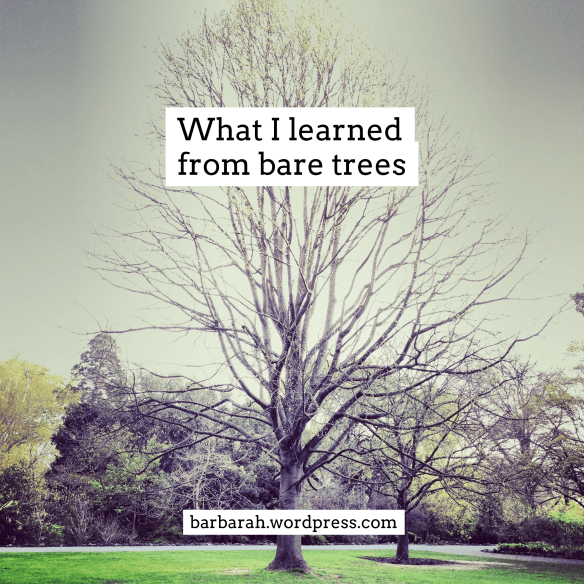
What I Learned from Bare Trees

Fall seemed to arrive late this year, and winter weather is already upon many of us. Thankfully, there’s still a good bit of color in many trees. But others are already bare.

I’ve written before about having trouble when the leaves are off, when the landscape is bleak and barren. I soak up fall’s beauty to sustain me through long, colorless winters.

But just recently, something I read touched off a search for the science behind why deciduous tress lose their leaves

  • The leaves wouldn’t survive the cold in many places.
  • Trees conserve water through the winter by purposefully dropping their leaves.
  • Leaves damaged by “insects, disease or general wear and tear,” according to this source, are made to fall off so they can be renewed again in the spring.
  • Some leaves provide resources for the plant before dropping off. According to this source, “A number of deciduous plants remove nitrogen and carbon from the foliage before they are shed and store them in the form of proteins in the vacuoles of parenchyma cells in the roots and the inner bark. In the spring, these proteins are used as a nitrogen source during the growth of new leaves or flowers.”
  • Dead leaves nourish soil.

I either didn’t know, or more likely had just forgotten learning these facts in school way back when. But it helps to know that there is a reason God created trees this way. Their loss of leaves actually protects them and helps them survive the winter and leaf out again in the spring.

Couldn’t God have made all the trees evergreen? He could have. But they’d all look like fir, spruce, or pine trees, made the way they are to survive the winter in a different way. Deciduous trees provide us with such rich color, beauty, and variety. Then they picture death, giving way to springtime resurrection. Some provide fruit in the summer.

It would be nice if the leaves could change into beautiful colors and then go back to green without dropping off, or at least get their green leaves back sooner. But there’s much they can teach us.

Sometimes loss is for our good. The things we want to hang on to would be harmful or prevent us from growing. “Every branch that does bear fruit he prunes, that it may bear more fruit” (John 15:2).

Dead leaves nourish the soil which then helps the tree grow. “we rejoice in our sufferings, knowing that suffering produces endurance, 4 and endurance produces character, and character produces hope, 5 and hope does not put us to shame, because God’s love has been poured into our hearts through the Holy Spirit who has been given to us” (Romans 5:3-5).

When leaves are off the trees, we can see things we couldn’t before. On our drive to church during our first fall and winter here, I discovered houses, ponds, animals, and scenery that had been hidden when the trees were leafed out.

A leafless tree “Displays a certain loveliness—The beauty of the bone (John Updike, “November”). Hebrews speaks of ” the removal of things that are shaken—that is, things that have been made—in order that the things that cannot be shaken may remain (12:27). When life is stripped to its basics, we see the strength of that core of God’s truth; we see what really matters. Corrie ten Boom said, ” “You can never learn that Christ is all you need, until Christ is all you have.” Or, taken in reverse, when Christ is all you have, you find He is all you need. Thanksgiving in the midst of long nights and barren landscapes reminds us of what’s most important and what bounty we still have.

Sometimes our normal sources of provision fail us. But God provides for us through seasons of loss and barrenness. “And my God will supply every need of yours according to his riches in glory in Christ Jesus” (Philippians 4:19).

Sometimes we have to learn to be content in doing without. “I have learned in whatever situation I am to be content. I know how to be brought low, and I know how to abound. In any and every circumstance, I have learned the secret of facing plenty and hunger, abundance and need. I can do all things through him who strengthens me” (Philippians 4:11b-13).

Seasons of rest come between seasons of fruitfulness. No one can give out incessantly without respite. Jesus told His disciples, “’Come away by yourselves to a desolate place and rest a while.’ For many were coming and going, and they had no leisure even to eat” (Mark 6:31).

Life is transient. “Nothing gold can stay,” as Robert Frost said. Not only do seasons come and go, but life itself will fade from fruitfulness to winter. Hair and skin lose their color, limbs lose their strength. We echo the psalmist’s prayer: “Now also when I am old and greyheaded, O God, forsake me not; until I have shewed thy strength unto this generation, and thy power to every one that is to come” (Psalm 71:18).This promise to Israel can be applied to God’s children now: “Even to your old age I am he, and to gray hairs I will carry you. I have made, and I will bear; I will carry and will save” (Isaiah 46:4). “So we do not lose heart. Though our outer self is wasting away, our inner self is being renewed day by day” (2 Corinthians 4:16). For those who know the Lord, life’s winter will give way to eternity’s spring.

Gone, they tell me, is youth.
Gone is the strength of my life:
Nothing remains but decline,
Nothing but age and decay.

Not so, I’m God’s little child,
Only beginning to live;
Coming the years of my prime,
Coming the strength of my life;
Coming the vision of God,
Coming my bloom and my power.

~ William Newton Clarke

After the flood in Noah’s time was over, God said, “While the earth remains, seedtime and harvest, cold and heat, summer and winter, day and night, shall not cease” (Genesis 8:22). Thomas O’ Chisholm picked up this truth in his great hymn, Great Is Thy Faithfulness:

Summer and winter and springtime and harvest,
sun, moon, and stars in their courses above
join with all nature in manifold witness
to thy great faithfulness, mercy, and love.

Though seasons change,

There is no shadow of turning with thee;
thou changest not, thy compassions, they fail not;
as thou hast been thou forever wilt be.

Great is thy faithfulness!
Morning by morning new mercies I see:
all I have needed thy hand hath provided–
Great is thy faithfulness, Lord, unto me!

What do barren trees teach you?

(Sharing with Inspire Me Monday, Global Blogging, Senior Salon, Hearth and Soul, Purposeful Faith, Tell His Story, Happy Now, InstaEncouragement,
Recharge Wednesday, Worth Beyond Rubies, Wise Woman,
Share a Link Wednesday, Let’s Have Coffee, Heart Encouragement,
Faith on Fire, Faith ‘n Friends, Grace and Truth)

God’s Deadlines

If you’ve had or worked with children, you have likely faced this scenario. A child does wrong repeatedly. After much instruction and admonition, the parent or teacher says, “If you do that one more time, you are going to face this consequence.”

The child does it one more time. The adult begins to administer the promised consequence, and all of a sudden, the child starts doing whatever he was supposed to, or starts crying and pleading for mercy.

Knowing when to be firm and when to show grace was one of the hardest parts of parenting for me. But if I had promised my children a certain consequence would follow certain actions (or lack of actions), I felt I needed to follow through. They needed to know I would keep my word, plus they needed to be trained away from last-minute feigned repentance that only occurs when punishment is coming.

Our church is reading through and discussing Jeremiah together, five chapters a week. Jeremiah’s message was not a popular one. Basically he had to tell the people to get ready for the consequences of their actions. In the Israelites’ case at this time, the consequences for their continued idolatry, disobedience, and lack of repentance involved the king of Babylon conquering their city and deporting most of them to Babylon as captives.

Sometimes people accuse God of cruelty when He sends judgement on people, but they forget the years of longsuffering that led up to the judgment in question. Closing the door of the ark so no one else could get in seems drastic, but people had several decades of preaching and warning beforehand. “The Lord saw that the wickedness of man was great in the earth, and that every intention of the thoughts of his heart was only evil continually (Genesis 6:5) and “Now the earth was corrupt in God’s sight, and the earth was filled with violence (verse 11). 1 Peter 3:20 says, “God’s patience waited in the days of Noah, while the ark was being prepared, in which a few, that is, eight persons, were brought safely through water.” God was patient, but He also said His Spirit would not always strive or contend with man (Genesis 6:3). There was a deadline.

Similarly, God had sent His prophets over years to preach to the people in Jeremiah’s time. God told Jeremiah a couple of times not to pray for the people, and the ESV Study Bible notes how unusual this command was  I don’t think that meant that Jeremiah could not bring them before the Lord at all. But, if I understand it correctly, he couldn’t pray for God to turn away His judgment unless the people repented.

But the people flat out refused to repent. A few times they came to Jeremiah to inquire of the Lord for them, or they called out to God to help them, but their repentance was either not genuine or was short-lived. At one point, they responded to God’s pleas for their repentance and warnings of future consequences with “That is in vain! We will follow our own plans, and will every one act according to the stubbornness of his evil heart” (18:12). Another time they said, “As for the word that you have spoken to us in the name of the Lord, we will not listen to you” (44:16). God pleaded with the people to turn away from their folly and come to Him, but they wouldn’t. So, eventually, consequences had to come.

God’s consequences are often meant to have a sanctifying effect. He chastens out of love and for our good.

My son, do not regard lightly the discipline of the Lord, nor be weary when reproved by him. For the Lord disciplines the one he loves, and chastises every son whom he receives.

. . . He disciplines us for our good, that we may share his holiness. For the moment all discipline seems painful rather than pleasant, but later it yields the peaceful fruit of righteousness to those who have been trained by it. (Hebrews 12:5-6, 10b-11)

Scattered throughout Jeremiah are God’s promise of future restoration of His people. They would spend 70 long years in exile. But among those taken captive were future heroes of the faith, like Daniel, Shadrach, Meshach, and Abednego, who would take a bold but gracious stand for God and witness for Him to foreign kings. Ezekiel preached to the exiles. Ezra and Nehemiah led the people back to Israel.

But not everyone made it back. In the course of 70 years, many died.

Back in Numbers 13-14, Israel refused to advance into the land God promised them. He pledged to be with them and help them overtake it, but they refused in fear. They were condemned to wander in the wilderness for 40 years, until every adult who had refused to obey had died.

But God’s deadlines don’t refer just to chastening. Earlier this year it was on my heart to write to a woman who was like a second mother to me. But I put it off. I would be sending her a Mother’s Day card in a few weeks, and I planned to write a letter to send with it. But then I received word that she’d had a series of medical issues, was unresponsive, and was in her last days. I know with all the joys of heaven, she’s not thinking of not receiving a letter from me. But I have the regret that I didn’t respond to that prompting and share some words of encouragement. When my grandmother and aunt died, I also regretted that I had not kept in touch better in the last few years. A pastor’s wife told of the regret she felt when she leaned that a lady she saw regularly at some place of business had died suddenly. She realized that she had never spoken to her about the Lord. We only have so much time to do good.

Proverbs 27:1 (NASB) says, “Do not boast about tomorrow, For you do not know what a day may bring forth.”

Sometimes when we think about the limitations of time and the shortness of our days, we can get into a frenzy. But that’s not what God wants, either. Jesus only had 33 years on this earth, with only three and a half of those years involved in official ministry. Yet He was not frenzied. He didn’t heal or preach to everyone on earth at the time. He rested sometimes. But He did everything God wanted Him to do. We need to seek Him for wisdom, guidance, and the right priorities for each day.

Eventually, we are all going to face a final deadline. The Bible says in 2 Corinthians 6:2: “Behold, now is the favorable time; behold, now is the day of salvation.”

It’s wise not to put off repentance and believing on Jesus as Lord and Savior, because we never know when our time will be up and we’ll hear God’s final call.

It’s wise not to put off obedience, because the consequences have to come at some point.

It’s wise not to put off doing good, because someday we’ll no longer have the opportunity.

The older I get, the more I’m aware that I have more days behind me than before me.  I want to follow God wholeheartedly until that final deadline comes.

How about you?

(Sharing with Inspire Me Monday, Global Blogging, Senior Salon, Literary Musing Monday, Hearth and Soul, Purposeful Faith, Happy Now, Tell His Story, InstaEncouragement, Anchored Abode, Recharge Wednesday, Worth Beyond Rubies, Share a Link Wednesday,
Wise Woman, Let’s Have Coffee, Heart Encouragement, Faith ‘n Friends,
Grace and Truth, Faith on Fire, Blogger Voices Network)