Friday’s Fave Five

On Fridays I like to pause for a few moments with Susanne and friends
to reflect on some of the blessings of the week.

It has been another fairly quiet week, for which I am thankful. Here are some favorite parts:

1. An offer of pizza. I had gotten out to the store a bit later than planned on Friday. By the time I got home and we got everything put away, it was time to start dinner. Then Jim said those magic words, “Do you want to order pizza?” It’s not that getting take-out pizza is uncommon. I ask for it sometimes when I’m tired. But the fact that he took into account that I was probably tired after a long shopping excursion and offered meant a lot to me.

2. A productive day. I’d had several days where I felt like I was just spinning my wheels, busy but not accomplishing anything. Saturday morning I specifically prayed that I’d have a productive day. I got several around-the-house tasks done that morning and a lot of computer work done in the afternoon. That felt good.

3. Sunday lunch at my son and daughter-in-law’s new house. We had eaten Mexican food take-out during a work day there, and I brought dinner over on moving day. But this was the first “official” sit-down dinner there. They have everything unpacked and have gotten quite a number of projects done. Everything looks really nice!

4. Cool Ranch Doritos. Normally I don’t care for ranch-flavored things. But I snitched borrowed a few chips from someone’s plate one day, and I was hooked. I think they put something addictive in them. And this week, the sore had a buy one, get one free sale on them!

5. Blue skies and sunshine. I’ve mentioned, probably several times, longing for them. Today (Thursday afternoon) is cold, but bright and lovely. Does my heart good.

How was your week?

January Reflections

January is usually a welcome quiet spot after the busyness of the holidays. But this year it’s appointment month for me. Mostly follow-up appointments that just happened to get bunched up together. Today is, thankfully, the last one for now.

Early in the month we helped our son and daughter-in-law move into their first purchased home. It was structurally fine but needed numerous smaller fixes–painting, patching holes, cleaning multitudes of dog hair (even from the dishwasher!), turning a space leading to the attic into a pantry, etc. They’ve just about got the preliminaries done, and then they can take some of the bigger projects one at a time. It’s exciting to see what’s new every time we go over!

We owned the house they had been renting. At one time we thought about using it as rental property or maybe moving there if we ever needed to downsize. But in the end, we decided to sell it. Jim spent a number of evenings and weekends touch-up painting and fixing things, and we all went over for an evening of cleaning. We had a good offer after just a day and a half of it being on the market! We’re waiting on the appraisal and such to be worked out but hope to close in a couple of weeks. Jim will be thrilled not to have the responsibility of two properties any more.

For the first time since about last April, COVID numbers have gone a bit down this month in our city. I hope that trend continues and spreads worldwide. But the newspaper also reported cases of a new strain that is not deadlier but is more contagious. Our church is meeting in person, with people sitting in family groups six feet apart. But a few of us are still using Zoom, mainly those with physical issues. We can’t participate in the discussion times that way like we could when we were all on Zoom, and I miss that. But I am thankful for the option to watch in real time.

Timothyisms

I don’t know if I just haven’t been paying close enough attention, or if he’s getting old enough not to say cute/funny things any more. I hope not the latter. One thing I smiled at privately: when he was packing up items from his room, he named them one by one. One was his “favorite rubber band.” 🙂

Creating

No cards this month! I can’t think of anything creative I have done in a while except hang my winter wreath out front.

Watching

We haven’t really been in movie-watching mode, either. There are a few series we follow, but not many are on now. We’ve enjoyed watching The Weakest Link. I’m still working through Lark Rise to Candleford while riding my exercise bike.

Reading

This month I finished (linked to my reviews):

I’m currently reading:

  • Nicholas Nickleby by Dickens. I’m on a quest to read the Dickens books that I haven’t yet.
  • Be Loyal (Matthew): Following the King of Kings by Warren Wiersbe
  • Write Better by Andrew Le Peau
  • The Laura Ingalls Wilder Companion by Annette Whipple
  • Influence: Building a Platform that Elevates Jesus (Not Me) by Kate Motaung and Shannon Popkin
  • In Between (A Katie Parker Productions #1) by Jenny B. Jones. I don’t usually read YA, but I found this on a Kindle sale and it looked good.
  • Fear and Faith by Trillia Newbell

That looks like a lot. But the Dickens one is an audiobook. I have been reading a chapter a week of Fear and Faith on Saturdays, which our church Bible reading plan schedules as a catch-up day if needed. I read the commentary, which amounts to half a chapter or a chapter at a time, with my morning Bible reading. I’ve been chipping away at the LIW and writing book for a long while–I don’t keep them where I usually read, so I forget about them.

Blogging

Besides books reviews and almost weekly Friday Fave Fives and Laudable Linkages, I’ve shared on the blog this month:

We have a few events to look forward to In February. And every day of winter brings us closer to spring, more sunlight, growing things returning. (Winter is not my favorite.Can you tell?) But in general I’m not looking too far ahead. There’s much in Scripture about moving forward a day at a time, a step at a time, in faith and hope and obedience.

How was your January? What are you looking forward to in February?

(Sharing with Grace and Truth, Hearth and Soul, Senior Salon, InstaEncouragements)

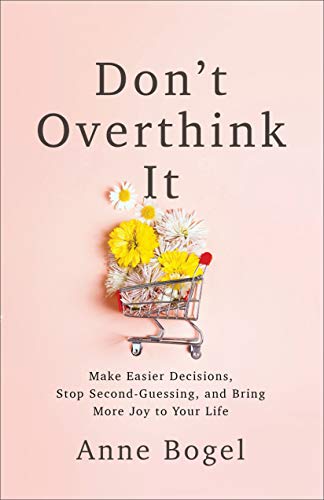
Book Review: Don’t Overthink It

Many life decisions require a time of waiting and serious thought. But some of us get stuck giving too much thought to things that don’t really matter. I can’t tell you how many times I have hovered between punching in 45 or 50 seconds on the microwave before finally entering 47.

Anne wrote Don’t Overthink It: Make Easier Decisions, Stop Second-Guessing, and Bring More Joy to Your Life to help fellow overthinkers combat “analysis paralysis” and “decision fatigue.”

Overthinking also carries a significant opportunity cost. Mental energy is not a limitless resource. We only have so much to spend each day, and how we choose to spend it matters (p. 15).

I could identify with Anne Bogel’s opening illustration. She had to make a road trip, but a severe storm was predicted to come across her route. Her two main options were to leave at the appointed time and hope she was okay driving through the storm, or leave several hours earlier and miss some family activities as well as the storm. Instead of coming to a decision, she kept refreshing the weather page on her computer.

One of the biggest takeaways from the book that helped me was the realization that sometimes there is no one right perfect answer. Anne realized that in her travel decision mentioned above: she wasn’t going to be entirely happy with either option. That took some of the pressure off, and she used other factors to arrive at a decision.

I went through this a few years ago when I needed a new bedspread. I found two that I liked—unusual for me, because my favorite colors haven’t been trendy in home decorating for a number of years. I loved the fabric pattern in both. One was a little busy: a faux quilt with fabric squares in no particular order. The other was a little too plain: mostly white with a design made out of a floral fabric strip. I spent weeks (maybe months?) dropping in the two different stores to look at my choices and coming away empty-handed. I finally bought the patchwork one, put it on my bed—and immediately wished I had bought the other one. Then I realized I would have had the same reaction with whichever one I bought because neither was 100% perfect. (I did come to enjoy the bedspread I bought. But I think realizing that neither choice was perfect freed me to like the one I got instead of pining away for the other. “It doesn’t have to be perfect to be good,” p. 43)

Some of the other strategies Anne discusses are starting small, approaching change with the belief that it’s possible, examining the causes of analysis paralysis, letting go of perfectionism, letting values inform decisions, creating routines to eliminate everyday decisions, not beating yourself up over mistakes, but learning from them and moving on, building in margins for the unexpected, adopting a “try and see” approach rather than a pass/fail one, and so much more.

The last resonated with me. Anne described a yearly trip her family took in which they squeezed all the driving into one day to get it over with and have more time at their destination. For years they discussed the pros and cons of breaking the trip into two days. Finally one year they decided to just try it and see how it worked out. It was an experiment: it wouldn’t ruin their vacation. If they didn’t like it, they could go back to their one-day drive next time. That takes the pressure off.

Another tip that stood out to me: “complete the cycle,” or, basically, finish what you start. Putting things where they belong, filing the paperwork while you have it in your hand, etc. “When we promptly complete our cycles, we get to bypass all kinds of avoidable last-minute emergencies” (p. 69).

Here are a few of the many quotes I highlighted:

When seeking a solution, highly intelligent people may see whole landscapes of possibilities that others don’t see—which may inadvertently lead them to make simple decisions needlessly complex. These positive traits have an unintended consequence: they make us prone to analysis paralysis because they prod us to search for additional options, whether or not we need them. Those extra options don’t lead to better decisions; they just overwhelm us. And when we’re overwhelmed, we can’t decide anything (p. 38).

When we put off doing something we don’t want to do, we keep the unpleasant thing right in front of us for much longer than we need to. As long as we’re contemplating the issue, we’re dwelling on the negative. If we’re dreading something, we can serve ourselves well by dealing with it sooner rather than later. If we’re overthinking something we can actually do something about, the best thing we can do is speed up to move on. Take action as quickly as possible (p. 88).

It’s a mistake to give all your thoughts equal weight. Some thoughts don’t deserve to be taken seriously, so don’t dignify them with a response (p. 105).

The book is divided into three parts with questions at the end of each chapter. Linda led a discussion of each part which really enhanced our reading. (Part 1 is here, 2 is here, 3 is here.) Thank you, Linda!

I appreciated that Anne’s tips were both practical and flexible. I think this book is a good resource for anyone prone to overthink.

(I’m counting this book for the Self-Help category of the Nonfiction Reading Challenge.)

(Sharing with Carole’s Books You Loved, Booknificent)

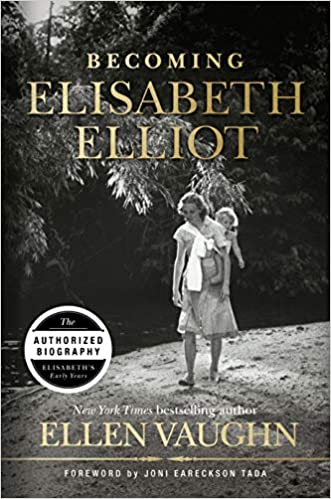
Book Review: Becoming Elisabeth Elliot

Elisabeth Elliot has been one of my heroes for decades. I first discovered her in college when I read Through Gates of Splendor, her book about the ministries and deaths of her husband and four friends. Then I read nearly everything she had written, received her newsletter and a Back to the Bible devotional mailing of her writings for years, and got to hear her speak in person twice.

The Elliots and their friends had wanted to reach out to a seemingly unreachable tribe in Ecuador. Though the beginning seemed promising, all five men were speared to death by the tribe, known then as Aucas (later by their own name for themselves, Waodani). A few years later, Elisabeth and her young daughter, Valerie, and Rachel Saint, sister to one of the other men, went to live among the Waodani. Some became believers, with a testimony that still stands to this day.

Elisabeth eventually came back to America. She authored 30 books and spoke to women, eventually hosting a radio program, Gateway to Joy, and sending out a monthly newsletter.

She surprised herself by remarrying a college theology professor, Addison Leitch. He succumbed to cancer four years later. She was an adjunct professor for a while. A few years later, she married Lars Gren. She had dementia the last several years of her life, lost the ability to speak, and died at age 88 on June 15, 2015.

Those are the spare details of her life. But they don’t capture her personality, her character. Why did so many women love to read her words and hear her speak and write her letters asking her advice about their problems?

Ellen Vaughn has attempted to answer those questions in her authorized biography, Becoming Elisabeth Elliot. I admit I had mixed emotions when I first heard of this project. Vaughn was well aware that she was going to be up against a number of expectations. She had access to Elisabeth’s multiple journals as well as many friends and relatives.

Of course, Elisabeth didn’t start out as the Elisabeth Elliot of such wisdom and depth. She began life as Betty Howard. Her early journals reflect a normal girlhood and a fair amount of teenage angst over boys and disagreements with her mother. Yet even as young as eleven, she showed a depth of thought and desire to follow and obey God. Betty Stam, who was killed by the Chinese along with her husband, John, had been a guest in the Howard home and made a great impression on young Betty. As a child, Betty Howard wrote and took Betty Stam’s prayer for her own.

Vaughn goes on to follow Betty’s education, meeting of Jim Elliot, and the long wrestling over whether they should marry. Jim had thought God wanted him to be a single missionary. When he became attracted to Betty, he wasn’t sure whether that was a result of God’s leading or his own desires. It took a few years to figure out. Finally he and Elisabeth married and worked among the Quichua Indians in Ecudaor. Then there are the details leading up to the Waodani outreach, the men’s deaths, Elisabeth’s wrenching grief, working with Rachel Saint, and return to the US.

The biography stops there, with a second volume in the works. I hadn’t realized that this was only part one until I started reading it. I wish that had been made more plain, but it wouldn’t have affected my desire to own and read the book.

Elisabeth was a critical thinker and wrestled with the ways of God, pat, churchy answers, what worldliness and being a missionary even meant, and so much more. She was strongly introverted and could come across as distant and aloof (when she first met Jim’s parents, he told her she had “made a universally horrible impression.”) She could seem unemotional, but she poured out her emotions in her journals.

One thing that Elisabeth discovered in her walk of faith was that God’s ways are inscrutable. She was a gifted linguist, and her first mission was an effort to reduce the Colorado language to writing. But the one man who knew both Spanish and Colorado well and who was willing to help her was senselessly murdered. Her careful work and notes were stolen. Her husband died. Her time of living with the Waodani bore some fruit but was fraught with frustrations. She felt all her work to that point was in ashes.

But she knew God was good and trustworthy, and the best thing, the only thing she could do was obey him, even when she didn’t understand. Her experiences and wrestling over issues of faith and practice made her who she was and gave her a depth and realism that struck chords with other women.

I felt overall that the biography did a good job. Ellen didn’t put Elisabeth on a pedestal, nor did she present her as unworthy of esteem. My one criticism is that, perhaps in an effort to show that Elisabeth was an ordinary woman and not a super-saint, some excerpts from her journals were shared that I can’t imagine Elisabeth would have wanted public. I understand why some people destroy their journals and letters before they die. I’m thankful Elisabeth didn’t, and I appreciate the insight they gave into her thinking. Still, some of it was probably not meant for public consumption.

Also, an index would have been helpful.

I’m looking forward to the next volume. I knew much about Elisabeth’s early life from her writings, but I’m not as familiar with the second half. I did learn several new things, however. For instance, I didn’t know (or forgot, if I had known) that Elisabeth was told about and wanted to go to the Waodani long before she and Jim married, and that part of the groups urgency to reach them was “rumors that the Ecuadorian government and the oil companies might well solve the ‘Waodani problem’ by using the military” (p. 139). Also, Through Gates of Splendor was written in a six-week period while she was in a hotel and her folks took care of her daughter. The publishers urgently wanted the story to be available. In her previous writings, I had sensed some tension between her and Rachel. The problems there are detailed here, and understandable. They were two very different personalities with completely different methods and training. I appreciate Elisabeth’s discretion in not dragging all of it out into the public eye.

I appreciate this summation of the Elliots near the end of the book:

Whether you agree or disagree with their choices, whether you resonate or not with their particular personalities, the takeaway from their lives is a reckless abandon for God. A willingness to cast off any illusions of self-protection, in order to burn for Christ. An absolutely liberating, astonishing radical freedom that comes only when you have, in fact, spiritually died to your own wants, ambitions, will, desires, reputation, and everything else (p. 274).

A couple of my friends reviewed this book as well:

Michele: A Life of Reckless Abandon for God
Ann: Becoming Elisabeth Elliot

(Sharing with Tell His Story, InstaEncouragements, Carole’s Books You Loved, Booknificent)

(I’m counting this book for the Biography category of the Nonfiction Reading Challenge.)

Spiritual Sacrifices

Sacrifice doesn’t seem like a beautiful word. It conjures up images of animals, blood, and altars, or it makes us think of something we should give up that we don’t want to.

Definition.org has this as one meaning of sacrifice: “Forfeiture of something highly valued for the sake of one considered to have a greater value or claim.”

On the one hand I think of the sacrifices God made for us. Think of the trouble humanity has cost Him on an everyday basis for millennia. Yet He created us and He desires our fellowship. Amazing! And because He does, He sent only begotten sinless Son, the Lord Jesus Christ, to lay down His life and take on Himself our sin and the just punishment we deserved. Jesus, in full agreement and in full submission to His Father, willingly surrendered, sacrificed His life for us. If we repent of our sin and believe on Him, we can be saved, cleansed, forgiven, and made His own children. In addition, we have a home waiting for us in heaven and His grace, presence, and help here and now. We don’t merit that forgiveness and salvation by any kind of sacrifice we make: there’s nothing we could ever do that would be enough to earn it. It’s a free gift based on His sacrifice.

In His example, though, I think the definition doesn’t fit in the sense of surrendering something highly valuable for something of more value. We are certainly not of more value than God’s Son. But He did love us enough to give His greatest treasure for our redemption.

In light of that, any kind of sacrifice we might make for Him pales in comparison. I’ve known of dear folks who echo David Livingstone’s sentiments:

People talk of the sacrifice I have made in spending so much of my life in Africa. Can that be called a sacrifice which is simply paid back as a small part of a great debt owing to our God, which we can never repay? Is that a sacrifice which brings its own blest reward in healthful activity, the consciousness of doing good, peace of mind, and a bright hope of a glorious destiny hereafter? Away with the word in such a view, and with such a thought! It is emphatically no sacrifice. Say rather it is a privilege. Anxiety, sickness, suffering, or danger, now and then, with a foregoing of the common conveniences and charities of this life, may make us pause, and cause the spirit to waver, and the soul to sink, but let this only be for a moment. All these are nothing when compared with the glory which shall hereafter be revealed in, and for, us. I never made a sacrifice. Of this we ought not to talk, when we remember the great sacrifice which HE made who left His Father’s throne on high to give Himself for us. (Speech to students at Cambridge University, December 4, 1857)

I get what he’s saying. Jesus did so much for us, and we don’t appreciate it nearly enough. We should be so filled with love and gratitude that we can’t help giving back to Him.

And yet—the Bible calls us to sacrifice to God and acknowledges the high cost. The animal sacrifices in the Old Testament were fulfilled in the life, death, and resurrection of Christ. But God calls us to other kinds of sacrifice.

You yourselves like living stones are being built up as a spiritual house, to be a holy priesthood, to offer spiritual sacrifices acceptable to God through Jesus Christ. 1 Peter 2:5

What kind of spiritual sacrifices are we to make?

For you will not delight in sacrifice, or I would give it; you will not be pleased with a burnt offering. The sacrifices of God are a broken spirit; a broken and contrite heart, O God, you will not despise. Psalm 51:16-17

Even in Old Testament times, the sacrifices which were a picture of the coming perfect Sacrifice could be an empty ritual if one’s heart was not broken and contrite before God. I think this is the first sacrifice: our pride, our stubborn clinging to our “own” way, our laying aside of anything in our lives that is not pleasing to God. It’s also a continual sacrifice as we walk daily with the Lord, read His Word, grow in Him, and become more aware of how much that desire for our “own” way is ingrained in our thinking.

I appeal to you therefore, brothers,by the mercies of God, to present your bodies as a living sacrifice, holy and acceptable to God, which is your spiritual worship. Romans 12:1

Not just our broken spirit and heart, but even our bodies are to be surrendered to Him. He reminds us that this is only our reasonable service in light of God’s mercies to us.

Through him then let us continually offer up a sacrifice of praise to God, that is, the fruit of lips that acknowledge his name. Hebrews 13:15

I’ve wondered why our praise to God would be called a sacrifice: perhaps because we have to get our attention off ourselves and our concerns.

Do not neglect to do good and to share what you have, for such sacrifices are pleasing to God. Hebrews 13:16

Some years back my husband commented on the honesty of this verse, acknowledging that it does cost us something to do good to others.

I have received full payment, and more. I am well supplied, having received from Epaphroditus the gifts you sent, a fragrant offering, a sacrifice acceptable and pleasing to God. Philippians 4:18

This and the previous verse indicate that sometimes those spiritual sacrifices manifest themselves in meeting physical needs. Paul’s response to the Philippians’ sacrifice shows forth some of the beauty of a sacrifice given and received.

Several years ago, my husband took our youngest son out to shop for my birthday. My son was excited about perhaps buying a little something for himself after getting Mom’s present. As my son chose the item he wanted to purchase for me, my husband told him that item would take all the money he had. It took my son a few moments to process the realization that if he bought that gift for me, he wouldn’t be able to buy anything for himself. Finally, though a little teary, he decided to go ahead with the purchase. I can’t tell you how that touched my heart to realize that he denied himself to do something special for me.

Even if I am to be poured out as a drink offering upon the sacrificial offering of your faith, I am glad and rejoice with you all. Philippians 2:17

Paul was willing for his life to be poured out in ministry to others.

And walk in love, as Christ loved us and gave himself up for us, a fragrant offering and sacrifice to God. Ephesians 5:2

Even more than Paul, Christ is our example of walking in love and giving oneself.

It’s okay to call a sacrifice a sacrifice. The Bible does. It’s even okay to say it hurts. Jesus agonized in the garden of Gethsemane. Hebrews 12:1-2 says that Jesus endured the cross for the joy set before Him.

Therefore, since we are surrounded by so great a cloud of witnesses, let us also lay aside every weight, and sin which clings so closely, and let us run with endurance the race that is set before us, looking to Jesus, the founder and perfecter of our faith, who for the joy that was set before him endured the cross, despising the shame, and is seated at the right hand of the throne of God.

We can look ahead, too, to the time when every sacrifice will fade away for joy.

For I consider that the sufferings of this present time are not worth comparing with the glory that is to be revealed to us. Romans 8:18

So we do not lose heart. Though our outer self is wasting away, our inner self is being renewed day by day. For this light momentary affliction is preparing for us an eternal weight of glory beyond all comparison, as we look not to the things that are seen but to the things that are unseen. For the things that are seen are transient, but the things that are unseen are eternal. 2 Corinthians 4:16-18

Often, what makes a sacrifice seem hard is the struggle to give up what we think is ours: our time, our schedule, our goods, our lives. But as David prayed after the people of Israel offered the things needed for the building of the temple, “But who am I, and what is my people, that we should be able thus to offer willingly? For all things come from you, and of your own have we given you.” (1 Chronicles 29:14). If we remember that anything we have is not our own but was given to us by God in the first place, and if we meditate on His mercies and all He has done for us, it doesn’t seem so hard then to surrender it back to Him. Back to our definition, whatever the value of what we sacrifice, it pales in comparison to the worth of the One to whom we are sacrificing.

The beauty of sacrifice is the humble surrender to God of what He freely gave us, in response to His great love and mercy, for use in His service in a life of love and ministry to others, which He regards as wellpleasing, as a “sweetsmelling savour.”

The Lord is God, and he has made his light to shine upon us. Bind the festal sacrifice with cords, up to the horns of the altar! Psalm 118:27

(Revised from the archives)

(Sharing with Hearth and Soul, Sunday Scripture Blessings, Selah, Scripture and a Snapshot, Inspire Me Monday, Senior Salon, Tell His Story, InstaEncouragements, Let’s Have Coffee, Recharge Wednesday, Share a Link Wednesday, Heart Encouragement, Grace and Truth, Blogger Voices Network, Faith on Fire)

Laudable Linkage

IMG_0195

A short but meaty list of good reads from this week:

There Are No Shortcuts to biblical discernment. HT to Challies.

A Christian Response to Riots Left and Right. “Peaceful protest is a protected right in this country, rioting is not. Let’s set the politics aside and consider the biblical principles for a moment.”

More than Sexual Purity, HT to Challies. “The unintentional message over time was that this was spiritual maturity: consistent devotions and sexual purity. By setting such a low bar for men, though, we inevitably train men to be lazy, selfish, insecure, and ambitionless. We raise a generation of men to check spiritual boxes and then live for Xbox. But men are capable of so much more in Christ than Bible reading and self-control (not to diminish either).”

When Your Identity Becomes a Liability: 4 Responses to Unjust Suffering. I fear the days are coming when we’ll need this.

An Illustration of Repentance, HT to Challies. I found this helpful in understanding why there’s not always instant outward change when we seek repentance.

Dignity Beyond Accomplishment, HT to Challies. “She loves her life. She loves her life even though she will, like most Americans, never finish an Ironman. But that does not finally matter. Human life is good and worthy of dignity not because of accomplishment, but simply because it is loved into being by God.”

Though I don’t like parents lying to kids, even for fun, I love this little boy’s response to hearing that his mom ate all his candy. I wonder, though, what the mom was expecting and why she would do this.

Friday’s Fave Five

On Fridays I like to pause for a few moments with Susanne and friends
to reflect on some of the blessings of the week.

It has been a quiet week in many ways. Here are some of the best parts:

1. A friend’s very good news. She had waited many weeks to be able to have a biopsy. Finally had it last week, and the results came back this week: no cancer! Praise the Lord!

2. A peaceful transfer of power. Whichever administration you prefer, I appreciate that we have an orderly manner for a transfer of leadership in this country. We’re so used to it, we take it for granted. But it hasn’t happened this way for much of history and still doesn’t in some countries. (Please, no commentary on one administration over another. I try to avoid politics here.)

3. A rescheduled schedule. I noticed several weeks ago that I had four appointments bunched up together in January. On one hand, it would have been nice to get them all over with at once. But I just don’t operate well with that many outside appointments so close together. I made some phone calls and rescheduled them to about one a week and have enjoyed that pacing.

4. An impromptu visit. My son and daughter-in-law have been super-busy with projects on their new house. It needed a lot of cleaning, painting, and little fixes. Then she texted me to ask if they could come over Thursday night to escape paint fumes for a while. We always enjoy visiting with them, but had a fun time with dinner and seeing pictures of what they had accomplished so far.

5. Lindt Lindor milk chocolate truffles. This is my favorite candy, and I usually receive some on special occasions. But my husband has found some at a discount store he frequents, so I have had some on hand ever since Christmas. I try to ration them out to just one or sometimes two a day–it’s too easy to just pop them in one after another! I’ve been happy to have my occasional special treat a little while longer than usual.

It’s been a cold and overcast week. I’m hoping to see sunshine and blue skies sometime soon. I just saw a plump robin on the tree outside—a reminder that spring is coming.

Book Review: Daddy Long Legs

I’ve read a couple of books based on the 1912 Daddy Long Legs by Jean Webster (Dear Mr. Knightly by Katherine Reay and Sincerely, Jem by Kate Willis in A Very Bookish Christmas). But I had never read the original story. I figured it was time to remedy that.

Jerusha Abbott,, who calls herself Judy, has grown up in the John Grier Home orphanage. She has just about aged out of the system. She’s finished high school and is working at the home.

Then she receives word that one of the trustees has offered to pay her way through college. One of Judy’s teachers had told him she could be an excellent writer. The trustee will pay all of Judy’s expenses and give her an allowance. The donor does not want Judy to know who he is. He’ll communicate through his secretary. His only requirement is that she write him a letter once a month about what she’s learning.

The rest of the book is made up of Judy’s letters. She was told to address her letters to Mr. John Smith. She had caught a glimpse of him from behind during one of the trustees’ monthly meetings to the orphanage. She could only make out that he was very tall, so she nicknames him Daddy Long Legs.

Although thoroughly excited by her opportunity, Judy faces challenges as well. An East Coast girl’s college is a different environment from an orphanage. Judy faces a social learning curve as well as an academic one.

But for the most part she faces life optimistically. Her letters are usually lively and cheerful. But sometimes she’s downhearted or angry—sometimes with Daddy Long Legs.

Since I’d read other books based on this story, I knew the surprise twist near the end of who “Daddy” was. But it was still satisfying to see how it came about and to see little clues appear.

The original books contained some drawings by the author (Judy refers to them in her letters). But, unfortunately, the free Kindle version didn’t have them.

One thing that irked me, though, was that Judy seemed to feel obligated to make several “digs” at religion. Yes, this is a secular book, and so I don’t expect it to portray Christian values. But I don’t expect it to poke at them, either. What religious instruction Judy had at the orphanage seemed institutional and cheerless (she says of one dinner with new friends, ““We don’t have to say grace beforehand. It’s a relief not having to thank Somebody for every mouthful you eat. [I dare say I’m blasphemous; but you’d be, too, if you’d offered as much obligatory thanks as I have.”]) Maybe that’s what she’s rebelling against. But I couldn’t help wonder if some of these thoughts were the author’s and this was her way to get them out into the world. One thing Judy shares from her vast amounts of reading in college was that “I didn’t know that people used to be monkeys and that the Garden of Eden was a beautiful myth.” Maybe that’s what starts her on a negative religious path; maybe it was there before and this new “learning” brought it to the forefront. Elsewhere she says, “Thank heaven I don’t inherit God from anybody! I am free to make mine up as I wish Him. He’s kind and sympathetic and imaginative and forgiving and understanding—and He has a sense of humour.”

A couple of quotes I enjoyed:

It isn’t the big troubles in life that require character. Anybody can rise to a crisis and face a crushing tragedy with courage, but to meet the petty hazards of the day with a laugh—I really think that requires SPIRIT.

Most people don’t live; they just race. They are trying to reach some goal far away on the horizon, and in the heat of the going they get so breathless and panting that they lose all sight of the beautiful, tranquil country they are passing through; and then the first thing they know, they are old and worn out, and it doesn’t make any difference whether they’ve reached the goal or not.

Normally epistolary novels aren’t my favorite, but this was a pleasant read. The author has a nice style. Someday soon I hope to get to the sequel, Dear Enemy, focusing on one of Judy’s roommates.

I am counting this book as my classic by a new-to-me author for the Back to the Classics Challenge.

(Sharing with Carole’s Books You Loved)

Whatever happened to these sayings?

I don’t want to be guilty of that bane of older people: considering everything “back in my day” to be superior. No era or society has been perfect since Eden.

Many societal perspectives have improved from what I grew up with. And I love the conveniences, technology, and multiple ways to communicate that we have today. 

But in my youth, I heard certain sayings repeated enough to become truisms. I don’t hear them any more, but I think we need them more than ever.

  • I disapprove of what you say, but I will defend to the death your right to say it” (Evelyn Beatrice Hall). Freedom of speech used to be one of highest values in this country. Now, if you don’t fit within the prevailing narratives, you’re publicly shamed or “canceled.” We’ve gone from absolute truth to the postmodern lack of absolute truth to “My truth is the only truth.”
  •  
  • “It takes all kinds to make a world.” That seemed to sum up how people reconciled the fact that others could think so differently from themselves. Along with this one was:
  • “Live and let live.” Most didn’t advocate “anything goes.” There are times to speak out against wrongdoing. But we’re also not made with cookie cutters. We won’t all do and act the exact same way in everything.
  • “Before you judge a man, walk a mile in his shoes.” This encouraged people to consider the background, personality, and perspective of others. Now, people make all sorts of judgments based on a 140-character tweet instead of trying to understand the other person’s viewpoint.
  • “We’ll have to agree to disagree.”This one went around fairly recently, but it’s been quickly forgotten. Now people can’t seem to just disagree on matters large or small without vilifying each other.
  • “Don’t believe everything you read.” A corollary to this was “Just because you see it on TV (or in the newspaper) doesn’t mean it’s true.” Now we tend to believe articles and posts that support our views and disbelieve whatever doesn’t.

Of course, these are limited. They are not Scripture. Some may have exceptions. But they are pretty good common sense, and some are based on Scriptural truth.

What do think? Is it possible to bring these back? Can you think of any others?

(Sharing with InstaEncouragements, Grace and Truth, Senior Salon)

The Dreaded Proverbs 31 Woman

The Dreaded Proverbs 31 Woman

“Oh, her.” Eye-roll.

That might be the reaction you get if you mention the Proverbs 31 woman these days.

I had not grown up with a lot of Biblical teaching. So when I read Proverbs 31 some time after becoming a Christian, I aspired to be like the woman described there. I never felt I’d “made it.” But I thought she was a worthy role model

I hear a lot of women expressing dismay or discouragement over this ideal woman. They feel they can never live up to her, and every reading or sermon on this passage only shows up their shortcomings all the more.

Well, she is an ideal woman. In context, a mother is advising her son about a virtuous woman (according to the KJV and NKJV. Many translations describe her as “excellent”; the NIV and CSB call her “a wife of noble character.”)

But this passage is more than just a mother’s high ideals for her son. Since “all Scripture is given by inspiration of God, and is profitable for doctrine, for reproof, for correction, for instruction in righteousness” (2 Timothy 3:16-17), this passage is God speaking through this mother to us through the ages. And I don’t think He meant the passage as a discouragement or a stick to beat over our heads.

If you think about it, there is someone even higher that we’re supposed to be like.

You therefore must be perfect, as your heavenly Father is perfect. (Matthew 5:48)

Now, that can be discouraging! But this passage and others like it point out how far we fall short in order to alert us to our need for Christ’s righteousness and grace. We know we’re not perfect on our own and never can be. As the hymn says, “My hope is built on nothing less than Jesus’ blood and righteousness.” Jesus lived a perfect life, keeping all God’s law, and then died on the cross for our sins, was buried, and then rose again (1 Corinthians 15:1-4). When we believe on Jesus as Savior and Lord, His righteousness is attributed to us (imputed is the theological term). “For our sake he made him to be sin who knew no sin, so that in him we might become the righteousness of God” (2 Corinthians 5:21). So when we stand before God some day, He is not going to check off all the boxes of Proverbs 31. He’s going to look for the righteousness of Christ, which can only be received by faith.

When we believe on Christ, we’re changed. As we read His Word and grow in Him, we become more like Him (2 Corinthians 3:18). We might think of Proverbs 31 as what the righteousness of Christ would look like lived out in the home. Many of these traits are repeated for both men and women in the New Testament.

The Proverbs 31 woman didn’t do everything in this passage in a day. The picture is of her lifetime. Just like we’ll never be completely like Christ until we get to heaven, but we should be growing more like Him day by day, so we can grow more like this woman.

We have to remember, too, the context of the times in which this was written. A 21st-century virtuous woman’s activities will look different from a woman of King Solomon’s time.

There are scores (maybe hundreds) of books, messages, studies, etc. on this passage. So we won’t exhaust it here. But here are a few principles drawn from the life of this lady:

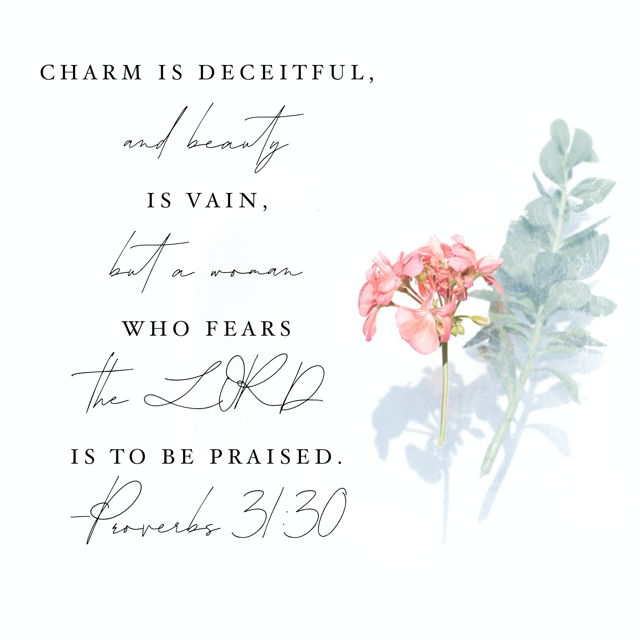
She loves and reverences God. “Charm is deceitful, and beauty is vain, but a woman who fears the Lord is to be praised” (verse 30). Though this aspect is mentioned last, it permeates the rest of the passage.

She is trustworthy. “The heart of her husband trusts in her, and he will have no lack of gain. She does him good, and not harm, all the days of her life” (verses 11-12). She doesn’t hide things from him or present a false front.

She’s industrious. “She looks well to the ways of her household and does not eat the bread of idleness” (verse 27). She “works with willing hands” (verse 13b). She’s active about the household and diligent in providing food and clothing for the family (verses 13-15, 18-19, 21-22, 24).

She’s kind. “The teaching of kindness is on her tongue” (verse 26b).

She ministers to those in need. “She opens her hand to the poor and reaches out her hands to the needy” (verse 20).

She’s wise. “She opens her mouth with wisdom” (verse 26a).

She’s savvy. She can buy a field, she knows how to discern if merchandise is good (verses 16, 18, 24). In David Copperfield, his first wife is a sweet, pretty thing named Dora. But she couldn’t manage a household. She called herself a “child-wife.” I don’t know if I could buy a field—it’s a bit more complicated than it was in Old Testament times. We’ve bought and sold property—or rather, my husband has, and I have cosigned. I’ve been so thankful he understood all the paperwork. But whether I could buy a field or not, I don’t have to be a child-wife.

She plans ahead. “She is not afraid of snow for her household, for all her household are clothed in scarlet” (verse 21). The ESV note says “scarlet” could be translated as “in double thickness.”

She’s strong. “She dresses herself with strength and makes her arms strong. . . . Strength and dignity are her clothing, and she laughs at the time to come” (verses 17, 25). I wrote more on being a strong woman here.

She cares about her appearance. “Her clothing is fine linen and purple” (verse 22b). Purple was not a common clothing color in those days. In my younger years, I wondered if it was wrong to want to look attractive. This verse helped my thinking, as did the fact that God made the world beauitful when He could have made it just functional. Of course, we can go too far in this area. Peter reminds us that it’s “the hidden person of the heart with the imperishable beauty of a gentle and quiet spirit, which in God’s sight is very precious,” rather than “external adorning” (1 Peter 3:3-4). We have to be balanced. But at least the Proverbs 31 women isn’t slovenly in her home or clothing.

She’s respected. Her children call her blessed and her husband praises her (verses 28-29). OK, maybe not every day. Remember this is a summation of her whole life. Moms and children have their bad days. But over the course of life, her behavior and attitudes are such that her family should be able to see her value and respect her. Her husband sitting in the gates with the elders (verse 23) indicates a position of respect and leadership for that time as well. Her activities and demeanor help him rather than detract from his position.

Remember, this woman is a personification of the ideal. No real woman has everything together all the time. We can give ourselves grace even as we seek God’s help and strength to grow in these traits. Elisabeth Elliot said, “The fact that I am a woman does not make me a different kind of Christian, but the fact that I am a Christian makes me a different kind of woman.” I hope that, instead of dreading or disliking or fearing the Proverbs 31 woman, you’ll look on her as a friend, a picture of what a “different kind of woman” looks like.

Proverbs 31:30

(Sharing with Sunday Scripture Blessings, Selah, Scripture and a Snapshot, Hearth and Soul, Inspire Me Monday, Senior Salon, Remember Me Monday, Tell His Story, InstaEncouragements, Recharge Wednesday, Let’s Have Coffee, Share a Link Wednesday, Heart Encouragement, Grace and Truth, Faith on Fire, Blogger Voices Network)