I hope you all have a very special Christmas! May this sweet thought be a blessing to you:


I hope you all have a very special Christmas! May this sweet thought be a blessing to you:

(Photo courtesy of Bev Lloyd-Roberts at the stock.xchng.)
Most of us have a vision in our minds of the perfect Christmas: family gathered around, a clean and sparkling house, a beautifully adorned Christmas tree with piles of lovingly chosen presents underneath, a feast for the eyes and the table, scents of roasting turkey or ham, pumpkin pies, apple cider, everyone marvelously getting along like the end of a made-for-TV movie.
But what if that’s not reality this year?
What if one member is in prison? Or the hospital? Or overseas or across the country? Or in heaven?
What if a lost job or a major medical expense has led to a depleted bank account and bare cupboards?
What if grief overshadows joy?
Is Christmas then ruined?
Let’s go back to that first Christmas.
Mary and Joseph away from home in a strange city. They did not have a beautifully decorated house: they did not even have a hotel room. The only scents of the season were those of nearby animals. Mary, as a young, first-time mother, did not have the blessing of a modern hospital and sanitary conditions, a skilled nursing staff and childbirth training. Giving birth was painful and messy. If Joseph was her lone attendant, he would have been out of his element helping a woman deliver a baby. Perhaps he was dismayed or frustrated that he could not provide better for her in her moment of need. And after the blessed relief of a healthy child safely born, there was little acknowledgment of this Child. The shepherds, Simeon and Anna, and, later on, the wise men rejoiced in who He was. But soon the young parents would face the danger of a king bent on killing the Child in their care. Mary’s reputation would suffer as many thought her Child was illegitimate. The ominous promise hung over her head that a sword would pierce through Mary’s own soul.
What did Mary and Joseph have then, that lonely, uncomfortable, smelly night? They had the Child of promise. A Child whom they were told to name Jesus, which means “Jehovah saves.” His very name is a promise. He would reconcile them to God by taking care of their greatest need: He would “save His people from their sins.” They had the realization that this Child was the long-awaited and longed-for Messiah, the King, the Son of the Highest. What cause for joy and wonder! They had no idea how it would all work out. But they had the promise, and because of the promise, they had hope.
It’s certainly not wrong to enjoy a decorated tree, presents, wonderful food, and family gathered. But we can celebrate Christmas even all of those elements are missing or less than ideal. We can celebrate in our own hearts and with those around us that same promise, that same hope. Like Mary, we can treasure these things and ponder them in our hearts. Like the shepherds, we can make “known the saying that had been told them concerning this child” and go back to daily life “glorifying and praising God for all they had heard and seen, as it had been told them” (Luke 2: 17-20). If all we have is faith in Jesus’ fulfillment of the hope and promise of that first Christmas, we are blessed indeed.
(Revised from the archives)
(Sharing with Inspire Me Monday, Global Blogging, Senior Salon, Hearth and Soul,
Happy Now, InstaEncouragement, Anchored Abode, Grace and Truth, Faith on Fire)

This evening marks 40 years my husband and I have been married!
I had not planned to post about it until next week’s Friday’s Fave Five. But then I accidentally came across a post from ten years ago on 30 things I love about my husband on our 30th anniversary. So I thought I’d repeat and expand it.
40 Things I Love About My Husband:
1. He loves God.
2. He fulfills well the admonition in Deuteronomy 6:7 to teach children God’s Word in the course of daily life: “And thou shalt teach them diligently unto thy children, and shalt talk of them when thou sittest in thine house, and when thou walkest by the way, and when thou liest down, and when thou risest up.” Jeremy has said he gets more out of a conversation with his dad than almost any sermon.
3. He is a wonderful father.
4. He leads gently, not tyrannically or despotically.
5. He has kind eyes.
 6. He kills bugs for me.
 7. If he drives my car and notices the gas is low, he fills the car up for me.
8. He knows how to fix a multitude of things.
9. He is smart.
 10. He can usually handle problems and issues with people firmly but not angrily.
11. He is calm in a crisis and knows what to do or can figure it out in short order.
12. He has a great sense of humor.
13. He is very patient with my foibles.
14. He is a great griller!
 15. After Thanksgiving dinner he gets the rest of the meat off the turkey and then cleans out the roasting pan.
16. Sometimes he will clean the bathrooms unasked and unexpectedly.
17. He has a strong work ethic. He not only works hard and long to support us, he likes to do his best at any task.
 18. He took excellent care of his mother.
19. He is generous.
20. He has a lot of financial savvy.
21. He has a lot of sanctified common sense.
22. He is discerning.
23. He is generally more relaxed than I am. I appreciate the counter balance to my tenseness.
24. He can handle most of the technological stuff.
25. He is thoughtful.
26. He is more outgoing than I am.
27. Though he probably would say he doesn’t feel at ease in social situations, he handles them with apparent ease.
28. He is generally more upbeat and cheerful than I am. If he does get into a bad mood of some kind, it doesn’t usually last long.
29. He is still a gentleman.
30. He’s a man of strong principles.
31. He builds things for me.

32. When there’s one piece left of a special treat he knows I like, he leaves it for me.
33. He’s a wonderful father-in-law.
 34. He’s a wonderful granddad.
 35. He listens when I need to talk something out.
36. He likes to find good deals.
37. He likes to problem-solve and is good at it.
38. He is compassionate.
39. He shows his love to me in countless ways every day.
40. He made this video for me eleven years ago to one of my favorite songs: “The Voyage,” sung by John McDermott of the Irish Tenors. I love to watch it every year. Some day we need to make an updated version.
Happy, happy anniversary! I wouldn’t have wanted to spend the last 40 years with anyone but you!
(Sharing with Global Blogging, Senior Salon, Hearth and Soul, Happy Now, InstaEncouragement, Grace and Truth)
 It’s Friday, time to count the blessings of the week
with Susanne and other friends at Living to Tell the Story.
During the busiest weeks, it’s still important to stop and count our blessings—maybe even more important then since they can so easily be forgotten in the rush of activities. But since we are busy, I’ll keep it short and sweet.
1. Christmas cards and newsletters. We get fewer every year, but I love sending and receiving them.
2. Christmas lights. They provide such cheer, I always hate to take them down after Christmas. I know we don’t know for sure exactly when Christ was born, but I love that we celebrate His birth in the darkest part of the year. That makes all the verses about light seem even more meaningful.
The people who walked in darkness have seen a great light; those who dwelt in a land of deep darkness, on them has light shone (Isaiah 9:2).
My eyes have seen your salvation that you have prepared in the presence of all peoples, a light for revelation to the Gentiles, and for glory to your people Israel” (Luke 2:30-32).
Again Jesus spoke to them, saying, “I am the light of the world. Whoever follows me will not walk in darkness, but will have the light of life” (John 8:12).
3. Packages arriving from all the online ordering. Fun! One even went to the wrong place, but the recipient graciously brought it to us.
4. Tylenol and Icy Hot spray. My back has been giving me a hard time this week.
5. Central heat. I know I say this every year. But it’s been cold this week, and I am so thankful all I have to do is push a button to turn the heat up.
I hope your Christmas preparations are going well, and I hope you have a wonderful Christmas!
Some time before the end of the year, probably after Christmas, I’ll post the books I read this year as well as my top ten or so. Meanwhile, I’ll post the wrap-ups to some of the reading challenges I’ve participated in.

It’s amazing, isn’t it, that we accumulate books we really want, but then they sit unread for months or years.
Adam at Roof Beam Reader hosted the TBR Pile Challenge to encourage us to get to those books on our shelves, Kindles, or TBR lists. The goal was to read twelve books, and we could choose two alternates in case we decided not to finish one of our original picks. I’m happy to report that I was able to complete everything on my list. The titles link back to my reviews, and the date immediately following is the year of publication.
My alternates were Saving Amelie by Cathy Gohkle (2014, finished 3/17/19) and Close to Home by Deborah Raney (2016, finished 6/3/19).
I enjoyed all of these to some degree. I’ll probably benefit most from On Writing Well (at least I hope can remember to incorporate its instruction). How to Understand And Apply the New Testament and There’s a Reason They Call It GRANDparenting had lots of great advice. Booked had much food for thought. A Little Princess and The Wednesday Letters were sweet and charming. So was How Green Was My Valley except for a couple of scenes. Annabel Lee was riveting. 84, Charing Cross Road had been on my TBR list for years, so I was glad to finally see what it was all about. Leisha Kelly’s series was a favorite. Steal Away Home brought a story to light I had been unaware of. Terri Blackstock’s books are always good, and her If I Run series provided great reading time. So did Deborah Raney’s Chicory Lane series. Cathy Gohkle is a new-to-me author but already a favorite.
I’m sad that Adam won’t be continuing this challenge next year. But I enjoyed the fun motivation to actually get to these books.
 The Gilded Age: A Tale of Today is not one of Mark Twain’s more well-known books. It’s the only one he wrote with a collaborator, Charles Dudley Warner, who was also a friend and neighbor. The story goes that their wives challenged them “to write a better novel than what they were used to reading.”
But this book is distinctive for an additional reason: its name became applied to the era after Reconstruction until the 1900s. According to this site, “American economy grew at its fastest rate in history” during this period. Such a rise gave way to more industrialization and a class of sudden and ultra-wealthy citizens. “The period also was marked by social movements for reform, the creation of machine politics, and continued mass immigration.” according to the same site.
Twain’s and Warner’s novel satirizes much that was characteristic of the era. But the story itself focuses on a few individuals.
The Hawkins family is poor but decent, located in Obedstown, TN. The family patriarch, Si, has bought 75,000 acres of Tennessee land. It’s not worth much at present, but with the expected changes on the horizon—the expansion of the railroad and discovery of coal for fuel—Si expects some day the land can be sold for a fortune and provide for his children.
In the meantime, their old friend Eschol Sellers has written to urge them to come to Missouri for the wealth of opportunities there. Mrs. Hawkins supports her husband’s decisions, but following Sellers has not boded well for them in the past. He means well, but he always comes up with grand schemes that never quite work out as expected.
On their way, they acquire two more children by adoption who have been newly orphaned. Their fortunes go up and down—mostly down. Si is tempted to sell the Tennessee land several times, but holds out. The older children venture out to work and help the family.
Parallel to the Hawkins and Sellers story is that of two friends, Harry and Phillip, who set put to make their fortune by becoming civil engineers for the railroad. Harry seems like a more refined version of Sellers, but Phillip is earnest and wants to truly learn the job.
The young men eventually cross paths with Laura Hawkins, the adopted daughter who has grown into a fascinating beauty. Henry is smitten. Laura is not unkind, but neither is she interested in Henry. Phillip is also in love with a girl who wants to become a doctor and isn’t interested in committing herself to a relationship.
Laura has an unfortunate relationship with a man who swept her off her feet and encouraged her to elope. When he gets tired of her, he confesses that he was already married and therefore his marriage to her was a sham. He leaves her. Laura changes as a result, becoming more calculating and ruthless.
Sellers, Laura, and Washington Hawkins end up in Washington DC in a grand scheme to get Congress to buy the Tennessee land to establish a college for Negroes. The book’s authors seems to believe that there is not a sincere, uncorrupt senator or representative, and we see a lot of the machinations of the political process: “The chances are that a man cannot get into congress now without resorting to arts and means that should render him unfit to go there.”
Some of the characters end in tragedy. Some are singed by circumstances but wiser in the end. A couple receive a hard-won happy ending.
Some sections are autobiographical. Twain’s biography says that his father had his own version of Tennessee land that always seemed to hold out hope for a good future, and his brother was killed in a steamboat accident similar to the one that orphaned Laura. One section of the book describing Phillip has a footnote that his life to that point mirrored Warner’s.
I understood how the book’s title could be applied to the era. Of course, the era wasn’t named the Gilded Age at the time Twain and Warner wrote. So, though they were satirizing the times, I think they also might have been pointing out the futility of so many individuals in the story who were seeking after the next great elusive thing instead of settling down and working hard for their goals and livelihoods.
Though this book is satire, it also has some wonderfully sweet and poignant moments.
The book kind of dragged in the middle for me, with the young men’s relationships and everyone’s schemes not going anywhere. But it picked up again in the end, with some parts being riveting.
There are a few “damns” in it. The portrayal of black people was probably accurate to the times but is condescending and insensitive in places.
Eschol Sellers’ first name is different in some versions because a real Eschol Sellers showed up and protested after the book was first published. Sellers was based on a cousin of Twain’s who was influential in his father’s land deal.
A few of my favorite quotes:
He . . . was not wanting in courage, but be would have been a better soldier if he had been less engaged in contrivances for circumventing the enemy by strategy unknown to the books. It happened to him to be captured in one of his self-appointed expeditions, but the federal colonel released him, after a short examination, satisfied that he could most injure the confederate forces opposed to the Unionists by returning him to his regiment.
There are many young men like him in American society, of his age, opportunities, education and abilities, who have really been educated for nothing and have let themselves drift, in the hope that they will find somehow, and by some sudden turn of good luck, the golden road to fortune. He was not idle or lazy, he had energy and a disposition to carve his own way. But he was born into a time when all young men of his age caught the fever of speculation, and expected to get on in the world by the omission of some of the regular processes which have been appointed from of old. And examples were not wanting to encourage him.
Whatever her thoughts may have been they were unknown to Philip, as they are to these historians; if she was seeming to be what she was not, and carrying a burden heavier than any one else carried, because she had to bear it alone, she was only doing what thousands of women do, with a self-renunciation and heroism, of which men, impatient and complaining, have no conception. Have not these big babies with beards filled all literature with their outcries, their griefs and their lamentations? It is always the gentle sex which is hard and cruel and fickle and implacable.
I listened to the audiobook wonderfully read by Bronson Pinchot. He did an amazing job with the nuances, inflections, and numerous accents. One nouveau riche character is Irish but has traveled in France and changed her last name to a French pronunciation. Bronson nails an Irish accent trying to sound French as well as a variety of Southern accents.
This book first came to my attention when I was searching for a book set in TN for the “Classics from a place you have lived” category of the Back to the Classics challenge. As it turned out, only parts of the book take place in TN. But many of the main characters are from TN, and the “Tennessee land” is almost a character itself, so I am hoping this book will still qualify.
Have you ever read this book? What did you think?
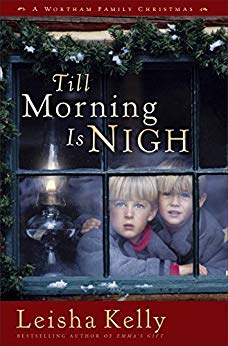 Till Morning Is Nigh: A Wortham Family Christmas by Leisha Kelly comes about in the middle of her six-book series about the Wortham family. I finished the series back in September but wanted to save the Christmas story until now.
The Wortham family had been down and out during the Depression. With their last hope of a job fallen through, they hit rock bottom. They took shelter in an abandoned house, then got the idea that perhaps the owners would let them stay there in exchange for fixing up the place. The owner was an elderly woman named Emma who took a chance on the family. She had not been able to live home alone, but the Worthams eventually moved her back into her home with them, and she became a grandmother and mentor to the family. That was back in Book 1, Julia’s Hope.
This story opens several years later. Emma has passed away as has the Wortham’s neighbor, Mrs. Hammond, a mother of ten children. George Hammond had been devastated and unstable after his wife’s death, and the Hammond children often spent as much time at the Wortham’s house as their own.
George had seemed to settle down for a while. But now it’s the first anniversary of his wife’s death, and he’s missing. The older children think perhaps he has drowned his sorrows in a drinking binge, but they fear worse. Some of the middle children are angry. The younger children are just sad and afraid. The Worthams take them all in and try to help. On top of everything else, some of them have the flu.
While nursing the various sick ones, keeping everyone fed, praying and worrying, Samuel and Julia Wortham try to prepare a meager Christmas and discuss what they should do if the worst has happened to George.
When a friend tells Julia, “I don’t know how you do it,” Julia responds, “I don’t. Whatever you think I’m accomplishing, I really can’t manage at all. Nothing but the good Lord could have gotten me through this holiday.”
Someone suggests that they make a Nativity scene out of what materials they have. The project starts out as a diversion but eventually becomes meaningful in various ways to different ones.
This story is a reminder that not all Christmases are giddy parties. Sometimes deep grief and stark need prevent the usual Christmas we’ve come to expect. But joy, love, and light can shine in and touch hearts.
I think this book could be read easily as a stand-alone. Enough of the back story is explained that readers new to the series wouldn’t feel lost. But the story is richer for having read the rest of the Worthams’ books. I enjoyed them all, so I recommend them all to you.
(Sharing with Grace and Truth, Carole’s Books You Loved, Booknificent)

Our church is reading through Matthew this month. Luke’s account of Christ’s birth is more detailed than Matthew’s compact version. But one thing that stands out to me in Matthew’s telling is at the end of chapter one.
After reassuring Joseph that Mary is still pure and her pregnancy is of the Holy Spirit, the angel says: “She will bear a son, and you shall call his name Jesus, for he will save his people from their sins.” Then Matthew adds this comment:
All this took place to fulfill what the Lord had spoken by the prophet: “Behold, the virgin shall conceive and bear a son, and they shall call his name Immanuel” (which means, God with us).
Jesus was to be the baby’s name, but He would also be called Immanuel. The prophecy Matthew quoted was from Isaiah 7:14, written around 700 years before Matthew’s book.
We often zip by that phrase to get to the next part of the narrative. But the fact that God is with us is so significant, I want to ponder it for a moment.
God was with His people in full fellowship and harmony in the garden of Eden. But then they sinned and were sent out of the garden. Sin separates from God. He is always omnipresent, everywhere at all times. But that complete, harmonious fellowship was broken. He made a way for people to be reconciled to Him through Christ, but Jesus’ sacrifice would not take place for thousands of years. People in the OT looked ahead to what God would do to redeem them. People in the NT and our day look back.
God told Isaac: “I am the God of Abraham your father. Fear not, for I am with you and will bless you” (Genesis 26:3).
Israel became God’s chosen people, known especially because their God was with them. He was not a block of wood or brass set up in a tent. He was a Spirit who led and protected them. After one of Israel’s most grievous sins in the wilderness, before they came to the promised land, God sent them on ahead with Moses. God promised to make the way for them into Canaan, but He would not go with them “lest I consume you on the way, for you are a stiff-necked people.” Moses pleaded:
Moses said to the Lord, “See, you say to me, ‘Bring up this people,’ but you have not let me know whom you will send with me. Yet you have said, ‘I know you by name, and you have also found favor in my sight.’ Now therefore, if I have found favor in your sight, please show me now your ways, that I may know you in order to find favor in your sight. Consider too that this nation is your people.”
And [God] said, “My presence will go with you, and I will give you rest.”
And he said to him, “If your presence will not go with me, do not bring us up from here. For how shall it be known that I have found favor in your sight, I and your people? Is it not in your going with us, so that we are distinct, I and your people, from every other people on the face of the earth?” (Exodus 33:1-16).
Have you ever felt like Moses? “Don’t send me if You’re not going with me. I can’t go forward without You.”
Before Moses died, he assured the people, “Be strong and courageous. Do not fear or be in dread of them, for it is the Lord your God who goes with you. He will not leave you or forsake you. (Deuteronomy 31:6).
When Moses died and Joshua was appointed to take Israel on to the promised land, God reassured him, “Have I not commanded you? Be strong and courageous. Do not be frightened, and do not be dismayed, for the Lord your God is with you wherever you go” (Joshua 1:9).
The psalmist rejoiced, “God is our refuge and strength, a very present help in trouble. . . The Lord of hosts is with us; the God of Jacob is our fortress” (Psalm 46:1, 4, 11).
David declared, “I have set the Lord always before me; because he is at my right hand, I shall not be shaken. . . You make known to me the path of life; in your presence there is fullness of joy; at your right hand are pleasures forevermore” (Psalm 16:8,11).
The prophets, who so often had to point out the people’s sins, also reminded them that God had nor forsaken them and was with them. “Then Haggai, the messenger of the LORD, spoke by the commission of the LORD to the people saying, ‘I am with you,’ declares the LORD. . . all you people of the land take courage,’ declares the LORD, ‘and work; for I am with you,’ declares the LORD of hosts” (Haggai 1:13; 2:4).
Through Isaiah, God promised His people: “When you pass through the waters, I will be with you; and through the rivers, they shall not overwhelm you; when you walk through fire you shall not be burned, and the flame shall not consume you” (Isaiah 43:2). Notice He didn’t say “if” you pass through water and through fire. He said “when.” Trouble’s going to come. But God is with us in it. Earlier Isaiah had quoted God, “Fear not, for I am with you; be not dismayed, for I am your God; I will strengthen you, I will help you, I will uphold you with my righteous right hand. . . For I, the Lord your God, hold your right hand; it is I who say to you, ‘Fear not, I am the one who helps you'” (Isaiah 43:10,13).
When Jesus took on flesh, He was with His people in a physical way. Before He ascended back to heaven, He promised them, “Behold, I am with you always, to the end of the age” (Matthew 28:20).
Those verses we often lean on in anxiety in Philippians 4 are predicated by “The Lord is at hand; do not be anxious about anything, but in everything by prayer and supplication with thanksgiving let your requests be made known to God. And the peace of God, which surpasses all understanding, will guard your hearts and your minds in Christ Jesus”(Philippians 4:5b-7).
We can trust God for our provision. “Keep your life free from love of money, and be content with what you have, for he has said, ‘I will never leave you nor forsake you’” (Hebrews 13:5).
At the end of life, if we know Him, we can rest in the fact that “Even though I walk through the valley of the shadow of death, I will fear no evil, for you are with me; your rod and your staff, they comfort me”( Psalm 23:4). Then we’ll be “absent from the body, and to be present with the Lord” once again in full fellowship unhindered by a sin nature (2 Corinthians 5:8).
An old song said God is watching us from a distance. No, He is very close. “But now in Christ Jesus you who once were far off have been brought near by the blood of Christ” (Ephesians 2:13). Because Jesus was God’s Son, born of a virgin, lived a sinless life, died on the cross for our sins, and rose again, we can be forgiven, redeemed, close to Him. In overcoming and need, in anxiety and danger, in everyday life and our walk with God, and finally in death, we can rest and rejoice in the fact that God is with us.
For thus saith the high and lofty One that inhabiteth eternity, whose name is Holy; I dwell in the high and holy place, with him also that is of a contrite and humble spirit, to revive the spirit of the humble, and to revive the heart of the contrite ones. (Isaiah 57:15).
Immanuel
Written by C. H. Spurgeon at the age of 18
When once I mourned a load of sin;
When conscience felt a wound within;
When all my works were thrown away;
When on my knees I knelt to pray,
Then, blissful hour, remembered well,
I learned Thy love, Immanuel.
When storms of sorrow toss my soul;
When waves of care around me roll;
When comforts sink, when joys shall flee;
When hopeless griefs shall gape for me,
One word the tempest’s rage shall quell–
That word, Thy name, Immanuel.
When for the truth I suffer shame;
When foes pour scandal on my name;
When cruel taunts and jeers abound;
When “Bulls of Bashan” gird me round,
Secure within Thy tower I’ll dwell–
That tower, Thy grace, Immanuel.
When hell enraged lifts up her roar;
When Satan stops my path before;
When fiends rejoice and wait my end;
When legioned hosts their arrows send,
Fear not, my soul, but hurl at hell
Thy battle-cry, Immanuel.
When down the hill of life I go;
When o’er my feet death’s waters flow;
When in the deep’ning flood I sink;
When friends stand weeping on the brink,
I’ll mingle with my last farewell
Thy lovely name, Immanuel.
When tears are banished from mine eye;
When fairer worlds than these are nigh;
When heaven shall fill my ravished sight;
When I shall bathe in sweet delight,
One joy all joys shall far excel,
To see Thy face, Immanuel.
(Sharing with Inspire Me Monday, Global Blogging, Senior Salon, Hearth and Soul, Purposeful Faith, Happy Now, InstaEncouragement, Anchored Abode,
Worth Beyond Rubies, Recharge Wednesday, Let’s Have Coffee,
Faith on Fire, Grace and Truth)

 In Terri Blackstock’s novel, Catching Christmas, Finn Parrish is a grumpy cab driver called to the house of an old woman named Callie. First he’s put out to make a residential call, as he needs money and can make more in the city or at airports. Then he finds the old woman alone and asleep in her wheelchair. She wakes up and introduces herself—and continues to fall asleep, wake up, and introduce herself for the rest of their time together. When she is awake, she makes unfiltered comments on the people she sees.
Finn takes her to her doctor’s office and tries to explain to the distracted receptionist. He leaves for a few hours, but can’t get his mind off Callie. He drives back by the doctor’s office to check on her, and finds her asleep right where he left her. He makes a fuss insisting that they see her now and waits for her, then takes her home. He leaves his card in case she needs help and wonders what kind of loved ones she has, that they would leave her in such a state.
Callie’s granddaughter, Sydney, is a lawyer in a firm that is downsizing. Her job is hanging by a thread, dependent on her current ridiculous case, one she doesn’t believe in. On top of the extra work created by layoffs, her grandmother suddenly seems to be not quite in her right mind. She wished she could have accompanied her to the doctor, but they both need her job.
The next day Finn gets an early call from his dispatcher. A customer has requested him by name. He’s thrilled until he finds out it’s Callie. She wants him to take her several places in town. He doesn’t want to be stuck with her all day, doesn’t want to be responsible for her, and can’t afford to spend his day on one fare. But he goes. Callie has a way of talking people into what she wants, and she has a secret mission.
This book is outside Terri’s usual suspense dramas (though there’s a touch of suspense when a black limousine shows up). But I’m so glad she wrote it. It’s a sweet and touching story, just right for the holidays. Finn and Sydney don’t have much of a spiritual foundation, but they’re impacted by Callie and some of the people in her life. The faith element is not spelled out quite as much as I’d like: Finn and Sydney are just beginning to understand what it means. But it’s a strong undercurrent.
I also enjoyed reading Terri’s afterword about the influences that went into the story.
I’d like to give away my gently-used copy of this book. If you’d like to enter a drawing to win it, leave a comment on this post. I’ll draw a name on Wednesday morning, Dec. 18, the same day as my giveaway for The Carousel Painter. You can enter both giveaways but only win one: if you’d like to enter both but have a preference of one over the other, let me know. Due to mailing costs, I can only ship to continental US addresses. I’ll count all comments on this posts as entries for Catching Christmas unless you ask me not to.
Even if you don’t win, I hope you’ll check out this great book.
(Sharing with Global Blogging, Senior Salon, Carole’s Books You Loved, Booknificent)
(Update: The giveaway is closed and the winner is Becka. Congratulations, Becka!)
It’s Friday, time to count the blessings of the week
with Susanne and other friends at Living to Tell the Story.
Does time speed up in December? Sure seems like it! Here are some highlights from this busy week.
1. A pretty snowfall that didn’t impact roads much and was mostly gone in a day. Snow is not my favorite thing, but I couldn’t deny this was pretty.

2. Christmas decorations for the porch. I’ve long wanted something Christmasy on the table of our front porch. I had a couple of gift cards for Hobby Lobby, so I wandered around there for a while and came up with this:

I originally wanted one cardinal, but couldn’t find any in the Christmas section. I found a pack of three in the floral area, and now I am glad to have more than one.
3. Feeling better. I woke up Thursday morning feeling pretty awful and thinking I would probably have to go in to see the doctor. I spent most of the morning resting, and by lunchtime was pretty much back to normal. Such a relief on a busy week.
4. Lunch with a friend at Cracker Barrel. One of my favorite people and one of my favorite places!
5. Harvest Loaf Cake. I think I mention this every December, but it’s a favorite every year!
What’s a highlight from your week?
 Stray Thoughts