Book Reviews: If I Run Trilogy

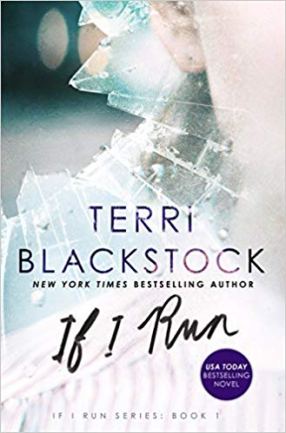
If I RunTerri Blackstock’s If I Run trilogy follows Casey Cox on the run from the law. In the first book, also titled If I Run, Casey went to meet her friend, Brent, at his home only to discover his bloody, lifeless body. Horrified, she ran from the scene, leaving a trail of evidence and DNA between his house and hers. She threw a few things together and fled in disguise.

Dylan Roberts has been hired by Brent’s parents to find Casey. He and Brent grew up together, but Dylan had never met Casey. Dylan had been a criminal investigator while in military service, but his severe PSTD has prevented him from landing the police job he wanted. As Dylan searched for Casey, he can’t help but do a bit of his own investigating and profiling. Nothing pointed to Casey as a killer — except her DNA at the crime scene.

Dylan is a Christian and struggles with gaining victory over his PTSD. Casey is not a believer, but comes across a Christian lady in her new location.

As Casey starts life with a new look, name, and job, she discovers that a missing girl is being kept captive. If Casey helps her, she risks blowing her cover and being discovered. But how can she not?

The chapters go back and forth from Casey’s and Dylan’s viewpoints as more of the story unfolds. Casey’s reasons for running become clear.

If I'm FoundIn Book 2, If I’m Found, Casey is on the run again in a different town with a different look and name. Dylan believes her story and finds an untraced way to communicate with her. They agree that it’s too dangerous for Casey to come back: first they need to have a solid case against the people who killed Brent and are after her. Dylan has to be careful to make it seem like he is still searching for Casey while he’s actually seeking evidence to clear her.

Meanwhile Casey accidentally witnesses parents giving their daughter to a man who pays them for time with the girl to abuse her. By the time Casey realizes what is going on, it’s too late to stop the incident. But she can’t let this happen again and looks for ways to rescue the girl and bring the adults to justice.
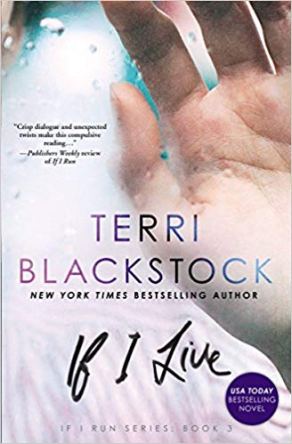
If I LiveI was a little afraid the plot would follow the same formula in Book 3, If I Live, with Casey risking her own safety to help an innocent victim. Thankfully, that was not the case. By this point in the story, Casey is getting weary. She and Dylan have not only met, but have come to care for each other. But they still need further evidence to bring a solid case against Casey’s pursuers. Dylan is having a harder time keeping up the ruse that he’s still looking for Casey, which puts his own life in danger. Meanwhile Casey is having an even harder time avoiding notice as the police have issued several pictures of her in different disguises taken from various business security cameras. Danger escalates on all sides as Brent’s killers get more desperate. In this book some of the chapters are from the killer’s point of view as well as Dylan’s and Casey’s. Dylan is gaining victory over his PTSD, but his parents’ misunderstanding makes it even harder.

Finally Dylan and Casey have what the evidence they need. But who can they give it to? They can’t trust anyone in the police department, because the killer has several of them under his thumb. As they concoct a plan, they draw closer to each other, closer to God, and the plot comes to an exciting conclusion.

____

I read the first two books in this series in quick succession while traveling. Since I had the third one on hand, I decided to wait to review the series all togteher after reading the last book.

The story grabbed me from the very beginning. Each book was hard to put down. I was glad I had them all before I started so I could immediately go to the next one instead of waiting. I’ve loved Terri’s books since I first read her Newpointe 911 series decades ago and passed them on to my mom. I love that her characters are relatable. I enjoyed getting to know both Casey and Dylan and felt with them through their stresses and faith journeys.

Terri says in the afterword of the last book that this series was inspired by the old TV show, The Fugitive. That was one of my favorites shows as a kid, with the innocent man on the run from the relentless detective. I also didn’t realize until that afterword that the three covers go together to form a picture. Clever!

If I Run seriesAn excellent series all together. Highly recommended if you like suspense stories. Even though that’s not the genre I read most often, I enjoyed this series very much. As it happens, just now the first book is on sale for the Kindle app for $1.99.

(Sharing with Literary Musing Monday, Carole’s Books You Loved)
Book Review: Steal Away Home

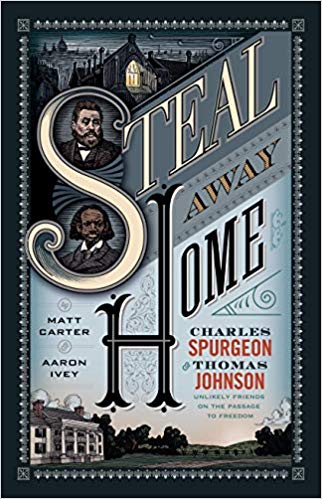
Steal Away Steal Away Home: Charles Spurgeon and Thomas Johnson, Unlikely Friends on the Passage to Freedom by Matt Carter and Aaron Ivey is a fictional book based on facts. It parallels lifelines of two men growing up in very different circumstances and their eventual meeting and friendship.

The two men in question are Charles Haddon Spurgeon, famous and oft-quoted English preacher in the 1800s, and Thomas Johnson, a Southern slave who was freed after the Civil War, became a pastor, and eventually became a missionary to Africa. “In 1879, there were only two Christian missionaries in the entire country, and Thomas Johnson would be the very first African-American missionary to ever step foot on Cameroon soil as an ambassador for the Good News.”

It’s unlikely that two men from such different lives would cross paths. But a member of Johnson’s congregation knew Spurgeon, knew that Johnson lamented his lack of education, and knew there were funds for students who needed them to go to Spurgeon’s college, so he recommended Johnson to Spurgeon. The story has Johnson hearing of Spurgeon while still a slave, when slave owners were burning Spurgeon’s books and papers because of his stance against slavery. So meeting Spurgeon had special meaning for Johnson. They became friends after their first meeting, even to the point of Johnson traveling with Spurgeon for a retreat and being present at Spurgeon’s death.

Though this tells the story of both men, it’s not a full biography of either. It mainly tells their stories as they relate to each other.

And because the book is fictional, we don’t know what’s real and what’s made up. I would have preferred a realistic account.

I’ve read two biographies of Susannah, Charles’ wife, and several accounts of his life. I know he suffered from depression. Most accounts portray him as joyful with occasional bouts of depression: this book characterizes him as mostly depressed with occasional bouts of joy.  The truth is probably somewhere in-between. Probably depression affected him much more than anyone knew. I knew he had gout as well, but didn’t know just how extensive the pain from that could be. But the authors seemed to play up the negative physical and spiritual effects of both Susannah and Charles.

I did not know anything about Johnson, so of course I can’t compare what was said of him. I did learn that he wrote his autobiography, Twenty-Eight Years a Slave, or the Story of My Life in Three Continents. I would love to read that some time.

In a fictionalized story, naturally we expect there will be a few made-up scenes – conversations that did not happen yet reflect events or characteristics of the person’s life, etc. But according to this and this review, some scenes were revised, even the details in the account of Thomas’ conversion. If that’s true, I am very disappointed that the authors would make such revisions. The authors themselves say the book is “not a biography, and it’s not a history book, but a story, based on real events that occurred in history. Many passages in the book are word-for-word quotations from Spurgeon’s or Johnson’s own writing.” They were inspired by another historical book written as fiction that brought the characters and situations to life an wanted to do the same with this book. They admit that they “take literary license, and deviate slightly from the historical record,” but assert that “the overwhelming majority of the persons, places, dates, and even the dialogue of this book are based on real events.”

But aside from those quibbles, I did enjoy learning the relationship between these two men. I felt the hopelessness of Johnson’s situation as a slave, the palpable fear as the slaves met privately late at night to quietly worship together, the long road he had to face even after freedom was granted. I appreciated that Spurgeon was a leading voice against slavery and in treating people of all colors as equals. And though I think the authors over-emphasized Spurgeon’s suffering (they often portray him as incapacitated and don’t show much of the productive aspects of his life), I did appreciate the window into what his down times might have been like.

The title, Steal Away Home, comes from an old spiritual which is referred to often throughout the book. It’s sung here by Mahalia Jackson and Nat King Cole.

(Sharing with Literary Musing Monday, Carole’s Books You Loved)

When sleep won’t come

A few years ago I asked Facebook friends, “Why am I awake when I should be asleep and sleepy when I should be awake?” One responded, “Welcome to middle age.” I can be dragging and nodding off before getting into bed, and then wide awake after.

I usually keep everything conducive to sleeping: lights off, soft music playing. Reading usually keeps me even more awake. One friend responded to my Facebook query that sleeplessness is an excellent time to pray. True. Sometimes I do pray then. But I also get frustrated when I can’t seem to dig in and get much done in the daytime because I need a nap because I am so groggy. It just seems like it would be so much more efficient to sleep at night and work during the day.

Still, I know that stewing about it only makes it worse. I remind myself in the night that even if I am not asleep, I’m resting. I can enjoy the quietness and freedom to just relax without any demands on my time. I breathe deep and slow, sometime pray, sometimes think, until eventually I drift off. And I catch a nap in the day time if I need to, but I try to keep it short so as not to perpetuate nighttime wakefulness.

Several nights ago, though, was one of my worst nights ever. I don’t think I slept more than an hour the whole night. And what’s worse, I had a three-hour drive the next morning and meetings all afternoon and evening. I wasn’t feeling particularly nervous about the trip. Last year I had made the same journey for a writer’s conference, and I was much more on edge then because it was the first time I had traveled alone or attended anything like a conference in years. But God got me through that, and I knew a bit more what to expect this time. So I had a bit of apprehension, but nothing like the year before. Perhaps underlying nerves were the problem, even though I wasn’t consciously feeling nervous at the time. I tried all my usual tactics, to no avail.

Then I had to fight worry. How was I going to drive and stay awake in meetings for a conference my husband had paid good money for without sleep? Some of my health issues get worse without sleep. What if they flared up? I knew these thoughts and concerns would only drive sleep further away, so I tried to give them to the Lord and stay relaxed.

On top of everything else, I was intensely uncomfortable. Hot one minute, cold the next. The sheets irritated my skin. I got up and went to the couch in the living room, thinking a change of venue might help. It didn’t. Maybe I was coming down with something?

I went ahead and got up at 4:30 a.m. and took my shower. But I was sad and frustrated and even a bit hurt because God had not answered my prayer. He knew I needed sleep. He made me to need sleep. He knew everything on the schedule this day. Why had He let me go most of the night without sleep when I earnestly begged Him for it?

I didn’t know. I sent a quick text to a friend letting her know what was going on and asking her prayers. I decided to just keep getting ready for the trip and see what happened. I felt like I was moving through molasses or walking like a zombie (to mix metaphors). I couldn’t eat much and began to feel nauseous.

I couldn’t remember if I had actually prayed about whether to go to the conference. Was this God’s way of telling me no?

After I got everything ready to go, I knew I could not drive safely in the condition I was in. I decided to try to take a nap in my desk chair and see what happened. I asked God to direct me and help me know whether to go or stay. I asked Him, if He wanted me to go, to multiply whatever sleep I could get in my nap like the loaves and fishes and make it enough. And I fell blessedly asleep for maybe an hour.

When I woke up, my stomach still wasn’t feeling 100% well, but all grogginess was gone. I left for the conference. The night before I had made a sandwich for lunch so I didn’t have to look for a restaurant first thing when I got to town: since I was running late, I was able to eat a few bites on the way. I got to the conference just after the first introductory meeting ended. Though I would have liked to have gotten there in time for it, it wasn’t entirely critical. I had enough time to peruse the schedule to choose which of the workshops to attend that afternoon. I attended the rest of the conference and had a wonderful time. I had no trouble sleeping in the hotel room that night.

Still I pondered why God had not answered my prayer for sleep the night before. One of the truths that had sustained me on a recent family trip was “Your heavenly Father knows what things you have need of (Matthew 6:8). One by one He met each of my needs on that trip. Why did He seem to withhold one this time?

Perhaps one reason was to increase my dependence on Him. I thought I already was depending on Him for a number of issues relating to the conference and travel! But maybe He wanted to take me to a different level.

Philippians 4:11-13 came to mind: “Not that I am speaking of being in need, for I have learned in whatever situation I am to be content. I know how to be brought low, and I know how to abound. In any and every circumstance, I have learned the secret of facing plenty and hunger, abundance and need. I can do all things through him who strengthens me.” I can’t say I have totally learned that contentment, but I am in the process.

And then 2 Corinthians 12:9-10 came to my attention. “And he said unto me, My grace is sufficient for thee: for my strength is made perfect in weakness. Most gladly therefore will I rather glory in my infirmities, that the power of Christ may rest upon me. Therefore I take pleasure in infirmities, in reproaches, in necessities, in persecutions, in distresses for Christ’s sake: for when I am weak, then am I strong.

God may have any of a number of reasons to allow us to suffer a need of some sort. He’s not being cruel or unkind: all of His Word and years of knowing Him testify to that. God told Israel that He let them suffer hunger in the wilderness to humble them, to test them, and to turn their focus from their physical need to the spiritual. Unanswered prayer can cause us to examine ourselves for any hindrances on our part. Sometimes He cuts off something we need to produce more growth, to bring us to maturity.

I still don’t know why God didn’t answer my prayer for sleep on a night when sleep was critically needed. But He did meet my need, even though not in the usual way. Even in the face of a sleepless night and a full day, “God is able to make all grace abound to you, so that having all sufficiency in all things at all times, you may abound in every good work” (2 Corinthians 9:8).

See also:

When I Don’t Get What I Need
When the Solution I Want Isn’t What I Need
Let Patience Have Her Perfect Work
Reasons Why Prayers Aren’t Answered

(Sharing with Inspire Me Monday, Literary Musing Monday, Tell His Story, Let’s Have Coffee, Wise Woman, Woman to Woman Word-filled Wednesday, Faith on Fire, Grace and Truth)

Laudable Linkage

It’s been a little while since I have shared good finds on the Web. Here’s my most recent batch. Maybe you’ll find some of these good reading as well.

Partially Hydrogenated Bible Study. “Much like junk food manufacturers, Christian writers have been known to appeal to our senses to garner popularity. But the stakes for dining on spiritual junk food are high.”

Falling in Love With God’s Word, HT to True Woman.

The Gift of a Friend’s Rebuke. “Because I had not willfully sinned against her in my heart, my conscience had not been awakened to shine the light on my oversight. But still, I had hurt my friend. So much so that she no longer looked forward to hanging out with me, which was how she knew she needed to address it. Because she valued our friendship and cared about me, she spoke up, even though it was highly uncomfortable for her.”

The Surprise Meaning of Judge Not Lest You Be Judged.

Are We Doing Church Wrong?

Avoiding Difficult People, HT to True Woman. Though “there are clear circumstances that call for avoidance, distance, or even permanent severance from a relationship,” the “cultural philosophy of avoiding difficult people has an underlying worldview that should alarm any Christian.”

How Does She Do It? The Making of an Atypical Woman. HT to True Woman. “Isn’t that the beauty of God’s work in our lives? He takes us — the un-super, regular, sometimes scraping-by women — and he works on us.”

Kitchen Table Discipleship, HT to Story Warren. “So often we think our greatest accomplishments will come from outside the four walls of our house, but the discipleship we do right at the ‘kitchen table’ has eternal impact as we raise little ones to love and follow Jesus.”

Our Culture of Contempt, HT to Challies. “People often say that our problem in America today is incivility or intolerance. This is incorrect. Motive attribution asymmetry leads to something far worse: contempt, which is a noxious brew of anger and disgust. And not just contempt for other people’s ideas, but also for other people.” “Contempt makes political compromise and progress impossible. It also makes us unhappy as people.” “What we need is not to disagree less, but to disagree better.”

Famous Christian Quotes . . . That Aren’t Real, HT to Challies.

Evangelicals Embracing (and Rejecting) Lent, HT to Challies. I really appreciate the balance here. “What is more important than the practices we take on is the heart attitude behind them. If there’s anything we should give up this time of year, it’s our sense of superiority either to those outside the church or those inside the church who do things differently than we do.”

A thought from Pinterest. I couldn’t find where it originally came from to credit the creator.

And don’t forget, it’s that time of year (seems way early to me!)


Friday’s Fave Fives

It’s Friday, time to look back over the blessings of the week with Susanne at Living to Tell the Story and other friends.

I was sorry to miss the Friday’s Fave Fives last week. I had to go out of town that morning and had planned to post before I left. But a combination of not sleeping very much the night before, not feeling well that morning, and getting ready for the trip crowded out the time. So I’ll try to condense two weeks into only five favorite parts. 🙂

1. Our church ladies’ group changed its meetings from every other month to every six weeks, so we get a few more times together through the year. I always enjoy the fellowship and the insight from discussing Scripture together.

2. Safety in rain and flooding. We had tons of rainfall week before last, with more than five inches Saturday. Thankfully our property is elevated, but several roads were flooded out. I was at the ladies’ group when my husband texted that the main road home was flooded. I asked the ladies if they knew another way around. The pastor’s wife tried to explain it to me and then offered to drive that way so I could follow her. Then another lady said she was going that way and offered to lead me out. We stayed in the rest of the weekend. Church was cancelled and everyone was urged to stay off the roads. Locals have said they have never seen anything like the flooding we had. One aftermath of all the rain was a 25-foot-wide, 60-foot-deep sinkhole! I’m so thankful for safety. And I am thankful the electricity didn’t go off and that we’ve had some bright sunshine in the days since.

As a subpoint to this one, our community Facebook page was a big help. I actually keep their posts hidden most of the time, because it’s just too busy for me with lost and found pets and searches for plumbers and mechanics and such. But during the flooding that was the best place to find out if local roads were flooded or open.

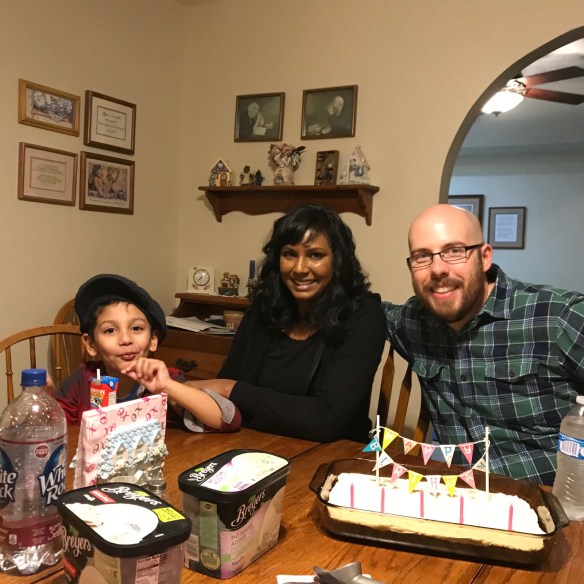
3. Birthdays. We celebrated my beautiful daughter-in-law’s birthday week before last and my dear husband’s birthday this past week.

IMG_1378

4. My second writer’s conference and an encouraging prize. I wrote more about it here, but I was able to attend a writer’s conference last weekend. I’m thankful for safety there and back, good meetings, good workshops, good conversations. And I was especially thankful to have won a prize in a couple of contests. Last year the person who critiqued my manuscript sample had not one good word to say about it, and I seriously rethought whether writing was just a dream. My critique this year was so encouraging, and that and the contests encouraged me that, though I still have a long way to go, I am learning and growing.

5. A new bathroom floor! Our master bathroom had carpet, which doesn’t really work well in a bathroom. Ever since we first bought the house, we’ve wanted to replace the carpet. We had bought the materials but my husband hadn’t had a chance to work on it. He decided that he’d use the time while I was away to do so. It looks nice!

Before:

Before

Even if we liked the carpet, we would have needed to change it because it was getting loose and bumpy.

After:

After

Such an improvement! He did a great job. Next: painting the walls and cabinets, changing the drawer knobs, and finding new bath mats! I love the rug that’s there, but it’s shredding.

Bonus: Tried to keep it to five, but I just had to squeeze in one more. 🙂 My doctor was concerned about some of my lab work at my physical last fall and wanted me to come in for a recheck this week. All my numbers were good and he was pleased!

It’s been a busy couple of weeks, but I am looking forward to a bit of relaxation and then digging back in to my manuscript and some other projects.

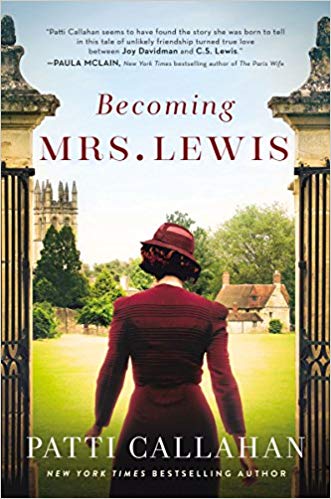
Book Review: Becoming Mrs. Lewis

I did not start reading anything by or about C. S. Lewis until about twenty years ago. Something I read then indicated that his marriage was just one of convenience so his American wife could stay in England. Since then I’ve read varying accounts of his relationship with his wife, Joy. Patti Callahan asserts that the woman whom Lewis mourned in A Grief Observed and who inspired Til We Have Faces had to have been more than just a dear friend. The letters between the two have been lost, but Patti researched all of the other pieces of Joy’s and Lewis’ writings she could find plus biographies of them to get to know Joy. Based on her findings, she crafted a fictional story titled Becoming Mrs. Lewis: The Improbable Love Story of Joy Davidman and C. S. Lewis.

Mrs. LewisJoy was something of a child prodigy, graduating from high school and college early and earning a master’s degree by age twenty. She was Jewish, an atheist, and, for a brief time, a Communist. She married William Gresham in 1942 and had two sons, but the marriage was troubled almost from the start. Bill was an alcoholic with some seeming mental issues after his military service. In one incident when Bill was drunk, despairing, and talking of suicide, Joy dropped to her knees and prayer to a God she did not believe in – and felt something of an encounter. It was enough to change her perspective and start her searching for answers. She had read and respected C. S. Lewis and knew he had converted to Christianity from atheism, so she wrote to him.

They corresponded for three years. In the meantime, due to health issues and a need for more answers, Joy took a trip to England, where she stayed with a friend, rested, wrote, and finally met Lewis, who asked her to call him Jack. By this time, Joy’s marriage was seriously crumbling, and she was beginning to have feelings beyond friendship for Jack. But she wanted to keep her friendship with Jack pure. She determined to try to save her marriage – until she learned that her husband and cousin were having an affair. Then she asked for a divorce.

Joy returned home as soon as she was able and returned to England with her boys. She and Lewis visited often. She and the boys even stayed with Lewis and his brother, Warnie, for several weeks. They read and edited each other’s writing, walked, ate, drank. Joy fell hard for Jack, but he treasured the philea (brotherly, friendly) type of love they had. He felt he was too old to start thinking about romance, and, besides, in the eyes of his Anglican church, she was still married. When Joy had to face leaving the country due to bureaucratic regulations, Jack offered a civil marriage and bought her a house. When Joy was diagnosed with cancer, Jack realized his true feelings for her and married her in earnest.

Joy was an intelligent, complicated woman. She reminds me very much of the woman at the well in John 4, “looking for love in all the wrong places,” as the saying goes. Early in her life, she was made to feel that she could never “measure up.” Her father punished her for besmirching her A report card with a B. Her mother compared her unfavorably to her prettier, more graceful cousin. She sought for acceptance and assurance of her worth in a string of sexual encounters. She came to learn that sex in itself does not equal love.

Joy is also a reminder that true Christians don’t always fit in a nice, neat box. Really, we have to look no further than our Bibles to know that. Almost every major figure in the Old Testament had serious family and/or personal issues, and the NT epistles dealt with issues in churches that we scratch our heads over these days. Yet even in the messiness of her life both before and after salvation, and the up and down pattern of her growth, there’s a steady trajectory of growing in grace and knowledge.

I must know when it is enough. And I must trust God — again and again I was learning and relearning to trust the truth who had entered my sons’ nursery. The rusty and decrepit habit of trusting in only myself, only abiding in my own ability to make things happen, died hard and slow (Chapter 40).

Much of what I’d done — mistakes, poems, manipulations, success and books and sex — had been done merely to get love. To get it. To answer my question: do you love me? . . . From that moment on, the love affair I would develop would be with my soul. [God] was already part of me; that much was clear. And now this would be where I would go for love — to the God in me. No more begging or pursuing or needing. Possibly it was only a myth, Jack’s myth [Til We Have Faces], that could have obliterated the false belief that I must pursue love in the outside world — in success, in acclaim, in performance, in a man.

The Truth: I was beloved of God.

Finally I could stop trying to force someone or something else to fill that role (Chapter 44).

Jack: I’ve spent all my life in an attempt to find Truth and moral good and then to live it. I can’t discard my moral habits for feelings, which are just that — feelings (Chapter 42).

I enjoyed getting to know Joy and seeing Jack as a normal person in everyday mode. And I loved the truths quoted above that Patti incorporated into the story.

However, even given Joy’s penchant for looking for love through sex at first, there seems to me to be more of a sensual aspect of the story than needed to convey Joy’s misdirection. Even a hill is unnecessarily described as appearing “like the breast of a woman in recline.” Another friend mentioned the preponderance of alcohol in the story. Even allowing that different Christians have different convictions about whether and how much a Christian can consume, alcohol seems the major drink of choice for any occasion here. It’s mentioned even when we really have no need to know what the characters are drinking. I’m left wondering why. I don’t know how much of these things are the author’s choices and how much of it is integral to Joy’s story. Because of these issues, this book won’t appeal to everyone. While I don’t endorse everything in the book,  I think if one can set aside some of the objectionable elements, Joy’s growth as a person, as a Christian, and her impact in Jack’s life and work can be seen and appreciated. The choice whether to read it or not must be left to individuals.

Linda is currently hosting a four-week book club to discuss this book. Week one’s discussion is here: week two is here. Week three is here., just posted today, with one more session coming next week. So it’s not too late to join in if the discussion if you’d like.

Linda also pointed us to a couple of nice videos. In this one, the author shares her thoughts and shows photos of Jack and Joy and videos of Jack’s house, the Kilns.

This one shows aspects of Oxford, integral to both Jack and Joy:

An interview with the author is here (HT to Linda).

(Sharing with Carole’s Books You Loved)
My Second Writer’s Conference

Friday and Saturday were  a whirlwind of activity as I had an opportunity to attend my second Carolina Christian Writer’s Conference. I had a wonderful time, and my head is still spinning, processing all I learned.

Karissa Culbreath was the keynote speaker. Wow! She was both sweet and dynamic, accomplished yet relatable.

As with last year, there were four different workshops times over the two days, with about half a dozen workshops to choose from each time. Most times I wanted to attend two or three, so it was hard to narrow down the choices. I wish they all could have been recorded. Topics ranged from how to find (make) time to write, how to navigate social media, fears, grammar and editing, writing for children and youth, writing for various markets, aspects of nonfiction and fiction writing, mastering Amazon – and multitudes more.

There was an informative panel discussion Friday night, an opportunity to split into different genre groups with a few of the faculty members on hand to answer questions, a “lightening learning” session where we went in small groups from table to table to hear five minutes of each speaker’s best or favorite tips, and an opportunity to eat lunch with one of the speakers.

We also had an opportunity to send in an outline and ten pages of a manuscript ahead of time for a critique and then to have a fifteen minute meeting with the person who critiqued us. Last year the manuscript was given to one of the speakers, and we didn’t know who until we got a notice of our meeting time with them. This year we got to choose which person we wanted to look at our manuscripts. We were also able to sign up ahead of time for a fifteen minute meeting with another of the faculty members. I got both of the people I requested for each of those (last year the person I asked for had no slots available). Then Friday morning we had the opportunity to sign up for another fifteen minute meeting. That person ended up having a different role than what I had thought, so in a sense we didn’t really fit each other’s needs. Still, she gave me a piece of key, valuable advice that’s going to have a big impact on how I shape my book, and I enjoyed the conversation.

Last year, some of you may remember, I’d had no plans to attend a conference, and I had never even heard of this one. When I did hear about it from an online friend, it was only 2-3 weeks before the conference. Since it was in the city where we used to live, that sparked more of an interest and a possibility to go since it was in a familiar place. But it was so soon, and we had my mother-in-law’s care, and I had not traveled alone nor attended anything like a conference in eons, etc., etc. But God worked it all out. I had a manuscript I’d started, but it was really in no shape to be seen. But it was all I had, so I pulled it out of mothballs with no time to shape it up and sent it in. The critique last year was pretty devastating, with not one positive note, leaving me thinking perhaps writing was just a pipe dream. But the critique was good in pointing out some glaring mistakes I was (obviously) unaware of, making me now acutely aware of them. And the rest of the conference encouraged me that all was not lost yet. Last year I also missed all of Saturday mornings events due to being sick in my hotel room.

This year, I started off feeling sick before I ever left. I ended up missing the very first explanatory session, but was able to attend the rest of it. Last year my nerves were taut with the newness of everything, being in circumstances I was unused to with a lot of strangers. It wasn’t until the last few hours then that I just relaxed and enjoyed the rest of it. This year, though nerves did flare up, I was more at ease and relaxed through the whole conference. I enjoyed a lot of good conversations with fellow conferees.

Last year, since the conference came up so suddenly, I just kind of went with the flow and had no idea what to ask. This year, after a year of more intense focus on my writing and reading writing blogs in the meantime, I came with two pages of typed questions. 🙂 I didn’t get all of them answered – I wished my fifteen minute sessions could have been thirty – and I added several more questions after the conference was over.

My critique session was as different as night and day than last year. Part of that was the different personalities of the critiquers. The lady I had last year was not unkind, but she was just more of a matter-of-fact personality. The lady I had this year was very sweet and encouraging. She did have some corrections and valuable editorial notes, but the whole tone of the critique was more uplifting. I was so thankful and encouraged for the growth God led me through since last year, and the hard critique last year was definitely one of His tools.

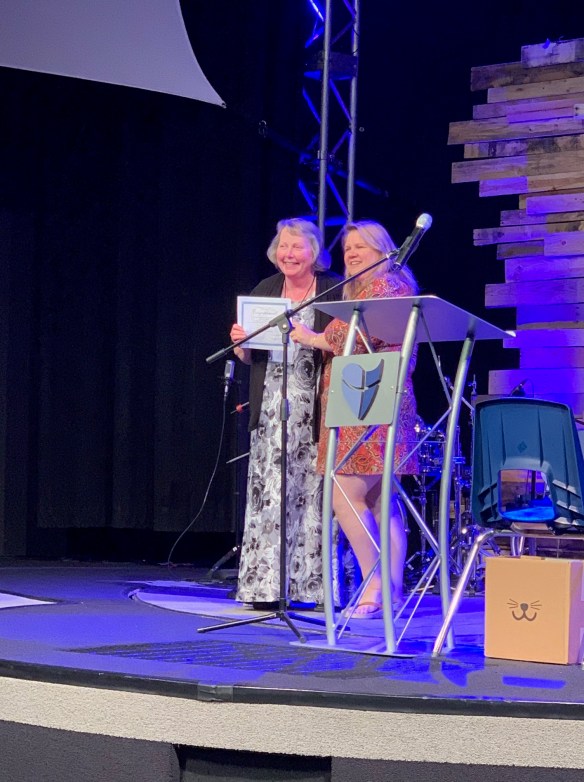
One new aspect of this year’s conference was contests. We had an opportunity to submit writing in any of several categories. If I remember correctly, I think we could enter as many times as we wanted, but there was a $20 fee for each entry which was then used to provide scholarships for people who needed financial help to attend. The fee was for a good purpose, but also served to limit how many entrees most of us could submit. As it happened, I won first place in the Devotional category.

IMG_1391

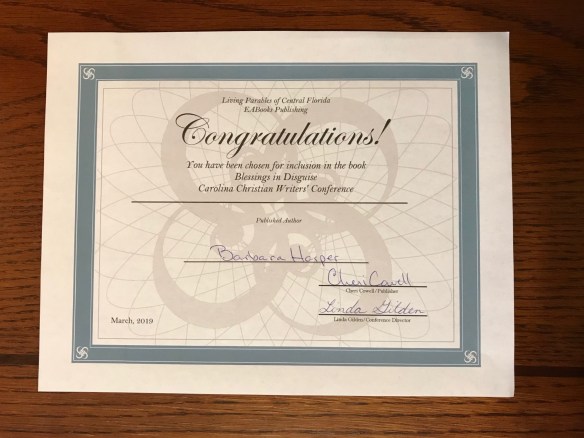
And! EABooks sponsored a contest in which we could submit entries on the theme “Blessings in Disguise,” and they would choose 20-25 to be included in their book compilation. That would not only give us exposure and an opportunity to get our message out, but being actually published would increase our writing credentials. My entry was one of those chosen for the book.

IMG_1392

IMG_3919

(Special thanks to my new friend Tori for taking and sending me the last photo!)

Besides just being excited about winning anything, I am so encouraged. Though I still have a long way to go and a lot to learn, the positive critique and conversations and the contests all help me know growth has occurred and I’m heading in the right direction.

Last year I shared some of my takeaways from last year’s writer’s conference. Those were all reinforced. It will probably take me several days to process everything from this conference. But I would encourage you to attend a conference if you have any desire to write, especially for publication. You can get some of the information from blogs and books on writing. But the ability to ask questions, talk with people inbetween workshops, have lunch with a writer or editor, listen in on some of the more informal sessions like the genre groups and “lightning learning,” and especially the fifteen-minute meetings with the faculty are experiences you can’t get anywhere else.

For me as a first- and even a second-timer, it helped that the conference was small. It wasn’t quite so overwhelming that way. Many areas have one or two-day writer’s conferences. There’s a really big Blue Ridge Mountain Christian Writer’s Conference not too far from me that I may try to make it so some day. But it’s five days, and therefore more expensive. And if my head is about to explode after two days, I don’t know what it would do with five. But there are also that many more writers, editors, and publishers to hear from and opportunities to interact and ask questions.

Now – back to regular life, laundry, and more writing.

(Sharing also with Literary Musing Monday)


Laura Ingalls Wilder Reading Challenge Wrap-up for 2019

The end of February closes the Laura Ingalls Wilder Reading Challenge for this year. I hope you had fun with it, and I look forward to hearing about what you read!

A week from today I’ll use random.org to draw a name from the comments on this post to win either The Little House Cookbook compiled by Barbara M. Walker, Laura’s Album: A Remembrance Scrapbook of Laura Ingalls Wilder by William Anderson, The Little House Coloring Book, or a similarly-priced book related to Laura. A week should give some of us who are still reading time to finish up and post about our reading. You don’t have to have a blog to participate: you can tell us what you read in the comments here. If you have a blog, you can either let us know what you read in the comments or share the links back to any reviews or challenge-related posts from your blog or even from Goodreads if you review books there. Due to shipping costs, I’m afraid I can only ship to those in the US, unless you’d like a Kindle version.

For my part, I read:

Fairies

Laura Ingalls Wilder’s Fairy Poems, compiled by Stephen W. Hines, illustrated by Richard Hull. I had forgotten that Laura wrote such poems until Rebekah mentioned them. Laura is usually more matter-of-fact than fanciful, though some of her descriptions are lovely. So I was interested to see how she did with fairy poems. Hines provides a brief introduction, telling how Laura came to write the poems for the San Francisco Bulletin. Then he shares an adaptation of an essay Laura wrote called “Fairies Still Appear to Those With Seeing Eyes.”

There are only five poems in the book, spread out over several pages with a number of illustrations. The poems are very old-fashioned, naturally, as they describe the various activities fairies are involved in. I’m not normally into fairy poems, so I don’t know how they would measure up for young readers today.

Honestly, I didn’t care for the illustrations much. I think I would have preferred lighter colors, maybe a watercolor effect. I liked the detail of the plants and animals, but not the fairies and people.

Have you or your children read this book? What did you think?

LIW song book

The Laura Ingalls Wilder Songbook compiled and edited by Eugenia Garson.

The copy I checked out from the library looks like the one above, but I saw other copies on Amazon with a Garth Williams illustration of Pa with his fiddle on the front.

What I appreciated most about this one was Garson’s research. She looked up every song mentioned in the Little House books, provided a few sentences of background for it (when it could be found), and a quote from the LH book where it was mentioned. Sheet music is provided for all the songs, making me wish I could play the piano enough to pick out the tunes. I was familiar with just a few of them. This would be a nice resource for anyone wanting to learn more about music from this era.

Traveler

I also read On the Way Home and The Road Back by Laura Ingalls Wilder. These two books have been packaged together with West From Home, Laura’s letters to Almanzo while visiting Rose in San Francisco for the World’s Fair, into one volume called A Little House Traveler. Since I had read West From Home a few years ago, I did not read that one at this time. The first is Laura’s record of moving with her husband and daughter by covered wagon from South Dakota to Mansfield, Missouri; the second is her journal of traveling back to South Dakota to visit her two remaining sisters 40 years later in an un-air-conditioned Buick. I reviewed them here.

I also wrote Why Laura Ingalls Wilder Is Still Worth Reading because some question whether she is any more. No, she and her family were not perfect. But we can still learn from them.

That’s it for me. How about you? Remember, leave a comment on this post about what you read or did for the challenge before Thursday of next week to be eligible for the drawing.

Update: The giveaway is closed. The winner is Rebekah! Congratulations!

(Sharing with Carole’s Books You Loved)

End-of-February musings

I’ve finally taken the plunge. Some of you know that I am in the process of writing a book. I have the rough draft finished and now have to go back through and work on editing and shaping up. Publishers these days want authors to have a public platform in place before considering their book. So I created an author Facebook page to keep separate from my personal Facebook account. I want to invite you to like and follow my author page here. I probably won’t link every blog post there – just the more devotional ones for now. And I’ll share updates about the book progress as well as general encouragement. I do have a Facebook page that my blog automatically shares posts to, as some prefer to read them there. If I end up posting the same content both places, I’ll probably close down the blog page and just keep the author one. But we’ll keep them as is for now and see how it goes.

February has always been pleasant to me, even though it’s still wintry and cold. It’s a short month, and it brings us one month closer to spring! Two highlights in February for me are Valentine’s Day and my daughter-in-law’s birthday. For scheduling reasons we celebrated each after the official day.

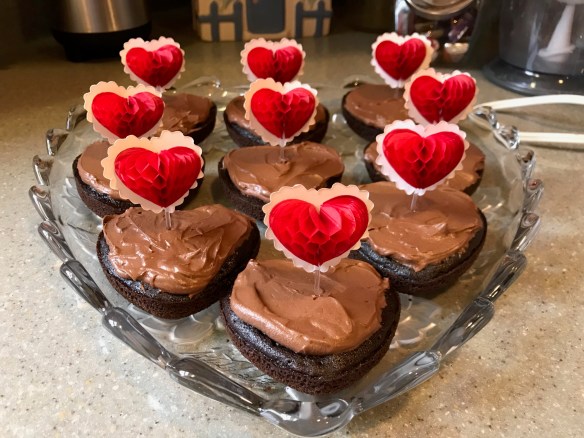
Valentine’s Day vies with Christmas as my favorite holiday. I made my usual “meat hearts” (mini meat loaves shaped like hearts) and chocolate heart-shaped cupcakes. My grandson’s parents suspect red dyes of giving him problems, so we’re trying to avoid anything with red dye. Since most sprinkles and colored sugars for Valentine’s Day have red in them, I looked for non-food decorations and found these cute little cupcake toppers at Target.

IMG_1352

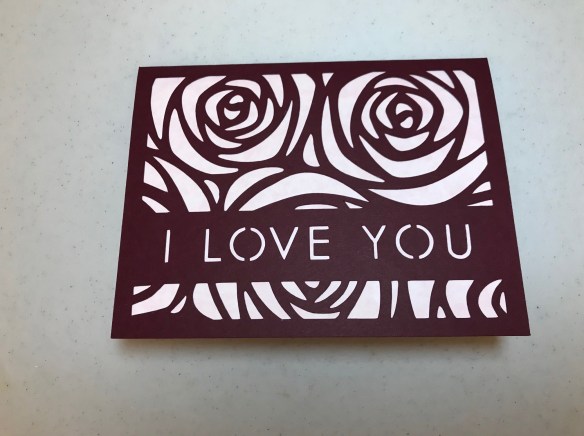
My special gift to my family is making a card for each of them. I try to make them according to their color preferences, likes, etc. This was for my husband:

img_1347.jpg

The Cricut machine did all the heavy lifting of cutting that out. I just had to choose the design and glue it together.

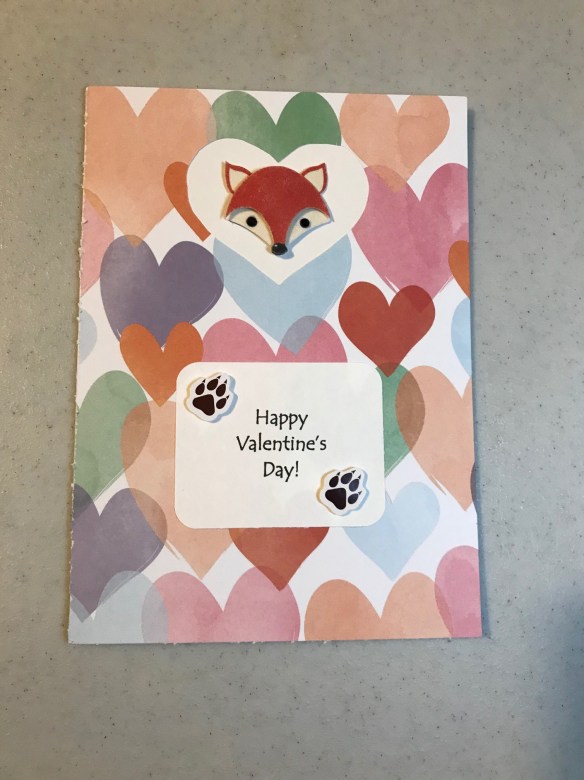
This was for Jeremy, who likes foxes:

img_1340.jpg

The fox and paw prints are stickers.

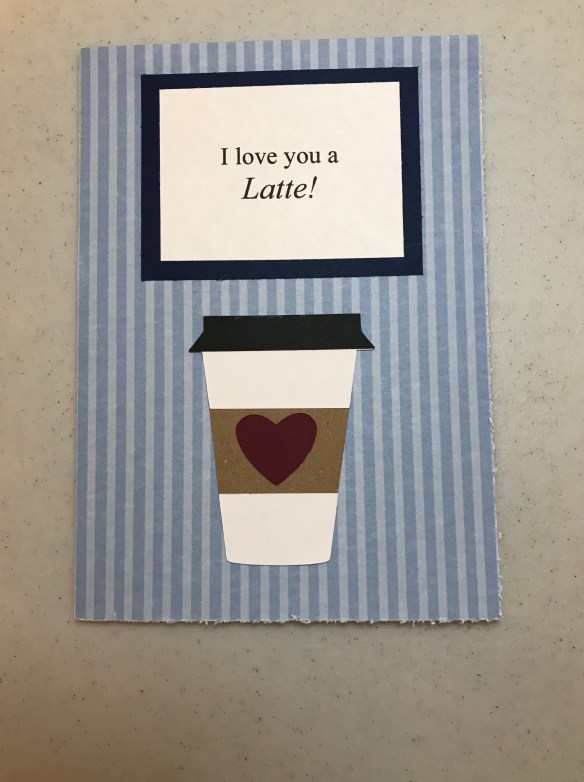
This was for Jason, a coffee-lover who likes blue:

IMG_1349

This is for Mittu, my daughter-in-law:

img_1346.jpg

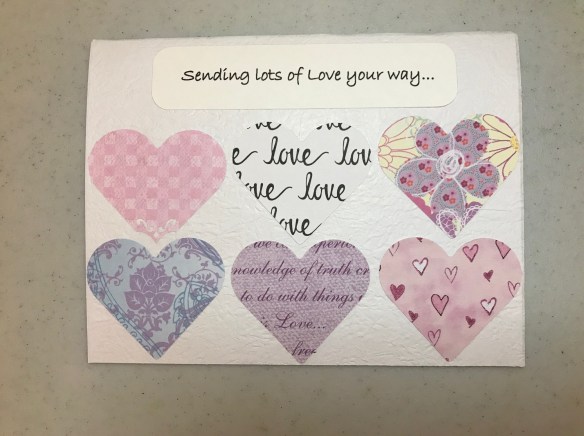
She likes lavender and purple, so I used a heart-shaped punch and several lavender pieces of scrapbooking paper. On the checkered one, I used a corner punch at the bottom.

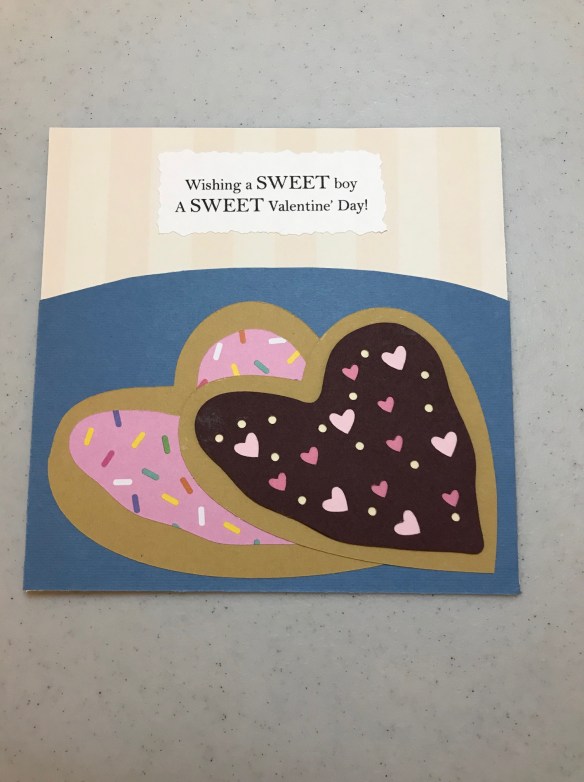
This was for my grandson, Timothy.

IMG_1345

The top cookie shape was done on the Cricut, and I got it a little too big, but it worked out ok. The shape of the bottom one was also done on the Cricut, but the paper on top looked like sprinkles already.

And, finally the last one was for Jesse, who likes red and prefers non-mushy cards. 🙂

img_13481.jpg

Though you could say jam is mushy . . . 🙂 The jam jar and letters were done on the Cricut. The Cricut also had the “You are my jam” letters shaped in an arch, but for whatever reason, they would not come out right. So I found a clipart banner and typed the words on it. There must be a way to type letters in an arch on the computer, but I couldn’t figure it out. Normally I would ask Jesse, but the card was for him. 🙂

Then, it’s always a joy to celebrate our sweet daughter-in-law’s birthday.

IMG_1378

I found that cute little birthday cake banner at the grocery store.

IMG_1371

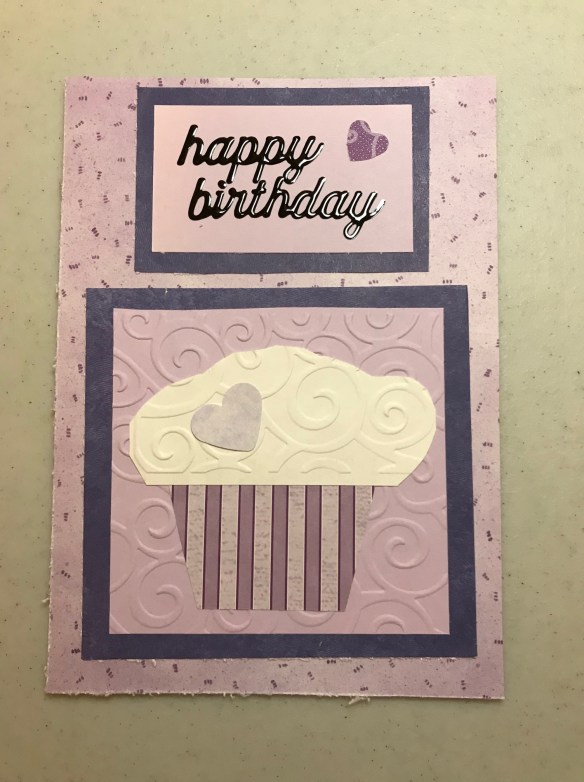
This is the card I made for Mittu’s birthday:

IMG_1363

The letters were stickers; the square and rectangle shapes were cut with my paper cutter; the hearts were made with punches. I actually did the cupcake freehand, which doesn’t usually work out well! But it came out ok this time. Oh, the texture designs on the background and icing were done with the Cuttlebug embosser.

Those celebrations are not only enjoyable in themselves, but they are bright spots in the long winter and wait for spring. We are starting to see some bulbs pushing through the soil, but we still have some cold temperatures predicted for the next several days.

We experienced a lot of major flooding in our area last weekend after several days of heavy rain. Our house was fine, as it’s on raised ground. But a lot of roads around us were flooded over, including an on-ramp to the interstate.

We’re still adjusting to the loss of my mother-in-law. I wrote a tribute to her here. Since my parents and my husband’s father passed a long time ago, we’re not new to or surprised by grief. But they lived 1,000 and 2,000 miles away, respectively. Adjusting to their being gone took different forms – like missing calling my mom. Since Jim’s mom lived in our home for the last five years, there were triggers everywhere, and changes affected everything from what I buy at the store to how I use my time even to how I load the dishwasher. But she was doing so poorly her last few months, it’s a relief to know that she is no longer in a non-working, silent, crumpled body, and she’s with her Lord, her husband, and her sister. And we know from previous experience that those triggers lessen over time. In fact, in some ways I have felt guilty over enjoying some of the changes, like being free to go anywhere any time without arranging for a caregiver, not having to set up the ramp on bath days, not having hospice people (nice as they were) coming in and out, my husband being able to transfer his work station back into the room she had occupied, etc.  But I tell myself that if she could talk to me, she’d probably say something like, “Thank you for your care, but please, go on and enjoy your life.” (Forgive me if I have said this before – I thought I had but couldn’t find it here.)

Something that just occurred to me recently was that my mother-in-law cared for her own parents in various ways for years. They did not live with her, but they lived near-by, and my in-laws were the go-to people when her parents needed help of any kind. Of course they visited other times than when they needed help, and probably needed more help the older they grew. In some way I can’t quite explain, it helped me to realize that she understood what was involved in care-giving, and that I was able to give back to her in that way.

Of course, one thing I am into every month is reading. I read and reviewed these books (titles link back to my reviews):

  • Marilla of Green Gables by Sarah McCoy, a nice imagining of what Anne’s Marilla might have been like as a girl.
  • Murder in an English Village by Jessica Ellicott, kind of a cozy mystery involving a jet-setting American and a homebody Englishwoman who are friends with opposite personalities and who stumble across buried secrets in a sleepy little post-WWII English village.
  • Katie’s Dream by Leisha Kelly, the continuing saga of the Worthham family in the post-Depression era. This time Sam’s brother, recently released from prison, brings a little girl he insists is Sam’s, even though Sam never even met the girl’s mother. The story involves untangling the confusion and deciding what’s best to do with  a little girl who only wants a home.
  • Read the Bible for Life: Your Guide to Understanding and Living God’s Word by George H. Guthrie. Excellent resource for just what the subtitle says. Especially helpful in discussing the different genres we find in the Bible and how to get the most out of them.
  • A Little Princess by Frances Hodgson Burnett, classic riches-to-rags-to-riches story that I had never read before. I am so glad I have now.
  • Journaling for the Soul: A Handbook of Journaling Methods by Deborah Haddix. Good resource: covers just about any journaling method you could imagine. (Congratulations to Kathie for winning the giveaway!)
  • I’d Rather Be Reading: The Delights and Dilemmas of the Reading Life by Anne Bogel. Pleasant musings on the reading life.
  • On the Way Home and The Road Back by Laura Ingalls Wilder. The first is Laura’s record of moving with her husband and daughter by covered wagon from South Dakota to Mansfield, Missouri; the second is her journal of traveling back to South Dakota to visit her two remaining sisters 40 years later in an un-air-conditioned Buick.

I’m currently reading Becoming Mrs. Lewis: The Improbable Love Story of Joy Davidman and C. S. Lewis by Patti Callahan, Love Is Not a Special Way of Feeling by Charles Finney, and Steal Away Home: Charles Spurgeon and Thomas Johnson, Unlikely Friends on the Passage to Freedom by Matt Carter and Aaron Ivey.

Around the blog, besides the book reviews, Friday’s Fave Fives, and Laudable Linkage:, I’ve shared

  • It’s Okay to Say It Hurts. “Enduring hardship as a Christian is not just a matter of a stiff upper lip or a smile that glosses over painful circumstances.”
  • Praying to Love More. “In my ongoing quest to understand what Christian love is and to grow in it, I compiled Bible verses which specifically spoke of praying to love.”
  • Smelting the Soul. “Instead of being discouraged that God continually shows me the ways in which I fall short, I can rejoice that He is continuing to refine me.”
  • Why Laura Ingalls Wilder Is Still Worth Reading. No, she and her family were not perfect. But we can still learn from them.

And that about wraps up February! I have an adventure coming up that I look forward to telling you about a little later on.

(Shannan invites us to share our end-of-month round-up posts, what we’re into, what’s keeping us sane. Sharing also with Inspire Me Monday, Literary Musing Monday, Tell His Story, Porch Stories, Let’s Have Coffee, Woman to Woman Word-filled Wednesdays, Faith on Fire, Grace and Truth, Linda’s Book Bag)

Traveling with Laura Ingalls Wilder

I read two short books about Laura Ingalls Wilder’s travels as an adult. They weren’t written with an eye toward publication, at least not in the form she left them. They were just travel journals, notes she made for herself along the way. Perhaps she just wanted to remember certain things about her trips, perhaps she wanted to note details for letter-writing, or perhaps she did plan on incorporating some of the information into future articles or books. But since she did not start writing for publication until seventeen years after her first trip, it seems more likely that these were just notes she kept for herself. Both were published after her death.

The first book, On the Way Home, details Laura’s move with her husband and daughter from De Smet, South Dakota to Mansfield, Missouri in 1894. Laura’s daughter, Rose, who was seven at the time, provides an introduction and ending to set the context from her vantage point as a child. Rose had had to stay with her grandparents (Ma and Pa Ingalls) while her parents had diphtheria. Dire prediction were forecast about their health, but they survived, although Almanzo walked with a limp the rest of his life and “was never as strong as he had been” (p. 8). In addition there was a worldwide “panic,” which Rose explained was different from a depression. For these and various other reasons, the Wilder family decided to move, traveling with anther family, the Cooleys. Rose shares details of some of their preparations, like Laura’s sewing to make money. Once Laura “made sixty good firm buttonholes in one hour, sixty minutes; nobody else could work so well, so fast. Every day, six days a week, she earned a dollar” (pp. 11-12). I enjoyed seeing a few glimpses of the Ingalls family through Rose’s eyes, like her “aunt Grace, a jolly big girl,” singing “Ta-ra-ra boom-de-ay” (p. 9).

After the family got their covered wagon ready, packed it, and said good-bye to their loved ones, the narrative shares Laura’s notes. Often she jotted down little details like the price of crops, landscape conditions, places they found to bathe or trade, and the weather. (The first day, their thermometer showed 102 degrees inside the wagon!) Of course, as with any trip, there were various mishaps, like a horse running away, causing a later start one day.

Some of her most interesting notes involved the people they met along the way, like a Russian settlement.

Laura’s notes end just after the family’s arrival in Mansfield. Rose takes up the narrative again, describing her father going out every day to search for just the right spot. When he found it, the family dressed up to take the $100 bill they had hidden in Laura’s writing desk to the banker and buy the land. But the $100 was missing. Rose was highly offended that her parents asked her if she had told anyone about it or played with the desk. Since they could not find the money, Almanzo looked for work for a few days while still keeping an eye out for an ideal property. Finally they found the $100 and bought what they later named their Rocky Ridge farm.

To be honest, I have never been fond of Rose. I read one biography of her years ago in which she just did not seem like a likeable person. Then in more recent years I read that she played fast and loose with facts, even in biographies she wrote. So I have never really trusted her. I enjoyed her writing and the scenes from her viewpoint here, but she paints Laura rather harshly most of the time. Then again, Rose seems highly sensitive. For instance, when her father cut wood from the property to sell in town, she greeted him outside when he came back and learned he had sold the whole load. Excited by the news, she ran in to tell her mother. When she “pranced out to tell my father how glad she was . . . he said, with a sound of crying in his voice, ‘Oh, why did you tell her? I wanted to surprise her.'” Rose then writes:

You do such things, little things, horrible, cruel, without thinking, not meaning to. You have done it; nothing can undo it. This is a thing you can never forget (pp. 106-107).

She might have been referring to her father being cruel for his reaction, but I think she’s talking about herself. Somehow she magnified what would have been in the grand scheme of things a minor misunderstanding and disappointment into something “horrible” and “cruel.”

There’s one really odd sentence in Laura’s section. She described hating to leave the Russian settlement where they were camping. As she looked back on the scene:

I wished for an artist’s hand or a poet’s brain or even to be able to tell in good plain prose how beautiful it was. If I had been the Indians I would have scalped more white folks before I ever would have left it (p. 30).

She wasn’t wishing the Russians harm, because she had enjoyed her time there. Looking at it again just now, she seems to be saying if she lived there, she would have put up a fight rather than leave the area – or perhaps she understood the Indians fighting to stay on their land in a way she had not when she was a child.

The Road Back contains Laura’s notes made some forty years later on a trip back to De Smet to visit Carrie and Grace, the only remaining family members. It was interesting reading this right after the previous book, because they covered the same ground, only going the opposite direction, in an un-air-conditioned Buick instead of a covered wagon. Laura was 64 and Almanzo was 74.

I marveled at how many times Laura remarked on the good dirt or gravel roads. Some roads were made of cement, but many were not: yet in that day they still beat the trails or prairies they had come in on.

They had not been back in the forty years they had lived in Mansfield. Laura had written Little House in the Big Woods, but it had not been published yet. So she was not well known as a writer at that point except for her columns for the Missouri Ruralist.

Once again Laura detailed road, weather, crop, and economic conditions of the places they traveled through. She also listed their travel expenses: their first night on the road, they spent $3.42 for gas, food, a night in a cabin, and paper. They got a lot of their news about different areas from filling station attendants. Once again, Laura’s humor winks in places. She described seeing a group of signs along the road that said, “For the land’s sake, eat butter.” When they stopped to eat, she wrote, “I had bacon and eggs and coffee, bread, and for the land’s sake ate the best butter I’ve tasted” (p. 305).

I enjoyed her different observations about seeing again the places and people she had know. She said of Carrie, “She had changed a great deal but I knew her.” (I guess so, after 40 years.)

She waxed a bit more philosophical in this journal. She and Almanzo and those they visited also did some sight-seeing. One interesting stop was observing the carving of Mount Rushmore in progress.

The narrative ends near the end of the trip, where they stopped to eat and call Rose to say they were nearly home. Laura noted that though she didn’t keep up very well with the accounting, the trip cost “$120 for 4 weeks and 2,530 miles” (p. 344) for the trip to De Smet and back.

TravelerThese two books have been packaged together with West From Home, Laura’s letters to Almanzo while visiting Rose in San Francisco for the World’s Fair, into one volume called A Little House Traveler. Since I had read West From Home a few years ago, I did not read that one at this time. On the Way Home and West From Home had been published as stand-alone books, but The Road Back has only been published here. Rose had On the Way Home published a few years after her mother’s death. Roger Lea MacBride, Rose’s lawyer and heir, found the notes for the other two book in Rose’s papers after her own death. He had West From Home published and wrote the introduction. Abigail MacBride, Roger’s daughter, provided the introduction for The Road Back. It’s interesting that the mode of transportation for the first trip was a covered wagon; for the second, a train; and for the third, a car.

Sprinkled throughout the book are pictures of the Ingalls and Wilder family, their homes, and some of the scenes the Wilders might have seen in their travels. At the end is a short (three-page) biography of Laura, a family tree, photographs of notes children had written to her, and a copy of her last letter to Rose.

I enjoyed visiting with Laura on her travels. Even though her notes were off the cuff and not polished, I enjoyed her powers of observation and descriptions as well as her characteristic humor.

(Sharing with Literary Musing Monday, Carole’s Books You Loved)