Friday’s Fave Five

FFF fall background

It’s Friday, time to look back over the blessings of the week with Susanne at Living to Tell the Story and other friends.

This week has gone by in a blur. Jim was out of town almost 4 full days. He usually gets up in the middle of the night to turn his mom over (to avoid bedsores since she can’t turn herself). I don’t know how he does that and still functions for work the next day – I felt like a zombie after just three nights, even with opportunities to nap in the daytime. But we all survived the week. Here are a few favorite spots:

1. My dear daughter-in-law came over one night with Jason and Timothy while Jim was gone and made nachos for all of us, then sent shepherd’s pie over another night. With having the full care of Jim’s mom, it was nice to be relieved in the area of cooking. And then they brought dinner over Thursday night as well!

2. Safety for all. Jim’s flights went well and we had no major issues while he was gone.

3. A helpful customer service representative. There was a problem on one of Jim’s flights that not only wasn’t handled, but both the flight attendant and the pilot seemed flippant about it. Jim contacted the airline after he got home. So often when you talk to a company about a problem, they just want to give you a coupon and be done with it, without really listening and addressing the problem. But the rep he talked with listened and took it seriously.

4. Gluten free blondies. Baked goods are the hardest things to make gluten-free with the right texture and taste. I tried this recipe, and they were wonderful! Some gluten free things taste ok the first day, but get worse by the day: these stayed good until they were all gone. Definitely a keeper.

5 Cooler temperatures. I’ve been saying for weeks that it doesn’t feel like fall yet – now it finally does! We have temperatures in the 60s in the daytime and 40s at night this week. I love having a space between the extremes of summer and winter.

Happy Friday!

Women of the Word

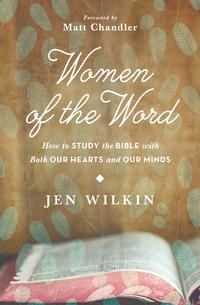
WOTWIf you could only read one book about studying the Bible, I would recommend Women of the Word by Jen Wilkin.

I read it four years ago, but wanted to read it again. I should probably reread it every few years.

Jen opens with some of the mistaken approaches she took to reading the Word of God at first. One was reading it as if it were a book about her and to help her. Though the Bible does help us, it is a book about God. Another “turnaround” for her was the realization that the Bible should speak to the mind as well as, and even before, the heart.

If we want to feel a deeper love for God, we must learn to see him more clearly for who he is. If we want to feel deeply about God, we must learn to think deeply about God (p. 33).

We must love God with our minds, allowing our intellect to inform our emotions, rather than the other way around (p. 34).

Jen’s great passion is promoting Bible literacy, which she says “occurs when a person has access to a Bible in a language she understands and is steadily moving toward knowledge and understanding of the text” (pp. 36-37). She emphasizes the steady movement: we won’t some day “arrive” at complete Bible knowledge, but we should be ever growing.

But “we may develop habits of engaging the text that at best do nothing to increase literacy and at worse actually work against it” (p. 37). She discusses several of those wrong habits, like the Xanax approach (which “treats the Bible as if it exists to make us feel better,” p. 39), the Magic 8 ball approach, and several others.

Then she shares Five P’s of Sound Study: purpose, perspective, patience, process, and prayer, explaining, illustrating, and giving example of each. Within “process” she discusses comprehension, interpretation, and application, and she stresses reading in context and in consideration of the genre of each book.

Throughout the book Jen emphasizes that Bible study and literacy is not an end in itself: it is a means of knowing God for who He is, getting to know Him better and being changed to become more like Him.

Our study of the Bible is beneficial only insofar as it increases our love for the God it proclaims. Bible study is a means to an end, not an end in and of itself. It is a means to love God more, and to live differently because we have learned to behold him better. And it is a means to become what we behold. The reciprocal love of God is a love that transforms (p. 148).

She includes an excellent chapter expressing the great need for women to teach women and sharing helps for those who would go on to lead Bible studies. I especially appreciated the admonition to avoid “ricocheting around the entire Bible…Good teaching will necessarily involve the use of cross-references, but not at the expense of the primary text” (p. 139) and to avoid “feminizing the text” (p. 140) as well as the rest of the advice in this chapter.

I am glad I read this again, and I am happy to recommend it again.

(Sharing with Semicolon‘s Saturday Review of Books,
Literary Musing Monday,
Carole’s Book’s You Loved)

Because My Father Is My King

But as for Aslan himself, the Beavers and the children didn’t know what to do or say when they saw him. People who have not been in Narnia sometimes think that a thing cannot be good and terrible at the same time. If the children had ever thought so, they were cured of it now. For when they tried to look at Aslan’s face they just caught a glimpse of the golden mane and the great, royal, solemn, overwhelming eyes; and then they found they couldn’t look at him and went all trembly. C. S. Lewis, The Lion, the Witch, and the Wardrobe

Our church is going through the psalms together and discussing a few at a time on Sundays. In many psalms, the writer pours out his heart to God pleading for mercy, justice, protection, forgiveness, revival. Often the writer comes to God out of sorts, but after a few moments of meditating on who his God is, he is set to rights and sees things clearly.

Other psalms (like 95-100) set forth God’s majesty, holiness, and greatness and our response of awe and worship.

On those occasions in Scripture when someone meets a heavenly being of some kind, like an angel, that person often falls to the ground in worship that the angel has to correct. If just an angel causes that reaction, we can understand God answering Moses’ request to see Him by saying Moses would not be able to withstand seeing the full scope of His glory and splendor. John had been the closest disciple to Jesus during the Lord’s time on Earth. Yet when John saw Jesus in all His glory in Revelation 1:17, he didn’t shake his hand, slap him on the back, cry out, “So good to see you again!” He “fell at his feet as dead,” overwhelmed.

It’s good for us to meditate on and remind ourselves of just Who our God is in all of His aspects. We don’t often think of His majesty, splendor, and greatness unless we encounter those traits in Scripture. Sometimes a glorious sunset or huge waterfall or massive lightning storm will give us a glimpse of His powerfulness and immensity.

Yet sometimes I have a hard time reconciling the greatness of God that would immerse me in awe and bring me to my knees in worship with the closeness and intimacy of my Abba, Father, described in Romans 8 and Galatians 4. It’s not that the Old Testament presents God as massive and majestic and the New Testament portrays Him as close, personal, and loving: no, both aspects are presented all through the Bible.

So one day, this illustration came to mind of a child of a king.

A beloved child played on the floor with his father and sat in his lap to read a book.  His father rocked him to sleep and comforted him when he was hurt or afraid. The child knew his father was something called a king, but he didn’t quite understand what that was or what his father did at work every day.

But one day, an affair of state required his father to wear his full royal regalia and address the nation. As the child stood with his mother and siblings, the king’s entrance was announced, accompanied by a trumpet fanfare. When the king came in, the child hardly recognized the man as his father. He looked so different in his crown and royal robe, standing so erect, receiving the applause of the audience, speaking in such authoritative and measured tones, followed by his entourage. The child was awed, but a little afraid of the king. But as his father finished speaking and turned to go back to the family residence within the castle, he searched for his son, and smiled. And then the child recognized the love in his father’s eyes and knew that he was indeed, the same daddy who had comforted him and played with him so often before.

It’s an imperfect analogy, and it wouldn’t carry over in every single point. But the gist of it helps me to reconcile how the Lord whose full holiness will overwhelm me is the same Abba Father who comforts and cares for me now.

Because my Father is my King, I can rest in His power and authority. He’s in charge, and He is just. He is both kind and righteous. He employs all the sources of His kingdom to protect me and provide for me.

Because my King is my Father, I have the closest access to Him. I can rest in His love and know He cares about every detail of my life. I have a glorious inheritance.

He is worthy of my worship, my trust, and my love.

But to all who did receive him, who believed in his name, he gave the right to become children of God. John 1:12, ESV

See what kind of love the Father has given to us, that we should be called children of God. 1 John 3:1a, ESV

O worship the King, all glorious above,
And gratefully sing His power and His love;
Our Shield and Defender, the Ancient of Days,
Pavilioned in splendor, and girded with praise.

O tell of His might, O sing of His grace,
Whose robe is the light, Whose canopy space,
Whose chariots of wrath the deep thunderclouds form,
And dark is His path on the wings of the storm.

Thy bountiful care, what tongue can recite?
It breathes in the air, it shines in the light;
It streams from the hills, it descends to the plain,
And sweetly distills in the dew and the rain.

Frail children of dust, and feeble as frail,
In Thee do we trust, nor find Thee to fail;
Thy mercies how tender, how firm to the end,
Our Maker, Defender, Redeemer, and Friend.

~ Robert Grant

(Revised from the archives)

(Sharing with Inspire Me Monday, Literary Musing Monday, Tell His Story, Let’s Have Coffee, Woman to Woman Word-filled Wednesday, Porch Stories, Wise Woman, Faith on Fire)


Friday’s Fave Five

FFF fall background

It’s Friday, time to look back over the blessings of the week with Susanne at Living to Tell the Story and other friends.

Here we are near the end of the first week of October. It’s still not looking too fallish outside. Some leaves have started changing a bit, but I am looking forward to blazing fall colors, hopefully soon. And crisp, cool fall weather! The temperatures have lowered some, but they are not in “cool” range yet.

Meanwhile, here are some favorite parts of the last week:

1. A dripping faucet fixed. The incessant dripping I heard every time I went into the bathroom was about to drive me buggy – on top of the thought of wasted water and money. My husband took care of it last Saturday – and then cleaned the tub and toilet while he was there. Nice man.

2. Sunshine. We had a lot of rainy or overcast weather for several days last week, and the sunshine this week has lifted my spirits.

3. A good visit with my daughter-in-law’s parents who were visiting for a long weekend and came over Sunday night for dinner.

4. A quick take-out lunch. I mentioned last week not cooking for three days in a row. I made up for it this week! I had some extra time in the kitchen last weekend. Picking up lunch after church from McAlister’s Deli was a big help.

5. New fall decorations. I mentioned last week that all the fall decorations were the same as the last few years. But this week I added to them. I have wanted to make a burlap wreath for years now and finally did so this week. I shared the process and the tutorials I worked from yesterday.

IMG_1155

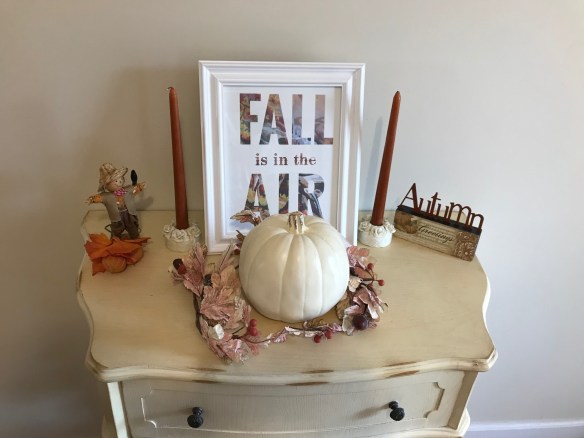
Then, in looking through my autumn Pinterest board, I found a lot of free printables and printed and framed a couple. This one is from this site:

IMG_1158

I normally have a floral printable with a verse in that frame, so I just slipped this in on top of it. I may start rotating printables there with the season.

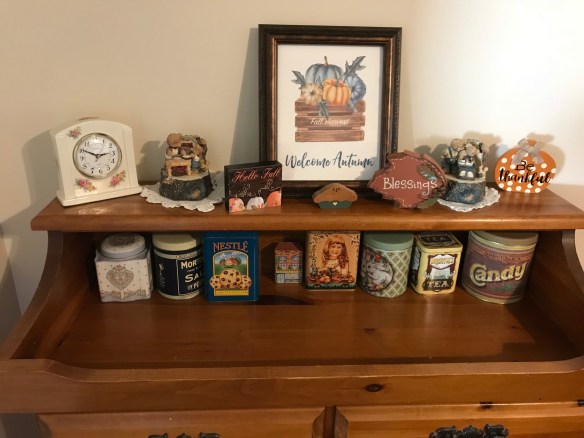
And this one is from this site:

IMG_1157

Thankfully I had an unused frame tucked in a closet. The “blessings” leaf and “Hello Fall” block are new, courtesy of a Hobby Lobby gift card. The little wooden pie cutout I have had for years and tuck it here and there. The little “Be Thankful” pumpkin was a birthday gift from a friend. The little rosy clock looks a little out of place amid the fall things, but that’s ok. Usually my decorations match it better, but we can make exceptions for fall and Christmas. 🙂

All in all, a very good week. I hope yours was, too, and if not – may next week be better!

Cards and Crafts

I thought I’d share with you some of the recent cards I made as well as a hot-off-the press craft.

This was for a baby shower for a couple at church:

img_1085.jpg

I had seen several ideas similar to this on Pinterest. The “onesies” were made with the Cricut machine. I learned you can make a reasonable looking cloud by cutting an oval or circle with scalloped scissors. I was a little afraid the twine would come loose, but I kept the card propped open on my table for a couple of days, and everything stayed put.

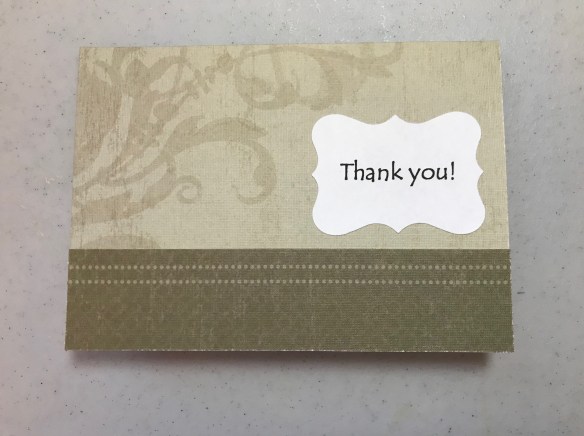
This was a thank-you card for a friend:

img_1130.jpg

This was another instance where the paper itself was so pretty and had enough detail that adding much else would have been superfluous.

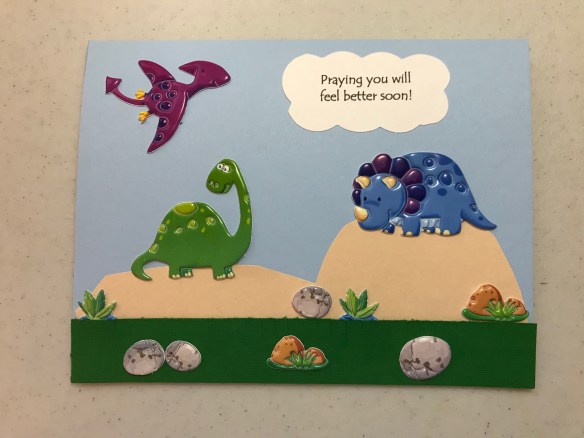
This was for a little boy in our church recovering from surgery:

IMG_1131

I asked someone who knew the family well if there was an animal or character he particularly liked, and they mentioned dinosaurs. None of the dinosaur shapes on the Cricut looked like what I wanted, so I used puffy stickers. I cut the grass and hills free hand and snipped across the strip of grass to make it look a little more 3-D. then I tucked a couple more packages of dinosaur stickers inside for him to play with.

This was for Jesse’s birthday:

img_11561.jpg

He is very much into computers – his work, his major, his classes, and his hobbies all revolve around the computer. So I wanted to reflect that. The computer shape was done on the Cricut, and the desk was a scrap of wood-grained paper I had on hand. I liked it better before I added the “snacks,” so I should have left well enough alone. But they also reflect him accurately.  🙂 The bottle was done with the Cricut and was supposed to look like the type of flavored water he drinks. The plate and brownie I did free-hand.

When I put out my autumn decorations, I realized there was a door I had no wreath for. And we can’t have that, can we? 🙂 Somehow I must have misplaced one, because I remember having a scarecrow one in addition to the one near the front door. Anyway, I remembered I had the same thought about needing another wreath last year, and even bought supplies for a burlap wreath, but didn’t get around to it then. So I found them in my craft room closet and worked on it bit by bit. It didn’t take all that long, but I had to work it into odd bits of time. I found a plethora of burlap wreath ideas on Pinterest. I found instructions for the burlap part here, and a helpful video tutorial here. The felt roses came from a site I had used before for them here. This is a much simpler way to make felt roses than many tutorials I’ve seen that tell you to cut multiple petals and sew them all together. I used a hot glue gun instead of stitches. I was really pleased with how it turned out!

I cut the leaves freehand out of felt and glued everything on with hot glue. I learned to do the bow when I worked part time for a florist friend in early married days.

True confessions: I didn’t realize until I got the burlap part all done that I hadn’t gotten the burlap loops even in length all around. So I put the flowers and bow on the place the difference was the most noticeable. Also, a couple of times while pushing the burlap through the wreath form, my thumb accidentally poked a hole in the burlap. But thankfully the loose weave that enabled the hole also enabled fixing it by just moving the threads around.

I’m trying to decide whether to put an initial or something on the other side. But for now I like it as is.

It felt really good to get some creative projects done!

Book Review: Emma’s Gift

Emma's gift Emma’s Gift is the sequel to Julia’s Hope by Leisha Kelly. I think you could read and understand the second book without the first one, but you’d get much more out of the story with both of them. Plus, since Julia’s Hope will probably be one of my favorite books read this year, I encourage you to read it, too.

In Julia’s Hope, Julia and her husband, Samuel Wortham, and their two children lost everything during the Depression. They were hitchhiking east to get a job with Samuel’s cousin when they got word that the job fell through. Totally alone and with no hopes, they find shelter in an abandoned farmhouse. Then Julia gets the idea that perhaps the owner would let them stay in return for fixing up the place. They find the owner, Emma, who is an elderly amputee who can no longer live alone. She agrees to the arrangement, much to the consternation of some of her friends who think the Worthams are taking advantage of her. Before long the Worthams suggest that Emma come back to the farmhouse and stay with them, which she agrees to do, and they become something of an adopted family for each other.

Emma’s Gift picks up the story several months later. Emma was not in good health in the last book and knew her time was soon coming to an end. She passes away near the beginning of this story. It’s not unexpected, yet it’s still a blow to the family. But then their neighbor, a mother of ten children, passes away the same night, totally unexpectedly. The Worthams take in the children while the woman’s husband, George, deals with his grief. While glad to help, and, really, having no choice, an addition of ten children, one a newborn, weighs heavily. Helping the children through their grief while dealing with their own is a challenge.

Uncertainty also weighs on both families as their houses and land were owned by Emma. Emma had tried to give the Worthams the deed to the house they were in, but Samuel refused at the time. George has been unable to make any payments for months, if not years, and Emma wanted to forgive the debt. But now her affairs are in the hands of her nephew, so everyone has to wait to see whether he’ll abide by Emma’s wishes or take the property as his own.

Some of the townspeople bring food out and stay to help with the children, which helps Julia to feel that they are finally accepted. Some of the men help Samuel deal with George, who is on the verge of doing something stupid.

Even though the first part of the book is heavy with grief, please don’t let that deter you. The light does break through in the end, and it’s heartwarming to see the progression.

The point of view switches back and forth between Julia and Samuel. Two themes emerged for me: that everyone has something to give to help others no matter how much or little they have, and when you’re weighed down almost to the breaking point, God’s grace sufficient.

A few favorite quotes:

It made me feel good inside to love her right over top all the rough edges.

Kissing cheeks, passing plates, even listening to George pour out his woes one more time over a late cup of root coffee—it was all the work of God. Because people need each other. And sometimes we don’t realize how much we have to give until we’ve started giving it.

It doesn’t take away the pain of this world. But just knowing the outcome can stop the ache that comes in the middle of some lonely night, or can give you words to make a crying child smile again. God is faithful. Our shelter in the time of trouble. Our refuge in the time of storm. We don’t always know what he’s given us. When we’re deep in the hurt of some awful moment, we don’t always know what good things God has prepared for the days ahead. But we do know so much of himself has been given to our hands. To cherish. To rest in. And especially to share.

These two books are all I have, but there is another sequel, and then another three-book series with some of the same characters as well as a Christmas story. I’d like to get to the rest of them some day. In looking up Leisha Kelly after reading the last book, I was sad to discover that she and her teenage son had died in a car accident some years ago. But I am glad she left this legacy behind.

(Sharing with Carole’s Books You Loved, Semicolon‘s Saturday Review of Books, Literary Musing Monday)

When Little Trials Give Us Big Trouble

IMG_1154

Sometimes it seems easier to trust the Lord for the big trials of life rather than the little irritations.

When a major crisis comes my way, I realize it’s too big for me. I’m acutely aware of my need for God’s grace and strength. I feel myself sinking, like Peter, and cry out for help almost instinctively.

But when I encounter some smaller provocation — when someone interrupts what I am doing; when my computer acts up; when I am running late to an appointment and hit every red light along the way; when another driver cuts me off; when I am in a hurry at the grocery store and the customer in front of me has some time-consuming problem; when I give dinner a quick stir and slosh red sauce over the side of the pan and onto the stove, the floor, and/or myself — then too often I react with simmering impatience, carnal anger, unloving harshness, discouragement or depression.

Amy Carmichael once wrote:

The hardest thing is to keep cheerful (and loving) under little things that come from uncongenial surroundings, the very insignificance of which adds to their power to annoy, because they must be wrestled with, and overcome, as in the case of larger hurts. Some disagreeable habit in one to whom we may owe respect and duty, and which is a constant irritation or our sense of the fitness of things, may demand of us a greater moral force to keep the spirit serene than an absolute wrong committed against us. (1)

“Well, I was provoked.”

Love…is not easily provoked. I Corinthians 13:5

“I’m only human.”

Yes. That’s the problem, not an excuse. With the exception of One, all humans have a sinful nature. Our natural reaction is likely to be a selfish one. As Christians we’re called to have a supernatural reaction.

But the fruit of the Spirit is love, joy, peace, longsuffering, gentleness, goodness, faith, meekness, temperance. Galatians 5:22-23.

Even on the highway or in a check-out line.

Thank God there is forgiveness with Him, His mercies are new every morning, and if we confess our sin, He is faithful and just to forgive us our sin and to cleanse us from all unrighteousness(I John 1:9).

But how can I get the victory over wrong reactions to little provocations and react in a right manner the next time?

  • First of all, instead excusing it, recognize it as sin and confess it to Him.
  • Carefully evaluate and use my time better, such as such as stopping whatever I am doing early enough for an appointment so that a few red lights will not cause me to be late (or agitated), slowing down and take the necessary time to accomplish something so haste doesn’t create more problems, etc.
  • Fix the issue, if possible. Find out if there is something wrong with the computer, gently ask the other person to refrain from or change whatever they are doing, etc.
  • Put it into perspective. A little thing is just a little thing. Being a Christian doesn’t mean every little bump in the road is going to be removed.
  • Relinquish control of my life and time and schedule into the Lord’s hands will help me to handle interruptions better. Have you ever studied the life of Christ with an eye toward how much He was interrupted? It’s enlightening. Even when He was interrupted during prayer or on his way to perform a miracle, He never reacted harshly or impatiently.
  • Relinquish the “I” factor as well. Some of the agitation I experience is simply my thwarted desire for things to go my way. I mentioned in an earlier post that another of Amy Carmichael’s experiences that helped me was when she felt the “I” “rising hotly” in her toward one who was unfair and dominating, and she realized that moment was a chance to die to self. “See in this which seems to stir up all you most wish were not stirred up — see in it a chance to die to self in every form. Accept it as just that – a chance to die.” (1)
  • Do unto others as I would have them do unto me. I need to remember that I’m probably unwittingly irritating someone else sometimes who is graciously (I hope) being forbearing with me. I need to handle the irritations that come from other people as graciously as I would want them to handle mine. Instead of focusing on the irritant, I need to focus on that person as another child of the Father whom He loves every bit as much as He loves me and seek ways to serve him or her.
  • Forbear. A former pastor used to say forbearing was just good old-fashioned putting up with each other. In Ephesians 4:1-3, Paul says, “I therefore, the prisoner of the Lord, beseech you that ye walk worthy of the vocation wherewith ye are called, With all lowliness and meekness, with longsuffering, forbearing one another in love; Endeavouring to keep the unity of the Spirit in the bond of peace.” Not just forbearing, but forbearing in love. “Above all, keep fervent in your love for one another, because love covers a multitude of sins,” (I Peter 4:8). Colossians 3:12-14 says, “Put on therefore, as the elect of God, holy and beloved, bowels of mercies, kindness, humbleness of mind, meekness, longsuffering; Forbearing one another, and forgiving one another, if any man have a quarrel against any: even as Christ forgave you, so also do ye. And above all these things put on charity, which is the bond of perfectness.”
  • Remember that my testimony before others is at stake. “That ye may be blameless and harmless, the sons of God, without rebuke, in the midst of a crooked and perverse nation, among whom ye shine as lights in the world” (Philippians 2:25). I sometimes think of Satan standing before God and accusing that Job only served God because God blessed him, but let Satan take away Job’s blessings, and he would curse God. I envision Satan saying of me, “Yes, she acts like a nice Christian at church, but let me trip her up here and there and see how she reacts.” We’re not only a testimony to others in our homes and at check-out lines, but we forget that our testimonies are as far-reaching as heaven. Rosalind Goforth was a missionary wife to China during years when the Chinese were quite suspicious of and disdainful toward “foreign devils.” To try to alleviate those feelings and establish relationships with the Chinese, the Goforths would allow crowds of the curious into their home to look around and to talk with them. This resulted in some agitation and disruption as well as theft of some of their belongings, but overall they felt it was worth it. Of one particular day, Rosalind writes:

The day had been an unusually strenuous one, and I was really very tired. Toward evening, a crowd of women burst through the living room door and came trooping in before I had time to meet them outside. One woman set herself out to make things unpleasant. She was rough and repulsive and– well, just indescribably filthy. I paid no attention to her except to treat her as courteously as the rest. But when she put both hands to her nose, saying loudly, “Oh, these foreign devils, the smell of their home is unbearable!” my temper rose in a flash and, turning on her with anger, I said, “How dare you speak like that? Leave the room!” The crowd, sensing a “storm,” fled. I heard one say, “That foreign devil woman has a temper just like ours!”

Now, I had not noticed that the door of my husband’s study was ajar, not did I know that he was inside, until, as the last woman disappeared, the door opened and he came forward, looking solemn and stern. “Rose, how could you so forget yourself?” he said. “Do you realize that just one such incident may undo months of self-sacrificing, loving service?”

“But Jonathan” I returned, “you don’t know how she — “

But he interrupted. “Yes, I do; I heard all. You certainly had reason to be annoyed; but were you justified, with all that is hanging in the balance and God’s grace to keep you patient?”

As he turned to re-enter his study, he said, “All I can say is I am disappointed!

Oh, how that last word cut me! I deserved it, yes, but, oh, I did so want to reach up to the high ideals he had. A tempestuous time followed alone in our inner room with my Lord. as I look back now, it was all just one farther step up the rocky hillside of life — just climbing! (2)*

One time when I posted Rosalind’s experience, a commenter took offense at Jonathan’s response to his wife, thinking he should have been a little more sympathetic and suggesting that the lost need to understand that we’re not perfect. But Rosalind felt that what Jonathan said and how he said it were just what she needed to bring her to conviction. A theme she deals with all through the book is her lack of love and tendency toward wanting her own way, and by the end of the book the nationals they interacted with had a much different testimony of her. Yes, lost people or new Christians need to understand that though we are changed we’re not sinless, but this was a matter of first impressions. Jonathan was right that a harsh reaction could undo much positive ministry. Though understanding her annoyance, his point was that it was not an excuse and she could have accessed God’s grace to react in a right manner.

  • The verses mentioned above in Galatians 5 say that gentleness, long-suffering, self-control, etc., are all a part of the fruit of the Spirit. Maintaining time in the Word so He can speak to me through it, yielding to His control throughout the day, memorizing verses in the areas I am having trouble with, sending out a quick prayer for help when I feel that agitation and frustration building up will all help in gaining the victory.
  • Pray. Part of a prayer I often pray from Colossians 1:9-14 is I might be “Strengthened with all might, according to his glorious power, unto all patience and longsuffering with joyfulness” (verse 11). That’s also a reminder to focus not just on avoiding irritation but to also cultivate the positive: longsuffering and patience with joyfulness.
  • Remember “we glory in tribulations also: knowing that tribulation worketh patience; And patience, experience; and experience, hope: And hope maketh not ashamed; because the love of God is shed abroad in our hearts by the Holy Ghost which is given unto us. (Romans 5:3-5, KJV). Even the little tribulations can be used by God to grow and sanctify us. Elisabeth Elliot wrote in A Lamp For My Feet (and it encourages me that she felt this way about some people, too, sometimes):

How can this person who so annoys or offends me be God’s messenger? Is God so unkind as to send that sort across my path? Insofar as his treatment of me requires more kindness than I can find in my own heart, demands love of a quality I do not possess, asks of me patience which only the Spirit of God can produce in me, he is God’s messenger. God sends him in order that he may send me running to God for help.

This is true of irritating situations and intimate objects as well as people. Like sandpaper they can help rub off our sharp edges.

  • Behold our God. II Corinthians 3:18 says we’re changed more and more into Christ’s likeness as we behold Him. When I look inside and tell myself I need to be more kind, loving, forbearing, etc., I get discouraged and fail because I don’t have it in myself. “For I know that in me (that is, in my flesh,) dwelleth no good thing: for to will is present with me; but how to perform that which is good I find not” (Romans 7:18). But when I look at Him, that irritability seems to just melt away. “The Lord is gracious, and full of compassion; slow to anger, and of great mercy.  The Lord is good to all: and his tender mercies are over all his works.” (Psalm 145:8-9).

Let us therefore come boldly unto the throne of grace, that we may obtain mercy, and find grace to help in time of need. Hebrews 4:16.

___________
(1) Houghton, Frank. Amy Carmichael of Dohnavur. (Fort Washington, PA: Christian Literature Crusade, 1983), 86-87.

(2) Goforth, Rosalind. Climbing. (USA: Bethel Publishing, 1940), 45-46.

(Revised from the archives)

(Sharing With Inspire Me Monday, Literary Musing Monday, Tell His Story, Let’s Have Coffee, Porch Stories, Faith on Fire)


Friday’s Fave Five


It’s Friday, time to look back over the blessings of the week with Susanne at Living to Tell the Story and other friends.

I’m trying not to start every single FFF with a comment about how fast the week went…but, man, it sure seems like September flew by quickly! For now, I get a few moments to slow down time by reflecting on the best parts of the last week:

1. Lunch with a friend at her house. Great food and fellowship. 🙂

2. Meals out or brought in. My daughter-in-law recently said that eating out is her love language, and I feel much the same way. Somehow I ended up not cooking for three days in a row.

3. Quick, simple meals. I’m thankful my family is content with just soup and sandwiches when I have had a busy day and am late getting to meal preparation.  And! Soup! Though we have it year round, it’s especially nice in the fall and winter.

4. Fall decorations. No picture, since it is pretty much the same every year. I’m feeling more ready for fall now that they’re up.

5. Flourless Applesauce Spice Cake. Wonderful stuff even if you don’t need to go flourless.

Happy Friday!

What’s On Your Nightstand: September 2018

Nightstand82The folks at 5 Minutes For Books host What’s On Your Nightstand the last Tuesday of each month in which we can share about the books we have been reading and/or plan to read.

I checked my calendar yesterday morning, but I somehow got my weeks mixed up and thought I had another week before the Nightstand post! Instead, I am a day late. Oh, well…

Since last time I have completed:

The Guernsey Literary and Potato Peel Pie Society By Mary Ann Shaffer and Annie Barrows, reviewed here. Loved this! And the movie was wonderful, too, despite a few changes to the plot.

Julia’s Hope by Leisha Kelly, reviewed here. Loved this story about a family struggling during the Depression who ends up sharing a house with an elderly amputee.

Tea With Emma by Diane Moody, reviewed here. Something of a modern take on Jane Austen’s Emma. It was…okay.

Reclaim Your Life from IBS: A Scientifically Proven Plan for Relief without Restrictive Diets by Melissa G. Hunt, reviewed here. Both practical and helpful.

Helen Roseveare: On His Majesty’s Service by Irene Howat, reviewed here.

The Scars That Have Shaped Me: How God Meets Us in Suffering by Vaneetha Rendall Risner, reviewed here. Excellent. Deep. Convicting.

I’m currently reading:

Emma’s Gift by Leisha Kelly

The Lost Castle by Kristy Cambron

Rereading Women of the Word by Jen Wilkin

I’ve been using my normal audiobook time to listen to a series of lectures on Classics of British Literature by John Sutherland.

I’m also reading parts of The Elements of Style by William Strunk and E. B. White, but it’s more of a reference book than one to read straight through.

Up Next:

Reading the Bible for Life: Your Guide to Understanding and Living God’s Word by George Guthrie. Some of his blog posts have been very helpful to me, so I am looking forward to his book.

There’s a Reason They Call It GRANDparenting by Michele Howe, recommended by Michele Morin.

I am trying to decide whether my next audiobook with be Amazing Grace: William Wilberforce and the Heroic Campaign to End Slavery by Eric Metaxas or Alvin York: A New Biography of the Hero of the Argonne by Douglas V. Mastriano. I know a little of both men’s stories and would like to learn more.

I have all kinds of Christian fiction in my Kindle app and on my shelf, but I am not sure which one will be next.

I think that wraps up by reading activity for this month! Are you reading anything good?

Book Review: Julia’s Hope

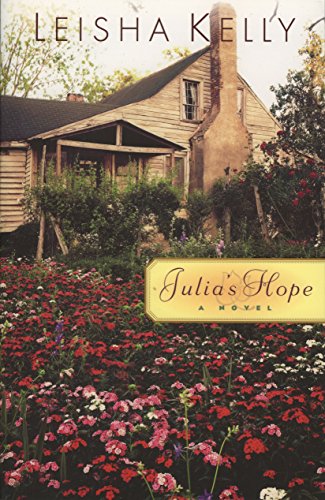
JuliaIn Julia’s Hope by Leisha Kelly,  Samuel Wortham is out of a job, like so many others in the early 1930s. Not only did his business close, but the investment he financed with money from his wife’s inheritance failed. The family has just a few dollars. Sam’s cousin says there’s work for Sam in Illinois, so the family is going to hitchhike from Pennsylvania.

Julia, Sam’s wife, is understandably angry with Sam over the lost investment, but she tries to keep a brave face for the children and make the trip an adventure.

It occurred to me then that I ought to pray for help in getting over the anger I felt towards Sam. But I didn’t do it. I guess it was easier to think that I’d forgiven him already and was just entitled to my feelings beyond that.

A few days into the trip, with money gone and the family eating in soup kitchens and sleeping wherever they can, Sam calls his cousin to tell him where they are. He’s told the job fell through and the cousin himself is looking for work.

But when Samuel stepped out of that office, looking like a stormy wind had dashed him against a wall of stone, the clouds descended over me and I turned away. I knew by his face. Dewey wouldn’t be coming. Dewey couldn’t carry all the hopes we’d pinned on him. We were alone.

One day, caught by a sudden downpour, the family takes refuge in an abandoned farm house. Something about it appeals to Julia and the children, so she proposes they find the owner and see if they might be allowed to stay in return for working on the place. Sam thinks the idea is crazy, but Julia is so set, he humors her.

They discover the homeowner is an elderly lady named Emma. She loves the house, but due to a heart condition and the loss of  leg, she can’t live there alone any more, so she has been living in a boarding house in town. Though what the Worthams propose is unconventional, she agrees to let them stay at her house so that it doesn’t deteriorate further.

The Worthams feel like they are taking unfair advantage, though. So within a few days they propose a new situation: that Emma come out and live with them at the house. She agrees.

Emma and Julia both know how to live off the land – what greens are good for food or tea, how to plant seeds and cultivate vegetables etc. But Sam is totally out of his element. He has never farmed and he’s worried about Emma’s care. But there doesn’t seem to be anything else he can do, so he puts forth his best effort.

Emma is a town treasure, so many of her friends check on her and the Worthams. Some of her friends, however, suspect the Worthams have “sweet-talked” her and are out to milk her out of her property, and they make no end of trouble despite Emma’s assurances. One in particular “was a difficult sort, one who was pleased to be displeased.”

My thoughts:

I loved this story. Its main appeal to me is how clearly Leisha communicates the character’s feelings. I ached along with Sam in his financial predicament, his guilty feelings, and his loss of self-respect. I understood Julia’s struggle to put aside her anger,  forgive, and attend to her children in a way that kept them hopeful, rather than afraid. I felt Emma’s joy at being home again.

But I also enjoyed reading about this time era, not one that I can remember seeing much in fiction. I enjoyed the gelling of a new family group. And I appreciate the way the people in the community helped each other though most of them didn’t have a lot themselves.

We all need each other, and that’s how the good Lord intended things to be.

“You think when that boy come bringin’ the Lord bread and fish, that the Lord shoulda just sat an’ ate it all his own self?”

“Well, no, he couldn’t. He fed the five thousand.”

“That’s right,” she said with a smile. “Didn’t look like it, but God’s got plenty for ever’body. So it don’t hurt me none to share.”

The point of view switches between Sam, Julia, and Emma, so we see their different perspectives. The faith element is woven in naturally.

This is the first book in a long time that I stayed up too late to read and had a hard time putting down. I immediately started reading the sequel, and I am looking forward to more with the Wortham family.

(Sharing With Literary Musing Monday, Carole’s Books You Loved, Semicolon‘s Saturday Review of Books)