Friday’s Fave Five


It’s Friday, time to look back over the blessings of the week with Susanne at Living to Tell the Story and other friends
.

The last Friday of January – we’re almost 1/12 of the way through 2018 already! Last week I wasn’t sure if I could come up with five faves for the week – but there are always things to be thankful for, even if it requires more thought some weeks than others. This week, I have the opposite problem – more than five things to share! So maybe I’ll save a couple for next time. Here are some favorite parts of the last week:

1. A family outing. We went to Ripley’s Mirror Maze in Gatlinburg last Saturday and then had a great lunch at No Way Jose’s Cantina. We had been to the maze once before, about a year ago. In fact, when it was proposed this time, I wasn’t sure if I wanted to go – it’s a pretty short maze, and I wasn’t excited about driving all the way to Gatlinburg. But I am so glad we did. Timothy enjoyed it last time, but this time he was super-excited and vocal about it. When we quickly got to the end, we decided we didn’t want it to be over yet, so we trekked back through – I think confusing some who were going the other way. πŸ™‚ All in all a fun morning. Afterwards we crashed at home for an afternoon nap (it’s nice that a child’s schedule coordinates with a grandma’s πŸ™‚ ) and got Five Guys burgers for dinner. πŸ™‚

2. An understanding caregiver. On our way home Saturday we realized we weren’t going to make it by the time my mother-in-law’s caregiver usually left, so we texted her to let her know and apologize. She said it was no problem at all.

3. A good visit with the cardiologist. “Everything looks great, come back in six months.”

4. Sorting, organizing, purging files. I have a two-drawer (pink!) filing cabinet in my sewing/craft room with pattern booklets, leaflets, and pulled-from-magazine instructions for several crafts. I hadn’t tended to it in some time, and there were some things out of place, new things that needed a home, out-of-date items that needed to be thrown out, other things needing to be set aside to give away (one nice thing about getting to “a certain age” is becoming more realistic about what I might actually get to). I’ve been working on that here and there this week, for anywhere from 15 minutes to an hour or so at a time, and it’s been gratifying both to get it in order and get reacquainted with what I had in there.

5. A new can opener might seem like an odd thing to be thankful for. But my old one was giving me fits, leaving gaps where it didn’t cut through a lid and tearing paper off the side of the can in the meantime. I bought another one, but it wasn’t a whole lot better. My husband got me this one. The blade doesn’t come in contact with the food inside, and the lid doesn’t fall into or dip into the can – and it works great! It took me a few tries to get the hang of it, but now I love it.

And that’s it for this week. Happy Friday!

Book Review: Conscience: What It Is, How To Train It, and Loving Those Who Differ

ConscienceΒ  Conscience: What It Is, How To Train It, and Loving Those Who Differ by Andrew David Naselli and J. D. Crowley is a fairly short book at 149 pages (not including indexes), but it’s packed full.

They begin with a brief explanation about what got each of them thinking and then studying about the conscience. Then they explore what the conscience is and does and look briefly at every verse in the New Testament that mentions conscience. They bring out several principles, more than I can reiterate here, but a few stand out: conscience has been given to us by God; no two people have exactly the same conscience; “no one’s conscience perfectly matches God’s will”; conscience can be damaged in a number of ways; we should listen to it and not violate it so that we don’t damage it; once God shows us clearly that an issue our conscience troubles us about is not an issue in God’s Word, we yield to God as Lord over our consciences (e.g., Peter submitting to God’s rule about eating certain kinds of meat even though at first his conscience condemned them as unclean in Acts 10).

Our consciences might misregister due to being “hardened by the deceitfulness of sin.” – if we keep doing something that we feel is wrong and ignore conscience. “Feeding excuses to your conscience is like feeding sleeping pills to a watchdog” (p. 64). Our consciences are also affected by “the standards of other people such as your culture, family, or spiritual leaders. You simply go with the flow without thinking through the issues” (p. 64).

Since Christians are (or should be) continually reading God’s Word and growing spiritually, our consciences will change over the years as we realize some scruples are not Biblically based and as we become convicted of some issues that we had not previously realized were sin. We continually calibrate our consciences to align with God’s Word.

But since we’re all in different stages of growth and come from different cultures and have been taught different things about right and wrong, all our consciences are not going to be on the same page at the same time. How then do we interact with each other?

We should not sin against our conscience by thinking, “Well, Mr. A and Miss B. do this and they are strong Christians, so it must be ok.” No, “Each one should be fully convinced in his own mind” (Romans 14:2), we should do everything we do as unto the Lord (Romans 14:6), and we shouldn’t do anything that we can’t do with the full faith that it is okay (Romans 14:22-23) (“Don’t forget that ‘faith’ here refers not to saving faith in Christ [14:22a makes that clear] but to the confidence a person has in their heart or conscience to do a particular activity” [p. 97]). One whose conscience is strong in a certain area shouldn’t despise someone whose conscience bothers them on that issue, and the person whose conscience bothers them shouldn’t judge the person whose conscience has no scruples about issues which are not clearly defined in Scripture (Romans 14:3-4). Bringing up a specific matter, the authors write:

Don’t roll your eyes. This question may make you “face palm” in amazement at how strange someone else’s conscience might be. That’s typically how someone with a strong conscience reacts when they hear about the scruples of the weak. But to the weak of conscience, these are life-and-death matters. Conscience is always a life-and-death matter since sinning against it is always a sin, and getting used to sinning against conscience in one area will make it easier to sin against conscience in other areas. The strong must not look down on the weak but bear with them (Romans 15:1) and, if opportunity arises, gently help them calibrate their conscience (p. 79).

A few of the many quotes I have marked:

We should expect disagreements with fellow Christians about third-level matters [disputable matters where the Bible allows for differences], and we should learn to live with those differences. Christians don’t always need to eliminate differences, but they should always seek to glorify God by loving each other in their differences (p. 87).

Mature Christians should help other Christians train their consciences, but no one should force others to change their conscience (p. 92).

Our ultimate goal is not simply to stop judging those who are free or to stop looking down on those who are strict. Our ultimate goal is to follow the example of our Lord Jesus, who gave up his rights for others. He joyfully renounced his unbelievable freedom in heaven to come to earth and become an obedient Jew in order to save his people (Rom. 15:3-9) (pp. 95-96).

Have the right proportion. Keep disputable matters in their place as third-level issues. Don’t treat them like first- or second-level issues. And don’t become preoccupied with them or divisive about them. They shouldn’t be so important to you that it’s all you want to talk about. They shouldn’t be the main reason that you choose what church to join. They shouldn’t be issues that you are the most passionate about such that you are constantly trying to win people over to your position and then looking down on them if they decide not to join your side (p. 101).

Unfortunately I have seen this far too often. We spend a disproportionate amount of time on these issues, and let them distract us from the main issues.

Notice how generous Paul is to both sides. He assumes that both sides are exercising their freedoms or restrictions for the glory of God. Wouldn’t it be amazing to be in a church where everyone gave each other the benefit of the doubt on these differences, instead of putting the worst possible spin on everything? Paul says that both the weak and the strong can please the Lord even while holding different views on disputable matters. They have different positions but the same motivation: to honor God. They both do what they do for the glory of God (p. 106).

Christ gave up his life for that brother or sister; are you unwilling to give up your freedom [to do something your conscience is free about] if that would help your fellow believer avoid sinning against conscience? That’s what this passage is talking about when it refers to putting “a stumblingblock or hindrance” (Rom. 14:13) in another’s way (p. 109).

Christian freedom is not “I always do what I want.” Nor is it “I always do whatever the other person wants.” It is “I do what brings glory to God. I do what brings others under the influence of the gospel. I do what leads to peace in the church (p. 115).

One of the authors is a missionary to Cambodia, and they discuss dealing with cross-cultural issues of conscience as well. For instance, the author had a fledgling mango tree that finally produced three pieces of fruit. A friend doing some concrete work at his house ate the fruit. In the US, we’d consider that at least thoughtless and selfish, at worst, thievery. But in that culture, eating fruit while on or passing through someone else’s property was not a problem at all (there is even Biblical precedent for that in Deut. 23:24-25 and Luke 6:1). Reacting negatively to that would be seen as stingy. Preaching against it as “sin” would have either confused the hearers or caused them to dismiss the missionary’s message. They cite another case in another country where the people had no qualms about a women’s chest being uncovered, as they associated breasts with feeding babies, but to them “the sight of a woman’s thighs stimulates lustful desires” (p. 125). So a lady missionary thought the bare-chested women were highly immodest, but they thought she was immodest for wearing clothes that showed her thighs. The authors devote a whole chapter to dealing with these kinds of issues, pointing out especially that when we discuss sin, we need to major on what the Bible clearly says is sin, not sin in our cultural contexts, and we need to be careful that we’re not reproducing churches or Christians that mirror the culture that we came from, but rather we need to help them reflect Christ in their own culture.

There is so much more that I’d like to share, but I am in danger of reproducing the book as it is. Much of this was not new to me, as once when we moved to a different area and could not find a church “just” like the one we came from, I had to study through Romans 14 and related passages to come to terms with differences in preferences among the folks in our new area.Β  But this is a much more thorough exploration than mine had been. I appreciated not only the study but also the practicality, balance, and accessibility (easy to understand without a lot of theological-ese) of the book. Highly recommended.

(Sharing with Semicolonβ€˜s Saturday Review of Books, Literary Musing Monday, Carol’s Books You Loved)

Reminder: Laura Ingalls Wilder Reading Challenge

Just a reminder that the Laura Ingalls Wilder Reading Challenge starts here a week from tomorrow on Feb. 1! More information and an extended book list is here (you don’t have to choose a book from the list: it’s just there for suggestions).

I’ll have a post here next Thursday where you can sign up to let us know you are participating and what you plan to read. I’m looking forward to seeing what your choices are!

God’s Back

I mentioned in my recent review of The Man Who Was Thursday by G. K. Chesterton one quote that stood out to me. While several of the characters are trying to figure out a conundrum, the main character, Syme, says, β€œShall I tell you the secret of the whole world? It is that we have only known the back of the world. We see everything from behind, and it looks brutal. That is not a tree, but the back of a tree. That is not a cloud, but the back of a cloud. Cannot you see that everything is stooping and hiding a face? If we could only get round in frontβ€”.” The whole book has had a variety of interpretations since its publication, but I took this observation to mean that we don’t have the big picture. In trying to figure out the mysteries of the universe, even believing that God is at the helm and wisely and lovingly guides and provides, there are still things that don’t make sense to us.

In trying to understand the book better, I came across this article. It provided much food for thought though I am not sure I agree with every point. But I did take note of the connection it made between seeing the back of things with Moses seeing the “back” of God. After the disastrous incident of the golden calf, and that after all God had done to manifest Himself to His people, He is so angry that we wants to consume them. In Exodus 32 Moses intercedes, and God relents. In Exodus 33, God tells Moses to continue on with the people toward the land He had promised them, but God’s presence would not go with them. The people mourn and Moses intercedes again in one of my favorite passages, pleading with God for His presence with them.

When God promises to go with them, Moses responds in worship, β€œPlease show me your glory.” God replies:

β€œI will make all my goodness pass before you and will proclaim before you my name β€˜The Lord.’ And I will be gracious to whom I will be gracious, and will show mercy on whom I will show mercy. But,” he said, β€œyou cannot see my face, for man shall not see me and live.” And the Lord said, β€œBehold, there is a place by me where you shall stand on the rock, and while my glory passes by I will put you in a cleft of the rock, and I will cover you with my hand until I have passed by. Then I will take away my hand, and you shall see my back, but my face shall not be seen.”

Then the next day:

The Lord descended in the cloud and stood with him there, and proclaimed the name of the Lord. The Lord passed before him and proclaimed, β€œThe Lord, the Lord, a God merciful and gracious, slow to anger, and abounding in steadfast love and faithfulness, keeping steadfast love for thousands, forgiving iniquity and transgression and sin, but who will by no means clear the guilty, visiting the iniquity of the fathers on the children and the children’s children, to the third and the fourth generation.” And Moses quickly bowed his head toward the earth and worshiped.

As I pondered these passages once again, this thought struck me:

If this is the back of God – merciful, gracious, slow to anger, abounding in steadfast love and faithfulness, keeping steadfast love, forgiving sin – what must the front be?

No wonder no one can see His face and live! We’d be overwhelmed!

Besides these verses that refer to His mercy, grace, love, and forgiveness, other passages of Scripture tell us about His wisdom, power, omnipresence, and so many other attributes.

I don’t know exactly what we’ll “see” of Him in heaven, but I do know this: I may not understand everything that happens, I may question why some things have to be and wonder why God does some things and doesn’t do other things, but what I do know to be true of Him helps me to trust Him for what I don’t understand.

IMG_0716

(Sharing with Inspire Me Monday, Literary Musing Monday, Glimpses, Tell His Story, Woman to Woman Word-filled Wednesday, Coffee for Your Heart, Porch Stories, Faith on Fire)

Laudable Linkage

img_0021

Here are recent reads that have captivated my attention:

Love Like Birch Trees.

How to Sit at the Table With Those Who Hurt and Offend You, HT to Linda. “Extending love to someone who offended you does not mean you’re accepting such treatment – it means you realize you cannot thrive in a place of anger and resentment.”

What to Say Instead of “I Know How You Feel” to Someone Who Is Struggling, HT to Linda. Sharing our similar experience in an effort to let someone know they’re not alone often just draws attention to ourselves and makes the other person feel unheard. This gives a helpful distinctive.

When Our Heroes Don’t Live Up to Their Theology, HT to Challies. How do we think about spiritual giants who were blind to the wrongness of slavery.

Helping Your Daughter by Being Her Emotional Coach, HT to Story Warren.

You Can’t Have Ethics Without Stories, HT to Story Warren.. “We often forget what the Bible actually is. If not a dictionary or an encyclopedia, what is it? The Bible is, among other things, he writes, ‘a faith-forming narrative.’”

Why Children’s Books Should be a Little Sad, HT to Story Warren.

How DNA Testing Botched My Family’s Heritage, and Probably Yours, too, HT to Challies.

And finally, this dog has a dedicated owner:

Happy Saturday!

(Links do not imply complete endorsement of sites or authors.)

Friday’s Fave Five


It’s Friday, time to look back over the blessings of the week with Susanne at Living to Tell the Story and other friends
.

I’m late with FFF today. I had some errands to run this morning, so I didn’t have time for a post, but I was thinking of not posting today anyway. It hasn’t been a bad week, generally, but I could only come up with 2-3 things to mention. And…I confess I was out of sorts from two nights in a row of waking up during the night and then not being able to get back to sleep for two hours. But one thing I appreciate about this exercise is that, if you stop and think for a bit, there are always things to be thankful for. So here’s an abbreviated FFF for the past week:

1. Sunshine. We’ve had some bitter cold, but at least the sun has been shining more than last week, when we had several overcast days in a row. That makes such a difference to my general outlook on life.

2. Warmth. I know I have mentioned this before, but it’s still been so cold that I have really appreciated a snug house that keeps us toasty.

3. Help. We had a bit of snow this week, and since we don’t have it enough for TN to justify buying all kinds of equipment to deal with it, a lot of people don’t make it in to work. The main roads were fine, but neighborhoods and subdivisions were still icy. The helper we have for my mother-in-law doesn’t live far from us, but her neighborhood is on a hill that’s hard to maneuver when it’s icy. I thought she wouldn’t be in on Tuesday, but she was only a couple of hours late.

4. A new CD, Great Things He Hath Done by Sacred Music Services.

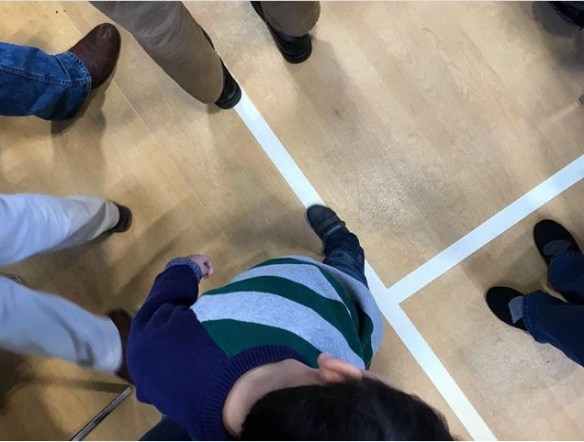
5. A Timothy funny. My son, d-i-l, and grandson Timothy (3 1/2) were attending a church potluck, and they told Timothy he needed to stand in line. He took them literally. πŸ™‚

Image-1

Happy Friday!

Book Review: The Man Who Was Thursday

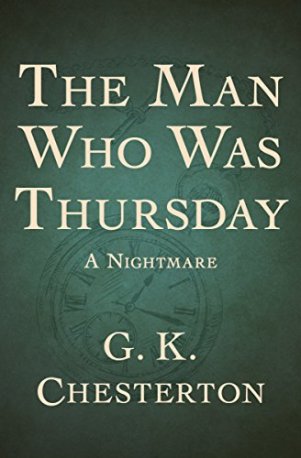
ThursdayIn The Man Who Was Thursday by G. K. Chesterton, Gabriel Syme and Lucian Gregory both profess to be poets, but they argue publicly about the nature of poetry and anarchy, Gregory leaning toward anarchy and Syme a “poet of law, a poet of order; nay, … a poet of respectability.” Privately Gregory confesses that he really is an anarchist, and to prove it, he wants to take Syme to a meeting of a council of anarchists. Seven men make up the council, each with a code name of a day of the week, led by Sunday. Thursday has just died and Gregory feels sure he will be elected to fill his place. He swears Syme to secrecy.

After further discussion and the codes necessary to get into the meeting, Syme asks Gregory in turn to swear not to tell a secret of his own. After Gregory agrees, Syme confesses that he is a detective with Scotland Yard.

Don’t you see we’ve checkmated each other? I can’t tell the police you are an anarchist. You can’t tell the anarchists I’m a policeman. I can only watch you, knowing what you are; you can only watch me, knowing what I am. In short, it’s a lonely, intellectual duel, my head against yours. I’m a policeman deprived of the help of the police. You, my poor fellow, are an anarchist deprived of the help of that law and organisation which is so essential to anarchy.

As Gregory makes his speech at the meeting, he fears saying anything that Syme can use against the organization, so he comes across as very tame. Syme stands up with rousing words that get the meeting behind him, and he is elected as Thursday.

Undercover, he meets with the council to determine their plans so he can thwart them. But when one of the council, an old, frail man, follows him after the meeting, Syme tries several tricks to evade him, only to find him continually following. When they finally confront each other, Syme is stunned to learn that this man is also an undercover detective. And that’s just the first step in his discovering that all is not as it appears.

My thoughts:

This book is quite suspenseful all the way through, and the latter part becomes allegorical. I had not known that going in: before choosing this book,Β as I tried to read enough about it to know whether I’d be interested, but not so much as to spoil it, I had missed this aspect. I’m struggling with that same line between revealing too much yet wanting to share more in reviewing it.

It gets pretty weird at the end, and I wasn’t sure what the allegory meant. As I sought some more insight this morning, I came across part of an article by Chesterton in which he lamented, “I have sometimes had occasion to murmur meekly that those who endure the heavy labour of reading a book might possibly endure that of reading the title-page of a book.”

It is odd that one example occurred in my own case… in a book called The Man Who Was Thursday. It was a very melodramatic sort of moonshine, but it had a kind of notion in it; and the point is that it described, first a band of the last champions of order fighting against what appeared to be a world of anarchy, and then the discovery that the mysterious master both of the anarchy and the order was the same sort of elemental elf who had appeared to be rather too like a pantomime ogre. This line of logic, or lunacy, led many to infer that this equivocal being was meant for a serious description of the Deity; and my work even enjoyed a temporary respect among those who like the Deity to be so described. But this error was entirely due to the fact that they had read the book but had not read the title page. In my case, it is true, it was a question of a subtitle rather than a title. The book was called The Man Who Was Thursday: A Nightmare. It was not intended to describe the real world as it was, or as I thought it was, even when my thoughts were considerably less settled than they are now. It was intended to describe the world of wild doubt and despair which the pessimists were generally describing at that date; with just a gleam of hope in some double meaning of the doubt, which even the pessimists felt in some fitful fashion.

So realizing that it’s an allegory and being reminded that it was a nightmare helped me comes to terms with thinking I was reading a crime drama only to encounter the increasing weirdness near the end. It is a crime drama, but it’s also fantasy and philosophy.

But realizing it is an allegory also opens more questions as to what it all means. The biggest question most people have, according to my reading, is just who exactly is Sunday and what does he represent? Even the characters “see” him in different ways.

β€œI suppose you are right,” said the Professor reflectively. β€œI suppose we might find it out from him; but I confess that I should feel a bit afraid of asking Sunday who he really is.”

β€œWhy,” asked the Secretary, β€œfor fear of bombs?”

β€œNo,” said the Professor, β€œfor fear he might tell me.”

My usual go-to sources for analysis of the classics, Schmoop and SparkNotes, don’t include this book, but this article says it’s meant to be a riddle, like Job, in that everything is not explained, but we’re assured God is in control, and this article asserts that it “revolves around two of the deepest of all theological mysteries: the freedom of the will and the existence of massive, irrational evil.” The latter also suggests a plausible identity for Sunday.

This was my first time reading Chesterton beyond an occasional witty quote, and his wit shines here, as in the irony of “law and organisation which is so essential to anarchy.” A few more examples:

If you didn’t seem to be hiding, nobody hunted you out.
___
His soul swayed in a vertigo of moral indecision.
___
β€œIt cannot be as bad as you say,” said the Professor, somewhat shaken. β€œThere are a good number of them certainly, but they may easily be ordinary tourists.”

β€œDo ordinary tourists,” asked Bull, with the fieldglasses to his eyes, β€œwear black masks half-way down the face?”
___
β€œMy God!” said the Colonel, β€œsomeone has shot at us.”

β€œIt need not interrupt conversation,” said the gloomy Ratcliffe. β€œPray resume your remarks, Colonel. You were talking, I think, about the plain people of a peaceable French town.”

And the more philosophical:

This is a vast philosophic movement, consisting of an outer and an inner ring. You might even call the outer ring the laity and the inner ring the priesthood. I prefer to call the outer ring the innocent section, the inner ring the supremely guilty section.
___

But right up against these dreary colours rose the black bulk of the cathedral; and upon the top of the cathedral was a random splash and great stain of snow, still clinging as to an Alpine peak. It had fallen accidentally, but just so fallen as to half drape the dome from its very topmost point, and to pick out in perfect silver the great orb and the cross. When Syme saw it he suddenly straightened himself, and made with his sword-stick an involuntary salute.

He knew that that evil figure, his shadow, was creeping quickly or slowly behind him, and he did not care.

It seemed a symbol of human faith and valour that while the skies were darkening that high place of the earth was bright. The devils might have captured heaven, but they had not yet captured the cross.
___
Shall I tell you the secret of the whole world? It is that we have only known the back of the world. We see everything from behind, and it looks brutal. That is not a tree, but the back of a tree. That is not a cloud, but the back of a cloud. Cannot you see that everything is stooping and hiding a face? If we could only get round in frontβ€”

The second article I referred to has an interesting section on our only seeing “the back side” of things, tying it in with Moses seeing the “back” of God in Exodus 33:17-23.

I’m sorely tempted to go back and reread it now with the understanding of its allegorical nature and some of these insights. But I think I’ll wait. I saw reference in some of my research to an annotated edition which might be helpful. Meanwhile, I am glad to have read it and thankful to the Back to the Classics challenge for steering me towards books I might not otherwise have picked up. I found this book quite funny in places, especially in some of the dialogue, suspenseful throughout, and ultimately seriously thought-provoking. It’s a sign of a good book when it has you pondering it long after closing it.

(Sharing with Semicolonβ€˜s Saturday Review of Books, Literary Musing Monday, Carol’s Books You Loved)

What do you know?

I recently read about a young woman’s experience running into a beloved Sunday School teacher she’d had as a child. As her heart swelled with fondness and gratitude for this woman’s ministry in her life, she opined that it’s the relationships, not the instruction that matters.

While I rejoiced in the relationship this woman had with her teacher and the way it inspired her to teach her own students, I was saddened that she downplayed the lessons. Religious instruction matters very much. The epistles are replete with warnings about wrong doctrine and correction thereof. Yet relationships are important, too. They help flesh out the truth and get it from the head to the heart.

I’ve heard the acquiring of Biblical knowledge downplayed because “Knowledge puffeth up, but charity edifieth,” according to I Corinthians 8:1.Β  That’s an example of ripping a verse out of its context and not couching it in the overall setting of the whole Bible. Yes, the Bible warns us against becoming proud of our knowledge, but it doesn’t discourage us from gaining knowledge.

Creation reveals knowledge of God’s existence, wisdom and ways. “The heavens declare the glory of God, and the sky above proclaims his handiwork. Day to day pours out speech, and night to night reveals knowledge.” Psalm 19:1-2.

God was angry with Job’s friends because they had not spoken what was right about Him.

God asked Job, “Who is this that darkens counsel by words without knowledge?

Job was comforted by the truth of knowing that his “Redeemer lives, and at the last he will stand upon the earth.”

The psalmist asks, ‘Make me to know your ways, O Lord; teach me your paths. Lead me in your truth and teach me, for you are the God of my salvation; for you I wait all the day long.” Psalm 25:4-5

The psalmist urges people to “Give ear, O my people, to my teaching,” including “the glorious deeds of the Lord, and his might, and the wonders that he has done” – information about Him as a means to knowing Him – and to pass that knowledge down to the next generations.

The first few verses of Proverbs say that Solomon gave them, β€œto know wisdom and instruction; to perceive the words of understanding; to receive the instruction of wisdom, justice, and judgment, and equity; to give subtilty to the simple, to the young man knowledge and discretion. A wise man will hear, and will increase learning; and a man of understanding shall attain unto wise counsels.” By contrast, later in the chapter it says fools hate knowledge.

Paul prayed for people who had “a zeal for God, but not according to knowledge” (Romans 10:1).

See how many times in 1 Corinthians 6 Paul says, “Do you not know…?”

Paul told Timothy to “Avoid the irreverent babble and contradictions of what is falsely called ‘knowledge'” (1 Timothy 6:20).

Peter tells us to supplement our faith with virtue, knowledge, self-control, and other qualities.

That’s just a small sampling of passages that talk about knowledge. If we also look at passages that talk about leaching and learning, we see that God places great value on them.

I have also heard the argument that it is more important to know by experience than to just know facts: for instance, it is better to spend time interacting with a person than just learning about them. It’s true that many of those passages about knowledge are referring to this experiential type of knowledge. But isn’t it also true that in getting to know someone you learn facts about them, their likes, dislikes, preferences, etc.? Years ago I saw a comical card for a wife from a husband depicting various domestic scenes. I don’t remember the exact wording, but the gist of it was, “I may not do A, B, and C that you want me to, and I may do D, E, and F that you don’t want me to, but I sure do love you, honey!” But living with an utter disregard for a wife’s preferences is not a manifestation of love. If husbands are to dwell with their wives according to knowledge, how much more should God’s people seek to know what pleases and displeases Him?

God has given us His Word, among other reasons, that we may know Him. We learn about Him that we might think of Him correctly and know how to please Him. Yes, just learning facts about Him is not sufficient and doesn’t take the place of knowing Him. But knowing Him without learning His Word makes for a shallow relationship.

God wants us to love Him with not just our hearts and souls, but our minds, to be transformed by the renewal of our minds, to gird up the loins of our minds.

It’s true that knowledge can “puff up” with pride, but rather than avoiding gaining knowledge, we need to remind ourselves that If anyone imagines that he knows something, he does not yet know as he ought to know” (1 Corinthians 8:2), and we need to remind ourselves that the purpose of gaining knowledge is to better know the Lord and serve Him and others.

It’s true there are some things that surpass our ability to comprehend, like the love of Christ and the peace of God.

It’s true that if we have all knowledge, but have not love, we are nothing. But that doesn’t mean we abandon knowledge. That verse also says “if I have all faith, so as to remove mountains, but have not love, I am nothing.” We obviously don’t abandon faith. But we use knowledge and exercise faith in love.

We do have to be careful to keep things in balance and not become like the Pharisees, who were all academic knowledge and no heart and soul. We shouldn’t stop with just learning facts about God or think of knowledge as an end in itself, but we should acquire knowledge of God through His Word in order to learn to know Him better, to get to know Him experientially, and to show love to His people, our spiritual family, in a way that builds them up in truth, and to answer those who would pervert or distort the faith. Like Paul, we pray that our “love may abound more and more, with knowledge and all discernment” (Philippians 1:9) and that we might “[increase] in the knowledge of God” (Colossians 1:10b).

That their hearts may be encouraged, being knit together in love, to reach all the riches of full assurance of understanding and the knowledge of God’s mystery, which is Christ, in whom are hidden all the treasures of wisdom and knowledge. Colossians 2:2-3

(Sharing with Literary Musing Monday, Inspire Me Monday, Glimpses, Tell His Story, Woman to Woman Word-filled Wednesday, Coffee for Your Heart, Porch Stories, Faith on Fire)


Laudable Linkage

IMG_0195

I have a short but good list of thought-provoking reads discovered in the last week or so.

Freak Out Thou Not. This Means You.

On Being a Christian Woman in the Year of Our Lord, 2018, HT to Challies. A lot of good thoughts here, among them: “We must teach the women to act like Christian women, not door busters. We must teach them that the Christian life is not one of getting our way or forcing our plans or barging in––it’s one of dying daily, humble waiting, prayerful dependence, and unseen service where our right hand is ignorant of our left.”

Well-behaved Women Rarely Make History,” HT to True Woman. The article from which this statement was taken out of context actually lauded well-behaved, ordinary women. (On a side note, I have no idea what the author means by “God’s seven eyes” – I have never heard that before.)

Publicly, We Say #MeToo. Privately, We Have Misgivings, HT to Challies. “The fact that such unwelcome advances persist, and often in the office, is, yes, evidence of sexism and the abusive power of the patriarchy. But I don’t believe that scattershot, life-destroying denunciations are the way to upend it. In our current climate, to be accused is to be convicted. Due process is nowhere to be found.”

Logan Paul and Our Embrace of Two Minutes Hate, HT to Challies.

Boring Church Services Changed My Life. “The work of ministry is not so much about finding new, tantalizing ways to make people excited about Jesus, but about the timeless rituals that shape their hearts.”

Three Questions for the New Year. I like this: simple, but effective. Somehow I have never seen the first one on any goal-setting plan, and I am wondering why no one thought of this before?! Someone probably has and I just haven’t come across it til now. But I don’t know why I never thought of it. I do this with planning for a day but for some reason never thought about it when planning for the year.

This is not a new post, but an older one I return to occasionally: The New Year talks about setting goals rather than resolutions and considering all the different aspects of your life.

And a couple of funnies found on Pinterest:

To be fair, the instructions could have been clearer: Show your work, or Write and equation for this problem. But I love this answer from a very literal-minded child. I tend to be like that with math, too – I don’t know how I got it, I just figured it out.

*Eyeroll*

Happy Saturday!

Friday’s Fave Five


It’s Friday, time to look back over the blessings of the week with Susanne at Living to Tell the Story and other friends
.

We’ve been blessed with a break in our cold snap and enjoyed temperatures in the 50s this week. But we’re back to 17 this weekend and more cold next week, so I’ll enjoy the moderation while I can. Meanwhile, here are some other great parts of the last week:

1. Hot oil treatment for hair. I have dry skin anyway, exacerbated by having the heater drying out the air in the winter. My scalp has been a particular problem, and using a moisturizing shampoo and conditioner didn’t help a whole lot. Years ago I used to occasionally use VO5’s Hot Oil Treatment for Hair, so I looked for it again – couldn’t find it in stores, but found it online. That and an occasional application of Scalpicin brought blessed relief.

2. Rearranging books and other tasks. Last fall I got rid of some books in my sewing/craft room, which opened up some space on those shelves. I had books I’d read in the last year or so stacked up sideways in front of the regular books on my bedroom bookshelves, so I took some time one afternoon to rearrange my books. The bookshelves in the family room are pretty well organized, but the ones in the sewing room and bedroom had some of the same categories of books in each, so I got a workout carrying armloads of books back and forth, getting books on the same subject matter together, and finding a place for the newer ones. I even culled a few more to give away. I was extremely satisfied with the results.

During December, some tasks that can wait get pushed lower and lower on the to-do list while the holiday activities are going on. This week it was good to get some of them taken care of, like hand-washing a few items that needed that care, setting up files for some card-making ideas I had printed out and torn out of magazines, etc.

3. Not cooking all weekend. Friday afternoon my son and d-i-l came over and brought take-out from a favorite BBQ place. Then Saturday night, my husband asked if I wanted to get pizza. Well, I am not going to turn down that offer! Then Sunday after church he suggested takeout from McAlister’s Deli. I enjoyed the food as well as the break. Then one warm afternoon this week, my son and d-i-l asked if we could could get out a Christmas gift we’d been holding back for Timothy – an outside riding toy that it had just been too cold to use (he knew there was a big box covered up in the garage but didn’t know it was for him. πŸ™‚ ) They offered to make dinner, so I had one more evening “off.” That came in especially handy that night because I had pulled something the wrong way in my shoulder and had spent much of the day with Tylenol and a heating pad. (The shoulder is still tender but much better, and Timothy loved his new toy!)

4. A running gas fireplace. We hadn’t been able to use ours most of the time we’ve lived here because it emitted a terrible odor. We haven’t really needed it, so it hasn’t been a priority. My husband has tinkered with it sometimes, and recently cleaned it all out thoroughly, but it still smelled too bad to use. Then it occurred to him maybe the smell was coming from a build-up of residue on the fake logs in it, so he pulled those out and started it up – and it ran fine! He found some new logs online, and now we have a working fireplace! Even though we probably still won’t use it much – it gets the family and dining areas toasty, but then the warmth keeps the thermostat from coming on, so the rest of the house gets cold. But it will be especially helpful if we have a power outage and also if we ever need to sell the house.

5. Jesse receiving a grant. Jesse (youngest son) has been pursuing his Bachelor’s degree online for several months now. There was a small snafu that just recently came to light in his filling out his financial paperwork, so he corrected it, and he just received word that he not only received a grant for this semester, but they also gave him the one he should have received last semester as well. He was thinking he would have to obtain a loan to finish, but with these grants, the money he had saved, and a new part-time job, it looks like he will probably be able to finish without taking out a loan, or if he needs one, it won’t be much.

It’s been a week full of blessings large and small, and I am thankful to God.

Happy Friday!