Book Review: What Follows After

What Follows AfterIn What Follows After by Dan Walsh, Scott and Gina Harrison are separated, but no one knows it. They attend functions together and ask their boys, Colt, age 11, and Timmy, age 6, to pretend as if everything is all right. But everyone is miserable, and Colt has finally had enough. He decides to take the money he has saved and buy bus tickets for himself and Timmy to go to their favorite aunt and uncle’s house. They feel sure their aunt and uncle will take them in, listen to their side of the situation, and talk some sense into their parents.

Everything goes as planned until the bus stops for a short break. Colt and Timmy get something to eat at a nearby diner. When all sorts of Army vehicles begin to pass by, Timmy is enthralled and won’t come when Colt needs to use the restroom. Colt decides it won’t hurt to leave Timmy there for a few minutes. But when he comes back, Timmy is gone. The waitress said he went out with a man she thought was their dad. They had gotten on a different bus heading the opposite direction from their aunt and uncle’s house.

The story is set in 1962 Florida on the eve of the Cuban missile crisis, which, though it doesn’t affect the story directly (except in taking attention and manpower away from the kidnapping case), does add a layer of tension. I was born in the 50s and thought Walsh did a good job recreating that era.

There are a lot of threads to the story: Scott and Gina’s relationship, what led to its current standing, the kidnapping, the motive and the man who did it, race relations in the South at the time, and people’s reactions to the current crisis with Cuba. I thought the overall story was good, and Walsh brought out a lot of good points about the Harrison’s marriage and what needed to be done to mend it.

Walsh is known for writing that tugs at the heartstrings, for books that could easily be made in Hallmark movies. But though all the elements were there to make this another winner, somehow it just fell flat to me. The characters did not seem fully developed and some of the conversation seemed cliche. Whatever it is that draws me in and really makes me feel for the characters just seemed to be missing this time. But, skimming through reviews on Amazon and Goodreads, none of them seemed to have any objections except just a very few people who didn’t like the religious element. So maybe it was just me.

But even though I didn’t feel it was up to Walsh’s usual standards, it’s still a fine book and I’d still recommend it. Maybe you’ll like it better than I did. I especially like the paragraph from which the title comes, that “what follows after” a crisis or terrible situation can be good, that God can bring beauty and blessing out of misery and work all things together for good for those who love Him.

(Sharing at Semicolon‘s Saturday Review of Books)

Laudable Linkage

I’m back with my periodic round-up of note-worthy reads discovered online in the last couple of weeks:

Called Out to Gather. Good discussion of the Biblical teaching about the church.

Spiritual Drafting and the Dangers of Christian Complacency. “We all benefit from observing other Christians and seeing how they live the Christian life. This is God’s grace to us, giving us men and women who are worthy of imitation, putting people in our lives who are stronger than we are spiritually. But having such strong believers in our lives is meant to drive us to imitate them, not to simply take advantage of their efforts. Their example is meant to spur us on to greater earnestness in our spiritual lives, greater discipline in our pursuit of holiness.”

When NOT Helping Hurts. A missionary wrestles with the dilemma of when help is actually needed and when it fosters dependency.

Three Things You Should Not Say to a Newlywed.

Lessons From Little People: Life at Child Speed. Some go forward at full-tilt, some like to stop and explore and ponder.

Evolution and a Universe as Young as Humanity.

Hermeneutical Fidelity – Key Bible Passages in the Same Sex Marriage Debate. Answers to revisionist interpretations concerning homosexuality.

Why N. D. Wilson Writes Scary Stories for Children. I’ve not read one of his books, but his philosophy here reminds me of C. S. Lewis’s quote that to withhold “the knowledge that he is born into a world of death, violence, wounds, adventure, heroism and cowardice, good and evil…would be to give children a false impression and feed them on escapism in the bad sense. There is something ludicrous in the idea of so educating a generation which is born to the Ogpu and the atomic bomb. Since it is so likely they will meet cruel enemies, let them at least have heard of brave knights and heroic courage.”

And I thought this was cute, especially how much the dog’s tail was wagging all the way through!

Happy Saturday!

Friday’s Fave Five

friday fave five spring

It’s Friday, time to look back over the blessings of the week with Susanne at Living to Tell the Story and other friends.

I’ve had a pretty quiet schedule this week – nice after several weeks of busy ones! Here are the highlights:

1. Days at home. For the last few weeks, it seems like I’ve been out of the house nearly every morning but one. This week, except for the gym, I’ve been home every morning but one. That’s been both restful to my brain and spirit plus allowed me to get much more done at home.

2. Lunch at my son and daughter-in-law’s. My husband and youngest son were over at their house working on some projects on Saturday, and after I did my errand-running, I was able to go over and spend some time and share lunch.

3. First rose buds of the season. I wasn’t expecting these yet, so it was a delight to see them.

IMG_1640

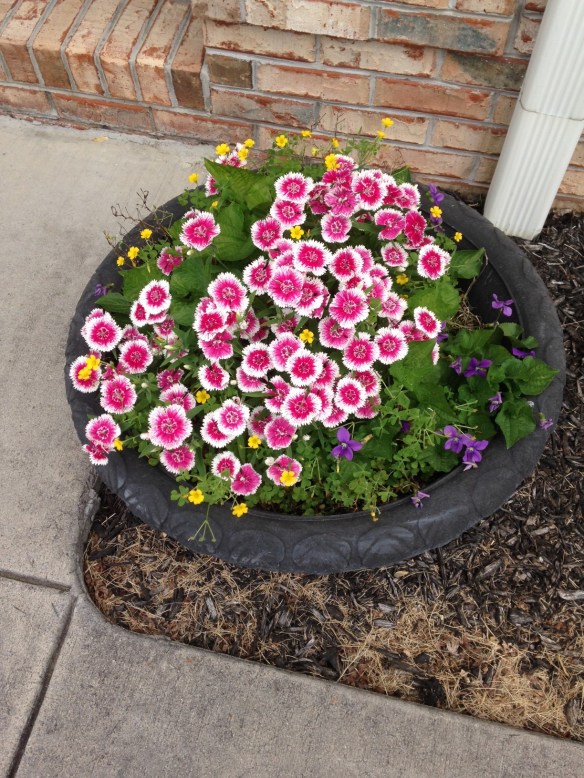
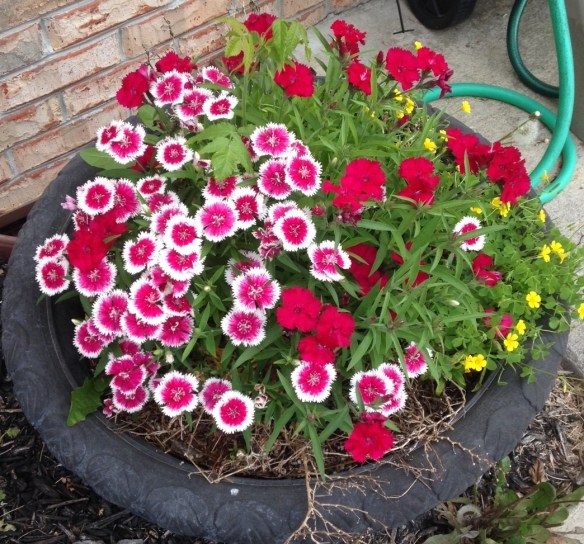
4. Returning flowers. I usually plant these planters by the front door with a variety of flowers and hadn’t realized I had gotten a few annuals in the mix some time before. I had been thinking a while back that I needed to clear the old stuff out of them in preparation for replanting this year, but I am glad I didn’t. I was so surprised to see these flourishing, and with no effort on my part. I’ve forgotten what they are – maybe some of you know? There are some weedy things in there I need to dig out – in fact, I think those little yellow flowers are weeds, but I kind of like the contrast they provide.

IMG_1641

IMG_1642


5. The annual closet changeover. I finally got all my winter things put away and culled a few things to get rid of. Feels nice to have that done, plus I love the way the closet looks with the lighter colors in it.

We’ve had some gorgeous spring weather this week and now have some rain to wash the pollen out of the air. Happy Friday!

The Value of Housework

IMG_1639

Housework is probably not on many people’s lists of favorite things to do. I tend to get frustrated over having to put aside the more interesting or even spiritual pursuits in order to dust or do laundry. But I do value housework. I don’t get excited about the need to dust, but once I get started, I enjoy the clean surfaces. I like the results of picking up, sweeping, doing laundry, washing dishes, even if I am not fond of the process. But even the process can be lightened up with listening to an audiobook, podcast, or music, or conversation while working with someone.

I’m embarrassed to confess this, but, believe it or not, when my husband and I were first married, I often wouldn’t do dishes until we ran out of clean silverware. We didn’t have a dishwasher, and I was a part-time student with two part-time jobs and the adjustments of being newly married. Plus both my jobs involved cleaning – a person’s home and five banks (my husband and I did the banks together – nice job for students because it could be done any time the bank was closed), so by the time I got to my own home, well, who wanted to clean then? But that meant that washing dishes, plus everything else I didn’t get to, took up a big chunk of time on Saturdays. I eventually learned it’s easier (and more sanitary and less disgusting) to clean in smaller doses as I went along, especially once I had children and no longer had big chunks of time to do anything.

I’ve been in homes where housework wasn’t valued – where I would have been afraid to eat or use the bathroom, where bugs crawled all over everything. I’ve been in hotels where there was pink stuff growing in the corners of the shower and the bedding looked questionable. I’ve been in restaurants with a waitress that acted like she could care less about serving and food that was under or over-cooked or unidentifiable. I’ve even gotten food poisoning from restaurant food. It makes such a difference when people care.

I just finished reading and reviewing True Woman 201: Interior Design by Mary Kassian and Nancy Leigh DeMoss yesterday, and one of the chapters I most appreciated dealt with work. Before discussing “keeping the home,” they couched the discussion in the greater spiritual principles that work is good, that we work because we’re made in God’s image and He works, that Jesus did humble physical labor longer than He worked as an itinerant evangelist and teacher. In the course of that chapter the authors quoted a couple of feminists of the past concerning housework:

“Women’s work within the home gives her no autonomy; it is not directly useful to society, it does not open out on the future, it produces nothing” (Simone de Beauvoir).

“Women who adjust as housewives, who grow up wanting to be just a housewife, are in as much danger as the millions who walked to their own death in the concentration camps … they are suffering a slow death of mind and spirit” (Betty Friedan).

Wow – pretty strong stuff. It made me wonder – did they live in a pigsty, then? Or did they hire housekeepers but devalue them as “lesser” specimens of womanhood? Or did they value housework if someone was paid for it but not if women did it in their own homes? Reminds me of the G. K. Chesterton quote, “[Feminism] is mixed up with a muddled idea that women are free when they serve their employers but slaves when they help their husbands.”

I decided to list all the advantages I could think of for housework:

1. Sanitation. I have been in homes where there were roaches crawling over caked-on food on counters and appliances and toilet seats and sinks were black. Bleah.

2. Sense of peacefulness. When things are chaotic in the house, it’s hard to relax. But when everything is in order with my surroundings, my mind and heart feel more orderly.

3. Not being embarrassed if someone comes by unexpectedly, or not having to do a major overhaul before having people over. There may be shoes off by the couch or a newspaper or glass on the end table, but there’s an overall sense of order and cleanliness.

4. Saves time. Staying on top of things is much easier than having to do major clean-ups.

5. Being able to find things rather than having them get lost in the shuffle or buried.

6. Save money. Things last longer when they’re taken care of, plus you avoid purchasing things that you forgot you had.

7. Releases you to be creative in other areas. For some of us its hard to be creative in a mess.

8. Multitasking – with some chores you can listen to music or a podcast or an audiobook while your hands are busy with something else.

9. Almost instant gratification. You can see the dish pile diminishing and the dust disappearing.

10. Sense of accomplishment. I’ve been thinking over this post for a few days, and just this morning while listening to Robinson Crusoe heard this passage, in which he brings supplies into a cave. “At first this was a confused heap of goods, which, as they lay in no order, so they took up all my place; I had no room to turn myself.” Then he tells how he arranged things, made furniture, fixed a place to hang his gun, etc., then “so that, had my cave been to be seen, it looked like a general magazine of all necessary things; and had everything so ready at my hand, that it was a great pleasure to me to see all my goods in such order.”

Of course one can go too far and make everyone feel like they can never relax for fear of getting something dirty or out of place. You want a place where everyone is comfortable, not a museum. I knew of one women who did all sorts of things around the house that she thought a good wife was supposed to do only to find that those things didn’t really matter to her husband: he’d rather be greeted by an attentive, peaceful wife than neglected by one who was in a constant frenzy over the house. It’s good to confer together over these things. Some people don’t mind a little dust as long as clutter is picked up. We all have things that “bug” us or make the room feel unclean, but then have other things we can live with, at least for a while.

And we don’t have to go all Disney princess, singing “Whistle While You Work” while bluebirds tie bows in our hair.

And there are seasons and moments of life when housework takes a back seat (when a young child is in the house, when there is a “teachable moment” with a child or an opportunity to sit and play with him for a moment, when a husband wants you to do something or go somewhere with him and leave the dishes for now, when a friend needs a listening ear, when you’re tired, etc.).

And it is ok to pay someone to clean your house: it’s not a sin if you don’t do it all yourself. Even the Proverbs 31 lady had help. I’ve known elderly or working women to hire household help  for various tasks or people to hire help for special occasions. By the way, if you’re a mom, it’s perfectly ok and even a good thing to have your children do household tasks. It’s good for them to learn to pitch in, to learn the value of work, to value keeping things clean and orderly, to train in that way for their own homes and jobs. We always had the attitude that kids doing work wasn’t just “helping Mom,” but rather instilling in them that we all pull together as a family to get things done (more on children and chores here).

But the point is that housework is valuable and does provide meaningful service, for ourselves, for our families, for guests.

Of course,  the feminists quoted probably didn’t have any problem with a woman swishing a broom occasionally: what they particularly disliked was the idea of a woman being a full-time homemaker. I’m glad for many of the choices available to women today, but one of them is being a fill-time homemaker (I realize that not everyone who wants to be at home can be). I prefer the term homemaker to housewife, because I am not married to my house: I am creating a home. In a sense every woman is a homemaker, because every woman has a home, whether she’s single or married, has children or does not, works outside the home or does not. And as someone who has been a homemaker for 36 years, full-time for 32, I can tell you it isn’t a mind-numbing, useless existence. It can be as creative as you make it.

Some years ago I wrote Encouragement for Homemakers, and want to pull a couple of quotes from there:

Homemaking—being a full-time wife and mother—is not a destructive drought of usefulness but an overflowing oasis of opportunity; it is not a dreary cell to contain one’s talents and skills but a brilliant catalyst to channel creativity and energies into meaningful work; it is not a rope for binding one’s productivity in the marketplace, but reins for guiding one’s posterity in the home; it is not oppressive restraint of intellectual prowess for the community, but a release of wise instruction to your own household; it is not the bitter assignment of inferiority to your person, but the bright assurance of the ingenuity of God’s plan for the complementarity of the sexes, especially as worked out in God’s plan for marriage; it is neither limitation of gifts available nor stinginess in distributing the benefits of those gifts, but rather the multiplication of a mother’s legacy to the generations to come and the generous bestowal of all God meant a mother to give to those He entrusted to her care.”
~Dorothy Patterson

I long to accomplish great and noble tasks, but it is my chief duty and joy to accomplish humble tasks as though they were great and noble.
~Helen Keller

What you do in your house is worth as much as if you did it up in heaven for our Lord God. We should accustom ourselves to think of our position and work as sacred and well-pleasing to God, not on account of the position and work, but on account of the word and faith from which the obedience and the work flow.
~ Martin Luther

And I’ll add this one just discovered in the True Woman book:

“The reason we give priority to managing household responsibilities is not that vacuuming, dusting, or cooking are intrinsically valuable or satisfying tasks. It’s that we want to create a peaceful, orderly, welcoming environment conducive to nurturing and growing disciples for the kingdom of God” (p. 154).

So take heart as you go through your home bringing order out of chaos: your work is both valuable and meaningful. And perhaps be inspired by this:

The Blue Bowl

All day long I did the little things,
The little things that do not show;
I brought the kindling for the fire,
I set the candles in a row,
I filled a bowl with marigolds—
The shallow bowl you love the best—
And made the house a pleasant place
Where weariness may take its rest.

The hours sped on, my eager feet
Could not keep pace with my desire.
So much to do! So little time!
I could not let my body tire.
Yet when the coming of the night
Blotted the garden from my sight,
And on the narrow graveled walks
Between the guarding flower stalks
I heard your step, I was not through
With services I meant for you.

You came into the quiet room
That glowed enchanted with the bloom
Of yellow flame. I saw your face;
Illumined by the firelit space,
Slowly grow still and comforted—
“It’s good to be at home,” you said.

~ Blanch Bane Kuder

See also:

Encouragement for Homemakers, which, incidentally, contains my favorite ever comment from my husband.
Happy Housewife Day!
I confess: I don’t really like to cook.
A Real Home.
Wanting things to be “perfect.”
A Homemaking Meme.
Another homemaking meme.
A prayer for home.
Two views of housework.
Meditations for daily tasks.
Thy list be done.
The Value of Homemakers.

(Sharing With Inspire Me Monday)

Book Review: True Woman 201: Interior Design

True Woman 201I’m not sure how I first came across True Woman 201: Interior Design: Ten Elements of Biblical Womanhood by Mary Kassian and Nancy Leigh DeMoss (now Wolgemuth). But I saw that it was a study of Titus 2:1, 3-5, a passage I’m very much interested in, and I’ve enjoyed what I’ve read of Nancy’s writings. In fact, I’ve been asking myself why I haven’t read more of her. My “interior design” can always use some work, so this seemed like a good book to work through.

It is set up as a ten week study for either an individual or a group. Each week contains five daily 15-minute or so readings around one particular “design element.” There are leader resources as well as videos which run about 20 minutes that cover the highlights of the lessons on TrueWoman201. So a group studying together would work through the lessons for the week, meet together and watch that week’s video, and then discuss the lessons. I only watched 3 or so of the videos. Though they did provide a good recap, I just didn’t feel inclined to listen to the same things I had just read.

Normally when you hear Titus 2:1-5 preached or taught, people hone in on a woman’s responsibility to love her husband and children, be submissive to her husband, and be a “keeper at home,” with much debate over exactly what that last one involves. Off the top of my head I can only think of one time where I have heard the whole passage dealt with, and that was at a lady’s conference where there were sessions on each section. So I very much appreciated that the authors here dealt with every part of the passage, beginning with verse 1. Titus is told to “teach what accords with sound doctrine,” and the authors explain that one’s doctrine is a set of beliefs and that “sound” doctrine is healthy, without contamination. They discuss the use of a “plumb line” in decorating or building to help one’s work to stay straight and show how we need to use the “plumb line” of Scripture to make sure we’re “in accord with sound doctrine,” “That we henceforth be no more children, tossed to and fro, and carried about with every wind of doctrine, by the sleight of men, and cunning craftiness, whereby they lie in wait to deceive” (Ephesians 4:14).

There is so much in here that it would be hard to encapsulate it all, but here’s a little bit about each “design element” after discernment:

Honor: “A True Woman makes much of Christ…She is ‘reverent in behavior.'”

“The basic meaning of the ‘fear of God’ is ‘reverential awe.’ It’s a personal, jaw-dropping awareness of God’s majestic greatness and holiness, reflected in a commitment to honor Him by turning from sin and faithfully obeying His Word” (p. 41).

Slander and being “slaves to much wine” (Titus 2:3) are seen as a lack of reverent behavior toward God and our fellow man, a self-promotion and self-indulgence that dishonors His sacrifice for us.

Affection: “A True Woman values the family…She “loves her husband and children.”

The authors make some interesting observations in this section, one noting what’s not on this list. If we were going to come up with a curriculum for discipling young women, we’d likely list Bible study, prayer, etc. – which are essential for all believers. But the specific things mentioned in this passage emphasize God’s priorities for women, which in our day is countercultural. This passage also emphasizes that these things must be learned. And they observe that this passage is for all women, even for those who are single or without children (Nancy was single with no expectation of marriage at the time of this writing), because marriage and childbirth is part of God’s plan of redemption, the marriage relationship picturing that between Christ and the church.

“As God designed it to function, ‘family’ helps us to understand what it means to have a heavenly Father and be part of a household of faith….God gave us these images so we’d have human thoughts, feelings, experiences, and language adequate and powerful enough to understand and express deep spiritual truths” (p. 68).

Discipline: “A True Woman makes wise, intentional choices…She is ‘self-controlled.'”

“Sometimes we focus too much on trying to change or stop the behavior, when what we need to do is go back and find out what kind of thinking produced that kind of behavior in the first place. It’s easier to fix the ‘what’ if we understand the ‘why.’…Here are some examples of the type of false beliefs that may have accounted for your behavior:

I have a right to return tit for tat.
Life should be easy.
He’s the problem, not me.
I deserve to be happy.
I just can’t handle it!
Indulging is better than holding out.

What if you paused to recalibrate your mind with truth?” (p. 101).

Virtue: “A True Woman cultivates goodness…She is ‘pure.'”

“Virtue and purity are two sides of the same coin: the presence of goodness and the absence of defilement” (p. 111).

The authors discuss the difference between “positional purity” that Christ wrought for us when He died on the cross for our sin, and “personal, practical purity (sanctification)” in which our everyday lives grow bit by bit to match our “position.”

“Two of the three times when diabolos refers to slander, it’s speaking specifically to women. God created women as relators and gave us an amazing capacity for verbal communication. Unfortunately, Satan likes to turn this strength into a weakness. He likes to turn virtue into vice” (p. 121).

“The Bible’s definition is broader…Slander means to speak critically of another person with the intent to harm…even if the information is correct. That’s why diabolos has been translated ‘malicious gossip’ as well as ‘false accuser'” (p. 122).

“Getting rid of vice and growing in virtue isn’t easy. It takes work. That’s why the Bible says, ‘Make every effort to add to your faith virtue’ (2 Peter 1:5). That’s right: love-motivated, Spirit-enabled, Christ-glorifying effort” (p. 131).

“In ancient Greek, the word pure originally meant ‘that which awakens awe’ or ‘that which excites reverence.’ Purity is ravishingly beautiful. It makes the gospel attractive and believable. When you make every effort to cultivate virtue in your life, the great ‘Refiner and Purifier of silver’ will reveal His beauty in you, and others will be drawn to love and worship Him!” (p. 131).

Responsibility: “A True Woman maintains the right work priorities…She values ‘working at home.'”

“In our minds, the question isn’t ‘Should women work?’ but rather ‘What is God’s view of work?’ ‘How do I choose which work receives the most time and attention at this stage of my life?’ ‘Am I giving my home the focus and priority God wants it to have?’ And ‘am I determining the value of my work based on earthly or heavenly economics?'” (p. 135).

“Work…exists because we’ve been made in the image of the great worker, God. We work because He works. Work is a God-ordained activity. Honest, diligent, attentive, productive, innovative, creative, faithful, fruitful, conscientious, hard work bears witness to God’s nature and character” (p. 142).

“Work does not primarily exist for the purpose of financial gain (though we may get paid). It’s primary purpose is to glorify God” (p. 142).

“No legitimate work, undertaken for the glory of God, is menial or meaningless. Hard physical labor wasn’t beneath the dignity of the Son of God. Jesus worked as a carpenter for about seventeen years and only about three years doing itinerant ministry. Carpentry was a lowly, ill-paying profession. Yet Jesus was doing God’s work when pounding a nail just as much as He was doing it when preaching on a hillside–because He was doing what God wanted Him to do when God wanted Him to do it” (p. 143).

“[The Proverbs 31 woman] could be a bit intimidating for the most energetic, gifted woman. But the thing that stands out in this passage is not so much all this woman’s abilities or all the things she does. What makes her extraordinary is the fact that she is so utterly un-self-centered and that she consistently demonstrates a heart to serve her family and others–all grounded in her reverence for God” (p. 149).

“To be idle is to ‘not be working or active,’ to habitually avoid one’s responsibilities, or to fill one’s time with things of no real worth or significance. Idleness is not the opposite of busyness. Idle people are often extremely busy. Take the woman of Proverbs 7 for example: “She is loud and wayward; her feet do not stay at home; now in the street, now in the market,  and at every corner she lies in wait” (Prov. 7:11-12). Though this woman was busy, she was actually being idle; for she wasn’t doing the ‘good work’ she was supposed to do” (p. 151).

“The reason we give priority to managing household responsibilities is not that vacuuming, dusting, or cooking are intrinsically valuable or satisfying tasks. It’s that we want to create a peaceful, orderly, welcoming environment conducive to nurturing and growing disciples for the kingdom of God” (p. 154).

Benevolence: “A True Woman is charitable…She is ‘kind.'”

“In the type of ‘random acts of kindness and senseless acts of beauty’ that society commends, the benefactor and the beneficiary generally have little if any awareness of each other’s deepest motivations and needs” (p. 159).

“For a believer, kindness is a fruit of the Spirit that is empowered, enabled, and directed by God. When our kindness extends beyond those who deserve or reciprocate our benevolence, when it reaches out to those whose shortcomings and failures we know full well, that is when we reflect the heart of Him who is ‘kind to the ungrateful and the evil'” (Luke 6:35) (p. 159).

Disposition: “A True Woman cultivates a soft, amenable spirit…She is ‘submissive.'”

“Jesus Christ is the epitome of submission. His ‘not-My-will-but-Yours-be-done’ attitude is at the heart of the gospel story” (p. 182).

Legacy: “A True Woman is a spiritual mother…She ‘teaches what is good.'”

“Deborah had a God-given nurturing instinct that gave her courage and compassion. She wasn’t driven by the things that drive many modern women–power, control, position, or recognition–but by a mother’s heart. She saw herself as ‘a mother in Israel'” (p. 211).

Paul’s use of the Greek word neos in Titus 2:4 “indicates that his categories of older and younger had more to do with experience, life stage, and spiritual maturity than chronological age. A neos is a newbie, a ‘greenhorn’–a fresh, inexperienced novice. It’s a woman new to the circumstance in which she is placed. The point is, if you want to be the kind of woman who brings glory to God, you should actively learn from the lives of women who have walked the path before you, and actively teach those who are coming after. Regardless of your age, the Lord wants you to be both a learner and a teacher” (p. 219).

“The older we get, the bigger the catalog of failures Satan can throw in our faces. You may think, ‘I don’t have anything to offer.’ But you can teach out of your failures as well as your successes” (p. 223).

Beauty: “A True Woman displays the attractiveness of the gospel…’So that the word of God may not be reviled.'”

“A Christian woman whose life doesn’t bear witness to the transformative power of the gospel causes the gospel to be blasphemed, defamed, and dishonored–it’s as though she invites vandals to deface it with foul graffiti. If, on the other hand, she cooperates with God and allows Him to change her, she ‘adorns’ the gospel. To adorn means to beautify it and make it attractive. Outsiders will look at her life and say, ‘Wow! Her life makes me think the Bible is true!’ We can’t just tell them it’s true. They need to see and feel and experience that it really is true through our lives” (p. 235).

They stress that God’s design for genders is not fluid according to whatever the world’s thoughts are: they’re a part of “sound doctrine.” On the other hand, they agree that God’s design doesn’t turn out cookie cutter Christians who all look the same, that how this works out in a life might differ from woman to woman. I appreciated that while they held fast to those areas where Scripture is specific, they dealt evenhandedly with controversial issues like a woman working outside the home, sharing a list of Biblical women who had other kinds of jobs, but stressing the primary ministry of home and family. They mention also that though many of these characteristics should be true of men as well, there are reasons that the Holy Spirit inspired Paul to list some characteristics for men and some for women.

If there is a “201,” there must have been a “101,” and there was: True Woman 101: Divine Design, which focuses on God’s plan and design for womanhood. I have not read it yet but probably will some day. It looks like it’s laid out the same as this was with 5 daily readings for each chapter, covering eight weeks rather than ten.

Back to True Woman 201: I thought the layout was a bit distracting at first. The spiritual “interior design” theme was couched in a similarities to the design of a home, and there are lots of photos relating to that kind of thing scattered throughout the pages. Verses and quotes are in sidebars. I got used to it after a while, and it’s a minor complaint. Overall I thoroughly enjoyed this study. I appreciated the authors’ thorough and gracious treatment of the topic and I can enthusiastically recommend it to you.

(Sharing at Semicolon‘s Saturday Review of Books)

Book Review: The Moonstone

MoonstoneThe Moonstone by Wilkie Collins opens with a copy of a family paper from an unnamed source. The writer and his cousin, John Herncastle, were soldiers in the English battle for Seringapatam, India, in 1799.  The night before, stories were told by the men in the camp about various treasures to be found there, especially one called the moonstone, a large yellow diamond in the forehead of a statue of a moon god. The narrative tells of the history and legend of the stone, including three Brahmins who were supposed to keep it under constant watch and “certain disaster to the presumptuous mortal who laid hands on the sacred gem, and to all of his house and name who received it after him.” After the battle, the narrator and his cousin were charged with keeping the men from looting, but the narrator came across his cousin in a room with the diamond in his hand and two dead and one dying Indian at his feet. Though the narrator knew his cousin had stolen the diamond and killed the men, he could not prove it since he had not actually seen it done, so he didn’t bring it to the authorities. He did, however, turn his back on his cousin and has written this narrative to explain to the family why he has done so. The family in turn turned their back on John. The narrator concludes, “Although I attach no sort of credit to the fantastic Indian legend of the gem, I must acknowledge, before I conclude, that I am influenced by a certain superstition of my own in this matter. It is my conviction, or my delusion, no matter which, that crime brings its own fatality with it. I am not only persuaded of Herncastle’s guilt; I am even fanciful enough to believe that he will live to regret it, if he keeps the Diamond; and that others will live to regret taking it from him, if he gives the Diamond away.  ”

Fast forward 50 years or so, and John Herncastle tries to visit his sister and her daughter. His sister refuses to see him. He retreats, but leaves the diamond to his sister’s daughter, Rachel, in his will. Rachel’s birthday is coming up, and her cousin Franklin Blake has been assigned to bring the diamond to her for the occasion. Knowing the diamond’s history, he is unsure whether giving it to Rachel is the best thing to do, but after consulting with longtime friend and family butler, Gabriel Betteredge, they conclude that giving it to her is the only thing that can be done.

So Franklin gives her the diamond and fastens a little setting so she can wear it on her blouse. And who should crash the party but three traveling Indian jugglers, who can’t escape seeing the diamond.

The next morning, it’s discovered that the diamond is missing, stolen out of Rachel’s room. The Indians are the first suspected, but they have an alibi. Rachel is strangely uncommunicative about the incident.

The story continues from there with various people being suspected and cleared, various family secrets coming forth, and finally the mystery revealed.

The Moonstone is considered by many to be the first detective novel written (Poe wrote mysteries, but they were short stories) and contains many elements that soon became standards of the genre: bumbling local police, a famous detective with eccentricities, false leads, , the “least likely” suspect being the perpetrator, a plot twist, and the detective summing everything up and filling in the missing pieces at the end. The detective is oddly missing in the middle of the novel, but Franklin Blake pursues the mystery, and even Gabriel Betteredge confesses to getting “detective fever.”

The story is written as a series of accounts requested by Blake from various people of what they saw and experienced, so in a sense the reader gets to consider the evidence and play detective along the way.

I thought the story dragged a bit in the middle, when the accounts there seemed to have little to do with the diamond theft: later, however, the reason for those seemingly unrelated details comes to the forefront. Like Dickens, with whom Collins was friends and for whose magazine he wrote, there are no extraneous details or characters: everything fits into the plot, though it doesn’t always make sense until the end. The latter third of the book really picked up the action and I found it hard to put down at that point. The story was originally published monthly in Dickens’ magazine, and at the end of many chapters I thought Collins showed great skill in ending the chapter on a note that would makes readers breathless until the next installment. I was glad I didn’t have to wait a month between chapters! I also thought Collins shone in having characters reveal details about themselves unawares and seemingly contradicting what they meant to reveal about themselves..

The Moonstone and The Woman in White are considered the best of Collins’ novels. I had read the latter a couple of years ago and consequently wanted to read more of Collins, but shied away from this one because I wasn’t sure how much superstition about the stone would play a part in it. But that turned out to be a very minor part of the story, mainly contained in the first section about its history. As the first narrator said, ” crime brings its own fatality,” and the book mainly deals with the crimes along the way of the moonstone’s history.

Though I normally enjoy reading analysis in Sparknotes, I thought they were a little off in a couple of places concerning this book. Here they say the story is “a novel in which women don’t speak often and therefore do not have a distinctive presence.” But the women spoke quite often – one of the major narrators is a woman. And they assert that the moonstone is symbolic of Rachel’s femininity and virginity and the theft of it from her room symbolic of her “deflowering.” But I saw no reason to associate it as such, especially as she is not “deflowered” in the incident.

I enjoyed listening to the audiobook narrated by several and the perusing parts of the text at Project Gutenberg.

(Sharing at Semicolon‘s Saturday Review of Books)

Day by Day

This hymn text has ministered to my heart many times over the years.

This is a lovely arrangement of this hymn, with a little bit about the background of it:

Day by day, and with each passing moment,
Strength I find, to meet my trials here;
Trusting in my Father’s wise bestowment,
I’ve no cause for worry or for fear.
He whose heart is kind beyond all measure
Gives unto each day what He deems best—
Lovingly, its part of pain and pleasure,
Mingling toil with peace and rest.

Every day, the Lord Himself is near me
With a special mercy for each hour;
All my cares He fain would bear, and cheer me,
He whose name is Counselor and Power;
The protection of His child and treasure
Is a charge that on Himself He laid;
As thy days, thy strength shall be in measure,
This the pledge to me He made.

Help me then, in every tribulation
So to trust Thy promises, O Lord,
That I lose not faith’s sweet consolation
Offered me within Thy holy Word.
Help me, Lord, when toil and trouble meeting,
E’er to take, as from a father’s hand,
One by one, the days, the moments fleeting,
Till I reach the promised land.

~ Karolina W. Sandell-Berg, 1865

As thy days, so shall thy strength be. Deuteronomy 33:25b

Friday’s Fave Five

friday fave five spring

It’s Friday, time to look back over the blessings of the week with Susanne at Living to Tell the Story and other friends.

It’s been a little quiet around the blog this week – I’ve been busy with other things. But here are some highlights of the week:

1. Timothy’s birthday! My little grandson turned 2 this week! Some of you may remember that two years ago he was born 10 weeks early and spent that whole ten weeks until his due date in the NICU. It was a very long and emotional time, as he’d experience pluses one day and then minuses the next. But I am so grateful God spared him. He has been such a joy, and I can’t wait to see how God uses his life!

IMG_1604

The card I made for Timothy’s birthday

2. A trip to a little zoo for Timothy’s birthday. We had planned to revisit the Knoxville zoo, but someone at my husband’s work told him about Little Ponderosa, so we decided to give it a try. We weren’t sure how big it would be and feared they might have only a handful of animals, but they had plenty. They also had paved trails, something else we had wondered about. We could walk up to most of the enclosures and touch and feed the animals. It was just the right size for Timothy’s age.

Timothy petting the goats in the spiffed-up wagon Granddad put together for him.

Timothy petting the goats in the spiffed-up wagon Granddad put together for him – came in handy when he got hot and tired near the end.

We went home for a nap and then got back together again for dinner, cake, and presents. All in all it was a wonderful day!

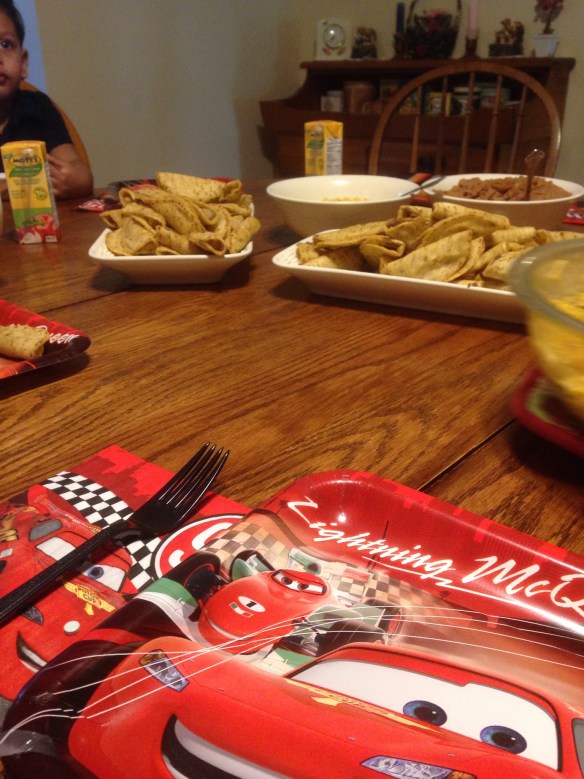
Toddler birthday dinner - mini tacos and juice boxes with car-themed plates!

Toddler birthday dinner – mini tacos and juice boxes with car-themed plates!

3. The adorable birthday cake my daughter-in-law made. He’s very much into anything on wheels right now, but especially cars.

Adorable birthday cake my daughter-in-law made.

4. Lunch at a favorite but distant restaurant. When we were first visiting the area to look at houses, schools, etc., before moving, we stayed in the same hotel, stocked up on supplies at the same W*Mart, and ate often at an Italian restaurant called Gondoliers.  I love their stuff, but they’re too far away for us to go to regularly. It was fun to be back in that area and to eat their Meat Eaters pizza there.

5. Not having to replace a shower curtain. My son’s shower curtain had what I thought was mildew over a good portion of it. I treated it in several ways with no luck. I looked around and this particular style was no longer sold, plus I couldn’t find anything in the colors I wanted. I decided to toss it in the washer – and it came out almost as good as new! I don’t know why just washing it worked when stronger treatments didn’t, but I was very glad I was going to be able to keep it.

That’s life – big blessings mixed in with the smaller everyday ones. I’m thankful for this opportunity to stop and count them.

Happy Friday!

Winner of The Tenth Plague giveaway

The-Tenth-Plague

The winner of the giveaway of the paperback version of The Tenth Plague by Adam Blumer is Faith. Congratulations, Faith!

For those who didn’t win, check out Adam Blumer’s Facebook page, where he’ll be posting about various other giveaways over the next few months.

Thanks for entering, and thanks to Adam for sponsoring the giveaway and writing such great books!

Book Review: The Reunion

The ReunionI’ve had The Reunion by Dan Walsh in my Kindle app for months now (or years…yikes!), but Lou Ann’s review caused me to move it up to my next Kindle read.

Aaron Miller is a Viet Nam vet who works as a maintenance man in a trailer park. Serious injuries sustained in the war sent him home and caused him to become addicted to painkillers. He lost his family, his job, his home, and lived on the streets for a time. But he found the Lord and began the slow road to recovery.

Even though his job might not look prestigious to most, he does it well. And in the course of it, he seems often to be put in the way of people who need help. A teen-age girl with an abusive boyfriend. A legless veteran who is on the verge of ending it all. An elderly woman whose home is crushed by a tree.

Unbeknownst to Aaron, three men he knew back in Nam are looking for him. And when one of them hires journalist Dave Russo, who is writing a book about Viet Nam vets in honor of his later veteran father, they just might find him.

All of Dan’s books that I have read are heartwarming, but this one is probably the most so. I kept thinking it would make a great Hallmark Movie. 🙂 I loved the Amazon introduction to this book: “There are people in this world we pass right by without giving a second thought. They are almost invisible. Yet some of them have amazing stories to tell, if we’d only take the time to listen…” I loved Aaron’s character and could just picture him as one of those kinds of people most would tend to overlook but who faithfully does his work well and who has a great story behind him. I enjoyed Dave’s story as well. Dan did a wonderful job weaving all the different elements of the story together and pulling at the heartstrings.

Here are just a couple of quotes that stood out to me:

Of course, it was clear the thing Billy needed most was a friend. It didn’t help that Billy talked so much once he got going. One thing after another, like he’d been sitting on a mountain of words and Aaron had come in and set off a volcano.

Most of the people who blame God for everything never even try things his way, so how can they blame Him when it all goes wrong? But they do. I did. For years, til eating that meal. That day, the lights came on. And I saw that all I ever did was do things my way, my whole life. And all it ever did was get me in trouble and more trouble.

I also enjoyed the Author’s Note at the end where Dan says two stories about two different WWII Congressional Medal of Honor winners (Bobbie E. Brown and Bill Crawford) who came home, eventually became janitors, and had very different endings inspired him and caused him to think about people we overlook who might have amazing life stories or might have accomplished great things no one would ever guess. Plus he was inspired by Jesus’ example of speaking to out-of-the-way, overlooked people. And I join him in expressing gratitude for “the unsung warriors whose actions have made it possible for the rest of us to live free.”

(Sharing at Semicolon‘s Saturday Review of Books)