Friday’s Fave Five

FFF spring2It’s Friday, time to look back over the blessings of the week with Susanne at Living to Tell the Story and other friends.

I was so sorry to miss last week. As I mentioned in an earlier post, my oldest son was visiting all week from out of town and my husband took the week off as well. Mittu’s mother was also visiting and Jesse’s girlfriend came on a couple of excursions. We did a lot of visiting, went on a few outings, and celebrated Jeremy’s birthday, and there just wasn’t time to get to the computer much last week. Even this week I seem to be in recuperate/catch-up mode and haven’t been online as much as I usually am. I have a bunch of posts in me Feedly to catch up on!

With all of that, the past couple of weeks have been full of many faves: this is one of those weeks that will be hard to narrow down to five! But here goes:

1. Time with family. I had thought that with our being tied down to a certain extent with Great-Grandma and Jason and Mittu being limited with how much they could take Timothy out (as a preemie he has still had more of a vulnerability to infections even though he’s older and bigger now. They’re just now starting to be able to take him out to places that aren’t too crowded) that this might be something of a boring visit for Jeremy, but we managed to get a number of activities in. Besides talking and visiting a lot (the best part!) we rented a movie (The Lego Movie), had lunch at Jason and Mittu’s one day, had a picnic at a nature center, some went kayaking one afternoon, and we visited the farmer’s market and unwittingly stepped into a history fair complete with people dressed up in Civil War era regalia, then ate at a downtown pizza place. We enjoyed celebrating Jeremy’s birthday and seeing him meet Timothy for the first time.

Jeremy and Timothyjpg

photo(8)

Thankfully we were able to manage caregivers for Great-grandma for the couple of times we wanted to do something after the usual times we have someone in for her. There were a lot of firsts for Timothy but he did well even with two doctors visits and his four month shots in the mix.

2. My birthday was yesterday. My family always makes it a special day. We went out to eat at one of my favorite restaurants (which my husband doesn’t like, but agreed to go to for my sake. I only ask to go on my birthday. πŸ™‚ ), Jim and Jason and Mittu gave me flowers, we got to Face Time with Jeremy, and everyone was thoughtful and generous with gifts.

photo(6)And triple chocolate cake was a bonus, too! πŸ™‚

photo(7)

3. Frozen yogurt. We stopped at a frozen yogurt place after the picnic. I’m lactose intolerant, and the only one I had been to before had a couple of dairy free options. This one didn’t, but I decided to try it anyway with a few Lactaid tablets. I had chocolate and peanut butter, and it was so good, with no negative effects.

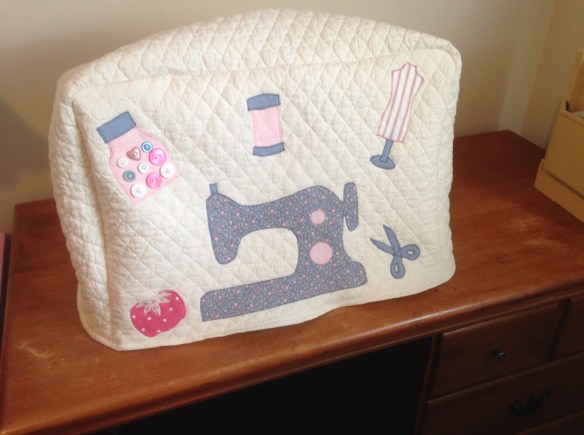
4. A finished project – a new sewing machine cover.

photo 25. Lots of time doing this with this sweetie.

photo(5)There – I think I more or less covered everything! πŸ™‚

Happy Friday!

Β 

Book Review: The Memoirs of Sherlock Holmes

HolmesI’ve been going through the Sherlock Holmes books by publication date, but I was tempted to skip The Memoirs of Sherlock Holmes, which is another collection of short stories, and go on ahead to The Hounds of the Baskervilles, which I really wanted to get to. Then I remembered that Memoirs was the book where Holmes’ nemesis, Professor Moriarty, was introduced and where (slight spoiler here though it is well known and the title suggests it) the author seems to have killed off Holmes. According toΒ Wikipedia he did so in order to spend more time on historical novels, but public pressure was evidently enough for him to bring Holmes back in a later book, saying that he had faked his death.

So I embarked on this collection of stories and was delighted to find that in addition to the above, this set introduced Holmes’ brother Mycroft (portrayed as smarter than Holmes but less energetic), shows Holmes as completely depleted physically due to one case, and shared one case where he totally missed the mark. Of the last, he told Watson, “If it should ever strike you that I am getting a little overconfident in my powers, or giving less pains to a case than it deserves, kindly whisper ‘Norbury’ in my ear, and I shall be infinitely obliged to you.” Holmes also shared with Watson the case that got him started investigating crime (I had wondered, with Watson, how a mind such as Holmes’ had gotten started on this particular career path.)

Holmes’ statement about having only one friend in college seems to conform his introversion: “I was never a very sociable fellow, Watson, always rather fond of moping in my rooms and working out my own little methods of thought, so that I never mixed much with the men of my year. Bar fencing and boxing I had few athletic tastes, and then my line of study was quite distinct from that of the other fellows, so that we had no points of contact at all.”

There is a story titled “The Adventure of the Cardboard Box” which was originally published in the American version of this book but later removed because two characters in it were adulterous. It was not in the version I listened to.

Overall I enjoyed this collection of stories. Doyle continued to avoid a formulaic approach, with each story and case showcasing Holmes’ skills without becoming repetitive. One of the best of any of his stories that I have read so far is “The Final Problem,” the last story in the book which introduces Moriarty and deals with Holmes’ apparent death. There is an intensity about it that is different from the others. I thought at first perhaps that was just my impression because I knew what the end would be, but then I read this is one of Doyle’s favorite stories as well.

I listened to the audiobook read by Simon Prebble. I had avoided his narrations up until now because I am used to his voice in the Jeeves books by P. D. Wodehouse, which are a completely different tone and feel than Holmes’ stories. But he adapted to the tone very well and soon I had completely forgotten that this was also the voice in my head for Jeeves and Wooster.

(This will also be linked toΒ Semicolonβ€˜s Saturday Review of Books.)


Finished Project: Sewing Machine Cover

Whew! I don’t think I have ever been away from the blog this long before. My oldest son, Jeremy, was here all last week and my husband was off as well. Jason and Mittu and Timothy came over a number of times as well as Mittu’s mother, who was also in town visiting for a few days. Jesse’s girlfriend also came over a couple of times to meet the rest of the family. Between visiting, a few outings, keeping up with groceries and cooking, and then after everyone left recuperating, catching up on laundry, running errands, and more grocery shopping – well, you can see why I haven’t been around much lately. πŸ™‚ It was a wonderful time, though – I’ll probably say more about it on my weekly Friday’s Fave Five.

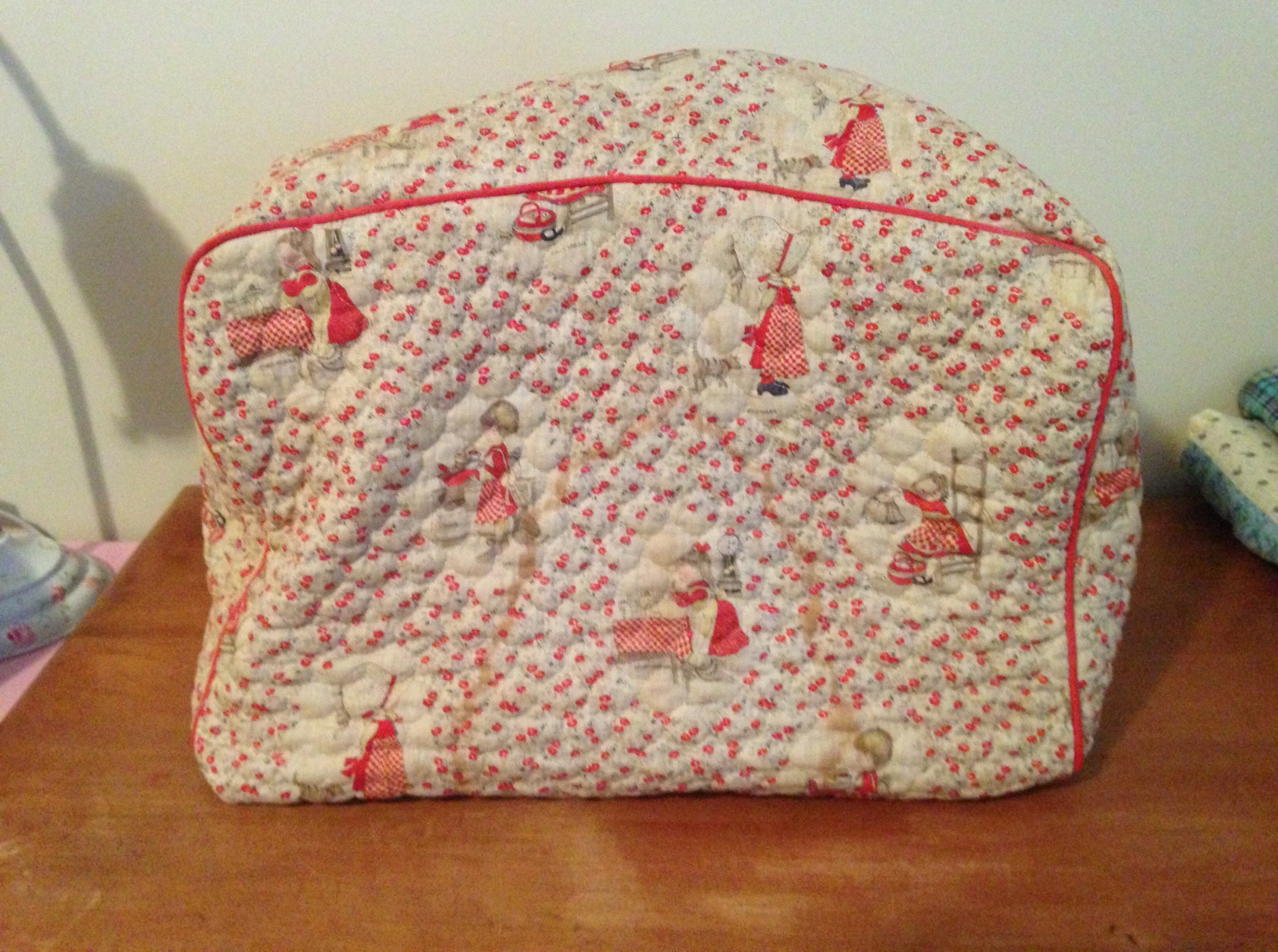
My sewing/craft room doubles as a guest room. Jeremy would be staying there this visit, and though the room has been a continual work in progress ever since we lived here, I pretty much have it about like I want it with just a couple more touches to finish. One project I’ve been wanting to get to for some months was to make a new cover for my sewing machine. My old one was red (which I don’t care for or use in my decorating any more), Holly Hobbie (which I got over a long time ago), and looked like something had been spilled on it. It was about 30 years old, so I felt a new one was overdue.

Old Sewing Machine Cover

Old Sewing Machine Cover

I’ve been looking up ideas online for some time and gathered them into a Pinterest board for Sewing Machine Covers. Deciding what to do is the hardest, usually longest part of any project for me.Β This one was my main inspiration, but I didn’t want to do it exactly like that (and I couldn’t get to the original post about it – all I had was the photo).

I finally came up with a plan and got it in my head that I wanted to get it done before Jeremy came – not that he would notice or care about it, but you know how someone coming over is the impetus to get some things done. I didn’t get it completely finished before he got here, but it was far enough along that I could toss it over the sewing machine. I just finished it, or as much as I am going to do with it for now, this morning.

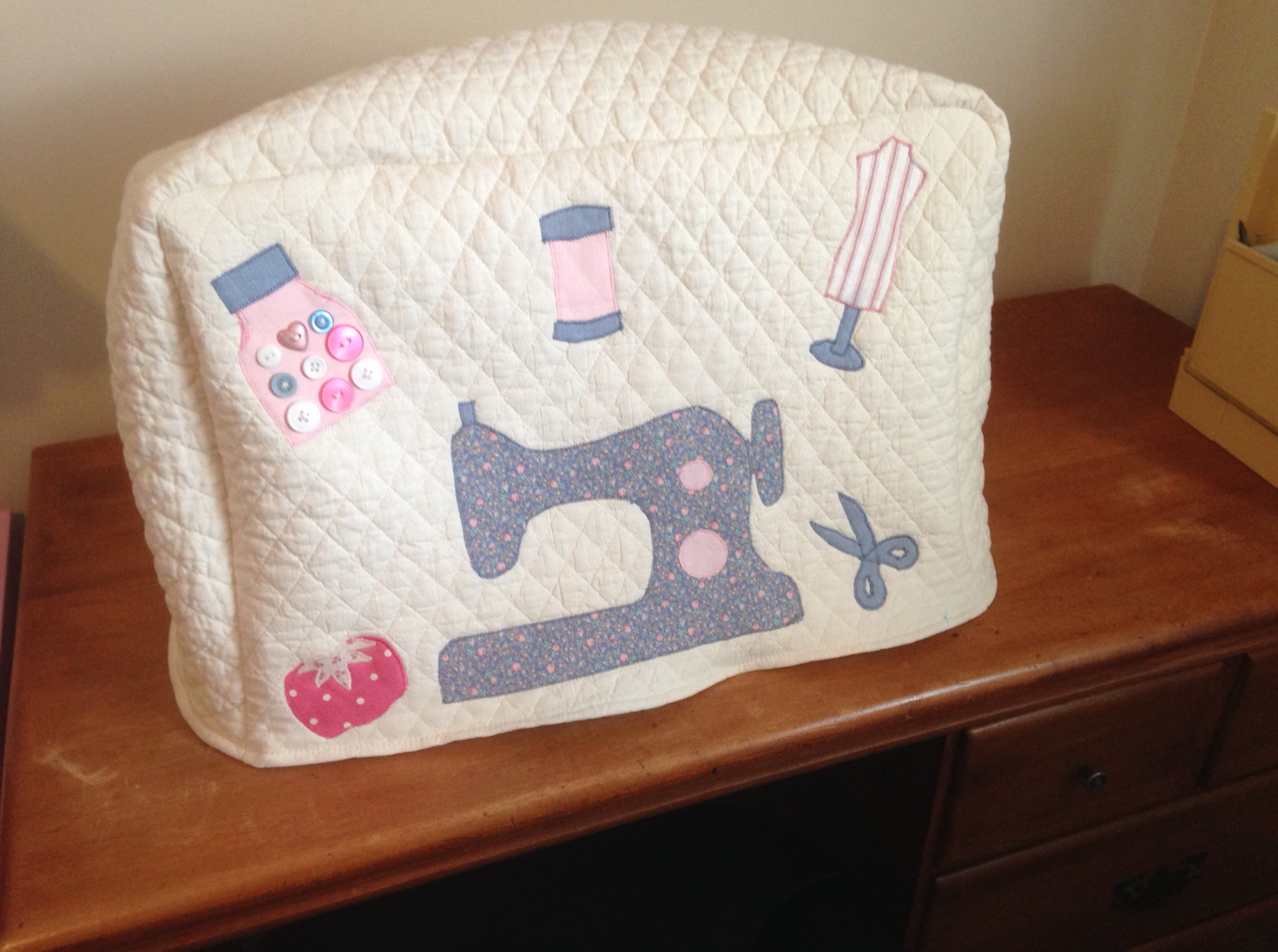
I knew I wanted a sewing machine on front, andΒ this mug rug gave me the idea to add some sewing accessories. I was going to try to just wing it drawing the shapes I wanted, and then decided that the couple of dollars for that pattern as well asΒ this one for the sewing machine would be money well spent. I enlarged the sewing machine pattern by 150% on my printer, but the other pieces are the same size as the pattern except that I cut the pincushion down a bit.

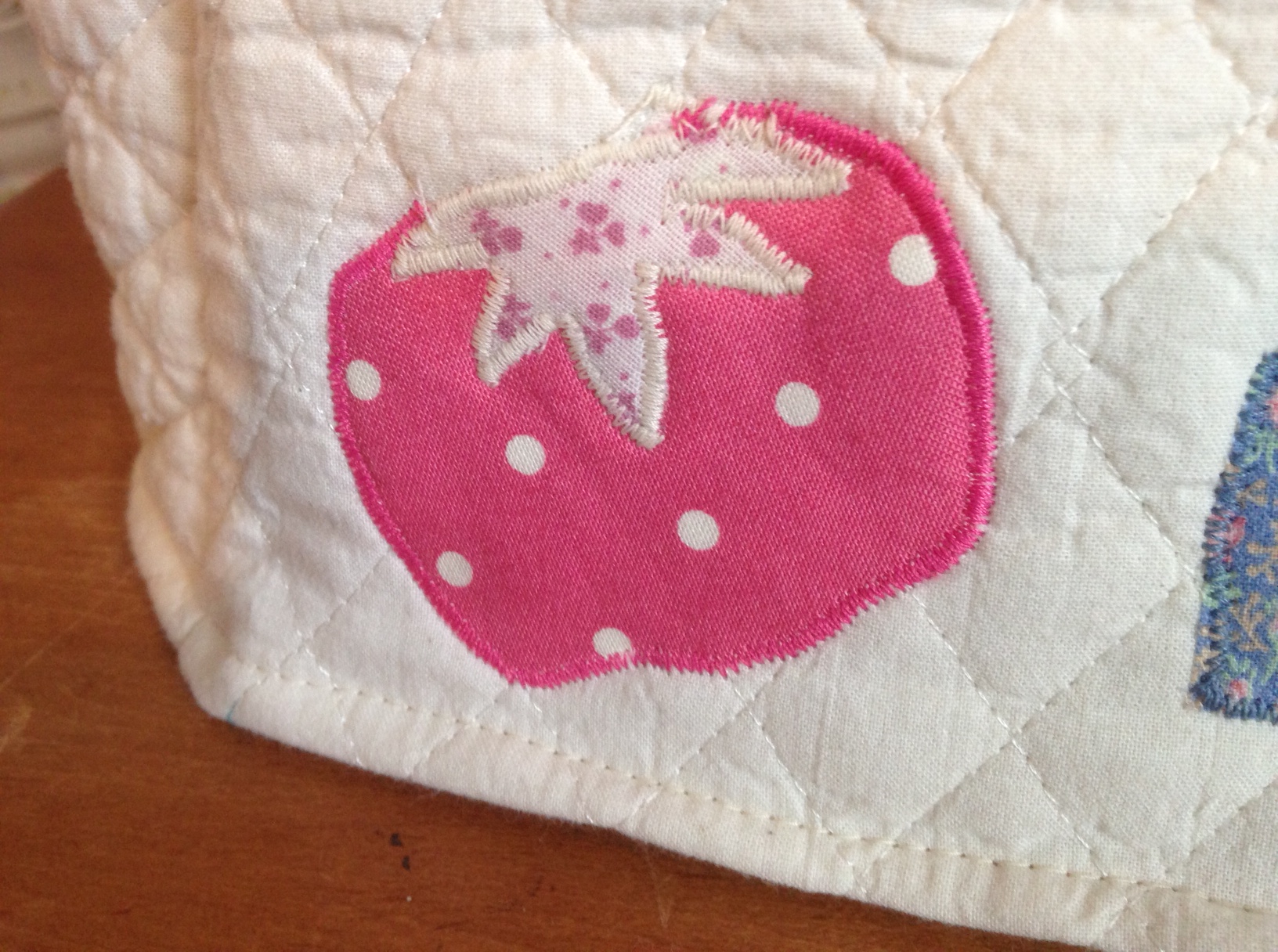
I had never appliqued before, except for one vague memory of an attempt at trying to use the satin stitch on my machine and having thread pile up in a lump at the beginning. So I don’t know why I decided to try to do that on a project like this that needed so much of it, and on a deadline. Glutton for punishment, I guess. πŸ™‚ I did use Wonder Under to fuse the pieces on, but needed to cover the outside edges in stitching so they wouldn’t ravel. Much of the satin stitch actually came out looking like a zigzag stitch. You do have to help guide/push the fabric through while sewing, and it’s hard to get a feel for how much to do that without the stitches spacing too far apart. That really bugged me until one of the patterns I was looking at this morning said a zigzag stitch could be used – so I can just pretend I meant it to be that way. πŸ™‚ It wasn’t until the last item I stitched that it began to look more like a satin/applique stitch.

Anyway – here it is:

photo 2

I was going to put a ruffle at the bottom out of the same fabric that I used for the sewing machine applique – but I didn’t leave myself enough room. That is one of my favorite fabrics – it’s from a maternity dress I made during my first pregnancy. πŸ™‚ You can’t really find those shades of pink and blue together on fabric much these days.

I used a fabric that was already quilted for the base because I didn’t want to have to deal with quilting the background fabric (sorry Wendy — maybe next time. πŸ™‚ Wendy is an expert at free-motion quilting on the machine and has been encouraging me to try it).

This was the last item I appliqued where it was just starting to look like I knew what I was doing.

photo 3(1)

No, I’m not going to show you a close-up of the zig-zaggy ones! πŸ™‚ Though you can see a bit of it to the right of the pin cushion there.

It might’ve helped to use a slightly wider stitch to be more sure of catching the fabric edge, but some of the pieces were so small I didn’t want the outline stitching to take up too much of it. There were a couple of places I strayed off the path a bit, especially with some of the pinks that were lighter and harder to see. At some point it occurred to me that I could use a washable fabric marking pen to outline where I needed to stitch on those hard-to-see places.

I’ve thought about adding some stitching like that inΒ this piece to kind of tie everything together. I may also come back at some point and embroider some pins in the pin cushion. I was originally going to do another design on the back so I could change it around as desired – but I got to a point where I just felt like I needed to get it done. It’s usable now, and I can think about the other touches and add them later if I decide I want to.

It’s not perfect – but I like it, and it is much better than what I had.

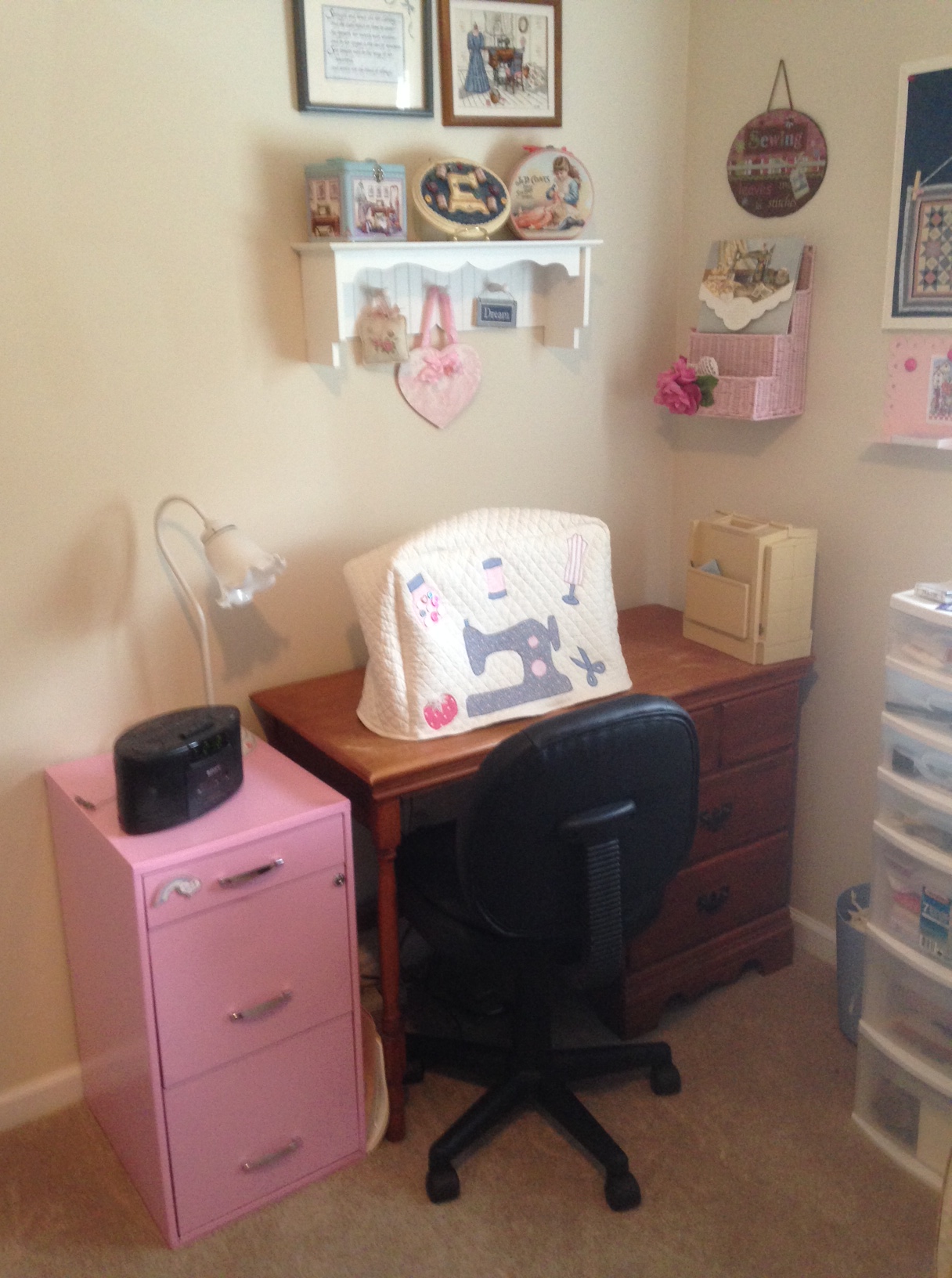
Here’s my little sewing corner:

photo 4(1)

No, my desk isn’t usually that clean, and yes, I did clear it off just for the picture. πŸ™‚

It was nice to get behind the sewing machine again and especially nice to get a project done that has been on my mind for ages.

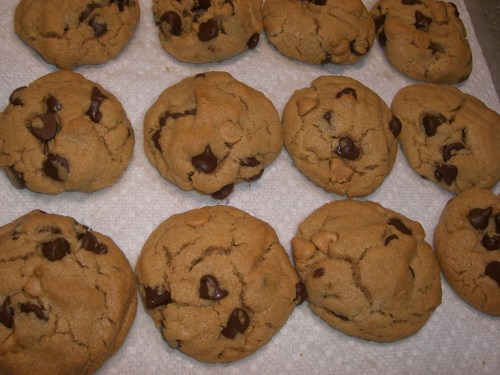
My Favorite Cookie Recipes

I think I have posted most of these before, but recently I wished I had them all in one place to link to and decided to gather them together when I had time. So here they are:

Pudding Chip Cookies

I can’t remember whether I discovered these on a pudding mix package or had them at a friend’s house, but I love the flavor the pudding adds to it.

2 1/4 cups flour
1 tsp. baking soda
1 cup butter or margarine, softened
3/4 cup packed brown sugar
1/4 cup granulated sugar
1 pkg. (4 serving size) instant vanilla pudding
1 tsp. vanilla
2 eggs
1 pkg (12 oz) semi-sweet chocolate chips

Combine butter, sugars, pudding mix, and vanilla; beat until smooth and creamy. Beat in eggs. Mix flour with baking soda. and gradually add flour mixture. Stir in chips. Drop from teaspoon onto ungreased baking sheets, about 2 inches apart. Bake at 375 for 8 to 10 minutes (mine usually take 10-12 minutes). I used to add chocolate chunks or miniature Hershey’s kisses just for something different, but I haven’t been able to find those lately.

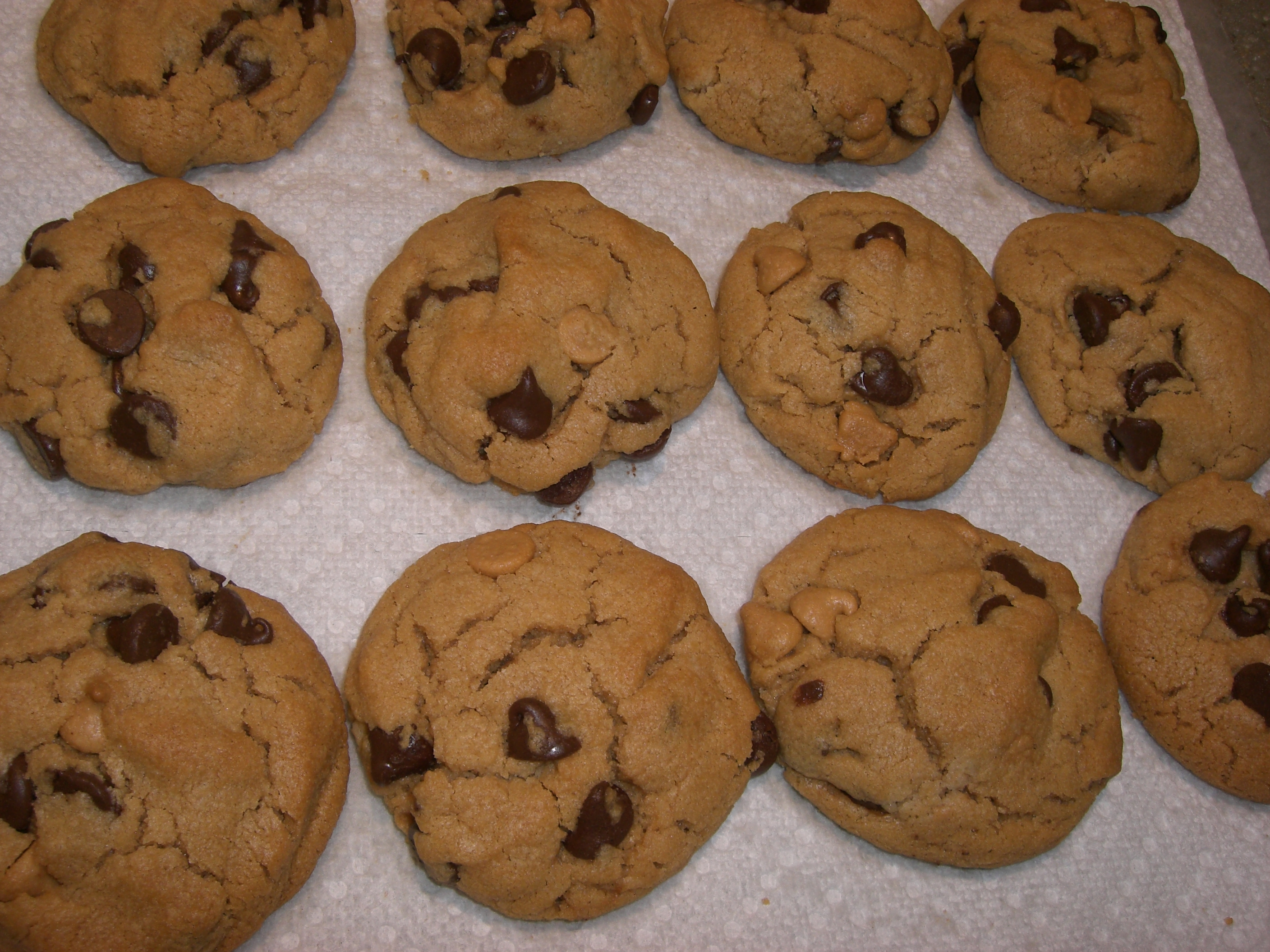
Cookies

Double Peanut Butter Chocolate Chip Cookies

I kind of adapted this when I was trying to find a recipe that came close to the peanut butter cookies at the Great American Cookie Company place at the mall. This is basically a peanut butter cookie recipe I found in a magazine, but it’s not mashed down with a fork and it has peanut butter chips added. Because I love chocolate and peanut butter together, I also added chocolate chips

1 1/2 cups all-purpose flour
1/2 tsp. baking soda
1/2 c. margarine, softened
1 c. peanut butter
1/2 c. light brown sugar, packed
1/2 c. granulated sugar
1 large egg
1 tsp. vanilla
1 c. or more semi-sweet chocolate chips
1 cup or more peanut butter chips

Preheat oven to 375. Mix flour and baking soda. Beat margarine and peanut butter in a large bowl until creamy. Add sugars and beat until fluffy. Beat in egg and vanilla until well-blended. On low speed or by hand gradually add flour mixture. Beat just until blended. Add chips and mix well. Drop by rounded teaspoonfuls about 1 1/2 inches apart on ungreased cookie sheet. Bake 10-12 minutes or until browned. Cool on cookie sheet 1 minute before removing to cool completely.
Choco-Peanut Butter Dreams

I first saw these in a magazine, probably in an ad for one of the ingredients. From the first try I loved them. I often make them in the fall.

1 1/2 cups brown sugar — firmly packed
1 cup peanut butter (creamy or chunky)
3/4 cup butter or margarine
1/3 cup water
1 egg
1 teaspoon vanilla
3 cups Quaker Oats (quick or old fashioned) — uncooked
1 1/2 cups flour
1/2 teaspoon baking soda
1 1/2 cups semisweet chocolate chips
4 teaspoons vegetable shortening
1/3 cup chopped peanuts (optional)

Heat oven to 350. Beat together brown sugar, peanut butter and butter, until light and fluffy. Blend in water, egg and vanilla; add combined dry ingredients; mix well. Shape dough into 1β€³ balls. Place on ungreased cookie sheet; flatten to 1/4β€³ thickenss with bottom of glass dipped in sugar. Bake 8 – 10 minutes or until edges are golden brown. Remove to wire rack, cook completely.

In a heavy saucepan over low heat, melt chocolate pieces and vegetable shortening; stir until mixture is melted and smooth. Top each cookie with 1/2 teaspoon melted chocolate; sprinkle with chopped nuts (if desired). Cool until set.

Store in an airtight container. Makes 6 dozen.
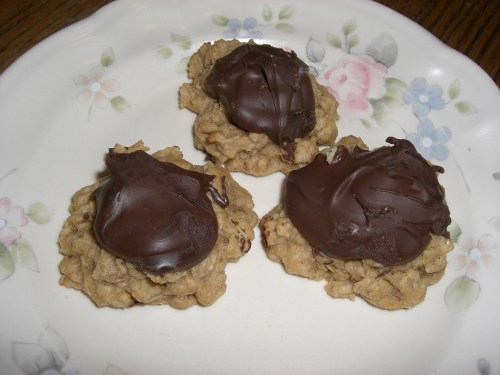
CIMG3227

I generally do these as drop cookies and skip the rolling into balls and flattening step, but the rolling and flattening would probably make them look more uniform, if that is important to you. I like them without the peanuts on top. I also don’t use 4 T. of shortening–more like 1 1/2. Sometimes I leave it out all together.

Quick Peanut Butter Kiss Cookies

These are a pared-down version of the originals but taste every bit as good. My daughter-in-law got this recipe in one of her classes. They’re great for a quick treat, and for those with gluten sensitivities, they’re flourless. We don’t always have Hershey’s kisses on hand so I sometimes just mix chocolate chips in the dough.

1 c. peanut butter
1 c. sugar
1 egg
Hershey’s Kisses

Thoroughly mix together peanut butter, sugar, and egg. Drop by teaspoonful or roll into 1 inch balls onto ungreased baking sheet. Bake at 350 for about 10-11 minutes, until slightly browned. Immediately place an unwrapped Hershey’s Kiss in the center of each cookie and press down. Let sit on pan for a minute or two, then remove from pan. Let cool before storing. Makes 24-26.

Peanut butter kiss cookies

Congo Bars

I don’t know why they’re called that, and in trying to find a recipe to link to, I found all kinds of variations! But this one is pretty simple plus makes more than the usual 9 x 13 pan. Great for when you need to take cookies somewhere but want to leave some home for the family as well.

1/2 cup margarine
2 3/4 cup brown sugar
4 eggs
2 1/2 teaspoons baking powder
1 teaspoon salt
2 3/4 cups flour
1 to 2 cups chocolate chips

Preheat oven to 350 degrees. Melt margarine and combine with brown sugar.Add eggs and beat well. Add dry ingredients and mix well. Spread mixture into a greased 11 x 15β€³ pan. Sprinkle chocolate chips on top. Bake for 20-25minutes. Makes 2 dozen, depending on how you cut them. Chopped nuts can be added if desired.

Congo bars

Snickerdoodle Blondies

I am just going to share Annette’s photo and link to her recipe since there is where I found these. I love snickerdoodles but don’t like all the forming into balls and rolling them in sugar and cinnamon. When I saw them as bar cookies on Annette’s blog, I knew I had to try them, and now they’re a family favorite, plus I like to take them to church fellowships and meals that I make for others.
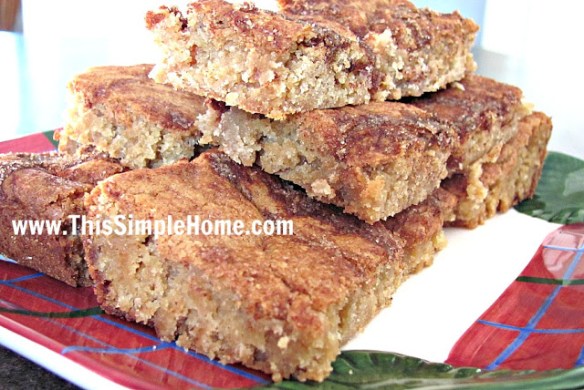
snickerdoodle bars

Gingerbread Teddy Bears

I got this recipe way back in college when the Home Economics Department at my college was having a Christmas Open House. I don’t make them every year because all of that ball-rolling is a little tedious, especially if you’re doubling the recipe. But they’re fun to make (especially if you have helpers) and they taste great. I wasn’t a great fan of gingerbread cookies before these, but I like that these are soft and chewy rather than hard and crisp.

1 c. butter or margarine
2/3 c. packed brown sugar
2/3 c. dark corn syrup, light corn syrup, or molasses
4 c. all-purpose flour
1 1/2 tsp. ground cinnamon
1 tsp. ground ginger
3/4 tsp. baking soda
1/2 tsp. ground cloves
1 beaten egg
1 1/2 tsp. vanilla
Miniature semi-sweet chocolate pieces
Decorator icing (optional)

In a saucepan combine butter, brown sugar, and corn syrup. Cook and stir over medium heat til butter is melted and sugar is dissolved. Pour into a large mixing bowl and cool 5 minutes. Meanwhile, combine flour, cinnamon, ginger, soda, and cloves. Add egg and vanilla to butter mixture and mix well. Add the flour mixture and beat til well mixed. Divide the dough in half; cover and chill at least two hours or overnight.

To make each teddy bear, shape dough into about a 1-inch ball for the body, one 3/4-inch ball for the head, and six 1/2-inch balls for the arms, legs, and ears. On ungreased cookie sheet, place the 1-inch ball and flatten slightly. Place 3/4-inch ball next to (touching) the β€œbody” for the head. then do the same for the arms and legs. Place two 1/2-inch balls above the head for ears. If desired you can pinch off just a teeny bit of dough for a nose, or use miniature chocolate chip. Use miniature chocolate chips for the eyes and either a navel on the belly or 3 β€œbuttons”. Bake at 350^ for 8-10 minutes or until done. Carefully remove and cool.

If desired, pipe on smile, bow tie or vest or other decorations with decorator icing (1/2 c. sifted powder sugar and approximately 2 tsp. milk, blended to piping consistency, tinted with 1-2 drops food coloring). Makes 20-23.
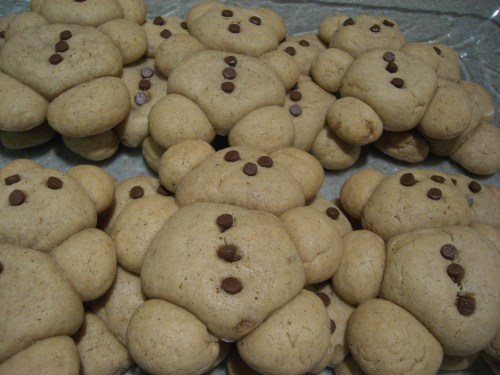
I do make a few others here and there, but these I make most often. Usually I end up with less than the recipe says it will make,Β  I think because I tend to make them bigger than intended, but I put what the original recipes said they’d yield.

Enjoy! Let me know if you make any of these and what you think.

(Updated to add: Now that we have gluten-free family members, I’ve made most of these with King Arthur Measure for Measure Gluten-Free Flour with good success.)

Friday’s Fave Five

Β FFF spring2

It’s Friday, time to look back over the blessings of the week with Susanne at Living to Tell the Story and other friends. Here are some highlights of my week:
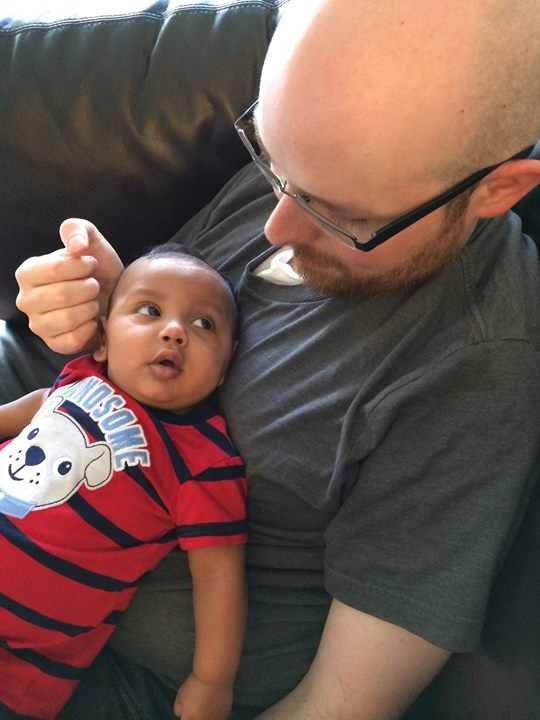
1. Timothy’s first visit to our house. He did pretty well! And I always love a chance to hold him. It was nice to have Jason and Mittu over again, too. πŸ™‚

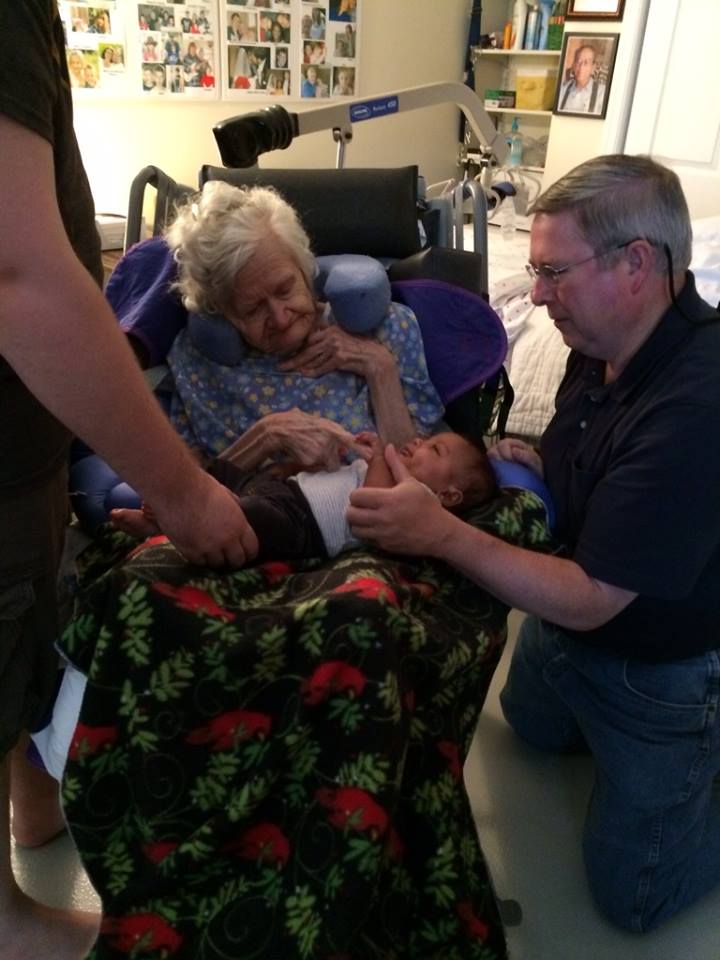
2. Timothy’s meeting Great-Grandma for the first time. She was delighted. πŸ™‚

tandgg

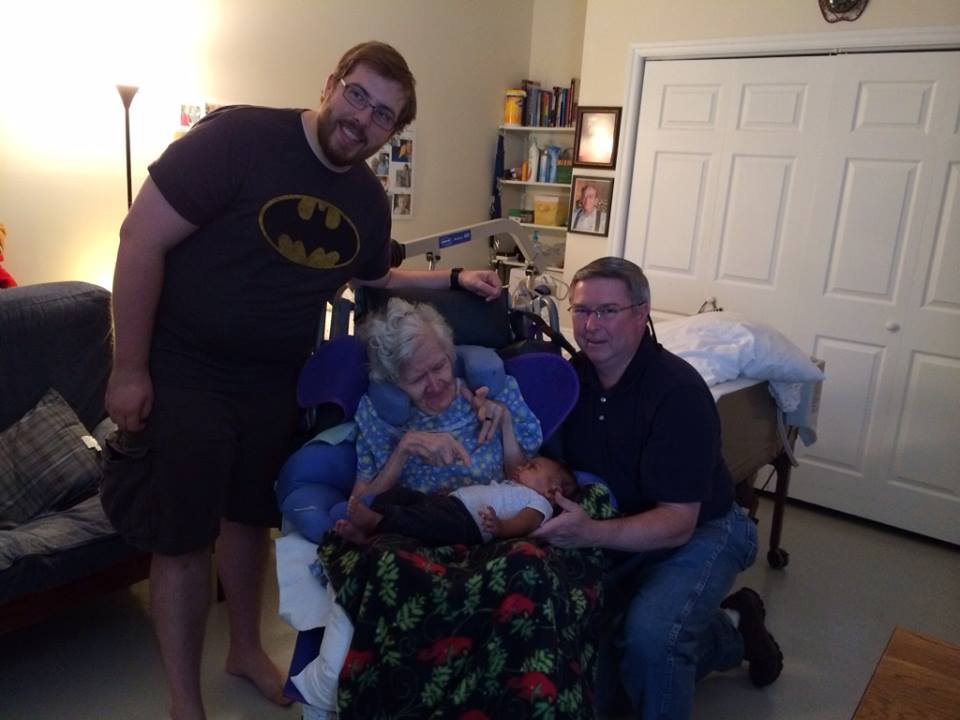
Four generations:

fouirgen

3. Family pack barbecue. For dinner while they were here we got a “family pack” of barbecued chicken, potato salad, and baked beans from Buddy’s Bar-B-Q. The family pack was made for five, and we had five adults, so I was a little afraid it might not be quite enough, but the portions were generous. It was very good!

4. More stitching and project progress. The first part of my crewel stitching project seemed to take forever, but now it is going pretty quickly. I didn’t have time today to take picture updates – maybe next week.

5. This:

CIMG5312

I’ve mentioned it before, but using it again today made me appreciate it all over again. Makes cleaning ceiling fans blades and getting spiderwebs from the ceiling a breeze, and I found a new use for it today: getting the dust between the dryer and the wall.

Two other blessings this week: today is Jason and Mittu’s fifth wedding anniversary, and my oldest son Jeremy comes in this weekend to visit for a week!

Happy Friday!

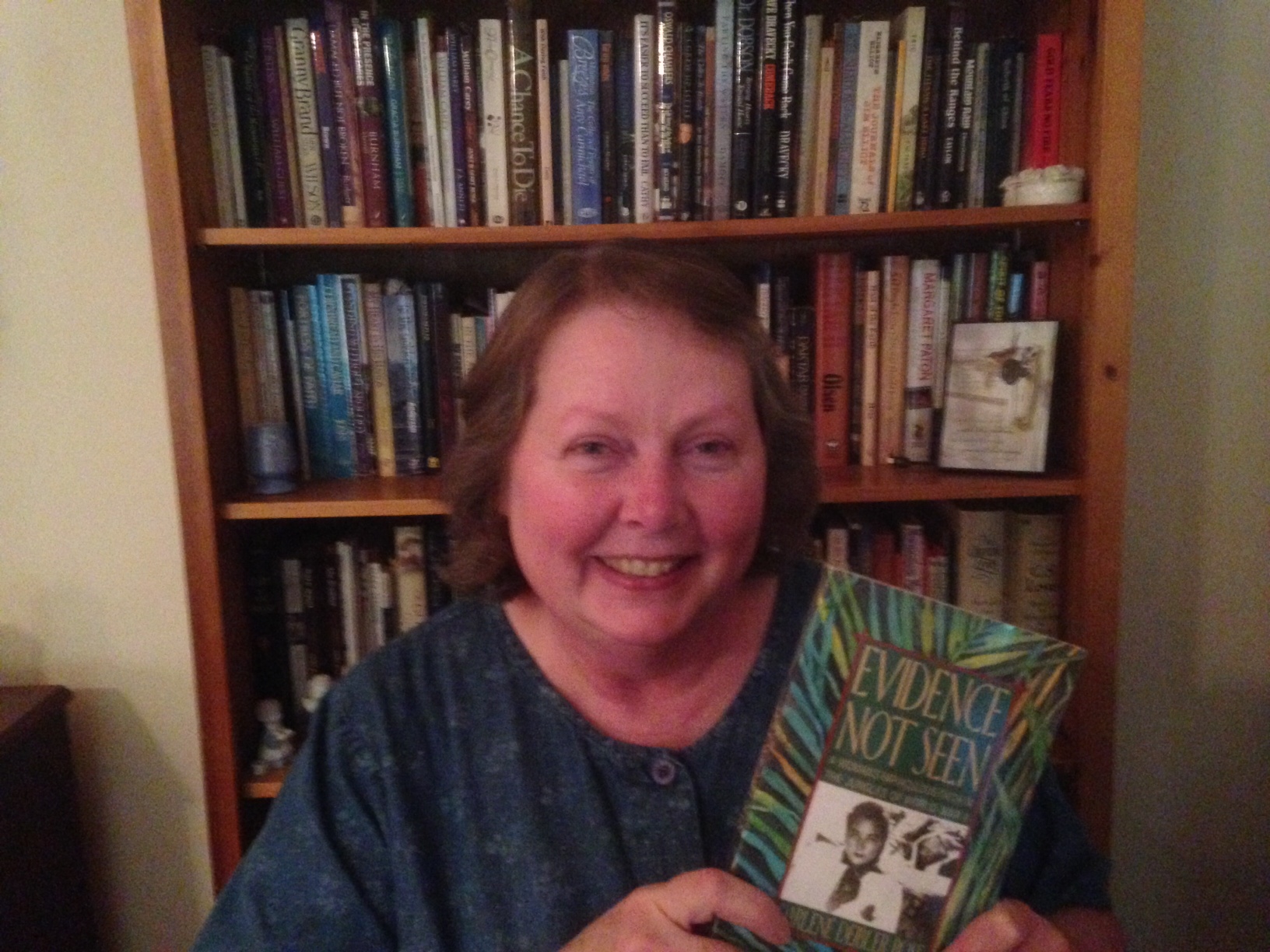
Carrie at Reading to Know is celebrating her 8th blogging anniversary with a giveaway of a $50 Amazon card, but to qualify she asks readers to post a photo of themselves with a favorite book.

The hardest part for me was choosing just one book. Of course the Bible would be the all time #1 favorite, and I don’t want to just take that for granted. In a recent book meme I had a hard time choosing just one book in any category. But Evidence Not Seen (linked to my review), about a missionary wife who was taken captive and confined to a Japanese prison camp during WWII, would definitely be up there in the very top echelons of my favorites.

photo 4

Book Review: Dear Mr. Knightley

Dear Mr KnightleyThe cover and title of Dear Mr. Knightley almost makes you think it will be a cute modern takeoff of Jane Austen’s Emma. But it’s far from that, and, oh my, so rich on so many levels.

Samantha Moore (known as Sam) has spent most of her life in the foster care system. Because of her past and being so often moved about, she finds it hard to relate to people: to protect herself from being hurt she hides her true self. She confesses, “I let go of people and relationships to protect myself, and then I detached so completely that I lost the ability to relate.” At one foster care home she discovered classic books. She became fast friends with Jane Eyre and loved the “safe, ordered, and confined” world of Jane Austen. Classic books became her refuge, and in many cases she responds to people by quoting them, thus hiding her real self.

When presented with the opportunity to receive a grant to go to graduate school, she decides to take it. One unusual stipulation is that the grantor wants to receive “personal progress letters” from her on a regular basis. To preserve his anonymity and give her more freedom to express herself, he goes by the pseudonym George Knightley. Sam accepts the conditions and finds school much harder than she thought and trying to open up and relate to people even harder. He letters to Mr. Knightley become “one-sided soul purgings,” made possible because of the anonymity and because she is sure they will never actually meet.

Much of the book unfolds her growth as a person and in her relationships, including one with a young hostile 14 year old who comes to the group home where she lives and with a couple of new friends at school. When she (literally) runs into her favorite contemporary author, who is speaking at a class in her school, she introduces herself and is invited to coffee, and so starts a tentative friendship with him. But just when she is learning to trust, will a betrayal set her back?

I don’t want to say much more about the plot than that, but I loved watching Sam’s growth. A quick glance at some reviews at Amazon and Goodreads showed that some readers thought she was “a jerk” and didn’t like her. But that’s the whole point: she comes across that way (not in her letters, but to her potential friends) in the “I’m going to drive you away before you drive me away” stance that many people who have been deeply wounded take to protect themselves. Watching the ups and downs of her beginning to realize how she’s been coming across, open up, take risks, learn to trust was full of pathos. Similarly, her naivete, which some criticized, was, I thought, quite understandable since she hadn’t been in any kind of a setting where people tried to teach her about life, the world, and relationships until she came to Grace House, a group home, as a teenager. She eventually learns that “self-protection keeps you from love.”

I also loved the multitude of classic book references and quotes, not only from Austen and Bronte, but also Dickens, Dantes (The Count of Monte Cristo), L. M. Montgomery, and C. S. Lewis. I especially liked a passage where Sam reads about Eustace becoming a dragon in The Voyage of the Dawn Treader and realizes her own dragonish tendencies and her need to be delivered from them. Sam (and Reay) loves many of the same books I do. We became friends when she wrote that “George Knightly is a good and honorable man – even better than Fitzwilliam Darcy, and few women put anyone above Mr. Darcy. Yes, Darcy’s got the tempestuous masculinity and brooding looks, but Knightley is a kinder, softer man with no pretense or dissimulation. Yes, he’s a gentleman. And I can write with candor to a silent gentleman, and I can believe that he will not violate this trust.” Yes! I’ve always liked Knightley better than Darcy.

I appreciated the way the faith element was brought in very naturally. Sam isn’t open to it at first because she thinks “He doesn’t pay attention to me. But…I want to badly to believe that God cares, that all of this matters to Him, that all this pain has a purpose and that none of it tarnishes me forever.” After her encounter with a couple who show her Christ’s love, who “drop hints and hope like bread crumbs for me to follow,” she writes, “How can I not believe that there is a God who exists and loves, when the people before me are infused with that love and pour it out daily? I still can’t grasp that it’s for me, but what if it is?”

I’m normally not a fan of epistolary novels, because not many people really write letters at all these days, much less letters full of plot points and dialogue, but I could easily set that aside and just get into the story and its telling in this way. Even though I think such letters are still probably unrealistic, the style fit this story well. This is the first novel I have been this wrapped up in in a long time, eagerly looking for ways to get in more reading throughout the day (the Kindle app on the phone is nice for that: it’s a little harder to read on a small screen but handy if you find yourself with a few minutes to spare here and there).

I had gotten this book when it was either free or very inexpensive for the Kindle app, and then had forgotten about it. I’m thankful the Austen in August reading challenge reminded me it was there. Katherine Reay is a favorite new author. This is her first novel, and I eagerly await more.

Austen in August

(This will also be linked toΒ Semicolonβ€˜s Saturday Review of Books.)

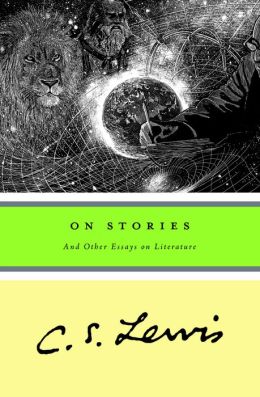
Book Review: On Stories and Other Essays on Literature

On StoriesSomeone recommended On Stories and Other Essays on Literature by C. S. Lewis some time last year. I asked for and received it for Christmas, but then set it aside when I entered a number of reading challenges for this year. But something in How to Read Slowly touched off a train of thought that reminded me of Lewis’s book, so I was happy to pick it up recently. Then realizing it could qualify for Carrie’s Narnia Reading Challenge for July made me push a little harder to try to get through it by the end of the month.

Nineteen of Lewis’s essays were compiled for this book by Walter Hooper, one of his biographers, his private secretary for a time, and eventually the literary executor of his estate. The last selection in the book is a transcript of a discussion recorded with Lewis and two colleagues. Many of the essays were previously published in magazines or in Lewis’s books: others had been unpublished until this book. Some are Lewis’s thoughts on fiction, science fiction, writing for children, etc., while others are critiques of other writers’ work (Dorothy L. Sayers, Rider Haggard, George Orwell, Tolkien, and others).

There is no way to really review a book like this, so I am just going to share some observations.

I hadn’t known and was fascinated to learn in Hooper’s mini-biography which introduces the book that in Lewis’s time “the most vocal of the literary critics were encouraging readers to find in literature almost everything, life’s monotony, social injustice, sympathy with the downtrodden poor, drudgery, cynicism, and distaste: everything except enjoyment. Step out of line and you were branded an ‘escapist'” (p ix). I’m glad Lewis not only stepped out of the box but succeeded and made it okay to enjoy stories as stories.

Lewis states many times in various essays that he did not write the Narnia series or his science fiction trilogy with morals or symbolism in view, as many people in his time and since have thought. They started with certain pictures in his mind (a faun carrying an umbrella) and developed from there. “Never…did he begin with a message or moral, but…these things pushed their own way in during the process of writing” (p. xv). He says in the transcript at the end, “The story itself should force its moral on you. You find out what the moral is by writing the story” (p. 145).

Reepicheep and Puddleglum the Marshwiggle were his favorite characters (p. xi).

He decried the kind of fiction where “the author has no expedient for keeping the story on the move except that of putting his hero into violent danger. In the hurry and scurry of his escapes the poetry of the basic idea is lost” (p. 10). Of course he had no problem with putting the hero in danger, as you know if you’ve read Narnia or the Space Trilogy: sometimes that’s a necessary part of the plot. But if that’s all the story is, it might be enjoyable to some, but there’s no deeper meaning.

He also believed that the “marvels in a good Story” should not be “mere arbitrary fictions stuck on to make the narrative more sensational” (p. 12). In other words, the story itself should be intrinsic to the “world” in the story. A story about pirates shouldΒ  have a different feel and problems than a story about giants and dragons. The plot shouldn’t be such that it could be stuck into any setting.

He quotes Dorothy L. Sayers as saying, about the assumption that she wrote to “do good”: “My object was to tell that story to the best of my ability, within the medium at my disposal — in short, to make as good a work of art as I could. For a work of art that is not good and true in art is not good and true in any other respect” (p. 93).

When asked what he thought of a certain book, he replied, “I thought it was pretty good. I only read it once; mind you, a book’s no good to me until I’ve read it two or three times” (p. 146).

I found his thoughts on critiques and book reviews quite interesting in “On Criticism” and in his answering of some criticisms of his work in “On Science Fiction.” Then to see/read him “in action” critiquing other books was enlightening. He didn’t pull any punches, but he wasn’t mean or belittling, and he complimented and praised the good while sharing honestly what he thought was bad. He made a strong case for truly evaluating what was good and bad and not deeming a book bad just because one doesn’t like a particular genre.

He thought The Lord of the Rings would “soon take its place among the indispensables” (p. 90). He was right. πŸ™‚

I didn’t look up every word I didn’t know in this book, but I should have, especially with a dictionary app at hand on my phone. I eventually started doing so partway through the book.

Though Lewis has such a wealth of knowledge, I found him very readable and not hard to follow for the most part. I’d love to have sat in on one of his classes.

And here are some of my favorite quotes:

“It might be expected that such a book would unfit us for the harshness of reality and send us back into our daily lives unsettled and discontent. I do not find that it does so….Story, paradoxically enough, strengthens our relish for real life. This excursion into the preposterous [speaking here of The Wind in the Willows] sends us back with renewed pleasure to the actual” (p. 14).

“No book is really worth reading at the age of ten which is not equally (and often far more) worth reading at the age of fifty – except, of course, books of information” (p. 14).

On the topic of frightening elements in children’s literature, he agreed that “we must not do anything likely to give the child those haunting, disabling, pathological fears against which ordinary courage is helpless,” but to withhold “the knowledge that he is born into a world of death, violence, wounds, adventure, heroism and cowardice, good and evil…would be to give children a false impression and feed them on escapism in the bad sense. There is something ludicrous in the idea of so educating a generation which is born to the Ogpu and the atomic bomb. Since it is so likely they will meet cruel enemies, let them at least have heard of brave knights and heroic courage. Otherwise you are making destiny not brighter but darker. Nor do most of us find that violence and bloodshed, in a story, produce haunting dread in the minds of children…Let there be wicked kings and beheadings, battles and dungeons, giants and dragons, and let villains be soundly killed at the end of the book…I think it possible that by confining your child to blameless stories of child life in which nothing at all alarming ever happens, you would fail to banish the terrors, and would succeed in banishing all that can ennoble them or make them endurable” (pp. 39-40) (emphasis mine).

On The Lord of the Rings: “Here are beauties which pierce like swords or burn like cold iron; this is a book that will break your heart” (p. 84).

“‘But why,’ some ask, ‘why, if you have a serious comment to make on the real life of men, must you do it by talking about a phantasmagoric never-never land of your own?’ Because, I take it, one of the main things the author wants to say is that the real life of men is that of mythical and heroic quality” (p. 89).

“The value of myth is that it takes all the things we know and restores to them the rich significance which has been hidden by the ‘veil of familiarity.’ The child enjoys his cold meat (otherwise dull to him) by pretending it is buffalo, just killed with his own bow and arrow. And the child is wise. The real meat comes back to him more savory for having been dipped in a story…If you are tired of the real landscape, look at it in a mirror. By putting bread, gold, horse,apple, or the very roads into a myth, we do not retreat from reality: we rediscover it. As long as the story lingers in our mind, the real things are more themselves. This book [LOTR] applies the treatment not only to bread and apple but to good and evil, to our endless perils, our anguish, and our joys. By dipping them in myth we see them more clearly” (p. 90).

I love that – that by seeing truth in stories we sometimes see it more clearly than we otherwise would have.

If you like Lewis or like literature, I highly recommend this book to you.

Chronicles of Narnia Reading Challenge

(This will also be linked toΒ Semicolonβ€˜s Saturday Review of Books.)

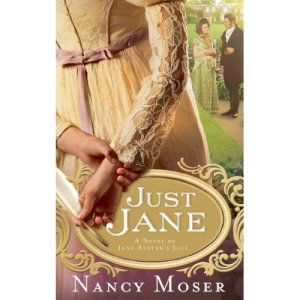
Book Review: Just Jane

Just JaneJust Jane: A Novel of Jane Austen’s Life by Nancy Moser caught my eye when it came through as free or inexpensive for the Kindle app because I so enjoyed How Do I Love Thee?, her novelization of Elizabeth Barrett Browning’s life.

The novel is written from Jane’s point of view beginning when she is in her early twenties. She’s the seventh of eight children, the youngest of two girls. She enjoys writing and her family enjoys hearing her stories, but there doesn’t seem to be much thought of publishing yet. She has had some encounters with a Tom Lefroy to the point where she believes they have an understanding. While he is away at law school she cherishes hopes of their coming union. But, if you know her life story, you know she never hears from Tom and he marries someone else.

She continues at home doing all the things a single woman in the 1800s would do, with the addition of writing, until her family moves to Bath. She not only doesn’t want to go, but she is furious that the decision was made without even consulting her. She has lived in the rural village of Steventon all her life and hates Bath. She has no choice but to move with her family, but she does not write during the years they live there.

Though she has another romantic encounter or two, she never marries. When her family moves again to more commodious accommodations, she is inspired to pick up her pen again. Her first novel is rejected, which may be an additional reason she stops writing for a while, but eventually, as the world knows, she is finally published. She writes anonymously at first but eventually her secret comes out.

The book ends some years before her death, but the author provides a postscript with details of her remaining years. I much appreciated a section at the back where Moser tells what is fact and fiction in the book. Unfortunately, many of Jane’s letters were destroyed, and though Moser drew from them and even seamlessly wove some into the story, she had to fill in the best she could with what she knew.

I thought I would really like this book since I liked the earlier book of Moser’s and since I generally enjoy Austen’s books. I didn’t dislike it per se, I just didn’t love it as much as I thought I would. Sometimes when you approach a book with high expectations it makes it especially hard for it to live up to them. I felt there was too much information about her family: by the time she’s in her mid-twenties, most of her brothers have either already married or are getting married, and the drama of their relationships wasn’t really what I was reading the book for. Then again, I’m sure she and her parents and sister would have been involved and interested, so it was definitely a part of her life and I can understand its inclusion. I missed her humor: some of her writing has been described as “biting satire” (some of the “bite” goes a little too far for me sometimes),Β  but some of it has a lighter touch. I just finished listening to Northhanger Abbey and loved some of the humorous interchanges with Henry especially (also the name of her favorite brother) and the way she subtly gets across to the reader some of the things naive Catherine Morland misses in her first foray away from home. I also thought she came across as somewhat negative (downright grouchy sometimes), but near the end she did say that she wrestled with discontentment and was guilty of “the unforgivable act of complaining. For what good comes from that particular vice – for the complainer or her unlucky listener?” Moser says in her afterword that Jane was “witty, wise, discerning, creative, loyal. She was also stubborn, judgmental, insecure, and needy. She was…a lot like us.” She did learn along the way that she could “wallow in unhappiness or make a determined choice to leave it behind and move forward. Life is not fair – nor often understandable. But it is ours to live to the best of our ability.”

I did empathize with what seemed to be an inclination towards introversion: though she loved visiting family and having them visit, there were times she declined certain activities because she just needed some time alone. She “embraces silence and solitude.” Though she attended balls in her younger years, she seemed to be more of a homebody later on.

So…upon reflection I guess I did appreciate more from it than I thought. πŸ™‚ That’s one thing reviews are good for – going back over the story and trying to put it all into perspective. I did enjoy her more at the end of the book than at the beginning or middle and appreciated what she learned about contentment and life and finding one’s place.

And I loved the cover!

One last note that I especially liked: when one reviewer seems to portray Jane’s work as “educational,” she says, “I didn’t mean for it to be educational…at least not with any conscious intent.” Her sister Cassandra replies, “Your stories portray true life. In that there is always education.” Amen to that. I think that’s what resonates with us in the books that most appeal to us, no matter the setting: when they depict something of real life and touch our hearts with truth.

Linking to the Austen in August challenge:

Austen in August

(This will also be linked toΒ Semicolonβ€˜s Saturday Review of Books.)


Friday’s Fave Five

Β FFF spring2

It’s Friday, time to look back over the blessings of the week with Susanne at Living to Tell the Story and other friends.

I didn’t think I’d get to a FFF today – it has been a busy day, plus at first I just couldn’t think of anything to mention that I haven’t mentioned before. But it is ok to be thankful for things again/still. πŸ™‚ This is where the value of an exercise like this manifests itself: after just a few concentrated minutes of thinking it over, I found that there were more than five, as usually happens. So here they are:

1. Another ladies’ newsletter completed. Some months I pretty much know what I am going to include in it, so it is just a matter of getting it down and formatted. Some months I have no idea, and this was one of those. But after praying for the Lord to direct me in what to put in, it’s so neat to have different things come to mind and then see it all come together.

2. Cake pops. I was craving something caky, but I don’t dare make a whole cake for just three of us. I was in Wal-Mart and remembered these (that’s the only place I have ever seen them):

nlFit the bill perfectly!

3. Face Time with Jason, Mittu, and Timothy. We don’t see Jason and Mittu as much as we used to since they have a new baby in the house and their own washer and dryer now. πŸ™‚ And we got so used to seeing Timothy several days a week while he was in the hospital, that to go a couple of weeks without seeing him seems like half of forever. I was craving a visit and texted to ask if they wanted to Face Time, and we did. It was nice to catch up and fun to see him almost in person, though I enjoy pictures, too. It was nice, too, to talk to him a bit – don’t want him to forget Grandma and Grandpa’s voice! πŸ™‚

4. An appointment deferred, or actually not deferred, but I thought I had an appointment for my physical Thursday but was relieved to find it was actually scheduled for next Monday. It was just a busy week, and though I could’ve worked around it, it was nice to discover I didn’t have to after all.

5. Take-out a couple of times this week. My husband brought home Chinese food Saturday night, and then one night when he had to be out of town Jesse and I got take-out from Ruby Tuesday’s.

Other little blessings: I’ve enjoyed our hummingbird visitor coming more frequently, bringing his mate, and getting a little less skittish about seeing us through the window, plus seeing a baby rabbit in the back yard (we’ve seen adults plenty of times but this is the first baby we’ve seen). I’ve also made some more progress on my stitching during the evenings and my new project last weekend. Here is a sneak peek:

photo(3)

A major blessing this week has been your gracious comments on my 8th blogiversary post. Thanks so much – you’re all very kind. πŸ™‚