Book Review: The Scarlet Pimpernel

PimpernelThe Scarlet Pimpernel by Baroness Orczy is the forerunner of the heroes with a secret identity genre, at least according to Wikipedia. It was originally published as a play in 1903, then as a novel in 1905.

A scarlet pimpernel is a small red flower in England, and it’s also adopted as the name and sign of an English man who dons different disguises to help rescue those slated for the guillotine in France during the Reign of Terror of the French Revolution in 1792. He is rumored to have 19 men under his command, and his exploits have made him the talk of England, with everyone wondering about his true identity.

Citizen Chauvelin is an agent who has come from France specifically to find out the identity of the Scarlet Pimpernel and to stop him. He calls on an old friend, Lady Marguerite Blakeney, a Frenchwoman married to the very rich but very foppish English Sir Percy Blakeney. Chauvelin is convinced that in the circles in which Marguerite moves, she is sure to hear something that might be helpful to him. To ensure her cooperation, he threatens the safety of her brother with papers that show that he is in league with the Scarlet Pimpernel and therefore in danger of his life.

Marguerite wrestles with her conscience: she is as enamored of the Scarlet Pimpernel as everyone else and does not want to be the downfall of a brave man. Though she is French, she feels her countrymen have gone way too far in the Revolution. On the other hand, her she loves her brother dearly, and he is her only remaining family member.

She considers turning to her husband for help, but they have been estranged since the first days of their marriage, although they put up a good front for everyone else. Marguerite had once spoken out against the Marquis de St. Cyr, unwittingly causing him to be arrested and sent to the guillotine. Her husband can’t forgive her for that and doesn’t trust her. Besides, he’s slow, lazy, and dimwitted, so she doesn’t feel she can confide in him.

I’ll leave the plot there so as not to spoil it. I wouldn’t say Baroness Orczy is the best writer – there are places in the book that are tedious, other places a bit overwrought – but this is certainly an exciting book, with intrigue, suspense, danger, and everything we love about heroes in disguise.

Scarlet PimpernelI first came across this story years ago as a film starring Jane Seymour and Anthony Andrews (and a young Ian McKellen [Gandalf] as Chauvelin), which I loved. There is a good bit more swashbuckling and derring-do in the film than in the book, and the film shows the audience who the Scarlet Pimpernel is right off the bat, whereas the book slowly unfolds it. The film is based not only on the book The Scarlet Pimpernel but also Eldorado (which I haven’t read), which includes more about Marguerite’s brother and the rescue of the captive Dauphin. Many of the details are changed or in a different order, but they did keep the overall story arc the same, and they especially captured the angst of Marguerite and Percy’s love for each other that they each keep hidden at first because of their misunderstandings.

For those who would want to know, there is smattering of “damns” and “dems” and “demmed.” There are also what I did not recognize as minced oaths, but when I looked them up I saw that they were. I wish those weren’t there. :-/ But otherwise this is a fun story.

I listened to the audiobook read by a Mary Sarah, who was not the best narrator, but the book was still enjoyable.

(This will also be linked to Semicolon‘s Saturday Review of Books.)

This also completes one of my requirements for the  Back to the Classics Challenge hosted by Karen at Books and Chocolate.

classics2014

Laudable Linkage and Videos

Here are just a few good reads from the past week, with more commentary than usual:

A Tale of Two Comparisons. Most times we get into trouble when we compare ourselves with others, and the Bible warns against the wrong kinds of comparisons that provoke jealousy, envy, discouragement, or discontent. But we can do so in a way that spurs us on to grow and to follow them as they follow Christ.

7 Do’s and Don’ts of Welcoming People to Your Congregation.

Gary Thomas’ ‘Sacred Marriage’: Not the Last Word on Marriage, HT to Challies. I kept thinking “Yes!” as I read through this. The author takes issue with the premise “What if God designed marriage to make us holy more than to make us happy?” by pointing out that marriage was created before the fall and its purpose is primarily companionship rather than sanctification (although God can use it in our sanctification, but I have read so many “holy, not happy” posts about marriage that if I weren’t married and read those things, I’d be discouraged from ever getting married, because they made it sound so dreary.)

Let Your Husband Love You, HT to Challies. “I get it. The kids have been climbing on you all day…you’re sick of being clawed at, sucked on, licked, punched, kicked, pulled, snotted on, cried on, spit up on, pooped on, and peed on….I know you don’t want to be touched and for some reason, an innocent compliment can offend you. But…” Excellent. She also responds here to some of the feedback she got from her post.

My friend Lou Ann has been conducting a survey of singles and shares some results of it in The Singles Survey: Introduction and Part 2. Very important. We so often unwittingly wound our single friends..

And here are a couple of short videos that made me smile:

Shared by my son, a little girl meets her father’s twin brother for the first time and gets confused. The look on her face is priceless.

And I clicked on this after looking at one The Story Warren shared about a camera shaped like an egg in a penguin colony. That was pretty neat, but this one was funny:

Have a great Saturday!


Friday’s Fave Five

FFF birds on a wire

Welcome to Friday’s Fave Five, hosted by Susanne at Living to Tell the Story, in which we can share five of our favorite things from the last week, a wonderful exercise in looking for and appreciating the good things God blesses us with. Click on the button to learn more, then go to Susanne’s to read others’ faves and link up your own.

Another Friday, another opportunity to look back over the blessings of the last week. Here are a few of mine:

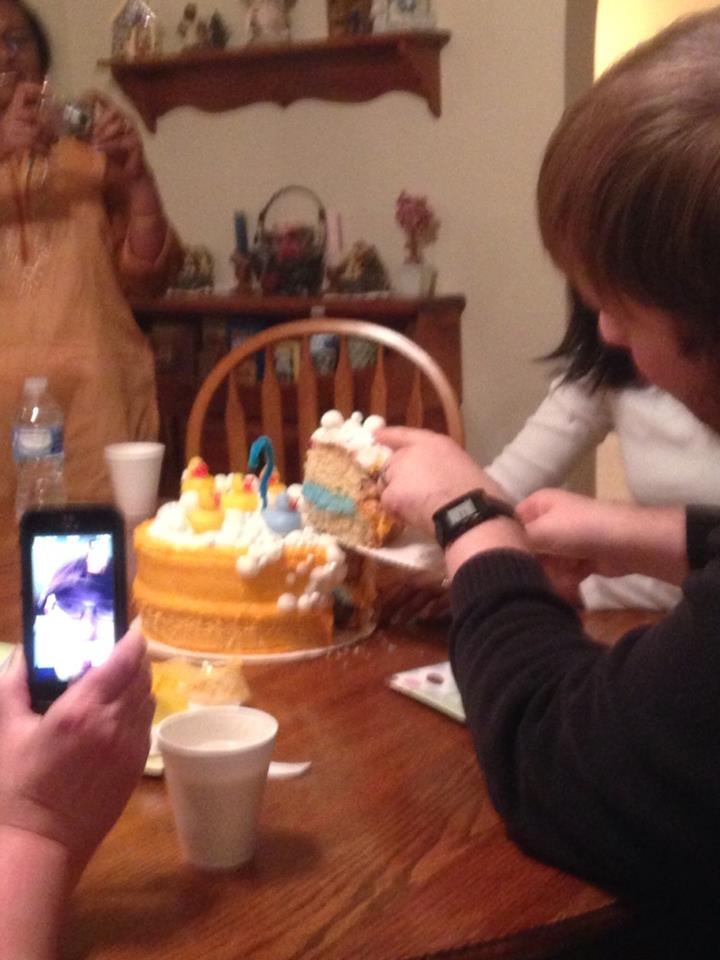
1. A gender reveal party to find out what our new grandchild is going to be. A friend of my son and daughter-in-law made this adorable cake:

gender cake

The filling inside would be pink or blue, indicating girl or boy. And, it’s going to be…

baby gender

A boy! I think all of us were thinking girl for some reason, so we’ve had to adjust our thinking. We got to see the latest ultrasound pictures and we’re very much looking forward to meeting this little guy in a few months!

2. Flowers. My daughter-in-law’s mom was here this last weekend and brought some flowers when she came for the gender-reveal party. I thought they were pretty but didn’t look at them too closely because I was getting things ready for the party. Then one day this week I walked by and caught a whiff of carnation, probably my favorite floral smell. Most flowers make me sneezy and sniffle if I smell much of them, but not carnations. And pink ones even! Having flowers in the house in January, especially, brightens up winter days.

photo(7)
3. A new car for my oldest son. He’s had his car for over 10 years and was saving up to replace it next year, but the car has been having one problem after another, has broken down and had to be towed several times just in the last few months, and he finally decided not to put any more money into fixing it. He and my husband and a friend did a lot of car shopping online and in both our towns, and he finally found one he likes and can afford with a high reliability rating. That’s such a big relief.

4. A call from a dear friend of 30+ years. It’s so good to touch base and catch up with each other.

5. Glad for things that didn’t happen. It has been bitterly cold this week, but thankfully no precipitation to make driving treacherous and no broken pipes. And they say these hard freezes kill off some of the bug population, so I’m happy there will be that fringe benefit this spring and summer. 🙂

Happy Friday!

Book Review: The Blue Castle

Carrie chose as the January selection for her Reading to Know Classics Book Club The Blue Castle by Lucy Maud Montgomery of (Anne of Green Gables fame), which dovetails nicely with her L. M. Montgomery Reading Challenge also held in January. This book is one of the few LMM wrote for adults and the only one set totally outside Prince Edward Island. It was originally published in 1926.

Blue CastleThe Blue Castle opens with a very depressed Valancy Stirling. It’s her 29th birthday, and she has no friends, has never had a boyfriend or anyone even remotely interested in being one, and she is surrounded by a large and eccentric family, including a domineering mother who goes into “fits” of silent treatment over the slightest perceived violation of her wishes. Her actions are hemmed in by what her gossipy clan would say and whether her uncle might cut her out of his will if she displeases him. With no hope of anything ever changing for the rest of her life, no wonder she’s depressed.

She gets just a bit of a respite by reading books primarily about nature by author John Foster (when her mother will let her), but usually she escapes to her blue castle, the place in her daydreams where she’s beautiful and pursued by handsome princes.

This 29th birthday isn’t helped by the fact that it is raining relentlessly, but that at least saves her from the anniversary picnic of her aunt and uncle. She has been having occasional pains in her chest, and she chooses this day to sneak out to a local doctor (not the family-approved one) to see about it. The doctor is called away on a family emergency just after her exam, but he writes her to tell her that she has angina, probably only has a year to live, and should avoid stress and strain. Thus changes everything for Valancy. No longer does she have to worry about being cut out of anyone’s will or following the same dreary, monotonous routine for the rest of her life. She begins saying exactly what she thinks and doing exactly what she wants, to the point that her family thinks she is losing her mind. Then when poor disgraced Cissy Gay, daughter of the town drunk, is dying, Valancy scandalizes her family by going to live with them to be a housekeeper, cook, nurse, and companion to Cissy. Worse, she takes up with that Barney Snaith, whom everyone is convinced has a sordid past.

When Cissy dies, Valancy does not want to return home, so she proposes to Barney Snaith, telling him she only has a year to live. She loves him but does not expect him to love her. He takes her up on her offer, and they move to his island, which reminds Valancy very much of her blue castle.

They spend the next year exploring the island, getting to know one another, and being very happy. The writing here sounds more like the LMM I know and love, with her descriptions of nature and their wanderings and their happiness at home.

Then, when a year is about up….well, I won’t spoil the story for you. 🙂 Let’s just say it takes an unexpected twist.

I had a hard time liking the book at first. The first part was so depressing, and then when Valancy started to assert herself, she went overboard (though that’s not entirely surprising considering how long and severely she was repressed). But somewhere during the time she went to take care of Cissy and then her marriage I started enjoying it more, and I really liked how it ended. I did guess who Barney really was earlier in the book, but his family connections totally surprised me.

There almost seems to be an anti-religious tone in the book, as all the Stirlings are upstanding church members despite their gossip and harshness (even their minister is harsh and judgmental), but Valancy does tell Roaring Able (Cissy’s father) that there are good people in both their churches, and she does find a little church back in the woods whose pastor is simple and sincere and interested in ministering to people. I’d disagree with Barney that their happy life on the island was “what it must be like to be born again,” at least not in the Biblical sense, but he probably meant it along the lines of springtime renewal.

Thanks, Carrie is for choosing this book for the Classics Book Club! I don’t know when I would have come across it otherwise.

Reading to Know - Book Club    L. M. Montgomery Reading Challenge

(This will also be linked to Semicolon‘s Saturday Review of Books.)

This also completes one of my requirements for the  Back to the Classics Challenge hosted by Karen at Books and Chocolate.

classics2014

Made to Crave Bible Study

Made to CraveSome months ago I saw that Made to Crave: Satisfying Your Deepest Desire With God, Not Food by Lisa TerKeurst was free or only a couple of dollars for Kindle apps at the time. I had seen many around the Internet say good things about it, so I bought it, and it lay languishing with all my other Kindle purchases. 🙂 But I saw a note on my friend Kim’s blog that the Proverbs 31 Ministries was hosting a Bible study using Made to Crave beginning this week, so I signed up for it as a way to motivate myself to get into the book.

Several years ago I started a different blog, I Corinthians 10:31, to deal with weight loss issues because I didn’t want that subject to take over here. I decided to post my thoughts or things that stood out to me in each chapter of Made To Crave over there, again, so it doesn’t take up so much space here (we’re doing three chapters this first week; I don’t know if we’ll keep that pace throughout). I will probably post a general review of the book here when I finish it, but if you’re interested in following along with the individual chapters, they’re there under the label Made to Crave study.

I don’t think it’s too late to join in the online Made to Crave study at Proverbs 31 Ministries if anyone is interested – we’re only on the second chapter today. I’m not sure if I will stay with the study there, as there is a little more hoopla than I like, but I know some people go for that. The “extras” – Twitter parties and such – are not required to participate in the study: they’re just there for people who want those extras. But whether I continue with that particular venue or not, I will continue with the book and jotting notes on each chapter at I Corinthians 10:31.

Book Review: A Study in Scarlet

Some years ago in another town, the local radio station would play classic radio programs on Friday nights, and occasionally some of these would be Sherlock Holmes stories. I enjoyed them, but I was never inclined to read any of the books about him. However, over the past few years we’ve seen several film and TV adaptions or shows loosely based on the Holmes’ character, and I was curious to find out what the “real” (or maybe I should say original) Sherlock Holmes was all about.

Study in ScarletA Study in Scarlet is the first Sherlock Holmes book written by Sir Arthur Conan Doyle. It was first published in a magazine, and it’s one of the few Sherlock Holmes stories to be made into a full length book: the rest are short stories.

The book is told from Dr. John Watson’s point of view and opens with his coming back to England to recover after being wounded as an army doctor in Afghanistan. He runs into an old friend and, after sharing that he is looking for someone to share living quarters and expenses, the friend introduces him to Sherlock Holmes, who is looking for a roommate. The friend forewarns Watson that Holmes is a bit eccentric, but Watson feels he can get along with him well enough.

Upon their first meeting Holmes tells Watson he perceives he has been in Afghanistan, but doesn’t explain how he came to that conclusion yet. The two move into 221B Baker Street, and as they get to one another, Watson discovers that Holmes knows very little about literature, astronomy, politics, and other subjects, but knows a great deal about chemistry and sensational literature and a bit about geology and botany. Holmes feels he only has so much room in his brain and only wants to put into it what will help him in his craft. Watson can’t quite figure out what Holmes does for a living until Holmes reveals he is a consulting detective. Watson doubts Holmes abilities until Holmes tells him all about a telegram deliverer by observation, and Watson has the opportunity to question the messenger about Holmes’s speculations which are, of course, correct. Watson then becomes Holmes’ biggest fan.

The telegraph Holmes receives concerns a case in which his opinion is wanted. Holmes invites Watson to come along to meet Inspectors Gregson and Lestrade at an abandoned house where a male corpse has been found. There is a bit of competition between Holmes, Gregson, and Lestrade, but of course Holmes notices clues and makes deductions that the others miss.

Just when Holmes has identified the killer (but hasn’t yet explained how he did so), the story abruptly shifts to a desert scene in America where the only two people left in a caravan, an older man and a young girl, are about to die from hunger and thirst. At first I thought maybe this was a book of short stories after all and this was the next story, but after a while characters pop up with the same names of some of the characters in the first part. The man and girl are rescued by a caravan of Latter-Day Saints (Mormons) who are traveling to Salt Lake City, and they invite them to come along on the condition that they adopt the Mormon religion. Not having much choice, they do so, and the man, John Ferrier, adopts the girl, Lucy. Lucy grows and Ferrier prospers until Lucy falls in love with a man who works in nearby mines. The man in not a Mormon, though, and Brigham Young tells Ferrier that this is against Mormon rules and he has thirty days for Lucy to chose one of two other men, or something dire will happen. Each day a number is painted somewhere on Ferrier’s property, counting down to the 30 days.

Though at first I resented this time away from Holmes and Watson, the story about Lucy did get interesting and suspenseful. I won’t ruin it by telling what happened except to say that it does connect with the corpse in London that Holmes is investigating.

Then the story shifts back to Watson’s retelling of the arrest of the killer, his confession and his side of the story, and Holmes’ explanation for how he found him out.

I very much enjoyed this adventure with Sherlock Holmes and will probably delve into some of his other stories in the future. I listened to this story via an audiobook read very nicely by actor Derek Jacobi.

(This will also be linked to Semicolon‘s Saturday Review of Books.)

This also completes one of my requirements for the  Back to the Classics Challenge hosted by Karen at Books and Chocolate.

classics2014

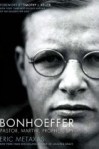
Book Review: Bonhoeffer: Pastor, Martyr, Prophet, Spy

bonhoefferDietrich Bonhoeffer is one of those names I’ve heard for years but never really knew anything about, so when Bonhoeffer: Pastor, Martyr, Prophet, Spy by Eric Metaxas came up for sale at a good price on both Audible.com and Amazon’s Kindle store, it looked like a good time to learn more about him. (The Kindle price has gone back up but at this writing the audiobook at Audible is just $3.99.  The narrative parts were easy to listen to, but the philosophical parts were harder for me to grasp just by listening, so I was glad to have the Kindle version with which to read and ponder more slowly.)

I finished this book back in the fall, but noted so many places in it that even beginning a review by looking back at those notes was daunting. The book itself is some 600+ pages. So I finally decided that I wouldn’t summarize the book or his life except to say that he was a German Lutheran minister who helped to found what was called the Confessing Church, who opposed Hitler to the point of participating in the conspiracy to assassinate him, who was executed because of his part in that plot, and whose theology has been argued about ever since. You can find many further summations online (Wikipedia’s article on Bonhoeffer is a nice one). I’m just going to share some of my own impressions and things I liked and didn’t like.

I was intrigued by the family discussions he grew up with. His mother was a Christian, but his father, Karl, was not, yet his father “respected his wife’s tutelage of the children in this and lent his tacit approval of it” and attended the family religious activities, though the family did not attend church. Karl Bonhoeffer was a psychiatrist and “taught his children to speak only when they had something to say. He did not tolerate sloppiness of expression any more than he tolerated self-pity or selfishness or boastful pride.” He also wanted his children to keep their emotions under control, feeling that “Emotionalism, like sloppy communication, was thought to be self-indulgent.” He had a strong dislike of cliches and didn’t allow his children to use them, which puzzled me at first until I understood that he wanted his children to think for themselves rather than just parroting catch-phrases. These all worked together to cause his children to be razor-sharp thinkers.

Some followed their mother, some their father. When Dietrich announced at age 14 that he was going to be a theologian, his lawyer brother questioned his choice and called the church a “‘poor, feeble, boring, petty bourgeois institution.’ ‘In that case,’ said Dietrich, ‘I shall have to reform it.'”

I liked that spirit about him, which led him to start the Confessing Church when the German Christians began to let themselves be Hitler’s puppets. He wasn’t one to sit back and grouse about issues when he could take action. On the other hand, that spirit is probably part of what led him into the conspiracy against Hitler.

I can understand the problems with Hitler’s regime and atrocities and the feeling that this could not be allowed to continue. I can condone a staging a coup to take him down. I can appreciate the difficulties in doing so because Hitler’s popularity with the public was at a high by the time his generals knew what was going on behind the scenes and knew that something must be done. They tried to limit him before WWII began and failed, and by that time any movement against him would have been at the peril of their own lives. I wrestle with whether an assassination attempt was the right response. With some of the conflicts in the world in my lifetime, I’ve often wondered whether taking out the one guy at the head of the trouble would be a better recourse that having multitudes die in a war, and I have always been glad that I wasn’t the one who had to make such decisions. So I can appreciate the moral wrestlings people of conscience would have had in that day, yet I still have trouble with a professing Christian pastor conspiring to have a leader killed, especially in light of the kind of political leadership Paul was under when he wrote in his epistles about what a Christian’s stance should be under it: he didn’t say anything about attacking those in charge or taking them out. Even though Bonhoeffer wasn’t the one pulling the trigger or planting bombs personally, he said that to aid as he did he’d have to be willing for such. “If necessary, he would be willing to kill Hitler…Bonhoeffer had to be clear that he was not assisting in the fulfillment of a deed he was unwilling to do” (p. 388, Kindle version).

I can’t really regard him as a martyr: he was persecuted for his faith, in being cut off from preaching, teaching, and writing, but he was executed for his part in the conspiracy against Hitler, not for his faith (unless you believe, as Metaxas evidently does, that his faith was what drove him to be a part of that plot).

I do appreciate his integrity in realizing that any action of this kind he took had to be his action alone and not something he could lead the church into. I also appreciated his testimony of unfailing kindness while imprisoned.

I am confused about his theology: some statements he made in the book I liked and agreed with, like the difference between cheap grace and costly grace, but some had me scratching my head. Evidently I am not the only one, because in a few articles I have read since finishing the book, there are some who argue over whether he was conservative or liberal and what his views were on various important doctrines. I was confused, too, at how he could discern problems with wrong theology yet still align himself churches that taught wrong theology.

I really disagreed with him here:

Bonhoeffer knew that to live in fear of “guilt” was itself sinful. God wanted His beloved children to operate out of freedom and joy and to do what was right and good, not out of fear of making a mistake. To live in fear and guilt was to be “religious” in the pejorative sense that [he] often talked and preached about. He knew that to act freely could mean inadvertently doing wrong and incurring guilt. In fact, he felt that living this way meant that it was impossible to avoid incurring guilt, but if one was wished to live responsibly and fully, one would be willing to do so (p. 424-425K).

Only the man whose final standard is not his reason, his principles, his conscience, his freedom, or his virtue, but who is ready to sacrifice all this when he is called to obedient and responsible action in faith and in exclusive allegiance to God – the responsible man, who tries to make his whole life and answer to the question and call of God (pp. 445-446K).

God…demands responsible action in a bold venture of faith and…promises forgiveness and consolation to the man who becomes a sinner in that venture…one must sacrifice oneself utterly to God’s purposes, even to the point of possibly making moral mistakes (p. 446).

I do agree Christians should operate out of love for God rather than a neurotic fear of misstepping, but I don’t thing “freedom in Christ” precludes walking circumspectly or working out our salvation with fear and trembling. I don’t honestly think Bonhoeffer would say that, either, but there is a balance there and statements like these seem to lean too far one way. I can understand being willing to sacrifice reputation (as Mary, Jesus’s mother did), but I don’t see that God calls us to sacrifice virtue, when He is the one who has called us to virtue, and to sacrifice oneself to Him to the point of making moral mistakes seems incongruous.

I enjoyed the historical aspects of the book, particularly  about how Hitler came to power. I had always wondered how such a man could have been elected to leadership or not deposed at some point. I don’t know where I was during some of my history lessons, but I didn’t know (or had forgotten) that Germany was quite unhappy with their lot after WWI, and part of what brought Hitler to glory was his reclaiming some of the territory Germany had lost. Then he staged certain events or recast them to the public to make it look like he had no choice but to take certain actions. It was also fascinating how he somehow escaped so many assassination attempts on his life.

I was perturbed by some aspects of Metaxas’s writing. He seemed to assume the reader knew certain aspects of Bonhoeffer’s life already and would refer to them way beforehand, plus he would mention someone and say something like “In 20 years he will be the person who does such and such.” I know a biography is a different genre than a novel or story, but some story-telling techniques can make it more interesting (and not ruin the suspense by spilling the beans too soon). He seemed to feel as if Bonhoeffer could do not wrong except that he sometimes “spoke hyperbolically, for effect, and sometimes it backfired” (p. 364K). He also got a little carried away sometimes with sentences like, “Behold, that unpredictable magus, Adolph Hitler, would now with a flourish produce from his hindquarters a withered olive branch and wave it before the goggling world” (p. 356K) and, commenting on Hitler’s atrocious table manners, “the famously vegetarian Reichsfuhrer indecorously bolted his meatless mush.”

Some of the articles I found online that discussed Bonhoeffer or disagreed with much of what Metaxas wrote are:

Hijacking Bonhoeffer.
Metaxas’s Counterfeit Bonhoeffer: An Evangelical Critique.
Bonhoeffer: Approaching His Life and Work (a second article titled Bonhoeffer and the Scriptures is underneath the end notes of the first article).
So Many Different Dietrich Bonhoeffers.

I don’t feel so bad about my confusion of where Bonhoeffer stands if even the experts don’t agree on it. 🙂 But there are enough quotes of his dismissing certain core doctrines that I wouldn’t call him an evangelical (in Hijacking Bonhoeffer, the author makes the argument that Mataxas painted Bonhoeffer as much more conservative than he was to make him more appealing to conservatives, therefore “highjacking” him from the liberals who claim him as their own.)

So…I’m glad to have read the book, particularly for the historical aspect but also to get something of a window into who Bonhoeffer was, though the window itself may not have been the clearest, according to these other sources.

(This will also be linked to Semicolon‘s Saturday Review of Books.)

Sanctity of Life

I didn’t realize until earlier today that it is Sanctity of Human Life Sunday, but I didn’t want to let the day end without saying something about it.

As a Christian I believe God is the author of life, and He says he knew us even in the womb.

“Before I formed you in the womb I knew you, And before you were born I consecrated you; I have appointed you a prophet to the nations.” Jeremiah 1:5

For you formed my inward parts;
    you knitted me together in my mother’s womb.
 I praise you, for I am fearfully and wonderfully made.
Wonderful are your works;
    my soul knows it very well.
My frame was not hidden from you,
when I was being made in secret,
    intricately woven in the depths of the earth.
Your eyes saw my unformed substance;
in your book were written, every one of them,
    the days that were formed for me,
    when as yet there was none of them.
Psalm 139:13-16

This column, On abortion, it’s best to err on the side of life, makes the point that if there is any chance at all that the unborn fetus is a real human life, then it is best to treat it as such.

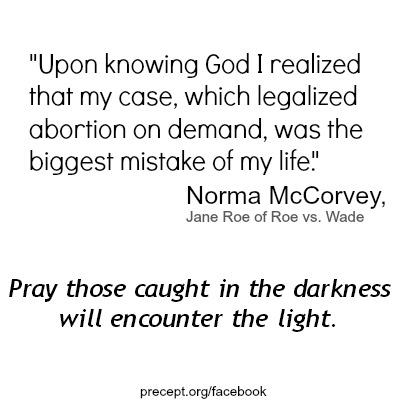
I saw this going around Facebook:

Roe mistake

“Each day, 2,150 women wake up in America believing abortion is the only realistic solution to an unplanned pregnancy” (care-net.org).
God brought Norma out of darkness and into His marvelous light.
Many women are still sitting in the darkness;
will you help them see the light of the world?

We win by showing love, compassion, and mercy to one frightened woman at a time.”

Laudable Linkage

Here are a few good reads from the last week:

When Your Calling Frightens You.

The Distinct, Positive Impact of a Good Dad.

The Mother I Meant To Be.

I Signed Up For This. Accepting the difficulties of motherhood, by God’s grace.

The Dark-Tinted, Truth-Filled Reading List We Owe Our Kids.

Russian Mother Takes Magical Pictures of of Her Kids and Animals. Some of the most gorgeous photos I’ve seen.

And if you’ve ever wondered what would happen if you threw boiling water into freezing air:

And here’s one way to walk a dog:

I didn’t watch the whole thing – it’s about the same for the first couple of minutes.

Hope you gave a great Saturday!

Friday’s Fave Five

FFF birds on a wire

Welcome to Friday’s Fave Five, hosted by Susanne at Living to Tell the Story, in which we can share five of our favorite things from the last week, a wonderful exercise in looking for and appreciating the good things God blesses us with. Click on the button to learn more, then go to Susanne’s to read others’ faves and link up your own.

This has been a fairly balanced week between getting some things done yet not feeling pressured and overburdened to get things done. Here are some of the highlights of the week:

1. Good weather. Not only did we not get predicted bad weather this week, but we actually had sunshine! Or at least more than we’ve had in a while. Does my heart good.

2. Rest. I wasn’t feeling well Sunday – nothing major, but it was enough that I needed to stay home from church. We’re not legalistic about Sunday activities, but I do try to keep it a day of rest as much as possible by not doing anything around the house that doesn’t absolutely have to be done, so I felt free to just rest, doze, and read off and on all day rather than feeling like I needed to be up doing something, and it was so refreshing.

3. A decorating dilemma solved. I had some more formal, elegant candle holders, wedding gifts from dear friends, on the mantel in the family room, along with some birdhouses, which are a bit more casual. I didn’t feel the candle holders “fit” there, but I didn’t want to move them until I had something to replace them, and I wasn’t sure where to put them. Our living room is a bit dressier, but much smaller than in our previous house, so there was no place for them there. I went out to Hobby Lobby this week and found this neat little piece:

photo(3)

It was on sale half-price, but even then was a bit more than I wanted to spend…but I had a gift card for HL from Christmas, so I let it be my Christmas present. 🙂 It fits in nicely with the rest, I think:

photo(5)

Next decorating project: replacing the plaque over the mantel. Love it (and I do have another place in mind for it), but it’s out of proportion to everything else. I do have some ideas – just have to decide which one to use.

The candle holders found a home on top of my desk:

photo(6)

I probably should put candles in them, huh? 🙂 The little angel figurine, by the way, was originally in a dish garden arrangement that my mom had sent to me for Valentine’s Day in college ages ago, and the little wooden house on the mantel was made by Jim’s dad.

4. Getting just a bit of sorting and organizing done: just the basket on my desk and the most-used drawer of my desk, but it felt good to get them in order.

5. Another problem solved: finding a way to turn my mother-in-law’s nightgowns into hospital-type gowns. Easier to dress and undress her, and more comfortable, too.

Overall a good week! I hope yours was, too.