Through Gates of Splendor

Through Gates of Splendor by Elisabeth Elliot


Five missionaries working in different outposts in Ecuador in the early to mid-1950s became burdened for a tribe of killers known then as the Aucas. Early encounters with the white man had not gone well when the rubber hunters came to harvest while also “plundering and burning the Indian homes, raping, torturing, and enslaving the people” (p. 14). But the Aucas killed not only white men, but any outsiders and even their own people. “Could Christian love wipe out the memories of past treachery and brutality?” (p. 14). The missionaries hoped so and longed to be a part of reaching this tribe with the love and gospel of Christ. Upheld by the truth that “Thou wast slain, and hast redeemed us to God by thy blood out of every kindred, and tongue, and people, and nation” (Revelation 5:9b), they began to plan and strategize as to how best to reach these hostile people.

Through Gates of Splendor by Elisabeth Elliot is the story of how these five men came to the Lord, came to be called to the mission field, their marriages, and how each was led to become part of “Operation Auca.” It’s no spoiler to say the operation ended in the death of the five, because that fact was known long before the book came to be and was probably a great impetus in it’s writing. But then it is not right, either, to say that is how Operation Auca ended, because God used it in the lives of the Aucas themselves as well as of people all over the world in the decades since. But knowing how the story “ends” lends a poignancy to the men’s lives and words.

The five men were:

Nate Saint, a brilliant pilot whose dreams of flying the big planes was cut short by an illness, but who went on to become a pilot for Missionary Aviation Fellowship, bringing much-needed supplies, human contact, and medical help to missionaries in outpost stations. He had an ingenious engineer’s mind which he used to great effect solving problems and improving life, and a healthy balance between doing everything in his power to ensure success and safety yet trusting God for the outcome.

Jim Elliot, from Portland, OR, intense and passionate, had a burning desire to share Christ with those who had never heard of Him, yet also had a humorous side and felt with George MacDonald that “It is the heart that is not yet sure of its God that is afraid to laugh in His presence” (p. 17).

Pete Fleming, from Seattle, WA, quiet, studious, would probably have been a college professor if he had not felt called to the mission field.

Roger Youderian, of Louistown, MT, severely affected by polio as a child, was called to the missionary field while serving in the military.

Ed McCully, from Milwaukee, WI,  was planning to go to law school when a Bible study led him to abandon all to follow Christ wherever he might lead.

Even before Operation Auca was even remotely thought about, most of the men were willing to give themselves even unto death. Jim wrote in his journal:

“‘He makes His ministers a flame of fire.’ Am I ignitible? God deliver me from the dread asbestos of ‘other things.’ Saturate me with the oil of the Spirit that I may be a flame. But flame is transient, often short-lived. Canst thou bear this my soul – short life? In me there dwells the Spirit of the Great Short-Lived, whose zeal for God’s house consumed Him. ‘Make me Thy fuel, Flame of God.'” (p. 17).

Nate Saint, likewise, considered himself “expendable,” saying, “Every time I take off, I am ready to deliver up the life I owe to God” (p. 58), and Pete later wrote:

“I am longing now to reach the Aucas if God gives me the honor of proclaiming the Name among them…I would gladly give my life for that tribe if only to see an assembly of those proud, clever, smart people gathering around the table to honor the Son – gladly, gladly, gladly! What more could be given to a life?” (p. 26).

All of the wives, as well, were willing to live in “primitive” conditions and to be used in God’s service in whatever way He saw fit.

But they were not careless. Every step of Operation Auca was steeped in thought, discussion, sometimes disagreement, and prayer for the best outcome for all involved. And every step looked like it was going well.

What then led the Aucas then to kill the five men? When God opened the tribe to visits later, at first they said it was because they thought the men might be cannibals. In a later book I believe someone was told that the photographs the missionaries had scared them: they thought somehow it involved the soul of the person in the photograph. In Steve Saint’s more recent book, End of the Spear, he was told that an argument had broken out among the Auca men involving a woman, and one man wanted to prevent the bloodshed amongst the tribe and turned their anger towards the white men. It is possible that all of these factors played a part, or that as the Aucas (now known by their own name of Waodani [going by Steve’s spelling of it since he has worked with them for years, but I have also seen it as Huaorani or Waorani]) got to know white people and their language better, they may have felt more of a freedom of expression in later years that they did at first.

I first read this book in college, and the lives of these men and their wives and their dedication and love for the Lord touched me greatly. I have read it many times since, and it never fails to speak to me. The version I read this time is the same one I read in college, a brown around the edges 1977 fifth printing: the first printing was in 1956. It was interesting to see what I had underlined in previous readings and what stood out to me this time. It also touched off a lifetime of reading missionary biographies, reading just about everything Elisabeth Elliot has written and reading several other books about Operation Auca and the lives of those involved.

If you’d like to read more about any of these, I recommend the following:

  • The Dayuma Story by Rachel Saint, sister of pilot Nate Saint. Dayuma was the Auca girl who had escaped the tribe years earlier, taught the men Auca phrases, and later went back to share the gospel with her tribe.

I’m sure there are other books and biographies out there (I have one of Nate Saint on my bookshelf that I’ve not read yet). but these are the ones I have read. In addition, Elisabeth Elliot touches on the experiences of her time in the Ecuadorian jungle in several of her other books. One of my favorites is in The Savage My Kinsman when she quotes William Cullen Bryant’s poem, “To a Waterfowl,” and applies it to herself, especially the last line: “He, who, from zone to zone, Guides through the boundless sky thy certain flight, In the long way that I must tread alone, Will lead my steps aright.”

There are also several films and film clips of interest:

  • Through Gates of Splendor, narrated by Elisabeth Elliot, using footage that she, Nate Saint, and Life Magazine had taken.
  • A “This Is Your Life” feature of Rachel Saint, part 1 and 2.
  • End of the Spear” (linked to my thoughts), a feature film.
  • Beyond the Gates of Splendor, a documentary made 50 years after the events. This is one I would recommend above all the others if you only have time for one. It is in four parts on Vimeo (Part 1, 2, 3, and 4), but I found the audio a bit hard to hear.

There are also several videos of Steve Saint speaking with Mincaye, one of the killers who eventually became a surrogate grandfather to Steve’s children. Talk about grace!

I wanted to say just a word, too, to those who criticize missionary efforts and who believe that primitive tribes should be left as they are. By the Waodani’s own admission, the tribe probably would have become extinct now if someone had not come to tell them of a better way of life. Why would anyone want to deny them that? In Spirit of the Rainforest (different people and field, but also a primitive tribe) this rather lengthy quote explains some of their feelings (I started just to link to it, but I feel it is so important that I copied it here):

“The naba wants to know why you want to change the way you live out here in the jungle,” Keleewa said to Hairy after Doesn’t-Miss talked.

Hairy was surprised at the question. “Because we’re miserable out here. We are miserable all the time. The people from Honey [predominantly Christian village] came here and made peace with us many seasons ago and their village keeps getting better. We want that for us. If it means throwing spirits away and getting new ones, we will do it. [This is not something said lightly. Many were under the impression that they would be killed if they tried to get rid of their spirits.] But we need someone to teach us these new ways.”

Hairy didn’t have spirits because he was not a shaman. But he followed everything the spirits told his shaman. I knew my spirits would be very irritated if Hairy quit following the spirits. No one who has killed as often and as long s Hairy could ever stop it…

Doesn’t Miss talked with Keleewa for a while. Keleewa paused and thought how to say what the naba said. Then he told Hairy, “He says there are many people in his land that don’t think that he, or any of us, should be here helping you at all. They say that you’re happy here and that we should leave you alone. He wants to know what an experienced killer like you would say to them.”

Hairy grew even more serious. “I say to you, please don’t listen to the people who say that. We need help so bad. We are so miserable here and out misery never stops. Night and day it goes on. Do those people think we don’t suffer when bugs bite us? If they think this is such a happy place out here in the jungle, why aren’t they moving here to enjoy this beautiful life with us?”

Doesn’t-Miss was quiet. Then he got out of his hammock and walked down the trail…When he was too far away to hear, Hairy said to Keleewa, “Is he stupid? Doesn’t he have eyes? Can’t he see these lean-tos we call houses? Can’t he see us roam the jungle every day, searching for food that isn’t here, so we can starve slower? Can’t he see that our village is almost gone, that this move we are making now is our last hope to stay alive?”

Keleewa was slow to answer. He knew Hairy wouldn’t understand what he was about to say. “Most nabas think just like him,” Keleewa told Hairy, and shook his head because he knew he couldn’t explain why.

“Nobody’s that stupid,” Hairy snapped. “They must hate us. They think we’re animals” (pp. 180-183).

I said in an earlier post:

Why would even any non-Christian want to see a whole people group extinguished due to infighting or disease? Especially these days when we clamor to save the spotted owl and other endangered species? Shouldn’t endangered people be at least equally as important as endangered animals?

Would anyone in their right minds really want such practices as burying a widow along with her husband or killing twins or deformed babies to continue? So many primitive tribes practice these kinds of things.

Why deny these people the choice of hearing that there are other ways? Why not allow them to hear the gospel and let them make their own choice? So many who bask in the multitudes of freedoms we have here in the US would rather keep people like this in darkness in the name of preserving their culture. Most missionaries I know of these days consciously and conscientiously try not to “Americanize” the native churches but rather try to respect their culture and form churches within that culture while introducing healthier ways of living and civil practices. Who could possibly have a problem with that?

Thank you, Carrie, for allowing me to choose this book for  the Reading to Know Book Club in a year of featuring classics. It truly is a Christian and a missionary classic, and I am glad folks are revisiting it or discovering it for the first time.

Reading to Know - Book ClubI’ll leave you with the song the men sang the night before they launched “Operation Auca,” and from which the title of the book is taken (words and thoughts are here.)


(This will also be linked to Semicolon‘s Saturday Review of Books.)

And Carol‘s Books You Loved.

Books you loved 4

Laudable Linkage and Video

It’s been a few weeks since I’ve done this, but here is some interesting reading from the last few weeks:

How My Mother’s Radical Views Tore Us Apart. Fascinating article about how a famous feminist’s daughter felt about her mother’s mothering, and how she values being a mother even though her own mother called it “servitude.” It’s not from a Christian standpoint and I wouldn’t completely endorse everything in it, but it is eye-opening.

What the Doc Teaches that Pastor. Not just for pastors. “There’s no glory and no transformation in a message people do not understand.”

A Call to Live Like People Matter. “It means considering the tasks on your to-do list less important than the people you’re doing them for.”

The Church: The Manifold Wisdom of God. “Though I am deeply troubled by the state of segments of God’s Church, Paul teaches that it is through this broken and dysfunctional instrument that God is going to show others the variety of His wisdom.”

Believing the Gospel For Our Friends. When sharing struggles with friends, some can be too harsh, some can be too soft. This shares how a true gospel outlook can help us strike the right balance.

When Separation Clouds the Gospel. While acknowledging that there is a time for Biblical separation, the author warns that unbiblical separation does harm.

On the home front: Why I Make My Bed {10 Reasons I Keep My House Clean}

This spoof cracks me up, especially as our church is splitting up into small groups on Sunday nights over the summer –  though not like this one!

Friday’s Fave Five

Another week has flown by, and I don’t have much to show for this one. I think I am recuperating from last week when we had family here and were doing something almost every day. 🙂 Here are some favorite parts of this week:

1. Fresh, clean sheets and pillows plumped up from being washed and dried. One of my favorites of life’s little pleasures.

2. A good doctor visit for Jesse. I am ashamed to say he has not had a physical in the three years we have been here, and several before that were only sports physicals. Thank God he has been remarkably healthy. We finally got that done, and except for his lab work being a bit low in a couple of areas, easily remedied, everything is fine.

3. A belated Father’s Day. Jim didn’t want to open gifts or anything when my family was here over Father’s Day, so we focused on my step-father that day, and honored Jim this last Sunday. It’s fun to have the family all here (Jeremy via FaceTime), to get him some things he was wanting and a couple of things he was not expecting.

4. Grilled ham steaks. I had gotten these for when my family was going to be here but ended up not using them, so Jim grilled them last Saturday, and because we had extra we had enough to use for several days. Yum!

5. Leftovers. I adapt some meals for just the three of us, but others I make as I always have and use the leftovers for lunch or sometimes even for another dinner. Thankfully my family doesn’t mind – depending, of course, on exactly what’s left over (some leftovers are left until they grow fuzzy stuff). We’ve had some that everyone liked this week, besides the ham, and it’s nice to have an easy meal just heating up leftovers, especially on Wednesday nights when our church has prayer meeting and meal time is a bit rushed.

Hope you have a great Friday!

FFF daisies

Friday’s Fave Five is hosted by Susanne at Living to Tell the Story, who invites us to share five of our favorite things from the last week. It’s a wonderful exercise in looking for and appreciating the good things God blesses us with. Click on the button to learn more, then go to Susanne’s to read others’ faves and link up your own.

The Hidden Art of Homemaking Book Club: Chapter 10, Drama

Chapter 10 of The Hidden Art of Homemaking by Edith Schaeffer, which we’re discussing a chapter at a time at  The Hidden Art of Homemaking Book Club hosted by Cindy at Ordo Amoris, is about drama.

I didn’t think I would get much out of this chapter. I have little if any ability in regard to acting anything out. I remember one night at church when I was a child and we were supposed to be acting out a scene from the Bible where people were mourning (I think maybe the widow in the New Testament whose son had died whom Jesus raised to life). We either had veils or handkerchiefs – I remember all that showed for us “mourners” was our eyes, and I couldn’t stop giggling, but that left me red-faced and teary, so I suppose it had the same effect. 🙂 I tried maybe once doing a skit in college and was miserable at it. It’s hard for me to keep a straight face even when as a family we are trying to surprise or put something over on someone.

I also wasn’t sure how Edith would incorporate drama into home life. I can see its use in the church or in Christian ministry, but in the home, at first the only application I could think of was in reading aloud to children. And that’s primarily what she talked about, though she ventured into some discussions of the value of reading books, different types of books to read, etc.

Some of my favorite times with my children when they were young were when I read stories out loud to them, and though I’m not great at doing different voices for different characters, I made an attempt and also tried to convey the different emotions of what we were reading. I agree with much of she she said when one has young children, but if no one is interested as they all get older, if no one besides Mom would enjoy reading a book aloud together, then there is not much else one can do with that, at least until grandchildren come along. The Christian school where we used to live they did have moms and grandmothers come for class library times to read stories aloud for the elementary classes instead of the librarian always doing that.

I’m surprised she didn’t venture into other areas that could use dramatic talent. One family in a former church had a mom who was very dramatic, and she was frequently asked to take on a character for cantatas or dramatic productions at church, and she and various members of her family were involved in a local community theater: she was the White Witch in The Lion, the Witch, and the Wardrobe, and I think one of her daughters was Lucy, and the whole family as well as several church members enjoyed seeing them do that. I think of Little Women and the various plays they put on, little puppets, even finger puppets, that we used with our children, pretending their stuffed animals were speaking to them or acting something out, etc. At lot of their play involved acting our various scenarios: school, church, etc.

There are various ways to incorporate drama into family life, even for those of us who don’t necessarily have any latent dramatic longings such as she describes in the first few paragraphs. It can definitely be used for fun, but even reading the Bible aloud can and should be done, yet not overdone, with feeling rather than in a deadpan monotone.

So I did end up having my imagination sparked and getting more out of this chapter than I thought I would.

What’s on Your Nightstand: June 2013

What's On Your NightstandThe folks at 5 Minutes For Books host What’s On Your Nightstand? the fourth Tuesday of each month in which we can share about the books we have been reading and/or plan to read.

It’s months like these when the fourth Tuesday occurs when there are several days of the month left that tend to throw me, but thankfully I did remember. It’s been a busy month (seems like I always say that…) with two sets of company, but I did get some reading in.

Since last time I finished:

Island of the Blue Dolphins, by Scott O’Dell for Carrie’s Reading to Know Book Club for May, reviewed here.

The Greatest Thing in the World by Henry Drummond, a closer look at I Corinthians 13. It’s a very short book: I should try to read it once a month or so for a while.

Bonhoeffer: Pastor, Martyr, Prophet, Spy by Eric Metaxas. I finished listening to the audiobook but I was going through the Kindle version as well (both were on sale around the same time) to highlight some things, and have not finished that yet. Hope to get my thoughts together for a review soon.

The Merchant’s Daughter by Melanie Dickerson, based loosely on Beauty and the Beast, reviewed here. Liked this one very much.

The Duet by Robert Elmer, about two older people who are complete opposites in many ways but are attracted to each other, reviewed here. Not wowed by it, but it was pleasant.

The Incorrigible Children of Ashton Place, Book 1: The Mysterious Howling by Maryrose Wood, reviewed here. This was quite fun, especially the audiobook version read by Katherine Kellgren.

I’m currently reading:

Through Gates of Splendor, by Elizabeth Elliot, a missionary classic, for Carrie’s Reading to Know Book Club for June, selected by myself.

Light From Heaven by Jan Karon, last of the Mitford series, via audiobook.

The Hidden Art of Homemaking by Edith Schaeffer along with Cindy at Ordo Amoris who is hosting a read-along book club where we discuss a chapter at a time. My discussions are here.

Next up:

Invisible by Ginny Yttrup. Her first novel Words was one of my favorites of 2011, so I have have high hopes for this one.

The Incorrigible Children of Ashton Place, Book II: The Hidden Gallery by Maryrose Wood.

The Magician’s Nephew and The Last Battle by C. S. Lewis for Carrie‘s Chronicles of Narnia Reading Challenge

Possibly The Wind in the Willows for Carrie’s Reading to Know Book Club for July. I saw a video of it some time ago that I didn’t really care for, but that may not be the story’s fault. I might give it a try.

After that, I’m not sure, but I have a few books stacked on my Nightstand and scores downloaded into my Kindle app to choose from.

Spiritual Snobbery

In a Sunday School lesson a couple of weeks ago, I can’t remember the exact context, but something came up about different ways saved and unsaved people react. One man pointed out that we came up with fairly tame reactions for the saved and fairly awful ones for the unsaved when actually saved people can display awful reactions and even unsaved people can display kindness, love, thoughtfulness, etc. That struck a chord with our teacher, who then spent the next two Sundays teaching about “Spiritual Snobbery.”

It jarred me a bit to think of it as “snobbery,” but that’s exactly what it is when we think we’re “better” in any way than anyone else. That led me to remember a situation when a young woman brought together her extended birth family and adopted family. The adopted family were Christians, the birth family primarily was not. Admittedly the circumstances were a bit awkward for everyone, made more so by two completely different cultures in the same room. But instead of the Christians in the room reaching out to the lost, they pretty much kept to themselves and ignored them, making them feel like outcasts and outsiders. The non-Christians didn’t approach the Christians saying, “Can you tell me how to get what you have?” There was nothing displayed that they’d want to have. Instead, they withdrew and kept to themselves.

By contrast, Jesus went out of His way to minister to the “outsiders” of His day: He took special pains to speak to the woman at the well, He called a tax collector to be one of His disciples, He ate with publicans and sinners, He accepted the love of a fallen woman, the hero of one of his parables was the Good Samaritan when the Samaritans and Israelites were enemies.

Our Sunday School teacher brought up Isaiah 5:21 (“Woe unto them that are wise in their own eyes, and prudent in their own sight!) and II Corinthians 10:18 (“For not he that commendeth himself is approved, but whom the Lord commendeth”), discussed some of the dangers of “spiritual snobbery” and some of Jesus’s rebukes of the Pharisees, and then discussed some ways to combat spiritual snobbery. I’d like to share the ways he mentioned along with some others that came to mind.

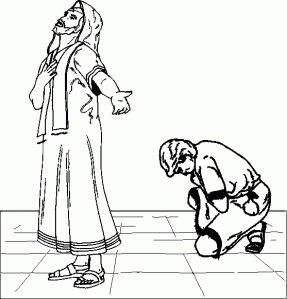
phariseeandpublican

Cures for Spiritual Snobbery

1. Remember where we came from.

See Ephesians 2:1-14. We were dead in sins, apart from Christ.

2. Remember God’s grace.

Also from the above passage, we were saved only by the blood of Christ due to His mercy and grace, not because of anything good in ourselves or any work we could do.

3. Remember any good thing we have is from God.

“For who sees anything different in you? What do you have that you did not receive? If then you received it, why do you boast as if you did not receive it?” (I Corinthians 4:7, ESV).

4. Cultivate genuine humility.

– See the difference between the Pharisee and the publican (Luke 18:9-14).
– “Have this mind among yourselves, which is yours in Christ Jesus, who, though he was in the form of God, did not count equality with God a thing to be grasped,but emptied himself, by taking the form of a servant, being born in the likeness of men. And being found in human form, he humbled himself by becoming obedient to the point of death, even death on a cross.” (Philippians 2:5-8, ESV)

5. Recognize that partiality is a sin incompatible with true religion.

See James 1:27-2:17.

6. Love our neighbors as ourselves.

Mark 12:30-31: “And you shall love the Lord your God with all your heart and with all your soul and with all your mind and with all your strength.’ The second is this: ‘You shall love your neighbor as yourself.’ There is no other commandment greater than these.”

7. Esteem others to be better than ourselves.

Let nothing be done through strife or vainglory; but in lowliness of mind let each esteem other better than themselves” (Philippians 2:3).

8. Develop compassion.

Keep their end in mind if they don’t come to Christ, empathize with their trying to solve their problems without Him.

9. Remember common grace.

Because everyone is made in the image of God, even though we’re marred by sin, some still retain a reflection of Him. Rosaria Butterfield pointed out in Secret Thoughts of an Unlikely Convert that the gay community she came from was very caring of each other, and it was eye-opening when the gay community and the Christian community ended up side by side while trying to minister to someone in need.

10. Realize that even if we did every single thing right, we’d still have nothing to brag about.

Luke 17:10: “So you also, when you have done all that you were commanded, say, ‘We are unworthy servants; we have only done what was our duty.’”

Have you ever noticed a tendency toward spiritual snobbery in yourself? What has helped you to combat it?

I’m linking here today:

Book Review: The Duet

DuetIn The Duet by Robert Elmer, Gerrit Appeldoorn is a widower who is supposed to be retired from his dairy farm in the primarily Dutch community of Van Dalen, Washington. But he struggles trying to figure out what he is supposed to do with himself, especially when his son, who has taken over the farm, fusses at him every time he tries to do any of his old chores.

One day he meets his granddaughter’s new piano teacher, widow Joan Horton, and is instantly attracted. Their many differences cause sparks to fly at first: he is staunchly Calvinistic and opinionated, has rarely been outside Van Dalen, and spent most of his life with mud on his boots. She is a Nazarene, citified, not Dutch, refined, a world traveler, on her way to becoming a department head in her university.

In addition, each faces various problems with a son and a major crisis.

I had picked this up because I loved Robert Elmer’s Wildflowers of Terezin (linked to my review) and wanted to check out another of his books. This one has its sweet moments, and I love when a love story involves someone other than the young, svelte, and beautiful, but I didn’t like it quite as well as Wildflowers. Maybe that’s because I found nothing in Gerrit that was appealing to me except his relationship with his granddaughter. But it was a pleasant read and one I wouldn’t hesitate to recommend.

(This will also be linked to Semicolon‘s Saturday Review of Books.)

The Hidden Art of Homemaking Book Club: Chapter 9: Writing – Prose and Poetry

Chapter 9 of The Hidden Art of Homemaking by Edith Schaeffer, which we’re discussing a chapter at a time at  The Hidden Art of Homemaking Book Club hosted by Cindy at Ordo Amoris, is about writing.

I’m a little late reading and discussing it this week because we had family here until yesterday, but this is one chapter I did not want to miss.

I’ve enjoyed writing since I was very young: poetry as a child and teen-ager, various journals (which I am grieved to say I threw away in my teens), letters, a handful of magazine articles, a few magazine columns, several years’ worth of monthly newsletters for a church ladies’ group, and a nearly 7 year old blog. I’ve always enjoyed expressing myself in that way, and find I can think things through more easily by writing about them. It’s hard to work through a swirling tangle of thoughts, and by writing I can take a strand at a time, pin it down, and then sort through them all.

I’ve often wondered if God might have something more for me to do with writing. For years I’ve had a desire to write a book, but I don’t know if that’s just a personal ambition or something from the Lord. Edith encouraged me by saying, “Writing for the enjoyment of expression – like music or painting – does not need an audience of more than one,” and “If you simply love to write and want to do it, my advice is write. But write without ambitious pride, which makes you feel it is a ‘waste’ to write what will never be published. Write to communicate to someone, even if it is literally only one person. It is not a waste to write beautiful prose or poetry for one person’s eyes alone! (p. 136).

She mentions several homey ways to write: notes in lunchboxes, cards, letters, writing out our prayers and praises to God, etc. She challenges us to write not just for people whose views are similar to our own. I love her description of trying to “formulate something in writing which will give them the feeling that they have been spending the evening with you, toasting their toes at the same fireplace with a pot of steaming tea by their sides while you have talked earnestly to them” (pp. 137-138).

She encourages us, too, that not everything we write will be a “masterpiece,” or “accomplish its purpose, and more than each meal is going to be the ‘perfect meal’ or each painting the ‘perfect painting,'” but each time we write we can do so “in a way which comes across as giving of oneself” (p. 140).

I received a thoughtful, handwritten thank you note this morning, a treasure in this electronic age, and can enjoy the reading of it over and over and the remembrance of my friend and our time together. Some of my treasures are letters, especially those from my mom, who did not write much (she preferred calling to writing), especially now that she has passed on. I have little from my maternal grandmother, who dies when I was four, besides two handwritten recipes, another treasure.

I was reminded, while reading this chapter, that Laura Ingalls Wilder and other writers didn’t start until later in life, and that she wrote magazine columns before books. That encourages me that sometimes things that have to be left on the back burner are more flavorful for their time there. Isobel Kuhn, a very expressive writer, began by writing “circular letters” of the people they ministered to in China for their supporters, lively descriptions rather than bare-faced facts and figures, and out of that grew her writing of several books. That encourages me that writing “where we are” can develop the skills for a wider audience later.

So I am encouraged and refocused, to write as unto Him, to write as giving of myself, to write to encourage others, to write earnestly so as to make the other feel they’re right beside me, and to trust Him for leading, guidance, and grace to write in whatever venues He provides.

And I am so very glad God communicated to us through writing, through the written Word and the Living Word.

Family Visit and Friday’s Fave Five

Wow, I don’t think I have ever been away from my blog for a whole week before! My step-father, two of my sisters, and one nephew from TX came for nearly a week-long visit and just left this morning. We had a great time with a balanced amount of just hanging out and talking and then going and doing some fun things. All of us except Jim, Jason, and Mittu, who had to work, drove a couple of hours to meet up with another sister, her significant other, a niece, and her daughter from SC in Asheville, NC. for  few hours yesterday, and one night we got together at a restaurant with an aunt and uncle from across town that we’d been trying to get together with for three years – we joked that it took family coming from TX to make it happen. We did a lot of talking, eating, and laughing all week.

This has been a whole week of highlights, here are five of them:

1. Visiting with extended family, of course. 🙂

2. Meeting my great-niece for the first time. She’s two and absolutely adorable.

3. Playing games. We had several rousing hands of Apples to Apples one night and Taboo another night.

4. Going to Jason and Mittu’s for dinner one night. She makes a wonderful easier and lighter version of Chicken Cordon Bleu that is one of my favorite dishes, had some neat egg salad bites for appetizers, and chocolate waffles with ice cream for dessert.

5. Dixie Stampede. A rootin’, tootin’, wild west revue type of show is not necessarily my favorite, but the whole experience  of a dinner show with the family was great fun. We had a fun, wonderful waiter. One of the food items you get is a whole small rotisserie chicken, and as he was serving those he was calling out, “Chicken nuggets!” I had seen on the web site that they don’t offer serving utensils as part of the experience, so I slipped some plastic ones in a plastic bag for us. When our waiter saw them, he said, “Cheater, cheater!” and when he was gathering up plates afterward joked about not wanting to touch the “contraband.” They serve one food item at a time (which works out well, because they serve a massive amount of food, and you’d never be able to eat it all at one time), and when he delivered the corn on the cob, he joked, “Try eating that with a fork!” They do give you a warm, wet cloth at the hand to wipe your hands.

All in all it was a great week! But I am officially giving myself the day off today, except for laundry, and I foresee a nap in my future since we got up with them at 4 a.m. to see them off. And I will try to catch up with you all throughout the day.

Linking up with Susanne‘s Friday’s Fave Fives today:

FFF daisies

Friday’s Fave Five

FFF daisies

Welcome to Friday’s Fave Five, hosted by Susanne at Living to Tell the Story, in which we can share five of our favorite things from the last week,  wonderful exercise in looking for and appreciating the good things God blesses us with. Click on the button to learn more, then go to Susanne’s to read others’ faves and link up your own.

Another week has flown by. Whew!  Here are some of its highlights.

1. A game night. This is actually from weekend before last but I had forgotten it by Friday. Jason and Mittu came over for a game of Settlers of Cataan, which we hadn’t done for a while. It ended up being about the closest game of that I ever remember playing.

2. Crescent rolls without seams:

Barbara's Cell phone pics 198

I have a couple of recipes which use crescent roll dough rolled out, and you’re supposed to press the seams together. They rarely stay pressed, so this was nice to see.

3. Annette’s Snickerdoodle Bars, made when my friend from last week came. I think I have mentioned them before: they’re a highlight any week I make them. 🙂

4. A nostalgic breakfast. My friend who came through last week on her way to see her daughter came back through last night, and we went out for breakfast this morning. We were headed out to one place when we saw the sign for Shoney’s breakfast bar. That used to be our go-to place when our kids were babies: they’d have regular coupons, and kids ate free. So we went there for old time’s sake, and they had many of the same features I remembered.

5. An eventful phone call. A man in our church has been on a list for a lung transplant and just got the call last night to head up to PA for surgery. I haven’t heard any word yet as to how everything went, but we’re hoping and praying for the best.

I may be scarce this next week as I have family coming in from out of town.

Happy Friday!