Review: The British Booksellers

The British Booksellers by Kristy Cambron

The British Booksellers by Kristy Cambron shifts back and forth from WWI to WWII.

Amos Darby and Charlotte Terrington are secret childhood friends with a love for books. But that’s all they can ever be. Amos is a tenant farmer’s son, and Charlotte is an earl’s daughter. Though Charlotte loves Amos, her parents arrange her marriage with Will Holt, the future Earl of Harcourt.

Amos goes off to WWI and comes back scarred. He opens a book shop on Bailey Lane in Coventry, England, but becomes something of a recluse.

Charlotte, now widowed Lady Harcourt, has opened a bookshop as well across the lane with her daughter, Eden. The booksellers have been rivals and enemies for over twenty years, though Eden has tried to negotiate a peace between them.

When an American lawyer, Jacob Cole, shows up with alarming news for Charlotte and Eden, they fight back to keep their estate, even though it is becoming ever harder to maintain.

But when WWII begins and German bombers fly across Coventry, Amos, Charlotte, Eden, and Jacob have to work together to help each other and their neighbors survive.

The Coventry Blitz is referred to as the Forgotten Blitz. The London Blitz received so much attention, Coventry was overlooked in the press. Kristy Cambron says in her author’s notes that some officials suppressed news of the devastation of Coventry so as not to damage morale.

The story includes four Land Girls, part of the Women’s Land Army in Britain who helped out at various farms and homes across the nation. I had read of these women in other books, so it was neat to see their roles fleshed out a bit more.

The historical story was quite interesting, but Charlotte and Amos’ story was so touching.

With characters who have a common love for books and who become rival booksellers, the importance of books comes up often. One of my favorite quotes about this aspect:

Books are an escape that beckons the reader from the heavy burdens of this world.’ Isn’t that what you told me once? They can challenge as well as comfort. Entertain and educate. Even save us in ways we’d never expect. You’ve used the words art, oxygen, and life all to describe them. Anyone who can see such value in these pages ought to also see that they could take him away from a future he doesn’t want. If anything, that is what Dickens wrote for his characters. Isn’t that what you wish for yourself?

I listened to the audiobook, beautifully read by Barrie Kreinik. Happily, this time the audiobook did contain author’s notes about the historical aspects of the book. There weren’t any notes about what inspired the personal stories, though.

With going back and forth between timelines, it was a little hard to keep up sometimes with where we were in the story. It’s not as easy with an audiobook to flip back to the beginning of the chapter to check the dates. Plus 1914 and 1940 sound alike. But it didn’t take too long to get oriented.

Overall, I loved the book and the characters and felt for them.

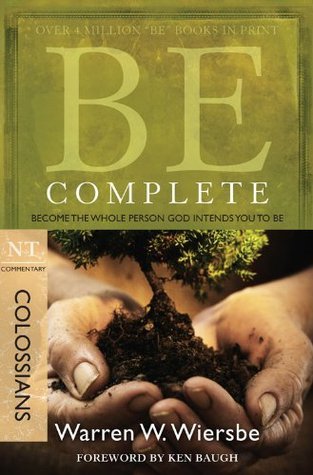
Review: Be Complete (Colossians)

Be Complete (Colossians): Become the Whole Person God Intends You to Be by Warren Woersbe

I think most of Warren Wiersbe’s “Be” commentaries are about the same size. So a commentary on Isaiah, which has sixty-six chapters, discusses large portions at a time.

The book of Colossians just has four chapters. So Be Complete (Colossians): Become the Whole Person God Intends You to Be covers just a few verses of Colossians in each of its twelve chapters.

Since Colossians is so densely packed, and the ESV Study Bible had a lot of notes on it as well, plus Wiersbe’s book had more detail, I decided to slow down my usual pace of reading and take time to soak in what was written.

Wiersbe calls Colossians “one of the most profound letters Paul ever wrote.”

The church in Colossae was not one that Paul started; in fact, he had never been to that city. But Paul had been in nearby Ephesus for three years, from which the Bible says “‘all they which dwelt in Asia heard the word of the Lord Jesus, both Jews and Greeks'” ‘ (Acts 19:10). This would include people in Colossae, Laodicea, and Hierapolis.” A Colossian named Epaphras seems to have heard Paul preach in Ephesus and then brought the gospel back to Colossae.

At the time Colossians was written, Paul was in prison. Epaphras was with him and evidently shared that a dangerous teaching was making the rounds in Colossae. So Paul wrote to help these believers. Wiersbe believed the false teaching was Gnosticism; the ESV Study Bible notes say that “an improved understanding of Gnosticism” due to more information having been discovered about it has led scholars to think Gnosticism was not the problem, but they don’t know exactly what false teaching was being promoted. Nevertheless, there’s much we can learn from Colossians even without knowing exactly what teaching was being combated.

Paul begins the book with greetings and thankfulness for the Colossians faith. Then he shares what he prays for them, one of my favorite prayers in the Bible:

And so, from the day we heard, we have not ceased to pray for you, asking that you may be filled with the knowledge of his will in all spiritual wisdom and understanding, so as to walk in a manner worthy of the Lord, fully pleasing to him: bearing fruit in every good work and increasing in the knowledge of God; being strengthened with all power, according to his glorious might, for all endurance and patience with joy; giving thanks to the Father, who has qualified you to share in the inheritance of the saints in light. He has delivered us from the domain of darkness and transferred us to the kingdom of his beloved Son, in whom we have redemption, the forgiveness of sins.

I have prayed this often for myself and loved ones.

Paul then writes about the preeminence of Christ, “the image of the invisible God,” the one who created everything and holds it all together, the head of the church. “In him all the fullness of God was pleased to dwell, and through him to reconcile to himself all things, whether on earth or in heaven, making peace by the blood of his cross” (1:19-20).

And, amazingly, “you, who once were alienated and hostile in mind, doing evil deeds, he has now reconciled in his body of flesh by his death, in order to present you holy and blameless and above reproach before him” (1:21-22).

Paul says his stewardship was “to make the word of God fully known, the mystery hidden for ages and generations but now revealed to his saints. To them God chose to make known how great among the Gentiles are the riches of the glory of this mystery, which is Christ in you, the hope of glory. Him we proclaim, warning everyone and teaching everyone with all wisdom, that we may present everyone mature in Christ. For this I toil, struggling with all his energy that he powerfully works within me” (1:25-29). In the Bible, a mystery wasn’t something to figure out from clues: it was something that was not previously revealed but now is.

Paul warns them to “See to it that no one takes you captive by philosophy and empty deceit” or “delude(s) you with plausible arguments” (2:8, 4).

Paul goes on to exalt Christ as the one “in whom are hidden all the treasures of wisdom and knowledge” (Colossians 2:3). As we received Him, we’re to “walk in him, rooted and built up in him and established in the faith, just as you were taught, abounding in thanksgiving (2:6-7).

After sharing the gospel, Paul gives practical instruction for how the gospel affects our lives, families, and workplaces. There are certain behaviors we’re to put off, others we’re to put on. We’re to “seek the things that are above, where Christ is, seated at the right hand of God. Set your minds on things that are above, not on things that are on earth” (3:1-2).

Paul wraps up his teaching by encouraging believers to pray, give thanks, and “Walk in wisdom toward outsiders, making the best use of the time. Let your speech always be gracious, seasoned with salt, so that you may know how you ought to answer each person” (4:5-6).

I can get so caught up in the affairs of this life, I need the reminder to “set my mind on things above” and exalt Christ above all.

A few more quotes from the book that stood out to me:

The gospel message does not center in a philosophy, a doctrine, or a religious system. It centers in Jesus Christ, the Son of God (p. 30, Kindle version).

Uniformity is the result of compulsion from the outside; unity is the result of compassion from the inside (p. 37).

Satan is so deceptive! He likes to borrow Christian vocabulary, but he does not use the Christian dictionary (p. 43).

The false teachers in Colossae, like the false teachers of our own day, would not deny the importance of Jesus Christ. They would simply dethrone Him, giving Him prominence but not preeminence. In their philosophy, Jesus Christ was but one of many “emanations” that proceeded from God and through which men could reach God. It was this claim that Paul refuted in this section (p. 57).

In the New Testament, saints are not dead people who during their lives performed miracles and never sinned. New Testament saints were living people who had trusted Jesus Christ. Paul wrote this letter to living saints (Col. 1:2), (p. 73).

Prayer is not our trying to change God’s mind. It is learning what is the mind of God and asking accordingly (1 John 5:14-15) (p. 81).

It does little good if Christians declare and defend the truth, but fail to demonstrate it in their lives (p. 113).

Paul did not ask for the prison doors to be opened, but that doors of ministry might be opened (1 Cor. 16: 9; Acts 14: 27). It was more important to Paul that he be a faithful minister than a free man. It is worth noting that in all of Paul’s prison prayers, his concern was not for personal safety or material help, but for spiritual character and blessing (p. 154).

I like how Wiersbe closed his commentary on Colossians:

As we come to the close of our study of this remarkable letter, we must remind ourselves that we are complete in Jesus Christ. We should beware of any teaching that claims to give us “something more” than we already have in Christ. All of God’s fullness is in Him, and He has perfectly equipped us for the life that God wants us to live. We do not live and grow by addition, but by appropriation (p. 173).

Life Doesn’t Always Turn Out Like We Thought It Would

Life doesn't always turn out like we thought it would.

Several years ago, two individuals from my college who were known for their close walk with the Lord found each other and began to date. They married and attended a local church, the same one we came to later, while the husband finished his graduate degree. He became an elder. The wife was active in the ladies ministry and teaching children. They had a couple of children.

After several years, they left to go to the mission field. There never seemed a family more perfect for missionary work.

After a few years, our pastor went to visit them on the field. He had nothing but positive things to say. He reported that the wife, in particular, seemed in her element.

A few years later, though, we received devastating news. The husband had been caught in infidelity. The family came home, and the elders met with the husband. He refused to repent, saying he loved his sin too much.

The wife was crushed. Not only had her husband turned into someone she didn’t know any more, but she lost the ministry she loved and was so suited for. Plus their coworkers back on the mission field had to pick up the pieces and minister to the people who were shattered by the fall of their leader.

I don’t know if the wife asked herself these questions, but in her place, I would have wondered if I made a mistake somewhere along the way. Had I married the wrong man? Had I missed signs that he had fallen away from the Lord? Had I failed him in some way that caused him to turn to someone else?

I do know that the pastor encouraged her that the situation was not her fault. Not that she was sinless, of course. No one is. But her husband’s sins were his own and he bore the responsibility of them. She was in the center of God’s will even with such things going on in her life.

It’s a shock that you can do everything “right,” so to speak, and end up with a life seemingly in shambles.

I imagine Joseph must have felt the same way, going from the favored son to being sold as a slave by his own brothers and then thrown into an Egyptian prison.

Or Job, described by the Lord as an upright man, yet he lost everything he owned as well as ten children all in one day.

Or John the Baptist. He was the forerunner of the Messiah, preparing the way for Jesus, pointing people to Him. Yet he ended up in prison, and ultimately was beheaded.

The Apostle Paul enjoyed a little over twenty years of public ministry. He took three long missionary trips, shared the gospel with who knows how many people, instructed and encouraged believers, and wrote several epistles which were incorporated into the canon of Scripture.

To be sure, life wasn’t all rosy. Paul experienced beatings, stonings, shipwrecks, sleeplessness, hunger, and more (2 Corinthians 23-28). But overall, his life could be considered a success in terms of being able to minister to large numbers of people.

But then Paul got arrested. He had not done anything wrong, but others supposed he had, and the resulting riot ended with Paul being taken into custody.

Paul was imprisoned for two years, released for a couple, then imprisoned again for a couple of years until he was beheaded.

Paul went from a leading apostle and well-known traveling preacher to a prisoner for many of his last years.

To the world, it might look like Paul’s life ended in failure.

But God encouraged Paul all through the book of Acts that he was on the right path.

And Paul’s ministry didn’t end just because he was in prison.

In the course of explaining why he was imprisoned, Paul was able to share his testimony before Felix, the governor of Judea, Festus, the governor who replaced Felix, and King Agrippa—all people he would not have been able to talk to under normal circumstances.

Paul wrote Ephesians, Philippians, Colossians, and Philemon during his first imprisonment and 2 Timothy during his second. Philippians is one of the most joyful books in the Bible, and Philippians and Colossians both have an emphasis on Thanksgiving—though they were written from prison.

Paul was chained to a Roman guard while imprisoned, so the guards heard all he had to say to his visitors. Paul tells the Philippians, “All the saints greet you, especially those of Caesar’s household” (Philippians 4:22). So evidently the gospel had filtered even into Caesar’s staff from Paul’s witness.

Friends were able to come talk with Paul and be taught or encouraged by him. Acts ends by telling us Paul “welcomed all who came to him, proclaiming the kingdom of God and teaching about the Lord Jesus Christ with all boldness and without hindrance” (Acts 28:30-31).

“Without hindrance.”

In 2 Timothy 2:9, Paul says, “I am suffering, bound with chains as a criminal. But the word of God is not bound!” Though Paul was bound, the word of God was not.

God can redeem and work in and through a life in shambles.

It was Paul who wrote of God’s strength in our weakness: “But he said to me, ‘My grace is sufficient for you, for my power is made perfect in weakness.’ Therefore I will boast all the more gladly of my weaknesses, so that the power of Christ may rest upon me. For the sake of Christ, then, I am content with weaknesses, insults, hardships, persecutions, and calamities. For when I am weak, then I am strong” (2 Corinthians 12:9-10).

And what God can do in our lives through suffering: “Not only that, but we rejoice in our sufferings, knowing that suffering produces endurance, and endurance produces character, and character produces hope, and hope does not put us to shame, because God’s love has been poured into our hearts through the Holy Spirit who has been given to us” (Romans 5:3-5).

And the glory that waits us after suffering: “So we do not lose heart. Though our outer self is wasting away, our inner self is being renewed day by day. For this light momentary affliction is preparing for us an eternal weight of glory beyond all comparison, as we look not to the things that are seen but to the things that are unseen. For the things that are seen are transient, but the things that are unseen are eternal” (2 Corinthians 4:16-18).

Others in the Bible found the same grace to endure.

Joseph was released from prison and became second to Pharaoh, eventually saving his own family, the future nation of Israel, from starvation.

Job’s fortune, family, and health were all restored to him, but most important of all, he encountered God in a way he never had before.

John was not spared in this life, but there was a place prepared for him in heaven.

The wife I mentioned at the beginning found God’s grace to sustain while she did the best she could in difficult circumstances.

We tend to equate spiritual success and God’s blessings with smooth sailing and positive circumstances. Saints through the ages have not found this to be the case. In fact, some whose lives seem to shine brightest for the Lord have experienced great trials—maybe because they have to seek the Lord and His strength to navigate their circumstances.

Meanwhile, God’s Word encourages us to “Rejoice in hope, be patient in tribulation, be constant in prayer” (Romans 12:12) because “after you have suffered a little while, the God of all grace, who has called you to his eternal glory in Christ, will himself restore, confirm, strengthen, and establish you” (1 Peter 5:10).

1 Peter 5:10

(I often link up with some of these bloggers.)

Laudable Linkage

Here is some of the good reading that caught my eye this week:

You’re Gonna Lose Everything, HT to Challies. “Pursue life apart from Christ and you will lose your life. But if you lay it all down, you will find life indeed. And this is the turning point for us. As we call others to follow Christ at the expense of everything else, we are calling them not to poverty, but to unsearchable riches: Yes, you’re gonna lose it all, but you have everything to gain.”

The Actual Divisive Ones, HT to Challies. “The divisive ones are those who reject what God has revealed in Scripture and through the preaching of the apostles. Being able to properly label the divisive ones is important.”

What to Do With the Nice Things People Say, HT to Challies. “Because just as we have blindspots that keep us from recognizing our weaknesses, some of us have trouble seeing the good God has entrusted to us and the good he is doing in us. Thus, humility here might look less like deflecting encouragement and more like saying, ‘Perhaps what I am seeing when I look at myself is not the most accurate picture.’ Growth then might begin with learning to believe trustworthy people when they tell us things about ourselves that we wish were true, but we’re not sure are.”

Be Quick to Listen, Slow to “Therapy Speak,” HT to Linda. “But all of us, and Christians in particular, should be careful about overrelying on therapy speak to describe our relationships with others. This language has consequences—not only for understanding our own lives rightly but for living together as the body of Christ. How we speak shapes what we do, and therapy speak might be limiting our ability to love our neighbors well.”

3 Things to Consider Before You Pick Another Fight. “A quarrelsome spirit never stays slow and steady. Unchecked, it becomes a torrential downpour of misery, soaking a home in resentment, pettiness, and frigid silence.”

Parents, Are You Raising Angry Partisans? HT to Challies. “Christian parents are called to raise our children ‘in the discipline and instruction of the Lord’ (Ephesians 6:4). Our children, in other words, should be able to look to us to see what a life submitted to Christ looks like. We should live in a manner that makes the gospel more intelligible to our children. I wonder, however, if our angry partisanship models the way of the flesh more than the way of Christ.”

What Does “Train Up” Mean in Proverbs 22:6? “Probably the most quoted verse in Proverbs is 22:6. Over the years, the verse has held as a precious promise to parents that if they do everything right, their kids will turn out right. It has also been used as a guilty club to beat up parents who are feeling defeated over the choices of a rebellious child. Both responses are a misinterpretation and a misapplication of the text.”

King Crimson—my thoughts on that portrait, HT to Challies. A thoughtful analysis of King Charles’ portrait in red, by someone who has actually seen it in person.

How the Legal System Enabled—and Will Curtail—the Transgender Movement, HT to Challies. This is both scary and hopeful.

A. W. Tozer quote

There are rare Christians whose very presence incites others to be better Christians.
–A. W. Tozer

Friday’s Fave Five

Friday's Fave Fuve

It’s the last Friday of May already. I’m pausing with Susanne and friends at Living to Tell the Story to look back over the blessings of the past week.

1. The National Memorial Day Concert on PBS Sunday night reminded and helped us honor the memories of those who died that we might enjoy freedom.

2. Grilling and family time. Monday, we enjoyed grilled burgers, hot dogs, sausage, sides, and cheesecake. We ended the day playing games.

3. Our care group met Sunday after church for a shared dinner and time of fellowship and prayer.

4. Sunny days. After several torrential downpours, tornado watches, and a bit of hail last week, it’s been nice to see the sun out all this week.

5. Pantry reorganizing. Our kitchen pantry is the size and shape of a small walk-in closet. The shelves on the right hold food. The shelves on the left hold some small appliances, paper goods, serving dishes, and assorted other items. I had an idea to reorganize some of the items on the left. I had hoped to create more space. Though that didn’t happen, the area looks neater and seems a little more efficiently arranged. That’s been on my mind to do for a while, so it was nice to have a chance to do it.

And that ends another week—and month! What’s a blessing from your week?

May Reflections

May Reflections

When our kids were in school, May was one of our busiest months. We had end-of-school-year recitals, plays, programs, and parties.

Now May is a relatively quiet month. I love that it’s still technically spring. It’s warmer than April but not as hot as June.

I told a friend recently that it seems the older you get, the more doctors’ visits you have, even when you’re healthy. I think May was the first month this year that I have not had any kind of medical appointment. Yay! I have three in June. :/ But that’s life.

This month we enjoyed Mother’s Day, a lunch with morning and afternoon sessions for women at church one Saturday, getting a glimpse of the Aurora Borealis, and getting spring plants in as well as regular family gatherings.

Making

The first card I made this month was for Mittu for Mother’s Day:

Handmade Mother's Day card

The daisies are multi-layered stickers. I had a little different design idea in mind when I started, but it eventually involved into this. It happens that way sometimes. I was pleased with it. I tried to use a decorative punch on the corners of the “Happy Birthday” part, but it messed up—so I just lopped the corners off. 🙂

This was for Timothy’s end-of-fourth-grade celebration:

End of fourth grade homemade card

The “4th Grade” letters are puffy stickers.

Watching

We enjoyed quite a few good films this month.

The Match was based on true events about a Nazi prison camp that arranged a soccer match between the prisoners and German athletes to celebrate Hitler’s birthday.

Hugo was about a boy living in a Paris train station in 1931. His father had worked in a museum and liked to tinker with inventions. He brought home a mechanical man found at the museum and tried to get it to work, When his father died, Hugo was given to the care of an uncle who kept the clocks at the train station. When the uncle died, Hugo continued to wind the clocks but remained hidden from the station inspector, stealing food from vendors. He becomes friends with a girl named Isabelle whose grandfather runs a toy shop in the train station. The older man turns out to be Georges Melies, a pioneering filmmaker (if you’ve seen the iconic image of a moon face with a rocket stuck in its eye, that’s his work). The film starts slowly at first, but eventually becomes quite interesting. Isabelle refers to a lot of literary classics, which was fun as well. The station inspector has some lines of double entendre, but otherwise the movie is clean.

The von Trapp Family: A Life of Music tells the story of the family from The Sound of Music, but from the viewpoint of Agathe, the oldest daughter. Matthew MacFadyen plays the father, who is a little less intimidating but also a little clueless in this version. Several points in this film are quite different from The Sound of Music, leaving me wondering which was closer to the truth. I have a book about the von Trapps in my Kindle collection, and this film is motivating to read that sooner rather than later. But as a movie and story, I enjoyed the film.

One Life is about the real-life Sir Nicholas Winton, played by Anthony Hopkins. The younger “Nicky” was a broker who had gone to Czechoslovakia in 1938 and saw families who had escaped from the Nazis in Germany and Austria but were living in desperate conditions. Worse, Czechoslovakia was under imminent threat of invasion. Nicky worked with a small crew to try to get as many children out to freedom as he could before the borders closed. The point of view goes back and forth between the older and younger Nicki. The older Nicki has a scrapbook he kept with all the details about the children he saved. He thinks it should be given to some historical site for preservation, but it ends up in the hands of a BBC television show. As I watched this scene, I realized I had seen a real-life clip of it in a video somewhere. This was quite a moving story. It makes you ponder the influence of one man. Nicky didn’t act alone, but if this telling is correct, nothing would have happened without his initiative and convincing others that it was possible. Yet he felt guilty for not doing more.

Lastly, one night Jim surprised me by suggesting we watch the 2007 film version of Jane Austen’s Persuasion. This is my favorite of Austen’s novels. I like the 1995 film version with Ciarán Hinds and Amanda Root much better, but it was still fun to revisit the story (except for the worst movie kiss ever in the 2007 version).

Reading:

Since last time I finished (titles link to my reviews).:

  • Be Satisfied (Ecclesiastes): Looking for the Answer to the Meaning of Life by Warren W. Wiersbe, nonfiction. Very good.
  • The Lazy Genius Way: Embrace What Matters, Ditch What Doesn’t, and Get Stuff Done by Kendra Adachi, nonfiction. We tend to go all out to solve problems (the genius way) or decide they are not worth the bother (the lazy way). Kendra suggests combining approaches to know what needs effort and what doesn’t–which may differ from person to person.
  • Now and Then and Always by Melissa Tagg, fiction, audiobook. Mara is running from several hard life circumstances when she ends up at a Bed and Breakfast owned by a woman named Lenora, who takes her in like a daughter. Lenora goes on a trip leaving Mara in charge, but ends up being gone for months with no way to contact her. Meanwhile, Detective Marshall Hawkins ends up at the B&B when placed on administrative leave from his job. He helps Mara with renovations while trying to overcome the crippling grief of losing his daughter. Good.
  • All My Secrets by Lynn Austin, fiction, audiobook. When an elite 1920’s family’s patriarch dies, his mother, wife, and daughter discover that the family’s wealth will go to a near male relative. The mother thinks the daughter should find a wealthy suitor before news of their financial ruin gets out. The grandmother thinks they should embrace a simpler lifestyle. Both try to influence the daughter. Very good.
  • Yours Is the Night by Amanda Dykes, fiction. A solider, fake chaplain, and reporter are all tasked with taking a French woman to safety during WWII, and the journey changes them all. Very good.
  • For a Lifetime by Gabrielle Meyer, Fiction, audiobook, third in her Timeless series about time crossers–people who live in two different timelines and have to chose one when they come of age. These time crossers are twins in 1692 as the Salem Witch trials begin, and one is a reporter and one an aviatrix in 1912. Very good.

I’m currently reading:

  • Be Complete (Colossians): Become the Whole Person God Intends You to Be by Warren Wiersbe
  • Lenten Lands: My Childhood with Joy Davidman and C. S. Lewis by Douglas H. Gresham
  • Write a Must-Read: Craft a Book That Changes Lives—Including Your Own by A. J. Harper
  • Everything Sad Is Untrue: (A True Story) by Daniel Nayeri
  • The British Booksellers by Kristy Cambron, audiobook

Blogging

Besides the weekly Friday Fave Fives, Saturday Laudable Linkage, and book reviews, I’ve posted these since last time:

I look through my spam comments occasionally, because, for inexplicable reasons, sometimes legitimate comments get in there. However, lately I’ve had hundreds of spam comments each time I look, most of them from the same IP address. WordPress doesn’t seem to have a way to ban that user. So I’ve temporarily closed comments on any posts older than a month. I hate to do that, because sometimes I do get comments on older posts. But spammers seem to target older posts. I haven’t had any spam comments since, so this tactic seems to be working. I may turn all the comments back on in a few weeks.

Writing

I had a couple of good sessions with my work-in-progress. It seems like the more I do with it, the more I see needs to be done. But step by step, hopefully it will eventually get done.

As we get ready to turn the calendar page, June will be a bit busier than May, but not too bad.

Has was your May? Are you looking forward to anything in June?

Old Age Syndromes to Avoid

Old Age Syndromes to Avoid

In our early married days, I worked in a fabric shop where we had a variety of customers of all ages. Among older ladies, there seemed to be two distinct types. One was very sweet, thankful for any little thing we did to assist them. The other was . . . not sweet.

I remember thinking, “I hope I am the nice kind of older lady when I get that age.”

At some point it dawned on me that if I wanted certain attributes when I got older, I needed to incorporate them while I was young.

“Old” always seems twenty to thirty years beyond my current age. But I am older, and I don’t know that I am yet the kind of older lady I want to be or should be. We’re all a work in progress, no matter how long we’ve lived.

But as I have been around the block a few times, I’ve seen some behaviors I want to avoid.

The “Know it All” Syndrome. When we’ve read the Bible and walked with the Lord for decades, hopefully we’ve acquired some wisdom along the way. But we misuse it if we try to answer most of the questions in Bible Study or Sunday School or feel we have to have the last word that sets everyone straight.

I’ve struggled with this recently. Bible teachers want participation. But I don’t want to monopolize the conversation. Yet I do want to share if I have something helpful to say. I’ve started praying before class that God would give me wisdom to know when to share and when to be silent.

The “We’ve Always Done It This Way” Syndrome. Every new generation brings with it new vocabulary, new technology, new methods. Older people can help younger ones discern between new methods and old truth and try to keep the latter from sliding into oblivion, but we shouldn’t insist that everything be done the way we always did it (or gripe when it isn’t).

The Busybody Syndrome. Busybodies can be any age. Paul is speaking of young widows when he speaks of “idlers, going about from house to house, and not only idlers, but also gossips and busybodies, saying what they should not” (1 Timothy 5:13). But older women can tend this way, too.

Many years ago, an older lady in our church at the time told one young mom of seven that she was having too many children too close together. She told another young married lady, who, with her husband, wanted to wait until he was out of school before starting a family, that she needed to get busy and start having children. You can imagine that both women were hurt and offended. I am sure that was not the older woman’s intent and that she thought she was helping others with the benefit of her accumulated wisdom. But she overstepped. Before sharing advice, we need to seek the Lord about whether it is really needed and how and when it should be shared.

Gossip Syndrome can also occur at any age or gender, but it’s something Paul specifically mentions in Titus 2 when speaking of the commendable kind of older woman. She’s not to be a “slanderer”–other translations say “gossiper” or “false accuser.” Slander can involve saying things that are untrue about someone else. Gossip can be untrue but seems to include spreading things around that may be true but aren’t anyone else’s business. The Bible has much to say about right and wrong uses of our words.

The Old Wives’ Tales Syndrome. The KJV and a few other Bible versions mention these in 1 Timothy 4:7: “But refuse profane and old wives’ fables, and exercise thyself rather unto godliness.” Other versions, like the ESV, leave out the “old wives” part and just say, “Have nothing to do with irreverent, silly myths. Rather train yourself for godliness.”

This overlaps gossip a bit, but “old wives’ tales” or fables often seem to involve health issues or warnings that aren’t based on fact. These days, they take the form of urban legends. When we were expecting our first child, someone told us not to get a cat because cats can suck a baby’s breath away. When my husband responded skeptically, the woman teared up because she was just trying to “help” us.

I see a version of this when people share dire warnings on FaceBook without fact-checking “just in case” it’s true. Some people do this so often, it’s like the old story of the “boy who cried wolf”: people don’t take the sharer seriously any more. Once again, we need to be careful of sharing falsehoods and unnecessarily scaring people. It’s usually easy these days to search online and find out the facts before we share.

The “Good Old Days” Syndrome. When we look back, our younger days can seem idyllic. We tend to forget or gloss over the negative aspects of certain eras. It’s not wrong to talk about some of the changes that have occurred over our lives or share history we’ve experienced. But we shouldn’t live in the past. We need to be alert for the good gifts God put in our present time as well.

The “I’ve Done My Time” Syndrome. I hear of women who are still teaching VBS or serving in the church kitchen well into their nineties. Good for them. 🙂 Many of us lose a certain amount of oomph over the years and can’t do all we used to. I wrote posts a few years ago on Why Older Women Don’t Serve and How Older Women Can Serve. We’re always in the Lord’s service as long as we live, but how we serve will probably change over the years. We shouldn’t have the mindset of checking out of active service. We might not be plugged into an official church ministry, but we can still minister to people by walking closely with God and being alert for opportunities to listen, giving a word of encouragement, praying, sending a note, etc.

It’s good to not only look at what to avoid, but what to emulate. Godly older women are to be “reverent in behavior, not slanderers or slaves to much wine. They are to teach what is good” (Titus 2:3). They have “a reputation for good works: if she has brought up children, has shown hospitality, has washed the feet of the saints, has cared for the afflicted, and has devoted herself to every good work” (1 Timothy 5:10).

Thankfully, in every stage of life, God has placed godly women just ahead of me to observe and learn from.

Instead of gossip, slander, and fables, we share truth. Instead of showing off our accumulated knowledge, we humbly seek God’s timing to share His truth. We hold fast to truth but stay flexible about methods where we can. Instead of tearing down, we build up and encourage. Instead of being busybodies or folding inward towards self, we take kind interest in others and seek to serve however He opens doors.

May God give us grace to walk with Him and serve Him and others well at every stage of life.

Titus 2:3

Revised from the archives

(I often link up with some of these bloggers.)

Laudable Linkage

Laudable Linkage

There was quite a bit of good reading posted this week:

The Power of Prayer, HT to Challies. “Sometimes, to protect a passage of scripture from the abuses it receives from those who twist it, we add so many qualifications that we eliminate not only the false teaching but also the profound truth it communicates. We find one such passage in the Sermon on the Mount where Jesus says, ‘Ask, and it will be given to you; seek, and you will find; knock, and it will be opened to you (Matt. 7:7).'”

The Missing Years, HT to Challies. “We were preparing for our daughter’s wedding when she called me one day in a slight panic, ‘Mom, I have no pictures of myself from 2009-2011! What happened?’ ‘What happened’ was, I was in the “desert years’- both literally and spiritually.” This is a lovely piece of writing as well as a comforting truth that God can redeem our “desert years.”

Too Much Times, HT to Challies. “Everyone experiences what I call Too Much Times,’ perfect storms where our most demanding challenges meet our most significant weaknesses and can lead to our lowest moments. Too Much Times are days, weeks, or whole years marked by too many demands, responsibilities, and burdens and not enough internal and external resources to keep all the balls in the air.”

On a Christian Approach to Education. “A materialistic worldview reduces education according to its usefulness in the here and now. But as Christians, we walk by faith and not by sight. We believe in the ‘deeper magic,’ the unseen things that are often more true than the seen things.”

Counseling Children Who Have Already Professed Faith in Christ. “I asked my children if they had any prayer requests. One of them responded, ‘Daddy, pray for me, that I would believe in Jesus and be a Christian.’ This wasn’t the first time that my son has mentioned this request. Like many children who’ve grown up in a Christian home, my son professed faith in Christ at an early age. But, like so many other young people who profess faith early, he struggles with doubts.”

Raising a Leader: 3 Leadership Qualities Your Kids Need. “Regardless of our personal style or our leadership resume, as mothers, we sit in the seat of influence with our kids. How we respond to their initiative, their creativity, and their all-pervasive energy in our home goes a long way in defining our children’s confidence.”

You Are an Influencer, HT to Challies. I appreciated this thoughtful, reasonable take on influencing, curating, and social media.

Don’t Complain; Be the Light. “Instead of moaning about the darkness, look to the light. The solution to a dark, crooked, perverse generation is not to complain and argue with them, but to keep being the light. To keep on being pure and blameless and harmless. To keep living in your identity as a child of God.”

Going to the Party. “Christians faced with terminal illness or imminent death often feel they’re leaving the party before it’s over. They have to go home early. They’re disappointed, thinking of all they’ll miss when they leave. But the truth is, the real party is underway at home—precisely where they’re going. They’re not the ones missing the party; those of us left behind are. (Fortunately, if we know Jesus, we’ll get there eventually.)”

Monday, the US celebrates Memorial Day to honor those who have died in the service of their country. On Sunday evenings before Memorial Day, I enjoy watching the National Memorial Day Concert to be reminded of what this day means.

"Our debt to the heroic men and valiant women in the service of our country can never be repaid. They have earned our undying gratitude. – President Harry S. Truman

Our debt to the heroic men and valiant women in the service of our country
can never be repaid. They have earned our undying gratitude.
– President Harry S. Truman

We take this day to mourn for those
Who suffered fates of ills and woes,
For those who fought until the death,
Who gave this nation their last breath.
To these passed on—we now salute.
Their legend we will ne’er dispute,
And as they sleep let us bestow
The highest honor that we know.

Author Unknown

Friday’s Fave Five

This month is just speeding by. I’m pausing for a few moments with Susanne and friends at Living to Tell the Story to remember and be thankful for the good things of the week.

1. Spaghetti fundraiser. A group of families in our church is going on a mission trip this summer and hosted a spaghetti dinner fundraiser after church last Sunday. It was nice to have dinner taken care of and have some time to fellowship.

2. End-of-fourth-grade celebration. Jason and Mittu invited us over to celebrate the end of Timothy’s school year with homemade Chicago-style pizza, salad, garlic bread, and a chocolate pudding/cream cheese/whipped topping dessert..

3. Dinner offering. Jason and Mittu had to cancel plans with another family because Timothy got sick. But they already had a bunch of food in the crock pot. So Jason texted, “Don’t make dinner! We’ll bring some over at 6.” I was sorry Timothy wasn’t feeling well but happy to receive food.

4. A light cooking week. With the meals mentioned above, plus getting Subway one night and Chick-Fil-A another, I’ve had an unplanned mini-vacation from the kitchen this week.

5. Jim’s routine colonoscopy went well. No problems reported.

A short but sweet list. How was your week?

Review: For a Lifetime

For a Lifetime by Gabrielle Meyer

For a Lifetime is Gabrielle Meyer’s hot-off-the-press third book in her Timeless series about time crossers.

In this series of novel, a time crosser is one who lives in two timelines. They live in one period of history, and when they go to sleep, they wake up in a different time without any loss of time between. When they go to sleep again, they wake up back in the first time as the very next day, going back and forth. They all bear a sunburst birthmark that marks them as time crossers, some over their heart, some on the back of their heads. The ones with the head marking have until their twenty-fifth birthday to decide which time they want to live the rest of their lives in. If they knowingly try to change history at all, they’ll forfeit their lives in that time period.

In this book, the time crossers are twin girls, Faith and Hope. One of their timelines is in Salem Village, Massachusetts, in 1692, just before the Salem witch trials begin. The twins are twenty-four, working at their father’s tavern and restaurant. They never knew their mother, having been told she died in childbirth. Their father is harsh and distant, treating them more like servants than daughters.

Their second timeline in in 1912, where Grace is a journalist and Hope is a beginning aviatrix in New York. Their mother in this timeline is a time crosser as well (from the previous book) and lives in Washington DC, where her husband had been a Pinkerton agent during the Civil War and then helped start the Secret Service.

The young women have both decided to stay in 1912 on their twenty-fifth birthdays. Hope thinks they should change history in 1692 so they can go ahead and stay in 1912. Grace thinks the risks are too great–one change could cause a catastrophe.

Grace is dutiful, thoughtful, kind, and level-headed. Hope is adventurous, strong-willed, and prefers acting to thinking.

In 1912, one of Grace’s articles exposed an owner of shirtwaist factories for his unsafe practices which resulted in a serious fire. He struck back by trying to buy the building her parents rented for their orphanage, offering three times the amount the building was worth. Grace wants to confront him, but her father warns that it’s unsafe. So they try to find another way to raise the money to purchase the orphanage themselves.

Also in 1912, Hope is attracted to her flying instructor, well-known aviator Lucas Voland. But he wants to keep their relationship professional. When she introduces Luc to Grace, they instantly dislike each other.

In 1692, Grace is attracted to a neighboring farmer named Isaac, but he only has eyes for Hope. Hope, however, wants nothing to do with him.

In 1912, Grace once looked up a history book about the Salem witch trials and saw, to her horror, that she was said to have accused Hope of being a witch. Grace shut the book and didn’t look up any more information about it. She didn’t tell anyone, and has no intention of accusing Hope–she doesn’t see how such a thing could ever be.

Meanwhile, some young girls are said to be “afflicted,” experiencing convulsions and complaining of being pinched, etc. They accuse a few women in the village of afflicting them. Thus the hysteria begins.

The Salem witch trials are not my favorite time in history to read about. They seem a blight not only on American history, but on church history. The lack of common sense, much less spiritual sense, among the leadership in the village is troubling. If this account is true, if anyone challenged to accusations, then they became a target.

But it was interesting to read how Grace, Hope, and Isaac dealt with life under such situations.

Plus I didn’t like Hope much as first. She seemed immature and selfish. But part of her story arc includes her realizing that about herself.

I had thought, with twins being the main characters, that the major conflict would go one particular direction. It didn’t appear to go the way I was thinking at first until a major, shocking, unexpected plot twist occurred. My interest in the book increased after that.

I listened to the audiobook, nicely read by Rachel Botchan. Happily, this audiobook did include the author’s historical notes at the end. She had ancestors on both sides of the Salem trials, sparking her interest. Her research shows that some of the afflicted girls probably had some form of mental illness, which would not have been understood at the time. But others took advantage of the hysteria. She said the reasons for the hysteria were many and complicated.

She also said both Grace’s and Hopes characters in 1912 were inspired by Harriet Quimby, who was both a journalist and flyer, the first woman to fly across the English Channel. (if you’re interested in reading this book, I would hold off reading about Harriet, or you might get some spoilers.)

I loved how everything ended up in both timelines. There are a number of themes in this book, but one that stood out to me was that God often works the most in our lives through circumstances that we did not want.