Here we are at the first Friday of June already. It’s time to slow down for a moment with Susanne and friends atLiving to Tell the Story. to think about the good things of the week before they are gone forever. Please feel free to join in!
1. Memorial Day. I am thankful beyond words for those who gave their lives in the defense of our country. It has become something of a tradition for me to watch the National Memorial Day Concert on PBS the Sunday evening before. They always have a few actors retelling the stories of a few veterans, and they are so moving.
2. A long weekend. All the family was off Monday, and Jim took off the previous Thursday and Friday as well.
3. A clean patio. Jim spent part of the weekend readying our patio for summer–pressure-washing the concrete, cleaning the patio furniture, etc. It all looked so nice.
4. Cookout with the family. Jim grilled burgers and everyone contributed something else to our meal. Timothy played with a water table we’ve had since he was a toddler. I wish I had thought to take a picture for a then-and-now comparison. We played games after the meal. A nice evening and a good kickoff for summer.
5. Ad free apps. I play a few games on my iPad mini while eating lunch and then again in the evening while watching TV. I usually get the free versions, which include ads. I understand the need for ads or fees. But sometimes the ads were SO annoying. Words with Friends was the worst—very long ads that would then hang up somehow so I’d have to force close and then restart the app. But the ad-free version was $9.99–way too much, in my opinion. One day I remembered I had a gift card for Apple from someone in the family. I hadn’t been sure what to use it for, but suddenly it occurred to me I could use it to go ad-free for some of my apps. It has made such a difference! Truly a gift.
I first discovered Jan Karon several years ago in the pages of Victoria magazine, which my “adopted mom” used to send me. Jan was Victoria‘s “Writer in Residence” one year. I don’t remember what she wrote in those pages, but I liked it and was inspired to look up her books.
Jan has written a whole series of novels set in Mitford, a fictitious small North Carolina town. The main character, Father Tim, is not your typical novel hero. He’s not suave, handsome, young, and muscular. He is middle-aged, balding, a little overweight, and often unsure of himself. But he and the other Mitford residents are some of the most endearing characters in literature.
I loved the stories and characters, but I was also amazed at the amount of spiritual truth woven in them. These books were not marketed as Christian fiction, yet they contained clear salvation decisions, Scripture, and scriptural applications.
I know I have read through all the Mitford books at least once, maybe twice, and I have listened to the audiobooks once. I have not reviewed them individually, but I gave a brief synopsis of each Mitford book here.
My friend, Melanie, is also a Mitford and Jan Karon fan. I think she was the one who alerted me that a Mitford Museum was being created in the school Jan attended in Hudson, NC. Their grand opening was last October, with many special events planned for the day. We would have loved to have gone then, but felt it would be too busy. Plus Covid was more active then. We decided we’d try to go this spring.
And we finally went this past week! My dear husband agreed to drive us. The museum was a little over three hours from us, but we planned to leave about 8, get there by 11:30, have lunch, and then spend the next few hours at the museum before heading back home.
It was closer to 12:30 by the time we got there, due to traffic, weather, and detours.
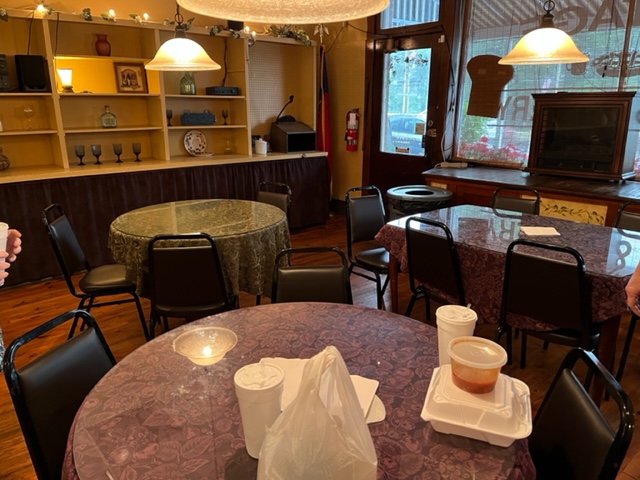
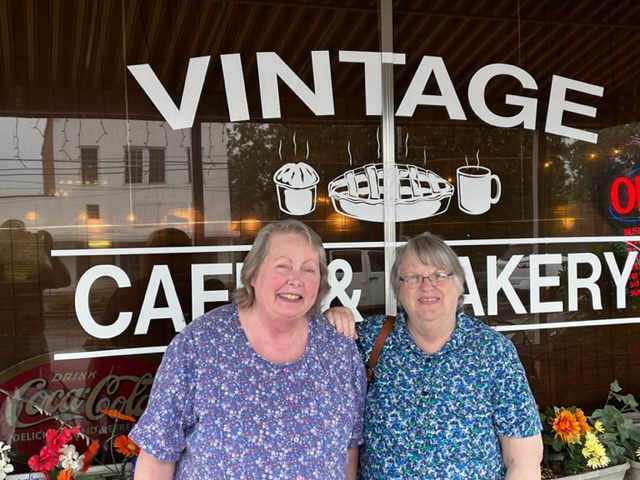
Melanie is on a few Mitford Facebook groups and had asked for recommendations for restaurants. We went to the Vintage Cafe and Bakery. It was so good. I loved the atmosphere of the place. They brought the best yeast rolls and sweet butter I have ever had to the table as an appetizer. We didn’t take a picture of any of the food–we were too hungry. But it was wonderful.
One interesting tidbit about the Vintage Cafe: sometimes they make the Orange Marmalade Cake that appears in almost every Mitford book. They didn’t have it when we were there. They don’t make it often because it is expensive, plus the owner had just made several servings of it for a Mitford tea the week before at the Museum.
We also had a couple of neat encounters at the cafe. Melanie knew a couple of people who worked at the museum through the Facebook groups. One of the ladies was eating there as we came in. Melanie had asked her to tell another lady that we would miss her, because we were running late, and this lady got off before we’d get to the museum. But in a little while, the second lady came to the cafe to see Melanie after she got off. I thought that was a sweet gesture.
On to the museum.
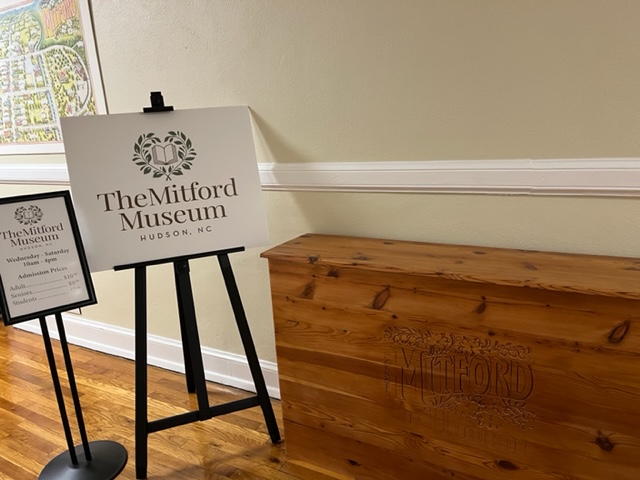
I had not realized that the museum was only one part of a larger enterprise. I did not take a picture of the front of the building, but I had seen it here. I thought that was the whole building, and that all of it was the Mitford Museum. But the building is three times the length of what’s in the picture and houses several businesses, arts-related offices, little shops, etc. It’s called the Hub Station and was formerly the Hudson School. The Mitford Museum takes up two classroom-sized rooms and a gift shop. One of the rooms was Jan’s actual classroom.
These are in the hallway leading up to the museum door.
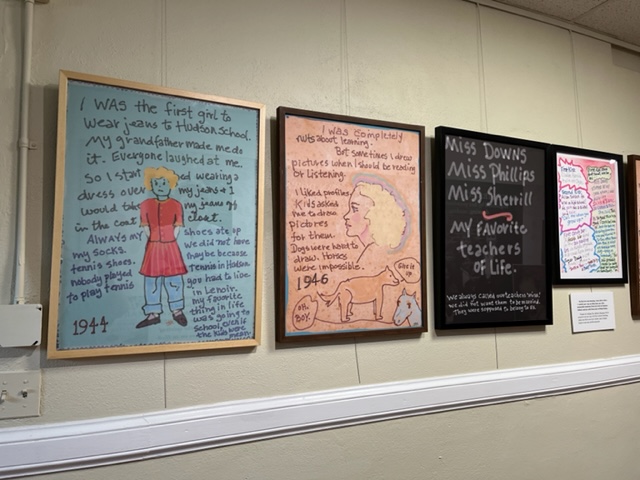
The two rooms that make up the museum are filled with memorabilia. There are notes from Jan at each display, telling what objects were or explaining some behind-the-scenes detail about them. Some items are from her childhood, like a big cast iron pot that her grandmother did laundry in. Some have to do with Jan’s life as an author. I had not known that she wrote ads for NC before writing books, but some are on the walls there–I think I have even seen them in magazines. Her descriptiveness and way with words shines through even there. One section shows the different houses she lived in and which books she wrote in which house.
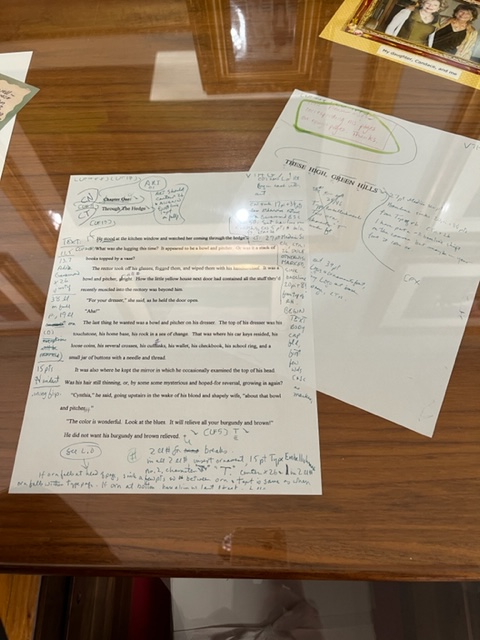
One of Jan’s actual desks is in the museum, along with some of her manuscripts. I wish I had taken a picture of the whole desk–it’s massive.
Jan’s typewriter, a gift from her daughter
An edited part of a manuscript
Above the desk is framed art work from the original covers of several of the books.
I had not read Jan’s children’s books, but one, Miss Fanny’s Hat, was based on her actual. . . I can’t remember if it was her mother or grandmother. But there is a picture of the real “Miss Fanny” wearing her hat, and the hat itself in a curio cabinet.
This was in a space between the two rooms:
If you’ve read Shepherds Abiding, you know Father Tim picked up an old, broken down Nativity set that he restored for Cynthia. That story grew from an old Nativity set Cynthia bought. If I remember correctly, I think Jan had a local artist restore it and included some of her experiences in Father Tim’s. That Nativity is in the museum. It’s huge.
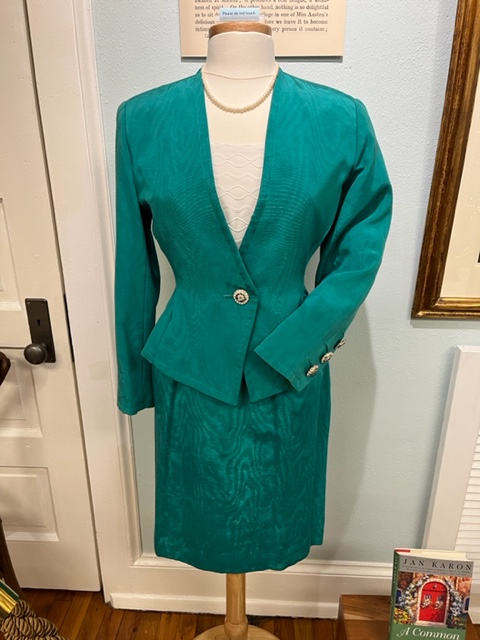
Another interesting story was that Cynthia married Father Tim in an aquamarine suit. Some time later, Jan saw this suit on eBay and said it looked exactly like what she had envisioned for Cynthia’s wedding suit. So Jan bought it, and now it’s in the museum.
I don’t know if you can read the print here, but this house was the basis for the Meadowgate Farm in the books, home of Father Tim’s friend and veterinarian who becomes his adopted son Dooley’s mentor.
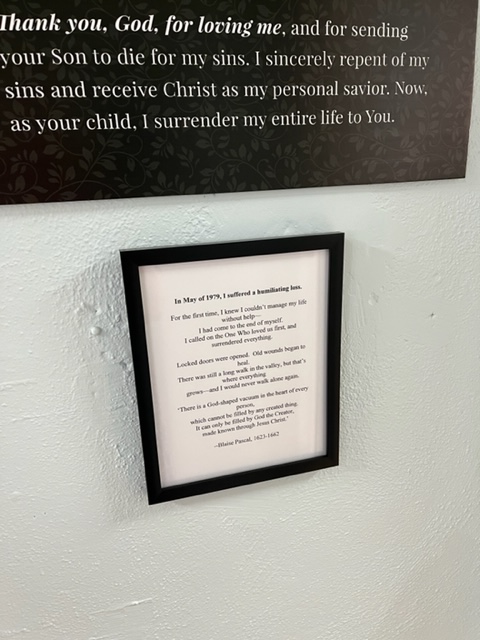
And I took this picture for the Author game that inspired Jan (which I had never heard of but now what to find!) But at the time, I missed reading the plaque above talking about how Jan declared to herself in the mirror passed down from her mother, grandmother, and great-grandmother that she was going to be an author some day. I wish I had gotten a photo of the mirror, too!
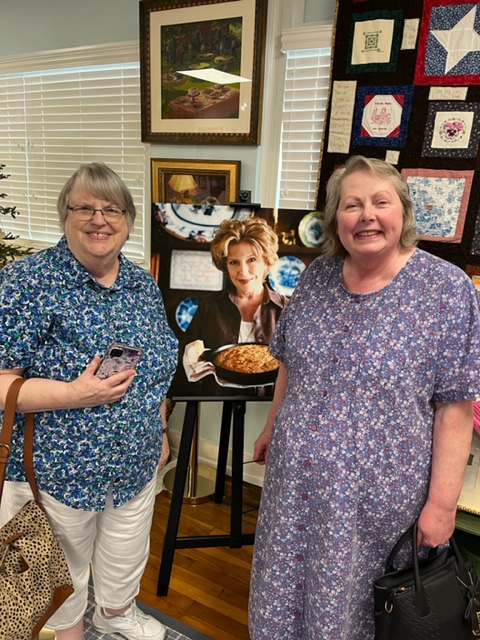
The friendly and informative docent took this picture of Melanie and me “with” Jan.
Melanie and I with Jan
Unfortunately, we didn’t get any pictures with Jim!
The gift shop is called Happy Endings after the bookstore in the books.
We made it just a day trip since there wasn’t much else to see in Hudson (though I spied some antique shops for those interested). Blowing Rock is nearby, but we didn’t want to stay overnight this time.
Because of the distance, I don’t know that I would go to the Museum again unless there was something going on I didn’t want to miss. They had just had a Mitford Tea at the Museum the week before, with Jan in attendance, and they’re planning another next May. I’m thinking about that. There is also a play about Mitford that I’d love to see sometime with Jim, since he’s not familiar with the books, but probably not this year. It sounds like they’ve done it before, so hopefully they’ll do it again.
I’ve shared links to the museum and Jan’s web page above, but the Museum has an active Facebook page with photos of events and the latest news here. And Jan Karon shares a lot of neat things on her Facebook author page here.
Are you a Mitford fan? Have you been to the Museum? I’d love to hear about it.
It’s nice when my end-of-month post lines up with the actual last day of the month!
Once again, the month has flown by. May is not the busy month it was when we had kids in school with all the end-of-year programs, recitals, etc. It’s odd how I am mostly glad not to have those activities any more, yet I still miss them sometimes.
Also, with all my mother-figures no longer living, I don’t have to do anything for that day except make a card for my daughter-in-law. While I miss my mom and other “moms” in my life, I enjoy the fact that the rest of the family makes plans for that day. They do a wonderful job making me feel special. My husband used to take me out to dinner that day. But the restaurants were so busy and waits were so long, he began making Mother’s Day dinner at home and employing the kids to take care of different faces of it. Nowadays he usually grills something. The last two years, Jason had made Chocolate Pretzel Pie, one of my favorite desserts (probably second to Texas Sheet Cake, which Mittu usually makes for my birthday).
The other big event this month was a road trip with my husband and my friend, Melanie, to Jan Karon’s Mitford Museum in Hudson, NC. Jan Karon authored a slew of best-selling books set in the fictional Mitford, based on the town she grew up in. I posted about the trip with lots of pictures here. It was something we’ve been planning and looking forward to since last fall, and it was so nice to finally go.
I also had a colonoscopy this month–not fun, but I was glad to get it over with and to have clear results. We’re still trying to figure out my stomach issues, but I am glad the procedure ruled out some major concerns.
We got wills and living wills and such made us and notarized, something that’s been on our need-to-do list for ages.
So I guess May was still busy in a different way!
It also seemed like this month turned from spring to summer quickly. Even though it’s not officially summer until later in June, we usually count summer as starting from the Memorial Day weekend. This year, however, it has started to feel like summer the last couple of weeks.
Timothyisms
My daughter-in-law sent me a couple of exchanges with my grandson, Timothy.
One day they were talking about roadkill. Timothy asked, “Do people eat bear?”
Jason said, “I don’t think that’s allowed in America.”
Timothy responded, “Maybe in Texas?”
🙂
Another time, Timothy asked his mom if it was fun in the 90s. She said yes and asked what he thought they did in the 90s. “Probably watched TV and wore cool clothes.”
Creating
I only made one card this month, for my daughter-in-law for Mother’s Day.
She likes sunflowers, as you might guess. The arrangement in the center is a multi-layered sticker. I was very pleased with myself for learning how to arch text on the computer without having to ask one of my sons! I did find a YouTube video that helped.
Watching
I watched Spiderman 3: No Way Home and loved it (except for a bit of language). I won’t spoil it if you haven’t seen it (and have missed spoilers everywhere), but it had a lot of neat parts.
As a family, we watched the first live-action Sonic the Hedgehog movie and Clifford movie. I wasn’t expecting to enjoy the Sonic one, but I did. Clifford was a disappointment in that they changed just about everything from the books except the dog’s and girl’s names.
The Girl in the Painting by Tea Cooper, fiction. Set in the late 1800-early 1900 Australia, a businesswoman and philanthropist suddenly breaks down at the sight of a painting. Her ward tries to find out why.
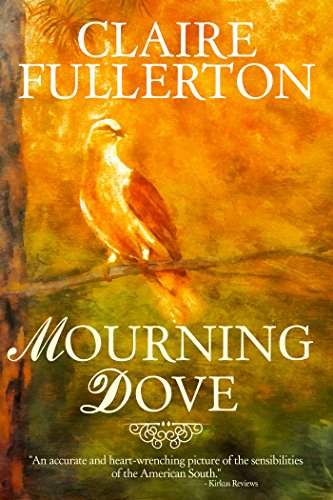
Mourning Dove by Claire Fullerton, fiction. Growing up in Memphis elite in a dysfunctional family in the 70s and 80s.
Mary Barton by Elizabeth Gaskell, fiction, audiobook. Part helping rich and poor understand each other, part coming-of-age, part unraveling a crime.
Eugene Onegin by Pushkin, audiobook, not reviewed yet.
IBS for Dummies by Carolyn Dean and L. Christine Wheeler. I didn’t review it per se but said a bit about it on Goodreads. I gleaned some ideas and information but was also greatly frustrated by the format and the New Age influences.
I’m currently reading:
Be Distinct (2 Kings): Standing Against the World’s Foes by Warren Wiersbe
Content . . . with Thorns? A look at why God allows weaknesses and needs in our lives and how Paul could say he was content with his.
Ministry in the Mundane. We want to get past the everyday necessary tasks in order to do something meaningful and important—yet our ministry most often is in the everyday mundane details of life.
Our Responsibility to Discern False Teaching. False teachers are accountable for leading others astray and misrepresenting God’s truth. But God also gives us plenty of warnings about them. We need to know His Word well enough to spot false teaching.
Encouragement in the Fight Against Temptation. I get discouraged that I am tempted by things I should have victory over. But I can use those temptations as a call to arms and defeat Satan at his own game.
Are You a Big Z or an Ordinary N? We can’t make words in Scrabble with just the high-scoring letters. We need the ordinary ones. People, too, don’t function alone. The stars and executives have a whole support staff. Even if we’re just an ordinary “N,” God has essential things for us to do.
And that just about wraps up May. I hope yours was good as well!
Imagine getting a Scrabble tray with the following letters:
JQZXKVW
Wow! All the highest-scoring letters! You’ll surely win this time!
Except there are a couple of problems.
First, there are no vowels. You’d only be able to play off vowels in your opponent’s words.
And most words are not made up of just the high-point letters. Usually you have to combine them with an ordinary D or T or N.
Too, I’ve often found that the words that use all the tiles and earn bonus points are most often made up of the more common letters.
Life is like that with people, too. The ones out front or with heavy responsibilities don’t operate alone. Stars have their publicists, make-up crew and stylists, agents, drivers. Executives have administrative assistants, mailroom workers, technicians. Presidents have cabinets, advisors, security details. Mills, factories, and manufacturers are mostly made up of everyday workers. Every company has those who keep the premises hygienic and pleasant by keeping it clean.
Have you noticed this principle in the Bible as well? Moses had Aaron and Hur. David had his mighty men. Elijah thought he was alone standing against the prophets of Baal, but God had 7,000 who had not bowed the knee to a false god. The obscure names among Jesus’ twelve closest followers were just as much disciples as Peter, James, and John.
Besides the Bible heroes we all know and love, lesser-known servants of God played key roles. A little servant girl told Naaman about the prophet in Israel who could heal him of leprosy. Unnamed prophets appear in only one scene, but deliver vital messages. “A certain man drew his bow at random” and killed King Ahab, one of Israel’s wickedest rulers. A woman only known as a Shunammite provided a respite for the prophet Elisha in his travels. A little boy gave his lunch of loaves and fishes to Jesus, who multiplied them to feed a multitude. “Joanna, the wife of Chuza, Herod’s household manager, and Susanna, and many others, who provided for” Jesus and the disciples “out of their means” alongside Mary Magdalene. Paul’s nephew brought news of an ambush planned against Paul, prompting his guards to beef up security.
Everyone has an important part to play in God’s kingdom, whether it’s a large or small part. If we envy another’s role, we forget they have their own set of problems and temptations. If we’re discontent with our role, we forget God sees and values it.
Have you ever had one tiny cog mess up a machine’s functions? A few wrong keystrokes in computer code can throw a whole program off. A little virus can wreak havoc in computers and bodies and communities. One person not doing their job right in the process of bringing a product to market can cause the end product to fail or even be unsafe. One customer service representative can make the difference in solving or causing problems, in our relief or frustrations with a company. One kind greeting at church can make a visitor feel welcome. One word of encouragement can change someone’s outlook.
The Bible uses the metaphor of the body to describe the church in 1 Corinthians 12:14-31. The body has a number of parts, but all are important. This passage has us imagine how ridiculous it would be if the whole body were an eye–how would it eat or walk or speak? Equally ridiculous is the thought of doing without one member or another. One part can’t say it doesn’t need another. Each part working together with the others helps the body function rightly, which aids all the parts. Ephesians 4:1-16 uses the same imagery, closing with, “Rather, speaking the truth in love, we are to grow up in every way into him who is the head, into Christ,from whom the whole body, joined and held together by every joint with which it is equipped, when each part is working properly, makes the body grow so that it builds itself up in love.” I’ve spoken of not thinking less of ourselves if we don’t have a big role to play, but Romans 12, also speaking of the church as a body, warns “not to think of himself more highly than he ought to think, but to think with sober judgment, each according to the measure of faith that God has assigned” (verse 3). There is no room for pride or discouragement with God’s giftings. But “having gifts that differ according to the grace given to us, let us use them” for His honor and glory and for the good of the rest of the body (Romans 12:6). We can be content in the place He has us.
My grandfather used to say, “God must love common folk, He made so many of us.” Sometimes God pushes us out of our comfort zones, like Moses, Jonah, Gideon, Esther, and others. But most of us won’t be the mega-best-selling author, the speaker followed by the masses, the hero about whom epics are written. Yet we can glorify God in our homes, churches, cars, businesses, neighborhoods. In fact, back to our Scrabble analogy, if we’re an N or T or an I, we can be used more often and in more places than a Q.
Our hearts go out to those in Uvalde, TX, with the recent mass shooting there. Our hearts are heavy with the sorrow and senselessness of it. I appreciated what Susanne had to say at the beginning of her Friday’s Fave Five this week. A couple of other posts that I found helpful:
Uvalde, HT to The Story Warren. “In these moments, everyone is searching for answers. Everyone wants to figure out something to do, something that will somehow stop the hurting. We try to find meaning in the unimaginable, try to make sense of an atrocious act. Can I offer some advice? If you know these families–or anyone facing grief–you don’t have to offer answers. You don’t have to come up with reasons. You don’t have to try to find the silver lining or the lesson to be learned. Don’t turn their tragedy into a talking point or something political. Instead, just sit with them in their grief.”
When Violence Touches a Child’s Life, HT to Challies. “Rather than react out of fear, we must help our kids by demonstrating an appropriate level of sobriety and sorrow by such events, while exhibiting that our hope is in Christ. The challenge is to find the right balance—teaching young people awareness and caution while equally encouraging trust in a sovereign God. “
Here are some of the other good reads found online recently:
Abiding in Christ: A Practical Description. “The word abide is a simple term. It means to remain, stay, or dwell. To abide is to continue in the same place for some stretch of time. The meaning is uncomplicated, but how does a believer abide in a Person?”
Bend Me Toward the Light, HT to Challies. “Written into creation is God’s plan for growth. Sunlight is essential, as is water. When our plants die, it’s often because of lack of light or moisture. So, if one of those things is less accessible than it should be, a plant will lean toward what it needs. We humans, on the other hand, will bend toward whatever gives us the most pleasure, physical comfort, and approval, no matter how it affects our health and growth.”
The Psalms Know What You Feel, HT to The Story Warren. “The psalms, however, are not a simple chorus repeated over and over again, but a symphony, filled with as many experiences and emotions as humans endure and feel. The five books that make up Psalms really are a master class in human adversity.”
Loving With a Limp, HT to Challies. “But should that surprise us? That God would inflict hurt to bring healing? Many will not imagine, nor accept, a God who could act this way. But he does, and he remains good. Even as he wrenched Jacob’s hip, even as muscle and fibre tore in ways that would never recover, God was healing a heart that was hard and deceitful, crafting through the pain and discomfort that became Jacob’s constant companion, a man that would birth a nation, and even the Messiah.”
How to Spot a Wolf, HT to Challies. “The Bible commands Christians, ‘Have confidence in your leaders and submit to their authority, because they keep watch over you as those who must give an account’ (Heb. 13:17, NIV). But God’s Word also tells of times when we shouldn’t trust and submit to leaders. What are the circumstances when honoring God means disobeying, fleeing, or even calling out those who minister in his name?”
What’s the Best Bible for Me? “Are you about to head to the bookstore (or, more likely, your laptop) to buy a Bible? The process may overwhelm you if you’re not prepared because choosing one has never been more complicated. We have more options but fewer bookstores where we can hold a Bible and flip through its pages. I’d love to help you take out some of the guesswork so you can make your decision based on more than a pretty cover.”
A Call to Raise Daughters Who Are Wise to Domestic Abuse, HT to Challies. “Abuse is easy to discern when it looks like something everyone knows is bad—a close-fisted punch, a shove down a stairwell, a locked closet. Abuse is much harder to discern when it looks similar to something good—like assertive leadership, exclusive affection, or clear direction.”
Expectations, HT to The Story Warren. “I heard an excerpt from a Christian podcast a few days ago and it hit me wrong. Two women were talking and one said something along the lines of, ‘I wish I had lowered my expectations for my children.’ She went on to explain how that was the better, more loving thing to do–how we should make it a point to welcome people just as they are and reassure them that however they show up is good enough. I call bull (sorry if you think that’s too blunt).”
The Hidden Danger of Productivity Systems. “When we learn to depend on our ways to getting things done and accomplishing our goals, we cease to rely on God. We believe that our systems can make us successful, rather than God Himself. And if we happen to achieve success, we run the risk of becoming complacent.”
Art Fan: How to Cheer Kids On to Creative New Heights. “Performing arts like dance, music, and theater do provide athletic-like opportunities to fill theater seats and shout Bravo!, but recitals, concerts, and performances tend to come around far less often than sporting events. Then there are art forms like painting, photography, or poetry that don’t readily provide fans with stand-up-and-cheer type opportunities.” One family came up with ways to encourage their children’s artistic endeavors.
Once again, I am running a little late. We has a fun but long day yesterday, and this morning I went back to bed for a while after I woke up. But it’s never too late to stop and recount the good things God has brought into our lives. We take time to do so every Friday with Susanne and friends atLiving to Tell the Story. Please feel free to join in!
1. Dinner and games with the family. Jason and Mittu invited us and Jesse over last Saturday for nachos and games and visiting. Mittu also made these wonderful chocolate cupcakes with peanut butter icing–and sent a few home with us!
2. Day trip. Some of you are familiar with Jan Karon, author of the Mitford books set in a fictional small NC town. Last fall, the Mitford Museum was opened in the elementary school Jan attended in the town of Hudson, NC. It’s a little over 3 hours away from us. I am a big fan of Jan and her books, but my friend, Melanie, is a super fan. We wanted to visit the museum ever since we heard about it and finally went yesterday. We also enjoyed a wonderful lunch at the nearby Vintage Cafe and Bakery. I’ll post about our excursion one day next week.
Melanie and I with Jan 🙂
3. My husband, Jim, graciously chauffeured and accompanied us even though he wasn’t familiar with Mitford or Jan’s writings. It was nice for Jim and Melanie to finally meet after only hearing about each other for so long.
4. Safety on the roads in bad weather. Rain was forecast for the whole day yesterday. It wasn’t too bad in the morning, but in the afternoon we kept getting notices of thunderstorms, flooding, and possible tornadoes. Thankfully we didn’t experience flooding or tornadoes, and were safe with the heavy rains and slick roads. I was doubly glad that Jim was driving.
5. Reward points. We decided to pick up pizza on the way home. When I started my order on my phone app, I saw I had enough reward points for two free medium pizzas.
We came home and ate pizza, and I had the German chocolate cake I had brought home from the Vintage Cafe. We watched a little TV and then crashed. Thus my tiredness and extra nap this morning. I don’t know why traveling makes me tired when I’m not driving, but trips usually wipe me out! But we had a great time and I am looking forward to telling you more about it.
I hope you have a good Memorial Day weekend. I am abundantly thankful for the sacrifices made by those who have gone before that we might enjoy the freedom we have today.
But her very first book was Mary Barton. Elizabeth began writing at the urging of her husband after the loss of their son. But she was also motivated by “a deep sympathy with the care-worn men, who looked as if doomed to struggle through their lives in strange alternations between work and want; tossed to and fro by circumstances . . . Whether the bitter complaints made by them, of the neglect which they experienced from the prosperous—especially from the masters whose fortunes they had helped to build up—were well-founded or no, it is not for me to judge. It is enough to say, that this belief of the injustice and unkindness which they endure from their fellow-creatures, taints what might be resignation to God’s will, and turns it to revenge in too many of the poor uneducated factory-workers of Manchester (from the preface toMary Barton).
Mary’s father is a mill worker who is critical of the rich in general and the “masters” (mill owners) in particular. He feels it’s unfair that the working class puts in so much effort with so little in return. The rich unfairly (it seems to him) not only have more, by seemingly little or no merit of their own, but they don’t help the poor in their need. The death of John’s wife and son fuels his views and his anger. He’s left to raise his daughter alone.
The story fast-fowards several years. Mary is now a teenager working in a dress shop. Jem, the son of family friends, has loved her since they were children. But she thinks of him as a brother. Henry Carson, the mill owner’s son, has noticed Mary and flirts with her on her breaks and after work. Mary is flattered by Henry’s attentions. She knows her father’s feelings about rich people. But she feels that once she marries Henry and her father experiences the benefit of his riches, he’ll be all right with her marriage.
Several issues between the mill owners and workers come to a head, with the workers threatening to strike. Some of the owners feel they need to concede to some of the workers’ demands. However, most of the owners, including Henry Carson, feel they need to stand firm; if they relent on any of these issues, the workers will just strike whenever they want something.
When the workers’ appeals fail, a group of them decides more drastic measures are needed.
Meanwhile, Jem comes to Mary to plead his case for her hand. She decisively tells him there is no hope. She could never love him. Not long after he leaves, however, she realizes she does love him. She agonizes over how to let him know and decides that it wouldn’t be right to go after him. She’ll just have to convey to him in more quiet manners her change of heart when they see each other. She tries to break things off with Henry, who doesn’t take no for an answer.
But Jem, taking her at her word, arranges to be away from home when Mary comes to visit his mother.
Then, suddenly, Henry is shot.
Jem is accused of the crime because his gun was found at the scene and because he was heard threatening Henry over Mary a few days earlier.
But Mary is sure she knows who the real killer is. How can she help Jem without betraying someone else?
Besides the industrial and romantic plot lines, Mary’s friend, Margaret, lives with her wise and level-headed grandfather, Job Legh. Margaret has a beautiful singing voice and but is going blind. Alice Wilson is an older lady who is everyone’s friend and the go-to helper when someone is sick, until she falls ill herself. Esther is Mary’s aunt, who disappeared from the family early on but shows up again. Jem’s mother, Jane, lose her twins and then her husband.
Elizabeth tries to help both sides of the industrial concerns to see the other truthfully. She definitely thinks the masters can be more compassionate and do more, and she spends more time on their shortcomings than the workers’. But she cautions that they have their troubles, too. In one scene, John Barton is going to a druggist’s for a friend.
It is a pretty sight to walk through a street with lighted shops; the gas is so brilliant, the display of goods so much more vividly shown than by day, and of all shops a druggist’s looks the most like the tales of our childhood, from Aladdin’s garden of enchanted fruits to the charming Rosamond with her purple jar. No such associations had Barton; yet he felt the contrast between the well-filled, well-lighted shops and the dim gloomy cellar, and it made him moody that such contrasts should exist. They are the mysterious problem of life to more than him. He wondered if any in all the hurrying crowd had come from such a house of mourning. He thought they all looked joyous, and he was angry with them. But he could not, you cannot, read the lot of those who daily pass you by in the street. How do you know the wild romances of their lives; the trials, the temptations they are even now enduring, resisting, sinking under? You may be elbowed one instant by the girl desperate in her abandonment, laughing in mad merriment with her outward gesture, while her soul is longing for the rest of the dead, and bringing itself to think of the cold-flowing river as the only mercy of God remaining to her here. You may pass the criminal, meditating crimes at which you will to-morrow shudder with horror as you read them. You may push against one, humble and unnoticed, the last upon earth, who in Heaven will for ever be in the immediate light of God’s countenance. Errands of mercy—errands of sin—did you ever think where all the thousands of people you daily meet are bound? Barton’s was an errand of mercy; but the thoughts of his heart were touched by sin, by bitter hatred of the happy, whom he, for the time, confounded with the selfish.
Just occasionally, the narrator (possibly Gaskell herself) might come across as a little preachy by today’s standards. But I think in her time, she wasn’t trying to “preach” as much as to open people’s eyes to the plight of others.
Though Wives and Daughters and North and South are still my favorite Gaskell books, I did enjoy Mary Barton very much, especially the last half.
I listened to the audiobook, which was included as part of my Audible subscription. Juliet Stevenson did a superb job with the narration and different dialects. But I also got the free Kindle version to read parts there. the novel is also only via Project Gutenberg here.
Millie Crossan is the narrator of Claire Fullerton’s Mourning Dove. When Millie was in her teens, her mother moved the family from Minnesota back to her native Memphis after her divorce.
Millie’s older brother and hero is Finley, eighteen months her senior. She looks up to him, follows him, feels secure in his care. “His presence was one part security blanket, one part safety net, and two parts old familiar coat conformed to fit my size after years of wear.”
They loved their father, who was much more involved with them than their mother. But he was an alcoholic who had trouble giving up his addiction. His death, as well as his addiction, had a profound influence on both children.
When the family arrived in Memphis, Millie’s mother, Posey, melted right back into her role. But Millie and Finley felt like outsiders until they got the hang of the culture of keeping up appearances at all costs.
Part of the novel is a coming-of-age story. Part of it is historical Southern fiction set in the seventies and eighties. Part of it is a nature-or-nurture question exploring how two close siblings can come to such different ends.
We learn early on that Finley is no longer with the family. As the story unfolds, we see his unraveling, leading to a tragic end.
I rarely have trouble “getting” the point of a book. But I did with this one. I searched for interviews with the author to try to gain a little more insight. She says here that the book started as a poem and then was transformed into narrative nonfiction before she turned it into a fictional saga. Since Claire, like Millie, moved from MN to Memphis and was raised by “the last of the great Southern belles,” I wonder if she had a “Finley” in her life. She shares in this interview what she wants readers to take away from the book, “That it’s not what we’re handed in life that matters, it’s how we handle the circumstances in which we find ourselves.”
This review helped me understand Finley a little more, especially this line: “When a child with intelligence and sensitivity is reared in an emotionally unstable household marred by tragedy, he may direct his intelligence toward destructive habits and pursuits.” Millie, by contrast (though she was not unintelligent or insensitive), keeps her feelings to herself. Her mother and her culture don’t encourage heartfelt openness. But Millie’s other relationships are somewhat stunted.
I was also a little confused because I had thought this was Christian fiction. But it’s not. Posey’s spirituality is only the socially acceptable kind, Millie has no use for God, and Finley goes the opposite direction, becoming a cult leader.
The ending left me a little flat at first, because it seemed there was nothing redemptive, nothing hopeful. Of course, in real life, tragedy doesn’t seem redemptive or hopeful at the time. And even if we can see ways God used it, after time has passed, it still hurts. But in books, usually there’s something to be gleaned from the events rather than just the fact that tragedy happened. I reread the beginning and the ending, and was caught by this sentence: “Every chord their father ever played in this room went out into the universe to ring forever, because music never dies, and they were born with it inside them.” A loved one’s influence lives on after them.
Have you read this novel? If so, I’d love to hear your thoughts.
The book of 1 Kings begins with the death of David, Israel’s greatest king, and ends with the death of Ahab, one of Israel’s worst kings.
In-between those two kings, the temple was built, but then the kingdom of Israel split in two. The southern kingdom, Judah, was ruled by David’s line. The northern kingdom with the rest of the tribes was ruled by various people.
A few of the kings were good to some degree, but most were bad and led Israel in their besetting sin, idolatry.
God raised up prophets to warn the kings and the people about the danger they were in due to their disobedience. This book had Elijah’s famous showdown with the prophets of Baal and Elisha taking up Elijah’s mantle. But there were many unnamed prophets faithfully doing God’s will.
Here are some of the quotes that stood out to me from Wiersbe’s writing:
The two books of Kings record about four hundred years of the history of Israel and Judah, while the two books of Chronicles see the history of the united kingdom and then the kingdom of Judah from the priestly point of view. Besides recording history, these books teach theology, especially the faithfulness of God in keeping His covenant, the sovereignty of God in directing the destinies of all nations, and the holiness of God in opposing idolatry (p. 13).
Integrity is one of the vital foundations of society, but integrity involves taking responsibility and facing accountability. This includes leadership in the home and church as well as in the halls of academe and the political chambers. It’s one thing to make promises at the church altar or to take an oath of office, but it’s quite another to assume responsibility and act with courage and honesty and seek to please God (p. 11).
God took the consequences of David’s two worst sins—a piece of property and a son—and built a temple! “But where sin abounded, grace abounded much more” (Rom. 5: 20 NKJV). This isn’t an encouragement for us to sin, because David paid dearly for both of those transgressions, but it is an encouragement to us to go on serving God after we’ve repented and confessed our sins. Satan wants us to think that all is lost, but the God of all grace is still at work (1 Peter 5: 10) (p. 53).
“Because of our proneness to look at the bucket and forget the fountain,” wrote Watchman Nee, “God has frequently to change His means of supply to keep our eyes fixed on the source” (p. 160).
Responsibility means our response to His ability (p. 214).
I appreciate Dr. Wiersbe’s help in getting more from 1 Kings.
When we’ve been Christians for decades, it seems like we’d have less trouble with sin.
After all, we’ve had so many years to grow, so many times in the Word of God, prayer, church, Sunday School, good books. We know we won’t reach perfection in this life. But shouldn’t we be closer to it?
I have not found myself anywhere near sinless perfection. And I can get quite discouraged when a random thought of anger or envy flashes across my mind. I should know better. Why am I still thinking like that?
But the Bible tells us we will always have our sin nature. “For the desires of the flesh are against the Spirit, and the desires of the Spirit are against the flesh, for these are opposed to each other, to keep you from doing the things you want to do” (Galatians 5:17). In fact, fighting sin is a good sign because it means we have God’s Spirit in us Who opposes sin.
And in some ways, as we grow in the Lord, we’ll be more sensitive to sin issues. I used to get convicted about angry outbursts. Now I get convicted about angry thoughts.
I don’t spend too much time wondering whether particular temptations come from Satan or from my own sin nature. Sometimes one or the other is a bigger factor, sometimes they work together.
But several years ago, I went through a situation that helped my perspective. For some period of weeks, I felt assaulted by untrue thoughts about God. I felt these thoughts came from Satan because they felt like an attack, and I normally didn’t have a problem with that kind of thing. I was discouraged, upset, fearful of blaspheming or at least dishonoring God.
Finally I thought of a tactic. I don’t normally try to address Satan personally. I leave him for God to handle. But I said, to whoever might be listening, “You know what? When I am tempted with wrong thoughts of God, I’m going to immediately turn my thoughts to His praise. I’ll sing a hymn or read a psalm or think about God’s attributes. So any temptation to wrong thoughts about God is going to result in more praise to Him and of Him and more worship of Him.”
The “thought attacks” stopped soon thereafter.
Recently it occurred to me that I could do the same thing with other temptations. Instead of just getting discouraged or irritated that I still have to fight selfishness or pride or jealousy or whatever, I can see the temptation as a call to arms. I can put on His armor and use the sword of His Spirit, His Word. I can preach His truth to myself and shore up my defenses. I can store up His Word in my heart, that I might not sin against Him (Psalm 119:11). I can pray against temptation (Luke 22:40, Matthew 6:13, Matthew 26:41). I can endeavor more closely to “walk by the Spirit, and you will not gratify the desires of the flesh” (Galatians 5:16). I can rejoice that God’s throne is one where we can find grace to help in time of need (Hebrews 4:15-16). I have His encouragement that “No temptation has overtaken you that is not common to man. God is faithful, and he will not let you be tempted beyond your ability, but with the temptation he will also provide the way of escape, that you may be able to endure it” (1 Corinthians 10:13). I can let God use this for good to strengthen me.
Though God offers grace, He doesn’t want us to take sin casually. Though God forgives us when we confess our sin to Him (1 John 1:9), He also tells us to “Look carefully then how you walk” (Ephesians 5:15), to put certain things away from us, to “Put to death therefore what is earthly in you” (Colossians 3:5). He warns us to “Be sober-minded; be watchful. Your adversary the devil prowls around like a roaring lion, seeking someone to devour” (1 Peter 5:8).
But “As a father shows compassion to his children, so the Lord shows compassion to those who fear him. For he knows our frame; he remembers that we are dust” (Psalm 103:13-14).
Temptation to sin isn’t sin, of course. Even Jesus was tempted.
But when I do succumb to temptation, one verse that especially means a lot to me is Micah 7:8: “Rejoice not over me, O my enemy; when I fall, I shall rise; when I sit in darkness, the Lord will be a light to me.” I love what Christina Rossetti said: “A fall is a signal not to lie wallowing, but to rise.” Instead of wallowing in discouragement over temptation, we can rise against it. And God can use even this to strengthen us, to encourage others, and to glorify Himself. So, once again, what Satan means for evil, God can turn around and use for good.





















 Stray Thoughts