Here I share the first set of recommended reading for the new year!
2020–What a Beautiful Time to Be Alive. “Don’t let bad thinking take this year from you. Don’t grit your teeth and just try to get through. Life is too precious for that and entirely too short. Live this year as you ought to live every other.”
The Longest Night. Long periods of waiting are not unusual for the children of God. “Years of waiting were not caused by a delay, but were part of God’s design. . .We can also trust He has a purpose in the waiting. Sometimes, while we are concerned with our circumstances, God is more interested in growing our character and our dependence on Him.”
Reading the Bible Requires Rules We Already Know, HT to Challies. “It’s easy to misinterpret the Bible when you don’t follow basic rules of interpretation. Therefore, I’ve offered the approach of asking three questions when reading any passage.”
The Bible Reading Plan I Recommend for 2021. You can find all kinds of Bible reading plans this time of year. Bible Gateway has several. Our church uses a five-year plan, though it’s laid out a little differently from this one. I’ve found that I like having a five-day-a-week plan. That gives time to catch up if you miss a day, plus time to consult other sources (commentary or Bible reading notes), plus a day or two to do other reading if you’re doing a Bible study or project.
Proactive and Reactive Bible Intake, HT to Challies. I had not heard the term “reactive” Bible reading, although I have done it. “In many ways, proactive Bible intake prepares us to know where to open the Scriptures when we need reactive Bible intake.” Both are needed.
Expecting Less From the Church, HT to Challies. I would not have thought of advising lower expectations from church, but I see the wisdom from this article. Sometimes our expectations are so high that we set ourselves up for disappointment because no church can meet them. “We have expectations of course—baptism, the Lord’s Supper, theological orthodoxy, preaching Christ crucified, prayer—but these do not include at least one new insight per sermon and arena-quality worship. These do not include my passive presence that waits for an experience like I had watching a recent movie.”
A Parable from the Dead, HT to Challies. I’ve been troubled by the news of Ravi Zacharias. This draws out some truths from the situation
Marriage: The Beginning of a Revolution, HT to Challies. What a sweet story, and an illustration of what a testimony a godly wedding and marriage can be. “The road to this joyous occasion was paved with tears, persecutions, and pain. In the Lord’s wisdom, it was this very pain that grew the character of the bride and groom and helped them to understand the value of a husband and the value of a wife.”
Someone Will Catechize Your Kids. Don’t Outsource It. HT to The Story Warren. Some might be turned off by the thought of catechism as rote or ritualistic teaching. But the basic idea in the article is just teaching truth. Kids will be exposed to all kinds of values: we need to be sure to teach them God’s truth o a level they can understand.
And finally, I don’t think we’re so far from Christmas that we can’t enjoy this sweet story (if you see this via email, you might have to click through to see the video):
Routines can help us establish good habits. Half the battle in establishing a regular quiet time or devotional time is staking out a workable, regular time and place. Some days—and some seasons of life—upend our schedules, and all we can do is watch for any available minutes. But we usually do better when we plan to work Bible reading into our day.
But a routine can become—routine. A rut, even.
How can we keep our Bible reading from becoming routine—or dig it out of the rut if it’s already there?
Pray. Ask God to remind us of the treasure His Word is. Sometimes I pray Psalm 119:18 just before starting my Bible reading: “Open my eyes, that I may behold wondrous things out of your law.” Or Psalm 119:25: “My soul clings to the dust; Revive me according to Your word” (NKJV).
Don’t expect high excitement every time. A Thanksgiving feast is wonderful and memorable. But the monthly tuna casserole and everyday peanut butter sandwiches nourish us as well. Some devotional times leave us overflowing with joy or conviction or inspiration. Most quiet times don’t end that way, yet the Word feeds us every time we partake of it.
Remember the purpose of time in the Word: not just to get through a certain number of chapters or a certain amount of time, but to meet with the Lord and get to know Him better.
Change your plan. If you usually read the Bible through in a year, maybe switch to a two-year plan or a five-year plan—or a 90-day plan. Or a biographical plan or a chronological plan. Bible Gateway lists 18 different plans. Near the end of the year you’ll see a number of posts and articles about ways to read the Bible in the New Year (though you don’t have to wait til then to start).
Change your style. We benefit from both reading and studying the Bible, but most of us are inclined one way or the other. If you usually read large chunks for an overview, perhaps study a particular book in more detail. If you like to camp out in one passage for days, maybe get the bigger picture by reading several chapters or a whole book at one sitting.
Add aids. I’ve only had a study Bible the last few years. The background information and notes help so much in comprehending more of the passage. One year I used Warren Wiersbe’s With the Word as a companion. This year I am using his “Be” commentaries.
Have a Bible reading project. Once I read through the gospels looking particularly for claims Jesus made about Himself. I put a “C” in the margin beside every verse of Jesus’ claims and then put them all together. Doing so provided a valuable resource plus woke me up from falling into familiar patterns from familiar passages. I’d love to read through the Bible noting every reference to God as Creator and what the passage shares about Him (His greatness, His power, etc.) I’d love to do the same thing with every passage where God promises to be with someone. Mardi Collier started reading the Psalms, jotting down every truth about God that she came across. As she came to a new truth, she’d write it across the top of a notebook page, and then list verses underneath as she found them. Some of the page titles focused on what kind of Person God is: My God is holy, My God is good, etc. Others shared God’s actions: My God hears me, My God is in control, and so on. Her study ended up covering the whole Bible and eventually became a book, What Do I Know About My God?
Ask different questions. When I first started reading the Bible on my own, I was instructed to look for a command to follow, a warning to heed, a promise to claim. I underlined them in different colors as I found them. Later I heard of asking the old journalism questions of a passage: who, what, when, where, why, and how. Those are great questions, but If you’ve asked them several times, chances are you already know the answers. Maybe ask, instead or along with those, what does this passage show me about God? Or, how does this person change over the course of his story? For example, the first few times I read Genesis, I missed the transition of Judah from Genesis 37-50. Now, reading in Exodus, I am noticing Moses’ change from arguing with God that he couldn’t fulfill His calling in Exodus 3 and 4 to becoming a great leader over the rest of the book. The changes in people in the Bible come about as God works in them and enables them through the circumstances He puts them in. That can inspire us that He is doing th same in our lives.
Try a different translation. I used the KJV for some 25 years. When I read the NASB and ESV, I saw passages with new eyes. I prefer to stay with the translations that are as close to word-for-word as possible rather than paraphrases. But sometimes I look up the paraphrases as commentaries.
Remove the references. Before we could cut and paste from the Internet, one of our former Sunday School teachers suggested that we type out some of the epistles as the actual letters they are without the verse numbers and headings. The chapter and verse numbers weren’t in the original text, but they do help us find and discuss passages. Sometimes, however, they are not well placed. One sentence can be broken up into several verses. So sometimes reading without the verse numbers can help us not to fragment the verse. Now you can buy Bibles printed without chapter and verse numbers.
Stop and think. Paul tells Timothy in 2 Timothy 2:7: “Think over what I say, for the Lord will give you understanding in everything.” It’s easy to sail through a familiar passage. In the narrative portions, we see how everything turned out just a few pages later. Remember the people in those situations—David hiding in caves from Saul, Joseph in prison, Daniel facing the lion’s den, etc.—didn’t know how everything would turn out. If we put ourselves in their situations the passage opens up to us more.
Make notes. I stopped journaling during my quiet time when I found I was spending more time writing than reading. But recently I’ve gone back to just writing a few notes both to reinforce what I just read or to remind myself later. My notes are usually just a short summary, but thinking about how I’d describe the passage helps me not gloss over it. Some people like to draw charts and diagrams and arrows and circles to engage the Scriptures more.
Don’t compartmentalize. Often we read for so many chapters or minutes and then pray, or vice versa. But we don’t have to separate prayer and reading. If we’re in a section of praise, we can stop and praise God. If a passage convicts us about something we’re doing wrong, we can stop and confess it to God right then.
How about you? What ways have you found to avoid or get out of a Bible reading rut?
I never heard Handel’s Messiah until I was in high school.
I had not grown up listening to either classical or religious music. (I grew up hearing “Your Cheatin’ Heart” and other such lovely little ditties). So while I was impressed with the beauty and grandeur of Handel’s oratorio, I can’t say I got much out of it. It was like drinking from the proverbial fire hydrant.
But my college performed selections from the Messiah frequently. And the church we attended the first fourteen years we were married did the same. I even got to be in the choir at church some of those years, so I learned the songs in more detail. Plus, I had become a Christian in later high school, so I could understand more of the spiritual significance and message of the piece.
When I learned that The Messiah had been composed during the Baroque era, with its “excessive ornamentation or complexity,” I understood why it was written the way it was.
As a result of hearing The Messiah over and over, becoming more familiar with it, learning more about it, and growing in the Lord, I came to love this piece of music. I anticipated each section just like I would rereading a favorite book or rewatching a favorite movie.
And then, just from growing familiarity with the music, I began to notice details. For instance, I had always thoughts of Isaiah 53:6 as somber and sad: “All we like sheep have gone astray; we have turned—every one—to his own way; and the Lord has laid on him the iniquity of us all.” But the tune Handel put to this verse seemed almost jaunty to me at first. Then one day I noticed the notes on the word “astray” were going astray.
Further into that piece, on “We have turned,” the notes are turning over and over.
Isaiah 40:4 says, “Every valley shall be exalted, and every mountain and hill shall be made low: and the crooked shall be made straight, and the rough places plain.” In the song based on this passage, the notes on the word “crooked” go up and down—they would look crooked on the sheet music. And the melody on “straight” and “plain” is mostly straight. The notes on “exalted” go up.
The melodies illustrate the words! And I had listened to and sung this I don’t know how many times before that clicked. In fact, I just caught “exalted” going up watching this video.
In many ways, my journey with the Bible parallels my journey with this piece of music.
I had attended church occasionally growing up. I knew some basic Bible truths and narratives. But I didn’t start reading the Bible myself until high school. The church I started attending when I was sixteen strongly encouraged its people to read the Bible through in a year. So I did.
And it was like trying to drink from a fire hydrant.
But I am so thankful for that emphasis at the outset of my Christian life. That grounded me more than anything else and set me off with good habits.
I didn’t understand everything I read. Similarly, in church, I couldn’t have told you the main points of the sermon afterward. But I got enough to chew on and to nourish me. The Bible speaks of those young in the faith as taking in milk from the Word. So I took in and digested what I could, and my life was changed.
When I got to something I didn’t understand, I’d just keep going.For instance, Psalm 60:4-5 says:
Thou hast given a banner to them that fear thee, that it may be displayed because of the truth. Selah. That thy beloved may be delivered; save with thy right hand, and hear me.
And I would think, “Wow, that’s good!” Then the next few verses listed a bunch of names I didn’t know. And then I came to verse 8: “Moab is my washpot; over Edom will I cast out my shoe: Philistia, triumph thou because of me.”
And I thought, “Huh?”
And then I’d keep going to verses 11 and 12: “Give us help from trouble: for vain is the help of man. Through God we shall do valiantly: for he it is that shall tread down our enemies.” And I’d think, “Wow, so good!”
I don’t know if that’s the best way for a new Christian to go about Bible reading. But no one had told me what to do about the parts I didn’t understand. I had never heard of study Bibles in those days. Still, the Lord met me in those times with His Word.
And as I kept reading in the 40+ years since (though not through the whole Bible in a year any more), I understood more and more. I saw how individual verses and books fit within the whole. I know what Moab and Edom and Philistia are now. There are parts that are as familiar as any favorite, much-read book. There are parts holding dear memories of God giving me just the right words in an hour of need. I anticipate what’s coming next in a passage. But I am still learning new things even from old, familiar stories and chapters.
So, why am I telling you this today?
I want to encourage you to get into a habit of reading your Bible, if you’re not already doing so.
And I want to encourage you to read all of it. Maybe not in a year. There are two-year plans and five-year plans and almost any kind of plan you could think of. But if we just keep turning to our old favorite passages, we’ll miss so much.
And if you’re discouraged because there is so much you don’t understand, I want to encourage you to keep reading. You’ll “get” more and more of it the more you read it. Someone has said that the Bible is shallow enough for a child to wade in, but deep enough for an elephant to swim in. God can speak to you and minister to you even if you don’t understand every little thing in the passage. In fact, we’ll never exhaust the Bible in this lifetime.
The Bible says to “long for the pure spiritual milk, that by it you may grow up into salvation” (1 Peter 2:2-3), and then to go on to solid food (1 Corinthians 3:1-2) as we “ mature, for those who have their powers of discernment trained by constant practice to distinguish good from evil (Hebrew 5:11-13).
But even more than spiritual food, the Bible provides spiritual fellowship. We don’t read the Bible as an end in itself, but to get to know God better. The Bible is the primary way God speaks to us. From the time God’s words were first written all the way through until the end of time, God expected His people to read and follow it.
His divine power has granted to us all things that pertain to life and godliness, through the knowledge of him who called us to his own glory and excellence, by which he has granted to us his precious and very great promises, so that through them you may become partakers of the divine nature, having escaped from the corruption that is in the world because of sinful desire (2 Peter 1:3-4).
What a treasure trove we have in the Bible! May we partake of it every day.
Your words were found, and I ate them, and your words became to me a joy and the delight of my heart,for I am called by your name, O Lord, God of hosts (Jeremiah 15:16).
These are some noteworthy reads if you have time today:
Look for Life Among the Living. “Don’t seek the living among broken mirrors, unfulfilled longings, and external doings. He is not there. He has risen!”
Never Read a Bible Verse (and Never Listen To a Sermon Clip). “I read the paragraph, not just the verse. I take stock of the relevant material above and below. Since the context frames the verse and gives it specific meaning, I let it tell me what’s going on.”
Allow Parenting to Push You Toward Humility. “We can admit our own shortcomings while also pointing our children to the truth of God’s word. To do one without the other is not true discipleship”
We Are Okay, and We Are Not Okay, HT to the Story Warren. From a family 40 days into quarantine in China. “If I only go where I feel safe, is that trust? If I only follow where I am guaranteed to be okay— health or otherwise— will my faith grow? If I only wander as far as I have placed my own protective boundaries, will I know the ever-sweeter presence of a Savior who would take me to the heights? Or will I be safe, but stunted?”
Your Child May Not Ask Questions, But He Needs Answers Anyway. “Kids are interesting little people. They are always thinking, always assessing, always making decisions in their minds about how things are. I think we forget that about them. We assume that if they aren’t talking about it, they aren’t thinking about it, but nothing could be further from the truth.”
These are some online reads that gave me much to think on:
5 Bible Study Techniques for Busy Moms. “We make it so complicated sometimes with rules and regulations, but the most important thing about being in God’s Word is to just actually be in it.”
And on that note, 10 Ways to Engage With Scripture. “How do you engage with Scripture? Since the key to knowing God’s heart is through His Word, I pondered her question.”
Can My Calling Really Be That Simple? “It’s easy, especially in Christian circles, to get grandiose ideas of what calling looks like. It’s easy to look for people who make a big difference, give up everything, and have the numbers (or passport stamps) to prove it.”
Ten Exhortations Concerning Gossip Blogs and Online Speech, HT to Challies. I would add, don’t pass on tweets or posts that contain this kind of thing, and don’t share something with the thought, “I don’t know if this is true, but just in case…” Check it out first.
James 3:1 and the Trembling Teacher. If you’ve ever tried to teach a Sunday School class, lead a Bible study, speak (or even write) about spiritual things, you can likely identify with this post.
To the New Parent, HT to True Woman. “What a gift you have in your hands and really, the best is still ahead of you. There’s no ‘Just wait until…’ God’s grace will equip you for each new season, even if his grace simply equips you to fall to your knees.”
This Is Your Body Today, HT to Challies. “What does it mean to bear on our bodies the marks of living in this world, to experience all that life and God will give and throw at us, and to not blame the sleeplessness or stretch marks on being a mother—or to find pride in them either because they birthed live children? To not blame the creaks and groans on laziness or lack or time. To not see ourselves as a victim of some perverse injustice, but to simply say to the body that holds us today and to the God who made it: ‘Thank you’ and also ‘This hurts’?”
When I first became a Christian, the church I was in urged people to read the Bible through in a year. I’m so glad, because I believe that grounded me in my faith more than anything else.
In later years, pastors often emphasized the need to read passages of the Bible in context and encouraged to read a book of the Bible through at a time rather than scattering our reading all around. I mentioned last weekDrew Hunter‘s quote that we wouldn’t read only page two of a friend’s three-page letter. Nor would we read a paragraph on page three and a line on page one. The Bible isn’t a book of random quotations. Each book is a coherent whole, and all together they present a unified message.
Reading the whole Bible helped me keep things in context and see the grand themes of the Bible. It helped me get into books like Leviticus and Chronicles, which I probably would not have drifted into. I found some nuggets there I would have missed. Reading all of the Bible helps you interpret it, as some passages shed light on other passages.
Most Christians I talk to have never read the entirety of the Bible. They may read it frequently but only parts of it. But daily reading parts of the Bible doesn’t mean you know it any more than daily reading the first chapter of Moby Dick makes you an expert on the famous novel. Ignorance of the whole of God’s Word makes us easy targets in the war Satan has waged against God. Lies can slip through undetected like poison gas because we’re just not that familiar with the truth.
I still believe in reading the Bible through, but I don’t do it in a year any more. Sometimes I wanted to slow down, but felt I couldn’t or I’d fall behind schedule. Once one does fall behind, it’s hard to catch back up. So now I just go at my own pace. I don’t even know how long it takes me. Sometimes I read a couple of chapters a day. Other times I read more or less. I usually read the shorter epistles a few times through before moving on because they’re packed so full and go by so quickly.
I’ve seen some two-year or other plans. John O’Malley said in Overcoming Your Devotional Obstacles, “If it takes you five years to read through the Bible, you are not less of a Christian. Read it at a pace that you can comprehend it and receive something from it.”
Some folks I know have tried “binge-reading” the Bible occasionally. Joel Arnold says, “A pretty average reader can finish in 100 days by reading just 40 minutes a day.” My friend Kim once read the whole Bible in 90 days and shared her experience here.
Joel once read the whole Bible in a week, 10-12 hours a day. Afterward he noted:
The Bible is the most intertwined body of literature I’ve ever read. The books cite, quote, allude and echo each other constantly. It’s like a city, built up layer by layer, strata by strata, so that each later addition rests on every layer that came before … We don’t usually sense these relationships because we’ve forgotten 95% of the OT before we ever get to the New. But having it all out in front of your brain at once changes that completely. You find yourself flipping back and forth constantly between the testaments, jumping across thousands of years of history to study the same teachings and sometimes even the same phrases (Meditations from Binge-Reading the Bible).
Obviously no one can read 10-12 hours a day every week. But if we can use vacation time to binge watch a TV series, why not use it to read the whole Bible?
However, if we only read the Bible in great chunks, we miss something. We’re also told to study it, meditate on it, chew on it. Sometimes we need to slow down and spend more focused time on a smaller passage. Charles Spurgeon is quoted as saying, “Some people like to read so many [Bible] chapters every day. I would not dissuade them from the practice, but I would rather lay my soul asoak in half a dozen verses all day than rinse my hand in several chapters. Oh, to be bathed in a text of Scripture, and to let it be sucked up in your very soul, till it saturates your heart!” Sometimes there’s nothing like honing in on one or a few verses for an extended amount of time.
Remember, the early churches did not have the entire Bible bound in one book for a long while. They had the Old Testament and gospels, but they would have spent a great deal of time on the one letter sent to their congregation and others as they came around.
I mentioned last week that Tim Challies said the larger blocks of reading were for familiarity, and reading for intimacy was slowing down and meditating on or studying shorter passages. Kelly Collier calls these two methods plow work (which “moves through large portions of Scripture more quickly,” like reading the Bible in a year or two) and trowel work (“taking a passage or verse of Scripture and settling in to dig for a long time,” like inductive Bible Study). I likened the two styles to a panoramic or macro lens. Or we could simply call them reading and studying.
I wrote a few years ago about finding time to read the Bible. Some seasons allow for both reading and studying, and it’s great to do both each day if you can. With the friend’s letter I mentioned earlier, we usually read the whole thing once or twice and then go back over it section by section. That’s good to do with a Bible passage as well. But it’s hard enough some days to get a few minutes to read the Bible at all. How can we possibly employ both reading and studying?
Here are some ideas:
Take turns. Often after I’ve finished a book of the Bible, I’ve taken a break to do a shorter study. Then I go back to the next book of the Bible.
Alternate days. Use a few days of the week for general reading, the others for more focused study.
Do the opposite of your church. For several years we were under a pastor who took a very detailed, thorough approach to preaching through a book of the Bible at a time. It took us years to get through Romans. But that was great, because then we knew it well. Since the preaching I heard was the in-depth, verse or two at a time style, my personal reading was more general. By contrast, when in other churches where the preaching covered more ground, I liked to do in-depth studies on my own.
Join a Bible study group. Bible studies tend to be slower and more focused (unless they’re topical), so I did in-depth study for the group and more general study on my own.
Adjust as needs arise. Once, chagrined and ashamed after an angry outburst, I set aside my regular Bible reading to look up and mediate on passages dealing with anger. That kind of thing has happened several times: an issue came up that I had to study out now.
Slow down and speed up as you feel led. In reading the Bible through, if I feel the need to put the breaks on in a certain passage and camp out for a while, I do so. Then I’ll pick up the pace for more general reading later.
There are going to be days when your regular routine flies out the window: illness, traveling, company, emergencies. God gives grace for those. I have a small devotional book called Daily Light on the Daily Path that is a few verses on a certain theme each day. Usually I use it to start my devotions, but some days that’s all I get to.
There are going to be seasons in life when finding time for quiet study is nearly impossible, like when young children are in the house. Just like we sometimes grab a protein bar instead of having a sit-down lunch, so our spiritual feeding sometimes has to be grab-and-go rather than a leisurely meal. When I truly only had time for a verse or two, God fed my soul with just those verses. Anything is better than nothing. One writer proposed a micronutrient Bible reading plan for those times.
We need to keep in mind the goal for reading the Bible isn’t just to get through it in a specified time. Instead, we read to learn it, learn from it, get to know God and His Word better.
Our current church has us read through a book of the Bible together. We’re asked to read five chapters of the Bible a week, one a day Monday-Friday with Saturdays to catch up. Then the preaching focuses on a short passage of a different book. Then we all learn a verse each month. So we incorporate the general overview reading, have a more in-depth study of a short passage, and spend a longer time meditating on one verse. That’s not a bad practice for one’s personal reading as well.
What ways have you find to incorporate both reading and studying the Bible? Do you tend toward one more than the other?
Here are a few of the good reads found in the last couple of weeks:
Humbly Coming Before Our Father, HT to Challies. “Although most people, even many professing Christians, believe that everyone is a child of God in a spiritual way, the word of God is undeniably clear that only those who are united to the Son by faith are the adopted children of God.”
Are You Following a Bootstrap Gospel? “The bootstrap gospel is good, and sometimes is even full of things that we need to hear, but it’s not enough. We need the real gospel to truly change our lives.”
A New Year’s Resolution Worth Keeping. “All living things need constant care, including faith. No one brushes her teeth and says, ‘Done, I never have to do that again!’ So it is with faith. Moment by moment, opportunity by opportunity, we must choose to walk by faith, or, by default, we defer to sight.”
Church kids and Church Shootings. “For times like these, for the church shooter days and the monster under the bed nights, for the why did this have to happen conversations, there is only one source of wisdom and truth, and our kids are counting on us to be able to offer the real answers and real promises of our good God.”
Is Your Church Worship More Pagan than Christian? HT to Proclaim and Defend. “Scripture is full of exhortations to God’s people to sing and make music to the Lord. Our God has been gracious to give us this means to worship Him. But it is important to understand that music in our worship is for two specific purposes: to honor God and to edify our fellow believers. Unfortunately, many Christians tend to grant music a sacramental power which Scripture never bestows upon it.”
Laughing at the Days to Come. The Proverbs 3 woman, instead of fearing the future, “laughs at the days to come.” “The woman who laughs at the days to come, however, does not live a life governed by the fearful question, ‘What if?’ Rather, she calmly and confidently approaches the unknown with the words, ‘Even if.'”
Courageous: Inspiring Courage Through Classic Literature. “Stories feed our children’s minds and spirits the same way food feeds their bodies. I want my children to feast on books with characters who point them to hope, who are brave and honest and kind.”
And finally, this is one way to help people wake up and pay attention to the flight safety information:
Lies That Keep Women from the Word: Busyness Is Not the Problem, HT to True Woman. “Imagine if you thought that in order for a green bean to nourish you, you had to eat it in a calm place with nice lighting and no kids. What if a shower cleaned you only when you had a journal on hand to write about it? Or what if toothpaste worked only in Instagrammable moments?” Silly, yet we do the same thing with Bible reading. Good stuff here.
A Different Kind of Christmas List. Doing all the things leaves us exhausted. Choose the ones that mean the most to you and your family.
The Christmas Rush. From the first Christmas to now, people rush by the most important aspect of Christmas.
Someone Needs to See You Suffer Well. “Don’t assume your suffering is a detour. Suffering may hinder or even halt a hundred things in our lives, but God loves to use our griefs to magnify our small visions of him. And suffering makes the gospel run with a pace unknown in prosperity.”
Some Kids Barely Survive Christmas: Celebrating the Son with Special Needs. “Special needs can isolate families. When a child’s sensitivities preclude even a routine trip to the grocery store, the usual avenues of fellowship — birthday parties, baby showers, church-wide dinners — become unfeasible. But love and fellowship from other believers, offered without judgment, can provide parents a cool cup of water as they labor through arid terrain.”
The Humility of the Given Self. Wise words on sacrifice and humility in motherhood, but applicable to all of us who are task-oriented.
Why Did God Give My Kids a Sick Mom? HT to True Woman. “For mothers struggling with chronic pain, fatigue, physical or mental illness, our inabilities can be soul-crushing. . . . We want our kids to see us smile, even though it’s hard. . . . Whether or not you’ve struggled with significant illness, we all have seasons when we worry we don’t have enough to give to our children. And we can all be encouraged that God has good purposes for us and our children in every season.”
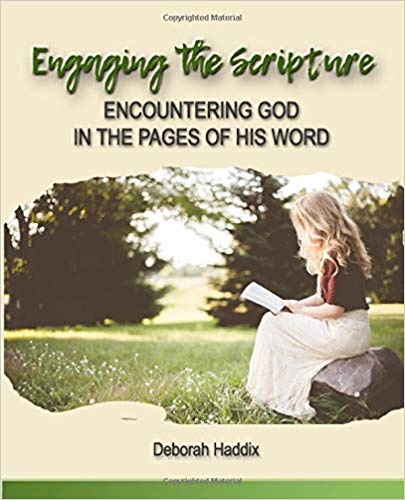
I love that Deborah emphasized engaging the Scripture—not just reading an assignment, not just searching for information. Rather, “we are to read intentionally with the purpose of hearing from God, knowing Him, deepening our relationship, and nourishing our soul” (p. 28).
Deborah has chapters on the importance of God’s gift of His Word, dealing with distractions, further explanation about what’s involved in engaging the Scripture. Then she has a chapter for each aspect of engaging Scripture: reading, writing, meditating, memorizing, and praying it. A later chapter shares ways to interweave these practices (meditating while memorizing, praying verses while writing them, etc,)
Each chapter is fairly short: three to six pages of text, a page of personal reflection about the chapter, a section on resources for implementing the chapter, and a practice page or two.
Each chapter includes multiple ideas for engaging, with the encouragement to chose which works best with your wiring, schedule, and season of life. Tidbits of advice, encouragement, and wisdom are interspersed throughout the pages. Just a few:
Experiencing distractions during our quiet time does NOT make us a failure (p. 34).
Overwhelm often results in total abandonment. Start small. Experience success. Then incorporate additional ideas as you move forward (p. 39).
The physical food we take into our physical body does not nourish us unless we properly digest it and take it into our cells. Just as physical food is needed for physical strength, spiritual food is necessary for spiritual strength. The Word you read (the spiritual food) must be chewed, digested, taken into your being, and one way to chew your food is by memorization (p. 100).
Deborah has mastered the art of writing the way writers for the Internet are advised to: short paragraphs and lots of white space. The book isn’t long, but its style makes it seem even more manageable.
This is a wonderful resource that I highly recommend.
Here are some good reads I’ve discovered recently:
The Oh So Human Dad’s Club. A look at some biblical fathers commemorated in the “Hall of Faith” despite serious flaws – encouragement that God can use any of us who are “only human.”
A Guide to Same Page Summer. This introduces a summer Bible reading plan, but it has some great principles for Bible reading in general.
Distinguishing Marks of a Quarrelsome Person, HT to Challies. “Of course, there are honest disagreements and agree-to-disagree propositions, but that’s not what the Bible means by quarreling. Quarrels, at least in Proverbs, are unnecessary arguments, the kind that honorable men stay away from (Prov. 17:14; 20:3). And elders too (1 Tim. 3). These fights aren’t the product of a loving rebuke or a principled conviction. These quarrels arise because people are quarrelsome.”
Losing a Foster Child. Some people don’t want to foster because of how painful it would be to let a child go after caring for it. But some children need just that kind of love and care during an unsettling time in their lives. This has some good help for the pain of giving back a foster child.
The True Woman blog, an arm of the Revive Our Hearts ministry, is holding a summer book club reading through Elisabeth Elliot’s just-published book, Suffering Is Never For Nothing. This book comes from a series of messages Elisabeth shared at a conference and is different from her earlier book, A Path Through Suffering (though I would guess they probably overlap). The book club starts this Tuesday, June 18, and continues for 6 weeks.
Someone set up a “bird photo booth” and caught some great close-up photos of birds.