Laudable Linkage

Laudable Linkage

Here are some of the good reads found this week:

Everything Short of Hell Is a Mercy, HT to Challies. “Everything short of hell is mercy. This one truth should change the way we view our hardships and frustrations, no matter how terrible they may be. If we, as sinners, are not facing the wrath of the infinitely Holy God at this moment, our life is better than we deserve. That is true for every Christian and non-Christian alive right now.”

What to Say to Dave About Regular Bible Reading, HT to Challies. “Few of us have it fully sorted, and so we don’t feel qualified to tell others what they should be doing. I certainly don’t feel like I can speak from anything other than the wisdom that comes from regular failure. But failure is a good teacher, even if I’m not a good student, so here are five tips I might give to Dave.”

Should You Send Your Kids to Catholic School? HT to Challies. Some considerations.

In a Day’s Work: God’s Pattern for Productivity. “I’ve been studying the book of Genesis in depth, and something struck me recently about how God structured the days of creation. I think there may be something in this pattern that we can imitate in our own work.”

How Vocational Stewardship Leads to Human Flourishing, HT to Redeeming Productivity. “By ‘vocational stewardship,’ I mean the intentional and strategic use of one’s vocational power (skills, knowledge, network, position, platform) to advance human flourishing.” I would add that those things can be done on a smaller scale with neighbors, relatives, and church members.

The Porcelain Room. “Do I worry so much that I’ll forget to give them something they’ll need that I forget to point them toward the Lord who knows what they’ll need—and who will make sure they have it? Am I so preoccupied with the thorns and thistles of life that I allow them to crowd out the good growth of the gospel in our family?”

The Best a Man Can Get, HT to Challies. I enjoyed watching the American men’s gymnastics team win their bronze medal, the first US men’s team to medal in some time. This article about the team was great, too. “It’s a quintessentially American success story about a quintessentially American team, made up of distinct, memorable characters. The phrase ‘Diversity is our strength’ has become a cheap leftist nothing, but there are times and places when it actually means something, and the Olympics is one of them.”

The Curse of Knowledge, HT to Redeeming Productivity. “Have you ever had a teacher who was very smart but terrible at teaching? An expert who used so much jargon you could not follow their explanation? This is called the ‘curse of knowledge.'” The author shares ways to bridge the gap.

The Quiet Grief of Caregiving: Four Balms for the Overburdened, HT to Challies. “I forced a smile, swallowed down the tightness in my throat, and struggled against the tide of grief that’s become as familiar and worn as a tattered coat. It’s a mantle common to many who walk beside the hurting — the heaviness that presses upon the heart when we’ve witnessed others’ suffering over and over and over.”

Church Skills: Use Them or Lose Them, HT to Challies. “You might not think you have church skills, but you almost certainly do. You will have developed ways of making conversation, showing interest in people, caring for them, serving in all sorts of ways and lots of other such things. But as with anything we have learnt to do, if you don’t keep using it, you will lose it.”

I’ve experienced His presence in the deepest darkness hell that men can create. I’ve tested the promises of the Bible, and believe me, you can count on them.” — Corrie ten Boom, survivor of Ravensbruck concentration camp after helping hide Jewish people during WWII

Laudable Linkage

Here’s a list of some of the good reads found online this week:

The Scariest Thing Jesus Ever Said, HT to Challies. “Both Jesus and James are putting a spotlight on our inclination to replace Jesus’ call to deny ourselves, take up our crosses, and follow him. We replace his call with a self-serving path in which we deny our neighbors, take up our comforts, and follow our dreams. When we do this, we exchange true faith for a counterfeit.”

Don’t Be a Fig Leaf, HT to Challies. “The inadequate fig leaves of ‘don’t beat yourself up,’ ‘you did your best,’ or ‘It’s okay’ pale in comparison to the robe that Christ puts on us.”

Hurt, Injustice, and Dealing with Reality, HT to Challies. “As much as I don’t want to diminish the reality of bad experiences, I also think there is some balance needed in how we think about these things. None of what I am about to say is meant to undercut real experience of hurtful things. None of what I am about to say is intended to say that when people have hurt us it isn’t real. But, nevertheless, I did want to make some broad observations.

Bible Engagement for Those Who Struggle to Read, HT to Challies. “When I first became a Christian, I was told that reading the Bible was like food and prayer was like breathing. That was great advice, but there was a problem. I’m not a good reader. I have gotten better over the years, but I wouldn’t say I’m a great reader even now. So how do I and others like me get the Bible into our minds, hearts and spirits?”

Whining vs. Biblical Complaint in Caregiving, HT to Challies. Though the context is caregiving, the principles can apply to distinguish whining vs. Biblical lament in any situation.

The Grandmother Who Helped a Child See. I’ve read and heard hymn writer Fanny Crosby’s biography, but don’t remember anything about her grandmother’s influence. I’m glad someone shared about her.

Never Underestimate the Power of a Handwritten Note, HT to Challies. “We live in a day and time where life is lived digitally more than ever before. We communicate primarily through apps, texts, and emails. Businesses increasingly send advertisements, bills, and communications via email than snail mail. Even birthday cards are now sent virtually. This means, a handwritten note is a rare gift.” Christina includes some tips for what to write in notes.

Laudable Linkage

Though still not caught up with the blogs I usually read, I got to a lot of them this week—as you can tell by my long list of links to share. Perhaps one or two will be as thought-provoking to you as they were to me.

January’s for Reflecting, not Resolving, HT to Challies. “Maybe part of the reason why so many resolutions fail by February is that they were early. Maybe the resolutions weren’t wrong; they were just underdeveloped. Maybe, they needed an extra month or two in the oven.”

Holy Prayers from Rocking Chairs, HT to the Story Warren. A lovely poem about mothers’ middle of the night sessions.

A Legacy of Love: Passing Down the Gift of Spiritual Discipline to Your Children. “Because of the legacy my mom passed to me, I have a vision that goes beyond serenity and candles. I want my children to see a mother desperate for Jesus, willing to do whatever it takes to be at His feet.”

Make Christianity Hard Again, HT to Challies. “The way of Jesus is the way of the cross. So don’t talk about it like we just need to be nice people. Here are three commands that have challenged me, with practical trails we can follow.”

I Must Decrease” . . . But How? HT to Challies. “It’s pretty clear: the world’s loud, incessant voice tells me that in order to be happy, I need to spend more of my time, money, and attention on myself. You’ve probably heard the same message about your need for this, as well.”

Wasn’t My Body, but It Was My Baby, HT to Challies. “Abortion isn’t just about a mother’s choice. It’s also about a father’s responsibility. Perpetuating the lie that men need to stay out of the abortion debate isn’t just untrue—it’s catastrophic for the generations to come.”

Don’t Women Need Access to Abortion for Rape? “‘You don’t have the right to tell my fourteen-year-old daughter she has to carry her rapist’s baby.’ That’s what Joe Rogan, the most popular podcaster in the world, recently argued when he interviewed Seth Dillon, owner and CEO of the satire website The Babylon Bee. How would you respond to that argument? Here are three arguments to consider.”

The Murderer Who Crushed a Worm. “We get hard through the steps of an unperceived process.” This is a different kind of hardness from the article above.

C. S. Lewis an Mrs. Moore: Relationship of Sin or Sanctification? HT to Challies. “Every biographer of C. S. Lewis must face ‘the Mrs. Moore question’ and decide what to make of the relationship the beloved writer had with a woman more than 25 years his senior who remained a major part of his life from the time he returned from the trenches of the Great War until her death in 1951.” I especially like the concluding paragraphs of how God uses difficult people in our lives.

God Plans Your Stops, HT to Challies. “If God plans our steps, it means He plans our stops as well. And if you sit with it for a minute, there’s comfort in that.”

Unraveling the Riddle of Rejoicing Always, HT to Challies. “Several years ago, while meditating on Philippians 4:4, the Lord helped me glimpse why it makes sense to always rejoice—even in hard times—and how it is possible to give thanks in everything.”

A Family Vacation, a Broken Transmission, and a God Who Is With Us, HT to Challies. A neat story about God’s provision in a crisis.

Caregiving As a Calling and Ministry, HT to Challies. “At the time I didn’t see it as a ministry, and I didn’t understand that I had been called. I saw caregiving as a giant disruption to everything in my life and a burden that was forcing me to ‘step out of ministry’ to do this caregiving thing that I hadn’t signed up for. Over time, God has shown me  that caregiving wasn’t a disruption; it was God’s plan for me all along.”

How Should I Dispose of an Old Bible, HT to Challies. Though the sacredness of the Bible comes from what it says and Who gave it to us, not the pages and ink, we still want to treat it with respect. This has a good suggestion.

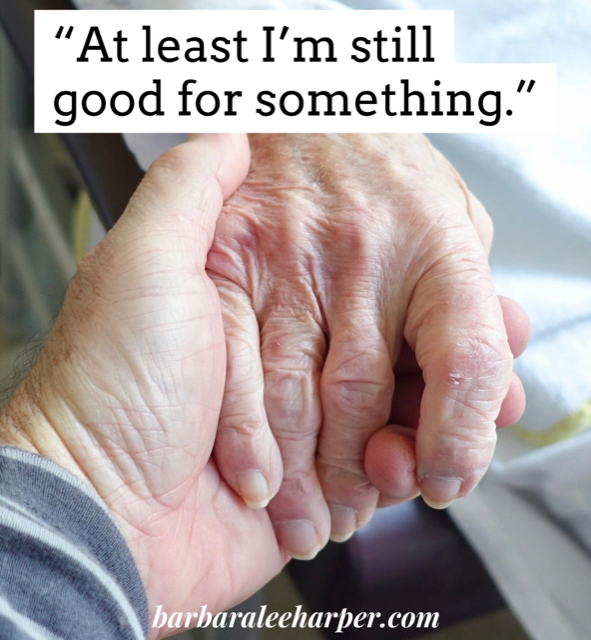
“At least I’m still good for something.”

When we first moved my mother-in-law over 2,000 miles to live in an assisted living facility near us, we would have her over for dinner sometimes, take her to my youngest son’s basketball games, and take her to church and other outings.

At one dinner, a favorite family story came up. Some years ago, my mother-in-law inadvertently said something inappropriate, using a term with double meaning of which she was unaware. Everyone laughed because they knew she hadn’t meant it in the way people would take it today. The incongruity of such a thing coming from her made it all the more funny.

As we told the story to our kids, who had either not heard it before or had forgotten it, we all laughed, even my mother-in-law.

After the laughter died down, though, she quietly said, “At least I’m still good for something.”

I don’t know if anyone else heard her say it or caught the significance. But her sentence went like an arrow to my heart. She wasn’t complaining or blaming anyone, but she didn’t feel useful any more.

When we first moved her into assisted living, my husband told her, “You’ll never have to cook to clean again.” That sounded pretty good after 70 or years of those activities.

Her only hobby was reading, and she delighted in being able to read all day to her heart’s content. She had always been a homebody, and just going to meals three times a day with a room full of other people taxed her. When aides would knock on her door to see if she wanted to go see the musicians, the magicians, the church choir, or whomever, she politely declined.

I don’t think she was discontent with her circumstances. But we all want to feel we’re of use in the world. There is a feeling of satisfaction and pleasure when we’ve accomplished something, but she didn’t have anything to accomplish any more.

In “The Grace to Be Diminished,” Win Couchman wrote of turning 80 and having to give up driving, changing from their usual place in the balcony at church to a place on the main floor where they didn’t have to fear falling, her husband’s hearing loss and short-term memory loss which caused him to be “silent and isolated at social functions.” But the “diminishment” that particularly touched my heart was when “one of the women who coordinates the potlucks called me and said with winsome authority, ‘Win, enough already. You have been involved with these evenings for about twenty years now, I think. You have done your bit. We want you and Bob to be at every one, but you are not to bring any more food, you hear?'”

Only then did I realize how the slowness with which I function now, and the accompanying late afternoon fatigue, was beginning to color my anticipation with some dread.

Gladly I responded, “Okay.” It’s awkward to walk into someone’s house on potluck Saturdays empty-handed just as another couple arrives loaded with goodies. In that moment, I silently look to God for the grace to be diminished.

Win and her husband, and I am sure my mother-in-law as well, graciously accepted the decline that comes with age, knowing that:

 So we do not lose heart. Though our outer self is wasting away, our inner self is being renewed day by day. For this light momentary affliction is preparing for us an eternal weight of glory beyond all comparison, as we look not to the things that are seen but to the things that are unseen. For the things that are seen are transient, but the things that are unseen are eternal (2 Corinthians 4:16-18).

Yet I think we should be careful not to diminish them unnecessarily.

In Atul Gawande’s book Being Mortal: Medicine and What Happens in the End, he writes of a woman who was responsible for her father’s care when he could no longer live alone. Yet her desire to keep him safe culminated in his living in a small room with nothing to do, “safe but empty of anything [he cared] about” (p. 109). 

What touched off this train of thought today was a section in Anthony Trollope’s The Last Chronicle of Barset, the sixth and last in his Chronicles of Barsetshire series. Mr. Harding was the main character in the first book, The Warden. Now, in the last book, he has become very old and increasingly feeble. He used to love to play the violincello, but can’t manage it any more. “He had encountered some failure in the performance of the slight clerical task allotted to him, and the dean had tenderly advised him to desist.” He loved going to the cathedral every day, to listen to the organ, read a theology book, or just walk around. But his feebleness caused his fearful housekeeper to write to his daughter, who came to encourage him that perhaps his days of walking alone to the cathedral might need to come to an end. He replied, “I do not like not going;—for who can say how often I may be able to go again? There is so little left, Susan,—so very little left.”

That line was heartbreaking—that there was so little left. Eventually Mr. Harding made peace with the fact that God had given him a good life and he had a better one to look forward to. He found the “grace to be diminished” and decline.

Another line in Gawande’s book says, “Making life meaningful in old age…requires more imagination and invention than making them merely safe does” (p. 137).

Hindsight is always so much clearer, of course, but I wish I had made my mother-in-law’s life more meaningful. When she was still able, I wish I had thought of small tasks she could do to help with meals. Cooking had been her love language of sorts. Though we thought we were honoring her by doing for her, perhaps she would have felt more useful with a way to contribute. I could have made a project of putting her photos in albums with her. I did ask about her early life—high school, how she met her husband, etc.–and even learned some things I hadn’t known before. But I wish I had done that more. Although our visiting almost every day and then bringing her home for her last years showed how much we regarded her, I wish I had often told her that we loved her and were happy to have the opportunity to care for her. Though she had intrinsic value as a being created in God’s image, we should have let her know more often that she was valued and important.

As I look ahead to growing older, a couple of passages especially comfort me. One is Isaiah 46:4: “even to your old age I am he, and to gray hairs I will carry you. I have made, and I will bear; I will carry and will save.”

Another is Psalm 92:12-15:

The righteous flourish like the palm tree
and grow like a cedar in Lebanon.
They are planted in the house of the Lord;
they flourish in the courts of our God.
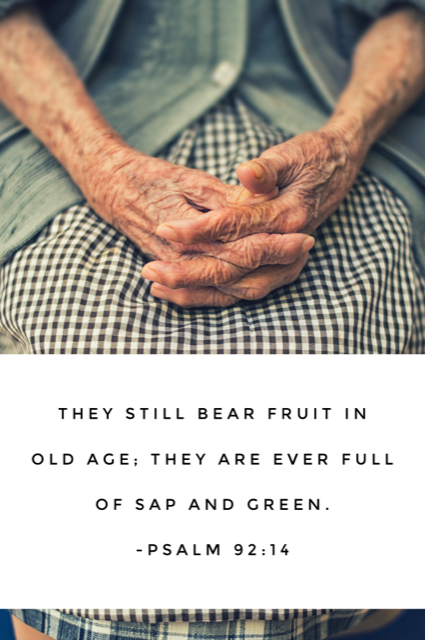
They still bear fruit in old age;
they are ever full of sap and green,
to declare that the Lord is upright;
he is my rock, and there is no unrighteousness in him.

During my mother-in-law’s last years, when she slept most of the time, I wondered what kind of fruit she was bearing in that state. A few came to mind. Her godly life—not perfect, but steadily walking with God and seeking to serve Him the best she could in her circumstances. Her uncomplaining patience. Her taking things with humor. Her willingness to “go with the flow.” Her testimony of peace and joy before her caregivers.

I wish these things had come to mind when she wondered what she was “good for.” I trust her Lord’s, “Well done, thou good and faithful servant” assured her that He was able to use her in many ways. And I hope that these thoughts will remind me to let others know the ways God used them in my life.

(I often link up with some of these bloggers.)

Comforted by the Ways God Uses Us

We took care of my mother-in-law in our home for five years. Many of you were reading here at that time and offered much prayer, love, and encouragement.

I had a sudden realization about that period of our lives this week. It was such a jolt, and then a comfort, that I thought I’d share it with you.

We had moved my mother-in-law, Colleen, from Idaho, where she lived for 30+ years, to SC, where we then lived, to an assisted living facility. She had to move again when we moved to TN. Then she had to be moved twice when her physical state declined to the point that the facilities could no longer care for her. She ended up in a nursing home, where she declined rapidly. She was 90 lbs. and in a constant fog. We felt she was being neglected, so we brought her home, thinking we were bringing her home to die. But with one-on-one care, she gained weight and became clearer and lived for another five years. I wrote about our experiences, things I learned, challenges we faced, etc., and filed them under Adventures in Eldercare.

My biggest regret from our caregiving experience was that I chafed under most of it. I wanted her to be well cared-for. But I didn’t want to be the one to do it. Of all the things I wanted to be when I grew up, a nurse was never one of them.

Plus, our “nest” was emptying, and though I missed our kids, I had big plans for my free schedule. I was going to write a book and all sorts of things (in the three years since she passed, I still haven’t finished the book, so obviously caregiving wasn’t the main roadblock).

I had to remind myself many times over those years that if caregiving was God’s will for me at that time, that He would give grace to do it; that He doesn’t always place us in positions that use our strengths, but often He puts us where we feel totally weak, that we might find our strength in Him; that caring for one person, even a mostly unresponsive person, in a back room is as much a ministry as preaching to thousands or writing a best-selling book or whatever.

But I can’t say I ever “got” those lessons in a way that stayed with me. I had to repeat them often, sometimes daily.

For some reason, one morning this week my mind wandered to some of the caregivers both in facilities and in our home who . . . let’s say, did not do a good job. I could tell you stories . . . At first I put several of those stories here, but then decided to delete them.

You think, when you’ve researched facilities and placed a loved one in one, that they’ll get the best care possible, that everyone knows what they are doing. But that’s not the case. There are a lot of kind, caring caregivers who do their best. Our dear Jessica, who was Colleen’s main caregiver for 3 1/2 or so years, was a treasure worth her weight in gold. But there were others who were just punching the clock. There were some about whom we wondered what ever brought them into health care in the first place. Did they think it would be an easy job to prepare for or to do? Did they used to be good but then got burned out?

Some of them did a good job as far as the physical things they were responsible for. But they seemed to forget that they were dealing with a person, especially when that person didn’t speak. They’d talk over her to each other instead of to her.

So this particular morning, as my thoughts ran through some of the caregiving situations we encountered, I began to realize that maybe what Colleen had needed most from me was not my nursing care. Maybe what she needed most from me was someone to watch out for her, to advocate for her, to insist that she be cared for in not only the best physical ways, but the most humane ways.

It’s not that we griped to caregiver managers or corrected all the time. We didn’t want to come across as know-it-alls or can’t-ever-be-pleased nitpicky types. We didn’t bring up every single little thing we felt was wrong. We only chose the most vital issues to discuss with the staff at her facilities or at the home health care agency. Still, there seemed to be way too much that we needed to speak to them about.

Years ago, before there were so many personality tests and ways of classifying them as they are now, the main way of sorting personalities was the four spiritual temperaments. I remember poring over Beverly LaHaye’s The Spirit-Controlled Woman. Though no personality classification is perfect, this one made sense to me and seemed a lot simpler than many of the personality classifications today.

My personality, according to that system, was melancholic—an unfortunate name since it sounds like I’m depressed or sad or morose, which I am not. One aspect of melancholics is perfectionism, which, like most personality traits, can be good or bad. Perfectionism can drive one to do the best possible job rather than leaving things done half-hardheartedly. You’d want your brain surgeon to be a perfectionist. But perfectionism can also lead to hyper-criticism and misery when you and everyone else can’t live up to your ideals. This trait “clicked” for me when a guest preacher in our church several years ago, Jim Binney, said that melancholics see things that are wrong and want to set them right.

I felt like much of the care I provided for my mother-in-law felt outside my natural gifts. As I mentioned before, that situation cast me on the Lord like nothing else.

But this particular morning, I realized God had used me in the ways He made me by helping me see the things that were wrong in her care, helping to right them, and eventually bringing her home. It’s not just that this area was one thing I did right in the midst of so much I felt I did wrong or struggled with. But I just felt particularly known and loved and useful in God’s hands. I hope that makes sense.

Whether God uses us as we feel gifted or totally outside our gifts and personality, our sufficiency is from Him.

(I often link up with some of these bloggers.)

Laudable Linkage

IMG_0195

I usually share these on Saturday, but I needed to wrap up the Laura Ingalls Wilder Reading Challenge yesterday. Here are some great reads if you have time:

Who Is the Holy Spirit? “If your ideas about the Spirit are divorced from the clear truths of Scripture, you will go astray into all kinds of error and ultimately damage the cause of Christ.”

The Benefit of Yielding to Jesus. Two different meanings of the word “yield,” and one leads to the other.

The Way He Should Go. “I heard the same proverb referenced by all sorts…What I didn’t frequent hear was what ‘the way they should go’ consists of.”

What’s To Be Done? Potentially, Nothing Else., HT to Challies. “In the end, there may not be anything more to do beyond the ongoing, slow Word-based ministry and giving the Spirit enough room to move without our insistence on more and more stuff to do.”

The Most Frightening Three Words, HT to Challies. A well-meaning “How are you?” can unsettle those suffering with a long-term illness or chronic pain. They don’t want to overload you, and they may not feel like going into it. Kimberly shares a better approach.

Cameraman, Lend a Hand,” HT to Challies. I’ve often wondered, when watching a video of a child crying or someone in distress, why the person filming doesn’t put down the phone and help.

Seven Questions to Ask in Evaluating Online Pundits, HT to Challies. “The digital revolution has made knowledge more accessible, the flow of information more diverse, and the ability to make your voice heard easier than ever before. The same revolution has also made invincible ignorance more sustainable, pervasive crankery more common, and the ability to discern what voices are worth listening to harder than ever before.”

Should “Broken” Genes Be Fixed? My daughter changed the way I think about that question, HT to Proclaim and Defend. “We believe the world is a better place for having kids like her in it, and we want the world to think hard about whether it really wants to go down a path of engineering a world where there are no Ruthies.”

Here’s What Iconic Historical Figures Would Look Like Today. This is strangely fascinating. An artist has rendered historical figures with modern hair styles and makeup to show what they would look like if they lived now.

I was reminded of the song, “See the Destined Day Arise” a couple of weeks ago and planned to share it during Easter week. Then I thought—why wait? As our church celebrated communion last week, as we look every Sunday, every day to the cross, we grieve at the cost of our salvation but rejoice that an able and willing Savior accomplished it. The first two stanzas were written by Venantius Fortunatus (c.530-600) and translated by Richard Mant (1837). The last stanza, chorus, and music were written by Matthew Merker. (I don’t know the church in the video: I just thought this was a nice, clear rendition.)

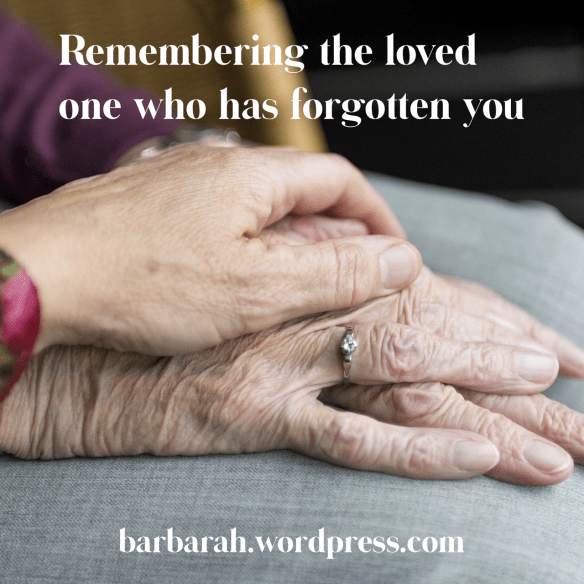
Remembering the loved one who has forgotten you

As a person ages, friends and loved ones often stop communicating as much.

Part of the problem is a busy schedule. When I worked in a nursing home ministry in college and then visited my mother-in-law in various facilities, I figured busyness was the primary reason so many residents seemed never to have a visitor.

But now I think perhaps people don’t visit elderly loved ones because they feel it’s futile since the person doesn’t even know them any more.

Dementia is one of the saddest afflictions. It’s heartbreaking when a loved one can’t remember who you are or how you are related.

But I can’t encourage you strongly enough to keep visiting. Why?

Because you remember.

Their biggest need is to know that they are loved and not forgotten. For the few minutes you spend with them, they are receiving personal attention.

We don’t know what they actually remember.

When a loved one can’t process thoughts well, we don’t really know what’s going through their minds. It could be there is a flicker of familiarity, but they can’t express it. Or they might remember, if just for a few moments, that you were there.

Assisted living and nursing home facilities can be lonely places.

Some residents are able-bodied and/or social butterflies, but many sit by themselves. Most of the activities involve bringing the group to the common area rather than doing anything with individuals  Most of these places are overworked and understaffed. We found a few gems in each facility my mother-in-law was in, but too many of the staff were burned out, uncaring, just punching a time card. We observed as they talked to each other over her without ever looking her in the eye or talking directly to her. One aide had eyes glued to the TV as she fed Jim’s mom rather than interacting with her. Can you imagine an existence where most people just handle you or do what’s necessary without a smile or a kind word?

Personal, focused, loving attention is the greatest gift you can give them.

You can’t assume they are well taken-care of.

When you visit a facility and arrange to place your loved one there, you assume the best. The administration sounds competent, the brochures look inviting. But we could tell you dozens of stories from our own experience, not to mention that of others. The residents often can’t speak for themselves. They need advocates to visit them frequently and bring any issues to the management’s attention.

When you do visit, here are a few things to keep in mind:

  • Don’t ask, “Do you remember . . .” people or situations. John Zeisel calls this “testing” in his book I’m Still Here: A New Philosophy of Alzheimer’s Care. He says such questions just set them up for a test they are sure to fail and can increase anxiety, agitation, and feelings of incompetence.. Sometimes they can remember the distant past more than the recent occurrences, but don’t assume. Just start talking about the person or situation you have in mind. If your loved one remembers, they’ll chime in. Instead of asking, “Do you remember me?” just say who you are. “Hi, Mom! It’s me, Jim, and your grandson son, Jason, and great-grandson, Timothy.” Mention the names but don’t make a big deal about them.
  • “Don’t alter their reality” was the cardinal rule at the nursing home my mother-in-law was in. In our college nursing home ministry, one blind lady spoke as if she lived on a plantation, even encouraging us to pick some flowers. We didn’t know whether to go along or try to bring her back to reality. Now I would know: either go with the flow or try to bring up a different topic of conversation. If they think they are in another state, or their husband is waiting for them at home, or whatever, it only agitates them to say otherwise. When my mother-in-law was in a memory-care unit, we often saw residents get quite upset if they stopped to ask us to take them somewhere, and we said we couldn’t. We learned to say, “I’m just here visiting my mom, but maybe this lady could help you,” and point them to an aide. That was better than saying, “No, I’m sorry, I can’t take you,” and having them get upset, and an aide having to come over and calm them down.
  • Divert or distract rather than arguing. If your loved one starts asking about someone who died, or asks to be taken somewhere they can’t go, or says something that doesn’t make sense, don’t try to “talk sense into them.” Jim’s mom sometimes asked to be taken to her daughter’s house 2,000 miles away. I used to remind her that she had moved to TN. But later on, I’d just say, “We can talk about it when Jim gets home.” She was mostly silent her last two years, but she would still sometimes ask about her sister, who had died long ago. Our caregiver would say something like, “I think she’s still asleep” and then start talking about something else. We tried never to lie to her, but we did redirect the conversation.
  • Have some topics of conversation in mind before you go. Sometimes it’s hard to know what to talk about. Family news is always good. But conversation can sputter after that. This is something I wish I had done better with my mother-in-law. I saw her almost every day, so when she would ask what’s new, sometimes all I could come up with was, “Well . . . I got the laundry done.” She loved news or little interesting tidbits or real-life stories. I wished I had looked for things like that to share with her when I visited. I also wished I had asked her more about her past.
  • Some might be able to play games, put together puzzles, do small crafts. If you have old family photos of people you can’t identity, this is a great time to bring them and ask about them.
  • Be cautious about gifts. Most times, they don’t really need or have room for anything. But if it’s a special occasion and you want to bring something, be aware of their situation. Don’t bring food unless you know they aren’t on any kind of dietary restrictions. And then bring food in a form they can eat (someone sent my mother-in-law a fruit basket, but she had no way to slice or peel any of it. She couldn’t have a knife in her room.) Cut flowers in a vase might be better than a plant no one has time to care for. Some other ideas:

All-occasion greeting cards (if they still send them)
Stationery and stamps (if they can still write)
Pens and pencils
Lotions (some might have skin sensitivities)
Bath items: nice-smelling shampoo, body wash, powder. Avoid bath oils – too slippery
Large-print books, magazines, crossword or word search puzzle books (if   they can still read)
Small individually wrapped chewable candies (if they can have them)
Small packages of cookies (ditto)
Pudding cups
Small throw blankets
Socks (slip-proof, if they are still mobile) and slippers
Magnifying glass
Tissues
Nice nightgowns or pajamas. (or hospital gowns if they are bedridden. We used this place often.)
Small photo albums with pictures of your family. (Big ones are too heavy.)
Pictures colored by a child

If you have a project-based ministry to the elderly in your congregation, please take the items to the person rather than sending them home with a loved one or dropping them off on the porch. The visit means more than the things.

What if you don’t live near your loved one?

Don’t stop communicating because you don’t think it will do any good. One lady who used to write to my mother-in-law would check with me occasionally to ask if I thought it was still worthwhile. I told her I honestly didn’t know if Jim’s mom would know who she was or would remember the note I read five minutes later, but for those few moments, she knew someone cared enough to communicate with her. We’re more inclined to send texts or Facebook greetings, but it’s worth the time to send a personal note to an elderly person who doesn’t have access to those other venues. Sometimes a FaceTime or Skype call can be set up. One of Jim’s brothers used to do this even after Jim’s mom no longer spoke. She could at least see him and his family and would sometimes wave a finger.

What if your loved one is being cared for by a family member?

It still helps to visit or at least communicate for a number of reasons. Your loved one needs to know you still remember and care for them. And it greatly encourages the one caring for them to have the rest of the family still participating. Caregiving can be weighty and lonely, and the interest and care of the rest of the family can be greatly encouraging. By contrast, it’s immensely saddening to have birthdays and Mother’s Days go by without hearing from anyone, even if the loved one doesn’t know what day it is.

It can be hard to visit an elderly loved one.

It takes time and slowing down. It’s hard to acknowledge the effect of years and to know they’re only going to keep declining. Their might be messy or smelly. My mother-in-law was easy to get along with, but some dementia patients are angry or combative. It might be easier to remember them as they were than see them as they are. Most people’s main regret when a loved one dies is that they didn’t spend more time with them. Do all you can while you can to avoid that regret. Even if they don’t remember you, you remember them. I’m not trying to heap guilt on you; I’m trying to lessen it.

Godly love is about giving and isn’t dependent on what the other can do for us.

They don’t have to remember you in order for you to minister to them. Our blessing them comes from:

1) The example of our Lord, who blesses us every day of our lives even though we can never repay Him.

2) Gratefulness because of all our loved ones did for us.

3) Doing unto others as we would want them to do to us. (Matthew 7:12)

It can be especially hard when the relationship has not been good, when issues have never been resolved and there’s no hope of dealing with them now. Some of my friends have exemplified 2 Corinthians 12:15 with their parents: “ And I will very gladly spend and be spent for you; though the more abundantly I love you, the less I be loved.Loving like Jesus means loving people even when they don’t “deserve” it. Love costs a great deal sometimes. As we pray to love more, we can ask that our “love may abound more and more, with knowledge and all discernment” (Philippians 1:9) and ask God to “make [us] increase and abound in love for one another and for all” (2 Thessalonians 3:12).

I’d love to hear from you about this topic. What have you found helpful when visiting elderly family members?

(I wrote a series of posts from our experience caring for my mother-in-law called Adventures in Elder Care. If you are in a caregiving season of life, you might find something helpful there. A couple of the posts there most related to this one are Am I Doing Any Good? and It’s Not for Nothing.)

(Sharing with Inspire Me Monday, Global Blogging, Senior Salon, Hearth and Home, Purposeful Faith, Happy Now, InstaEncouragment, Recharge Wednesday,
Worth Beyond Rubies, Share a Link Wednesday, Let’s Have Coffee,
Heart Encouragement, Grace and Truth, Faith on Fire)

Laudable Linkage

It’s been another good week for online reading! Here are posts I have learned from lately – maybe some of them will interest you as well.

Routine Bible Reading Can Change Your Life, HT to Challies. “But the way the Bible does its work on our hearts is often not through the lightning bolt, but through the gentle and quiet rhythms of daily submission, of opening up our lives before this open Book and asking God to change us. Change doesn’t always happen overnight. Growth doesn’t happen in an instant. Instead, it happens over time, as we eat and drink and exercise. The same is true of Scripture reading.”

Advent Reading Plans. Several doable, workable plans for reading from the Christmas-related passages of Scripture during December.

Don’t Downplay Your Suffering, HT to Challies. “One of the biggest mistakes believers can make when facing a tragedy is to minimize it. I think so many of us do it because we are lacking a robust theology of suffering.

The Most Difficult Time of the Year: How to Love Grieving Parents at Christmas.

How Long Does It Takes to Read Each Book of the Bible? HT to Lisa.

Should We Stop Publicly Shaming People?  HT to Lisa. Yes, indeed. Sometimes a public outcry helps, like the reaction to the Dove commercial a while back. But often instead of letting people learn from their mistakes, they are run into the ground and ruined for the rest of their lives.

Beyond Truth and Fiction: Loving Our Neighbors With Dementia, HT to Out of the Ordinary. The Christian alternative to lying to someone with dementia so as not to upset them.

My Husband Was Hurt by an I.E.D. The Lasting Injury Was to Our Family, HT to Challies. Sometimes devastating injuries don’t “show” on the outside and affect the whole family.

Join Me on a Ride to Malvern, HT to Challies. A favorite childhood memory, a reminder that “all of these ‘small moments’ have the potential of eternal significance for your child.”

Stop Hand Washing Your Dishes, HT to Lisa. Nice to have my preferences justified. 🙂

And a smile for the day, found on Pinterest:

Happy Saturday!

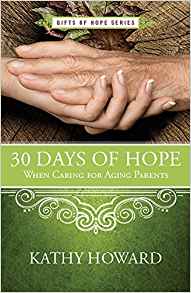
Book Review: 30 Days of Hope When Caring for Aging Parents

Hope in caregiving30 Days of Hope When Caring for Aging Parents  by Kathy Howard caught my eye both because of our own caregiving journey and because Kathy used to write for Do Not Depart, a group blog I follow.

Kathy opens with a brief introduction sharing caregiving experiences of her husband’s parents and her own. Then each of the 30 chapters begins with a Scripture passage, progresses through two pages of content relating the passage to caregiving, and ends with a short prayer.

Topics include how to still honor your parents when you’ve switched roles, “ugly emotions,” “losing them before they’re gone,” keeping peace with family members in the midst of differing opinions, forgiveness, perseverance, guilt, God’s grace in our weakness, and many others.

One point Kathy made that impacted me was that when we experience regret (over anger, impatience, or whatever), after we confess it to the Lord and receive forgiveness, we can release feelings of guilt and shame. God’s goal for those feeling is “repentance, restoration, and renewed usefulness (2 Corinthians 7:8-11). God never uses our past mistakes as a weapon against us. Instead, He desires to use them as a catalyst for our personal growth and change” (p. 65).

Another point I wish I had thought of was helping our parents deal with what they’re going through: loss of independence, failing bodies, upheaval in their living situation, death of plans and dreams, inability to participate in activities that have always brought them pleasure before, adjustments to new situations. By sharing God’s Word and truth with them, in a sympathetic rather than a preachy way, we can encourage their faith and help them renew their hope. There are aspects of this I just didn’t consider, and Jim’s mom was not one to complain or even say, “You know, I am really struggling with such and such.”

The format of this book is not an exhaustive treatise, but rather a friend sharing help, support, and information.

When you’re in the midst of caregiving, there is nothing quite like talking to or hearing from another caregiver who understands by experience all that’s involved. Kathy’s book provides that fellowship and encouragement and always points to the God of grace.

(Sharing with Semicolon‘s Saturday Review of Books, Literary Musing Monday, Carole’s Books You Loved)


Caregiver Resentment

Even though my mother-in-law is sweet and easy to get along with, I sometimes battle resentment over the circumstances of caregiving: feeling tied down, having strangers coming in my home at irregular times, etc. I’m guest posting today at The Perennial Gen about ways God is helping me deal with caregiver resentment.

(Sharing with Inspire Me Monday, Literary Musing Monday)